I-gave-up-my-corporate-job-to-travel-full-time-and.jpeg

I gave up my corporate job to travel full-time and live in other people’s homes for free

A few years ago, I was working a traditional 9-to-5 corporate management job in the San Francisco Bay Area.

After nearly a decade in my field, I had a car, a home, emergency savings, and no debts to pay off. I’d done everything “right” and accomplished things many strive for, but I wasn’t completely satisfied.

Then, in 2022, I left my job, booked a one-way flight to Italy, and began traveling full-time. What I thought would be a short break turned into over two years of seeing new countries while living entirely off my savings.

I kept thinking, “When am I going to get tired of constantly moving around … and how can I extend this lifestyle until that time comes?”

In an effort to stretch my savings further and extend my travels, I started house-sitting.

House- and pet-sitting has helped me keep traveling and stretch my savings


Woman smiling with cat

By 2022, I wanted something different for my life. 

Alanna Parrish


I came across the idea to house-sit while looking for ways to travel more economically. In return for looking after someone’s home while they are away, I get a place to stay.

For me, this felt like an amazing trade and a way to avoid paying for hotels or rentals. Sometimes, I’m also paid for these gigs — especially if pet-sitting is involved.


Woman smiling taking selfie while holding

I’ve watched homes and pets in many different cities. 

Alanna Parrish


Once I started, I expanded my network through travel, and I discovered a high demand for house-sitters, not only in the United States but also outside of it.

So far, I’ve watched pets and homes in more than 15 different cities, including some international ones.

I’ve woken up to ocean views in Honolulu; explored the food scene in Santa Fe, New Mexico; biked along Chicago’s Gold Coast; and discovered hidden-gem cafés throughout Greenpoint and Fort Greene, Brooklyn.

I love the freedom that comes with this lifestyle and the connections I’ve made


Woman smiling with cat on her shoulder

A lot of my house-sitting gigs involve watching pets. 

Alanna Parrish


Many people’s biggest living expense is rent or housing, but I don’t have to worry about budgeting for those. I try to line up my sits so that I don’t often need to pay for hotels or rentals, either.

This has completely changed the way I live. I love the freedom that this life brings, not only financially but also emotionally.

Since I’m staying in actual homes and often for longer periods, I’m better able to explore different cities and neighborhoods the way locals do, rather than as a tourist passing through.


Perosn holding e-reader, coffee, on sunny balcony

It’s been nice experiencing some neighborhoods as a local. 

Alanna Parrish


I get to meet homeowners from all over the world who’ve been incredibly generous and welcoming, often going above and beyond to make sure I feel at home in their space.

Building these relationships with the homeowners and their animals has been such an amazing part of this experience. I take it very seriously that people are trusting me to live in their spaces and care for every home and pet as if they were my own.

It’s not always easy to live this way, but I’m enjoying it


Woman standing in front of columns and arches

Before I started house-sitting, my life looked very different from how it looks now. 

Alanna Parrish


This lifestyle is not for everyone. I live out of a suitcase and often don’t know where I’m going next.

I am constantly planning where I will be living and how I’m going to get there. Sometimes I am booked months in advance; other times, I am figuring things out a few days before or dealing with last-minute cancellations.

The uncertainty can be stressful, but the trade-off has been worth it for me in the end.

These days, I work remotely while juggling paid sits and free ones so I can keep traveling. I don’t know when I’ll settle down and stay in one place again.

For now, this lifestyle fulfills my desire to explore, connect with others, and discover new places. And I still have a list of cities that I would love to visit — both in the United States and internationally.

Whether I see them through house-sitting or not, I don’t see myself slowing down anytime soon.


Source link

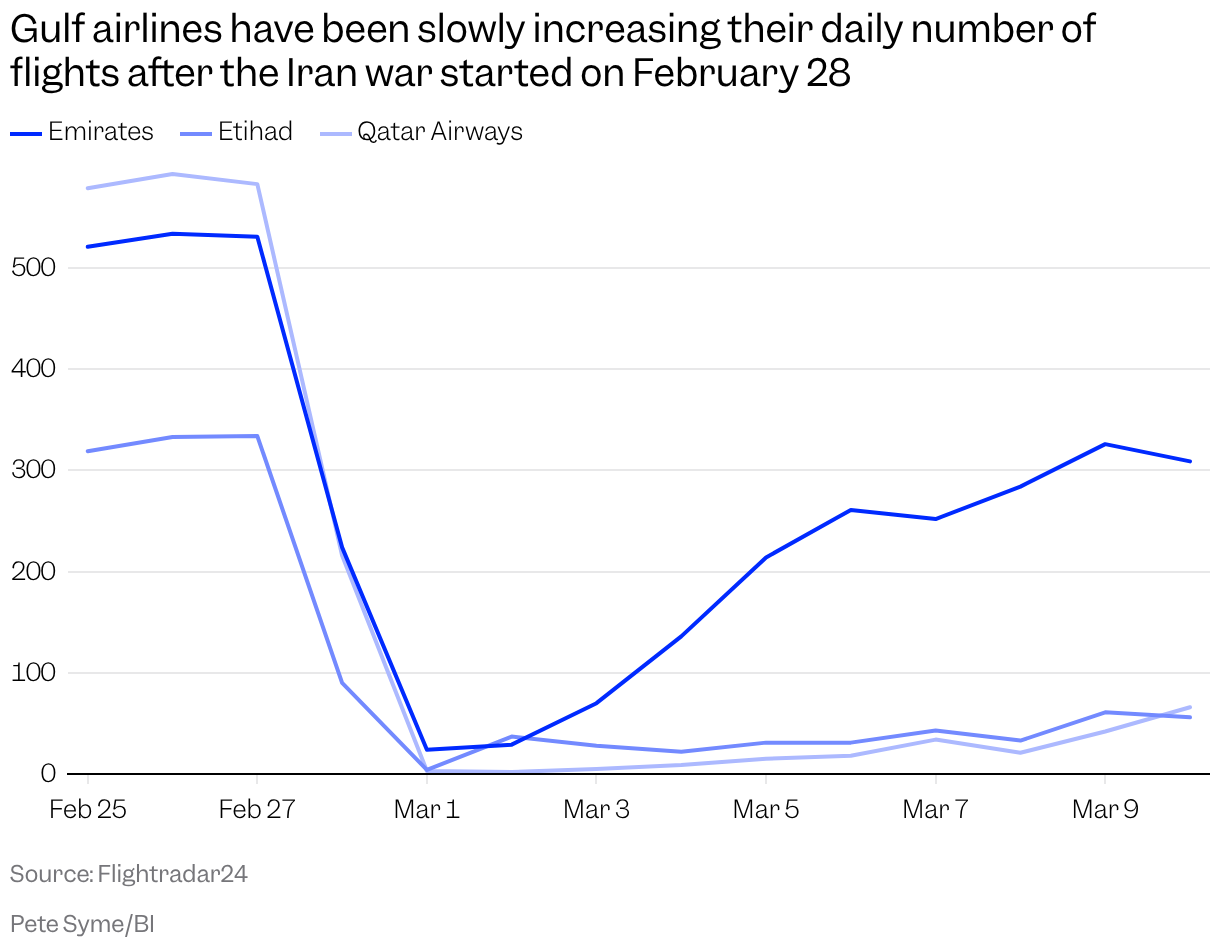
A chart showing the number of flights per day for Emirates, Etihad Airways, and Qatar Airways between February 25 and March 10, 2026.

Flights to the Middle East have resumed, but travel chaos is nowhere near over

Air travel is only getting more complex due to the Iran war.

Eleven days since the first strikes, some flights have restarted after the UAE partially reopened its airspace. However, cancellations and rising ticket prices spell headaches for travelers.

Dubai is leading the restoration of flights in the region.

Its airline, Emirates, operated less than 60% as many flights on Wednesday as on February 27, according to data from Flightradar24. That’s compared to 11% and 17% for Qatar Airways and Abu Dhabi’s Etihad Airways, respectively.

Emirates said last Friday it “anticipates a return to 100% of its network within the coming days.”

However, it still may not be plain sailing for customers. Flights into Dubai are often forced to circle around before landing due to Iranian drones or missiles.

Early on Wednesday, four people were injured when two drones fell near Dubai International Airport, the world’s second busiest airport for international passenger traffic last year.

Hours later, several inbound flights were again forced to enter holding patterns for 55 minutes.

“Safety, as ever, remains paramount as is our duty of care,” Emirates said in its statement.

Meanwhile, British Airways has canceled flights to the Middle East until at least March 28 — and to Abu Dhabi until “later this year.”

KLM, the Dutch flag carrier, canceled all flights to Dubai until March 28.

Rising ticket prices

Passengers flying in and out of the Middle East aren’t the only travelers affected, either.

“In general, it is likely airfares will increase in the short term, depending on the duration of the war,” Hans Jørgen Elnæs, an aviation analyst and advisor, told Business Insider.

Jet fuel is getting more expensive as oil prices have experienced huge volatility. Brent crude was around $90 a barrel on Wednesday morning — up 50% since the start of the year.

The Gulf airlines have become popular for offering stopovers between Europe and Asia, but many travelers are now looking for direct flights instead.

High demand and lower capacity have led to a “significant spike” in airfares on these routes, Elnæs said. “These ticket prices are not sustainable over time, in my view,” he added.

Thai Airways is raising ticket prices by 10% to 15% due to “overwhelming” demand and rising fuel costs, Chief Financial Officer Cherdchom Therdthirasak said Wednesday.

Also, Malaysia Airlines last week deployed additional flights from Kuala Lumpur to London and Paris.

The Middle East is also a vital air corridor for overflights, but airplanes have been forced to reroute north over the Caucasus or further west over Saudi Arabia.

Until at least next Wednesday, the European Union Aviation Safety Agency has banned European operators from flying over the region — including Saudi Arabia and Oman, whose airspace remains open.

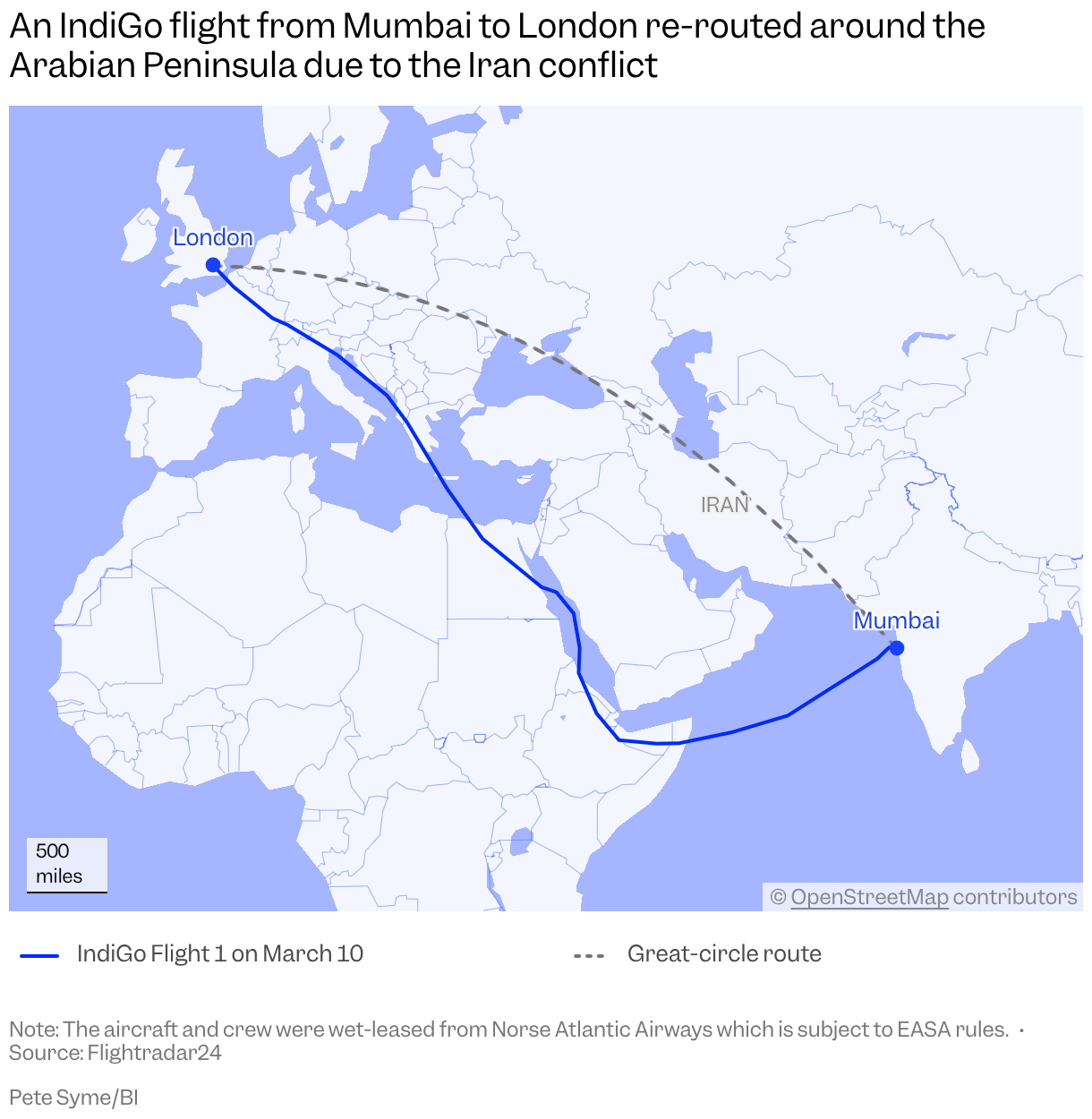
The Indian budget airline IndiGo is taking some particularly long detours; its flight from Mumbai to England is up to two hours longer than before.

That’s partially because it leases airplanes and crew from Norse Atlantic Airways for this journey. As it is a Norwegian airline, the EASA rules require it to fly over East Africa to avoid the Arabian Peninsula.

Some travelers look elsewhere

The World Travel & Tourism Council said Wednesday that it estimates the conflict is already negatively impacting the Middle East to the tune of at least $600 million a day in international visitor spending.

“It is too early to define the long-term impact on the Gulf region’s airlines and tourism. But in the worst case, if the war continues over time, it will hit hard on airlines, tourism, and GDP,” Elnæs told Business Insider.

“If airfares increase too much, it will hit demand, so the airlines need to find a balance here.”


A United Airlines Boeing 787-9 Dreamliner airplane departs from Los Angeles International Airport en route to Tokyo on October 17, 2025 in Los Angeles, California.

United Airlines is seeing more people transit through the US between Oceania and Europe.

Kevin Carter/Getty Images


The conflict has already prompted people to find new ways to travel between Europe and Oceania, such as taking a layover in the US. This is known as the Southern Cross Route and was formerly popular in the mid-20th century.

“Each day this week, we have booked over 1,000 people from Australia and New Zealand to Europe. Last year, we booked less than one a day,” United Airlines CEO Scott Kirby said at a Harvard event last Thursday, according to CNBC.

Some Europeans are also reconsidering where to vacation over the spring vacation period.

“We’ve seen, certainly, there’s a big collapse in bookings to the Middle East, and a big surge in bookings on short-haul airlines within Europe,” ​said Ryanair CEO Michael O’Leary.

Due to their cheaper tickets and strategy of hedging against fuel-price increases, such low-cost airlines often gain market share during geopolitical crises, Elnæs told Business Insider.


Source link

After-5-years-our-family-gave-up-full-time-travel-and.jpeg

After 5 years, our family gave up full-time travel and YouTube success. I worry we’ve messed up the kids.

After we stopped traveling full-time, our 11-year-old daughter, Brooklyn, became obsessed with her bedroom.

She wanted to repaint it. Rearrange it. Add shelves, plants, posters, and end tables to organize her art supplies. She asked for candles and incense (and permission to burn them).

She pushed back when my wife and I asked her to keep her clothes picked up — not out of laziness, she explained, but because the artist in her liked how it felt to leave things wherever they landed.

At first, this “new normal” bugged me. The requests and pushback felt endless, even erratic, as if we were chasing some moving target of comfort that she would never reach.

Then one night, I walked past her room and was drawn by the scent of vanilla drifting through the crack in the door. Curled up on her bed under a throw, a small reading light on and the warm glow of candlelight around her, she sat reading a hardcover copy of “The Count of Monte Cristo.”

And it finally clicked: After years spent in airports, hotels, and temporary spaces, this was the first place within her control that she could count on staying the same.

At first, a life of travel made sense for our family

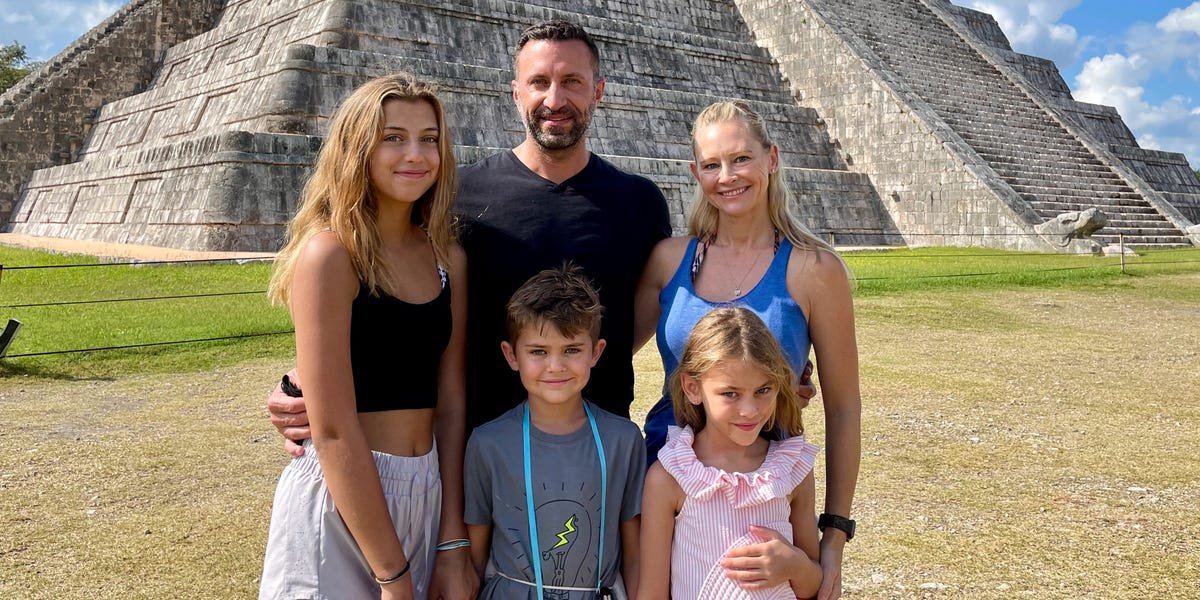
My wife and I began traveling the world with our three kids in 2020, at a time when structure had already fallen apart for most families.

School was remote. Routines were fractured. The future felt unpredictable. Travel, oddly enough, felt grounding.

If our kids were going to spend their days on screens anyway, why not replace textbooks with real places? Why not let geography, culture, and shared experience do some of the teaching?


Child on camel in desert

A snapshot of our family’s travels to Abu Dhabi.

Phil Lockwood


Almost immediately, we began documenting our journey on a new YouTube channel. It was a new direction for the entire family, and the excitement was universal. Our kids even started their own channels and began producing their own episodes.

We juggled the challenges of highlighting the far-flung places we were visiting, the mistakes we were making, and the logistics of pulling off long-term travel as a family of five. Friends and family started watching.

Then strangers, too. Our audience grew into the thousands somewhat slowly, then into the hundreds of thousands surprisingly fast. Soon, we’d reached over half a million YouTube subscribers.

Sharing everything online felt natural at the time. It gave structure to our travels and, through ad revenue and brand sponsorships, helped offset the high costs. And it felt useful—like we were showing other families what was possible if they were willing to step outside the usual script.


Family in Antarctica

Our family in Antarctica.

Phil Lockwood


In those early years, it felt like so many high-profile family YouTube channels were presented as success stories — adventurous, tight-knit, and inspirational. I didn’t see as much public skepticism, and some darker stories of family vloggers (like Ruby Franke’s) that would later dominate headlines hadn’t yet come to light.

So, at the time, we didn’t see ourselves as taking a risk — we saw ourselves as joining a small but growing group of households who were filming and sharing their lives publicly before the downsides were so widely discussed, documented, and understood.

For a while, it worked. Or, at least it appeared to. The kids were curious. We were together. We saw parts of the world that most families only talk about. And all five of us were enjoying building something meaningful together.

There were real benefits: closeness, adaptability, and perspective. Our kids learned how to navigate unfamiliar places and unfamiliar people. We learned to function as a family without the usual scaffolding of schedules and routines.

What we didn’t yet understand was what those benefits might be trading against.

As time went on, the cracks began to show — and coming home didn’t repair them all

Not all of our kids experienced the lifestyle the same way.

As our youngest and most adventurous, Colt thrived on the endless variety. Reagan, my oldest from a previous marriage, enjoyed the journey, but eventually chose to return to in-person school, and we adjusted our travel around her schedule with her mom. Brooklyn, though, gradually stopped enjoying it altogether.

There wasn’t a dramatic breaking point. It was a slow accumulation: long-haul flights at odd hours, constant activity, museums and cultural experiences designed for adults, not kids. Plenty of stimulation, but very little continuity.


Child with bird on arm

A moment from our time in Abu Dhabi.

Phil Lockwood


What I didn’t fully appreciate was how much childhood depends on repetition — seeing the same faces, returning to the same places, building friendships that deepen rather than reset with new people every few weeks.

Other nomadic families we met reassured us that this was normal. They told us our kids would grow more worldly, more mature, even more interesting than their peers. That any awkwardness later would be a sign of depth, not loss.

And I wanted to believe that. But as Brooklyn pulled further away from the lifestyle — showing little enthusiasm for new destinations, frustration with red-eye flights, and no desire to highlight her experiences in our episodes — it became harder to ignore the possibility that what we thought was enriching had become simply exhausting for her.

The hardest part wasn’t wondering what she wanted: She was clear that she’d rather be back home, back in school, and back to occasional family vacations. The hardest part was realizing that submitting to her desires would require dismantling a life we had just spent years reorganizing everything around.

Eventually, though — and after five full years of constant travel —we made the decision to stop. We returned to the house that we’d kept in Denver. Reagan graduated and headed to college. Brooklyn enrolled in in-person high school, while Colt chose to continue online for the flexibility. Our pace slowed, and the constant motion ended.

And yes —things got easier. The kids seem more independent than ever. Life feels calmer. There’s a structure where there used to be constant negotiation.


Family of four smiling in front of temple-like buildings

Our family posing in India.

Phil Lockwood


Still, the relief I feel is mixed with doubt.

Brooklyn still carries some resentment about not settling down sooner. She’s now trying to build friendships in a neighborhood where other kids grew up side by side for years. She missed that stretch of middle school — the inside jokes, shared routines, and the quiet accumulation of belonging. I sometimes wonder whether the introversion I see now is simply adolescence, or whether years without steady peer relationships reshaped her in ways we can’t fully undo.

Did the benefits of those experiences outweigh the costs? Did we assume that anything lost along the way would simply return? Or are we just seeing a normal adjustment after an unusual childhood?

I don’t have clean answers. I’ve only accepted that good intentions don’t guarantee harmless outcomes — and that parenting decisions made confidently at the time can look very different in hindsight.

I don’t regret our choice — just parts of the execution

I’m glad we traveled. I’m glad our kids have seen the world. I’m also glad we stopped. I don’t regret the journey my wife and I took our children on, but I no longer assume it was unquestionably right.

If I could do it again? I’d prioritize putting down roots earlier — fewer destinations, more seasons in one place, more chances for the kids to build friendships that weren’t constantly interrupted.

And I’d question whether sharing our adventures online was necessary at all.


Family of four posing with elephants

We visited Chiang Rai, Thailand.

Phil Lockwood


There’s a difference between traveling with kids and building a childhood around constant motion — especially when that motion is public.

We still travel, but only a few times a year, mostly around school breaks. Colt still loves going. Brooklyn hasn’t joined a trip since we settled back down; my sisters stay with her when we leave.

Recently, though, she’s started talking about ancient Greece and asking what it would take to see the ruins in person — but we’re careful not to read too much into that since interest isn’t always the same as readiness.

And if there’s one thing I’ve learned, it’s this: parenting decisions don’t come with clean verdicts. They come with trade-offs.

Sometimes the most honest stories aren’t about success or failure — they’re about realizing, long after the decision has been made, that you’re still not entirely sure where the line really was.


Source link