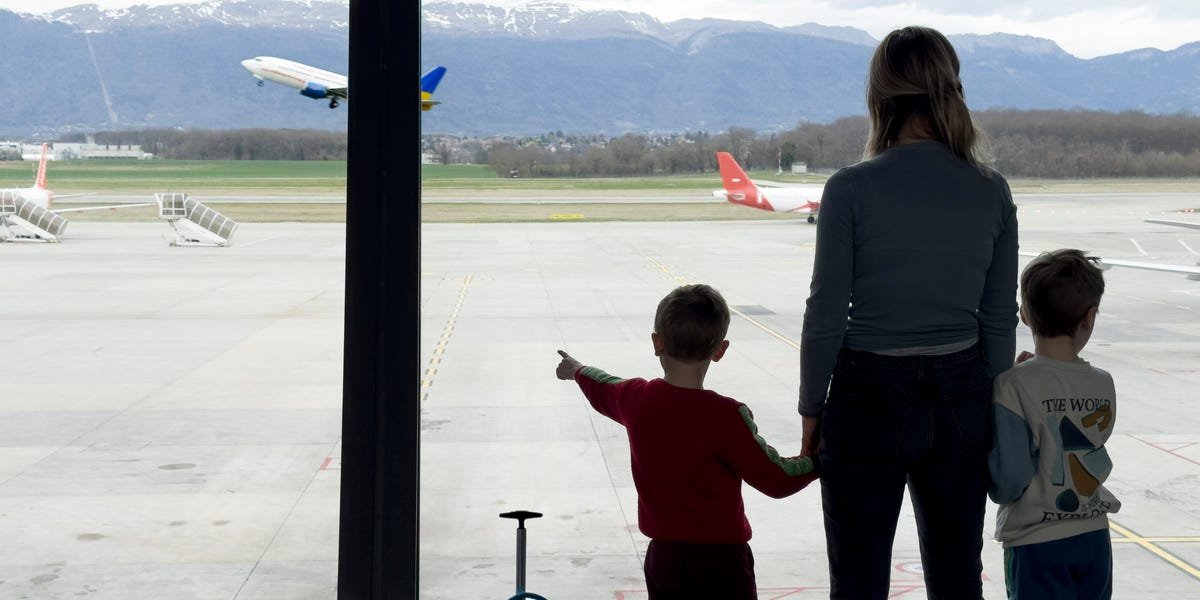
I don’t have kids, and therefore, I take a lot of trips with my godsons.
Throughout the year, we take easy day trips around South Florida that don’t require too much planning, and we also take weekend trips to other parts of the state, like Key West and Orlando.
The boys have busy high school schedules, and I’m pretty busy, too, since I work full-time as a teacher.
Despite our time constraints, I really try to be intentional about making memories as a family. Whether big or small, we usually go on a few trips each year.
I bring 3 specific travel documents with me whenever we travel
Now that we’ve been traveling together for a while and are taking trips to other states, I’ve started bringing specific documents for each kid: a copy of their birth certificate, notarized travel consent forms from each parent, and their passports.
I don’t always bring these documents if we’re going on a road trip around Florida. However, I bring them whenever we travel by plane or go to a different state.
Before I started taking the kids on trips, I usually traveled solo and flew a lot. During those years, I didn’t have to think about which travel documents minors need to bring on planes.
However, this past December, I took the kids on a trip to Philadelphia and New York City. This was our first big flight together. During my trip preparations, I learned that minors aren’t required to have IDs when traveling with adults.
Even though IDs weren’t technically required, this wasn’t a risk I was willing to take
I made sure each of the boys took their passports on this trip, which was a good call because the TSA agents asked to see their IDs each time we went through security.
I don’t know what would have happened if they didn’t have their documents with them, but I’m glad we didn’t find out.
I’m super Type A and like to be prepared for worst-case scenarios, which is why I prioritized bringing these documents with me on our trip.
Before we went on our holiday, I found a generic travel consent form online and had each kid’s parent fill one out for their child. Then we went to get the documents notarized.
These documents outlined our travel dates and destinations, so if any officials ever asked to see them, they’re clear.
I brought the birth certificate copies as a double layer of security to prove that the people who filled out the consent forms are actually the kids’ parents.
Some people might think this is excessive. I think it’s wise.
Thankfully, nobody asked to see these documents
I can’t imagine a scenario when a flight attendant or TSA agent would want to see such detailed proof of our travel plans, but it’s not a chance I’m willing to take.
We’re taking a family cruise later this year, and the agent I spoke with during booking told me I’d need to fill out a travel consent form for each child before we board.
They emailed the form to me before we finished our call, which I really appreciated. I’ve worked in the cruise industry before, so I know major cruise lines have their own versions of these documents.
If you cruise with minors you don’t have legal custody over, you have to fill out and submit these consent forms before embarkation.
I love my godkids and am so blessed to take them on trips. I want our vacations to be unforgettable — but not because they were ruined because I didn’t have the right documentation.
Some of the world’s most congested airspace has been disrupted by the US and Israel’s strikes on Iran.
Iran, Iraq, Kuwait, Bahrain, and Qatar have all closed their airspaces. Dubai International Airport, the world’s busiest airport for international traffic, has suspended all flights until further notice.
A video shared by Flightradar24 showed airplanes deserting the region on Saturday morning.
Data from the aviation analytics firm Cirium shows that about 970 of the roughly 3,400 scheduled flights to the region have been canceled as of 11:00 p.m. Central European time. Factoring in outbound cancellations, that number is closer to 1,900.
The three major Middle Eastern airlines — Qatar Airways, Etihad Airways, and Emirates — operate major hubs that connect passengers to destinations around the world, creating a massive ripple effect of disruptions.
Qatar canceled nearly 60% of its flights on Saturday, Emirates canceled 65%, and Etihad canceled 50%, per Cirium. They’ve pre-emptively canceled hundreds more on Sunday.
Dubai International Airport — the world’s busiest megahub for international traffic — was damaged by an apparent missile strike on Sunday morning, local time. It’s unclear how that could further impact operations even if the airspace opens back up.
A Cirium spokesperson said these carriers collectively carry 90,000 transiting passengers through their hubs daily — not including those destined for the Middle East.
Major airline disruption
Even for flights that don’t land in the region, it’s a key corridor for flying between Europe and Asia. Some flights appeared to re-route over Saudi Arabia. Other airlines were avoiding the region altogether.
Detours are costly for airlines: They have to pay for extra fuel, labor, and any associated passenger compensation. And it’s possible mass diversions could overwhelm certain airports.
In a post on X, Emirates said it was temporarily suspending all flights to and from Dubai, its home base. That’s equal to about 500 flights a day, according to Cirium.
Emirates urged customers to check their flight statuses before visiting the airport. “We are actively monitoring the situation and engaging with relevant authorities,” the airline added.
Qatar Airways said all flights to and from the country were suspended until at least midnight UTC, or 7 p.m. ET. It also expects delays when usual operations resume.
Doha’s Hamad International Airport advised passengers “not to proceed to the airport.” Additional staff were deployed there to help passengers affected by the disruption, the airline said.
Etihad Airways, which is based in Abu Dhabi, said all departures and arrivals to the city were suspended until 2 p.m. local time Sunday.
Kuwait’s civil aviation ministry said a drone attack left some airport employees with minor injuries and damaged a passenger terminal.
Saudia said flights to and from affected airports were canceled until at least Tuesday.
Diversions and flights to nowhere
For those already in the air during the strikes, many flights diverted to other nearby airports or turned back to their origins.
Flightradar24 shows an Emirates flight from Orlando to Dubai diverted to Istanbul in a 14-hour flight to nowhere. A Qatar flight from New York to Doha crossed the Atlantic but then diverted to Rome after about 10 hours in the air.
An American Airlines flight from Philadelphia to Doha had flown for more than six hours when it turned around over Ireland and started heading back across the Atlantic Ocean, flight-tracking data showed. It looks like the total flight-to-nowhere will last about 13 hours.
An Air Canada flight from Toronto to Dubai was over the Mediterranean Sea before U-turning. Passengers appear to face a total journey time of 10 hours.
In a video statement posted to Truth Social on Saturday morning, President Donald Trump vowed to destroy Iran’s missile program and navy, and ensure that the country can “never” have a nuclear weapon.
There is likely more disruption to emerge. When Iran launched strikes on a US air base in Qatar last June, more than 160 flights were diverted.
Similar cancellations and reroutes happened in February 2022 when Russia invaded Ukraine, and again in April 2025 amid rising tensions between India and Pakistan.
Air India, for example, had to reroute flights around Pakistani airspace last year, requiring some long-haul services between India and Europe and North America to add a fuel stop in Vienna.
Some airlines, like Finnair, still fly the long way around Russia on certain long-haul treks rather than canceling the service altogether.
I thought I was on track — until the year everything fell apart.
Just weeks into January 2023, I was blindsided by an unexpected breakup. In the months that followed, I moved through my days on autopilot, watching the year continue to unravel.
That May, I was laid off from my job coordinating large conferences and corporate travel. I took a position at a family-run wedding business that was building out its travel department. I told myself things were starting to look up.
But between a 90-minute commute, sitting at a desk all day, and performing mundane tasks not listed in my job description, I began to spiral instead of heal.
Almost every day, I’d retreat to my car at lunchtime and break down in tears, overwhelmed by how unhappy I was.
The “American dream” began to feel like a trap
Since I was a kid, I’d treated success like a checklist built from American expectations I absorbed through school, TV, and social media. It seemed simple enough: Stay in line with peers, get married before turning 30, and buy a big house to raise a family in.
It was becoming clear that this narrative might not align with the life I wanted for myself.
Later that same year, I dealt with a toxic roommate, a serious health scare in my family, and a car accident. Then, just days before the New Year, I got one final surprise: another layoff. This time, however, I felt relief.
Walking out of that office for the last time allowed me to stop chasing a version of success I knew would never satisfy me.
Distance changed the pressure I was living under
As 2024 began, I set a clear goal for myself to sublet my apartment, sell my belongings, and board a one-way flight to South Korea by April 15. My plan was to begin an eight-month journey across Asia and Australia. After four months of careful planning, I boarded that flight.
Starting the trip with a friend in Seoul made the beginning — and the 15-hour flight over — feel safe and manageable. When she boarded her flight back to the US, and I headed off to Thailand alone, that distraction disappeared. I was officially left alone with my own thoughts.
Early on in Southeast Asia, I questioned what I was doing and where it would all lead. I cried in hostels and had panic attacks on the back of motorbikes. My anxiety was triggered by the blasting music of Bangkok’s Khao San Road and Ho Chi Minh City’s endless traffic.
Strum escaped the pressure she’d been living under while traveling through the mountains in northern Vietnam.
Provided by Macie Strum
The more I took note of my surroundings, the less the world around me matched the urgency in my head.
As I traveled the Ha Giang Loop in Northern Vietnam by motorbike, I realized that my idea of success was built upon a level of pressure that didn’t exist up in these Vietnamese mountains. Local life didn’t revolve around strict deadlines and productivity scales. Instead, it centered on routine, family, and staying present each day.
As I moved through each country, I connected with travelers of every age and background, many of whom were unemployed, exploring new paths, working online, or simply figuring things out as they went. Some were meticulous planners; others lived day to day.
In the jungles of Malaysian Borneo, I met a fellow American who was also redefining her life after a heavy breakup. I remember the first night we met, we talked for hours about life, expectations, and the fear of what would come next.
We ended up traveling together to Kuala Lumpur, meeting again in Penang, and later in Bali. Seeing her in so many different places reminded me how many others were navigating the same uncertainty.
It reframed my view of travel — not as a break from real life, but as an active part of it. For the first time, uncertainty no longer felt like failure.
She’s building her career in Sarajevo, Bosnia and Herzegovina.
Provided by Macie Strum
I’ve redefined success
When that trip came to an end, I felt no pull toward the life I’d left the year before.
I returned to the US briefly, but chose to keep traveling to explore what alternative versions of success could look like for me.
In 2025, that decision took me to 17 European countries. As I explored, I found myself falling in love with one of the continent’s most misunderstood regions: the Balkans.
Today, I live in Sarajevo, Bosnia and Herzegovina, building a career as a freelance journalist without sacrificing my ability to travel. While the life I’m creating may not match the version of success I was raised with, it’s more aligned with how I want to live: flexibly, deliberately, and with purpose.
While I don’t know exactly what comes next, that no longer scares me the way it once did.
Do you have a story to share about living abroad? Contact the editor at akarplus@businessinsider.com.
After cartel violence erupted across the Mexican state of Jalisco this week, images and videos of burning cars and buildings, shuttered storefronts, and cities grinding to a halt hit the news. Flights into and out of Puerto Vallarta and Guadalajara were canceled. Residents were told to shelter in place and to ensure they had enough food and water. Tourists were on lockdown and frightened.
I watched it all from far away in Seattle, where I’m currently traveling, as my phone lit up every 15 seconds with messages of panic, forwarded video footage, and WhatsApp voice notes from friends and loved ones on the ground in Puerto Vallarta.
For most people, Puerto Vallarta was just one of several cities mentioned in the news cycle, but for me it was different — it’s been my chosen home base for the last five years.
I travel for a living, but Puerto Vallarta has always been special
My relationship with this city on Mexico’s Pacific coast began more than a decade ago, on my first visit in 2013. At the time, Puerto Vallarta was just another reporting assignment at a beach destination, but something hit differently, and I kept returning. It became the place I ran to whenever I needed a break from real life. Each visit stretched longer. By much of 2024 and 2025, I was there full-time.
When you spend that much time in a place, it stops feeling like an escape and becomes the backdrop of real life. You learn the traffic patterns, see familiar faces at the coffee shops and bars, pick up your mail. Routine sneaks up on you; it becomes home.
Every time Meagan publishes a story, you’ll get an alert straight to your inbox!
Stay connected to Meagan and get more of their work as it publishes.
You also build relationships. As I watched footage of a still-smoldering flame-licked car skeleton at an intersection just a few blocks from my last address, I listened to voice notes from friends. Fear sounds different when it comes from people you love.
For decades, Puerto Vallarta has been framed as one of Mexico’s easiest international trips
You don’t need to be a seasoned traveler or an adrenaline seeker to feel comfortable there. There are direct flights, large resorts, familiar comforts, and an infrastructure built around welcoming visitors.
Read more stories about Mexico travel
Plus, it’s jaw-droppingly gorgeous with that broad, blue curve of the Bay of Banderas and the jungle-covered crown of peaks that rise behind it.
For many Americans, Vallarta has been shorthand for “safe Mexico.” Could incidents like this change that perception? Inevitably, for some.
Travel decisions are rarely driven by data alone. They are fueled by emotion, personal tolerance for uncertainty, and individual experience. As happens after virtually every high-profile incident in Mexico, reactions tend to fall into familiar categories. There will be people who write Mexico off forever as a country to visit or live. Others will decide to wait and see.
And there will be people, like me, who are already itching to return because they understand something fundamental about moments like this: They’re traumatic precisely because they are disruptions, not constants.
The author says reports of violence in Mexico this week only increased her desire to return.
Courtesy of Meagan Drillinger
Like any place anywhere, Puerto Vallarta and Mexico are much more than their worst moments
Violence in Mexico is real. It’s serious. It’s also limited to very specific parts of a massive country. Mexico is vast and regionally complex. Episodes of cartel-related violence, while alarming, do not function as a constant across daily life in most destinations Americans visit.
Moments like Sunday’s violence highlight a perception gap that often shapes how Americans think about risk abroad versus risk at home. Americans tend to discuss violence in Mexico as though it exists in a fundamentally different category of danger. Yet in recent years, the US has developed its own unsettling familiarity with public acts of violence, mass shootings, random attacks, and sudden disruptions.
There is no longer a clean psychological divide between “safe at home” and “dangerous abroad.” We are, increasingly, navigating variations of the same reality.
I have no hesitation about returning to Puerto Vallarta
Living in Puerto Vallarta has not made me dismissive of safety concerns. What happened across Jalisco is devastating and serious. But living there has grounded my understanding of the city in lived experience rather than episodic headlines. It has made moments like Sunday’s violence feel personal without altering my relationship to Puerto Vallarta.
Watching the videos didn’t make me want to run further from Vallarta. If anything, it made me wish I were there with the community I love.
So, when do I plan to return? Soon. I’ll be heading back to Mexico in early March, this time to Puerto Escondido, Oaxaca, nearly 1,000 miles away from Puerto Vallarta. (Yes, Mexico is really big.) I have no hesitation about going. And, truthfully, if logistics allowed, I would go back to Puerto Vallarta this week. It’s not just a vacation destination to me, and it’s not just a clip on the news. It is nearly 13 years of memories, friendships, routines, and a sense of home that I have built over time.
Like any place anywhere, Puerto Vallarta and Mexico are larger than their worst moments. Like any place you love, those moments do not erase the steadier, more enduring reality of everyday life that surrounds them.
Hannah Donovan is four months pregnant. And with two little ones already at home, she and her husband had been banking on one family trip before life got even more hectic.
Puerto Vallarta was meant to be a babymoon — a chance to meet up with family nearby, soak up the sun, and actually relax for a few days.
However, less than 24 hours before they were set to head to their airport in Idaho, videos and pictures of burning cars and billowing smoke began circulating on social media.
Donovan said the images she saw online followed reports that Mexican forces carried out an operation on Sunday in Tapalpa, Jalisco, that killed Nemesio “El Mencho” Oseguera Cervantes, the leader of the Jalisco New Generation Cartel. The incident sparked retaliatory violence across multiple cities in Mexico, including in Puerto Vallarta.
The Donovans have since canceled their trip to Mexico and will play it by ear on whether they’ll try to visit Puerto Vallarta later.
“We’re incredibly grateful we’re not there, but we’re worried about the people who are, including travelers and our family who live there,” Donovan, 28, told Business Insider. “We’re definitely a little traumatized by the situation.”
Americans are rethinking their travel plans to Puerto Vallarta
The Donovans are among many Americans rethinking trips, moves, and stays in the region after chaos flared across parts of Mexico following the killing of Oseguera Cervantes on Sunday. Four people at the scene were killed, according to authorities. Three others — including Oseguera Cervantes — were wounded and later died, and two people were arrested. Three members of the armed forces were also wounded.
It comes after President Donald Trump designated the cartel a foreign terrorist organization. White House press secretary Karoline Leavitt said the US provided intelligence support for the operation, but stopped short of offering details on how. The administration has prioritized cracking down on Latin American cartels, urging leaders to take a harder line and deploying military force against suspected drug-smuggling vessels in the eastern Pacific and Caribbean.
In the hours since, the US and Canadian governments have urged citizens in some areas to shelter in place, and said most domestic and international flights in Guadalajara and Puerto Vallarta were grounded. On Monday, Mexican President Claudia Sheinbaum called for calm in the country, but many of those flights remained canceled.
Smoke over the city of Puerto Vallarta.
@morelifediares via Instagram/Youtube/@morelifediares via REUTERS
Mexico has become increasingly popular with American tourists, drawn by its vibrant nightlife, strong culinary scene, and affordability compared to other trendy international destinations such as France and Japan.
“Americans, especially on the West Coast, have long used it as an inexpensive place to go on vacation,” Robin Ingle, a specialist in travel security, told Business Insider.
Mexico has also seen a surge in tourism from people who previously would have traveled to the US but are avoiding the country for various political or financial reasons, he said.
“A lot of the people I’ve spoken to over the weekend would have gone to places like Florida, California, Arizona — now they’re going to Mexico instead,” he said of the tourists he’s spoken to since cartel violence broke out.
But as unrest spreads, some Americans who had planned to vacation or relocate there, or who are already in Mexico, are watching those plans unravel.
Business Insider spoke with three of them about what comes next.
Doug Howell will return to the US if things get worse
Doug Howell, a retired sales and distribution executive from the Spokane, Washington area, bought a rental place in Puerto Vallarta and now spends roughly six months a year there — a routine he’s kept up for the past 20 years.
“It’s very vibrant,” Howell, 63, told Business Insider. “I like to walk around the neighborhoods, everything is pretty close, or a short bus ride away if you want to check out the beaches or the waterfalls. There’s always something to do, and the food is incredible.”
Doug Howell and his daughters.
Courtesy of Doug Howell
On Sunday, Howell said he was standing on his balcony when he started hearing explosions, then saw plumes of smoke rising nearby. Before long, he said, he noticed highways and roads in and out of the area had been blocked off.
He was scared at first, he said, and hunkered down with neighbors.”We just stayed inside all day yesterday, and I didn’t go anywhere,” he recalled. “They actually bombed a store on a corner and a car on the bridge that’s not even a quarter of a mile away.”
By Monday, Howell, a member of MedJetHorizon — a global air medical transport and security response membership that provides evacuations— said things had calmed down in his neighborhood.
“They’re already on it today, and people are supporting each other in the community — that’s what I like about it,” he said. “One question everybody asks me: Is it safe? And it’s like, yeah, it is, unless you go to the wrong place at the wrong time. And that’s anywhere in the world.”
For now, Howell plans to stay in Mexico, but if things worsen, he said he plans to return to the States.
Linda Armijo worries about the future of the city
Linda Armijo and her husband have been visiting Puerto Vallarta for the past 25 years.
In January, they returned for a three-month stay in the city’s Marina Vallarta district, an upscale, waterfront area in northern Puerto Vallarta.
Armijo said that on Sunday, after her husband’s massage therapist warned that roads downtown were blocked, she went up to the rooftop terrace of their condo, which overlooks the city. From there, she said she could see five or six plumes of smoke.
Linda Armijo and her husband have been spending time in Puerto Vallarta for 25 years.
Courtesy of Linda Armijo
Smoke isn’t entirely unusual in Puerto Vallarta — controlled burns are common — but Armijo said this was more than she typically sees. “I came down to our condo and told Anthony, ‘There’s something going on, there are fires everywhere,'” she recalled.
Armijo said the city was hit by a series of disruptions, including the blast of an engine as a car was set on fire, interruptions to water service, and highways and roads blocked off. Although the uncertainty has left tourists and locals scrambling, they’re relying on each other to get by.
“I met two girls from LA who are renting a condo upstairs. They were meant to fly out yesterday, and threw away all their food and supplies before learning their flight was canceled. I shared some water with them,” Armijo said. She added that a building worker told her they were also accommodating those who needed to extend their stay.
Tourists watching fires in Puerto Vallarta.
Stringer/REUTERS
Armijo plans to stay put for now and said she isn’t especially worried about her safety. Instead, she’s thinking about what this could mean for the city.
“I feel safe in my building, and we have plenty of food and water,” the Spanish-speaker said. “It’s a minor inconvenience not being able to leave, but my biggest emotions are sadness and concern for the people of Puerto Vallarta.”
Long-term impact
In the near term, Ingle, the travel security specialist, said he expects to see an impact on the tourism scene.
“I know there’s going to be a blowback in the next month, people deciding not to go, because there’s a percentage of the population that doesn’t want to take risks,” he said. “Governments are putting out warnings, and that affects travel insurance.”
When it comes to the long-term impact, however, Ingle doesn’t see this weekend’s violence creating a lasting stain on Puerto Vallarta’s ability to attract tourists.
“If all the violence dies down quickly and gets cleaned up, I think this will go away,” Ingle said. “Normally, this will take a couple days, and then it will fix itself.”
The Monday morning commute won’t be messy in New York City. It will be nonexistent.
New York City Mayor Zohran Mamdani declared a state of emergency and a travel ban during a press conference on Sunday as a giant winter storm bore down on much of the Northeast.
The National Weather Service said to expect blizzard conditions and up to 20 inches of snow over the next 24 hours. Parts of New Jersey, Rhode Island, and Massachusetts could get up to 25 inches.
“The state of emergency closes the streets, highways, and bridges of New York City for all traffic,” Mamdami said. The travel ban begins at 9 p.m. Sunday and lasts until 12 p.m. on Monday.
US airlines, meanwhile, are canceling and delaying thousands of flights. As of Sunday afternoon, airlines had canceled over 3,000 flights and delayed over 2,900, according to the flight-tracking website FlightAware.
Every time Lauren publishes a story, you’ll get an alert straight to your inbox!
Stay connected to Lauren and get more of their work as it publishes.
New York City’s John F. Kennedy and LaGuardia airports have the highest number of cancellations, followed by Newark Liberty International Airport, Philadelphia International Airport, Ronald Reagan Washington National Airport, and Boston Logan International Airport.
Anyone hoping to catch a flight in the region on Monday can also expect major disruptions, according to Cirium, an aviation analytics company. At LaGuardia Airport, for example, 82% of flights scheduled for Monday have been canceled.
Adding to what will likely be a chaotic 48 hours for travelers, the Department of Homeland Security announced Saturday night that it was suspending TSA PreCheck and Global Entry due to the partial government shutdown.
Despite the announcement, however, TSA Precheck and Global Entry lanes remained open at major airports on Sunday. In a statement, the Transportation Security Administration said it is evaluating the situation “case-by-case.”
“At this time, TSA PreCheck remains operational with no change for the traveling public,” a spokesperson said. “As staffing constraints arise, TSA will evaluate on a case-by-case basis and adjust operations accordingly.”
The federal government entered a partial shutdown earlier this month, delaying funding for some agencies, like DHS. TSA agents are essential workers, so they’re still working — for now. During the full government shutdown earlier this year, TSA agents and air traffic controllers went 43 days without a paycheck.
Your layover doesn’t have to mean sleeping on the airport floor or surviving on a $10 hot dog.
Some airlines offer “stopover” programs that let travelers turn a layover into a mini‑vacation, giving you a few days to explore the stopover city before continuing to your final destination.
Flight prices usually stay the same, and hotels or activities may be free or heavily discounted. Think of it as two trips for the price of one — and a chance to see a new city along the way.
It might seem counterintuitive — after all, airlines are offering free perks — but the strategy boosts tourism for the home country and encourages travelers to choose a one-stop itinerary over a nonstop flight, which can ultimately be more profitable for the carrier.
I recently took advantage of Turkish Airlines’ stopover deal, spending three days in Istanbul before flying to my final destination, Croatia.
Every time Taylor publishes a story, you’ll get an alert straight to your inbox!
Stay connected to Taylor and get more of their work as it publishes.
It gave me just the right amount of time to shake off jet lag after the long flight from New York and check off Istanbul’s main sites, like the Sultan Ahmed Mosque (Blue Mosque) and the Spice Bazaar.
The Sultan Ahmed Mosque, or Blue Mosque, is a stunning Ottoman-era landmark in Istanbul. I was given a headscarf to wear inside.
Taylor Rains/Business Insider
Turkish is one of roughly two dozen global carriers with a stopover setup. Other examples include Copa Airlines in Panama City, Qatar Airways in Doha, Icelandair in Reykjavik, Fiji Airways in Nadi, and Iberia in Madrid.
With so many options, stopovers are one of the industry’s best travel hacks — though they require careful planning and the rules vary.
You have to apply for your accommodation
For Turkish, the stopover deal includes a free hotel on either the outbound or return flight, provided the layover is at least 20 hours but no more than 7 days. This duration requirement varies from airline to airline.
The hotel reservation wasn’t automatic upon booking. Travelers must separately apply for the voucher on Turkish’s stopover page or via email at least 72 hours before their trip.
You can usually select your preferred hotel, but the final assignment depends on availability and isn’t guaranteed.
Because part of my itinerary was in business class and my origin was the US, I received three free nights at a five-star hotel; eligible economy fares include two nights at a four-star hotel.
I stayed at the Fairmont Quasar, about 40 minutes from the airport and 30 minutes from Istanbul’s tourist-friendly Old City. The complimentary room would normally run around $200 per night during the offseason.
It was unusually snowy in Istanbul during my January trip.
Taylor Rains/Business Insider
It was a bit far from the main sites, as was the case with most of the other hotel options. Still, my room was comfortable, overlooked the Bosphorus Strait, and included breakfast.
Visa fees and transport costs between the airport, city, and hotel were not included; my cabs cost between $20 and $50, with higher fares during rush hour. There is also cheaper public transportation.
I received three nights because the program offers extended hotel stays to travelers flying from select countries, like the US, South Korea, Australia, and Canada. Those on shorter flights or from other locations receive one or two nights’ free, depending on the fare class.
I slept through much of my first day as I adjusted to the eight-hour time difference, but later headed out to explore Istanbul’s historic landmarks and eat a proper kebab.
The beef kebab with rice and sumac-laced onions was the best meal I had in Turkey.
Taylor Rains/Business Insider
The stopover gave me a buffer between the red-eye flight to Turkey and the hiking-focused trip I had planned in Croatia. The whole journey felt like less of a slog.
Not all stopover deals are alike
Each stopover deal works a little differently when it comes to eligibility rules and perks.
Typically, your layover must fall within the program’s specified timeframe, and your itinerary must be on a qualifying route. There may also be restrictions on fare class.
Most airlines also require you to add the stopover through a dedicated portal or customer service, either at the time of booking or within a set window afterward.
My final destination was Croatia. I wanted to get out of the city, so I drove 2 hours from Zagreb to Plitvice Lakes National Park. Visiting in the winter is cheaper, and there are very few other people.
Taylor Rains/Business Insider
Like Turkish, a few sweeten the deal with complimentary stays. UAE’s Etihad Airways includes up to two free hotel nights in Abu Dhabi as part of its program.
Ethiopian Airlines provides a free night at its Skylight In-Terminal Hotel at Addis Ababa Airport for layovers between eight and 24 hours. That’s enough time to sleep, but little chance to explore the city.
Others lean on discounted options. Qatar Airways, for example, offers name-brand hotel rooms in Doha at a small fee, ranging from $14 per person for one night to $76 per person for four nights.
Airlines like Copa and TAP Air Portugal offer structured stopover perks, such as discounts on hotels, restaurants, and experiences. Emirates also includes a stopover, and travelers can optionally add a curated multi-day tour in Dubai for an extra fee.
Others, like Air Canada, Air France, and Dutch carrier KLM, simply let travelers turn a layover into a multi-day visit without risking a fare hike, making their stopovers more of a routing perk than a bundle of freebies.
That means travelers are largely on their own for planning hotels and activities. Even so, stopovers remain a smart way to see a city you might not otherwise make time for.
For aviation and travel aficionados like me, they’re a double win: a chance to experience different airlines and aircraft while squeezing more cities into a single trip.
Looks like even “The Most Magical Place on Earth” isn’t enough to entice foreign travelers who are skipping the US.
Disney is facing some “international visitation headwinds” at its parks in the US, which include Disney World in Florida and Disneyland in California, the Walt Disney Company said in its first-quarter earnings report on Monday.
Despite the slowdown in international visitors, the company reported growth in its experiences segment, with visitation at its domestic parks up 1% in the most recent quarter.
Hugh Johnston, Disney CFO, told analysts on a call that the company has less visibility into international visitor trends than domestic because foreign travelers tend to stay in non-Disney hotels, but that there were other indicators international visitation was down.
“As a result of that, we pivoted our marketing and sales efforts, promotional as well as marketing efforts to a more domestic audience, and we’re able to keep attendance rates high from that perspective,” he said.
Every time Kelsey publishes a story, you’ll get an alert straight to your inbox!
Stay connected to Kelsey and get more of their work as it publishes.
Disney’s just the latest American company to feel the slowdown in foreigners traveling to the US.
International visitation was down for the eighth straight month in December, according to data from the National Travel and Tourism Office. As of October, the number of international visitors to the US was down 5.5% in 2025 compared to a year prior.
Amir Eylon, president and CEO of Longwoods International, a market research consultancy that specializes in the travel tourism industry, said visits from Canada especially declined, but that there were also significant declines in visits from countries like Germany, France, and India.
Canadian visits to the US were down 22% year-to-date as of October compared to a year prior, according to NTTO data.
“We have an image problem right now with our Canadian neighbors to the North and, as evidenced with some other countries, we have an image problem in some of our key international feeder markets as well,” Eylon told Business Insider.
His firm’s research has found a majority of Canadians say American trade policies and political rhetoric are deterring them from visiting the US in the next 12 months. Many also say they do not feel like the US is a safe place to visit.
Canadians also typically make up a significant portion of international travel to Florida, so Eylon said Disney likely isn’t the only destination in the Sunshine State feeling the slowdown.
Travelers seeking to avoid the US also have other options when it comes to experiencing Disney. Disneyland Paris is fully owned by the Walt Disney Company, while the company has minority ownership in the Disney resorts in Shanghai and Hong Kong. Disney has no ownership in Tokyo Disneyland, which operates under a licensing agreement.
Disney also benefited from consistent demand in domestic leisure travel, with Americans continuing to prioritize travel, Eylon said.
Are you an international traveler who had or has plans to visit a Disney park in the United States? If so, take our quiz below.
Have a story to share about travel to the US? Contact this reporter at kvlamis@businessinsider.com.
Air travel is showing more signs of recovery after Winter Storm Fern pummelled the country over the weekend.
There were around 1,300 canceled flights within, into, or out of the US as of 6:20 a.m. ET on Tuesday, according to data from FlightAware.
Dallas-Fort Worth International Airport led the charge with 276, followed by Charlotte Douglas with 138.
While more flights are likely to be canceled throughout the day, there were about 4,000 such cancellations early on Monday. The day ended with 6,250 canceled flights, per FlightAware.
That compares to Sunday’s 11,618 canceled flights.
Every time Pete publishes a story, you’ll get an alert straight to your inbox!
Stay connected to Pete and get more of their work as it publishes.
Sunday marked the worst day for air travel since the early days of the pandemic in March 2020, Transportation Secretary Sean Duffy said on Monday.
He added that the government expects flight schedules to return to normal on Wednesday.
“This storm is unique,” he said. “You get the ice, and you get the snow, and on top of that, we have now a cold weather snap that comes after it.”
Airport and airline workers have also struggled to get to work due to the state of the roadways.
On Monday evening, Heather Garboden, American Airlines’ chief customer officer, wrote to customers saying the storm “continues to present travel challenges across the country.”
American has been the most-affected airline each day, including over 1,900 cancellations on Sunday, per FlightAware.
Garboden added that five of the airline’s nine hubs were “significantly impacted,” including its largest at DFW, which saw “record-setting” weather conditions.
And as the storm affected cities that don’t generally experience such cold, many areas lacked the infrastructure to handle the heavy snow and ice.
This, in turn, has “led to staffing issues as team members, plus vendor and federal partners, struggle to make their way on the roads,” she said.
Airlines have waived change fees so that passengers have more flexibility to avoid disruption due to the storm.
However, while American’s waiver covers travel through Thursday, United Airlines’ is through Wednesday, and Delta Air Lines’ only continues through Tuesday.
Starbucks is getting CEO Brian Niccol to use the company jet for all his travels — and removing his quarter-million travel budget cap.
In a Monday filing, the Seattle-based coffee chain said that it was changing its agreement on how much Niccol could use the company’s private jet for his personal travel. And the main reason for this change is to ensure Niccol’s safety.
Before September, Niccol’s use of the Starbucks plane for non-work reasons was subject to an annual cap of $250,000, and if he exceeded that amount, he had to reimburse the company, the Monday filing wrote.
But after September, the board removed the $250,000 annual cap and replaced it with a “more frequent quarterly review of Mr. Niccol’s personal flights by the chair of the Compensation Committee,” per the filing. Starbucks has not imposed a new maximum spending limit.
“This change was driven by the security study’s recommendation that Mr. Niccol use Company aircraft for all air travel, including personal travel, and the Company’s ongoing monitoring of Mr. Niccol’s security situation,” the filing wrote.
Every time Aditi publishes a story, you’ll get an alert straight to your inbox!
Stay connected to Aditi and get more of their work as it publishes.
A Starbucks spokesperson said the company’s board recently decided to enhance security measures for Niccol, following a review of threats and risks to the chief executive.
Following the review, the board has made it a requirement to use private aircraft for all his travels, the spokesperson added.
Last year, Starbucks was hiring for a pilot to fly its private Gulfstream jets. In the job listing, the company said it would pay the pilot a salary between $207,000 and $360,300.
The filing also wrote that Niccol was paid about $31 million in compensation in 2025, a drop from the $95.8 million he was paid in 2024. His 2024 compensation was boosted by $90.2 million in stock awards he received as part of his signing contract.
Niccol started at the company in September 2024, moving over from Chipotle. He has helmed the chain’s “Back to Starbucks” turnaround plan, an effort to turn around several quarters of poor results because of a declining customer experience.
His offer letter in August 2024 showed that Starbucks had permitted him to use the company jet to commute from his home in California to the company’s headquarters in Seattle. In July last year, Business Insider learnt that Starbucks had set up a satellite office close to Niccol’s residence in Newport Beach.