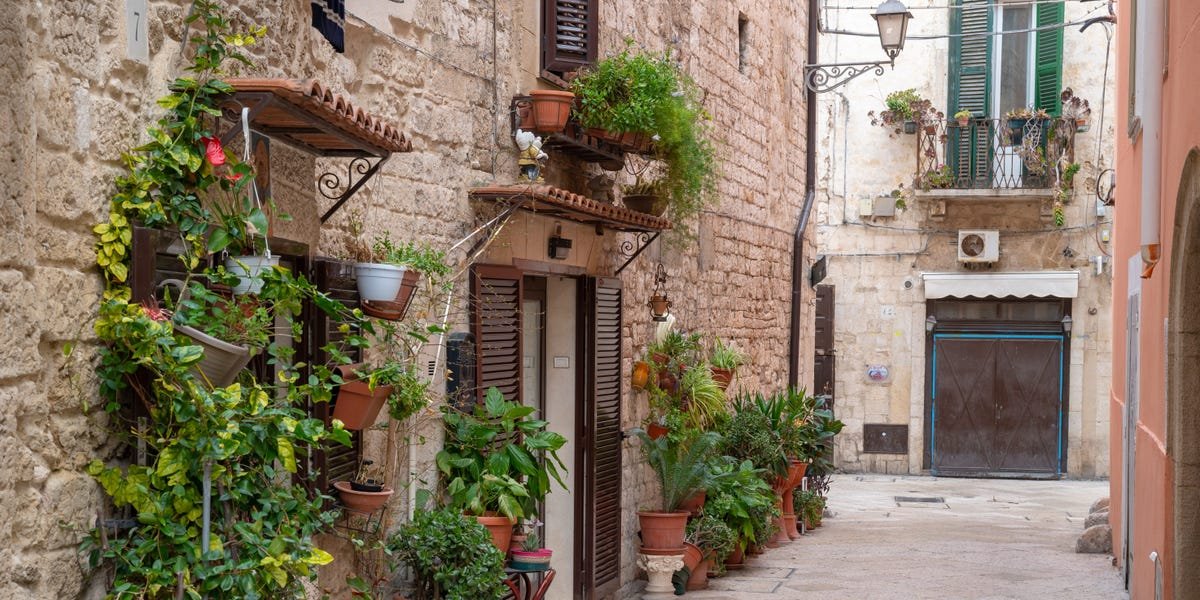
Beautiful towns like Ostuni, Monopoli, Trani, and Polignano a Mare are all within a 45-minute train ride from Bari Centrale station.
Ostuni took my breath away. I climbed up and down countless stairs to explore the hilltop city. I found myself surrounded by a maze of churches and white buildings, with splashes of vibrant color on their doors and window shutters.
Monopoli is tiny, but I loved ambling through the old alleys, which often had intricately detailed arches at their entrances, and walking the small stretch of the port to a red-and-white-striped lighthouse.
My favorite spot is Polignano a Mare, a coastal town with ancient white buildings perched atop a limestone cliff.
From there, I could spend hours taking in the spectacular views of the Adriatic Sea. For a closer look at the water, I walked under the Ponte Borbonico, an iconic bridge, to the picture-perfect pebble beach.
As the final stop of the day, I grabbed a caffè speciale — a coffee with cream, amaretto, and lemon peel — at a famous ice cream and coffee shop called Il Super Mago del Gelo before making my way back to Bari.
Nearly a year later, I still haven’t stopped thinking about my time in Bari. Although I made a rule not to revisit the same location twice on my annual Italy trip, I will absolutely make an exception for Bari.
Back in 2010, a three-day layover in Cairo on an EgyptAir flight from London to Johannesburg felt like destiny calling. I’d always been mesmerized by ancient Egypt’s pharaohs, myths, and architecture. Stepping off the plane, however, the Egypt of my imagination vanished almost instantly.
In its place was a sprawling, brown city of intense heat, dilapidation, and overwhelming frenzy. From the moment I left the airport, I felt like a walking target. Every interaction, from a forced perfume-shop detour to navigating the aggressive markets, felt like a potential scam.
And then, there they were. The Pyramids of Giza. They are, undeniably, breathtaking. More massive, more majestic, more impossible than any picture could capture. Standing before them, I felt a genuine awe I will never forget. But the magic was short-lived.
Turning around, the view was dominated by fast-food joints directly across from the Sphinx. The air was thick not with ancient mystery, but with the shouts of hundreds of vendors and the exhaust of countless tour buses. Even the famous Nile River turned out to be a polluted dump, with a stench so foul that Baby Moses would rot in his little basket.
This story is available exclusively to Business Insider
subscribers. Become an Insider
and start reading now. Have an account? .
I spent a year hiking in 11 countries, visiting some of the world’s most beautiful natural regions.
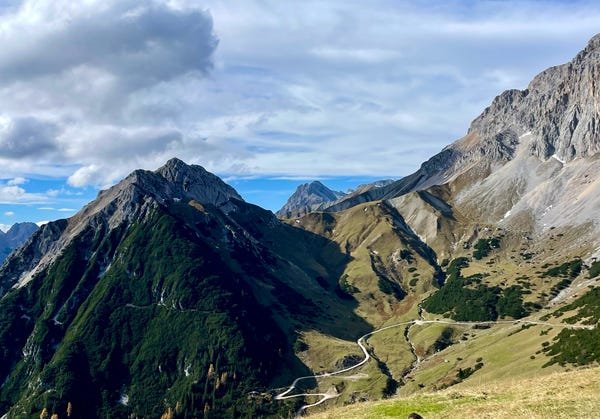
My favorite trails, including the Lago di Sorapis in Italy, had stunning views and less traffic.
Although I enjoyed every hike, there were some trails that I wouldn’t revisit because of the crowds.
Exploring the mountains is my favorite way to see a new place.
So, when I spent a year as a traveling winemaker and nomadic freelance writer in Europe and Oceania, I set out to hike in every country I visited.
I traversed narrow, rocky paths in the Dolomites, meandered through Scotland’s sweeping green valleys, and trekked past kangaroos in the Australian bush.
Now, over a year later, I can say I’ve hiked in some of the most awe-inspiring corners of the world. There are four trails I’d return to in a heartbeat, and three ticketed ones that felt crowded and overhyped.
I’d love to hike in Leutasch, Austria, again.
I hiked the Rotmoosalm-to-Wettersteinhütte loop, and found the experience so worthwhile. Sierra Newell
In the Austrian Alps, just south of the iconic Zugspitze mountain, lies Leutash, a lush, pristine alpine valley with an immense network of trails.
The circular Rotmoosalm-to-Wettersteinhütte tour was tough — the full loop is around 9 miles with over 3,000 feet of elevation gain — but in my opinion, it condensed the most idyllic aspects of the Austrian experience into one hike.
I saw dense forests, stunning craggy peaks, green meadows, mountain streams, ice-blue lakes, and traditional mountain huts, all in one day.
My hike to Lago di Sorapis in Italy was worth the effort.
I’m still thinking about my hike in the Dolomites. Sierra Newell
After traveling through the Dolomites last October with my boyfriend, I still dream about our 7.5-mile hike to Lago di Sorapis.
Carved into the rockface with a dramatic dropoff to the autumnal forest below, the technical out-and-back trail definitely required some steady footing on the ascent.
That said, the lake’s opaque turquoise waters, contrasted by pale rocky mountains, made it well worth the journey.
I’d definitely hike to the Kozjak waterfall in Slovenia again.
I loved my experiences hiking in the Soča Valley. Sierra Newell
My best friend and I road-tripped through Slovenia in the fall, traveling north to south along the Italian border. Deep within the magical Soča Valley is Slap Kozjak, a 49-foot emerald waterfall tucked inside an open gorge.
Just over 2 miles, the waterfall loop follows a scenic route along a cliff’s edge, over a wooden suspension bridge, and through ankle-high forest creeks.
Although I usually prefer longer, more challenging hikes, I loved that this route was easy enough that I still had energy to explore the area.
The iconic Hérisson waterfalls in France were stunning.
My hike to the Hérisson waterfalls was unforgettable. Sierra Newell
Over the summer, I traveled to the Jura region of France and hiked the iconic 4.3-mile trail that tours past a steep succession of seven unique waterfalls.
I found that this was the perfect time to visit — I loved watching the dappled sunlight filter through the bright green tree canopy, and almost glitter against the trail’s flowing rivers.
It’s a popular hike, though. Next time, I would start earlier to avoid the crowds and enjoy the picturesque views in solitude.
On the other hand, I’d skip the Italian Dolomites’ Tre Cime di Lavaredo next time — or plan my visit more strategically.
The Tre Cime di Lavaredo is a famous hike, but I was surrounded by tons of tourists. Sierra Newell
Most famously known as the Three Peaks of Lavaredo, this UNESCO World Heritage Site lies in the heart of the Dolomites.
I thoroughly enjoyed my fall visit here, but I made the mistake of starting in the early afternoon, and the hordes of visitors made my €40 parking fee much less worthwhile.
Even during the Dolomites’ low season, the popular, 6.3-mile trail was already filled with hikers, climbers, and beer drinkers by the time I started it.
I found the Eisriesenwelt in Austria to be too overcrowded.
This short ice-cave hike was memorable, but very crowded. Sierra Newell
The Eisriesenwelt was the first — and arguably the most memorable — hike I completed after moving abroad in August 2024.
South of Salzburg, it’s a relatively short but steep climb along an open rock face that leads to the largest ice cave in the world.
Although this hike was a fascinating and unique experience, it’s also easily accessible by cable car, which — in my experience — meant large crowds and long wait times.
The Fairy Glen trail in Scotland’s Isle of Skye was beautiful, but I wouldn’t go back.
The Fairy Glen was an easy, picturesque trail, but not one I’d necessarily visit again. Sierra Newell
My sister and I walked the Fairy Glen trail on the Isle of Skye during our Thanksgiving road trip through Scotland.
It’s an easy, mile-long path up grassy hills, past unusual rock formations and herds of roaming sheep. The views were beautiful and fairy-tale-like, but the small paid car park became flooded with visitors as the day progressed.
Between that, the short trail length, and the wet, gray weather that turned the trails into mud, I’d prefer to explore Scotland’s more dramatic and remote long-distance trails.
As an American who’s traveled to 44 countries over the last 30 years, I’ve seen my fair share of unforgettable places.
But if I had to choose one place to visit again and again, it would be Bali, an island and province in Indonesia that combines vibrant culture, natural beauty, and a pace of life that feels both energizing and restorative.
After spending a month on the island in 2023, I fell in love. Here’s what made my trip to Bali so special.
The food scene is incredible
I enjoyed a Javanese meal called Tahu Tek.
Gabby Garcia
One of my favorite meals during my time in Bali came from a street vendor. The Javanese meal, called Tahu Tek, featured fried tofu, bean sprouts, a thick peanut sauce, and a pile of crackers on top. It cost me less than $2 (USD), but it was packed with flavor.
Bali’s food scene goes far beyond street food, though. Even dining at restaurants felt affordable, making it easy to try local specialties, including babi guling, a traditional whole roasted pig.
Plus, I could easily find international cuisine alongside local dishes.
I often went to Milk & Madu, which served American-style food like pizza and burgers. I also loved spending mornings at cafés in Canggu, sipping smoothies and enjoying breakfast bowls.
Both the locals and expats in Bali were warm and welcoming
One of the main things that makes Bali truly special is its people. I’ve been to many destinations where the locals aren’t always open to expats and travelers. But here, everyone I met was warm, welcoming, and genuinely kind.
For example, I used an app called Grab, similar to Uber, where drivers can pick up passengers on their motorbikes or in their cars.
I was wary about riding on the back of a stranger’s bike, but the friendly drivers I had across several rides quickly made me feel at ease. Some would even check in with me during the ride to make sure everything was OK or to ask if I needed them to slow down.
Plus, I found an amazing community of digital nomads, creatives, and expats who decided to trade their office jobs for laptops in cafés. As an American living abroad, this made me feel at home.
It gave me a sense of familiarity in a new environment and made it easier to connect, since there was no language barrier. I felt more comfortable starting conversations and sharing experiences with other expats and long-term travelers.
During my time in Uluwatu, I met another nomad, and a simple conversation turned into spending the next few days together exploring. These kinds of moments felt much more natural and common in Bali than in other places I’ve visited, and I felt a strong sense of openness and connection.
There was always something exciting to do
I rode on a unique swing at Alas Harum.
Gabby Garcia
Another thing I loved about Bali was the diverse range of activities available. Whether I was in the mood to visit temples or relax on the beach, there was always something to do.
For example, in Ubud, I wandered through the Sacred Monkey Forest Sanctuary, where ancient temples sit under jungle canopies. There were signs everywhere warning visitors to hold onto their belongings, and for good reason. The sanctuary is home to over 1,260 monkeys, who I saw climbing railings and jumping between statues.
On the opposite end of the spectrum, I also visited Alas Harum, a tourism destination in Tegallalang with lots of opportunities for adventure. Here, I flew out on a giant swing that went over rice fields. Taking in the view from way above the terraces was equal parts terrifying and fun.
And when I wanted to relax, I visited the beach clubs, where I lounged by the water with music playing and a drink in my hand.
I’m already dreaming of returning to Bali
After traveling to 44 countries, I can confidently say I’m no stranger to exploring new places.
Every destination I’ve visited has shown me new ways of living, but in Bali, I experienced a way of life that felt joyful, balanced, and connected. Plus, the tropical, warm, and consistent weather didn’t hurt either.
Between the amazing food, the warm people, and the sense of adventure, I’m already dreaming of my next trip to this beautiful island.
In my early 30s, I was working long hours as the editor in chief of a magazine, juggling deadlines and the looming “should we have kids?” question — all while feeling completely wrung out. I drafted a resignation email.
When my boss called me in, she surprised me: “Take some time off,” she said. “Come back to manage a new launch later this year.”
My plan for a year off collapsed into two months.
It began quietly in India at a yoga retreat near Kerala and ended with an adventure in Indonesia, climbing Mount Bromo and motorbiking through Yogyakarta.
It wasn’t a true gap year, but it was long enough to reset. The next year, I stepped into my boss’s role, leading the creative team I’d almost left behind.
That experience made me realize that time off doesn’t have to derail a career — it can redefine it.
I wasn’t a student with few obligations or a 20-something who hadn’t settled on a career path. I was an established professional stepping away when the stakes were high.
Extended time off can carry long-term costs — lower earnings, disrupted savings, slower compounding — but for some, the benefits outweigh the risks.
David Burkus, an organizational psychologist and author, began researching sabbaticals in 2015.
“People report better mental and physical health, increased confidence, and a greater sense of purpose after an extended break,” Burkus told Business Insider.
He also notes the benefits for employers: Teams cross-train, share knowledge, and become less dependent on a few “indispensable” people.
Paid sabbaticals are still a rarity in the US. Society for Human Resource Management data showed that 5% of companies offered them in 2019, rising to 7% by 2023.
And despite employers not rolling them out broadly, employees are increasingly seeking time off. In SHRM’s 2025 benefits survey, leave was the second-highest priority for workers — trailing only health benefits — for the fourth year in a row.
A peer-reviewed study published in the Academy of Management in 2022 interviewed 50 professionals who had taken extended time off. All intervieweessaid they came back as better leaders.
DJ DiDonna, a senior lecturer at Harvard Business School and coauthor of the study, says everyone he interviewed wished they had taken one earlier.
DiDonna told Business Insider that the best times for a sabbatical often coincide with natural life transitions, like a honeymoon, a newly empty nest, or the “twilight career” stage before retirement.
This collection brings together people who took that pause at different ages, for different reasons, and for vastly different lengths of time.
If you’ve taken an adult gap year yourself, I’d love to hear from you at akarplus@businessinsider.com.
When people asked me what I was doing for the holidays, I responded almost too giddily, “I’m spending it alone.” Their eyes narrowed, “What?”
I told them I was sending my husband and the kids to his family in Massachusetts, and I’d stay back in Pennsylvania. All. By. Myself. I wouldn’t have to answer to anyone or for anything. Not requests for snacks or one more backrub. I wouldn’t have to sit rigid, wondering if one of my three kids was creeping out of a bed that wasn’t theirs. Or defend my parenting style while my oldest yelled about how life wasn’t fair and we must all really hate him, and why should he have to listen to anyone anyway.
After a beat, every single mom (and a few dads) told me: “I’m jealous. I want to do that. How did you swing that?”
I had hit a breaking point
The decision to be alone during the holidays came slowly at first and then all at once. I’d hit a breaking point that most parents, especially moms, are all too familiar with. But the moment I toyed with the idea of staying back — in a quiet, clean, empty house — that was it. It was all I could think about.
The author’s spouse was supportive of her taking time off.
Courtesy of the author
I broached the topic, gently, with my husband, who couldn’t have been more supportive and emphatic. “You should take a few days away!” But I didn’t want to be away. I wanted to be home alone. That was the key.
Every time Heather Mayer Irvine publishes a story, you’ll get an alert straight to your inbox!
Stay connected to Heather Mayer Irvine and get more of their work as it publishes.
As the days ticked closer to The Big Departure, people asked me when Jeff and the kids were leaving. “Wednesday, but I can’t ask when, specifically,” I’d laugh.
I explained to the kids that I needed some alone time; I needed to take a break. They, who are 8, 5, and 3, were relatively unfazed. My middle, big-feeling daughter made me promise to call her every two minutes. I wanted them to know that it was OK for Mom (or Dad) to step away and be alone. It didn’t mean I loved them any less. Something, something about distance making the heart grow fonder.
Self-care is crucial
Mental health experts agree. Solitude can be a crucial form of self-care (unless it makes you truly uncomfortable to be totally alone). “When you seek out intentional solitude, and the demands on your attention and focus melt away, it allows you to have a level of awareness that can support healing and growth,” Emily Moriarty, M.Ed., a licensed professional counselor and director of clinical services at Reset Outdoors, told Business Insider.
Finally, they were off. And I didn’t know what to do with myself. Everything was weirdly quiet. Clean. Empty. I loved it. I had a couple of low-key plans over the next few days, but my goal was to savor the silence and the lack of a schedule.
The author really enjoyed her time alone.
Courtesy of the author
When 5 p.m. rolled around on the first night, I started making dinner while listening to music. I danced a little. I ate while reading a book. No one argued with me that they didn’t like what was served. Cleanup was easy. I put my dishes away. I didn’t need to sweep — I don’t spill things on the floor.
I turned my phone off; I didn’t need an alarm. No one needed to reach me, and if they did, they could wait. Dad was more than capable. I slept in. I drank coffee on the couch in front of the fire in my pajamas. I forced myself to allow things to move slowly — something I have a hard time doing with or without kids.
“Solitude doesn’t include sitting alone in an office working,” Moriarty said. “It has to be non-work, non-caregiving time.”
When it was time for the Big Holiday Meal, I thought I’d feel a little lonely. But I didn’t, and that, I realized, was because this was my choice. I knew my family was enjoying themselves with relatives they don’t often see and having a little vacation. And I knew that they’d all be home before I knew it.
I had a little mom guilt
By the end of the fourth day, the air was thick with anticipation of the kids and Jeff coming home. I felt like I couldn’t watch TV fast enough. I couldn’t sit in a quiet, empty house fast enough. I couldn’t drink enough coffee fast enough. But when I started making dinner at 5 p.m., awaiting their 8 p.m. arrival, I realized if I had to keep doing this, I might get a little… bored?
I’m sure that has more to do with the stark contrast of raising three kids, co-running a household, and having a (fairly successful) career, and four days of abrupt, near-total solitude. If I didn’t have kids at all, I’m sure I wouldn’t be bored at 7 p.m.
People have since asked me if this will be my new holiday tradition. I did like it, maybe a bit too much, but it feels wrong to indefinitely celebrate the holidays without my kith and kin. Four days weren’t enough to assuage Mom Guilt, apparently.