In my opinion, Little River is one of Miami’s most exciting neighborhoods, especially in terms of food.
One of my favorite dinner options is Sunny’s steakhouse, where I get Parker House rolls for the table, some delicious seafood from the raw bar, and a hanger steak.
I always order the potato butter sauce for the steak (and also to dip my fries in). Reservations can be tricky to secure, but are released 30 days in advance on Resy.
If you can’t get into Sunny’s, my favorite local hotspot is Fooq’s, a restaurant with Persian-influenced wood-fired cuisine. I especially love the large, vibey dining room with chic lighting fixtures. After dinner, head upstairs to the Lion’s Den for disco-fueled sets on vinyl.
Then, end the night at ZeyZey, an open-air music venue that welcomes a mix of local artists and famous names. It’s family-friendly, unpretentious, and distinctly Miami.
You might not think it possible, but waiting in line at airport security is somehow getting worse.
Thousands of travelers in the US waited up to three hours at security checkpoints on Sunday as the ongoing partial government shutdown caused staff shortages at the Transportation Security Administration.
Some stalled travelers shared photos of the winding lines and crowds on social media. A video shared on X by Aubry Killion, an anchor at WDSU, the primary NBC affiliate in New Orleans, showed a line of passengers stretching all the way out into the parking garage.
MSY issued the following statement:
“Due to impacts from the federal government’s partial shutdown, the TSA at Louis Armstrong New Orleans International Airport (MSY) is experiencing a shortage of workers at the security checkpoint, which is causing longer-than-average lines.” pic.twitter.com/RGeCcqUVOi
A photo shared to Reddit showed a massive crowd at Hartsfield-Jackson Atlanta International Airport in Georgia, where wait times have reached an hour. The airport is also encouraging travelers to arrive early for their flights.
“The delays are the result of residual impacts from two ground stops issued on Friday, which created a temporary backlog in passenger volumes, combined with current TSA staffing constraints,” a Hartsfield-Jackson Atlanta International Airport spokesperson told Business Insider.
Every time Lauren publishes a story, you’ll get an alert straight to your inbox!
Stay connected to Lauren and get more of their work as it publishes.
Houston Airports, which operates the William P. Hobby and George Bush Intercontinental airports in Texas, warned travelers that the wait times could be hours long.
“As a result of the partial federal government shutdown, passengers at William P. Hobby Airport (HOU) should arrive at least 4 to 5 hours before their flight to allow extra time for TSA screening,” the operatorsaid in a press release. “At times, TSA wait times at HOU may extend beyond 180 minutes.”
Houston Airports said TSA PreCheck may be unavailable at William P. Hobby Airport due to limited staffing. At George Bush Intercontinental Airport, travelers were told to allow extra time for security screening.
The Department of Homeland Security last month said it was suspending TSA Precheck and Global Entry due to the government shutdown, but later backtracked, leaving it up to individual airports.
Lauren Bis, deputy assistant secretary for public affairs at DHS, said TSA agents “received only partial paychecks earlier this month and now face their first full missed paycheck, leading to financial hardship, absences, and crippling staffing shortages.”
TSA agents are federal workers under DHS, which means they are directly affected by the partial shutdown that began in January. During the earlier 43-day government shutdown last year, TSA agents went weeks without pay. A shortage of air traffic controllersat airports in 2025 played a significant role in forcing the government to reach an agreement.
The US Congress failed to reach an agreement to fund DHS in February, in part because Democrats demanded changes to how the department enforces immigration law.
Due to impacts from the federal government’s partial shutdown, the TSA is experiencing a shortage of workers at the security checkpoint, which is causing longer-than-average lines. Passengers with travel scheduled today are advised to arrive at least 3 hours before their…
— New Orleans Airport (@flyneworleans) March 8, 2026
The long waits affected several major airports across the United States. The Louis Armstrong New Orleans International Airport in Louisiana also told travelers to arrive early.
“Due to impacts from the federal government’s partial shutdown, the TSA is experiencing a shortage of workers at the security checkpoint, which is causing longer-than-average lines,” the airport wrote on X. “Passengers with travel scheduled today are advised to arrive at least 3 hours before their scheduled departure to allow plenty of time to undergo security screening.”
Security checkpoints at Charlotte Douglas International Airport in North Carolina are about a 50-minute wait.
Emilia Vasquez, a business development manager for Goodwill, landed in Dubai on Thursday, February 26. She and her 6-year-old son had flown in to celebrate her birthday, and they were planning to stay until Tuesday.
Two days later, the United States and Israel launched strikes on Iran, and everything changed — across the Middle East, airspaces shut down, airports closed, and thousands of travelers, like Vasquez, found themselves stuck in place.
As they navigated the logistics of getting stranded, they also faced another issue: the cost of getting stranded.
In a statement on March 1, the General Civil Aviation Authority of the United Arab Emirates, or GCAA, announced that the State would be bearing “all hosting and accommodation costs for affected and stranded passengers.” The announcement did not specify how or when travelers would be reimbursed.
For Vasquez, the flight cancellations meant watching her hotel stay grow longer by the day. She was staying at Taj Dubai hotel, a 5-star hotel near the Dubai Mall, and spending about $500 a day, roughly $300 of which went to her hotel bill. As of Thursday, she had spent $6,800.
With bills racking up and no immediate money from the Emirati government, she was only a few thousand dollars away from her credit card limit.
“I’m being responsible for paying for this hotel, the hotel literally telling us that if I cannot afford the hotel to leave and go somewhere else,” Vasquez told Business Insider on Wednesday. “I don’t feel safe to leave the hotel and go somewhere else. So I’ve been extending the days every day.”
With some airlines slowly resuming limited service out of the region, Vasquez managed to leave Dubai on Friday, but for many of the travelers who remain on the ground, bills continue to mount and confusion remains about whether they will be saddled with or reimbursed for these bills.
The Abu Dhabi and Dubai tourist ministries did not respond to requests for comment from Business Insider. The General Civil Aviation Authority of the United Arab Emirates did not respond to a request for comment.
‘We’re just trying to be as cheap as possible’
Fate Show and her father in the Dubai Mall China Town.
Courtesy of Fate Show
While some well-heeled visitors paid six figures to get out of Dubai, others have been funding their extended stays through a mix of credit cards, airline-provided vouchers, and crowdfunding.
As of Saturday, two of the region’s biggest airlines — Emirates and Etihad — have resumed limited flight schedules, prioritizing existing customers. Qatar Airlines remained grounded with the exception of limited flights to Doha. While the airlines haven’t released guidance around obtaining hotel vouchers, several travelers said they’ve been able to receive them.
Fate Show, a Ph.D. student, was flying from Kuala Lumpur, Malaysia, to Londonwith her dad after seeing her family for Chinese New Year. Their flight was scheduled to stop in Dubai on Saturday afternoon. When she arrived at the airport, she was met with chaos.
Emirates canceled their flight to London and provided a voucher to cover food and a hotel stay at the S Hotel Al Barsha, a 4-star hotel about 20 minutes from Dubai International Airport.
That voucher lasted four nights. On Tuesday, after the voucher ran out,they switched hotels to the Hampton by Hilton Dubai Al Barsha, where they paid for their stay out of pocket. The room, with two single beds, cost $112 a night and included breakfast.
They are trying to limit additional spending on food to $30 a day.
“We’re not trying to do anything fancy,” she said. “We’re just trying to be as cheap as possible.”
She and her father tried to buy new tickets home, but said they were too expensive. On Friday, they moved to the Copthorne Hotel with their Emirates voucher. Her flight has been rescheduled for Tuesday.
Even with the help of the Emirates hotel voucher, Show and her father have had to spend hundreds of dollars during their unexpectedly extended stay in Dubai.
“Obviously, that’s a lot of money we were not intending to spend,” she said. “We’re using a credit card, so we’re hoping to be reimbursed by next month when we repay it.”
Shanice Day has managed to get a flight to Australia from Dubai, in order to make it back to the US.
Courtesy of Shanice Day
Shanice Day, a stylist from Houston, traveled to Dubai on February 24 to celebrate her 30th birthday with her friend Remy Thomas, staying at the FIVE Luxe hotel near Jumeirah Beach.Their original flight home on March 1 was canceled, along with subsequent rebookings, and they were left paying for their hotel out of pocket.
On Tuesday, Thomas started a GoFundMe to fundraise for their accommodation and flights back. As of Friday, the pair had raised $9,978of their $11,000 target.
Day managed to secure a flight out of Dubai to Sydney on Thursday. The following day, she flew from Sydney to Los Angeles, the penultimate leg of her round-the-world journey back to Texas.
“I’ll probably get therapy after this experience,” Day told Business Insider. “I know it’s going to take me a while to build up the courage to travel again.”
Shrihari Madhu, the manager of Coral Cove, which rents out three apartments in Dubai Marina, told Business Insider they have been helping tourists stranded by flight cancellationsby offering free accommodation or a base fee of around $40 a night.Ordinarily, they rent their properties out for prices starting around $110.
“Many travelers are reaching out because they need an immediate reliable place to stay while navigating these disruptions,” Madhu said.
Madhu said the three apartments are currently occupied by guests whose travel plans were canceled.
The only thing more expensive than staying is leaving
On Monday, as tensions escalated and airspaces across the region shut down, some wealthy travelers in the UAE hired chauffeurs to drive them into Oman and Saudi Arabia. The trips involved hours in the car, including long waits at border crossings.
From there, they chartered private planes, spending upward of $200,000 to make it out, Ameerh Naran, the CEO of Vimana Private Jets, previously told Business Insider.
He said demand to leave the region had started to tick up on Friday, when the possibility of a conflict with Iran became more acute.
“There has been a clear emphasis on speed and certainty of departure, with many clients prioritizing the earliest viable routing rather than specific aircraft types or traditional preferences,” Naran said. “We have also seen increased demand for coordinated ground support to facilitate access to airports where airspace remains open.”
It’s been a confusing six days since missile attacks across the Middle East stranded travelers and planes in airports across the world.
Things are still far from normal as of Wednesday, but some travelers are getting home.
There is a slow-growing recovery in the United Arab Emirates, which has partially opened its skies and designated “safe” corridors for rescue planes to use.
There are a lot of people to move: cities like Dubai and Abu Dhabi host large expat populations and tourists, and their hubs usually handle tens of thousands of transit passengers a day.
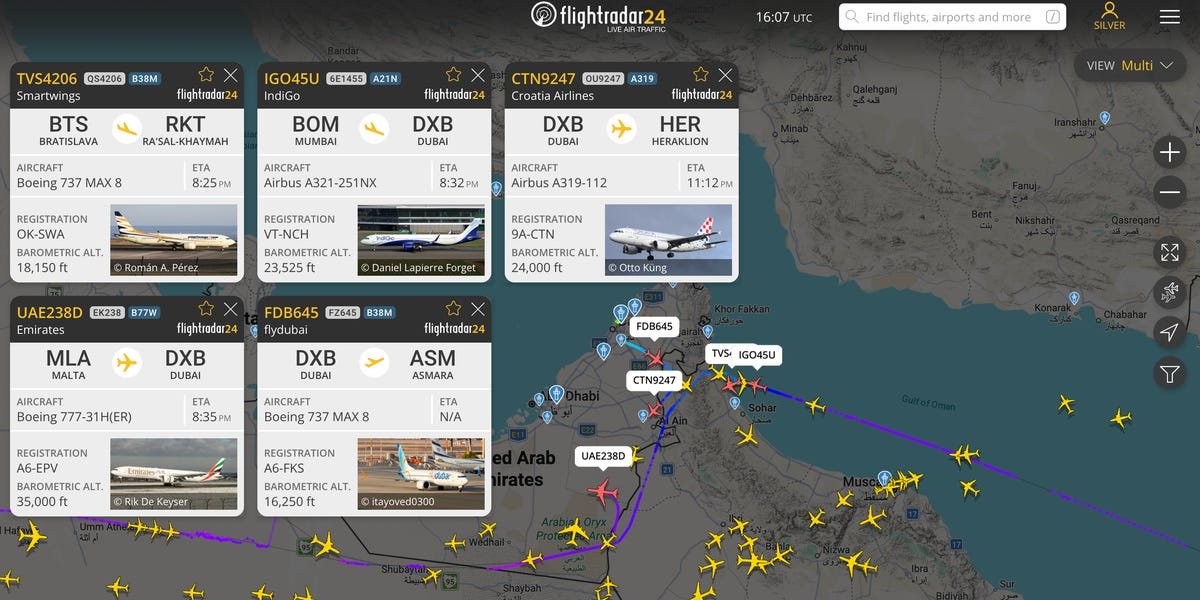
Working with local officials, Emirates, Flydubai, IndiGo, and Etihad Airways were among the first airlines to depart the UAE with passengers, crews, and cargo. Over 100,000 people followed these aircraft live on the aviation tracking website Flightradar24.
Even as Iranian threats continue to disrupt flying — forcing diversions, holds, and U-turns — airlines are still transporting passengers to destinations across Europe, Asia, and Africa.
Fortunately, Emirates and Etihad have big planes: many of their Airbus A380s, capable of carrying up to 615 passengers, have flown to cities such as London, Istanbul, Jeddah, Singapore, Paris, and Düsseldorf.
Although these flights don’t always take travelers all the way home, they offer a crucial escape from limbo — getting people into countries with open airspace and far more onward flight options.
Flightradar24 data shows several other carriers have joined the crowd: Air India, Air Arabia, Uzbekistan Airways, Kenya Airways, Morocco’s Royal Air Maroc, Saudi airline Flynas, Royal Jordanian, and India’s SpiceJet are all flying from Dubai to their respective hubs.
Passengers on a Kenya Airways rescue flight from Dubai arrive back home.
Thomas Mukoya/Reuters
European carriers, including Lufthansa, Swiss International Air Lines, Prague-based Smartwings, Aegean Air, and British Airways, are running special rescue flights from neighboring Muscat, Oman. Smartwings and Croatia Airlines are running select flights from Dubai.
Air France scheduled a repatriation flight from Dubai to Paris on Thursday evening, but suspended the plan shortly after the announcement due to “the ongoing security situation.”
Russian carriers Aeroflot and S7 Airlines have similarly departed with passengers, though their flights to Moscow are taking up to three hours longer because they have to fly the long way around closed airspace rather than fly directly over it.
Still, most airlines’ regular schedules to and from much of the Middle East remain suspended until at least the weekend, and they have asked passengers not to go to the airport unless they have been specifically notified.
No US airlines have sent rescue planes as of Thursday. Mark Dombroff, an aviation attorney with the law firm Fox Rothschild, told Business Insider that even if US carriers like United or American wanted to help, they legally can’t.
“The decision-making resides with the Federal Aviation Administration,” he said. “If the FAA says you can’t fly there as a US certificated carrier, that’s it. And in a sense, it’s no different than any other restricted airspace in this country, like Washington, DC.”
Some Americans have gotten home with the help of the State Department; it previously told those in over a dozen Middle Eastern countries to evacuate. The agency said it flew a charter flight to the US on Wednesday, and that more will be “surged across the region.”
It added that, as of Wednesday, “nearly 18,000 Americans have safely returned to the US,” including 7,300 helped by the State Department. It said thousands of others made it to Europe and Asia and are in transit back, and told those still stuck to get in touch for help by calling +1 (202) 501-4444 or filling out this form.
Some airlines remain effectively frozen. Qatar Airways has not flown a plane since Saturday due to Qatar’s airspace closure, leaving practically no options for those in Doha except to wait or drive hours to Saudi Arabia and fly out from there.
Flight options are still extremely limited
While some flights are better than none at all, special airline operations remain limited to certain routes and airports.
Flightradar24 data shows that Dubai International has seen just 100 takeoffs and landings since Saturday. Operations ramped up from Monday to Tuesday — but that was still less than 10% of the roughly 1,200 flights in and out on a usual day.
Rescue flights are largely restricted to the UAE, Oman, and Saudi Arabia: the skies over Iran, Kuwait, Iraq, Syria, Israel, Qatar, and Bahrain remain closed.
An Emirates A380 ferried hundreds of stranded people back to Germany.
Andreas Rentz/Getty Images
Aviation analytics Cirium estimates there are normally about 900,000 daily seats to, from, and within the Middle East; it said about 4.4 million seats in and out of the Middle East have been canceled since Saturday.
While airlines are actively adding flights to the schedule — despite the on-and-off missile threats in the region — there are nowhere near enough rescue seats yet to accommodate the tens of thousands of stranded travelers. British Airways said on social media on Wednesday that the rescue flights it planned through Saturday are already full.
Some wealthy travelers have abandoned commercial flying altogether, instead paying hundreds of thousands of dollars to charter private jets. Flightradar24 data shows a number of business aircraft flying to and from Oman, Saudi Arabia, and the UAE since Sunday.
Those with less deep pockets have chosen to travel by bus to Oman and Saudi Arabia, hoping to secure seats from airports still operating flights as normal.
But the drives are hourslong, and Oman Air warned Muscat-bound travelers crossing in from the UAE to arrive 12 hours early as traffic backs up for miles.
Passengers flying from Japan to Europe endured a 14-hour-long flight to nowhere on Tuesday after an engine issue.
All Nippon Airways Flight 223 left Tokyo around 11 a.m. and was scheduled to land in Frankfurt, Germany, about 14 hours later.
However, over six hours into the journey, it turned around while flying over the Arctic Ocean, north of Alaska.
Flight-tracking data shows how the Boeing 787 then headed back to the Japanese capital.
It took another eight hours to reach Tokyo’s Haneda Airport, where Flight 223 touched down around 1 a.m.
The plane diverted due to a “low engine oil level,” an ANA spokesperson told Business Insider.
Engine oil differs from jet fuel and is used to lubricate and cool the moving parts inside the engine.Returning to Tokyo, the airline’s main hub, would mean more resources for maintenance and repair.
The spokesperson added that the flight departed again on Wednesday morning, with a change of aircraft and crew.
Data from Flightradar24 shows the new plane departed at around 7:30 a.m. and is supposed to land in Frankfurt around 1 p.m. local time. That’s about 20 hours later than passengers initially expected to get there.
“The safety of our passengers and crew is our top priority,” the spokesperson said. “We sincerely apologize for the inconvenience caused to our customers by this extensive delay.”
Since the plane turned around roughly halfway through a huge journey, it was a particularly gruelling flight to nowhere — but not the longest.
Last June, a Qantas flight to Paris returned to Perth after 15 hours. It was mid-flight when Iran launched strikes against a US air base in Qatar, closing some of the world’s most congested airspace.
And in 2023, Air New Zealand passengers had a 16-hour flight to nowhere after an electrical fire in a terminal at New York’s JFK Airport.
When my husband Shayne and I sold nearly everything we owned to travel the world full-time, we thought we were ready for anything. We had spreadsheets, backup plans, a carefully managed budget, and, as two adults in our 50s, decades of experience behind us.
What could go wrong? Turns out, plenty.
Over the past two and a half years, we’ve lived in more than a dozen countries and traveled thousands of miles. We’ve hiked to waterfalls in Bali, wandered the streets of Barcelona, and eaten our way through Thailand.
But we’ve also made mistakes that cost us time, money, and more than a little peace of mind. Some were honest slip-ups, while others came from overconfidence, but they all taught us lessons we’ll never forget. Here are five of the biggest mistakes we’ve made.
Overplanning made us feel burned out
We’ve learned to leave room for spontaneity when traveling.
Shelly Peterson
At first, we packed every destination with nonstop activities. Sunrise temples, food tours, museums, waterfalls, cultural shows — we didn’t want to miss anything.
Every time Shelly publishes a story, you’ll get an alert straight to your inbox!
Stay connected to Shelly and get more of their work as it publishes.
But within a few months, we were running on fumes. The pace was unsustainable, and on some days, it felt like we weren’t even enjoying ourselves.
These days, we travel more slowly. We leave room for naps, long walks, and spontaneous days with no agenda.
Some of our best memories now come from lazy mornings and quiet moments, not the things we planned, but the ones we stumbled into.
We underestimated how hard it is to build a real community
We assumed full-time travel would mean constantly meeting fascinating people and forming deep connections around the globe.
Although we’ve met plenty of kind and interesting travelers, most friendships are fleeting, shared over a meal or a few days before everyone moves on. We didn’t expect how lonely it can feel to always be “the new people.”
Now, we intentionally choose places with digital nomad scenes, coworking spaces, and expat meetups. In Vietnam, for example, we love that locals and expats gather for weekly street-food tours and surf lessons.
It takes effort, but building community on the road is possible. We just had to actively seek it out.
One time, we misread our visa and had to change plans at the last minute
We’ve learned to always double-check visa rules.
Shelly Peterson
When traveling to Vietnam, we completely misunderstood how our visa worked and accidentally arrived in the country on the day it expired.
Immigration let us in, but warned us we had to leave almost immediately and apply for a new visa. We scrambled to book a last-minute flight to Cambodia and ended up paying a fine.
It was stressful, chaotic, and expensive. Oddly enough, though, our visit to Cambodia became one of our favorite unexpected adventures. But now, we double and triple-check visa rules and requirements ahead of time.
We’ve also let our guard down
Travelers should always be aware and alert to their surroundings.
Shelly Peterson
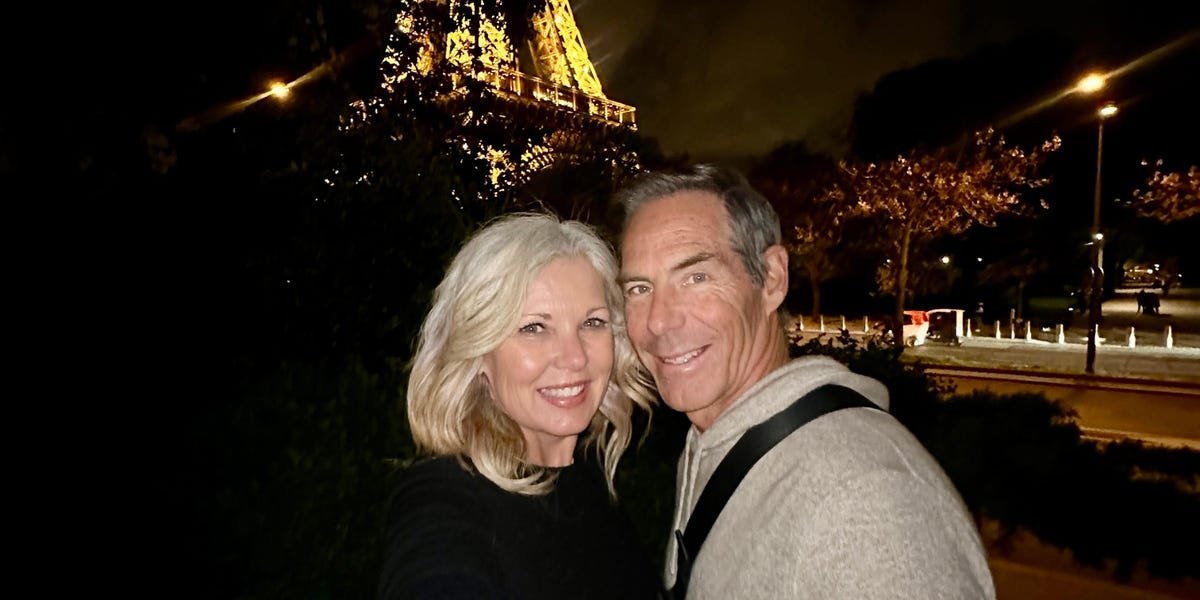
In Paris, Shayne had his crossbody bag slung around his back while boarding a crowded metro train. Seemingly within seconds, his phone was gone.
It was a rookie mistake, and we knew better, but sometimes travel lulls you into a false sense of security.
That one slip-up cost us days of frustration replacing his device and updating accounts, not to mention a chunk of money.
Even seasoned travelers need to stay alert, especially in busy cities and transit hubs.
Choosing accommodations with zero walkability made exploring more difficult
When we started traveling full-time, our first stop was Bali. We booked a picture-perfect villa with sweeping ocean views and dreamy Instagram potential. What we didn’t realize, though, was that it was over an hour away from the nearest town.
It was beautiful, but it made everyday activities like walking to cafés, exploring neighborhoods, or talking with locals nearly impossible.
Now, we prioritize location over aesthetics. Being able to walk out the door and explore a neighborhood, find a local market, or grab lunch at a street stall makes us feel like we’re actually living somewhere, not just passing through.
Despite the bumps in the road, traveling full-time has been incredibly rewarding
The mistakes we’ve made haven’t just taught us how to travel smarter. They’ve reminded us to stay humble, adaptable, and patient with ourselves.
We’ve learned to slow down, embrace the unexpected, and let go of the need for every day to be perfect, because no matter how experienced you are, travel always has something new to teach you.
And often, the detours become the best parts of the journey.