
The-US-Army-wants-to-see-if-it-can-get.jpeg

The US Army wants to see if it can get robots to rescue wounded troops like they’re doing in Ukraine

In a fight against a formidable enemy, there’s no guarantee medical evacuation crews will be able to reach wounded troops. Facing this possibility, the US Army is looking at using ground robots instead to get injured troops off the battlefield.

The Army’s 2nd Cavalry Regiment is drawing hard-won lessons from the war in Ukraine, where drones and artillery have made any battlefield movements extremely high-risk.

“When we’re looking at the conflict in Ukraine specifically, most of the use cases for unmanned ground vehicles have actually been in the sustainment and logistics,” said Maj. Andrew Kang, the fire support officer for the 2nd Cavalry Regiment.

That work includes casualty evacuations, Kang told reporters during a media roundtable last Friday, sharing that the regiment’s soldiers are providing industry partners with feedback during testing through the xTech innovation program.

The 2nd Cavalry Regiment, an Army Stryker brigade permanently based in Europe, would serve as a critical American combat force in a major conflict on the continent. The unit has been outfitting its soldiers with counter-drone systems through the Army’s Transformation in Contact 2.0 initiative, a force-wide push to more quickly adopt new technologies, and leaning into using uncrewed systems to its advantage.

The unit has trained Ukrainian troops cycling on/off the battlefield on American equipment, but concurrently with the training, the unit has become a sort of test bed for helping senior US leaders understand what troops will need in a future fight, experimenting with new technologies and tactics.

“During the training,” Col. Donald Neal, the 2nd Cavalry Regiment commander, said, “we learned a lot about their use of what we refer to as the triad: Unmanned Aerial Systems (UAS), counter-UAS operations, electronic warfare, and the network that enables all of it.” Those, however, aren’t the only lessons.

The Ukrainian battlefield has proven to be exceptionally grueling for casualty evacuations, a stark contrast to the quick evacuations on which American troops could rely during the wars in Iraq and Afghanistan. In Ukraine, helicopters are vulnerable to short-range air defenses, while medical teams and vehicles are haunted by drones.

That’s where the robots come in.

Ukrainian soldiers have been using uncrewed ground vehicles, or UGVs, for offensive missions. These operate like rugged flatbed trucks without a driver, and Ukraine has mounted machine guns and other weapons on them to attack Russian forces. Ukrainian troops also use them as mine-layers, scouts, and vehicle-borne improvised explosive devices.

Casualty evacuations, though, are proving to be a particularly critical area where these robots can help mitigate risk to medics.


Col. Donald Neal, Regimental Commander, 2d Cavalry Regiment.

Col. Donald Neal, Regimental Commander, 2d Cavalry Regiment, spoke at the same roundtable event.

U.S. Army photo by Sgt. Tien Dat Ngo


While aerial drones have been revolutionary for warfare, a trend that is continuing to expand abroad in the new US war in Iran, the uncrewed ground vehicles have been slower to proliferate.

Of the hundreds of thousands of Ukrainian drone missions that were executed last year, only 2,000 were UGVs. It’s more difficult to remotely drive them across varied terrain, but they offer the ability to move much larger payloads. For casualty evacuation and logistics, the ability to carry more is invaluable.

Rather than risk more injuries by sending medics forward, soldiers can send a UGV to pick up a wounded soldier. It’s an imperfect solution, as a wounded soldier has to be able to pull themselves onto the vehicle. Many UGVs are also susceptible to electronic interference and simple drone-spotting. These systems have, however, proven effective at getting troops off the battlefield, even surviving attempts to eliminate them by enemy forces. It’s another tool in the kit.

UGVs may also prove useful as decoys or sensors in areas too risky for troops, Neal said during Friday’s roundtable, and for boosting communications networks as mobile relays.

“Potentially, we see the biggest bang for our buck in utilizing them for things like breaching,” Kang added.

Breaching fortified enemy positions is one of the most dangerous jobs on the battlefield, requiring specialized combat vehicles to clear mines and cross obstacles while under fire. In Ukraine, breach operations have proven costly, with delays hindering breakthroughs and preventing armored formations from moving forward.

“Now, instead of having a manned formation go to the breach point, we could potentially load an explosive on a [remote-control] car-type platform and drive,” Kang said. The vehicle could blast a path forward for combat vehicles like 2nd Cavalry’s Strykers, wheeled armored fighting vehicles equipped with a mix of armaments.

One of the biggest challenges for the Army as it explores UGVs is the high price tag for some systems, Kang said. The platforms vary dramatically in cost, he said. While some more expendable versions are under $1,000,some cost almost $1 million.

“The cheaper the better,” Neal said of the affordability of ground robots. “In most uses for unmanned ground vehicles, we know we’re going to put them in a position where we’re not going to recover them, or they’ll be destroyed.”


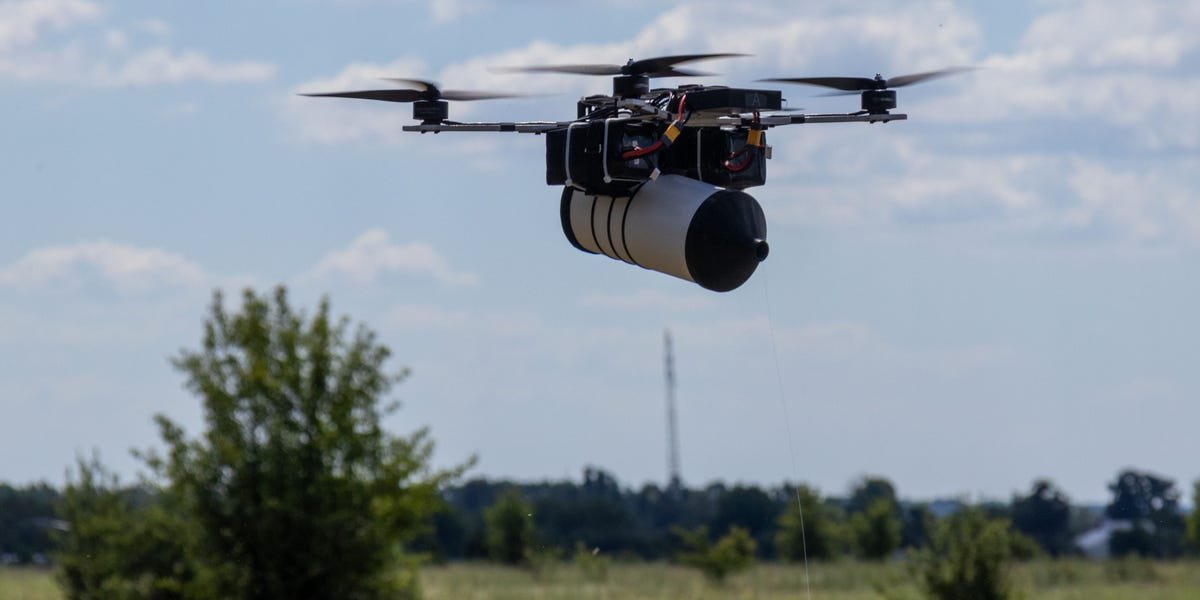

Source link

Ukrainian-troops-say-their-hard-won-lessons-on-Iranian-Shaheds-apply.jpeg

Ukrainian troops say their hard-won lessons on Iranian Shaheds apply far beyond their war at home

The drones Iran is launching at US forces are the same ones Ukraine has fought for years. Ukrainian soldiers say their battlefield experience offers lessons that matter in this fight.

Alex Eine, the commander of a small Ukrainian drone unit, said it was “surprising” to see reports out of the Middle East of multimillion-dollar interceptors being used to combat cheap Iranian one-way attack drones.

“When long-range drones are flying at you, don’t shoot them down with $3 million PAC-3s from Patriots,” he said, referring to a top interceptor for the most advanced US surface-to-air missile system.

Through trial and error, Ukraine developed low-cost defenses to counter Russia’s Geran drones, copies of Iran’s Shahed drones. Ukrainians involved in defending their country and Western analysts say other countries facing these threats need to be doing the same.

A 122nd Brigade sergeant with Ukraine’s Territorial Defense Forces who asked to be identified only by their call sign Fast, said that Ukrainian soldiers “were sure the US had some secret weapon,” some foolproof shield for stopping Shaheds. They were expecting to see it in action when this new war began, he said.

Instead, what they saw were viral video clips of an Iranian delta-wing drone sailing past defenses and slamming into a US Navy base in Bahrain, causing serious damage.


Smoke rises from a skyline with water in the foreground under a blue sky

Iran has been firing missiles and drones at US targets and its Middle East allies.

Stringer/Anadolu via Getty Images


“Now we see that it is a hard task, even for the US,” Fast said of defending against Shaheds.

On Wednesday, CNN reported, citing an unnamed source who attended a closed-door briefing, that Defense Secretary Pete Hegseth and the top general, Dan Caine, told congressional leaders that Shaheds pose a greater challenge for the US and allies than initially expected.

The Pentagon did not respond to requests for comment.

Speaking at a press conference on Thursday afternoon, Adm. Brad Cooper, the head of US Central Command, said that the US is “very familiar with the Iranian capabilities” and “planned for it right from the outset.”

He added that while he felt good about what the plan was, the military has been making adjustments.

Dimko Zhluktenko, a Ukrainian drone pilot with Ukraine’s Unmanned Systems Forces, said the US and others should lean more into the kind of low-cost systems that Ukraine has proven work against Shaheds.

Hard-won combat lessons

The reality of any major air defense battle is that some threats are likely to break through.

“I’m not surprised that some Iranian drones penetrated their defenses, as they act like a swarm,” said Ukrainian lawmaker Maryan Zablotskyy, who was an early advocate for interceptor drone air defenses. “It’s very difficult to intercept a whole bunch of them flying at the same time.”


A man wearing camoufage stands on the back of a camoufage-painted truck pointing a weapon into a cloudy and blue sky, with another man standing beside

Ukraine has developed mobile fire groups as part of its response to Shahed-style drones.

Andriy Dubchak/Frontliner/Getty Images


Last year, Ukraine saw Russian drones break through and kill over 500 civilians.

“There is no 100% counteraction,” said Oleksandr Skarlat, the director of the Sternenko Foundation, a crowdfunding organization for combat drones. “The question is no longer whether such drones will break through,” he argued, “but what the cost of destroying them will be and how quickly defense systems can adapt.”

Ukraine says it can intercept about 90% of Russia’s Shaheds. That rate isn’t perfect, but Kyiv is able to achieve largely effective coverage and do so with systems that are cheap enough to field at scale, helping it save its missiles like the Patriot and the National Advanced Surface-to-Air Missile Systems, or NASAMS, for Russia’s more dangerous threats.

Ukraine depends on a host of low-cost solutions against Shaheds, including electronic warfare, mobile gun teams, and interceptor drones.

A cofounder of Wild Hornets, the Ukrainian firm behind the popular Sting interceptor drone, said the Shahed threat “forced” their country to develop an entirely new branch of service dedicated to using drones to fight drones.

Ukraine began surging production of cheap interceptor drones, designed to fly at high speeds to intercept Shaheds, in 2025. It says it now produces over 1,000 of them a day.


A man in camouflage gear and a black beanie stands in a snowy field in front of trees holding a black and beige drone, standing beside black equipment

Ukraine has developed interceptor drones designed to take out Shaheds and other drones.

Alex Nikitenko/Global Images Ukraine via Getty Images


Math problems

Hegseth said on Wednesday that the US has “the most sophisticated air and missile defense network ever fielded” and that it has vaporized thousands of Iranian threats, both missiles and one-way attack drones.

“We have pushed every counter-UAS system possible forward, sparing no expense or capability,” he said, using an acronym for counter-Unmanned Aerial Systems.

Among the higher-end air defenses on the front lines of this multinational air defense fight are the MIM-104 Patriot and Terminal High Altitude Area Defense (THAAD) systems. Ship-based interceptors, like the SM-series missiles, and planes armed with air-to-air missiles are also in play.

Dara Massicot, a Carnegie Endowment for International Peace defense expert, wrote in an assessment on Monday that drone attacks are being intercepted “at an impressive rate,” but at the cost of “extensive resources of near-constant defensive counter air patrols and the use of ground-based air defense systems that are otherwise needed for intercepting inbound Iranian missiles.”

Zablotskyy, the Ukrainian lawmaker, said that the important thing is to “start thinking low-cost war.” Ukraine’s interceptor drones are priced at around $2,300 to $6,000 each, while Shaheds are generally estimated to cost $20,000 to $50,000 apiece.


Two men bending over holding a large grey drone between trees

Ukraine has more experience operating and stopping drones than any of its allies.

ROMAN PILIPEY/AFP via Getty Images


That cost ratio is much better than expending a multimillion-dollar interceptor missile on a drone costing only thousands. American military leadership says that they are working to address past imbalances.

“Interceptors, in general, we’ve had a number of new capabilities being fielded,” Cooper said on Thursday. “I think you have seen over a period of time us kind of get on the other side of this cost curve on drones.”

“If I just walk back a couple of years, you remember you used to always hear: ‘We’re shooting down a $50,000 drone with a $2 million missile.’ These days, we’re spending a lot of time shooting down $100,000 drones with $10,000 weapons,” he said.

The admiral declined to go into specifics on the new capabilities being fielded.

The US and Israel are flying over Iran and destroying as much as they can of Iran’s missile arsenal to try to limit its offensive attacks — a state-of-the-art air campaign that Ukraine can’t match, and it has cut both missile and drone attacks down tremendously since the war began.

Offers to help

The US military has taken broader drone lessons from Ukraine; however, observers say it has not adopted Kyiv’s low-cost interception architecture at the scale it needs for this and future wars.


A large camouflaged truck-mounted weapon beside trees and under a white sky

The US military’s Patriot air defense system is powerful, but every use is costly.

Thomas Frey/picture alliance via Getty Images


Ukrainians told Business Insider that the US should invest deeply in interceptor drones like the ones they use while also layering in electronic warfare and short-range air defenses.

“The use of interceptor drones might be the key to the Shahed challenge in the Middle East and elsewhere,” said Taras Tymochko, who led the Dronefall project, a program under the charity foundation ComeBackAlive that funded early development of interceptor drones in Ukraine.

“Of course, there is not much time to learn how to use interceptors,” he said. “But it is better to be late than very late.”

On Thursday, Ukrainian President Volodymyr Zelenskyy said that Ukraine “received a request from the United States for specific support in protection against ‘shaheds’ in the Middle East region.” At the same time, reports emerged that the US and other partners were considering purchasing Ukrainian interceptor drones.


A rocket trail is seen in the sky above the Israeli coastal city of Tel Aviv on March 5, 2026.

In the past, the cost of interception was often vastly more expensive than the target. Cheap interceptor drones are designed to change that.

Jack GUEZ/AFP via Getty Images


Massicot said that while this deeper “learning should have started long ago, now is the time to start — and catch up quickly.”

Several Ukrainians said the urgency for the US to learn from their country extends past the fighting with Iran or the threat from Russia. These countries aren’t its only foes that might rely on Shahed-type drones or swarms.

“Air defense in the Middle East is already unable to withstand the intensity of Shahed attacks,” Skarlat said. “Imagine what will happen if China gets involved” in the drone swarm way of war, he said.

“The world is not ready for massive attacks by Iranian drones,” he said.


Source link

Kelsey Baker, Military and Defense Reporting Fellow

It’s not just Harvard. The Pentagon is barring troops from attending more Ivy League schools and other top universities.

Secretary of Defense Pete Hegseth said Friday that the Pentagon is formally cutting ties with Ivy League schools and other top universities, barring all active-duty troops seeking graduate-level education from attending specific institutions.

Military attendance at select schools will be canceled starting this coming academic year, Hegseth said in an X post, accusing schools of indoctrinating service members with an unexplained “woke” ideology.

It is not clear how this change will affect active-duty students already in the middle of multi-year programs.

The military’s professional military education system has “been poisoned from within by a class of so-called elite universities who’ve abused their privilege and access,” Hegesth said, and have instead become “factories of anti-American resentment and military disdain.”

Elite schools, such as Princeton, Yale, Columbia, and the Massachusetts Institute of Technology, have “taken our best and brightest, the men and women who pledged their lives to this nation, and subjected them to a curriculum of contempt,” the secretary said. “They’ve replaced the study of victory and pragmatic realism with the promotion of wokeness and weakness. They’ve traded true intellectual rigor for radical dogma, sacrificed. Seek free expression for the suffocating confines of leftist ideology.”

The Pentagon did not respond to Business Insider’s request for specific details on Hegseth’s allegations. BI also requested a full list of schools affected by the Friday announcement, which was not provided.


US service members fly above the Pentagon in northern Virginia.

The Pentagon is scrutinizing its partnerships with institutions of higher learning.

DoD photo by U.S. Navy Petty Officer 2nd Class Alexander Kubitza


If a senior officer selected for graduate school is already a top performer, it’s unrealistic to think a one- or two-year program would fundamentally change them, said Dan Maurer, a retired Army lieutenant colonel and associate law professor at Ohio Northern University who called the thought of such a sudden personal philosophical change “far-fetched.”

He also said it’s valuable to have troops and civilians exposed to one another, as it helps bridge the ever-widening gap between American civilians and their military.

Hegseth made the announcement on X on Friday afternoon, just hours after using the platform to announce that the military’s relationship with Scouting America (formerly Boy Scouts) will hinge on the nonprofit’s acceptance of Pentagon requests to change the program, including halting DEI efforts and barring transgender youth from openly participating in Scouts.

These universities teach service members “to despise the very nation they swore to defend,” and enforce a “creed of globalist submission,” he said in the most recent announcement.

A list of 33 schools undergoing DoD review emerged online last week after an Army JAG notified active-duty troops and prospective students that certain schools may no longer be available to them and advised troops to “have a backup plan.”

That leaked guidance noted that Harvard was “fully off limits,” a reflection of the Pentagon’s previous decision to sever ties with Harvard University. Hegseth, who has a master’s degree from Harvard, accused it of being “one of the red-hot centers of Hate America activism.” Other schools were marked as risks.

One prospective student on active duty who hopes to attend one of the schools previously marked for review by the Pentagon told Business Insider the latest announcement from Hegseth has deflated them and may contribute to their decision to leave the military early. They spoke on the condition of anonymity due to concerns about professional repercussions.

A new review is forthcoming for “senior service” schools and internal war colleges, the secretary said, “ensuring they are once again bastions of strategic thought wholly dedicated to the singular mission of developing the most lethal and effective leaders and war fighters the world has ever known.”

He did not specify which institutions the review could include, though schools like the National Defense University and each service’s war college could be targeted.


Source link

Unjammable-drones-are-leaving-wires-everywhere-forcing-Ukrainian-troops-to.jpeg

Unjammable drones are leaving wires everywhere, forcing Ukrainian troops to move with caution

Small unjammable drones controlled by fiber-optic cables have become so integral to Russian and Ukrainian combat operations that they are leaving trails of cabling everywhere, turning areas of the battlefield into a tangled web.

As a counter to extensive electronic warfare, fiber-optic drones are becoming increasingly prevalent on both sides. And with sprawling cables stretched across the battlefield, soldiers are moving with greater caution.

“You see the little webs, and you never know — is it from the fiber-optic drone? Or it’s a part of a booby trap,” Khyzhak, a Ukrainian special operator who for security reasons could only be identified by his call sign (“Predator” in Ukrainian), told Business Insider. Mines and traps have also been prominent threats in this war.

Earlier in the war, first-person-view (FPV) drones — small quadcopter-style drones fielded by both Russia and Ukraine that often carry explosive warheads — relied on radio-frequency connections. However, both sides quickly figured out how to use signal jamming to stop them.

In response, Russia and Ukraine began developing fiber-optic FPV drones that connected to their pilots using spools of long, thin cables. The cables preserved a steady link and made the quadcopters resistant to traditional electronic warfare tactics.

The best chance that soldiers have to stop the fiber-optic drones is by shooting them out of the sky, but that requires precision, quick reaction times, and a lot of luck.


A drone armed with a warhead is flown as pilots of the 28th mechanised brigade of the Armed Forces of Ukraine test a fibre optic FPV drone with RPG munition on June 18, 2025 near Kostiantynivka, Donetsk Region, Ukraine.

Fiber-optic drones are connected to their operators by long, thin cables.

Kostiantyn Liberov/Libkos/Getty Images


The fiber-optic cables that provide these drones with their greatest advantage are also their greatest vulnerability, as they can get tangled in the environment and bring the flight to an abrupt stop. And even if they don’t get tangled, the cabling is still left draped across the battlefield after use.

Khyzhak, a soldier in the 4th Ranger Regiment, a Ukrainian special operations unit modeled after its US Army counterparts, said it is very common to see fiber-optic cables everywhere because there are more and more of these drones in use, and the cables frequently get stuck in trees and fields.

The 4th Ranger Regiment shared combat footage earlier this month showing Khyzhak, along with two other operators and their driver, narrowly avoiding a Russian fiber-optic drone strike while speeding back to base after a front-line mission.

The footage shows fiber-optic cables strewn in the field next to the road and even on Khyzhak’s gun.

“It was everywhere,” he recalled, speaking about the September incident, where the driver skillfully maneuvered out of the path of the Russian drone, which detonated on the side of the road.

Other video footage taken from the battlefield shows how fiber-optic cables crisscross like spider webs, sometimes only visible in direct sunlight or when viewed from a certain angle.

Khyzhak said the cables are particularly annoying during nighttime missions, when special operators can’t use a lot of light. He described them as a “tactical issue.”


Fiber-optic cables on the side of the road in Ukraine's Sumy region in September.

Fiber-optic cables are seen on the side of the road in footage shared by Ukrainian special operators earlier this month.

4th Ranger Regiment of the Special Operations Forces of Ukraine/Screengrab via X


Soldiers can’t always tell right away if it’s a harmless fiber-optic cable or something far more dangerous, like a booby trap. This forces them to think carefully about whether they should call an engineer, destroy the web with explosives, halt, or proceed forward.

It can definitely slow down the mission, Khyzhak said, and becomes a bigger concern the closer special operators get to the front lines, or if they’re working covertly in Russian-held territory.

Ukraine and Russia have expanded production of fiber-optic drones over the past year, and both sides are racing to develop variants that can fly farther across the front lines.

Russia, for instance, has begun to employ fiber-optic drones with a 50-kilometer (31-mile) range, which exceeds the distance that most known variants can travel. Cable length typically limits their range to between 10 and 25 kilometers (roughly 6 and 15 miles).

In Ukraine, fiber-optic drones have become such a threat to critical supply routes that soldiers have covered the roads with netting to protect vehicles from attacks, although it doesn’t always guarantee their safety.

Meanwhile, Ukraine’s defense industry is developing new countermeasures to defend against these drones. The innovations have also caught the attention of NATO leadership, which has been using lessons from the war to inform its own military planning.


Source link