President Donald Trump said that he will sign an order “instructing the Secretary of Homeland Security, Markwayne Mullin, to immediately pay our TSA Agents.”
Trump made the announcement on Truth Social on Thursday.
“Because the Democrats have recklessly created a true National Crisis, I am using my authorities under the Law to protect our Great Country, as I always will do!” Trump wrote.
It’s unclear whether Trump has the power to allocate funds immediately without congressional approval, as the Senate has failed to reach a deal on how to fund DHS. A partial government shutdown began on February 14 due to a stalemate over immigration enforcement, mainly affecting DHS agencies.
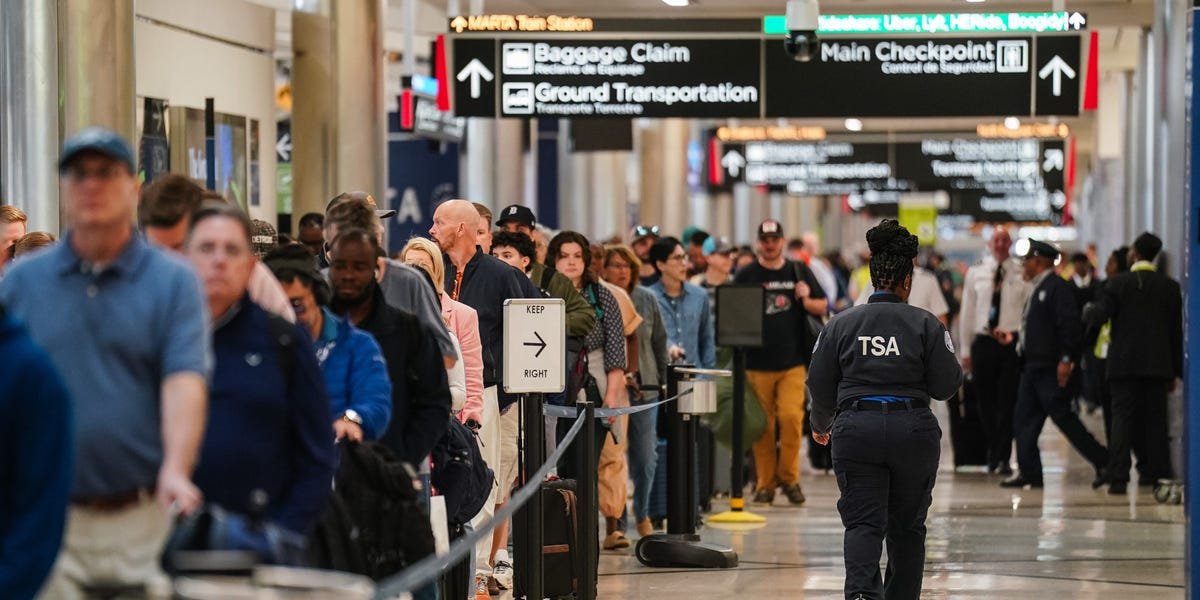
Trump’s comments come as travel chaos intensifies across major national travel hubs. TSA workers are set to miss another paycheck by Friday morning and have begun to call out sick en masse, creating a severe staffing shortage, which is leading to many hours in wait time at TSA checkpoints.
Delta Air Lines suspended travel perks for Congress members and their staff that usually speed up their security checks, citing the government shutdown.
The White House did not immediately respond to a request for comment.
This is a developing story. Check back for updates.
This story is available exclusively to Business Insider
subscribers. Become an Insider
and start reading now. Have an account? .
President Donald Trump said the US has destroyed military targets on Kharg Island.
The island, located off the coast of Iran, is central to the country’s oil empire.
Trump said the strikes did not damage the island’s oil infrastructure.
President Donald Trump said late Friday that the US had “totally obliterated” military targets on Kharg Island, an island off the coast of Iran that is central to its oil empire.
“Moments ago, at my direction, the United States Central Command executed one of the most powerful bombing raids in the History of the Middle East, and totally obliterated every MILITARY target in Iran’s crown jewel, Kharg Island,” Trump wrote.
“Our Weapons are the most powerful and sophisticated that the World has ever known but, for reasons of decency, I have chosen NOT to wipe out the Oil Infrastructure on the Island,” he added.
“However, should Iran, or anyone else, do anything to interfere with the Free and Safe Passage of Ships through the Strait of Hormuz, I will immediately reconsider this decision,” Trump continued. “Iran has NO ability to defend anything that we want to attack — There is nothing they can do about it!”
Representatives for CENTCOM and the White House did not immediately respond to requests for comment from Business Insider.
What is Kharg Island?
Kharg Island is a small island in the Persian Gulf, located roughly 300 miles from the Strait of Hormuz, which is known for its significance to Iran’s oil production.
Refineries on the island process nearly all of the nation’s oil exports. Disruption to the facilities there could have a significant impact on the global oil shortage, further driving up costs.
This is a developing story. Please check back for updates.
US trade groups are pressing President Donald Trump and his administration to quickly pay tariff refunds to small businesses.
In a joint press release, the Consumer Technology Association and the US Chamber of Commerce said they had filed a brief on Wednesday in V.O.S. Selections, Inc. v. Trump, a lawsuit by small businesses seeking refunds from Trump’s sweeping tariffs.
“The brief argues that an efficient, orderly process to deliver refunds is in the best interest of all parties — the Administration, the courts, and American businesses,” the press release wrote.
“On behalf of the hundreds of thousands of businesses, especially small businesses, that are now owed refunds, the Chamber and CTA are asking the court to establish an efficient, orderly process to deliver refundsen masse,” Neil Bradley, the Chamber’s executive vice president, said in the release.
He added that the trade organizations were concerned that other parties might try to benefit from the refund process, and “the last thing our system needs is for the trial bar to be profiting off refunds owed to small businesses.”
“While this matters for every American company, refunds are existential for the many smaller businesses and startups who shouldered the tariff burden,” Ed Brzytwa, CTA’s vice president of international affairs, said in the release.
The trade groups’ filing comes after the Supreme Court ruled, in a 6-3 decision in February, that Trump’s tariffs were illegal and that his justification for invoking the International Emergency Economic Powers Act was invalid.
And on Wednesday, Judge Richard K. Eaton of the US Court of International Trade ruled that US businesses that were subjected to tariffs are “entitled to the benefit” of the Supreme Court ruling.
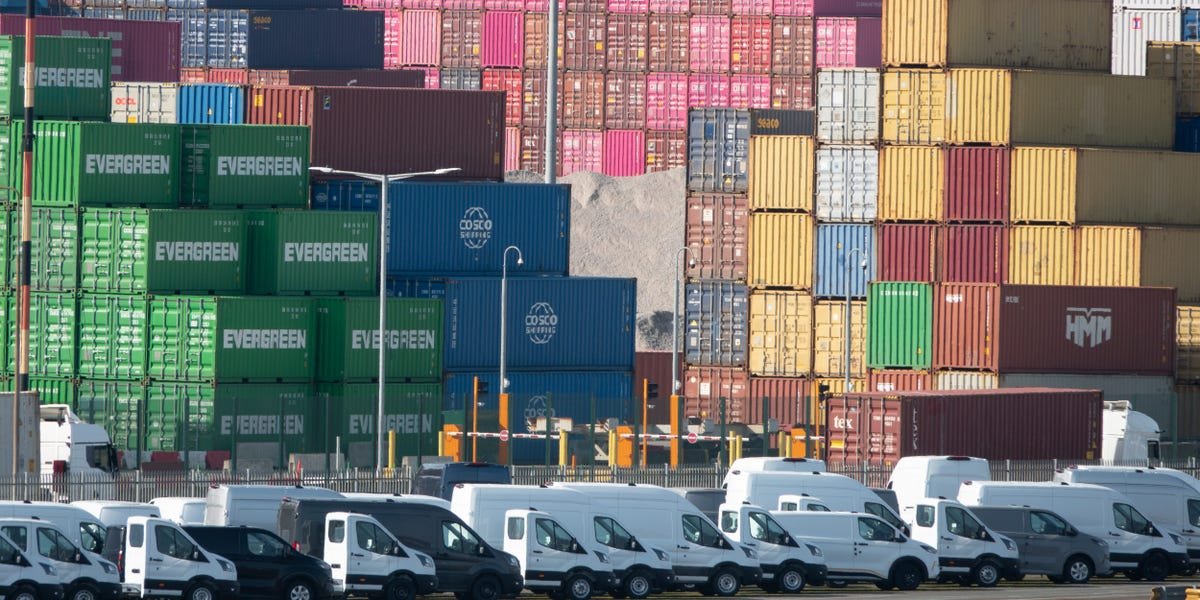
Even before Eaton’s ruling, companies had started demanding refunds. Major companies like Costco, Toyota, BYD, and FedEx filed lawsuits against the administration, seeking billions of dollars in tariff duties since they were imposed last April.
Representatives for the Trump administration did not respond to a request for comment from Business Insider.
This story is available exclusively to Business Insider
subscribers. Become an Insider
and start reading now. Have an account? .
A Supreme Court ruling recently struck down President Donald Trump’s IEEPA tariffs.
A federal judge on Wednesday said companies are entitled to benefit from that ruling.
US Customs must recalculate duties on imports, disregarding Trump’s IEEPA tariffs, per court order.
A federal trade judge on Wednesday cleared the path for refunds on President Donald Trump’s tariffs, applied through the International Emergency Economic Powers Act, after the Supreme Court recently struck them down.
In the ruling, Judge Richard K. Eaton of the US Court of International Trade said that US importers who were subject to those tariffs are “entitled to the benefit” of the Supreme Court ruling.
Eaton also ordered the US Customs and Border Protection — the agency responsible for collecting import duties — to “liquidate” import entries without regard to the tariffs Trump imposed through the IEEPA, a national emergency law that gives a president broad authority to regulate economic transactions.
The judge is essentially ordering the government agency to calculate the final bill for certain shipments entering the US as if the IEEPA tariffs never applied. Any accounting on goods that have already been calculated, or “liquidated,” but are not legally final, needs to be redone without the duties, the judge ordered.
Importers generally have 180 days after goods are liquidated before the accounting is legally finalized.
The move is another blow to the Trump administration, which sought to raise government revenue through taxes on imports. Trump applied double-digit tariffs through an executive order on nearly every country in April 2025, calling it “Liberation Day.”
On February 20, the Supreme Court struck down, in a 6-3 ruling, Trump’s IEEPA duties, stating that the national emergency law does not give the president the ability to unilaterally impose tariffs. The ruling made no explicit mention of refunds.
In the Wednesday order, Eaton indicated he will serve as the sole judge overseeing cases involving refunds of IEEPA duties.
The exact dollar figure for refunds remains unclear. The Penn Wharton Budget Model estimates that the tariff reversals could generate up to $175 billion in refunds.
Spokespeople for the White House and CBP did not immediately return a request for comment.
President Donald Trump said on Monday that wars “could be fought ‘forever,’ and very successfully” solely with munitions stockpiles, as the US engages in major combat operations against Iran.
In a late-night Truth Social post, Trump praised the US’ supply quantities of “medium and upper medium grade” weapons. It’s not immediately clear exactly which munitions or weapons he was referring to.
“As was stated to me today, we have a virtually unlimited supply of these weapons. Wars can be fought ‘forever,’ and very successfully, using just these supplies (which are better than other countries finest arms!),” he added.
His comments come amid global uncertainty over how long the US and Israel’s war with Iran will last.
Earlier on Monday, Trump told reporters that the campaign could last four to five weeks, but that the White House was prepared “to go far longer than that.”
Every time Matthew publishes a story, you’ll get an alert straight to your inbox!
Stay connected to Matthew and get more of their work as it publishes.
Washington and Tel Aviv pummeled Iran with hundreds of strikes on Saturday, killing Iranian Supreme Leader Ayatollah Ali Khamenei in the first wave of attacks.
Iran and its allies have responded by launching ballistic missiles, rockets, and drones at Israel and Gulf nations known to host US military bases. The fighting has plunged residential and tourist areas into chaos, disrupted hundreds of flights, and sent oil prices spiking.
In his Truth Social post, Trump admitted that weapons stockpile quantities are “not where we want to be.”
“Much additional high grade weaponry is stored for us in outlying countries,” he added. It’s unclear if the president was implying that the war with Iran may require munitions from other theaters.
The White House did not respond to a request for comment sent outside regular business hours by Business Insider.
The strike campaign on Iran has raised questions in some circles about remaining US stockpiles of long-range munitions, such as the Tomahawk cruise missile. There are fears that the Pentagon may need these weapons to deter a potential conflict with other adversaries, chiefly China.
US officials said they had used a wide variety of munitions, including drones, offensive missiles, and interceptors, against Iran.
In 1987, when Donald Trump was first flirting with running for president, he told an audience in New Hampshire that the United States should attack the “horrible, horrible country” of Iran, “and take over some of their oil.” In the years since, Trump talked about grabbing control of the natural resources of Venezuela, Iraq, Syria, Kuwait, and Libya, too.
For a long time — including during Trump’s first term — this smash-and-grab idea to corner the global energy supply was treated as something of a joke by outside analysts and political opponents. In this second administration, a version of it has become a building block of American power projection, both at home and abroad.
That policy is one of the reasons why the US captured Venezuela’s president. It’s the same reason why this White House now feels like it can choke Cuba so hard that Havana might cough up its leaders. And it’s why the Trump administration was bragging in the run-up to this past weekend’s massive American-Israeli assault on Iran that it could do so without upending the global economy.
The policy hasn’t received much attention, though it’s been hiding in something like plain sight. It goes by an almost comically-macho name, “energy dominance.” To vastly oversimplify, the plan boils down to three steps: maximize America’s share of the world’s energy supply, especially its fossil fuels; leverage the hell out of ’em; and then make rivals both foreign and domestic bend the knee.
Or, as President Trump put it in a speech he gave in Corpus Christi, Texas the day before he ordered this new attack on Iran, he’s “cementing America’s status as the number one energy superpower by far anywhere on earth.” The offensive includes strikes on a hospital and on a girls’ elementary school that left at least 60 dead, and possibly as many as 115, The New York Times reported.
Previous presidents from both parties encouraged more and more and more drilling, all in the name of weaning America off others’ fossil fuels. Now the US produces so much gas and oil — more oil than Russia and Saudi Arabia combined, according to the Energy Department — that it can turn that dynamic on its head. American-controlled fossil fuels can be used to try to push other countries into compliance with our petrostate.
American-controlled fossil fuels can now be used to try to push other countries into compliance with our petrostate.
“Our oil, our gas, our minerals, our coal,” Rich Goldberg, who last year helped set up the administration’s National Energy Dominance Council (NEDC), tells me. “If you can unlock those assets, that’s trillions of dollars and an incredible amount of power projection and leverage over our adversaries.”
Take Iran. Before the president ordered the bombing of Tehran’s nuclear facilities last year, he got a little jumpy. Iran had repeatedly threatened the global energy market, with its mines and drones and fast-moving attack boats stationed around the strategically-located Strait of Hormuz. “EVERYONE, KEEP OIL PRICES DOWN,” he posted on his social media site. “DRILL, BABY, DRILL!!! And I mean NOW!!!”
Trump’s advisers told him not to worry. The US and its allies now controlled so much of the world’s oil, Iran couldn’t make that much of an impact. Sure enough, crude didn’t rise too high for too long, peaking at $79 per barrel before settling back down to $66 two days later. In part, that was because of all of that cheap American and allied crude on the market. Energy Secretary Chris Wright later chalked it up as “perfect evidence of Trump’s energy dominance agenda, you know, growing production in the United States” — and a sign that the US could keep on attacking Iran with minimal economic blowback.
“It’s not going to change the price of the pump, because guess what? The US, we don’t get any oil anymore out of the Strait of Hormuz,” Secretary of the Interior Doug Burgum, considered one of the administration’s leading voices on energy, said last fall. “We didn’t have to worry about it. Other people in the world did. And this is the degrees of freedom and power that you have.” (We’ll see how long the optimism holds this time; almost all energy analysts are predicting a short-term bump in prices, with some foreseeing a jump to $100 per barrel.)
Then there’s Venezuela. When American forces grabbed Caracas’ dictator Nicolas Maduro in early January, Trump declared that the US was going to “run the country.” He wanted to do it by controlling Venezuela’s oil: where it flowed, and who profited from it. Wright and other US officials locked arms with Maduro’s business-friendly deputy, Delcy Rodríguez, rather than Edmundo González, the opposition leader the US recognized as the president-elect after the 2024 vote.
“CO2 was never a pollutant,” US Secretary of the Interior Doug Burgum said earlier this month.
ANNABELLE GORDON / AFP via Getty Images
Caracas’ oil was immediately cut off to what had previously been Venezuela’s closest ally, the communist government in Cuba. That deepened an economic crisis so severe that talk of another regime change in Latin America is now in the air. “If I lived in Havana, and I was in the government,” Secretary of State Marco Rubio said in January, “I’d be concerned.”
Oil isn’t the only explanation for Trump’s increasingly belligerent actions across the globe, though it explains a lot, as I noted in an essay for The New York Timesa few months back. “Since day one, President Trump has been unleashing American energy dominance to ensure the United States is not reliant on geopolitics and tensions around the world. This has resulted in record-high oil and gas production as well as stabilized oil prices,” Taylor Rogers, a White House spokeswoman, says in an email.
This drive towards energy dominance shows few signs of slowing down. Venezuela is one of 12 members of OPEC, the global oil cartel which has held sway over world’s energy prices for decades. One top analyst, David Doherty of Bloomberg New Energy Finance, laid out a scenario for me in which Trump leverages Venezuela to gain backdoor control of — or at least serious influence over — OPEC, which accounts for about half of all of the oil on the international market. Trump may already have some of that leverage. Immediately after the new round of attacks on Iran, the OPEC countries agreed to open their spigots a bit, a move that traditionally helps cool prices. Russia, Iran’s traditional ally, even agreed to up production by 62,000 barrels per day. “That’s like the ultimate energy dominance, right?” Doherty says. “Because it’s not just America’s energy anymore. It’s the world’s.”
But that dominance is not total, and the Trumpists see China as the biggest threat to it. Beijing’s solar, wind, and battery tech has become so efficient and cheap that it’s undercutting the appeal of US-controlled fossil fuels. What makes it all so galling, the Trump team says, is that the Chinese are doing so while dressing themselves as global good guys, working to stave off a planet-wide climate emergency. Beijing is now at the center of international climate talks, even as it continues to be the world’s polluter-in-chief. China exported more than $222 billion in cleantech last year. Its carmakers exported 2.6 million electric vehicles, worth more than $70 billion. US automakers sold about half of that — at home and abroad.
Goldberg, now with the Washington-based Foundation for the Defense of Democracies, calls Beijing’s play a “psyop” — a way for China to appear like a savior, all while connecting the world’s grid to its unreliable and possibly hackable equipment. “You couldn’t invent a better way to defeat the United States.”
If it’s a psyop, it’s a strange one, because the Chinese are simultaneously pulling it on themselves. While China continues to build coal plants — as much as 95% of the world’s new coal construction is happening there — renewable power is coming online in China even more quickly. China’s emissions have been flat or falling for the last 21 months straight. Bloomberg New Energy Finance expects solar to make up more than 30% of China’s power generation by 2030.
These are the kinds of changes Burgum used to celebrate, back when he was governor of North Dakota. In 2020, he boasted that more than a quarter of the state’s power was coming from wind; in 2021, he pledged his state would be “carbon-neutral” by the end of the decade.
These days, Burgum makes fun of people who worry about carbon dioxide as a greenhouse gas. “CO2 was never a pollutant. When we breathe, we emit CO2. Plants need CO2 to survive and grow. They thrive with more CO2,” he told Fox Business in February.
Burgum was the keynote speaker at a Foundation for the Defense of Democracies event in Washington the day after his Fox appearance celebrating the one-year anniversary of the National Energy Dominance Council. He was giddy about another event happening across town: Trump and his Environmental Protection Agency chief, Lee Zeldin, announcing the end of the EPA’s so-called “endangerment finding,” which declared greenhouse gases like carbon dioxide to be a public health threat, and formed the bedrock of two decades of climate regulation.
President Donald Trump signs an executive order directing the military to purchase electricity from coal-fired power plants during a “Champion of Coal” event at the White House in February.
SAUL LOEB / AFP via Getty Images
“Imagine if you could use AI to build the world’s largest house of cards, and then the president and Lee Zeldin both have one little finger, and they go like this today,” Burgum said, making a flicking motion.
Now, Burgum added, the National Energy Dominance Council would be freer than ever to do its work — cutting deals to further expand America’s oil and gas exports, sawing through the regulatory crust keeping the United States from building out its energy and power infrastructure. In January, for instance, the council announced an agreement to add $15 billion in power-generation projects to the mid-Atlantic grid.
Brittany Kelm, a former Shell and Valero Energy staffer now with the NEDC, said on a podcast last summer that the council acts as a “concierge, white-glove service” for energy companies looking to overcome the bureaucratic inertia that can overtake large-scale developments. Like the massive, 800-mile Alaska natural gas pipeline, stuck in planning and permitting limbo for decades, that’s now on track to be built before the end of Trump’s term, and will eventually supply 3.5 billion cubic feet of natural gas per day. I talked to a solar energy supplier’s rep who had good things to say about the NEDC, despite the administration’s overall hostility towards renewables.
“We’re not here to talk,” NEDC executive director Jarrod Agen, said at the Foundation for the Defense of Democracies event in Washington. “We are here to get deals done.”
Energy dominance is a blueprint for rewiring the American economy for the age of AI before China can do the same.
And they have to be done in a hurry, the Trumpists insist, because energy dominance is more than simply an instrument of geopolitical leverage. It’s a blueprint for rewiring the American economy for the age of AI before China can do the same. AI data centers require massive amounts of power, and the only way to reliably supply it at the scale required, the administration has claimed, is with fossil fuels. Wind and solar power are too susceptible to the elements.
“We can take Pennsylvania natural resources like gas, turn it to electricity, turn it to intelligence, and that intelligence lifts every single industry, not just one industry, not just the company that owns the data center,” Burgum told a gathering of AI and energy executives in Pittsburghlast July.
Big Tech is only kinda-sorta on board with that vision. These companies are plowing an unimaginable pile of cash into data centers and have jumped on the Trump administration’s narrative of an energy competition with the People’s Republic of China with both feet. In a late October letter to the White House, for example, OpenAI’s chief global affairs officer Chris Lehane warned of a widening “‘electron gap’ with the PRC” that could jeopardize the “greatest national economic opportunity since electricity drove the latter half of the Industrial Age.”
The fossil-fuels-or-bust part — that’s where the AI giants hop off. Renewables are just too cheap to pass up, even if they can’t operate 24/7/365. Natural gas plants take too long to build, with wait times of up to seven years for the turbines required. New nuclear operations take even longer. That’s why OpenAI is investing in both “natural gas and solar projects,” Lehane wrote. In February, Google signed up for another gigawatt of solar capacity in Texas. Microsoft just announced that it identifies renewable sources for all of its electricity consumption worldwide. According to Trump administration statistics, 93% of all utility-scale electrical generation in this country will come from renewables this year. Wind, hydropower, and solar already account for 27% of data centers’ global energy supply, according to the International Energy Agency. Such power sources will continue to grow, the agency predicts, as will a resurgent nuclear industry.
The Trump administration’s reactions to this trend towards renewables have been, for the most part, predictably hostile. At a February meeting in Paris, Wright gave an ultimatum to the International Energy Agency, which has provided authoritative data and policy guidance for a half-century. Either the agency stops focusing on “climate stuff,” or the United States quits, Wright demanded. Months earlier, the Trump administration was reportedly accused of threatening Asian and Caribbean diplomats as part of its successful campaign to torpedo a 100-nation agreement curbing emissions from cargo ships.
In fact, the demands to comply with Trump’s energy dominance agenda started before he took office. “I told the European Union that they must make up their tremendous deficit with the United States by the large scale purchase of our oil and gas. Otherwise, it is TARIFFS all the way!!!” he posted in December 2024. Washington has since elbowed out Moscow as Europe’s leading natural gas supplier.
The production site of Offshore Oil Engineering in China. Beijing is now at the center of international climate talks, even as it continues to be the world’s polluter-in-chief.
Costfoto/NurPhoto via Getty Images
Foreign allies weren’t the only ones getting the Biff Tannen treatment. In December,the Trump administration froze work on a wind farm off Long Island, until New York Gov. Kathy Hochul OKed a local natural gas pipeline. Burgum then announced the Trump administration was blocking it again, this time for “national security” reasons. The rationale was never quite spelled out. The NEDC team is looking to revive a second pipeline project, this one connecting New York to Pennsylvania’s gas country. New York and other northeastern states get too much of their gas from “foreign sources,” the NEDC’s Agen says, and by foreign, he means Canada. “You could make a national security case” that dependency presents a serious risk to the region, he adds.
“If that’s your policy priority, to build natural gas pipelines in this country so that we can deliver low-cost natural gas to all parts of the country as needed — and you have a blue state government that stands in the way — now you have to find ways to pressure the blue state governor,” says Goldberg. As the NEDC cleared the way for more fossil fuel projects, Burgum had been holding up federal approvals on hundreds of solar and wind farms that are designed to power millions and millions of homes.
Burgum claims this combination of AI-driven demand and politically-constricted supply hasn’t hurt consumers one bit. “No one’s electric bill has gone up because of a data center. It’s gone up because of the climate fantasy versus the energy reality,” he told Fox News. A recent Bloomberg analysis concluded the opposite: Electricity costs in areas near major data centers are up as much as 267% over the last five years.
Trump bragged during the State of the Union about forcing the “ratepayer protection pledge” he’s forcing tech firms into accepting, one that pushes the companies to “provide for their own power needs.” On the same day, the White House said that it had “jumpstarted the US nuclear sector,” to provide “clean, reliable baseload power.” Greenwire then reported that Burgum is beginning to review six of the “utility-scale” solar projects that the Interior Department previously held up. MAGA figures like Elon Musk and former White House official Katie Miller are touting solar as the cost-effective energy of the future. Meanwhile, there’s an effort underway to, shall we say, reinterpret the president’s previous blanket hostility towards renewables. Because the vision of energy dominance that centers around fossil fuels is colliding with the reality of spiking prices.
Despite the administration’s strongarming, and despite the favors Team Trump is doing for Big Oil, the economics of US fossil fuel production are unlikely to change, not in a way that’s transformative enough for the AI future. Prices are too low to make new oil drilling worth it. While America’s natural gas supply is increasing, according to the Energy Department, the amount of crude produced in the United States is slated to go down over the next few years. Coal is cratering much, much faster. Trump may have “thought that if he gave the industry everything they’d been asking for, then “new supply would pretty quickly follow, along with lower prices,” says Clay Siegle, a long-time energy market analyst now with the Center for Strategic and International Studies,” That one was never really in the cards… because it’s not really policy that sets us oil supply. It’s Wall Street and the capital markets.”
The impact of the Trump administration’s energy policies on the economy could take years to unwind, says Democratic Rep. Sean Casten, who spent decades in the sector before going to Congress. “It’s hugely slowing down people’s willingness to invest in the United States,” he adds. “Even if Trump was gone tomorrow, if you’re [the energy company] Orsted, and you went through all these headaches with the offshore wind operations — billions of dollars of investments in the US and thousands of jobs — why would you do that again?”
Burgum, who spent decades in business himself, is surely aware of at least some of this. Which makes some analysts wonder whether he is just doing this to please his boss, who has publicly expressed his opinion that windmills are “killing all your birds,” causing “cancer,” and ruining the views from his golf course in Scotland. Some outside experts wonder whether this whole energy dominance thing isn’t just a collection of Trump impulses: the kooky windmill conspiracies; the promotion of “clean, beautiful coal”; the attempts to undermine electric cars; the very understandable desire to hold down gas prices; the longtime impulse to seize other countries’ oil. “It’s pandering to the president. That’s clearly it,” says Ed Hirs, the Houston-based energy economist.
Perhaps so. But at a time when the Trump administration is openly contemplating decapitating more governments, pushing one-time allies towards America’s biggest rival, sabotaging projects that could supply power to millions, and upping the chances of a climate catastrophe — all in the name of energy dominance — maybe it doesn’t matter how coherent the theory of the case is. Maybe all that matters is how dangerous it’s proving to be.
“I’ve got a lot of things going on now. We have a big decision to make,” Trump said in Corpus Christi, the day before the attacks that have killed hundreds of Iranians, including the top tier of their political leadership. “I’d rather do it the peaceful way, but they’re very difficult people. I want to tell you that. They’re very dangerous people.”
In front of Trump were a pair of placards. They read: “America’s energy dominance.”
Noah Shachtman is a contributing editor at WIRED and a veteran reporter on global security issues. He previously served as the editor-in-chief of Rolling Stone and The Daily Beast.
Business Insider’s Discourse stories provide perspectives on the day’s most pressing issues, informed by analysis, reporting, and expertise.
Did Netflix walk away from Warner Bros. Discovery because of money? Or because of politics?
Money, says Netflix boss Ted Sarandos. Just money.
Sarandos, the streamer’s co-CEO, says Netflix pulled out of the WBD bidding war — ultimately won by Larry and David Ellison’s Paramount — because Netflix didn’t want to raise the price it would pay for WBD’s studio and HBO business.
The fact that the proposed Netflix/WBD deal was getting pushback from Republicans in Washington — and other regulators in the US and around the world — was not an issue, Sarandos said in an interview this weekend.
“I still believe in all the positives. I just believed in them up to $27.75 a share,” Sarandos told Bloomberg, referring to the price Netflix originally agreed to pay for WBD’s studio business and HBO unit in December.
I don’t know that Sarandos’ argument will entirely sway those who think the Ellisons’ attempts to court President Donald Trump and other Republicans had an impact on Netflix’s calculus. David Ellison, for example, attended last week’s State of the Union address as the guest of Trump ally Sen. Lindsay Graham.
Adding fuel to those theories: Netflix announced that it was withdrawing from the WBD auction shortly after Sarandos visited the White House on Thursday. But Sarandos says nothing in that meeting had anything to do with his decision. “It was a very productive meeting, nothing out of the ordinary,” he said.
Instead, Sarandos said, Netflix had already decided to bow out earlier that day, as soon as WBD told the company that Paramount’s most recent bid was a “superior proposal.” Just about everyone in the media world expected Netflix to counter that offer with a new one of their own.
But asked repeatedly about what role Trump and any other politician had in his decision, Sarandos insisted that the answer was zero.
“Things have been going exactly the way they should,” he said, arguing that “the president stayed completely neutral on this.”
This is also what Sarandos had said for the last few weeks, when asked if politics and/or Trump’s preferences would influence the deal. That made sense at the time — why complain about politics at the same time you’re trying to woo politicians?
And it may continue to make sense, given that Netflix may end up back in Washington in the future, asking for a sign-off on a different deal. (Sarandos did say it was “unlikely” he would try to buy something else in the next year or so.)
But what about Trump’s interest in the fate of CNN, which is currently owned by WBD, and which will become part of Paramount, assuming the deal closes? Trump had previously announced that it was “imperative that CNN be sold”.
Follow that idea to its logical conclusion, and it would mean that Trump would favor the Paramount bid, since it was for all of WBD, including CNN. The Netflix bid didn’t include the news network or WBD’s other basic cable channels.
“Once it was clear that we weren’t in the CNN business, it was a lot less interesting. He didn’t care that much more about our deal,” Sarandos said.
I wanted to make sure I understood what Sarandos was saying: Was it that once Trump realized Netflix didn’t want to buy CNN, he didn’t support Netflix buying any part of WBD? Or was it that once Trump realized Netflix didn’t want to buy CNN, he became less interested in its outcome, period?