Ciesla, a budding content creator, has gained over 129,000 TikTok followers and 190,000 Instagram followers who have watched her create this library. One of her most viral videos about the space has 7.8 million views.
Those viewers will be happy to know she plans to keep going. Ciesla hopes to add a porch, a decorated walkway outside, and landscaping.
In the meantime, though, she’s enjoying every second she gets to spend inside.
“As a mom and someone who has a loud brain that never really turns off, it’s so grounding to have a little escape from reality where I can do something I genuinely love,” Ciesla said.
“It’s honestly not just about the books,” she added. “It’s about having a space where I can reconnect with myself and breathe. Every person deserves to have a place like that.”
Nike CEO Elliott Hill inherited an uphill battle when he took over at the sports giant in October 2024.
Since then, Hill has made changes — both big and small — to the company as part of its turnaround strategy. After retiring from Nike in 2020, the former president of consumer and marketplace returned to guide the company amid declining sales, sluggish growth, and increased pressure from upstart rivals.
During the quarter preceding Hill’s start, Nike’s revenue declined 10% year over year to $11.6 billion, following flat growth in the 2024 fiscal year. Nike shares jumped about 8% on the day Hill’s appointment was announced in September.
The Nike veteran didn’t waste time launching his strategy when he took the helm, reevaluating the existing practices and adjusting them as needed.
“We lost our obsession with sport,” Hill said on a December 2024 earnings call. “Moving forward, we will lead with sport and put the athlete at the center of every decision.”
Every time Jordan publishes a story, you’ll get an alert straight to your inbox!
Stay connected to Jordan and get more of their work as it publishes.
Last week, during the company’s most recent quarter, Hill told investors that the comeback “won’t be a straight line.”
Here’s what Hill has been up to in 2025.
Hill kick-started his turnaround plan
Nike’s “win now” strategy — Hill described it on last week’s earnings call as Nike’s “immediate response to our biggest challenges and opportunities” — focuses on five key areas: culture, product, marketing, marketplace, and in-person presence.
The plan leans on a sports-driven reset that has “realigned” about 8,000 employees around its core sports categories, the company said. Those categories include running, basketball, football, and training, as well as sportswear.
The idea is to put the athlete “at the center of everything that we do,” Hill said in a March earnings call.
The running category is leading the effort and reflects the direction Hill is steering the company. Nike said its running business grew by more than 20% last quarter, which ended in November, marking the second consecutive period of comparable growth.
Nike’s senior leadership team got a revamp
Hill shook up Nike’s leadership this year.
In May, he restructured its consumer, product, and brand leadership to focus on three areas: consumer and sport, marketing, and product creation. As part of that overhaul, Nike’s former president of consumer, product, and brand retired, and Hill promoted four other Nike insiders to senior roles reporting to him: president of Nike (Amy Montagne), chief innovation, design, and product officer (Phil McCartney), chief marketing officer (Nicole Graham), and chief growth initiatives officer (Tom Clarke).
Hill also hired a new communications chief this year, Michael Gonda.
And he made another round of changes in December, eliminating the roles of chief technology officer and chief commercial officer. At the same time, Nike established the role of chief operating officer, which reports to Hill. The new job’s function is to “integrate technology more seamlessly into our sport offense,” Hill said in a note to employees that Nike released publicly. Venkatesh Alagirisamy, a 20-year veteran of Nike, transitioned into the role on December 8.
As part of the shake-up, general managers in all regions now report directly to Hill.
“It’s clear how important it is to stay closely connected to what’s happening on the ground, from intern to CEO, and every role I’ve held in between, I’ve felt that way,” Hill said on last week’s earnings call.
He began mending relationships with wholesale partners
Hill said Nike’s ties with wholesalers such as Foot Locker and Dick’s Sporting Goods had frayed amid its aggressive shift toward direct-to-consumer sales.
Since Hill’s return, he said he’s been mending those relationships. For example, Nike is back on Amazon and has struck partnerships with smaller retailers, such as Urban Outfitters and Aritzia.
Nike’s wholesale revenues increased 8% year over year to $7.5 billion during its most recent quarter, which ended November 30.
Hill pulled back on promotions and raised prices
Hill said that Nike would strive to provide a more “elevated” experience for consumers, speaking in a January interview with Fortune. He said Nike had become “too promotional” on its own site.
“Being premium also means full price,” Hill told Fortune. “We’ll focus on promotions during traditional retail moments, not at the consistent levels we are today.”
He said in March that Nike Digital, which includes its website and app,ran zero promotions in North America in January and February, down from over 30 during the same months in 2024. The cutback on promotions came alongside “surgical” price increases Nike made to mitigate tariffs in 2025.
He gave the House of Innovation concept store a makeover
The House of Innovation is Nike’s six-floor flagship store.
Jordan Hart/Business Insider
Nike’s 68,000-square-foot House of Innovation is the blueprint for its stores. It’s a six-story flagship store that opened in 2018, showcasing the company’s most advanced products. The first floor is dedicated to running, and the rest of the sprawling store is organized by sport, gender, and age.
Hill has frequently pointed to the revamped store in his first year as a model for Nike’s move to sports-driven retail layouts.
“It’s an immersive sport experience, and the refresh has already led to double-digit revenue increases,” Hill told investors in September.
Nike did not respond to a request for comment from Business Insider.
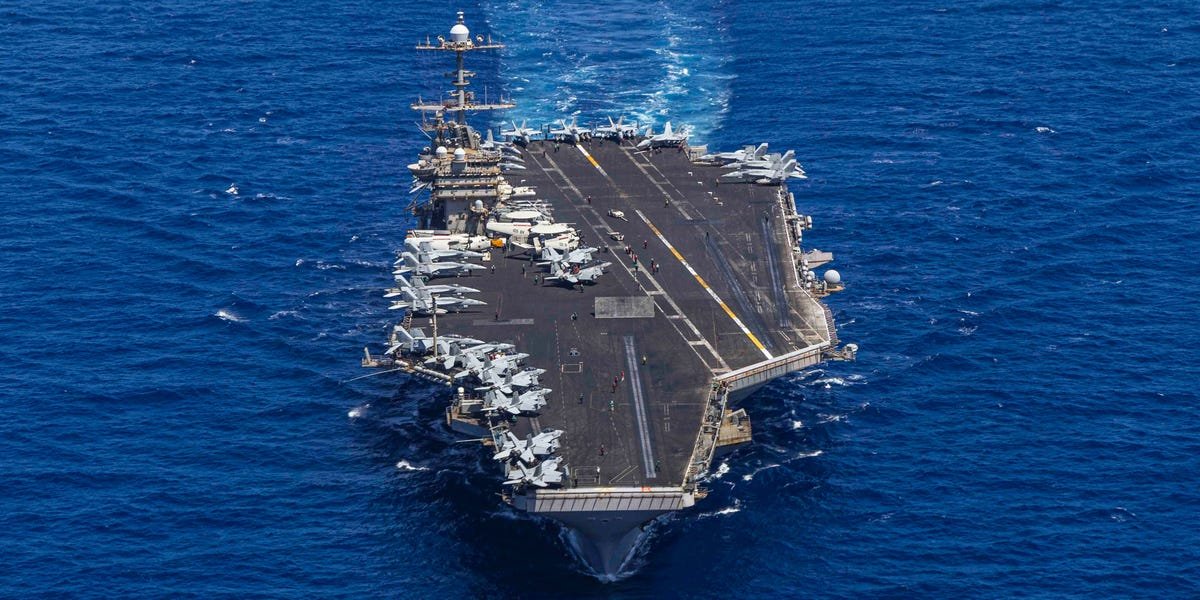
A US Navy aircraft carrier’s hard evasive turn to avoid enemy missile fire caught crewmembers off guard and sent a $60 million F/A-18 Super Hornet rolling off the deck and into the Red Sea, an investigation into the fighter jet loss revealed.
The fighter’s brakes weren’t functioning properly, investigators found, allowing the jet to slide across the deck when the carrier USS Harry S. Truman abruptly changed course during the late April action.
Poor communication, bad brakes, and a slippery surface all contributed to the loss.
A tow tractor also fell into the water alongside the expensive F/A-18 fighter jet, the second of three that the Truman lost during a monthslong Middle East combat deployment. When it went over, it nearly took sailors overboard as well.
Evading enemy fire
During their deployment, the Truman and its strike group led Navy combat operations against the Houthis, the heavily armed Iran-backed rebel group in Yemen that spent more than a year attacking key Middle East shipping lanes.
An F/A-18 fell overboard the Truman while the carrier took a hard turn.
US Navy Photo by Mass Communication Specialist 3rd Class Abbigail Beardsley
On April 28, the move crew lost control of an F/A-18 under tow in the Truman’s hangar bay, a maintenance area below the flight deck, the Navy reported at the time, and both the jet and its tow tractor tumbled into the Red Sea.
Right before it fell in, a sailor jumped from the cockpit, suffering minor injuries. The Navy didn’t share information or insight into the warship’s situation at the time of the plane loss.
According to the command investigation, the fighter jet and the tractor fell overboard while the Truman was conducting evasive maneuvers to avoid an incoming medium-range ballistic missile fired by the Houthis, a detail that had been reported but not confirmed at the time.
The move crew, which was preparing the F/A-18 from Strike Fighter Squadron 136 (VFA-136), the “Knighthawks,” for planned flight operations, didn’t hear the announcement that the ship was making a hard turn and was caught unaware when the ship began to tilt.
Sailors had removed the chocks and chains to pull the F/A-18 into the hangar bay. With the brakes engaged but not actually working, there was nothing to hold the aircraft in place when the carrier heeled in an evasive turn.
The hangar bay is an area underneath the flight deck where aircraft receive maintenance.
US Navy photo
It slid backward toward the deck edge, dragging the tow tractor behind it. The crew moving the Super Hornet abandoned their posts just before the fighter jet fell into the sea.
Bad brakes
The command investigation put the blame for the incident primarily on the fighter jet’s inadequate brake engagement and the lack of communication from the Truman’s bridge to flight deck control and the hangar bay.
Leadership also said that the non-skid, a rough, high-friction coating applied to the decks of Navy ships to keep people, vehicles, and aircraft from slipping on smooth steel surfaces, was ineffective, having not been replaced since 2018.
These problems, the investigation said, cost the Navy an F/A-18, a multirole fighter made by the US aerospace giant Boeing that has been in service with the Navy for decades.
The April incident was one of four major mishaps that the Truman and its strike group suffered during their deployment.
In December, the cruiser USS Gettysburg accidentally shot down one of the Truman’s F/A-18s in what the military described as a friendly fire incident. In February, the carrier collided with a cargo ship. And in May, the ship lost its third fighter jet after a landing failure caused it to slide off the flight deck and plunge into the sea.