
War-walkouts-and-200-fuel-are-turning-flying-into-a.jpeg

War, walkouts, and $200 fuel are turning flying into a grind

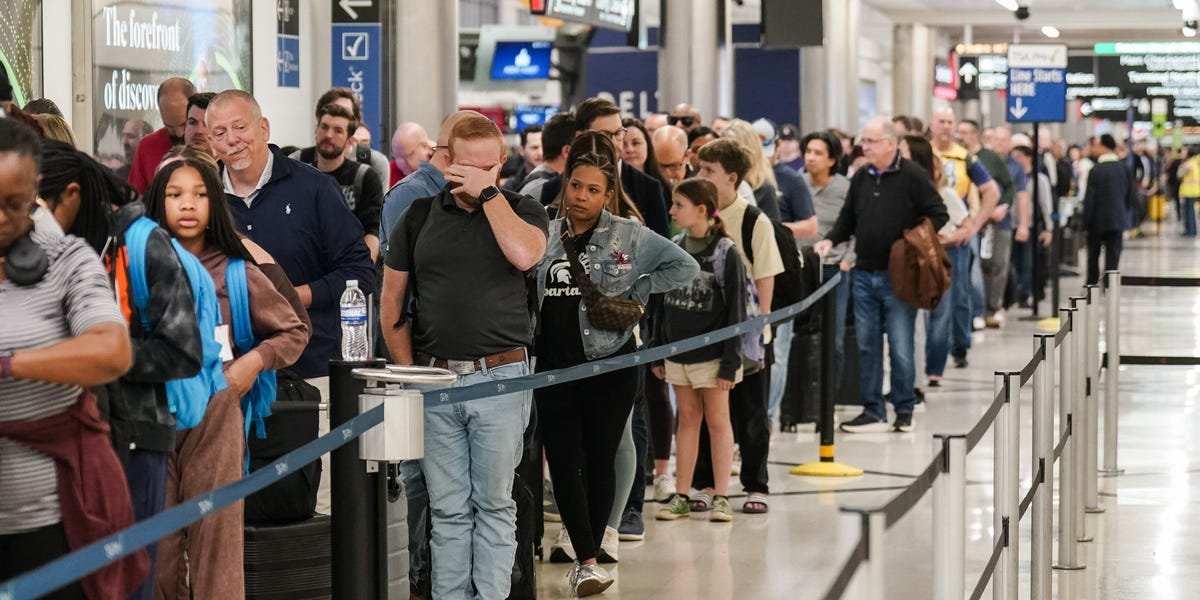
Jetsetting has gotten less glamorous — and that’s not expected to change even as President Donald Trump reinstates pay for Transportation Security Administration workers.

Trump on Friday directed Homeland Security to start paying TSA workers after Congress failed to agree on a path to end the partial government shutdown and fund the Department of Homeland Security.

The DHS said its agents could start seeing paychecks again as soon as Monday, but if you thought that would mean shorter airport security lines, you might want to pack a snack.

The airline industry is facing an assembly of problems — war, rising costs, staffing shortages, to name a few — that are making flying more expensive and stressful.

Staffing Shortages

The funding lapse had forced TSA officers, who make a starting salary of about $40,000 and often live paycheck to paycheck, to go without wages for weeks. Hundreds of them quit.

Even with the promise of full paychecks to come soon, the TSA will need to address this staffing shortfall.

Ha Nguyen McNeill, the agency’s deputy administrator, said almost 500 officers have quit since the partial shutdown began in mid-February. More than 1,000 TSA agents also quit during the 43-day government shutdown late last year.

The TSA employs about 50,000 officers, but it takes 4 to 6 months to complete training. That means those long lines might linger a while longer. It’s possible those open roles may not be filled in time for the FIFA World Cup in June.

“This is a dire situation,” McNeill told lawmakers on Wednesday. “We are facing a potential perfect storm of severe staffing shortages and an influx of millions of passengers at our airports.”

Adam Stahl, the TSA chief of staff, also addressed staffing lapses on Wednesday. He said the situation will “get worse before it gets better” despite Trump’s executive order.

“There are knock-on ramifications of attrition when the shutdown ends,” Stahl told “The Hill,” a TV news program on NewsNation.

He added that the recruiting pipeline is a “challenge.”

“Folks that are possibly in the pipeline or they’re considering going and joining the workforce will be dissuaded because of the lack of job security,” Stahl said.

Flying is getting pricier

Jet fuel costs are skyrocketing due to the US and Israel’s war on Iran, which is expected to add to the already elevated cost of flying.

Prices have surged to about nearly $200 a barrel since February, far surpassing the earlier $100 average.

As a result, some airlines are relying on consumers to cover the additional costs. Qantas Airways, Air India, Thai Air, and other airlines have already alerted flyers that they’re raising ticket prices.

The ongoing military conflict has effectively shut down the Strait of Hormuz, a waterway near Iran’s coast through which 20% of the world’s oil supply and liquefied natural gas typically pass. Other major oil hubs, including a key port in the United Arab Emirates, have sustained damage.

The war has also forced some countries to close their airspace, forcing airlines to reroute flights and find alternative routes.

Mounting anxiety

None of this is good for the airline industry. Some Americans are increasingly anxious about air travel, which could make them think twice about purchasing costly tickets.

In an Ipsos survey conducted in February, almost half of respondents said they’re “losing confidence in the safety of air travel.” Respondents with household incomes over $125,000 had even less confidence.

“That’s likely a worrying stat for the travel industry as the high earners are much more frequent fliers,” the global market research firm wrote in its report.

Less than 30% of respondents said they felt “confident in the safety of air travel.”

The survey doesn’t specify a reason. However, there could be several factors, including the war’s impact on international travel, rising ticket prices during a time of economic anxiety, the fallout from staff shortages, or a string of recent emergencies.

In January, a passenger jet collided with a Black Hawk helicopter near the Reagan Washington National Airport. Sixty-seven people died. And this week, an Air Canada passenger plane crashed into a fire truck, killing two pilots.



Source link

Ashley Stewart Business Insider

Amazon execs say layoffs are part of turning the company into the ‘world’s largest startup’

Internal memos from Amazon executives explained the company’s decision to lay off 16,000 corporate workers as necessary to become the “world’s largest startup,” according to the messages viewed by Business Insider.

“Our ambition is to be the world’s largest startup,” Amazon executives wrote in two such memos viewed by Business Insider. “That means doubling down on a culture of ownership, speed, and experimentation — which requires us to continue evolving how we’re structured.”

The “world’s largest startup” has become a common refrain under Amazon CEO Andy Jassy, who repeatedly referenced the company’s ability to operate like a startup in his latest shareholder letter.

The memos viewed by Business Insider, written by Amazon Web Services vice president Prasad Kalyanaraman and senior vice president Colleen Aubrey, include other similarities, providing insight into how Amazon likely directed its top executives to communicate about the layoffs:

  • Notifications within the teams in the US and Canada have been completed.
  • Identical language stating, “Please take care of yourselves and each other,” and that “the Employee Assistance Program (EAP) is available 24/7 for free and confidential support.”
  • Acknowledging that changes are difficult and ending with a forward-looking statement about what remaining teams can accomplish.

Greg Pearson, another AWS VP, also addressed layoffs in a memo and urged staff to “use technology to simplify work,” Business Insider previously reported. Amazon also shared more information for laid-off employees in an FAQ and emails from Amazon HR chief Beth Galetti.

Internal Slack messages viewed by Business Insider suggest affected teams include those within the company’s AWS cloud unit, such as the AI cloud service Bedrock, the cloud data warehouse service Redshift, and the ProServe consulting team, as well as retail business teams such as the Prime subscription service and the last-mile Delivery Experience team.

Amazon did not immediately respond to a request for comment from Business Insider.

Read the memos below:

Prasad Kalyanaraman, VP of AWS Infrastructure:

Team,
I want to provide an update on the organizational changes that Beth Galetti shared in her A to Z post earlier today. As Beth noted, these decisions are part of our ongoing effort to position the organization for the future while staying nimble and focused on delivering for our customers. Our ambition is to be the world’s largest startup. That means doubling down on a culture of ownership, speed, and experimentation—which requires us to continue evolving our structure.
The notifications to impacted colleagues in our organization who are based in the U.S. and Canada, have now been completed. In other regions, we are following local processes, which may include time for consultation with employee representatives and possibly result in longer timelines to communicate with impacted employees.
First and foremost, I want to thank the impacted colleagues who have worked tirelessly for our customers. I want to acknowledge that changes like this can be hard on our entire team. These decisions are difficult and are made thoughtfully as we position our organization for future success. Changes like these are difficult, especially when they affect colleagues we value. These decisions don’t diminish what we’ve built together; rather, they’re about positioning us to sustain and extend that impact as we continue to build the foundation for the future.
I also want to recognize what our team has accomplished this past year as we’ve made tremendous progress on scaling to meet unprecedented customer demand. These results reflect the talent, dedication, and collaboration across the breadth of our very diverse organization that must work together seamlessly — and those are qualities that will remain our foundation as we move forward.
Please take care of yourselves and each other. Remember that the Employee Assistance Program (EAP) is available 24/7 for free and confidential support.
Thank you for your resilience and continued focus on delivering for our customers. I’m confident in our team’s ability to navigate this transition and emerge stronger.
I’m looking forward to what we’ll accomplish together in the months ahead.
Prasad

Colleen Aubrey, SVP of Applied AI Solutions:

Hi,
I wanted to follow up on Beth Galetti’s post about organizational changes to A to Z earlier today. As Beth noted, this is a continuation of the work we’ve been doing for more than a year to strengthen the company by reducing layers, increasing ownership, and removing bureaucracy, so that we can move faster for customers. Our ambition is to be the world’s largest startup. That means doubling down on a culture of ownership, speed, and experimentation—which requires us to continue evolving how we’re structured.
Our organization plays a critical role in putting AI to work for our customers, transforming how companies deliver value to their customers, and these changes will help us sharpen our focus. I’ve seen how this team innovates and collaborates to solve real-world business challenges through applied Al. These strengths will be essential as we move forward with focus and clarity.
The notifications to impacted colleagues in our organization who are based in the U.S., Canada, and Costa Rica have now been completed. In other regions, we are following local processes, which may include time for consultation with employee representative bodies and possibly result in longer timelines to communicate with impacted employees. Changes like this are hard on everyone. These decisions are difficult and are made thoughtfully as we position our organization and AWS for future success. Please take care of yourselves and each other. The Employee Assistance Program (EAP) is available 24/7 for free and confidential support.
Thank you for your continued focus on delivering for our customers. I’m confident in our team’s ability to navigate this transition and emerge stronger, and I am positive that we’ll accomplish great things together in the months ahead.
Colleen

Have a tip? Contact Ashley Stewart via email at astewart@businessinsider.com or Signal at +1-425-344-8242. Use a personal email address and a nonwork device; here’s our guide to sharing information securely.


Source link

OpenAI-is-turning-to-the-court-of-public-opinion-in.jpeg

OpenAI is turning to the court of public opinion in its battle with Elon Musk

OpenAI is turning to the court of public opinion as it wages a legal battle with Elon Musk.

While Musk and OpenAI prepare to head to a high-stakes jury trial in April, the two are duking it out online over what exactly happened when Musk split ways with the AI startup he helped cofound.

Musk has been using recently unsealed court documents to attack his rival in posts on his social media platform, X. On Friday, OpenAI published a blog titled “The truth Elon left out.”

The blog, which provided commentary alongside excerpts from several court documents, alleges that Musk wanted “full control” of OpenAI, “since he’d been burned by not having it in the past,” and that OpenAI’s leadership was surprised when Musk suggested having his kids control AGI or artificial general intelligence during conversations about succession planning.

The statements are aimed at the heart of Musk’s lawsuit against OpenAI.

Musk is suing OpenAI’s key leaders, including CEO Sam Altman and President Greg Brockman, over allegations that the AI company misled him by shifting away from its core mission to remain a nonprofit. Musk said he donated $38 million to OpenAI when it was a nonprofit.

The startup, since its 2015 founding, operated as a nonprofit-controlled organization with a for-profit operating arm. It completed its transition to a for-profit public benefit corporation in October 2025.

Representatives for Musk and OpenAI did not immediately respond to requests for comment from Business Insider.

Last Tuesday, more than 100 documents related to the suit were unsealed, including diary entries from Brockman, which were obtained during the discovery process.

In one of the entries that was highlighted, Brockman appeared to write about his misgivings about pushing Musk out of OpenAI and committing to a nonprofit-only entity.

“Cannot say that we are committed to the non-profit,” the entry from the court documents said. “Don’t want to say that we’re committed. If three months later we’re doing b-corp then it was a lie.”

It was Brockman’s diary entries that US District Judge Yvonne Gonzalez Rogers cited in a recent ruling, in which she determined Musk had enough evidence that he’d been misled to take the case to trial.


Source link

Headshot of Peter Gelling

‘Big Short’ investor Michael Burry says AI is turning Big Tech into a worse business

Michael Burry, the investor made famous by “The Big Short,” says the era of Big Tech turning relatively small investments into huge profits is ending.

And he says AI is to blame.

In a recent Substack exchange with tech podcaster Dwarkesh Patel, Burry said the most important metric AI industry investors should be watching isn’t revenue growth, hiring, or even market size, but return on invested capital, or ROIC.

ROIC is a measure of how efficiently a company turns the money it puts into its business into profit.

“The measure to beat all measures is return on invested capital (ROIC), and ROIC was very high at these software companies. Now that they are becoming capital-intensive hardware companies, ROIC is sure to fall, and this will pressure shares in the long run,” Burry wrote.

AI, Burry said, is pushing companies like Microsoft, Google, and Meta away from their historically asset-light software models and toward a far more capital-intensive future defined by data centers, chips, and energy.

Even if AI expands Big Tech’s addressable market, he said, falling ROIC could pressure stock prices for years to come.

Burry rose to fame after his bet against the mid-2000s housing boom was chronicled in “The Big Short.” Outside the occasional cryptic social media post, Burry, for a long time, spoke publicly only rarely.

That changed late last year when he closed his hedge fund to outside cash and began writing financial analysis on Substack.

Perhaps most notably, he has recently compared the AI boom to the late-1990s dot-com bubble, calling OpenAI the “Netscape of our time.” Netscape’s IPO marked the beginning of dot-com hype in 1995. Five years later, the bubble burst.

Burry’s hedge fund, Scion Asset Management, has made large bets against Nvidia and Palantir Technologies, two darlings of the AI era, according to a regulatory filing released in September last year.

Leading AI companies, like OpenAI, Anthropic, Google, and Meta, are spending big to build out the infrastructure they need to support their energy- and data-intensive chatbots and other AI applications. Debt and equity investors have lined up to back these projects.

So far, however, those companies have not shown significant profit returns on their AI products, leading investors like Burry to sound the alarm that AI is a bubble on the verge of bursting.

“At some point, this spending on the AI buildout has to have a return on investment higher than the cost of that investment, or there is just no economic value added,” Burry wrote in the Substack post.


Source link

Business Insider BI breaking blue logo

Lou Gerstner, the former IBM chief credited with turning the company around, has died at 83

Lou Gerstner, the former CEO of IBM who led the company through one of the most consequential turnarounds in corporate history, died on Saturday at the age of 83, the company said.

Gerstner ran IBM from 1993 to 2002, arriving at a time when the company was under severe pressure, and its future was in doubt. IBM was losing money, the tech industry was shifting rapidly, and there was widespread expectation that the company would be broken up.

Instead, Gerstner chose to keep IBM together. He pushed the company to organize around customer needs rather than internal divisions, helping reposition IBM as a provider of integrated technology and services for large enterprises. That decision became central to IBM’s recovery and renewed relevance.

Gerstner also drove cultural change inside the company. He emphasized direct decision-making, accountability, and execution, while insisting that innovation mattered only if it translated into real value for clients. The approach marked a sharp break from IBM’s inward-looking habits that had taken hold before his arrival, IBM said in its announcement of Gerstner’s death.

His tenure included painful restructuring. IBM abandoned long-standing traditions, including its decades-long “cradle to grave” no-layoff policy, as it sought to stabilize its finances and compete more aggressively. Many credit those moves, along with Gerstner’s strategic focus, with saving the company from collapse.

Before joining IBM, Gerstner built a high-profile career in corporate America. He was a partner at McKinsey & Company, later served as president of American Express, and was CEO of RJR Nabisco. After leaving IBM, he chaired the Carlyle Group and focused on philanthropy, particularly in education and biomedical research.

A native of Long Island, New York, Gerstner earned a degree from Dartmouth College and an MBA from Harvard. IBM said it plans to hold a celebration of his legacy in the new year.

This story was written using Business Insider’s AI tools and edited by a Business Insider editor.


Source link

Kate-Winslet-says-turning-50-changed-how-she-defines-success.jpeg

Kate Winslet says turning 50 changed how she defines success

Kate Winslet turned 50 this year and says her definition of success has changed.

Speaking to Newsweek in an interview released on Tuesday, the “Titanic” actor spoke about aging and what it’s been like to reach this milestone in her life.

“I think that women get more interesting as we grow older. I think that we’re more involved in life. We have so much more experience,” Winslet told Newsweek.

She added that turning 50 “feels fantastic” and that she’s looking forward to what the coming years will bring.

“When we grow up, and we think about what we want to be when we’re older, I never imagined any of this,” Winslet said.

As a result, she said she has come to view success in a very different way.

“Success, actually, for me more these days is more about pulling it off, being a decent person. You know, being able to take care of people, having time for friends, also learning how to be OK with not being busy all the time,” she said.

Winslet said there’s value in learning to slow down.

“I think it’s important to remind ourselves that sometimes being OK just in stillness and in our own company,” she said.

She said she doesn’t know how to meditate, but it’s something she should learn.

Winslet isn’t the only Hollywood star who has reflected on how turning 50 has changed her perspective.

During a “Today” show appearance in November 2024, Lauren Sánchez Bezos said she didn’t think she would have so much to look forward to in life after turning 50.

“When I was 20, I thought, ‘Oh my gosh, life is over at 50.’ Let me tell you: It is not, ladies. It is not over,” she said.

In January, Chelsea Handler told Parade that she was feeling “pretty into myself” as she turned 50.

“My life is exactly what I hoped it would be — it’s more than I hoped it would be. I had no idea what the possibilities were or that I could live a life like this and feel so free,” Handler said.


Source link

Uber-is-turning-trip-and-takeout-data-into-insights-for.jpeg

Uber is turning trip and takeout data into insights for marketers

Uber wants advertisers to level up their marketing by tapping into data on the millions of rides and deliveries its users order every day.

The ride-hailing giant is announcing the launch of a new insights platform called Uber Intelligence on Monday, the company exclusively told Business Insider.

Launched in partnership with the data-connectivity platform LiveRamp, Uber Intelligence will let advertisers securely combine their customer data with Uber’s to help surface insights about their audiences, based on what they eat and where they travel.

It uses LiveRamp’s clean room technology, which lets companies aggregate their data in a privacy-safe environment, without sharing or seeing each other’s raw or personally identifiable customer information.

A hotel brand could use Uber Intelligence to help identify which restaurants or entertainment venues it might want to partner with for its loyalty program, for example.

Uber also hopes the platform can act as a flywheel for its broader ad business. Marketers can use the data clean room for segmentation, such as identifying customers who are heavy business travelers, then targeting them with ads on their next trip to the airport in the Uber app or on screens inside Uber cars.

“That seamlessness is why we’re so excited,” Edwin Wong, global head of measurement at Uber Advertising, told Business Insider in an interview. He added that the aim is for marketers to begin saying, “‘Oh, I’m not just understanding Uber, I’m understanding Uber in my marketing context.'”

Uber’s other route to revenue

Uber Intelligence is the latest step in the evolution of Uber’s ad business. Uber officially launched its dedicated advertising division in 2022. It offers an array of ad formats in the Uber and Uber Eats apps, on in-car tablets, in emails to its users, and on car tops.

The company said in May that its ad business had reached a $1.5 billion revenue run rate — the figure it has projected to hit by the end of 2025 — which would represent a 60% increase on last year. The company doesn’t break out a more specific ad-revenue figure and hasn’t provided an update on the run-rate number since May.

Uber Intelligence forms part of a bespoke set of services it offers its top advertisers. Earlier this year, it launched a creative studio where brands can partner with Uber to deliver more bespoke campaigns, such as offering rides to Miami F1 Grand Prix attendees in a luxury vehicle sponsored by La Mer, packed with freebie skincare products.

Andrew Frank, analyst at the research firm Gartner, said the launch of Uber Intelligence is another signal that Uber’s ad business is maturing.

“Early-stage ad businesses tend to focus exclusively on selling inventory while more mature ones focus more on delivering differentiated value through targeting and measurement solutions that help brands understand and optimize the impact of their spend,” Frank told Business Insider.

Uber’s unique source of “terrestrial data” put it in good standing against the likes of Amazon, Google, and other retail media networks that emphasize the value of their data-driven insights, Frank added. However, he said Uber may need to address privacy concerns related to aggregating highly sensitive data in order to maintain consumer trust and to comply with evolving global regulators as a collector of first-party data.

Vihan Sharma, chief revenue officer of LiveRamp, said its platform provides technical guarantees to ensure “zero movement of data.”

“The whole objective of a clean room technology is to build trust between data owners and consumers and the advertising ecosystem,” Sharma said.


Source link