Photos-show-a-major-fire-at-a-key-UAE-oil.jpeg

Photos show a major fire at a key UAE oil port, a day after the US struck a major Iranian depot

  • A fire broke out near a key oil port in the United Arab Emirates on Saturday.
  • Officials said debris from an intercepted drone caused the fire and that operations were suspended.
  • The US attacked Kharg Island, a major oil depot in Iran, on Friday.

Fire erupted at a critical oil hub in the United Arab Emirates on Saturday amid the ongoing military conflict in the Middle East.

Plumes of dark black smoke billowed around the Port of Fujairah, the only multipurpose maritime facility on the UAE’s east coast. The Fujairah government’s media office said debris from an intercepted drone caused the fire. No injuries were reported.

The fire comes after Iran said it would retaliate against the US for attacking Kharg Island on Friday. Kharg Island, located about 300 miles from the Strait of Hormuz, is key to Iran’s oil industry and has refineries that process nearly all of the country’s oil exports.

President Donald Trump said the US had “totally obliterated” military targets on Kharg Island in a Truth Social post on Friday. In a Truth Social post on Sunday, Trump said he hoped other countries affected by the Strait of Hormuz closure would send warships alongside the US to help secure it.

War broke out in the Middle East last month when the US and Israel launched joint strikes against Iran. In response, Iran has targeted US military bases in neighboring countries like Qatar, Bahrain, Kuwait, and the UAE. The ongoing military conflict has shuttered airspaces and halted most traffic through the Strait of Hormuz. US strikes on Kharg Island and damage to the UAE’s Port of Fujairah could impact oil prices, which again surged past $100 on Friday, driving up gas prices around the world.

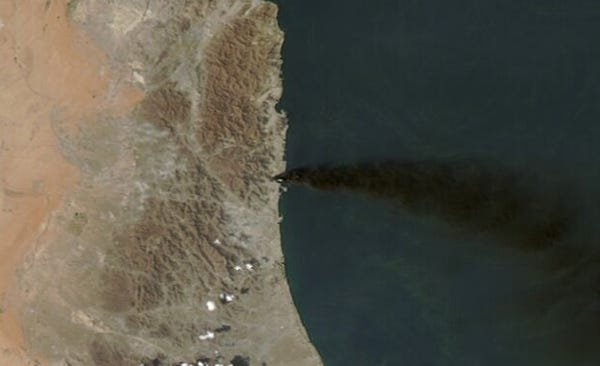
Smoke from the coast of Fujairah spread over the Gulf of Oman.

NASA MODIS satellite image of Fujairah on Saturday.

NASA Modis satellite image, November 14, 2026.

A satellite image taken on Saturday showed smoke from the fire spreading over the Gulf of Oman. The Port of Fujairah exported an average of 1.7 million barrels of crude oil and refined fuels each day in 2025, Reuters reported.

Some operations at the Port of Fujairah were suspended on Saturday.


Fujairah in the UAE on March 14, 2026.

Fire broke out in Fujairah on Saturday.

AP Photo/Altaf Qadri

Local outlets reported that some oil-loading operations were suspended on Saturday following the intercepted strike.

The Fujairah Oil Industry Zone can store millions of barrels.


Oil facility in Fujairah in the UAE on March 14, 2026.

The Fujairah Oil Industry Zone in Fujairah on Saturday.

AP Photo/Altaf Qadri

The Fujairah Oil Industry Zone, located near the port, is home to the largest commercial storage facility for refined oil products in the Middle East. The hub can store about 70 million barrels of oil.

The military conflict has sent oil prices skyrocketing.


Fujairah in the UAE on March 14, 2026

Oil prices have risen globally since the US and Israel launched attacks against Iran.

AFP/Getty Images

The ongoing war has disrupted the oil supply chain, sending oil prices over $100 a barrel this week. The International Energy Agency said it will release 400 million barrels from reserves in response, marking the largest coordinated release in the IEA’s history.

The International Energy Agency said the war has caused the largest oil market disruption in history.


Fujairah in the UAE on March 14, 2026.

Fujairah in the United Arab Emirates on Saturday.

AFP/Getty Images

The International Energy Agency said global oil supply will drop by 8 million barrels a day in March.

“Disruptions are not limited to upstream production and exports, with several refineries and gas processing facilities shut down due to attacks or for safety concerns,” the agency said in its monthly markets report. “The closure of the Strait is also forcing export-oriented refineries to cut runs or shut completely as product storage tanks top up.”

The UAE said it intercepted nine missiles and 33 drones launched from Iran on Saturday.


Fujairah in the UAE on March 14, 2026.

Iran launched over 30 drones at the UAE on Saturday, according to the UAE’s military defence.

AP Photo/Altaf Qadri

The UAE Defense Ministry said it intercepted nine ballistic missiles and 33 uncrewed aerial vehicles launched from Iran in an X post on Saturday.

“Since the onset of the blatant Iranian aggression, UAE air defences have engaged 294 ballistic missiles, 15 cruise missiles, and 1,600 UAVs launched from Iran,” it said.


Source link

Ive-lived-in-the-UAE-for-17-years-I-ran.jpeg

I’ve lived in the UAE for 17 years. I ran to the basement as missiles flew overhead — and I still feel safe.

On Saturday, I was standing on the beach below my home on Dubai’s Palm Crescent when I noticed thick plumes of black smoke rising from the Fairmont Hotel across the water on the trunk of the Palm Jumeirah.

I watched the dark fumes with dread as they rapidly grew thicker at sunset. The sight recalled the same images I saw from explosions in Beirut and Gaza during my own reporting in the region over the past few years.

I live in a beachfront apartment on the East Crescent, the outer arc that curves around Palm Jumeirah and shields it from the open sea.


Smoke from a building in Dubai, United Arab Emirates.

She saw smoke when standing outside her home on Dubai’s Palm Crescent.

Provided by Rebecca Anne Proctor


I had just gotten back from visiting a friend from graduate school and her family at a beach club at the base of The Palm Jumeirah. An afternoon meant to be spent enjoying the beach and the cool waters during one of the Gulf’s best times of year, quickly turned into one of spotting numerous missiles in the sky as they were being intercepted by the United Arab Emirates’ defense system.

The US strikes on Iran, which we had anticipated for weeks, had begun, and as many in the Gulf had feared, they have led to hundreds of missile and drone attacks on Gulf soil.

After an intense few hours filled with worry, I had gone down to the beach at my home to watch the sunset and try to find a moment of calm. Others had done the same. A fisherman stood with his line in the water. Couples walked by the water’s edge as the evening light shimmered on the waves. Others lounged by the pool.

For a moment, it looked like any other Saturday.


The sky near The Palm in Dubai, United Arab Emirates.

Looking up at the sky in Dubai.

Provided by Rebecca Anne Proctor


But the smoke still spiraled into the sky, an eerie reminder that it wasn’t. People stood quietly, watching.

Then, without warning, a fast-moving ball of fire flew over our heads and our building. Instinct took over. We ran for the basement, breathless, confused, scared, and frustrated. A woman rushed in after us, crying. She said she’d just driven past The Fairmont and seen it in flames.

I’ve lived in the United Arab Emirates since 2009. I never would have imagined that the sights of bombings I have reported on in other Arab nations would be seen and experienced here, a Gulf nation considered to be one of the safest in the world.

This is a place where my friends from Lebanon, Palestine, Syria, and even Iran and parts of Africa have come to for a safer life and better work opportunities.

They did not escape war to come to experience another war.

We knew it was coming

Since mid-January, there had been growing talk of a possible military strike on Iran. For weeks, people across the Gulf — residents and visitors alike — had been bracing for it. At conferences, art fairs, dinners with friends, and even casual work meetings, the subject would come up.

People would whisper about it, sometimes even joke.

“Let’s see if it happens next week or next weekend,” someone would say.

“Let’s have lunch while we still can,” a friend in Downtown Dubai told me recently. “We may all be living in the basement soon,” they added with a laugh.

But the moment never came.

We’re now in the second week of Ramadan — a time meant for reflection, charity, community, and peace. Dubai had been full of festive iftars and suhoors, the celebratory meals where Muslims break their fast after sunset.

Until this week, the city felt joyful, as it always does during this month.


Screenshot of emergency alert from United Arab Emirates.

She has received texts warning her to stay away from windows and falling debris.

Provided by Rebecca Anne Proctor


Life is carrying on

The last few days have brought real fear and confusion. At times I’ve felt completely on edge. But I also feel safe. I feel grateful.

As I write this on the evening of March 3, flights across the Gulf are still suspended. The UAE says it has intercepted 186 ballistic missiles and more than 800 drones. I can hear the fighter jets roaring overhead. And yet, outside, children are playing again. Birds are chirping.

Businesses are open, even if many people are working from home. Life is going on, and I do feel safe. I’ve gone through several nights of fitful sleep, waking up to emergency texts from the government on my phone warning us to stay away from windows and falling debris.

The noise and uncertainty have been scary. But seeing how the UAE has been handling the situation — confidently and with resilience — has given me strength.

Don’t get me wrong, this isn’t easy. I have also seen commentary and reports online that have used this moment to criticize the nation, dismissing it as “glitzy,” as if it isn’t a real place where real people live. But for those of us who call it home, it’s very real.

Over the 17 years I’ve been here, I have lived through two recessions, the COVID pandemic, and several floods. During each catastrophe, the UAE has surprised its skeptics and bounced back.

I don’t know how or when this will end. I am still undecided as to when or if I will leave. I’m still nervous going to sleep at night. It’s only been a few days, and I’m still jumping at loud noises. But each hour and day that passes, I do feel calmer. We will get through this. The UAE will get through this.


Source link

One-of-Amazons-data-centers-in-the-UAE-caught-fire.jpeg

One of Amazon’s data centers in the UAE caught fire after being hit by ‘objects’ amid the Middle East conflict

  • Amazon Web Services had a power outage at one of its facilities in the United Arab Emirates on Sunday.
  • The fire was caused by “objects” that impacted the facility at around 7:30 a.m. ET.
  • The impact sparked a fire. Firefighters cut power to the facility while they extinguished it.

Amazon Web Services said on Sunday that connectivity from one of its data centers in the United Arab Emirates was down after a fire at the facility.

AWS, Amazon’s cloud service, said that one of its “Availability Zones” had been “impacted by objects” at around 7:30 a.m. ET. The impact created “sparks and fire,” per AWS.

“The fire department shut off power to the facility and generators as they worked to put out the fire,” the company said.

The company did not say in its statement what the objects were.

According to Amazon’s website, an availability zone can comprise one or more data centers. The company has three availability zones in the UAE, per its coverage map.

The Sunday fire at the AWS facility happened amid US and Israeli military strikes on Iran and retaliatory attacks from the Iranian military on at least half a dozen Gulf states.

Read more about the US-Iran conflict

Photos and videos showed missiles streaking across the sky in Dubai on Saturday and Sunday. Fallout from intercepted missiles caused fires and other problems across the region. The Fairmont’s famed luxury property on the Palm saw damage, as did Dubai’s main airport and the Burj Al-Arab hotel.

Just before 7:30 p.m. ET, AWS said it was seeing “significant signs of recovery” for some systems, but power was still down at the center.

“We do not have an ETA for power restoration at this time. For customers that can, we recommend using alternate Availability Zones or other AWS Regions where applicable,” the company said in its Sunday evening statement.


Source link