

Jake Epstein

Ukraine is developing interceptor drone swarms to defend against Russian attacks

Ukraine’s defense industry is developing interceptor drone swarms to better protect its territory from massive Russian aerial attacks.

The development work marks a major next step for interceptor drones, which have emerged over the past year as a top defense priority for Ukraine, given their low cost and scalability.

Brave1, a Ukrainian government-backed innovation driver that helps the country’s booming defense industry create and refine new weaponry, told Business Insider that multiple companies in its cluster are working on swarm technology.

The desired swarm function could include both enabling a single operator to control multiple interceptor drones at once — locally and remotely — and allowing drones to communicate with each other independently during flight. Brave1 said that the former of these two scenarios is closer to fruition and scaled combat application.

Ukrainian operators use interceptor drones to hunt Russian strike and reconnaissance drones. They are armed with small warheads and fly directly into their targets or explode nearby to destroy them midair.

Typically, a pilot will control only a single interceptor drone, which can cost as little as $1,200. The Russian drones, by contrast, are estimated to cost between $10,000 and $100,000, depending on their function.

Interceptor drones have become a critical layer in Ukraine’s air defense umbrella amid worsening Russian aerial attacks and have surged in popularity since last year. Kyiv can now produce at least 2,000 every day, Ukrainian President Volodymyr Zelenskyy said in mid-March.


An employee of the Ukrainian SkyFall company conducts a test flight with a P1-Sun interceptor drone at an undisclosed location in Ukraine on March 19, 2026, amid the Russian invasion of Ukraine.

Typically, one pilot can control a single interceptor drone. 

Genya Savilov/AFP via Getty Images


This scale of production is crucial as Ukraine faces regular Russian attacks on cities and critical infrastructure that sometimes involve hundreds of drones in one night. Last week, Moscow’s forces launched nearly 1,000 drones over a 24-hour period.

Brave1 would not disclose how far along the interceptor drone swarm development is, but it said it is testing and developing components that, when fully brought online together, will enable this new technology.

These components include communications between the drone and ground control stations, as well as between drones; positioning and navigation; target detection and recognition; and terminal guidance, among other aspects.

A representative for Wild Hornets, the Ukrainian manufacturer of the popular Sting interceptor, told Business Insider that they consider drone swarms a distant technology. “What is available now is a primitive algorithm that is ineffective in combat.”

Brave1 said that the goal is to maximize intercept efficiency to the point where a single interceptor drone can bring down a single target. There are times, though, the organization added, when it makes sense to launch multiple interceptors, especially given the massive air attacks Ukraine is experiencing.

Brave1 said it aims to enable fully autonomous interceptions while keeping humans in the targeting loop, easing pilots’ workload rather than replacing them.

The success of interceptor drones in Ukraine has caught the attention of the US and its allies, who are looking into low-cost air defense solutions to meet the rising global drone threat without having to expend multimillion-dollar missiles.

This dilemma has been front and center in the Middle East in recent weeks as Iranian forces have launched thousands of strike drones at its regional neighbors. Several Gulf states have sought Ukraine’s help in dealing with the ongoing attacks.


Source link

The-US-is-sending-a-new-drone-killer-to-the-Middle.jpeg

The US is sending a new drone-killer to the Middle East. It’s logged over 1,000 Shahed intercepts over Ukraine.

The US Army is deploying an American-made counter-drone system that has intercepted more than 1,000 Shahed-type drones in Ukraine to the Middle East, two defense officials confirmed on Saturday to Business Insider.

One of the US officials, who spoke on the condition of anonymity to discuss military developments, said that the Merops system will arrive in the Middle East within a week. Once it arrives, it’ll be ready for combat in a matter of days.

They declined to say how many systems the US is sending to the Middle East, only that the deployment will include a large quantity of interceptors.

The Associated Press first reported the Merops deployment.

The counter-drone system, which uses a roughly $15,000 interceptor, would give US and allied forces a much cheaper air defense option against Iranian drones, compared to expensive surface-to-air missiles.

The weapon’s deployment to the region comes as Iran has launched thousands of cheap attack drones at the US military and its allies across the Middle East after the US and Israel began Operation Epic Fury on February 28.

The Shahed drones, which cost roughly $20,000 to $50,000 according to available estimates, complicate the air defense picture.

In significant quantities, they can overwhelm even advanced air defense systems, or at the very least force Patriot and Terminal High Altitude Area Defense (THAAD) crews to expend millions of dollars in interceptors to defeat a threat only a fraction of that cost.

How the Merops works

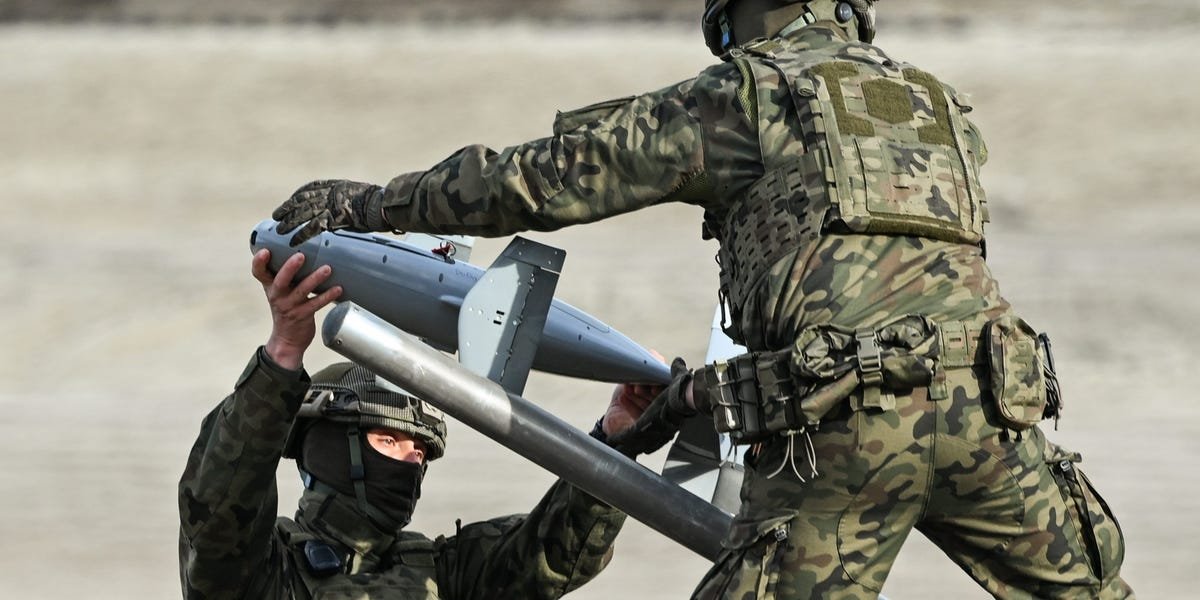
The Merops counter-drone system launches a propeller-driven drone called the Surveyor, which is a few feet long, can be carried by a single soldier, and uses artificial intelligence to navigate in jammed environments.

The overall system includes the Surveyor interceptor, a ground control station, and launch stations — all operated by a four-man crew with a commander, a pilot, and two technicians.

Its developer, the American initiative Project Eagle, says the Merops is tailor-made for taking down propeller-driven and jet-powered drones like the Shahed. So far, it’s logged over 1,000 kills against such uncrewed aircraft.

The Surveyor can fly at speeds of over 175 mph, meaning it’s more than fast enough to catch Iran’s commonly used propeller-driven Shahed-136, which flies at around 115 mph. Jet-powered versions of the Shahed reportedly fly as fast as 230 mph and are more challenging threats.

If the Surveyor, which can be mounted with a small explosive warhead, fails to hit its target, it can deploy a parachute to allow retrieval and relaunch of the drone.


A Surveyor drone descends while suspended from a parachute.

A Surveyor drone can be retrieved if it fails to hit any targets.

Artur Widak/NurPhoto via Getty Images


When Business Insider observed a demonstration of the Merops in Poland last year, one of the launchers was mounted on the back of a pickup truck.

A push for interceptor drones

According to one of the defense officials Business Insider spoke with, US forces in the Middle East are to be trained by Army soldiers from Europe to operate the Merops. The system is also being sent to countries in the region where US troops are not deployed.

The second defense official said that Merops’ use in Ukraine has provided the Army with air defense information that has already proven valuable in Eastern Europe and will now be useful for the Middle East.

US Army soldiers in Europe have taught NATO allies how to operate the Merops system, which was deployed to the alliance’s eastern flank following Russian drone incursions into Polish airspace.

Meanwhile, Ukrainian President Volodymyr Zelenskyy said on Thursday that his country had received a direct request from the US for help with countering Shahed drones.

Zelenskyy shared that he “gave instructions to provide the necessary means and ensure the presence of Ukrainian specialists who can guarantee the required security.”

Over the past year, Kyiv has focused heavily on building and deploying an arsenal of cheap interceptor drones to counter Russia’s versions of the Shahed, which the Kremlin launches in hundreds-strong waves at times.

Ukrainian interceptor drones cost around $2,500 each, and Zelenskyy has said that his country makes 1,000 of them a day.

All of these broader developments come amid the backdrop of President Donald Trump saying in an early morning TruthSocial post on Saturday that Iran had agreed to stop attacking US allies in the region.

“Iran, which is being beat to HELL, has apologized and surrendered to its Middle East neighbors, and promised that it will not shoot at them anymore,” he wrote. The president also threatened additional action against Iran, warning that the US is going to hit it harder.


Source link

Matthew Loh Headshot

Ukraine says its own Flamingo missiles flew nearly 900 miles to strike Russian Iskander factory

Ukrainian President Volodymyr Zelenskyy said on Wednesday that his country had struck a Russian military industrial plant with locally made cruise missiles that flew nearly 900 miles to reach their target.

Ukrainian officials earlier reported that the missile strike on Saturday had hit a plant in Votkinsk, an industrial town in Russia’s Udmurt Republic, some 860 miles from the Ukrainian border.

“We carried out precise strikes with Flamingo missiles at a range of 1,400 kilometers,” Zelenskyy said at a press conference in Kyiv. “I believe this is truly a success for our industry.”

Such an attack would be one of the longest-range strikes carried out so far by the Flamingo, which is touted as one of the star products in Ukraine’s local defense manufacturing scene. Kyiv has been aggressively trying to expand its weapons industry as a complement to Western supplies and as a future export sector.

The Flamingos’ target, the Votkinsk plant, manufactures some of Russia’s key munitions, such as ballistic missiles for the Iskander system and the submarine-launched Bulava missile.

Russia has not officially confirmed that the factory was hit, but Alexander Brechalov, the governor of the Udmurt Republic, said on Saturday that an unspecified facility in the region had been attacked and three people were sent to hospital.

Brechalov did not say if the Flamingo was used, but warned against drone threats over the region.

Ukrainian open-source groups later published satellite images that appeared to show damage to one of the workshops at the Votkinsk factory, with a gaping hole in its roof and signs of fire damage.

That evening, Kyiv had unleashed a large wave of drones and missiles into Russia in one of its biggest ever long-range attacks.

Russia’s defense ministry said that it shot down 77 Ukrainian drones on Saturday, but did not mention any Ukrainian missile threats.

Zelenskyy declined to say how many missiles or drones Ukraine launched in total on Saturday.

“There were interceptions by Russian air defense, there were also missiles that were not intercepted, and there were direct hits,” Zelenskyy said. “But the most important thing is that all the missiles that were launched all reached the target.”

Kyiv has often compared the Flamingo to the US-manufactured Tomahawk, saying that the Ukrainian turbofan-powered missile is much cheaper to make per unit and has a longer range of 1,900 miles.

The ground-launched Flamingo, however, takes up to 40 minutes to prepare for launch.

Ukraine is also still trying to build up its arsenal of the missile, with reports from last October saying that its manufacturer, FirePoint, hoped to produce up to seven a day by the end of 2025.

Kyiv said earlier this month that manufacturing had been affected by a recent Russian strike, with Zelenskyy warning that Ukraine had to “work on increasing quantity” of the Flamingo.

“We had certain technical problems because one large production line was destroyed as a result of a missile strike. They have already relocated and resumed production,” Zelenskyy had said at the time.


Source link

Macron-said-that-Ukraine-now-gets-two-thirds-of-its-intelligence.jpeg

Macron said that Ukraine now gets ‘two-thirds’ of its intelligence from France, not the US

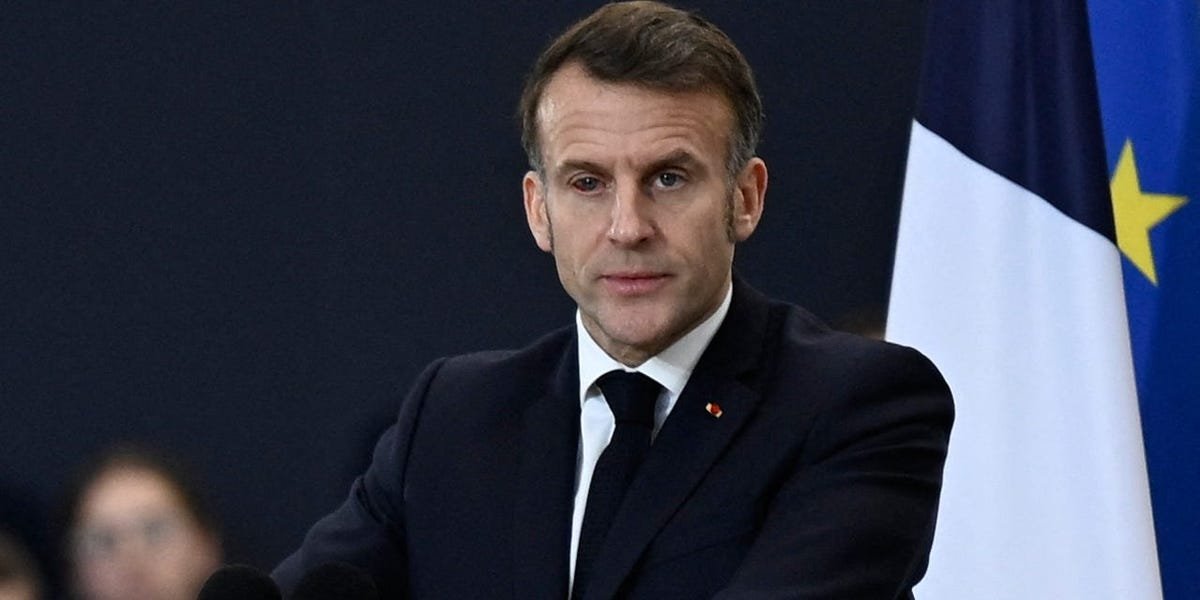
French President Emmanuel Macron said on Thursday that his country has now overtaken the US as the main provider of intelligence to Ukraine.

“Where Ukraine was overwhelmingly dependent on American intelligence capacity, a year ago, two-thirds is today provided by France. Two-thirds,” Macron said in a New Year’s speech to the French military.

The French leader’s comments indicate a shift in the dynamics of Western contributions to the war and suggest that the US may have scaled back its military relationship with Ukraine.

The US briefly suspended intelligence-sharing and aid to Ukraine in March 2025, as the Trump administration was attempting to negotiate a ceasefire between Kyiv and Moscow. After roughly a week, Washington said it was lifting the suspension.

But it’s been unclear so far whether the Pentagon has continued to provide intelligence at the same level as it did during the Biden administration.

The New York Times previously reported that, in those years, US-Ukrainian intelligence-sharing ties had been so close that officials from both countries worked in the same facility to coordinate military strikes.

One of the most vital roles played by US intelligence at the time was providing targeting data and situational awareness for Ukrainian troops, especially when the latter were using American-made systems for the attacks.

Ukraine has since been trying to develop its own strike capabilities, including long-range precision missiles, that might allow it to strike Russia without Western approval.

It’s also unclear exactly how Macron quantified two-thirds of Ukrainian intelligence capabilities. His speech did not say whether he was referring to two-thirds of the intelligence provided by Ukraine’s foreign partners or to two-thirds of all the intelligence used by Ukraine’s forces.

The Élysée Palace and French defense ministry did not respond to requests for comment sent outside regular business hours. Ukraine’s defense ministry and the Pentagon have also not responded to similar requests for comment on Macron’s remarks.

The French president’s point on intelligence-sharing with Ukraine aligns with his larger push to position Paris as a regional military leader, while the Trump administration seeks to curb American involvement in Europe. President Donald Trump has also recently rattled European leaders by alluding that the US could try to take over Greenland, a Danish territory.

Macron said on Thursday that France had helped Ukraine to rebuild its forces and provided Kyiv with security guarantees in the event of a ceasefire.

Last week, European NATO members and the US issued a declaration that said willing countries would form a multinational, “European-led” force to provide “reassurances” to Ukraine and stave off a second Russian invasion or attack.

“The signal sent to our Ukrainian partners, to other Europeans, and to the world is that we are ready,” Macron said. “We are ready to sustain this effort of resistance. We are ready to deter new aggressions or to maintain peace on our soil.”


Source link