Ukrainian-troops-say-their-hard-won-lessons-on-Iranian-Shaheds-apply.jpeg

Ukrainian troops say their hard-won lessons on Iranian Shaheds apply far beyond their war at home

The drones Iran is launching at US forces are the same ones Ukraine has fought for years. Ukrainian soldiers say their battlefield experience offers lessons that matter in this fight.

Alex Eine, the commander of a small Ukrainian drone unit, said it was “surprising” to see reports out of the Middle East of multimillion-dollar interceptors being used to combat cheap Iranian one-way attack drones.

“When long-range drones are flying at you, don’t shoot them down with $3 million PAC-3s from Patriots,” he said, referring to a top interceptor for the most advanced US surface-to-air missile system.

Through trial and error, Ukraine developed low-cost defenses to counter Russia’s Geran drones, copies of Iran’s Shahed drones. Ukrainians involved in defending their country and Western analysts say other countries facing these threats need to be doing the same.

A 122nd Brigade sergeant with Ukraine’s Territorial Defense Forces who asked to be identified only by their call sign Fast, said that Ukrainian soldiers “were sure the US had some secret weapon,” some foolproof shield for stopping Shaheds. They were expecting to see it in action when this new war began, he said.

Instead, what they saw were viral video clips of an Iranian delta-wing drone sailing past defenses and slamming into a US Navy base in Bahrain, causing serious damage.


Smoke rises from a skyline with water in the foreground under a blue sky

Iran has been firing missiles and drones at US targets and its Middle East allies.

Stringer/Anadolu via Getty Images


“Now we see that it is a hard task, even for the US,” Fast said of defending against Shaheds.

On Wednesday, CNN reported, citing an unnamed source who attended a closed-door briefing, that Defense Secretary Pete Hegseth and the top general, Dan Caine, told congressional leaders that Shaheds pose a greater challenge for the US and allies than initially expected.

The Pentagon did not respond to requests for comment.

Speaking at a press conference on Thursday afternoon, Adm. Brad Cooper, the head of US Central Command, said that the US is “very familiar with the Iranian capabilities” and “planned for it right from the outset.”

He added that while he felt good about what the plan was, the military has been making adjustments.

Dimko Zhluktenko, a Ukrainian drone pilot with Ukraine’s Unmanned Systems Forces, said the US and others should lean more into the kind of low-cost systems that Ukraine has proven work against Shaheds.

Hard-won combat lessons

The reality of any major air defense battle is that some threats are likely to break through.

“I’m not surprised that some Iranian drones penetrated their defenses, as they act like a swarm,” said Ukrainian lawmaker Maryan Zablotskyy, who was an early advocate for interceptor drone air defenses. “It’s very difficult to intercept a whole bunch of them flying at the same time.”


A man wearing camoufage stands on the back of a camoufage-painted truck pointing a weapon into a cloudy and blue sky, with another man standing beside

Ukraine has developed mobile fire groups as part of its response to Shahed-style drones.

Andriy Dubchak/Frontliner/Getty Images


Last year, Ukraine saw Russian drones break through and kill over 500 civilians.

“There is no 100% counteraction,” said Oleksandr Skarlat, the director of the Sternenko Foundation, a crowdfunding organization for combat drones. “The question is no longer whether such drones will break through,” he argued, “but what the cost of destroying them will be and how quickly defense systems can adapt.”

Ukraine says it can intercept about 90% of Russia’s Shaheds. That rate isn’t perfect, but Kyiv is able to achieve largely effective coverage and do so with systems that are cheap enough to field at scale, helping it save its missiles like the Patriot and the National Advanced Surface-to-Air Missile Systems, or NASAMS, for Russia’s more dangerous threats.

Ukraine depends on a host of low-cost solutions against Shaheds, including electronic warfare, mobile gun teams, and interceptor drones.

A cofounder of Wild Hornets, the Ukrainian firm behind the popular Sting interceptor drone, said the Shahed threat “forced” their country to develop an entirely new branch of service dedicated to using drones to fight drones.

Ukraine began surging production of cheap interceptor drones, designed to fly at high speeds to intercept Shaheds, in 2025. It says it now produces over 1,000 of them a day.


A man in camouflage gear and a black beanie stands in a snowy field in front of trees holding a black and beige drone, standing beside black equipment

Ukraine has developed interceptor drones designed to take out Shaheds and other drones.

Alex Nikitenko/Global Images Ukraine via Getty Images


Math problems

Hegseth said on Wednesday that the US has “the most sophisticated air and missile defense network ever fielded” and that it has vaporized thousands of Iranian threats, both missiles and one-way attack drones.

“We have pushed every counter-UAS system possible forward, sparing no expense or capability,” he said, using an acronym for counter-Unmanned Aerial Systems.

Among the higher-end air defenses on the front lines of this multinational air defense fight are the MIM-104 Patriot and Terminal High Altitude Area Defense (THAAD) systems. Ship-based interceptors, like the SM-series missiles, and planes armed with air-to-air missiles are also in play.

Dara Massicot, a Carnegie Endowment for International Peace defense expert, wrote in an assessment on Monday that drone attacks are being intercepted “at an impressive rate,” but at the cost of “extensive resources of near-constant defensive counter air patrols and the use of ground-based air defense systems that are otherwise needed for intercepting inbound Iranian missiles.”

Zablotskyy, the Ukrainian lawmaker, said that the important thing is to “start thinking low-cost war.” Ukraine’s interceptor drones are priced at around $2,300 to $6,000 each, while Shaheds are generally estimated to cost $20,000 to $50,000 apiece.


Two men bending over holding a large grey drone between trees

Ukraine has more experience operating and stopping drones than any of its allies.

ROMAN PILIPEY/AFP via Getty Images


That cost ratio is much better than expending a multimillion-dollar interceptor missile on a drone costing only thousands. American military leadership says that they are working to address past imbalances.

“Interceptors, in general, we’ve had a number of new capabilities being fielded,” Cooper said on Thursday. “I think you have seen over a period of time us kind of get on the other side of this cost curve on drones.”

“If I just walk back a couple of years, you remember you used to always hear: ‘We’re shooting down a $50,000 drone with a $2 million missile.’ These days, we’re spending a lot of time shooting down $100,000 drones with $10,000 weapons,” he said.

The admiral declined to go into specifics on the new capabilities being fielded.

The US and Israel are flying over Iran and destroying as much as they can of Iran’s missile arsenal to try to limit its offensive attacks — a state-of-the-art air campaign that Ukraine can’t match, and it has cut both missile and drone attacks down tremendously since the war began.

Offers to help

The US military has taken broader drone lessons from Ukraine; however, observers say it has not adopted Kyiv’s low-cost interception architecture at the scale it needs for this and future wars.


A large camouflaged truck-mounted weapon beside trees and under a white sky

The US military’s Patriot air defense system is powerful, but every use is costly.

Thomas Frey/picture alliance via Getty Images


Ukrainians told Business Insider that the US should invest deeply in interceptor drones like the ones they use while also layering in electronic warfare and short-range air defenses.

“The use of interceptor drones might be the key to the Shahed challenge in the Middle East and elsewhere,” said Taras Tymochko, who led the Dronefall project, a program under the charity foundation ComeBackAlive that funded early development of interceptor drones in Ukraine.

“Of course, there is not much time to learn how to use interceptors,” he said. “But it is better to be late than very late.”

On Thursday, Ukrainian President Volodymyr Zelenskyy said that Ukraine “received a request from the United States for specific support in protection against ‘shaheds’ in the Middle East region.” At the same time, reports emerged that the US and other partners were considering purchasing Ukrainian interceptor drones.


A rocket trail is seen in the sky above the Israeli coastal city of Tel Aviv on March 5, 2026.

In the past, the cost of interception was often vastly more expensive than the target. Cheap interceptor drones are designed to change that.

Jack GUEZ/AFP via Getty Images


Massicot said that while this deeper “learning should have started long ago, now is the time to start — and catch up quickly.”

Several Ukrainians said the urgency for the US to learn from their country extends past the fighting with Iran or the threat from Russia. These countries aren’t its only foes that might rely on Shahed-type drones or swarms.

“Air defense in the Middle East is already unable to withstand the intensity of Shahed attacks,” Skarlat said. “Imagine what will happen if China gets involved” in the drone swarm way of war, he said.

“The world is not ready for massive attacks by Iranian drones,” he said.


Source link

Videos-show-how-Ukrainian-helicopter-crews-use-machine-guns-to.jpeg

Videos show how Ukrainian helicopter crews use machine guns to hunt Russia’s exploding Shahed drones

Ukraine just gave us an extended look at one of its emerging tactics against Russia’s Shaheds: using helicopters to shoot the drones from above.

The Ukrainian navy published a two-minute montage of such operations on Thursday, saying that a helicopter crew had destroyed eight Shahed exploding drones and Gerbera decoy drones in a single day.

Cockpit and gun camera footage showed the Ukrainians engaging at least five delta-wing drones in flight, with another clip showing unidentified wreckage smoking on the ground.

Some clips indicate that at least one aerial engagement happened in the early morning or at night. Thermal footage from a gun camera showed the operator firing at a delta-wing drone, tracking its flight above open terrain before a screen flash indicates the drone was destroyed.

Other standard optical footage, filmed from a gun camera or the cockpit, appears to show several drones being destroyed high above the clouds or over water near a coastal settlement.

Additionally, an M134 minigun can be seen mounted from a helicopter’s side door, though the videos didn’t show the weapon itself in action.

The clips indicate some of the ideal conditions for downing a Shahed.

For one, the helicopter has to match the drone’s speed and trajectory and gain enough altitude to allow the minigun to fire downward at the Shahed. The chopper crew also needs to come within visual range of the drone to engage.

The footage comes several months after Ukraine said it would officially begin incorporating helicopter crews into its air defense network against Russia’s one-way attack drones, which Moscow uses in mass waves to pressure Ukrainian cities.

Because Russia mass-produces the Shahed and Gerbera, Kyiv has sought more inexpensive means, such as machine guns, instead of traditional antiaircraft missiles to counter them.

Ukraine’s commander in chief, Gen. Oleksandr Syrskyi, said in October that helicopters could sometimes destroy up to 40% of Russian Shaheds and Gerberas in one area.

Thermal and infrared cameras, such as the one seen in the latest footage, were among the systems that Syrskyi said would be equipped on such helicopters to improve their effectiveness.

Ukraine also uses ground crews with interceptor drones or truck-mounted machine guns to destroy Shaheds, but a helicopter crew can reposition much faster to engage multiple threats or hunt down a Russian drone that changes its flight trajectory.

The latter scenario became increasingly common as Russia was found to be outfitting Shaheds with more advanced communications and guidance systems, and, in rare cases, artificial intelligence.

Helicopters also allow for engagements at higher altitudes. Russia often directs its Shaheds to approach their targets at above 6,500 feet before swooping down to attack, making it more difficult for ground-based crews to hit the drones.

Aside from helicopters, Ukrainian troops have also been seen using M134 miniguns on turboprop planes to shoot down Shaheds.

Meanwhile, Russia has since been reported to be attempting to counter the Ukrainian helicopters by equipping its Shaheds with R-60 air-to-air missiles.

In November, Ukraine’s deputy minister of defense for innovation told Business Insider’s Jake Epstein that Moscow was also directly targeting patrolling helicopters and aircraft with Shaheds.


Source link

Ukrainian-soldiers-armed-with-scissors-say-they-cut-any-fiber-optic.jpeg

Ukrainian soldiers armed with scissors say they cut any fiber-optic drone cable they see — even if it might be their own

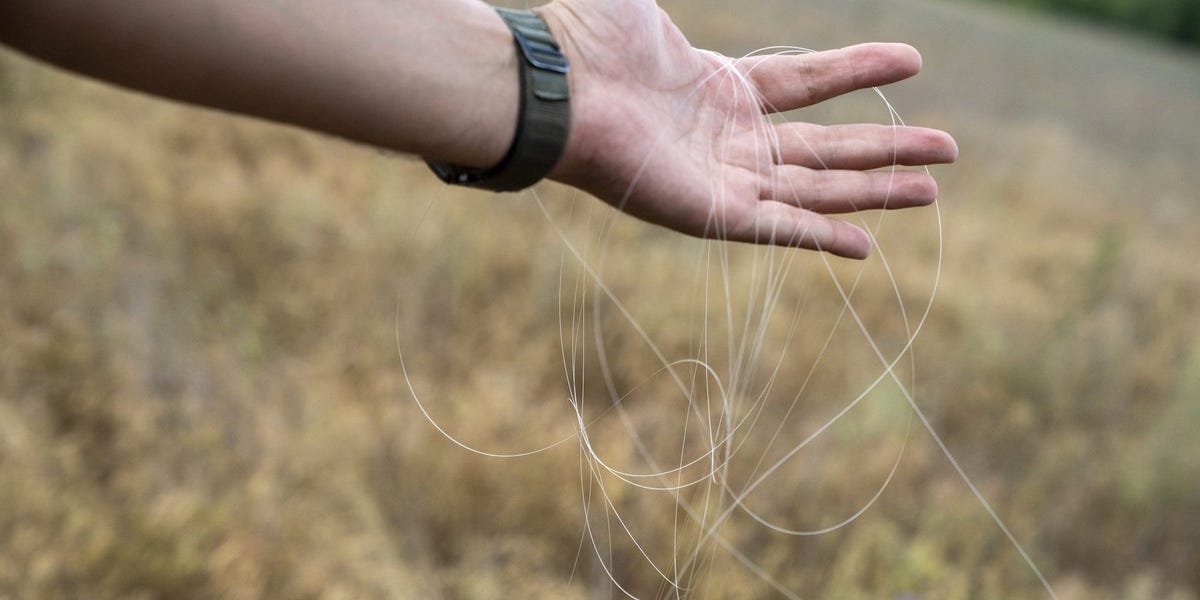
Ukrainian soldiers are out cutting and snapping any fiber-optic drone cables they come across, regardless of which side they belong to. They use scissors, knives, even their bare hands.

Troops say it doesn’t matter if a drone is Ukrainian or Russian. If they’re not sure, they just assume it’s hostile.

These unjammable drones controlled by long, thin cables have flooded the battlefield as a countermeasure to the electronic warfare that often renders radio-frequency drones inoperable.

As these drones have become increasingly prolific, the result has been forests and trenches snarled with discarded and active cables.


A snowy field with brown shubbery with thin white cables running across it and a small drone in a grey sky

Fiber-optic drones can leave webs of cables across Ukraine.

Francisco Richart/SOPA Images/LightRocket via Getty Images


Dimko Zhluktenko, an analyst with Ukraine’s Unmanned Systems Forces, said that he always carries scissors so that he can “cut each and every optic fiber that we see.”

He said that his unit “actually stopped considering them friendly or foe. We think that all of them are kind of the enemy drones.”

In a YouTube video about the gear he carries, Zhluktenko said scissors became so essential that when his unit started operating in areas littered with fiber-optic cables, every team member was required to carry a pair. He said that he bought retractors for his team so no one would lose them.


A man in khaki gear stands in a dark space with stairs leading up to light behind him, pulling out scissors from a pouch at his chest

An analyst with Ukraine’s Unmanned Systems Forces said he carries scissors to cut the cables of fiber-optic drones he comes across.

Dimko Zhluktenko


A Ukrainian soldier who spoke with Business Insider on the condition of anonymity said troops can often break the thin strands with their hands; that isn’t often necessary, though. Soldiers in his unit already carry scissors for medical purposes. Many also have knives.

He said that there can be so many cables about on the battlefield that “you don’t know if it’s a new thread or if it’s an old one that’s been lying around for a long time.” So his unit severs any they find as often as possible.

Not just fiber-optic cables

Other similar behaviors have been observed on the battlefield.

There are sometimes so many drones in the sky that soldiers looking up from the ground can’t even begin to tell which is friendly and which is hostile. In such cases, soldiers can be ordered to shoot down any drone they see.

Soldiers in charge of electronic warfare systems sometimes panic and jam everything in the air when they can’t tell drones apart, Zhluktenko previously told Business Insider.


Thin pale wires come out of a black and white cylinder with a gloved hand holding them

Drones controlled by fiber-optic cables are popular as they can’t be jammed.

Viktor Fridshon/Global Images Ukraine via Getty Images


Zhluktenko told Business Insider that cutting the fiber-optic cables is not something that he had to do often, as his unit was typically working in areas further from the front-line fighting that had fewer of the fiber-optic drones. He described it as something that they “sometimes” encountered.

Soldiers in Ukraine’s 15th Mobile Border Detachment “Steel Border” previously said in a video for Ukraine’s state border service that using scissors is a reliable way to disable the Russian drones. Russian soldiers have reportedly done the same.

If the cable is intact on an active and operational drone, the only other way to stop it is to physically shoot it (troops say a shotgun works best); that requires a mix of skill and luck, though.

Fiber-optic drones are a relatively new feature in this war that have not previously been fielded at this scale. That these drones can be disabled with simple tools — scissors, knives, bare hands — underscores a broader pattern in Ukraine: sophisticated systems are often countered with low-tech fixes.

In many cases, some of the most effective counters to advanced technology have been older or improvised combat tools — from shotguns used against small drones to nets draped over vehicles and positions to blunt aerial attacks. Even the drones themselves are cheap innovations designed to overcome more expensive equipment and wartime demands.


Source link

Ukrainian-drone-pilot-found-hidden-Russian-depot-realized-it-was.jpeg

Ukrainian drone pilot found hidden Russian depot, realized it was filled with horses and cars

Cosmos floated his quadcopter over the ruined warehouse, guiding it through a corner of the roof where shattered metal sheets had collapsed to form a hole.

The drone pilot’s unit, the Wild Division, suspected that the building was a logistics hub for Russian soldiers, roughly 15 km, or about 9 miles, from the line of contact in southern Ukraine. These hidden locations often held ordnance or fuel stockpiles, and Cosmos’ fiber-optic drone was armed with explosives to destroy them.

Yet inside, the drone rotated its camera to reveal what looked more like a farmer’s garage: Four civilian cars, a pair of motorcycles, and two bridled horses.

“We had not expected to see this. It was unusual,” Cosmos told Business Insider, speaking on condition that he be identified only by his call sign.

“We were expecting to find some armored vehicles,” he added.

Video of the discovery went viral last week in Ukraine, as the war has increasingly seen Russian soldiers using unconventional transport tools, such as pack animals and bicycles, to conduct assaults or logistics missions. Cosmos said his drone mission was conducted in early February.

The smaller profile of a horse or civilian car might be harder for a drone to spot, though Russia’s repeated use of them has also raised questions about the viability of its tactics and whether it’s been producing enough military equipment to sustain its invasion.

Cosmos’ squad mates and officers at the Wild Division, a first-person-view drone company in the 82nd Air Assault Brigade, had seen clips of Russian soldiers riding on horses to attack Ukrainian positions before.

One famous example they remember was in Zaporizhzhia, when a Ukrainian drone crew attacked Russian infantry crossing the front lines on horseback last month.

Cosmos, who’s been piloting drones for a year, said it was the first time he’d personally seen the animals on the front lines.

He flew his explosive-laden drone straight into the back of one of the cars, and said his crew later struck several other vehicles inside. When Russian troops moved their transport assets, the Wild Division found the next warehouse and attacked that one, too, Cosmos said.

“The enemy usually lives in hiding close to these places,” Cosmos said of the warehouse. “It’s common for us to check all targets. Sometimes we can see the enemy infantry, or you can see their vehicles.”

Russia calculates war differently

The Wild Division declined to say where exactly the warehouse was located, but its brigade is generally deployed in the Donbas.

The commander of Cosmos’ battalion told Business Insider that the discovery of the horses surprised him, too.

“I thought it had been a location for transport vehicles, sort of a transfer hub,” said the major, whose call sign is Fizruk.

Fizruk said the appearance of horses and cars in his area of the front line could be a sign that Russian forces are running low on standard resources, but also reflects Moscow’s attritional nature of fighting.

The cars discovered by Cosmos appear to be Nivas, inexpensive civilian off-road vehicles from the Russian Lada car brand.

“They treat these like they will be losses anyway, that they will be destroyed anyway,” he said. “Look, a Niva costs, let’s say, $2,000. A Hummer, which the Armed Forces of Ukraine uses in many places, costs $20,000, maybe more.”

“Since they lose their equipment in assaults, from that point of view, why pay $20,000 for one vehicle if you can buy 10 Nivas for $20,000?” Fizruk added.

The Kremlin is known to pressure the front line with repeated ground assaults, sending small groups of infantry to approach Ukrainian positions on foot or in cheap vehicles. The strategy has been costly, with NATO now saying that up to 25,000 Russian troops are dying each month.

Sustaining that style of war has pushed Moscow to informal means of recruitment and weapons procurement, including hiring troops from overseas and receiving ammunition from North Korea.


Source link

Matthew Loh Headshot

New Ukrainian method of catching enemy drones looks like a fishing rod in the sky

Ukrainian troops appear to be testing a new drone attachment that uses a cord or line to disable enemy propeller drones in the sky.

The tactic can be seen in a video posted on Monday by the 46th Separate Air Mobile Brigade, which published a video montage of its recent attacks against Russian infantry, vehicles, and drones.

In a caption, the brigade highlighted a “new way of capture of enemy drones in the air.”

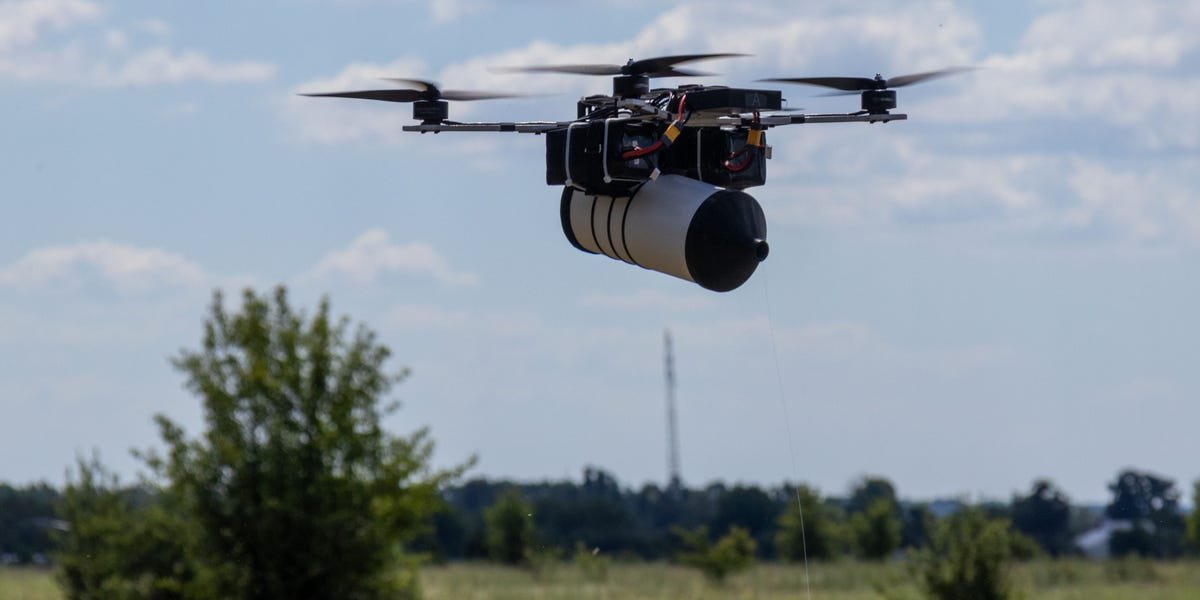
As seen from the first-person-view camera of the Ukrainian drone, the new contraption features a rod protruding from the interceptor’s chassis.

Thin rope or cord dangles from the rod, pulled taut by a small weight that sways into view as the Ukrainian drone flies high above the battlefield.

The brigade’s drone then appears to fly over its target — a small quadcopter — entangling the opposing device’s propellers with the attached line.

The brigade published footage of two such interceptions, as well as a third clip of a drone with the rod-like attachment attempting to crash into a fixed-wing drone.

The third target was likely a Russian Molniya one-way attack loitering munition. It’s unclear if the interception in the third clip was successful.

The novel, fishing rod-style device is another example of how the war is pushing militaries to develop new methods of physically disrupting drones as electronic warfare technology adapts.

Ukrainians and Russians have been experimenting with similar counterdrone tactics as a response to anti-jamming features on small attack drones, deploying fishing nets both on the ground and testing them on interceptors.

Some Western companies have also begun trialing drone-mounted and handheld net launchers as a defense against small quadcopters.

As Russia increasingly relies on large-scale attacks with fixed-wing Geran drones that typically fly at speeds of up to 115 mph, and in some cases even 230 mph, the war has led to the growing popularity of small, fast, and inexpensive drones acting as interceptors.

The 46th Separate Air Mobile Brigade’s fishing line apparatus, however, appears to be more suited to disabling quadcopters.


Source link

Ukrainian-Droid-lay-in-wait-on-a-road-at-night.jpeg

Ukrainian ‘Droid’ lay in wait on a road at night and ambushed Russians with an M2 Browning

A Ukrainian brigade has released footage of one of its uncrewed ground vehicles opening fire on a Russian armored personnel carrier, offering a rare glimpse at the emerging technology in action.

The 5th Separate Assault Brigade said on Wednesday that it deployed a Droid TW 12.7 — a remotely operated tracked system developed by a Ukrainian defense tech company — on a road deemed likely to be a route for advancing Russian troops.

The brigade said that the ground-based drone later encountered a Russian MT-LB, a lightly armored fighting vehicle often used to transport infantry.

Thermal footage filmed at night from the uncrewed ground vehicle, or UGV, shows it opening fire on the vehicle, its operator swerving a targeting reticle across the MT-LB’s front.

Business Insider could neither independently verify when nor where the footage was filmed.

The Droid TW 12.7 is equipped with an M2 Browning machine gun that fires .50 caliber rounds, which would typically pierce an MT-LB’s armor.

The 5th Brigade said it used armor-piercing incendiary rounds for the mission.

Sparks fly from the armored vehicle’s chassis as it slows to a crawl and drifts in front of the UGV, which continues firing point-blank.

“The 12.7 mm bullets punch through the MT-LB’s side, striking the crew and onboard systems,” a narrator said in the 5th Brigade’s video, referring to the metric measurement for .50 caliber bullets.

The MT-LB appears to be aimlessly crawling past the drone, indicating that its driver is incapacitated or its controls are damaged.

The UGV then pivots and begins firing on the rear of the MT-LB, “killing the infantry in the troop compartment,” the narrator said.

The 5th Brigade said that it found in the morning that the MT-LB crew and their passengers were “completely wiped out,” publishing short clips of the aftermath shot by a first-person-view aerial drone.

Wednesday’s published footage provides insight into how UGVs are increasingly used on the battlefield in Ukraine, where troops on both sides are experimenting with ground drones to perform missions that human soldiers must otherwise conduct.

While official statistics show that uncrewed aerial vehicles still dominated the drone warfare space last month, the spread of UGVs offers a possible future where Kyiv can rely on remotely operated systems for ground operations instead of risking its troops.

This year, Ukraine said that it aims to manufacture and deploy at least 15,000 UGVs across the battlefield.

Ukrainian and Russian teams have developed hundreds of such systems, ranging from buggies that can ferry provisions near the front lines to trucks outfitted with remotely operated machine guns.

The 5th brigade and DevDroid, the company that makes the Droid TW 12.7, did not respond to requests for comment sent outside regular business hours by Business Insider.


Source link

Unjammable-drones-are-leaving-wires-everywhere-forcing-Ukrainian-troops-to.jpeg

Unjammable drones are leaving wires everywhere, forcing Ukrainian troops to move with caution

Small unjammable drones controlled by fiber-optic cables have become so integral to Russian and Ukrainian combat operations that they are leaving trails of cabling everywhere, turning areas of the battlefield into a tangled web.

As a counter to extensive electronic warfare, fiber-optic drones are becoming increasingly prevalent on both sides. And with sprawling cables stretched across the battlefield, soldiers are moving with greater caution.

“You see the little webs, and you never know — is it from the fiber-optic drone? Or it’s a part of a booby trap,” Khyzhak, a Ukrainian special operator who for security reasons could only be identified by his call sign (“Predator” in Ukrainian), told Business Insider. Mines and traps have also been prominent threats in this war.

Earlier in the war, first-person-view (FPV) drones — small quadcopter-style drones fielded by both Russia and Ukraine that often carry explosive warheads — relied on radio-frequency connections. However, both sides quickly figured out how to use signal jamming to stop them.

In response, Russia and Ukraine began developing fiber-optic FPV drones that connected to their pilots using spools of long, thin cables. The cables preserved a steady link and made the quadcopters resistant to traditional electronic warfare tactics.

The best chance that soldiers have to stop the fiber-optic drones is by shooting them out of the sky, but that requires precision, quick reaction times, and a lot of luck.


A drone armed with a warhead is flown as pilots of the 28th mechanised brigade of the Armed Forces of Ukraine test a fibre optic FPV drone with RPG munition on June 18, 2025 near Kostiantynivka, Donetsk Region, Ukraine.

Fiber-optic drones are connected to their operators by long, thin cables.

Kostiantyn Liberov/Libkos/Getty Images


The fiber-optic cables that provide these drones with their greatest advantage are also their greatest vulnerability, as they can get tangled in the environment and bring the flight to an abrupt stop. And even if they don’t get tangled, the cabling is still left draped across the battlefield after use.

Khyzhak, a soldier in the 4th Ranger Regiment, a Ukrainian special operations unit modeled after its US Army counterparts, said it is very common to see fiber-optic cables everywhere because there are more and more of these drones in use, and the cables frequently get stuck in trees and fields.

The 4th Ranger Regiment shared combat footage earlier this month showing Khyzhak, along with two other operators and their driver, narrowly avoiding a Russian fiber-optic drone strike while speeding back to base after a front-line mission.

The footage shows fiber-optic cables strewn in the field next to the road and even on Khyzhak’s gun.

“It was everywhere,” he recalled, speaking about the September incident, where the driver skillfully maneuvered out of the path of the Russian drone, which detonated on the side of the road.

Other video footage taken from the battlefield shows how fiber-optic cables crisscross like spider webs, sometimes only visible in direct sunlight or when viewed from a certain angle.

Khyzhak said the cables are particularly annoying during nighttime missions, when special operators can’t use a lot of light. He described them as a “tactical issue.”


Fiber-optic cables on the side of the road in Ukraine's Sumy region in September.

Fiber-optic cables are seen on the side of the road in footage shared by Ukrainian special operators earlier this month.

4th Ranger Regiment of the Special Operations Forces of Ukraine/Screengrab via X


Soldiers can’t always tell right away if it’s a harmless fiber-optic cable or something far more dangerous, like a booby trap. This forces them to think carefully about whether they should call an engineer, destroy the web with explosives, halt, or proceed forward.

It can definitely slow down the mission, Khyzhak said, and becomes a bigger concern the closer special operators get to the front lines, or if they’re working covertly in Russian-held territory.

Ukraine and Russia have expanded production of fiber-optic drones over the past year, and both sides are racing to develop variants that can fly farther across the front lines.

Russia, for instance, has begun to employ fiber-optic drones with a 50-kilometer (31-mile) range, which exceeds the distance that most known variants can travel. Cable length typically limits their range to between 10 and 25 kilometers (roughly 6 and 15 miles).

In Ukraine, fiber-optic drones have become such a threat to critical supply routes that soldiers have covered the roads with netting to protect vehicles from attacks, although it doesn’t always guarantee their safety.

Meanwhile, Ukraine’s defense industry is developing new countermeasures to defend against these drones. The innovations have also caught the attention of NATO leadership, which has been using lessons from the war to inform its own military planning.


Source link