United Airlines is bringing one of the best perks of business class to economy.
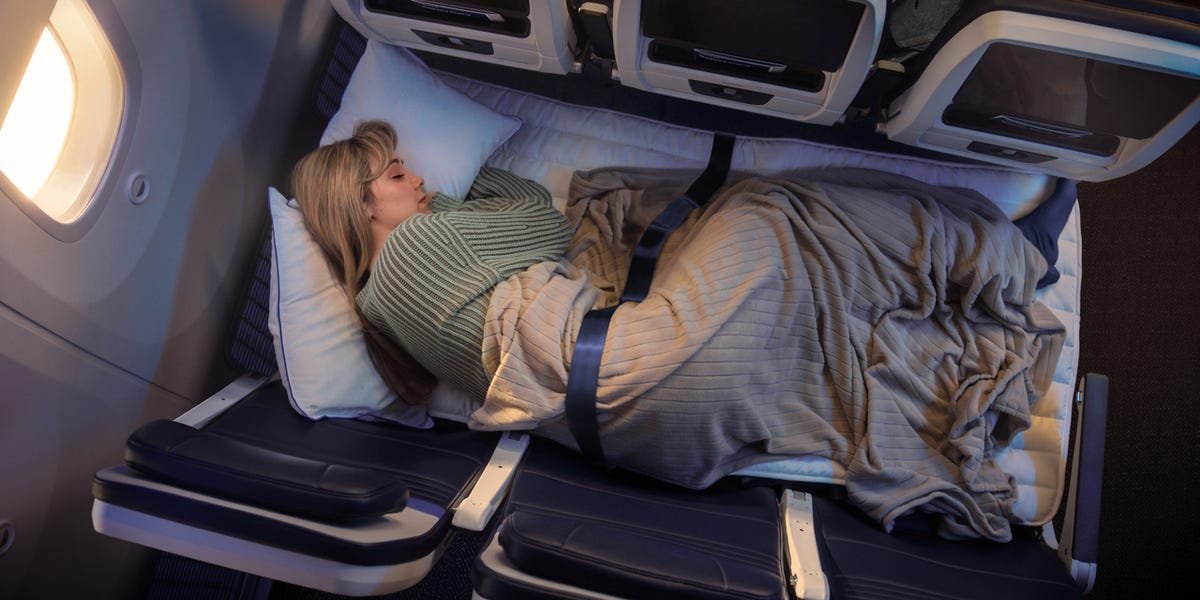
Starting in 2027, United customers flying on certain international flights can book the airline’s new “Relax Row” — a set of three coach seats with legrests that flip up 90 degrees to convert into a flat bed big enough for two adults and a small child.
It’s the same idea as the “Skycouch” on Air New Zealand, one of United’s Star Alliance partners. Other global carriers offer similar bed-like seating in economy by blocking entire rows so passengers can lie across them, but few have adjustable legrests to widen the sleeping surface.
Like the Skycouch, United’s Relax Row, which can also be booked by a solo person or a duo, comes with several special amenities: a custom-fitted mattress, a plush blanket, and two extra pillows. Families get a stuffed toy and kid’s travel kit.
United said that up to 12 Relax Rows, located between the economy and premium economy sections, will be featured on over 200 Boeing 777 and Boeing 787 aircraft by 2030.
It’s unclear how much the upgrade will cost or what routes it will be available on.
United Airlines
The Relax Row is another example of how United is catering to passengers willing to pay more for comfort but don’t need the caviar or expensive bubbly of business class. The carrier reported an 11% increase in premium revenue in 2025.
“Customers traveling in United Economy on long-haul flights deserve an option for more space and comfort, and this is one way we can deliver that for them,” Andrew Nocella, United’s EVP and Chief Commercial Officer, said in a Tuesday press release.
The Relax Row complements United’s premium-economy offering, Premium Plus, which features a reclining lounger, elevated meals, and a leg and footrest, but is more expensive than regular coach.
United joins an international trend
While the Relax Row is a first in the US market, United is far from the first airline globally to think up a bed in economy class.
Air New Zealand patented the revolutionary Skycouch in 2011. Its version can cost from a few hundred dollars to over $1,500, depending on the number of travelers, the route, and the season. Premium economy is usually more.
Beyond the special linens, the Skycouch also came with a “cuddle belt” to strap travelers to the seat when it’s in bed mode. United will likely have a similar seatbelt.
I flew in the Skycouch for 16 hours from Auckland to New York in 2022. I didn’t get priority boarding and received regular economy meals, but the bed was very comfortable for one adult.
Taylor Rains/Business Insider
A number of other carriers have created their own versions of the Skycouch. Japanese airline All Nippon Airways, for example, offers the “COUCHii” — a row of three or four seats with adjustable legrests that flip into a bed.
It’s exclusive to the airline’s Airbus A380 and costs between $96 and $540 per segment for three or four passengers, depending on the season; that jumps to $2,580 for one person with four seats to themselves during peak months.
Rather than design a special seat with flippable legrests, some carriers simply block a row for passengers who pay extra.
German flag carrier Lufthansa, for example, offers a “Sleeper Row” on long-haul flights over 11 hours, priced between $209 and $299 per leg. It can’t be booked in advance; it’s on a first-come, first-served basis at the airport.
Vietnam Airlines has its “Sky Sofa,” a row of three seats intended for one passenger to use as a narrow make-shift couch. It costs between $150 and $650, depending on the route.
Kazakh carrier Air Astana has the same setup. Its “Economy Sleeper” customers also get access to its business-class airport lounges.
Air New Zealand plans to take the coach couch idea one step further with the “Skynest” — two sets of three-high bunk beds in the economy cabin that passengers can book in time blocks.
Airline leaders previously said the Skynest would debut in early 2026, though the quirky sleeping pods have yet to fly. An Air New Zealand spokesperson told Business Insider the Skynest is expected to launch this year “once we receive delivery of our new aircraft.”