

This-Pentagon-announcement-on-an-Operation-Epic-Fury-soldiers-believed.jpeg

This Pentagon announcement on an Operation Epic Fury soldier’s ‘believed to be’ death is very unusual

The Pentagon last week announced the death of a US Army soldier killed while supporting Operation Epic Fury before a medical examiner had positively identified them. Former military spokespeople said that it was an unusual and awkwardly phrased departure from standard procedures.

In a press release titled, “DOW Identifies An Army Believed to Be Casualty,” the Department of Defense announced “the believed to be death” of Chief Warrant Officer 3 Robert M. Marzan, an Army reservist who died during an Iranian strike that also killed five other troops in Kuwait.

According to the release, Marzan, a soldier with the 103rd Sustainment Command, “was at the scene of the incident on March 1, 2026, and is believed to be the individual who perished at the scene. Positive identification of Chief Warrant Officer 3 Marzan will be completed by the medical examiner.”

A defense official told Business Insider a medical examiner has since confirmed Marzan’s identity.


Screenshot of the DoD announcement.

Screenshot of the DoD announcement.

war.gov/screengrab


Prematurely announcing a death risks misidentification, which can erode public trust if corrections are later required, two former military spokespeople told Business Insider. They also said attention to detail and clarity in these communications shows respect.

“When a service member is killed in combat, they deserve better than this,” Joe Plenzler, a retired Marine lieutenant colonel who worked in public affairs during the Global War on Terror, wrote in a post to LinkedIn.

He told Business Insider separately that “it’s a simple matter of respect to make sure that everything is accurate.”

US Central Command, which oversees American military operations in the Middle East, has reported seven US service members killed in action in the Iran war that began in late February. The fatal strike in Kuwait came as Iranian forces launched missiles into countries across the region. Marzan is the only service member in this conflict so far who has been described as “believed to be” dead.

Asked about the statement, the Office of the Secretary of Defense referred Business Insider to the Army, saying, “DOW announces, all follow-on questions go to the Army.” The Army did not provide comment to Business Insider.

Why the Pentagon statement was unusual

Typically, the military refers to a service member whose death has not yet been confirmed as “DUSTWUN,” short for “duty status — whereabouts unknown,” a retired Army spokesman who served during the wars in Iraq and Afghanistan told Business Insider. The term is used when a service member’s absence is involuntary and their status cannot yet be confirmed.

Announcing a death before positive identification by a medical examiner marks a break from norms that governed casualty reporting over two previous decades of war, the former spokesman said. The DUSTWUN designation is intended for situations where ongoing rescue efforts prevent an immediate determination, though recovery of remains is not always required to declare a service member deceased, according to military policies outlining casualty procedures.

“We had thousands of casualties throughout the conflicts in Iraq and Afghanistan and Syria,” said the retired Army official. “I don’t recall ever announcing someone as ‘believed to be a casualty.'”

Few communications are as important or sensitive as announcing a casualty, he said, describing a somber process honed after more than 7,000 US service member deaths during the Global War on Terror, according to Brown University’s Costs of War project.

Plenzler, the former Marine public affairs officer, told Business Insider that all communications related to sensitive topics, including casualties, were generally examined by at least three people before publication because of the heavy impact on public trust.

In his LinkedIn post, he recalled seeing “people removed from leadership positions for getting names incorrect during memorial services.”

While the former Army spokesman expressed disappointment in what they characterized as an awkwardly written DoD announcement, he also noted that many of the personnel who oversaw casualty communications during the height of the previous wars in the Middle East have since left the service, leaving newer troops to manage hard notifications and public messaging.

“We have been sort of out of this business now for several years,” he said.

Marzan, 54, lived in Sacramento and was assigned to an Iowa-based logistics unit. Business Insider could not reach a Marzan family member for comment.

Communicating casualty updates comes with a learning curve, the former Army spokesman said. The details of this release are unclear, but he said he hopes “they’ve learned a lesson from this.”

The announcement comes amid broader shifts in how the military communicates during fast-moving combat operations, including increased reliance on social media updates from combatant commands and the Pentagon. Communications once known for staid military-speak now often feature videos of US missile strikes or jets taking off, strong wartime rhetoric, or posts debunking Iranian “bogus claims.”



Source link

The-Pentagon-says-China-has-fielded-a-new-long-range-missile.jpeg

The Pentagon says China has fielded a new long-range missile. Here’s why the DF-27 is unusual.

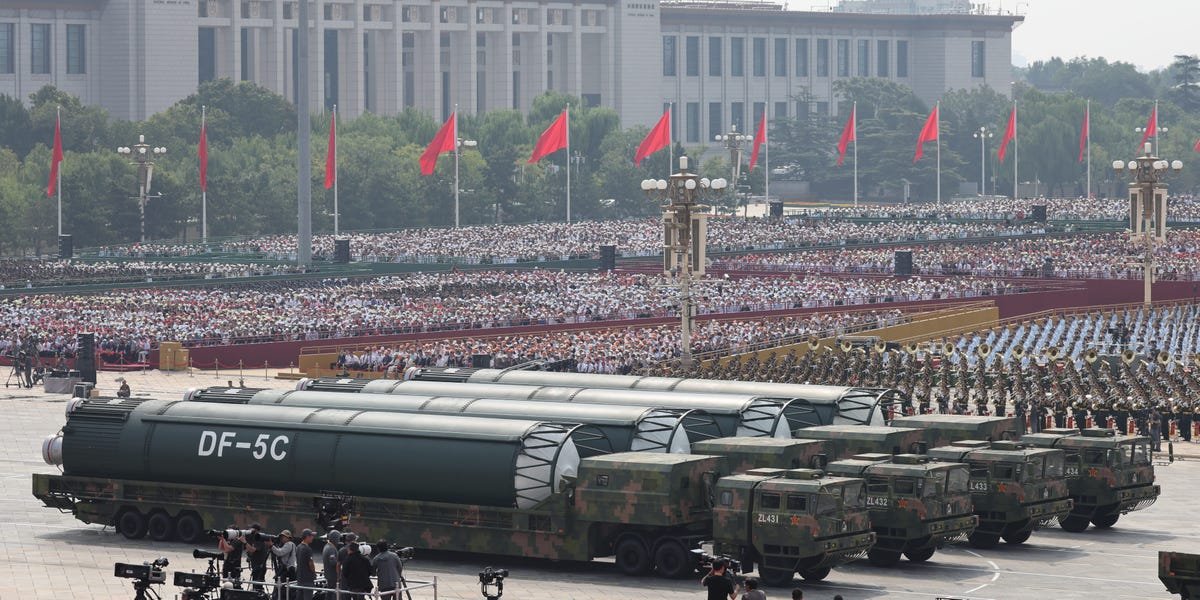
China appears to have fielded a new intercontinental ballistic missile, the DF-27, which can range the continental US and, unlike other ICBMs, serve a mix of missions, including targeting ships, a new Pentagon report says.

The Department of Defense’s annual report on the Chinese military, the latest of which came out last week, is the first public assessment that the missile is operational. The missile is said to have a land-attack and anti-ship role.

The latter role is unusual for an intercontinental-range ballistic missile, as is its conventional strike role documented in the new Pentagon report. ICBMs are primarily for nuclear strike.

The latest report offers little on the new missile beyond a map showing China’s “fielded conventional strike.” The DF-27, identified as an ICBM with a range of 5,000 to 8,000 km, shorter than some other systems built for strategic nuclear strike, is a new addition to that map showing Chinese missile ranges.

That range completely covers Hawaii and Alaska, and it also extends into parts of the continental US. The exact reach might vary depending on the launch site, but broadly, the weapon puts naval forces and US military installations across the Pacific at risk in a new way.

A “long-range” DF-27 missile was first mentioned in the 2021 Pentagon report. It said that indications on the range hinted at either an intercontinental- or intermediate-range missile. That uncertainty persisted until the 2025 report identified it as an ICBM.

The 2024 Pentagon report notably offered the most detail, stating that the DF-27 had been “deployed” to the Rocket Force. It added that this weapon likely has an option for an HGV, a hypersonic glide vehicle, “as well as conventional land-attack, conventional antiship, and nuclear capabilities.” The 2025 report, however, did not put the weapon under “fielded nuclear capabilities.”

According to the Missile Defense Advocacy Alliance, the DF-27 carries potentially significant strategic implications.

In an early assessment of the Chinese missile published two years ago, the group cited a leaked intelligence briefing indicating the missile was tested in February 2023 and warned that it could give China another means to hold targets at risk beyond the second island chain, with a high likelihood of being able to penetrate US ballistic-missile defenses and the potential to serve as a “carrier killer.”

China has not publicly commented on the DF-27, though local media have at times approached the topic indirectly.


A map showing estimated ranges of Chinese missiles outside of the mainland and towards other regions.

The estimated ranges of Chinese missiles across the region and towards the US.

US Department of Defense


Fielding the new DF-27 makes China the first to have an operational, conventionally armed ICBM. The US and Russia have not fielded similar capabilities; however, both have been pursuing new intermediate-range capabilities since the collapse of the Intermediate-Range Nuclear Forces Treaty, which the US walked away from in 2019 after accusing Russia of non-compliance.

The DF-27 is the latest example of China’s efforts to develop and field varied, flexible strike options for a potential conflict. The missile branch of its military, called the People’s Liberation Army’s Rocket Force, has grown exponentially, and Chinese military doctrine emphasizes the need for it to possess the ability to quickly, precisely, and, in some cases, preemptively strike targets.

With the new DF-27 ICBM, “China became the first to field an analogous capability: a conventional ICBM—with an ASBM variant—that can conduct rapid, long-range precision strikes out to intercontinental distances, including against its ‘strong enemy’s’ homeland and its naval forces at sea,” Andrew Erickson, a professor at the US Naval War College’s China Maritime Studies Inistitute, wrote last week.

Since the Pentagon’s annual reports cover only developments from the previous year, the newest one doesn’t include other notable missile developments in China from this year. An important development in September was Beijing’s reveal of the DF-61 and DF-31BJ, both ICBMs, at a military parade.

It’s unclear whether those missiles are operational, but even if they’re still in development, the implications of the presentation in the Chinese capital are that these missiles will eventually be additions to China’s already sizable land-based ICBM arsenal.


Source link

Tom Carter headshot

Tesla just made an ‘unusual’ move — and it could mean a rough end to the year

Tesla had a surprise Christmas present for investors this year: more bad news about its EV business.

Elon Musk’s automaker published a press release on Monday with a consensus of analyst predictions for the company’s latest quarterly sales, the first time it has publicly given Wall Street such a heads-up.

The delivery consensus, which is a compilation of predictions from analysts selected by Tesla, estimated that the EV giant sold 422,850 vehicles in the last three months of 2025, around 14.6% fewer than the same period last year.

That’s lower than Wall Street’s wider expectations. Analysts were expecting Tesla to sell 440,907 EVs, according to data compiled by Bloomberg.

It’s also a surprising move from Tesla, which typically does not issue public communications ahead of critical sales announcements.

Tesla, which is expected to report its latest quarterly sales as soon as Friday, did not respond to a request for comment.

“This is highly unusual for Tesla to send out a press release with quarterly consensus delivery estimates,” said Gary Black, managing partner at Future Fund, which sold its Tesla holdings in May.

Black wrote in the Tuesday post on X that the release suggested Tesla’s Q4 sales were lower than the Bloomberg consensus and were, in his view, likely closer to 420,000.

Investors remain bullish

Tesla’s stock price hit a record high this month amid investor optimism over the company’s robotaxi push, but the Cybertruck maker’s core EV business has had a difficult year.

Tesla was hit hard by the collapse in electric car sales after the $7,500 federal tax credit expired in September.

The company’s US sales reportedly fell to their lowest level since 2022 in November, despite the launch of cheaper versions of Tesla’s bestselling Model 3 and Y EVs.

Things haven’t gone much better outside the US. Tesla has been buffeted by fierce competition from local rivals in China, where an army of EV startups has rolled out high-tech electric vehicles at rock-bottom prices.

In Europe, meanwhile, the US automaker’s sales have collapsed nearly 30% so far this year amid backlash over Musk’s political interventions.

The slump has left Tesla facing a race against time to avoid its second consecutive annual sales decline.

Tesla has rolled out a range of incentives in the US and is pushing to introduce its Full Self-Driving tech in China and Europe, but the surprise delivery consensus estimated that Tesla will end the year having sold over 100,000 fewer EVs than in 2024.


Source link

Santacon London

5 of the most unusual Christmas traditions that non-Americans won’t understand

SantaCon.

  • Every country has its own Christmas traditions.
  • The US is no different, and there are many American traditions that baffle the rest of the world.
  • Hiding a pickle ornament and drinking eggs are some of the most interesting US Christmas traditions.

Christmas is the time for gift-giving, spending time with family, reflecting on the year, and … running around bars dressed up as a drunk Santa?

Like any other nation, the US has its own holiday traditions that might seem confusing to people from other countries.

We’ve chosen five Christmas traditions that are as American as fireworks on the Fourth of July and turkey on Thanksgiving.

Some Americans hide pickle ornaments in Christmas trees, but no one can really agree on how this tradition got its start.
pickle ornament
Pickle ornaments.

Many Americans have a pickle ornament for their Christmas tree. Traditionally, the ornament is supposed to be hidden somewhere on the tree, and the first child to find it receives an extra present, but it’s unclear where this tradition started. One website, Why Christmas, points to two potential origin stories.

The first legend goes that two boys were killed by an evil innkeeper, who put their bodies in a pickle barrel, but a passing Saint Nicholas was able to magically revive them.

The other suggests that a German-born soldier in the American Civil War was imprisoned, and begged for one last pickle before he died. A guard took pity on him and gave him a pickle, which miraculously sustained him.

Another theory posits that the pickle ornament got its start in Germany, per The New York Times, though few people there have heard of it. It is more likely that it was a marketing stunt invented by those importing glass decorations from Germany.

Popcorn is another decoration seen on American Christmas trees.
christmas tree popcorn

While Christmas trees as we know them are said to have originated in Germany in the 16th century and brought to German settlements in Pennsylvania, the popcorn garland is an American thing.

As Christmas trees were a relatively new idea, people had to get creative with their décor. Apparently, recently transplanted German Americans favored using fruits and nuts, thus turning to popcorn, which was ubiquitous.

Per The Daily Meal, this practice was originally meant to help feed birds during harsh winters.

However, the rest of the world might have a hard time understanding why everyone’s favorite movie theater snack would appear on a Christmas tree.

Drinking egg yolks is an American tradition that people from other parts of the world just don’t understand.
A glass of eggnog.
Eggnog.

According to The Spruce Eats, eggnog has its roots in posset, a punch with ale, raw eggs, and figs, served warm. British monks drank posset all the way back in the 13th century.

It eventually crossed over to America, where it was renamed eggnog. Its first known use dates back to 1775, according to Merriam-Webster.

Eggnog typically consists of egg yolks beaten with sugar, milk, and/or cream and your choice of alcohol. Rum, whiskey, and sherry are all acceptable options.

While eggnog might not seem that strange to Americans — even George Washington had his own recipe — it’s a hard sell to the rest of the world, who might not find drinking eggs appetizing, let alone when mixed with rum.

Getting drunk dressed as Santa is one festivity that’s spread to other parts of the world.
santa con

SantaCon’s roots are believed to be in ’70s Danish performance art, according to Vox, but it eventually crossed over to San Francisco in the ’90s, as a protest called Santarchy.

A secret society called the San Francisco Suicide Club was dedicated to pranking the city and generally causing chaos for fun. One of their events, Santarchy, began with members dressing as Santa, sneaking into bars and parties, and inciting mayhem.

Over the years, it became a giant pub crawl. One of the biggest SantaCons takes place in New York City every year, and has been advertised as a charity event.

According to Newsweek, the NYC SantaCon raised over $400,000 in the five years leading up to 2018 by asking participants for donations. The money goes to charities across the city, such City Harvest, The Secret Sandy Claus Project, and The Food Bank for New York City.

Mostly, though, it’s a drunken, debaucherously good time.

Raging bonfires help Santa find his way to homes in Louisiana.
christmas bonfire louisiana
Fireworks explode over a row of fires during the Festival of the Bonfires December 24, 2005 in Lutcher, Louisiana. It is said in Louisiana that the fires from the Cajun tradition help show Santa Claus the way to homes in the area on Christmas Eve.

Christmas bonfires are a Christmas Eve tradition in Louisiana, where tree-shaped bonfires are lit up on the levees that keep the Mississippi River under control.

It’s a Cajun tradition, Cajuns being the descendants of French Canadians driven from French colonies in Canada by the British in the 18th century. The bonfires are said to help Papa Noel (Santa Claus) find his way in the dark.

Hundreds of raging fires up and down the Mississippi River might not be everyone’s idea of an idyllic Christmas Eve.

Read the original article on Business Insider

Source link