
I-moved-to-a-resort-town-in-the-Italian-Alps.jpeg

I moved to a resort town in the Italian Alps 8 years ago. Living here has perks, but it’s no vacation.

When people ask why I settled in the Aosta Valley, they often assume I fell in love with a local or that I’m a ski bum. What actually happened was I fell in love with the region.

I first discovered Courmayeur, my new hometown, in 2018. I had just turned 40, my marriage had ended, and I’d left my job in Edinburgh.

Unmoored, exhausted, and heartbroken, I knew I needed to step outside my comfort zone. An Italian road trip with my rescue dog, Annie, felt like the perfect way to shake things up.

My mom joined us for the first leg. An avid hiker, she suggested we stop for lunch in her favorite mountain town in the Italian Alps. As much as I loved the relaxed, authentic vibe, I never imagined that eight years later, I’d be living here year-round.

Every time I returned to Courmayeur, it felt like coming home


The writer standing in a creek in the summertime.

I ended up staying in Courmayeur longer than I expected. 

Gemma Johnstone


I spent the rest of my road trip exploring Italy, then headed back up north and spontaneously stopped in Courmayeur again for a quick visit.

A few days turned into two weeks — and then turned into a few months, after I found a short-term, low-season rental and decided to stick around. Then, I extended my three-month lease to a yearlong one.

The peace, blue skies, and stunning scenery kept me here. I loved that, within minutes of stepping outside on a daily dog walk, I could be immersed in secluded nature with breathtaking views.

Plus, despite being surrounded by tranquil trails, the town is conveniently well-connected. It’s just a few hours away from Milan, Turin, and Geneva, making it easy for my much-missed friends and family to visit and for me to explore other parts of Europe.

Almost a year into my stay in Courmayeur, I took a short trip back to Scotland. I still wasn’t sure where I wanted to settle down long-term.

However, when I drove back into Courmayeur, I immediately felt such an overwhelming sense of being home that I began the process of securing residency.

Italian Alpine life comes with challenges no one posts about


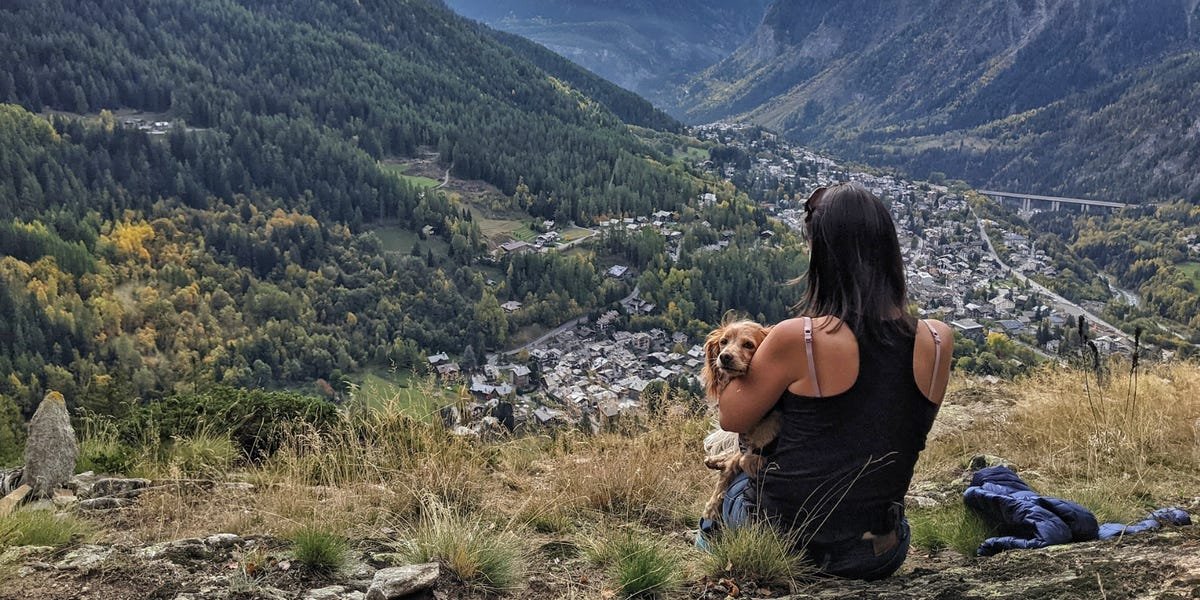
The writer and her dog sitting on a rock in the mountains, overlooking a town.

Living in the Alps is very different from visiting. 

Gemma Johnstone


During that first year, I realized that living in this picture-postcard Alpine resort year-round is very different from vacationing here.

Courmayeur’s population, which is typically around 3,000, swells significantly during the peak ski and summer seasons, and living in a tourist destination has its downsides. I don’t love the traffic-clogging narrow lanes, and the scarcity and high cost of apartment rentals.

During the low season, the town feels deserted. Suddenly, there are swaths of shuttered second-home chalets and closed restaurants. It’s a change of pace that I appreciate, but for those who thrive in a bustling environment, it could feel jarring.

Then there’s the language barrier. My Italian has been embarrassingly slow to improve, and even basic interactions felt intimidating to begin with.

Locals were always polite and helpful — and many working in the tourism industry speak English — but I understandably had to prove myself before I was fully embraced by the close-knit mountain community.

The cost of living is also a consideration; my winter energy bills, for instance, are much higher than I was used to in Scotland. I’m lucky to work from home, but I know seasonal workers who have struggled with long hours, limited days off, and low pay.

Living here is still so worth it for me


The writer and her dog sitting in the snow, looking out at a snow-capped mountain in the Alps.

Courmayeur isn’t perfect, but it was exactly what I needed. 

Gemma Johnstone


Despite the challenges, I don’t regret my decision to stay in Courmayeur.

Living here has confirmed how much I value nature, community, and calmness over status or city life. Moving doesn’t solve every problem, of course, but the right place gave me the space I needed to work through mine.

I find it grounding to live where the seasons dictate the rhythm of life. Of course, there’s skiing in the winter, but in the spring and fall, I help my neighbors with potato and apple harvests. In the summer, I hike to mountain refuges and swim in glacial lakes.

My community here is a mix of lifelong locals and a few expats, and they’ve all expanded my worldview. I admire the dedication and passion of hotel workers, lift operators, and mountain guides, and I love watching burned-out city slickers rediscover their joy for life here.

I’ve learned that life in the mountains of Italy can bring gorgeous nature, a slower pace, and a great community. However, it also requires a pile of patience, flexibility, and honesty about your reasons for moving here. I’ve seen people relocate here — and leave — when their expectations didn’t match the reality.

For me, though, staying in Courmayeur was just what I needed. Life here isn’t perfect, but every time I step onto a mountain trail above the village with my dog, I feel a steady, uncomplicated contentment.


Source link

The-5-vacation-destinations-that-will-be-more-expensive-to.jpeg

The 5 vacation destinations that will be more expensive to visit in 2026 because of tourist taxes

Tourists love Kyoto for its ancient temples, pagodas, and its cherry blossoms. But from early next year, staying in the Japanese city will become more expensive.

After March 1, visitors in Kyoto will face higher overnight taxes on accommodation across the city.

The tax is tiered according to the nightly cost of accommodation: rooms under 6,000 yen, about $38, a night will remain taxed at 200 yen, or $1.28, while the tax on rooms priced between 6,000 and 20,000 yen a night will double to 400 yen.

The steepest increases will be applied to high-end accommodations. Rooms costing 50,000 to 100,000 yen a night will see the tax jump from 1,000 to 4,000 yen, and those over 100,000 yen will rise tenfold to 10,000 yen.

Kyoto’s government estimates the revised tax will generate 12.6 billion yen a year, about $81 million.


Source link

Im-61-with-16-grandkids-Instead-of-downsizing-we-bought.jpeg

I’m 61 with 16 grandkids. Instead of downsizing, we bought a bigger vacation home to finally make family trips work.

This as-told-to essay is based on a conversation with 61-year-old Doug Beachy, a Cincinnati-based business owner who bought a vacation home with Pacaso in 2022. Pacaso is a platform for fractional ownership of luxury vacation homes. The company allows multiple individuals to co-own a second home and share ownership of the property. This conversation has been edited for length and clarity.

I’ve been married to my wife, Jamie, for 37 years. We have four married children and 16 grandchildren. Our oldest grandchild is 12, and our youngest isn’t quite one yet.

Once our kids started having children, they all moved back closer to home in Cincinnati, where we live. We own a five-bedroom home that’s about 4,000 square feet. We’re empty nesters, so there’s plenty of space for us, but when the whole family is over, everyone is on top of each other.

We’ve converted one room into a kids’ playroom and another into a nursery, and we have a finished basement where the kids can play, but family gatherings are still a bit hectic.

In the past, to bring everyone together, we would either rent a large beach house or book a cabin-style retreat in the woods here in Ohio.

We did that about every other year because it’s hard to coordinate everyone’s schedules — especially with grandkids in school — and seasonal rates for a large home are expensive. It was a big chunk of money for just a week’s experience.

We bought a vacation home

Hilton Head Island has always been a fun family destination for us. It’s an island in the Lowcountry of South Carolina, just outside Savannah, Georgia, with about 12 miles of pristine beaches.

There’s so much to do here from a family activity standpoint, in addition to simply soaking up the sun and going to the beach — it’s just a great place to relax and unwind.

Homes here can be expensive, though. The average home is priced in the upper $700,000s, and properties can sell for as much as $10 million. For a while, I thought about buying a second, larger home here, but I’m not retired yet, and I realized that putting that much money into a house where I don’t live full time just didn’t make sense.


An aerial view of homes along the shore in Hilton Head.

Hilton Head Island, South Carolina.

EyeEm Mobile GmbH/Getty Images


In early 2022, I started exploring different homeownership options, including shared or fractional ownership. That’s when I found Pacaso online and saw they had some homes available in Hilton Head.

We ultimately settled on an about 5,000-square-foot home with six spacious suite-like bedrooms — five with king-sized beds, large walk-in closets, and private bathrooms, and one with several bunk beds for the children — and seven and a half bathrooms.

As you can imagine, taking 20 people out to eat all the time is not exactly fun, so we wanted a house with a large, well-stocked kitchen. Our kitchen almost occupies the entire second floor and, by my last count, it can seat 19 or 20 people. It also has a beautiful ocean view.

Co-ownership was the best fit for us

When we bought the home, it was valued at over $5 million. We own a 1/8 share — we made a 50% down payment on our portion of the home — and there are seven other owners, whom we don’t know.

Our friends will say, “It sounds like a timeshare.” But I think it’s much more transparent than a traditional timeshare. There are no extra markups or mystery fees added on top.

I also feel that, unlike a timeshare, which can leave you feeling stuck and lose value over time, this is a long-term investment. Of course, everything depends on the real-estate market, but I feel fairly confident this is an appreciating asset.


Doug Beachy's vacation home.

The Beachy vacation home.

Courtesy of Pacaso


I think going this route, instead of buying another second or vacation home, has eliminated all the concerns I had about upsizing — like having to maintain the home ourselves or deal with high HOA fees. We wanted a place we could share with family, and this setup works well for us at this stage of our lives.

We spend more time together as a family

Pacaso provides a house manager who handles everything. It’s essentially a concierge service — the home is clean when we arrive and fully stocked with towels, linens, soaps, and disposable items, such as paper towels and paper plates.

When we go, the only thing we really need to think about is what food we want to buy, depending on what we plan to cook — and we have a lot of good cooks in the family.

We have the home reserved for 44 nights a year, and we use nearly all of that time. Not everyone in the family is there for every stay, but they come as they please.

Our family gets together more often now, about twice a year. In the summer, during the high season when the kids are out of school, we typically reserve the house for a couple of weeks at a time.


Doug Beachy and his granddaughter.

Beachy and his granddaughter.

Courtesy of Doug Beachy


The grandkids look forward to each trip and talk about it all the time. Many of them are around the same age, and they love the opportunity to spend time with their cousins.

The house came with six beach cruiser bikes, which is perfect because there are plenty of biking trails on the island. It also has a private pool and hot tub, and the grandkids love that it’s fully stocked with games and puzzles.

Our favorite things to do with them are spending time in the pool, watching the sunrise, and hanging out on the beach. We also take a lot of bike rides and play pickleball. We just love how much more quality time we’re spending together as a family.


Source link