
Casinos-are-donating-food-and-basics-to-TSA-agents-in.jpeg

Casinos are donating food and basics to TSA agents in Las Vegas to keep security lines short

As a government shutdown snarls air travel and stretches security lines, Las Vegas’s biggest industry is stepping in to show its support for unpaid TSA agents.

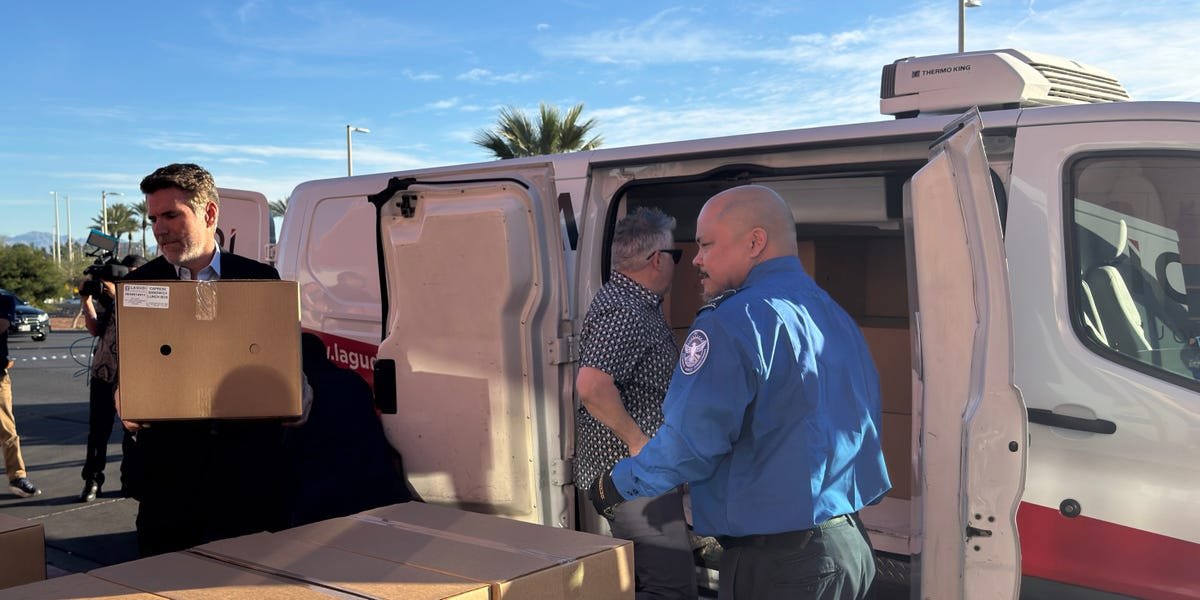
MGM Resorts International — the largest casino company on the Las Vegas Strip with a large portfolio of hotels, including the Bellagio, MGM Grand, and Excalibur — sent meals and care packages to its local TSA agents who have been working without pay for five weeks.

MGM Senior Vice President of Global Security and Aviation John Flynn said the company has so far delivered 1,400 lunches to Harry Reid International Airport, with more planned in the next week. There are more than 1,000 TSA employees at LAS.


MGM volunteers bagging hygiene products for TSA agents.

An MGM spokesperson said company employees volunteered to help bag basic necessities for TSA agents. Items include mouthwash, body wipes, and toothpaste. 

MGM Resorts International


Flynn said it’s critical that TSA agents are supported so they continue to show up for work to keep Las Vegas’ travel industry moving. If travelers worry about long security lines getting home, they may think twice about booking a trip in the first place — potentially leaving hotel rooms empty and casino floors quieter.

“We’re a city built on hospitality; we depend on travel and tourism,” Flynn said in a recorded message shared with Business Insider. “To be able to keep the lines low and to be able to keep that tourism engine thriving, it all happens here at the airport. Without [TSA agents], we wouldn’t have a seamless experience for our guests.”

It appears the donations are helping. I flew through Las Vegas on Monday around 8 p.m. and saw virtually no line in either the general or TSA PreCheck queue. I also cleared PreCheck in less than 2 minutes.


The empty TSA line at Las Vegas airport.

The general and TSA PreCheck lines at Las Vegas airport’s Terminal 1 were empty on Monday night. 

Taylor Rains/Business Insider


Luke Nimmo, a Las Vegas airport spokesperson, told Business Insider that donations from MGM and community members “make a difference,” and that wait times have been normal since the shutdown began over a month ago.

This is in stark contrast to some cities across the US, where lines have snaked around buildings and into parking garages for up to 3 hours. Airlines have had to delay flights to accommodate the lines; some passengers waited so long that they missed their plane altogether.

The chaos has popped up at seemingly random airports; it’s unclear why, though spring break travel has exacerbated the problems at some of them. Hot spots like Houston Hobby, New York-JFK, and New Orleans airports have seen the worst waits.

Nimmo said Las Vegas also saw short lines during last year’s shutdown thanks to “generous donations.” Among them was MGM, which sent 700 meals and personal items like soap and mouthwash to TSA agents in November 2025.

Las Vegas airport has opened a “food and essentials” pantry stocked with non-perishable snacks, ingredients, toiletries, and baby and paper products for TSA and customs agents affected by the shutdown.

But Nimmo said inventory is low and has asked the community for more donations. Stocking non-food products helps agents save money on other basic necessities.


Food pantry at las vegas airport.

Las Vegas airport has a food pantry for employees, but a spokesperson said it’s low on stock. 

Harry Reid International Airport


TSA agents received their first $0 paycheck over the weekend and won’t be paid until Congress reaches a deal to fund the Department of Homeland Security. DHS funding lapsed on February 14 amid a political fight over the Trump administration’s immigration tactics.

It’s unclear if any other casino companies have participated in TSA donations. The Wynn Las Vegas declined to comment; Caesars Entertainment did not immediately respond.

The timing of the shutdown and its subsequent chaos is especially sensitive for a tourism-driven city already navigating economic uncertainty and shifting travel demand.

Gaming revenue is up, but restaurants, retailers, and bars are suffering from declining visitor numbers. The Las Vegas Convention and Visitors Authority says the area saw a 7.5% decline in tourists — roughly 3 million people — in 2025, the city’s largest drop outside the pandemic.

Analysts attribute the decline in part to budget-conscious travelers feeling the pinch amid inflation and the city’s growing nickel-and-dime fees and surcharges. The city is also hosting fewer Canadians who have canceled their travel plans due to political tensions with the US.

Several airports are asking for TSA donations

Airports across the US have called on the community to help TSA agents working without pay. Denver International Airport and Seattle-Tacoma International Airport have set up donation boxes for gift cards and household essentials.

Many smaller airports like John Glenn Columbus International Airport in Columbus, Ohio, Eastern Iowa Airport in Cedar Rapids, and North Central West Virginia Airport near Clarksburg have similarly posted on social media asking for donations.

Denver and Columbus airports suggested gift cards for gas and grocery stores, but asked that they be no more than $20 and specified that they cannot accept Visa gift cards.

The gestures of goodwill are reminiscent of when airline pilots, flight attendants, and their respective unions sent pizza and other goodies to air traffic controllers working without pay during the 43-day-long shutdown in October and November last year.

This shutdown has not affected the pay of air traffic controllers, who work for the Federal Aviation Administration under the Department of Transportation, which is funded and open.


Source link

Head-of-LA-homeless-nonprofit-charged-with-pocketing-millions-splurging.jpeg

Head of LA homeless nonprofit charged with pocketing millions, splurging on luxuries including a Hermès jacket and a trip to Vegas

Authorities have found that some funding to combat homelessness in California has instead ended up in Greece.

The Federal Bureau of Investigation has accused Alexander Soofer, manager of LA-based housing organization Abundant Blessing, of “a years-long scheme to defraud the City and County of Los Angeles and other public entities providing funding for homeless housing.”

According to a complaint filed on Friday, while paying his staff “minimal wages” and feeding residents at his housing sites “ramen noodles, canned beans, and breakfast bars,” Soofer pocketed at least $10 million “through bank accounts associated with other businesses in his and his wife’s names” for personal expenses after “fraudulently obtaining” $23 million in public funding.

Federal officials said that between 2018 and 2025, Soofer’s organization received more than $5 million directly from the Los Angeles Homeless Services Authority and over $17 million through other nonprofits.

Investigators found Soofer’s misuse of funds includes $47,000 in luxury home purchases from stores like Restoration Hardware, $15,000 at Hermès, $15,000 at Chanel, $1,000 for cosmetic dermatology, and $4,500 for a four-night stay at the Wynn Las Vegas.

Authorities said they have yet to determine what Soofer bought at Chanel, but listed his purchases at Hermès as including a $1,250 pair of men’s Paris calf-skin loafers, a $910 pair of women’s Chypre sandals, a $455 Chevaux en Symetrie tie, and a $2,450 men’s trotting jacket.


Screenshot

The same Hermes trotting vest that the authorities listed in the photo section of the complaint.

Screenshot


In addition to luxury brands, the complaint said there is at least one property under his name associated with the misappropriated funds. That property in question is located in Greece and relates to “a $475,000 check issued from an Abundant Blessings bank account.”

The case against Soofer feeds into concerns that California’s efforts to combat homelessness may be ineffective and inconsistent despite large spending. According to the Public Policy Institute of California, as of 2024, the state had over 187,000 homeless people, representing about 24% of the nation’s total.

State Auditor Grant Parks wrote in a 2024 report to Gov. Gavin Newsom and lawmakers that, when his department analyzed five housing programs that received approximately $13.7 billion in combined funding, only two were “likely cost-effective.”

Parks also added in the report that, between fiscal years 2018-2023, California cities lacked reliable data to track cost efficiency and outcomes needed to fully understand why the problem didn’t improve, despite the billions spent by more than 30 housing programs.

The attorney’s office of the Central District of California referred Business Insider to the press release and did not comment further. An attorney for Soofer and the Governor’s office did not immediately respond to a request for comment.


Source link

Im-at-CES-in-Las-Vegas-to-check-out-the.jpeg

I’m at CES in Las Vegas to check out the latest in autonomous driving. Here’s what I’ve learned so far.

  • Robotaxis and autonomous cars once again have a large presence at CES 2026.
  • Several companies, including Amazon’s Zoox, are providing off-site demos.
  • Business Insider is providing an on-the-ground look at the latest in the advanced mobility space.

Business Insider is taking on CES 2026.

I’m on the ground in Las Vegas from Tuesday to Thursday, taking in all there is to know about the latest in the driverless space.

Robotaxis and self-driving cars have already had an outsize presence at the tech conference, especially in the previous hype cycle of the late 2010s and early 2020s.

Things have changed since then. The industry has largely moved on from mere concepts and technology validation to: How are we going to realistically scale autonomy?

It’s day one of the conference, and there’s already a lot to take in.

Nvidia CEO Jensen Huang unveiled the Alpamayo family, which will serve as an autonomous-driving stack for OEMs to deal with those stubborn edge cases — or the “long tail” of self-driving.

Uber and Nuro showed off an early look at the Lucid Gravity SUV that the companies hope public riders will be able to take by late 2026.

I’ll be spending less time at keynotes and speaker events and more on real-life demonstrations and meetings with industry leaders and commentators in autonomy

Think of this as my personal notebook, where I jot down everything I’ve learned and seen at the conference.

Check back in for more updates.

Amazon-backed Zoox is unlike any other robotaxi.

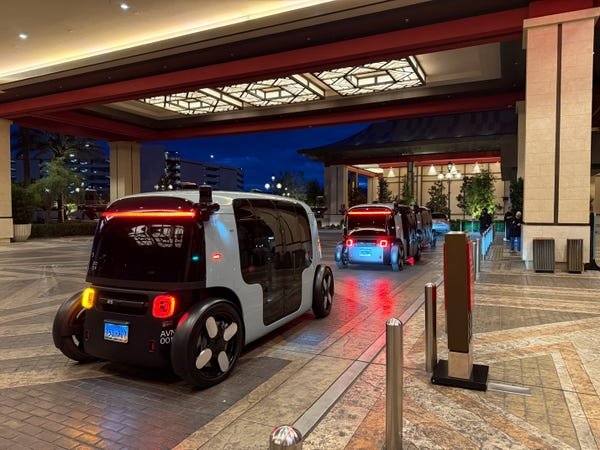
Zoox robotaxis line up in front of Resorts World Las Vegas

Lloyd Lee/BI

This is the first year Zoox, an Amazon-backed robotaxi company, will be giving live demonstrations of its service during CES.

I got to take a ride in one on Monday night in front of Resorts World. (The company tagline that I saw from an ad at the Harry Reid International Airport was: “Don’t just do the Strip. Zoox it.”)

My immediate thoughts were that Zoox feels unlike any other robotaxi or pseudo-robotaxi on the market. It felt more like I was on a theme park ride than in an everyday car we’re familiar with.

Unlike Waymo’s robotaxis, Zoox is not a regular car you could buy that’s been retrofitted with sensors. The Zoox car is bi-directional — meaning there’s no real front or back of the car — and the inside has no steering wheel, just seats.

The robotaxis were clearly a great tourist attraction from what I saw. My Uber driver wasn’t too happy about them.

Uber, Lucid, and Nuro have big plans to scale.


Uber, Lucid, Nuro

Left to right: Uber’s Sarfraz Maredia, Lucid interim CEO Marc Winterhoff, and Nuro cofounder Dave Ferguson.

Lloyd Lee/BI

Uber, Lucid, and Nuro had a swanky cocktail hour at Fontainebleau Las Vegas, where they quite literally wined and dined a room full of reporters, analysts, and investors: endless glasses of wine and an open bar, lobster tails, jumbo shrimp, too many appetizers to count, and a giant charcuterie board — the works.

Maybe understandably so? 2026 will be a big year for the three companies.

Uber’s plan is to roll out a robotaxi service by late 2026. The first market is San Francisco, where Uber will directly compete with Waymo. These two companies are partners in other markets, like Austin.

“We’ve been moving very, very quickly,” Nuro’s co-CEO and cofounder Dave Ferguson said. “We signed this partnership last July. We’re already testing the production-intent vehicles on public roads. And very soon, we’re going to have tens of thousands of them worldwide.”

Here’s a 60,000-pound John Deere combine for scale.


John Deere

John Deere’s X9 combine.

Lloyd Lee/BI

A quick image to get a sense of how big CES’s mobility division is at West Hall of the convention center: There’s a 60,000-pound combine from John Deere that’s sitting in the middle of the showroom.

The combine is one of the world’s largest on the market, according to Julian Sanchez, an engineer at the machinery company.

Even so, John Deere doesn’t even have the largest footprint on the floor. This year, it’s Hyundai.

The combine isn’t autonomous in the way we think about self-driving cars, Sanchez told me, but it is self-steering.

The world got a reality check on self-driving cars since the last hype cycle.


Tensor

Tensor aims to sell a personally-owned vehicle that will have Level 4 driving.

Lloyd Lee/BI

There’s a lot of talk of self-driving cars in the automotive industry, but the scope of what it can realistically achieve has narrowed down in the last decade or so.

Paul Costa, an ex-Apple veteran of 25 years who worked on the company’s abandoned self-driving car project, gave me a bit of interesting color from what he saw at CES in 2015 — when the driverless car hype was reaching its peak — and what’s different now.

“My sense at the time was that people really wanted to focus on Level 5 autonomy,” Costa, who now leads Ford’s electrical engineering team, told me. Level 5 is the highest level of autonomous driving set forth by the Society of Automotive Engineers. That means full autonomy in all weather conditions and no geofences. Waymo is currently Level 4.

The tone has been brought down to reality, according to Costa. The focus is on highly advanced driver assistance systems and eyes-off driving or Level 3 systems, he said.

“Now, I feel like here in 2026, L3 is extremely interesting,” Costa said. “It’s interesting for me to see how the industry — its focus has changed over the years.”

Signup Today: Connectivity and Tech Pro by Business Insider Intelligence


Source link