
Aggressive-resellers-are-ransacking-Goodwill-bins-and-vintage-stores-Their.jpeg

Aggressive resellers are ransacking Goodwill bins and vintage stores. Their finds sell for big money.

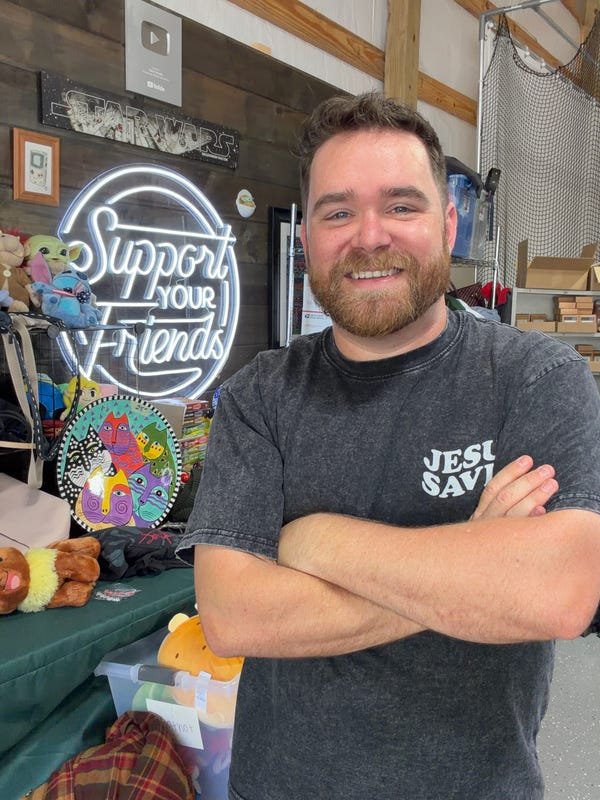
Chris Hatfield is a self-described “fast nickel, not slow dime” seller. This emphasis on speed makes sense given the eye-popping amount of product he moves: Hatfield, 43, spends five days a week digging through Goodwill bins in Texas. He and his wife, Stacy, aim to scoop up 150 to 200 pounds of clothes, bags, and other items — priced at $1.99 per pound — each day. He calls her strategy for grabbing merchandise “the claw machine,” snagging anything decent in sight. By contrast, he says he’s more judicious — he doesn’t wear gloves so he can feel quality out. At night, they flip their finds on Whatnot, a livestreaming auction site. Their average sale price is $11.21 per item, which doesn’t sound like a lot, but when you’re selling 150 pieces at a time, it adds up. “Our typical goal is to make $1,000 profit every day,” Hatfield tells me, on the phone from the Goodwill parking lot.

The resale economy has exploded in recent years. The US secondhand apparel market is expected to reach $79 billion by 2030 and is growing four times as fast as the retail clothing market, according to a new report from consignment platform ThredUp and retail analytics firm GlobalData. Per Morning Consult, nearly half of American consumers say they’ve made a secondhand purchase over the past three months.

The boom has led to an influx of professional or professional-ish resellers looking to make a buck. They hawk large amounts of merchandise on platforms such as eBay, Depop, and Whatnot. They say they add value to the items they turn, by fixing them up before selling them or having a discerning curator’s eye. Critics, however, argue that they cause arbitrary price inflation in secondhand markets and create artificial scarcity by scooping up in-demand merchandise. Are these people service providers saving clothes from landfills, or are they middlemen extractors taking affordable goods away from those who need them? Depends who you ask.

Hatfield, a former pest control guy who’s been in the reselling business for a decade, used to go live directly from inside a Goodwill outlet and auction off merchandise before buying it, but that location closed, and the new one’s hours make the logistics impossible. He estimates that about three-quarters of his customer base is other resellers, which is fine by him. They’ll sometimes tag his brand, Flip the World, on social media, which gives him a boost. The other night, he saw that a woman who bought a dress from him for $39 went on to sell it for $140. “I’m not trying to get max dollar because I know the next day I’m going to be right back here digging,” he says.

It’s not lost on Hatfield that his activities can sound a little icky. He’s seen posts online calling him a “creepy guy that sells dirty clothes” and readily admits that the bin digging can get aggressive when a swarm of resellers is trying to get their hands on goods. “I’m OK with it,” he says of the noise. After all, he tells me, he’s covered head to toe with tattoos. “I’m that weird guy.”


A man standing outside of Goodwill posing with a cart.

Hatfield with a haul. He is, indeed, that weird guy. 

Chris Hatfield/Flip the World


Reselling is hardly a new phenomenon. The Salvation Army was founded in 1897, Goodwill in 1902, as large-scale production made it possible to accumulate so much stuff that people needed to part with their older possessions. In the 1920s and 1930s, flea markets became popular among artists and musicians, and the term “vintage” began to appear by midcentury, partly as a rejection of the middle class. Thrift stores flourished during the economic turmoil of the ’70s, and then came ’90s grunge. Across generations, shopping secondhand is perpetually being rediscovered.

“Periodically, young people think, ‘Oh, wow, this is a really cool resource, why hasn’t anyone thought of this before?’ And they do, they have, and every generation kind of makes it their own,” says Jennifer Le Zotte, an associate professor of history at the University of North Carolina, Wilmington, and the author of “From Goodwill to Grunge: A History of Secondhand Styles and Alternative Economies.”

The internet and the sheer scale of modern mass production have pushed the resale market into its latest iteration. You no longer have to go to a thrift store to buy something secondhand — you can do so with a few taps on your phone. Instead of hauling an old coat to a local consignment shop, you can upload it to Depop in a few minutes. And the world is swimming in merchandise: In textiles alone, over 100 billion garments are produced each year, double the amount made in 2000.


A couple hold up one of their finds in he parking lot of a Goodwill. She's smiling, he's making a funny face.

Chris and Stacy Hatfield show off one of their finds in the Goodwill parking lot. 

Chris Hatfield/Flip the World


“There’s just so much more supply out there,” says Haley O’Sullivan, vice president of customer experience at Depop, an online fashion marketplace that’s being sold by Etsy to eBay.

It’s made it easier and more appealing than ever to become a supplier.

It’s hard to suss out how many resellers are professionals or rely on it as a significant source of income, but the cohort is certainly growing. Small and medium-sized businesses account for 70% of eBay’s sales in its largest markets (in the US, the platform defines a small business as anyone doing over $10,000 a year in sales). James Reinhardt, the CEO of ThredUp, tells me there are “degrees” of professionals. “I think about Uber — there are people who drive for Uber, and they do it full-time. And then there are people who drive for Uber for three hours on the weekends,” he says. “And are they professionals? Are they casual?” Many resellers start out casual and later move into it in full force.

That’s what happened with Crystal Maus, a South Dakota mom whose first flip was a Burberry coat that someone donated to a community organization supporting the homeless while she was volunteering. (She donated the proceeds back to the organization.) Recognizing the potential opportunity, she bought $100 worth of items at her local thrift store, “none of which were good buys,” but eventually got better and expanded what’s now her full-time eBay business from there. Maus’ is a volume play — she lists 350 items a week and grosses $15,000 to $20,000 a month. She sources in bulk, from online auctions, liquidations, and inventory offloaded by buy, sell, trade stores. “If I could find a pallet of Chanel bags for a good price, I would love that, but everybody would love that,” she says, adding that there’s “almost zero barrier to entry” for getting into reselling.

Rob and Melissa Stephenson, in Florida, have gotten so heavily into reselling that their main source of income is no longer reselling — it’s selling courses that teach others to resell. Their free intro video series promises to help pupils make $100 in seven days. “There’s so much stuff everywhere, there is not any near future where we’re creating crazy, crazy competitors,” Rob says.

When they do resell, the couple goes for individual items they can turn around for large profits — they’ll buy something for cheap on Facebook Marketplace, for example, and then sell it on eBay, where they’ve got access to a broader base of potential buyers. “It’s really easy to sit in your La-Z-Boy, find something on Marketplace, do the comps on eBay to figure out what it’s worth, send an offer on Marketplace, and then just go pick it up, bring it back, list it on eBay, and sell it,” Rob says. He describes a recent trip to Boise, Idaho, during which he found a steam oven in the back of a thrift store, picked it up for $1,000, and sold it on eBay for $15,000. “I don’t buy anything unless I can 10x it,” he says. They recently bought a house with an eight-car garage underneath it to store their inventory.


In the popular imagination, thrifting exists as a couple stumbling upon a buried treasure at a quaint Main Street shop, a teenager scoring a vintage concert T-shirt to impress their friends, or someone in need finding used office clothes to wear for a much-needed new job. The current reality is much thornier: The secondhand industry has come to reflect our global capitalist churn and the good, bad, and ugly that come with it.

If the tradeoff is reseller vs. landfill, the moral calculation is straightforward, but when it’s bin-diving reseller vs. in-need consumer, it’s not so clear-cut.

Daniel Burkett, a philosophy professor at Binghamton University, tells me resellers can divert resources from where they would have a better impact. “If I go and buy a nice suit jacket and then I flip it for a $20 profit on eBay, look at the good that’s bringing me, but then look at the good that might bring somebody who needs to go for a job interview,” he says.


A picture of bins willed with clothes and other items at Goodwill.

Swimming in this trash is (allegedly) treasure. 

Chris Hatfield/Flip the World


Some resellers told me they worry about their comrades’ tactics. Hatfield and a fellow reseller host a free weekly Q&A to try to steer people interested in the field in the right direction — or at least not in the wrong one. He worries some sellers get too aggressive on their streams and try to guilt customers into buying or run items so low that they’ll never be able to make money. “If you do a bunch of giveaways, you’re only going to get people to come to your shows because they want to win something for free, not because they want to invest into your business and your lifestyle and to support you and your family,” he says.

To be sure, there’s no shortage of, for example, cheap clothing or housewares. But the conflict isn’t just about need, it’s about want. Spending an hour in line at a sample sale to watch five resellers at the front bag everything up is infuriating. When you’re shopping at an estate sale or a thrift store, you don’t want resellers pushing you out of the way to get their hands on items they ultimately want to sell back to you for four times the price. The same goes for trying to get Pokémon cards at Target. One reseller I spoke to for this story had gotten into a fistfight with another reseller the same day we spoke.

To ensure regular customers get a fair shot, some retailers and sellers limit how much merchandise people can buy. On the other hand, some companies have relationships with resellers that allow them to offload their merchandise. When the name of the game is to sell, it’s hard to be too concerned about who to.

Onney Crawley, Goodwill Industries International’s chief marketing officer, says resellers contribute “meaningfully” to their stores’ performance, but they’re aware of the frustrations that come when some shoppers see them “quickly moving through and cherry-picking” merchandise. “Our challenge is to ensure we maintain an environment where everyone can have a good experience,” she says, which includes keeping the inventory flowing.

Professional resellers do offer benefits to consumers. Many of them curate their selections, saving end customers legwork and taking the time to evaluate value and quality. Even if they’re mainly focusing on volume, they’re doing the work to dig stuff up. Expertise can take different forms, whether it be spotting a vintage designer bag or being willing to wake up at 6 am to stand in line at a sample sale.

“It’s a fair game at the end of the day,” Elias Marte, a vintage watch dealer and one of the partners for Alfargo’s Marketplace, a menswear pop-up in New York.

The pros are also versed in the blocking and tackling of selling. Dealing with a pro-reseller may lead to a better overall buyer experience with shipping, listings, and returns, as well as faster customer service responses. Avritti Khandurie Mittal, vice president of product at eBay Services, tells me the pros “raise the baseline for reliability across the marketplace.”


The resale business is almost certain to accelerate going forward, bringing professionals and side hustlers with it. There’s no slowing in the production of new stuff, and trend cycles are hastening — a lot of what many resellers make their money on isn’t vintage finds, it’s fast fashion, random merchandise, and items that have quickly cycled into the “uncool” graveyard. AI could further speed things up by making it easier for sellers to list items and field customer questions. The reselling space has grown so much that it’s creating its own crop of influencers who make more money talking about flipping than actually doing it.

That’s indeed the case for Joshua Varnell of South Carolina, who, with his wife Hayley, runs Hairy Tornado. Their YouTube channel has nearly half a million subscribers, and the content they post there and on Facebook accounts for about 70% of their revenue. Their videos about hitting up flea markets, Goodwill bins, and Amazon overstock stores consistently rack up thousands of views. As to what they do still sell — largely on Whatnot — Varnell laughs and says it’s basically anything they think they can make money on. They made $10,000 selling a collection of rocks and crystals they got from a guy at a flea market who had them in the back of his truck. “I guess our rocks were good,” he says.

Joshua Varnell on the set of his Whatnot show.
Joshua Varnell/Hairy Tornado

A peek behind the scenes.
Joshua Varnell/Hairy Tornado

Clutch for looking and selling your best: a ring light.
Joshua Varnell/Hairy Tornado

This doesn’t sound like the most grueling work, but it’s not for the faint of heart, either. Even with the YouTube money rolling in, Varnell and his wife still go out to buy three or four days a week. He knows people who go to the thrift store multiple times a day and describes seeing other Whatnot sellers who livestream from clearance sections at Disney Springs in Florida and offer to buy and ship their finds to bidders for a profit — creating a convoluted form of online shopping.

“You have the haters that just think resellers mark everything up to some crazy price, but every item has a market value. Your job as a reseller is to find it at a place that is underpriced,” he says. “I don’t control what the market is willing to pay for some vintage L.L.Bean sweater, but if I can find it for a dollar, that’s obviously going to be profitable.”

Reselling may be somewhat of a meritocracy, but it’s one that’s been warped by rampant consumerism and the ruthless desire to make money. As long as the machine keeps running, there will be people like Hatfield and Varnell (who are friends, by the way — the former has a tattoo of the latter on his thigh). And they’ll be sitting in the parking lot, waiting to turn the excess into profit.


Emily Stewart is a senior correspondent at Business Insider, writing about business and the economy.

Business Insider’s Discourse stories provide perspectives on the day’s most pressing issues, informed by analysis, reporting, and expertise.



Source link

Headshot of Chris Panella.

Israeli combat footage shows it bombing vintage American-made fighter jets in Iran

Israel shared new footage of it bombing two of Iran’s American-made fighter jets preparing to take off as joint US-Israeli combat operations against Iran continue.

Iran’s fleet includes several vintage US aircraft, including the McDonnell Douglas F-4 Phantom II and legacy Northrop Grumman F-5s. Along with Iran’s few US-provided Tomcats, which were iconized in the “Top Gun” movies, these aircraft are part of an aging Iranian Air Force that has limited air combat capabilities against advanced Israeli and US aircraft.

The Israel Defense Forces video captured strikes on the F-5 and F-4 jets at an airport in Tabriz in western Iran on Sunday morning. The IDF said that it hit the aircraft as they were preparing to take off. The footage shows direct hits on each aircraft.

Israel and the US launched massive attacks on Iran on Saturday, dubbed Operation Epic Fury by Washington and Operation Roaring Lion by Israel. The attacks are aimed at eliminating Iranian leadership and ushering in regime change in Tehran. As of Sunday, Israel and the US say they’ve taken out dozens of Iranian officials, including Supreme Leader Ayatollah Ali Khamenei.

Iran has launched several phases of retaliatory missile and drone strikes against Israel and bases hosting US troops in the region, including Qatar and the United Arab Emirates. The US and Israel have said the operations will continue into the coming weeks.

In sharing the video on the F-4 and F-5 strikes, the IDF said the attacks “were conducted to degrade the Iranian Air Force’s activities and to further expand the degradation of their aerial defense.” The US has said operations are aimed at crippling Iran’s military.

Vintage US-made aircraft


An F-4 Phantom II aircraft painted with a camouflage color scheme.

The F-4 Phantom II was a workforce fighter bomber for the Air Force and Navy during the Vietnam War.

Vincent De Groot/185th Air Refueling Wing, Iowa Air National Guard


Iran operates a fleet of aging aircraft, including some that are US-made but have become obsolete over the years due to international sanctions and embargoes that have prevented the country from modernizing its fleet.

The F-4 Phantom II, manufactured by the McDonnell Aircraft Corporation and later McDonnell Douglas, now part of Boeing, entered service in the US in early 1960s and was a workhorse during the Vietnam War and Cold War. The two-seat, twin-engine fighter was flown by the US Air Force, Navy, and Marine Corps for decades as a principal air superiority fighter.

Through the 1970s and the end of the 20th century, the F-4 was gradually replaced by the F-15 Eagle, F-16 Fighting Falcon, and F/A-18 Hornet, as well as the F-14 Tomcat for various US armed forces.


A F-4 Phantom II is seen sitting on tarmac.

The F-4 was retired by the US in 1990s, while other countries gradually stopped flying the aircraft through the 2020s.

AFSC/Defense.gov


Prior to the 1979 Iranian Revolution, which upended ties, the US sold many of these aircraft to Iran.

Iran still fields large numbers of the aging fighters — among the most numerous of these Cold War designs still in service globally — but their operational rates have fallen sharply due to sanctions and the difficulty of sustaining upgrades and spare parts.

Iran has kept some aircraft flying due to reverse-engineering, but it’s been estimated to only have about 60 F-4s, fewer than 50 F-5s, and 20 to 30 F-14s in its inventory. Combat over the past year may have reduced those numbers even further.

Actual airworthy numbers are likely lower than reported, with some jets stripped for parts. Iran’s effective airpower remains contested and constrained by attrition and long-running maintenance hurdles.

In contrast, Israel and the US fly newer, more powerful aircraft, including the fifth-generation F-35 stealth fighter, as well as a mix of highly capable fourth-generation jets like F-16s and F-15s.

In previous conflicts, as well as the current one, Israel has said that it’s achieved air superiority over swaths of Iran with a mix of fourth- and fifth-gen fighters and by degrading Iran’s air defenses.


Source link

levittown 1950s

Vintage photos show daily life in America’s first ’50s suburb


Bernard Hoffman/Getty Images

Updated

  • Thanks to the postwar Baby Boom and other factors, families in the ’50s began moving to the suburbs.
  • Levittown in Long Island, New York, is widely recognized as the first modern American suburb.
  • Each home looked the same — they were all built in the Cape Cod-style and cost around $7,000.

As World War II came to an end, families looked for ways to start over. Emboldened by the GI Bill’s provisions for home loans, they moved out of the cities in droves for newly developed suburban communities. 

In fact, the suburbs expanded by 47% during the 1950s, according to the Gilder Lehrman Institute of American History.

Levittown in Long Island, New York, was one of the first to introduce the idea of a pre-planned, mass-produced uniform suburban community, The New York Times reported. Families started moving there on October 1, 1947.

Though the community welcomed an influx of families, non-white prospects weren’t allowed. Notably, African Americans didn’t see the same benefits from the GI Bill, and it would take some years before racial and ethnic minorities broadly shifted to the suburbs.

Here’s what it was like to live in America’s first modern suburb in the 1950s. 

Before the 1950s, people mostly lived in cities to be close to factory jobs.


children in 1940s


Historical/Getty Images

At the time, most people lived close to the city center to work in factories, or they lived in rural communities to work on farms, according to economist Jay Zagorsky.

Everything changed in the 1950s when soldiers returned from World War II, sparking the great migration to the suburbs.


soldier returns home from war


Irving Haberman/IH Images/Getty Images

The 1950 Census found that 60% of people lived in cities, while 40% lived in the suburbs. 

Thanks to factors like the construction of highways, the development of new neighborhoods from farmland, and even safety in the event of an atomic attack, these percentages would soon shift drastically.

The GI Bill made it easier to afford a new home, prompting this transition from urban to suburban.


levittown 1950s


Newsday LLC/Getty Images

The GI Bill provided each returning soldier with benefits designed to stimulate economic growth. Each soldier was given a year of unemployment and free tuition to go to college. The military pledged to back all home loans, which allowed veterans to buy houses with little to no down payments. 

The Baby Boom started at the same time, causing many families to outgrow their city apartments.


A family of four stands in front of their house in Levittown, NY.


Joseph Scherschel/Getty Images

Shortly after WWII ended, the Baby Boom began. In 1946, 3.4 million babies were born, more than ever before, and 20% more than in 1945, per History.com. This trend continued into the ’50s.

By the end of the boom in 1964, this generation made up 40% of the country’s population.

Most historians think it was because Americans were eager to have families after having postponed marriage and childbirth because of the Great Depression and World War II.

Whatever the reason, people flocked to the suburbs to accommodate their growing families.

In response to this growing need for space, suburban communities popped up at a faster rate in the ’50s.


aerial view of suburban community

An aerial view of a suburban community.

Hulton Archive/Getty Images

During the war, factories focused on creating wartime essentials, like airplanes and barracks. In the ’50s, they refocused their efforts on building home components and automobiles using the new practices — like the assembly line — they implemented in the war,

As a result, factories were able to produce materials for homes faster than ever before.

Levittown in Long Island, New York, is widely recognized as the first modern American suburb.


levittown 1950s


Tony Linck/Getty Images

Levitt and Sons, a construction company, purchased a 7-square-mile plot of potato and onion farms in Long Island in 1947. They set out to build one of the first uniform suburban communities in the US.

People flocked to home sale events to get themselves a slice of suburbia.


home sale in levittown


Al Fenn/Getty Images

The first homes in Levittown cost new residents around $7,000, The Guardian reported. For veterans, there was no down payment.

When adjusting for inflation, a Levittown home in 1950 would be roughly $97,000 in today’s money.

Every house in Levittown was identical. The Levitt family called it “the best house in the US.”


levittown


Joseph Scherschel/Getty Images

At first, all the homes were built in the same style, and some residents even admitted to walking into the wrong house at times because they couldn’t tell them apart, according to Khan Academy, citing Kenneth T. Jackson’s “Crabgrass Frontier: The Suburbanization of the United States.”

Outdoor spaces, like backyards, became focal points.


levittown


Robert W. Kelley/Getty Images

With the growing number of children, outdoor spaces became increasingly important to the suburban neighborhood. 

Inside each home, there were four rooms, a built-in TV set, and Hi-Fi for the radio.


levittown interior


Joseph Scherschel/Getty Images

At first, they were modest homes, but most families saw their new suburban lives as luxurious. 

Most Levittown residents experienced the responsibilities of owning a home for the first time.


A man and a woman clean opposite sides of a window.

A man and a woman clean opposite sides of a window. Many homeowners experienced the responsibilities of owning a home for the first time.

Newsday LLC/Newsday via Getty Images

Many Levittown homeowners learned homeownership responsibilities, such as tending to a lawn.

The suburb helped cement the idea of the “nuclear family” in American culture.

Levittown also had seven shopping centers.


levittown suburbs


Underwood Archives/Getty Images

The shopping centers were called “village greens” and were designed to make the town more of a bustling community, per Encyclopedia.com.

The suburbs were also known for being a safe alternative to the gritty city streets.


levittown school


Joseph Scherschel/Getty Images

Since the streets in the suburban neighborhood were considered safer than those in the city, parents used to allow children to bike around by themselves, per the National Center for Safe Routes to School.

Levittown was also known as a cheaper option compared to an apartment in the city.


levittown 1950s


Bernard Hoffman/Getty Images

The mortgage on a home in Levittown was reportedly about $29 per month, while most paid $90 per month in the city. 

By comparison, the average rent in New York City in 2026 is just under $3,500, according to Zillow. The monthly cost of a 30-year mortgage on a Levittown home today would be roughly $2,000.

With all the amenities and perks, the community grew rapidly. In less than a decade, the population of Levittown reached 82,000.


levittown


Bettmann/Getty Images

The community has over 17,000 homes, making it one of the largest private housing projects in the history of the US.

As a result, Levittown became a model for other suburban communities in the US during the 1950s.


suburban community in the 1950s

A suburban community in the 1950s.

Joseph Scherschel/Getty Images

Suburban home construction boomed in the 1950s. In fact, at least 15 million units were under construction by the end of the decade, according to the Wealth Management Group.

Although suburban communities boomed in the ’50s, the shift was reserved for white Americans.


levittown family


Joseph Scherschel/Getty Images

For years, there were rules that restricted minorities from buying homes in Levittown, and even as the Civil Rights Movement was starting to take form and the rest of the country began integrating after Brown v Board of Education in 1954, Levittown remained mostly white.

Two-thirds of Levittown residents today are white, according US Census estimates.

Some of the few non-white families resisted this standard.


William Cotter's Levittown home, plastered with signs.

Some non-white residents like William Cotter and his family fought against Levittown’s whites-only standard.

Newsday LLC/Newsday RM via Getty Images

In 1952, William Cotter, a Black man, and his family, sublet a home at 26 Butternut Lane. When the lease was up, Levitt refused to renew it or sell them the home.

The refusal sparked support for the Cotters, and the family eventually purchased another home from a white homeowner.

With modern highways leading to the suburbs, men commuted into the city.


Traffic on a highway near Levittown, New York.

New highways leading to the suburbs didn’t come without traffic.

Newsday LLC/Newsday via Getty Images

The suburban boom corresponded with the expansion of interstate highways in the US, starting the modern iteration of the commute from the suburbs to the city.

In 1950, 80% of men in Levittown commuted to Manhattan for work, The Guardian reported.

During a typical day, the streets of Levittown were filled with women, as the men were mostly working in the city.


levittown women


Bettmann/Getty Images

When men left to fight in WWII, women began entering the workforce, gaining newfound independence and freedom. However, they were suddenly expected to give this up again and instead focus on childbearing and rearing.

In 1963, author Betty Friedan wrote in “The Feminine Mystique” that the suburbs “were burying women alive.” However, some believe that women’s dissatisfaction with staying home “contributed to the rebirth of the feminist movement in the 1960s,” History.com reported.

Women also got active in civic engagement.


Women and children protest in favor of new stop signs.

Women and children protest in favor of new stop signs.

Newsday LLC/Newsday RM via Getty Images

In 1959, women of Levittown, with children in hand, protested in favor of putting stop signs in an area with automobile-related deaths.

Levittown became a symbol of prosperity and anticommunism in American politics and culture.


William J. Levitt speaks with three senators.

William J. Levitt speaks with three senators.

Bettmann/Bettmann Archive/Getty Images

As American politics increasingly centered on anticommunism and Cold War tensions rose, Levittown and suburbs like it took on a symbolic meaning in American culture, representing prosperity and the “American Dream.”

Levitt was once quoted saying, “No man who owns his own house and lot can be a Communist. He has too much to do.”

In 2026, Levittown is still a sizable community with a population of about 50,000. Though it’s full of modern businesses and technology, the community still holds a legacy as a post-war suburban haven.


Source link

THEN-AND-NOW-Vintage-photos-show-how-department-stores-have.jpeg

THEN AND NOW: Vintage photos show how department stores have changed

  • Department stores have changed dramatically over the last 100 years.
  • Department stores once sold necessities. Now, many are struggling to remain in business.
  • While some classic chains cease to exist, other retailers have found ways to increase sales.

In the early 1900s, department stores existed to sell necessities, including food, home goods, and apparel.

Today, many luxury department stores are struggling to survive.

The rise of the internet and surge in online sales have placed a major strain on department stores. Saks Global, the parent company of Saks Fifth Avenue, Bergdorf Goodman, and Neiman Marcus, became the latest department retailer to file for bankruptcy on Tuesday.

Take a look at how department stores have changed over the last 100 years.

In the early 1900s, department stores were focused on selling the necessities.

A Harrods department store.

Heritage Images/Getty Images

Core products included clothing and home goods. During times of war, the necessities on sale included military jackets, coats, and accessories.

That’s why Harrods, a famous department store in London, featured an in-house tailoring room throughout World War I. The space was utilized to alter used uniforms and sell new ones.

Department stores still sell the basics, but novelty items are also typically present.


Harrod's Department Store holidays

A modern Harrods department store.

Prisma by Dukas/Getty Images

You can find everything from household tools and fashionable clothes to toys and knickknacks at modern department stores — they seem to sell everything, in an apparent bid to compete with online retailers.

Harrods also sells store-branded items, including bags, stationery, and teddy bears.

Leading up to the 1930s, department stores were often crowded.


An old photo of a crowded department store.

A crowded department store.

Bettmann/Getty Images

Around 1929, people were encouraged to shop in order to help boost the nation’s sinking economy, Fortune reported.

But that same year, the stock market crashed, and the Great Depression officially began. The period lasted for 10 years, causing major layoffs, failing banks, and mass poverty.

Today’s department stores rarely see such large crowds, aside from major shopping events like Black Friday.


Macy's on Black Friday/

A Macy’s department store on Black Friday.

Kamil Krzaczynski/Getty Images

Even during major holiday sales, many modern shoppers still prefer to shop online from the comfort of their homes.

In 2025, shoppers in the US were projected to spend a record $11.7 billion online on Black Friday, an 8.3% increase from 2024.

It marked a contrast from the wild Black Friday scenes that could be seen in stores in the decade before the COVID-19 pandemic.

In the 1920s, employees worked in department store basements to make change for cashiers upstairs.


Making change for department store cashiers.

The basement of a department store in the 1920s.

Underwood Archives/Getty Images

In large stores that existed across multiple floors, vacuum systems transported the change upstairs through tubes.

None of those “tube rooms” are needed anymore, thanks to computers and credit cards.


A Macy's cashier.

A cashier at Macy’s.

Kena Betancur/Getty Images

Modern shoppers often don’t even have to interact with a cashier if they don’t want to. Instead, they can use touchscreen self-checkout machines to purchase products from many department stores.

Starting in 1924, Macy’s celebrated the holidays with its first annual “Christmas Parade.”


macy's first thanksgiving day parade

A photo from the first parade was taken in 1924.


Macy’s


Live animals such as elephants were included in the early days of the Macy’s parade. Balloons depicting popular characters such as Mickey Mouse appeared a little later in the ’30s.

The name has since been changed to the “Macy’s Thanksgiving Day Parade.”


The Radio City Rockettes at the Macy's Thanksgiving Day Parade.

The Radio City Rockettes at the Macy’s Thanksgiving Day Parade.

Scott Gries/NBC via Getty Images

Other aspects of the yearly tradition have also been changed. For example, live animals have been replaced with people dressed in costumes, and giant marching bands have become a staple. Tons of celebrities have also appeared on floats.

Minimal merchandise was showcased in store window displays throughout the ’40s.


department store display window

A department store display window.

Kirn Vintage Stock/Getty Images

Beginning in the 1870s at Macy’s, some chain retailers in New York City have made it a tradition to decorate store-front windows each holiday season.

There was some art to these displays, as props were placed alongside mannequins and merchandise to create a scene.

Contemporary display windows are unlike anything of the past.


A holiday display window at Macy's.

A holiday display window at Macy’s.

Nicolas Economou/NurPhoto

Modern department stores often incorporate technology, moving props, and bright lights into window displays.

As early as 1923, Barneys New York was a popular department store.


barneys new york

Barneys New York.

Peter Morgan/AP

Barneys New York was created by a man named Barney Pressman when he pawned his wife’s engagement ring and opened a shop on Seventh Avenue and 17th Street in New York City.

By the ’60s, Barney’s son, Fred, had turned the location into a luxury store, and the company became a national sensation throughout the 1990s and 2000s. By 2019, there were 22 stores in the US.

However, the chain faced difficulties and shuttered all stores in 2020.


A closing sale at Barneys New York.

A closing sale at Barneys New York.

WWD/Penske Media via Getty Images

Barneys New York filed for Chapter 11 bankruptcy in August 2019 and closed all remaining stores in February 2020.

Bonwit Teller was once a prominent luxury department store with a flagship location in New York City.


Bonwit Teller Department Store

A Bonwit Teller department store.

George Rinhart/Getty Images

The store was known for selling a range of high-end women’s clothing inside a luxurious Art Deco building. It grew to more than a dozen locations across cities, including Chicago, Philadelphia, and Columbia, South Carolina.

By 2000, every Bonwit Teller store had gone out of business.


Bonwit Teller out of business

Bonwit Teller’s closing sale.

Barbara Alper/Getty Images

In 1979, the Bonwit Teller company was sold from its original owners to outside corporations. Ten years later, in 1989, the store filed for bankruptcy and began shutting all of its stores, with its last location closing in 2000.

While the flagship Bonwit Teller store would have been exempt from the closure, the building was purchased by Donald Trump in 1979, who demolished it to build Trump Tower.

The Saks Fifth Avenue flagship store in New York City opened in 1924.


Saks Fifth Avenue in New York City.

Saks Fifth Avenue.

Bettmann Archive/Getty Images

Saks Fifth Avenue was once a bustling destination for luxury shoppers. At 650,000 square feet, the store spans an entire city block.

Saks Global filed for bankruptcy on Tuesday.


Saks Fifth Avenue.

Saks Fifth Avenue in New York City.

ANGELA WEISS/AFP via Getty Images

Saks Global’s 2024 acquisition of Neiman Marcus for $2.7 billion left the company in debt and struggling to pay luxury vendors, some of whom have withheld inventory.

Business Insider reporter Madeline Berg visited the Saks Fifth Avenue flagship store the day Saks Global announced it was filing for bankruptcy and found it to be “nearly empty” with little foot traffic.


Source link

Vintage-photos-show-Hollywood-icons-mingling-at-the-Golden-Globes.jpeg

Vintage photos show Hollywood icons mingling at the Golden Globes

  • The 83rd annual Golden Globes will air on CBS and Paramount+ on Sunday night.
  • Photos taken throughout the event’s long history show Hollywood icons celebrating together.
  • From Marilyn Monroe to Marlon Brando, every big star has been in attendance.

The very first Golden Globes were held on January 20, 1944, to celebrate the films of 1943.

Over the last eight decades, the Golden Globes have evolved to include television, have endured a few scandals, and — after a one-year hiatus in 2022 — are one of the first major events of Hollywood’s awards season.

These photos were taken across the Globes’ 82 years in existence. See how the ceremony has changed.

The Golden Globes were first held in 1944 by the Hollywood Foreign Press Association, a band of writers who came together in 1943.

Tony Curtis and his wife, Janet Leigh, at the 1958 Golden Globes.

Archive Photos/Getty Images

The first ceremony was held at the 20th Century Fox lot. It then moved around for two decades until finding its permanent home, the Beverly Hills Hilton, in 1961.

The award ceremony became more glamorous over time.


golden globes

Dorothy Malone presented Angela Lansbury the award for best supporting actress for “The Manchurian Candidate” at the 20th Annual Golden Globe Awards.

NBC/NBCU Photo Bank via Getty Images

By the 20th Golden Globes, the stage looked more like the one we see today.

All of Hollywood’s best and brightest attended the awards.


barbara stanwyck golden globes

Barbara Stanwyck and Gilbert Roland attended the Golden Globe Awards on February 21, 1952.

Earl Leaf/Michael Ochs Archives/Getty Images

In 1952, Barbara Stanwyck chatted with fellow screen icon Gilbert Roland.

Roland was nominated the following year for his part in “The Bad and the Beautiful.”

Stanwyck wouldn’t receive a Golden Globe nomination until 1966, and she was given the Cecil B. DeMille Award, a lifetime achievement award, in 1986.

The Golden Globes are known as the “fun” awards show because alcohol is famously served at every table.


golden globes

Deborah Kerr, Stewart Granger, and Jean Simmons attended the Golden Globe Awards.

Earl Leaf/Michael Ochs Archives/Getty Images

According to The Hollywood Reporter, over 7,500 glasses of bubbly are normally consumed over the course of the night.

And since the attendees are seated at tables, not in rows, there are more opportunities for mingling.


marlon brando judy garland golden globes

Judy Garland with Marlon Brando at the 1955 Golden Globe Awards.

Archive Photos/Getty Images

It leads to iconic table-mates like Judy Garland and Marlon Brando, who sat next to each other at the 1955 awards.

They both took home statues that night: her for best actress in “A Star is Born” and him for best actor in “On the Waterfront.”

Shirley MacLaine embodied old Hollywood glamour at the 1955 awards.


shirley maclaine golden globes

Shirley MacLaine at the Golden Globe Awards.

Michael Ochs Archives/Getty Images

MacLaine is part of a Hollywood dynasty — her brother is Warren Beatty.

Even future royalty appeared, like Grace Kelly.


grace kelly golden globes

Grace Kelly at a Golden Globe Awards ceremony.

Silver Screen Collection/Hulton Archive/Getty Images

Kelly won the now-discontinued award for world film favorite (female) in 1956.

She retired from acting that same year when she married Prince Rainier III of Monaco and became the Princess Consort of Monaco.

The Golden Globes’ lifetime achievement award is named after Cecil B. DeMille, seen below.


cecil b demille golden globes

Cecil B. DeMille with Corinne Calvet at the Golden Globe Awards.

Earl Leaf/Michael Ochs Archives/Getty Images

DeMille, pictured talking to French actor Corinne Calvet in 1952, is known for directing and producing some of the most famous films of all time, including “The Ten Commandments,” “Cleopatra,” and “The Greatest Show on Earth.”

This year’s Cecil B. DeMille Award honoree is Helen Mirren.

You never know which celebrities might end up sitting together.


lucille ball desi arnez

Desi Arnaz and Lucille Ball (right) chat with Hollywood gossip columnist Louella Parsons (left) at the Golden Globe Awards.

Jack Albin/Hulton Archive/Getty Images

In 2026, this would be the equivalent of DeuxMoi sitting with George and Amal Clooney …

Elizabeth Taylor, her third husband, Mike Todd, and her future fourth husband, Eddie Fisher, rubbed elbows at the 1958 awards.


elizabeth taylor eddie fisher mike todd

Eddie Fisher standing with Elizabeth Taylor and her husband, Mike Todd, at the Golden Globe Awards.

Hulton Archive/Getty Images

The 1958 awards were held in February. Todd died one month later in a plane crash.

While grieving, Taylor and Fisher, one of Todd’s best friends, began an affair, leading to the divorce of Hollywood golden couple Fisher and Debbie Reynolds.

Jayne Mansfield and Mickey Hargitay also attended in 1958.


jayne mansfield mickey hargitay

Actors Jayne Mansfield and Mickey Hargitay attend the Golden Globe Awards.

Earl Leaf/Michael Ochs Archives/Getty Images

These two have a famous daughter of their own, Mariska Hargitay, who is best known as Olivia Benson of “Law & Order: Special Victims Unit.”

Hargitay directed a documentary about her famous mother, “My Mom Jayne,” in 2025, in which she revealed that Mickey Hargitay isn’t her biological father.

Marilyn Monroe looked every bit the ’60s starlet at the 1962 awards.


marilyn monroe golden globes

Marilyn Monroe posed for a portrait at the Golden Globe Awards.

Michael Ochs Archives/Getty Images

That same year, she won her fourth and final Golden Globe, for world film favorite (female). Previously, Monroe won the best young box office personality in 1951 and the world film favorite (female) in 1953. She died just five months later, in August 1962.

In 2023, Ana de Armas was nominated for best actress in a motion picture (drama) for playing Monroe in “Blonde.”

Another iconic old Hollywood duo seen at the awards was Dean Martin and John Wayne.


dean martin john wayne golden globes

Dean Martin and John Wayne.

Bettmann/Getty Images

Wayne held Martin’s drink as the singer/actor presented a Golden Globe during the show.

Julie Andrews is a Golden Globes queen.


julie andrews golden globes

Julie Andrews received a Golden Globe.

Paul W. Bailey/NBC/NBCU Photo Bank via Getty Images

One of the most iconic moments in award-show history was when she famously shaded Jack Warner, the man who didn’t cast her in “My Fair Lady.”

When the stage musical “My Fair Lady” was made into a movie, Warner, head of Warner Bros. studios, decided to cast Audrey Hepburn as the lead, even though Andrews had played the role on Broadway and in London.

This snub proved to be a blessing, as it freed up Andrews for what might be her most iconic role of all time: Mary Poppins.

When Andrews won her Golden Globe in 1965, she thanked “the man who made all this possible in the first place, Mr. Jack Warner.”

It’s also a big night for couples. Just ask Mark Hamill and his wife, Marilou York.


mark hamill marilou york golden globes

Mark Hamill and his wife, Marilou York, at the 35th Golden Globe Awards.

Frank Edwards/Archive Photos/Getty Images

The “Star Wars” star and his wife have been married for more than 40 years.

Or Sonny and Cher.


sonny and cher golden globes

Sonny and Cher at the Golden Globe Awards.

Max B. Miller/Fotos International/Getty Images

The duo’s show, “The Sonny and Cher Comedy Hour,” was nominated for best television series musical or comedy in both 1973 and 1974.

Natalie Wood and Robert Redford caught up at the 1966 ceremony.


natalie wood robert redford

Natalie Wood and Robert Redford at the Golden Globes.

Max B. Miller/Fotos International/Getty Images

Wood and Redford, who died in 2025, met in high school and starred in a few movies together, such as 1966’s “This Property Is Condemned,” according to an appearance by Redford on Turner Classic Movies.

Some stars take their parents. It helps if your dad is a living legend like Henry Fonda, seen here with his daughter, Jane.


jane and henry fonda golden globes

Henry Fonda with his daughter, Jane Fonda, at the 36th Annual Golden Globe Awards.

Frank Edwards/Archive Photos/Getty Images

This father-daughter duo would team up two years later to film Henry’s last on-screen role, 1981’s “On Golden Pond.”

Jane was awarded the Cecil B. DeMille Award in 2021.

The Golden Globes can be kid-friendly, too. Here’s a 15-year-old Michael Jackson with his father.


michael jackson joe jackson golden globes

Michael Jackson and his father, Joe Jackson, posed at the Golden Globe Awards.

Frank Edwards/Fotos International/Getty Images

The Jackson 5’s album “Skywriter” was released in 1973.

A Michael Jackson biopic, simply titled “Michael,” will hit theaters in 2026.

But usually, it’s a night filled with love between A-listers like Doris Day and Rock Hudson.


doris day rock hudson golden globes

Rock Hudson and Doris Day as they held their Golden Globe awards.

Bettmann/Getty Images

Hudson and Day were both chosen as the “world’s favorite performers” multiple times.

Christopher Reeve attended the 36th annual Golden Globe Awards with his partner, Gae Exton.


christopher reeve golden globes

Gae Exton and Christopher Reeve.

Ron Galella/WireImage/Getty Images

We’ll see if any couples make their red-carpet debut on Sunday.

Tom Selleck and his wife, Jillie Mack, attended in matching tuxedos.


Jillie Mack and Tom Selleck during The 45th Annual Golden Globe Awards

Jillie Mack and Tom Selleck at the 45th Golden Globe Awards.

Ron Galella/Ron Galella Collection/Getty Images

Mack and Selleck have been married for 39 years.

Some of the most iconic actors of all time attended as they were just starting out.


dustin hoffman golden globes

Dustin Hoffman at the Golden Globes with his award for most promising newcomer.

Michael Ochs Archives/Getty Images

Back in 1968, Dustin Hoffman won the now-defunct award for new star of the year.

Hoffman won for his breakthrough performance in “The Graduate” when he was 30 years old.

Barbra Streisand won her first Golden Globe for her performance in “Funny Girl” in 1969.


barbra streisand golden globes

Barbra Streisand with her Golden Globe award for best performance by an actress in a motion picture — comedy or musical at the 26th Golden Globe Awards.

Max B. Miller/Fotos International/Getty Images

At 27 years old, it was her first Golden Globe nomination and win.

Now, Streisand is one of a few people to have received an EGOT — an Emmy, Grammy, Oscar, and Tony Award — though not all of them were competitive awards.

Young Arnold Schwarzenegger won new star of the year in 1977 for his role in “Stay Hungry.”


arnold schwarzenegger golden globes

Arnold Schwarzenegger held Raquel Welch in the air at the Golden Globe Awards.

Frank Edwards/Fotos International/Getty Images

Schwarzenegger wouldn’t be nominated again until 1995 for “Junior.”

Here’s John Travolta at his very first Golden Globes in 1978.


john travolta golden globes

John Travolta at the 35th Annual Golden Globe Awards.

Ron Galella/WireImage/Getty Images

Travolta was nominated for his role in “Saturday Night Fever” but lost. He would be nominated multiple times and scored a win in 1996 for “Get Shorty.”

Robin Williams won his first of six Golden Globes in 1979.


robin williams golden globes

Robin Williams with his award for the television show “Mork and Mindy” at the Golden Globe Awards.

Frank Edwards/Pictorial Parade/Archive Photos/Getty Images

He was nominated for 12 in total.

Angela Lansbury was already a much-loved actor when she won a Golden Globe in 1987.


Actress Angela Lansbury holds up her Golden Globe award, which she won for best performance by an actress in a TV-series drama in 1987.

Angela Lansbury at the Golden Globes.

Bettmann/Getty Images

Lansbury won for best performance by an actress in a TV series drama for her role in “Murder, She Wrote.” She died in 2022 at 96 years old.


Source link