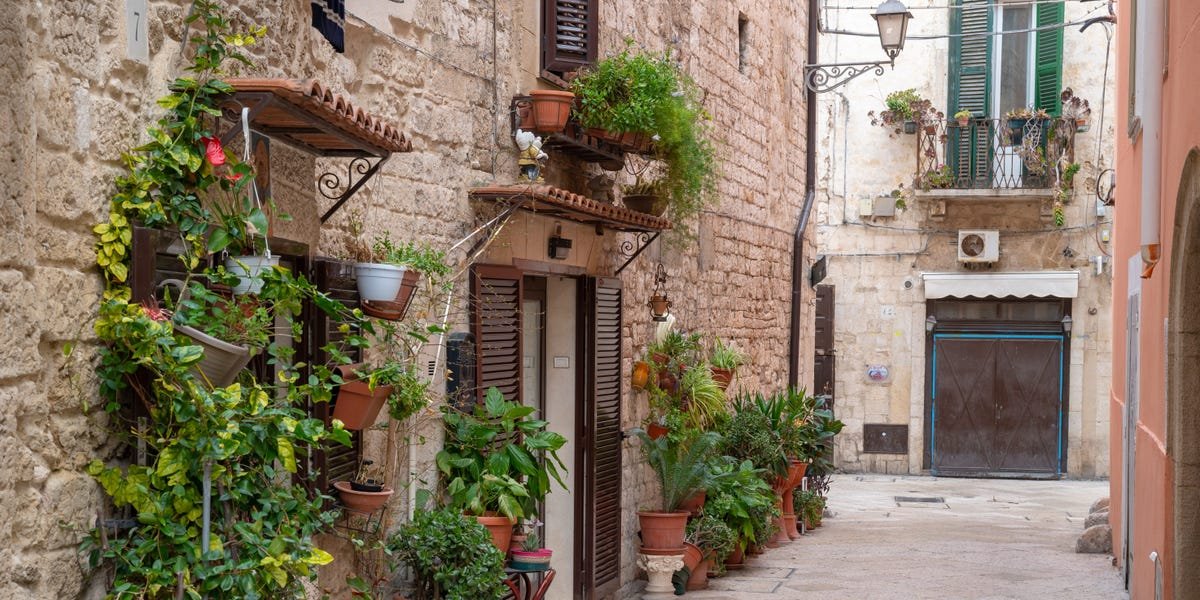
Beautiful towns like Ostuni, Monopoli, Trani, and Polignano a Mare are all within a 45-minute train ride from Bari Centrale station.
Ostuni took my breath away. I climbed up and down countless stairs to explore the hilltop city. I found myself surrounded by a maze of churches and white buildings, with splashes of vibrant color on their doors and window shutters.
Monopoli is tiny, but I loved ambling through the old alleys, which often had intricately detailed arches at their entrances, and walking the small stretch of the port to a red-and-white-striped lighthouse.
My favorite spot is Polignano a Mare, a coastal town with ancient white buildings perched atop a limestone cliff.
From there, I could spend hours taking in the spectacular views of the Adriatic Sea. For a closer look at the water, I walked under the Ponte Borbonico, an iconic bridge, to the picture-perfect pebble beach.
As the final stop of the day, I grabbed a caffè speciale — a coffee with cream, amaretto, and lemon peel — at a famous ice cream and coffee shop called Il Super Mago del Gelo before making my way back to Bari.
Nearly a year later, I still haven’t stopped thinking about my time in Bari. Although I made a rule not to revisit the same location twice on my annual Italy trip, I will absolutely make an exception for Bari.
Tourists love Kyoto for its ancient temples, pagodas, and its cherry blossoms. But from early next year, staying in the Japanese city will become more expensive.
After March 1, visitors in Kyoto will face higher overnight taxes on accommodation across the city.
The tax is tiered according to the nightly cost of accommodation: rooms under 6,000 yen, about $38, a night will remain taxed at 200 yen, or $1.28, while the tax on rooms priced between 6,000 and 20,000 yen a night will double to 400 yen.
The steepest increases will be applied to high-end accommodations. Rooms costing 50,000 to 100,000 yen a night will see the tax jump from 1,000 to 4,000 yen, and those over 100,000 yen will rise tenfold to 10,000 yen.
Kyoto’s government estimates the revised tax will generate 12.6 billion yen a year, about $81 million.
Thirty years ago, I fell in love with Croatia’s rugged shoreline the moment I saw the crystal-clear waters.
I grew up with sandy lakesides instead of tropical waters, so spending hours watching sea cucumbers, small fish, and crabs felt like nothing I’d ever seen or known before.
I’ve visited Croatia almost every year since then, and it’s continued to feel refreshingly authentic — unspoiled, relaxed, and not staged for tourists. Here are four of my favorite places in the country.
“Game of Thrones” fans should take a day trip to Lokrum Island to see a replica of the Iron Throne
Lokrum Island was a filming location for “Game of Thrones.”
Hterry15/Shutterstock
If you’ve ever dreamt about sitting on the Iron Throne from HBO’s “Game of Thrones,” I highly recommend visiting Lokrum Island, which doubled as the city of Qarth in the series.
After a short 15-minute ferry ride from Dubrovnik, you can wander the gardens of the Benedictine monastery.
Every time Emese publishes a story, you’ll get an alert straight to your inbox!
Stay connected to Emese and get more of their work as it publishes.
There’s also a small exhibition commemorating the series, with a replica of the Iron Throne.
And if you’re not a fan of the show, there’s still plenty to do on the island. Don’t miss floating in its salt lake (Mrtvo More), relaxing at one of the secluded beaches, or snapping pictures of the many free-roaming peacocks.
Relax on a quiet beach along Rab’s seaside promenade
I’ve been visiting Croatia since I was a child, and I love coming back to Rab Island’s beaches.
Emese Maczko
Although many tourists flock to Lopar and its sandy beaches, I prefer to spend time along the quiet seaside promenade between the towns of Palit and Rab.
This promenade is a place for simple joys, like starting your day with a jog, enjoying delicious breakfast with a view, or taking a refreshing swim. The energy remains high throughout the day as families swim, hunt for seashells, and grab ice cream.
The pathway is dotted with little beaches tucked under the shade of pine trees. In the summer, I love relaxing while listening to the rhythmic hum of cicadas, a sound so quintessentially Croatian that I can’t imagine the season without it.
Rastoke looks like a fairy tale brought to life
The waterfalls in Rastoke are beautiful.
DaLiu/Shutterstock
Located about 30 minutes away from Plitvice Lakes National Park, Rastoke is more than just a quaint little village.
With over 20 waterfalls along the Slunjčica River, original mills, a fairy garden, and an eco museum, visiting Rastoke is like taking a step back in time.
My kids loved visiting the fairy garden, which featured a variety of hidden fairy sculptures. Meanwhile, I enjoyed walking along a boardwalk to explore the waterfalls.
Imotski is one of the best hidden gems in Croatia
The town of Imotski overlooks Blue Lake.
Joachim Bago/Shutterstock
Perched at the top of a plateau overlooking Modro Jezero (Blue Lake) — which is located in a sinkhole — is the town of Imotski.
I recommend starting your trip with a visit to the Blue Lake Viewpoint. When water levels are high (typically after late spring-early summer rainfall), you’ll find people swimming.
But the fun doesn’t stop on the rare occasion that the lake dries out. In fact, it’s tradition for the empty crater to become the stage for a soccer game between the teams Vilenjaci (Elves) and Vukodlaci (Werewolves).
I also enjoy visiting the Topana Fortress, which is located at the town’s highest point, and the nearby Crveno Jezero (Red Lake), which is in a sinkhole, too, and boasts unreal views.
No matter where you go in Croatia, I’m sure you’ll be hungry to return for more — I know I am.
Almost every town, city, and village in Spain has an annual feria (festival), and my favorite is undoubtedly La Feria del Caballo (The Horse Fair) in Jerez de la Frontera.
Held every May at the González Hontoria fairground, the festival features plenty of food, drinks, dancing, and a program of equestrian events.
It’s beautiful during the day, but at night, the grounds are lit up in a spectacular way that makes everything look magical.
Another festival I enjoy attending is Las Fallas, held annually in March in Valencia. Hundreds of wooden and papier-mâché monuments called fallas are constructed around the city, and then, to conclude the festival, they’re burned.
These structures often portray local and world dignitaries or critique current events, creating a blend of art, satire, and tradition that’s really worth watching.