I-visited-Sagamore-Hill-the-country-estate-of-President-Theodore.jpeg

I visited Sagamore Hill, the country estate of President Theodore Roosevelt, dubbed the ‘Summer White House.’ Take a look.

Have you ever wondered what, exactly, brought about the end of the Gilded Age?

Look no further than our 26th president, Theodore Roosevelt, who was inaugurated in 1901 after the assassination of William McKinley, and pivoted the US away from its laissez-faire business traditions and toward the Progressive Era.

However, Roosevelt’s home, Sagamore Hill — nicknamed the Summer White House during his presidency — was built in 1884, smack in the middle of the Gilded Age.

The Sagamore Hill National Historic Site in Oyster Bay, New York, encompasses Roosevelt’s home, his son’s house (now a museum), a nature trail, a pet cemetery, and acres of land.

The park is free to enter, though you can pay $15 for a guided tour of Roosevelt’s home. During my visit, I roamed the property, its museum, and its nearby beach, but I’ll be back when the weather is warmer, giving me a glimpse of the home and its surroundings in their full glory.

Here’s what it’s like to visit the Summer White House and its expansive surrounding estate.

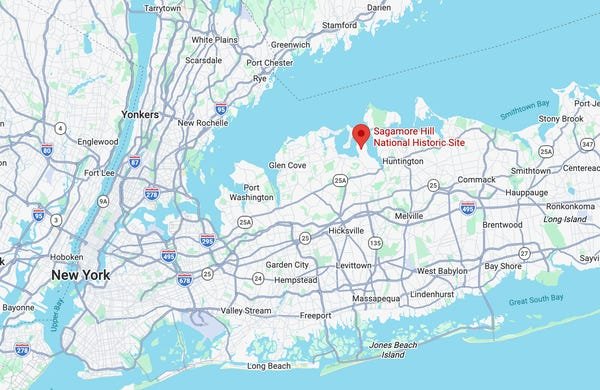
I drove out to Oyster Bay, a town on Long Island, to visit the Sagamore Hill National Historic Site, the home of President Theodore Roosevelt.

Sagamore Hill is around 38 miles outside New York City. 

Google Maps

It’s free to visit Sagamore Hill, which contains the Roosevelt Museum, a nature trail, Roosevelt’s home, beach access, and more.


sagamore hill musuem nature trail

It was established as a National Historic Site in 1962. 

Gabbi Shaw/Business Insider

During Roosevelt’s presidency, he spent his summers at Sagamore Hill, which was nicknamed the Summer White House.


sagamore hill map

Roosevelt was president from 1901 to 1909. 

Gabbi Shaw/Business Insider

Now, it’s a historic site open to the public.


the trail sagamore hill

The park is around 83 acres. 

Gabbi Shaw/Business Insider

The museum is located in the Old Orchard House, which was built on the estate in 1938.


exterior of old orchard

That’s Old Orchard in the distance, named for its location on the former orchard. 

Gabbi Shaw/Business Insider

It was the home of Theodore Roosevelt Jr., the president’s eldest son. He died in 1944, shortly after becoming the oldest general to storm the beaches on D-Day.


theodore roosevelt musuem at old orchard

The Theodore Roosevelt Museum at Old Orchard. 

Gabbi Shaw/Business Insider

Theodore Jr. and his wife, Eleanor, purchased the land for Old Orchard from his family after they “tired” of living in rented homes.


orchard hill exterior

The museum, like the park, is free to enter. 

Gabbi Shaw/Business Insider

It has 12 rooms, making it smaller than his childhood home atop the hill but more than enough for their four children.


orchard house

The back of Old Orchard. 

Gabbi Shaw/Business Insider

The home has since been turned into a museum for Roosevelt.


entrance of orchard house

The museum takes over the entire first floor. 

Gabbi Shaw/Business Insider

The upstairs is closed to the public, but the first floor is filled with Roosevelt facts and memorabilia.


orchard hill house

Roosevelt himself died before this house was constructed. 

Gabbi Shaw/Business Insider

The museum goes through Roosevelt’s entire life.


roosevelt museum

This display goes over his early life, growing up in New York. 

Gabbi Shaw/Business Insider

One of Roosevelt’s famed Rough Riders uniforms, custom-designed by Brooks Brothers, is on display.


rough riders uniform

The Rough Riders were a volunteer cavalry led by Roosevelt during the Spanish-American War. 

Gabbi Shaw/Business Insider

The hat and pin Roosevelt wore to President McKinley’s funeral are there, too. McKinley’s death led to Roosevelt, his vice president, becoming the youngest president ever at 42.


roosevelt hat and pin

McKinley was assassinated in 1901 by an anarchist, Leon Czolgosz. 

Gabbi Shaw/Business Insider

Part of Roosevelt’s legacy was his dedication to preserving land. A display of junior park ranger badges from across the US honors his love of nature.


national park ranger badges

Roosevelt was instrumental in preserving and protecting land for future generations. 

Gabbi Shaw/Business Insider

Of course, the museum also has a gift shop.


gift shop

There’s national parks memorabilia, books about Roosevelt, and more. 

Gabbi Shaw/Business Insider

Behind the museum is the entrance to a 0.7-mile loop trail that leads to the beach.


orchard grove house

A view of Old Orchard from the back. 

Gabbi Shaw/Business Insider

The surrounding forest is filled with oak and hickory trees.


woods sagamore hill

This path got pretty steep at some points. 

Gabbi Shaw/Business Insider

The trail leads to a boardwalk across a salt marsh to Cold Spring Harbor. A boardwalk in some form has been here since 1888, when Roosevelt built one for his family.


boardwalk at sagamore hill

This boardwalk crosses Eel Creek, a tidal salt marsh. 

Gabbi Shaw/Business Insider

During their time here, there were bath houses, a floating dock, and rowboats.


dunes sagamore hill

Roosevelt was an avid seaman. 

Gabbi Shaw/Business Insider

Now, it’s just a peaceful beach.


beach at sagamore hill

The water was quite still, almost like a pond. 

Gabbi Shaw/Business Insider

I hiked back to check out more of the grounds. These structures are from when Sagamore Hill was a functioning farm, from 1885 to 1948.


barns at sagamore hill

These structures were built in the early 1900s. 

Gabbi Shaw/Business Insider

Inside the former chicken coop, there’s information about the farm’s history, including images from the Roosevelt family’s personal archive.


barn sagamore

The structure was a chicken coop. 

Gabbi Shaw/Business Insider

I walked toward Roosevelt’s house. I passed what was once a working windmill — Roosevelt once cut open his head while trying to repair it.


windmill sagamore

His wife only asked him to stop bleeding all over the carpet. 

Gabbi Shaw/Business Insider

Finally, I came to Sagamore Hill. It was built in 1884 for Roosevelt and his first wife, Alice, but she died the same year, and Roosevelt left New York for years to grieve.


Sagamore Hill

Sagamore Hill. 

Gabbi Shaw/Business Insider

He returned for good after he remarried in 1886. Roosevelt and his second wife, Edith, remained married until his death in 1919.


roosevelts at home

The home was built in the Queen Anne style. 

Gabbi Shaw/Business Insider

The Latin phrase “Qui plantavit curabit” is etched over the front door. It means “He who planted will sustain.”


roosevelt family home crest

It’s the Roosevelt family motto. 

Gabbi Shaw/Business Insider

The house was designed by architects Lamb & Rich.


front door sagamore

They designed buildings across the northeastern US. 

Gabbi Shaw/Business Insider

A 22-year-old Roosevelt purchased the land on which Sagamore sits in 1880. He paid $30,000 for 155 acres, or roughly $1 million today.


sagamore side porch

The house has a wraparound porch. 

Gabbi Shaw/Business Insider

He lived here with his family until his death. During the seven years of his presidency, it became known as the Summer White House.


bench at sagamore hill

This bench looked a little worse for wear. 

Gabbi Shaw/Business Insider

Peace talks during the Russo-Japanese War were held here. Roosevelt would later win the Nobel Peace Prize for his role in ending the conflict.


driveway seating sagamore

He was the first statesman to be given the honor. 

Gabbi Shaw/Business Insider

A memorial for Roosevelt’s youngest son, Quentin, is on the property. A pilot, he was shot down during World War I, making him the only child of a US president to die during combat.


quentin roosevelt tomb

Quentin Roosevelt died in 1918 in France. His brother, Theodore Jr., would also die in France 26 years later, during World War II. 

Gabbi Shaw/Business Insider

The day before Roosevelt died in 1919, he told his wife, “I wonder if you will ever know how much I loved Sagamore Hill.”


sagamore hill house

Roosevelt died in January 1919. He was 60. 

Gabbi Shaw/Business Insider

After visiting, I understood why. It must’ve been a peaceful respite for Roosevelt, a true outdoorsman. I’ll be coming back when the trees are green and flowers are blooming.


exit sign from sagamore hill

The exit sign features a quote from Roosevelt: “Keep your eyes on the stars, but remember to keep your feet on the ground.” 

Gabbi Shaw/Business Insider


Source link

I-visited-JetBlues-first-airport-lounge-I-was-impressed-but.jpeg

I visited JetBlue’s first airport lounge. I was impressed, but one thing will stop me from going back.

Rejoice, JetBlue lovers: There’s now a lounge where you can eat, drink, and be merry while waiting to board your flight.

BlueHouse, the airline’s first airport lounge, opened at John F. Kennedy International Airport in New York City in December 2025, with a location at Boston Logan International Airport coming this year. It’s a way for the traditionally low-cost airline to make flying more luxurious, even for budget travelers.

When I fly, it’s usually for the cheapest fare. Last year, I finally took the plunge and committed to a JetBlue credit card to try to maximize points. All this to say, I don’t typically travel in a way that gives me access to an airport lounge.

So, when I found out about BlueHouse and its many amenities — 9,000 square feet, two floors, food from Union Square Events, cocktails from Please Don’t Tell, and coffee from Joe Coffee — I decided to try it out for myself.

A day pass cost me $79 on top of my airfare. For Premier cardholders, Mosaic 4 members (the highest tier of JetBlue rewards), and transatlantic Mint travelers (essentially JetBlue’s version of business class), entry is free for the traveler and a plus one. For the other levels of Mosaic, domestic Mint travelers, and people with the Plus card like me, entry ranges from $59 to $79 per person.

I was concerned it might be crowded (hence why some people are sticking with the airport bar), so I was pleasantly surprised to find it basically empty.

What I really appreciated were all the nods to New York City’s classic Art Deco architecture. The design was supposed to evoke “an NYC apartment-style aesthetic,” which, as someone living in an NYC apartment, I think they nailed.

JetBlue did not respond to a request for comment on its pricing or my experience.

Here’s what it was like to visit the inaugural BlueHouse location.

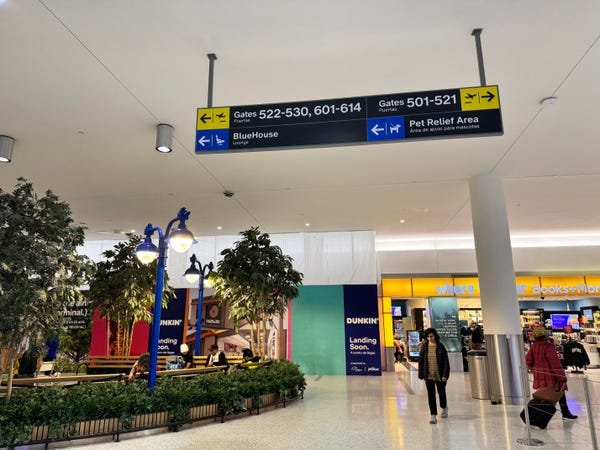
BlueHouse is located in Terminal 5 at John F. Kennedy International Airport in New York City.

Terminal 5 is under a lot of construction while JetBlue renovates.

Gabbi Shaw/Business Insider

There are clear signs all the way there. It’s across from Gate 527, around a five-minute walk once you’re out of security.


bluehouse is at gate 527

My gate was in the other direction, however.

Gabbi Shaw/Business Insider

I was lucky to catch the lounge at an off time, but this queuing area suggests that JetBlue is prepared for crowds.


entrance to bluehouse

BlueHouse opened in December 2025.

Gabbi Shaw/Business Insider

BlueHouse spans two floors, with a full bar, a coffee bar, and plenty of seating downstairs, and a quieter atmosphere upstairs.


entryway to bluehouse

The elevator reminded me of the vintage ones at the Empire State Building.

Gabbi Shaw/Business Insider
I paid $79 to get inside BlueHouse, but it’s free for Mosaic 4 members, JetBlue Premier cardmembers, and transatlantic business-class travelers. Blue Basic travelers can’t get in.


tunnel through bluehouse

I knew from this point on that there would be a lot of blue in the design.

Gabbi Shaw/Business Insider

The first thing you see when you walk in is the huge bar. All drinks are complimentary.


the bar at bluehouse

The bar was giving ’20s Art Deco vibes.

Gabbi Shaw/Business Insider

There is plenty of seating throughout the lounge, including booths, tables, bar stools, and individual chairs.


lounge area bluehouse

Here’s the largest part of the lounge.

Gabbi Shaw/Business Insider

The ceiling takes inspiration from Grand Central Terminal’s iconic constellation ceiling mural.


ceiling of bluehouse

The ceiling at Grand Central was designed by Paul Helleu, J. Monroe Hewlett, and Charles Basing.

Gabbi Shaw/Business Insider

But, of course, the most dominant color is blue.


seating area bluehouse

I appreciated all the little touches of decor.

Gabbi Shaw/Business Insider

I sat at one of the long tables so I could get a view of the entire lounge. Each seat had its own outlet for easy charging access.


seat at bluehouse

Outlets are a game changer at the airport.

Gabbi Shaw/Business Insider

There was a fridge filled with pre-packaged food and snacks. It had yogurt, fruit cups, sauces, and wraps.


bluehouse food

The cold food.

Gabbi Shaw/Business Insider

Next to it was a hot food area, with soups, sandwiches, and bowls.


food selection at bluehouse

The hot food.

Gabbi Shaw/Business Insider

For those looking for something lighter, popcorn, chips, and pastries were also offered.


snack selection bluehouse

The snacks.

Gabbi Shaw/Business Insider

There was a full coffee bar with one of the nicest coffee machines I’ve ever seen.


coffee machine bluehouse

I could’ve chosen between espresso, Americano, latte, cappuccino, cortado, flat white, or allongé.

Gabbi Shaw/Business Insider

I got an oat-milk latte and then added vanilla syrup. There was also an ample tea selection.


coffee bar bluehouse

The coffee bar was fully stocked.

Gabbi Shaw/Business Insider

The coffee was good — I realized it was Joe Coffee, a favorite of mine.


joe coffee bluehouse

Joe Coffee.

Gabbi Shaw/Business Insider

I went for a mini Caesar salad wrap. It wasn’t great, but it wasn’t bad either — and it was the perfect size for a pre-flight snack.


chicken caesar wrap bluehouse

I’ve had worse airport food.

Gabbi Shaw/Business Insider

I decided to get up and explore. In one corner, there’s a photobooth for anyone looking to relive their BlueHouse experience with a souvenir.


photobooth bluehouse

I’m not sure who wants a photograph of their time at the airport, but to each their own.

Gabbi Shaw/Business Insider

There were multiple single-stall bathrooms, but no showers, which surprised me. Airport lounges in major hubs often do feature showers.


bathrooms bluehouse

The hallway of bathrooms.

Gabbi Shaw/Business Insider

I liked that the doors had lights to let you know if the bathroom was occupied.


bathrooms occupied bluehouse

There are hotels where the doors do this, too.

Gabbi Shaw/Business Insider

I have to admit, the neon “Live, Laugh, Lav” sign did make me giggle.


bathroom sign bluehouse

The bathroom was huge.

Gabbi Shaw/Business Insider

Two large mirrors can give travelers a full view of their outfits.


bathroom mirror selfie bluehouse

I appreciated the back-lighting behind the mirror.

Gabbi Shaw/Business Insider

I noted the bathroom wallpaper was emblazoned with parking meters and fire hydrants. While I wasn’t really sure why, I liked it.


bathroom wallpaper

There were pigeons as well.

Gabbi Shaw/Business Insider

The last area I needed to check out on the first floor was a lounge space with a TV and couches.


TV room bluehouse

The TV room.

Gabbi Shaw/Business Insider

With that, it was time to go upstairs. The stairway featured art inspired by New York iconography.


staircase at bluehouse

The staircase.

Gabbi Shaw/Business Insider

I had too much luggage, so I took the elevator. Unsurprisingly, it was blue.


elevator bluehouse

The elevator had a mirror ceiling.

Gabbi Shaw/Business Insider

The second floor had a smaller, but no less stocked, bar.


upstairs bar bluehouse

The upstairs bar.

Gabbi Shaw/Business Insider

The floor had subway tiles, another nod to NYC.


subway tile at bluehouse

The subway tiles were also reminiscent of the ’20s.

Gabbi Shaw/Business Insider

There were barely any people upstairs, but there was more seating. My favorite was the long booth in the back.


upstairs lounge bluehouse

The upstairs seating area was a ghost town.

Gabbi Shaw/Business Insider

For more privacy, there were many of these little booths, each with its own table, light, and outlet. I really enjoyed the decor of this nook.


pods upstairs lounge

There were a few more of these areas scattered throughout.

Gabbi Shaw/Business Insider

There were conveniently placed screens throughout, so I could keep track of my flight status.


jetblue flight screens

This was just one of many departure screens.

Gabbi Shaw/Business Insider

There was the same coffee bar, snacks, hot, and cold food available as downstairs, just less of it.


upstairs coffee bar bluehouse

The upstairs coffee bar.

Gabbi Shaw/Business Insider

I hung around BlueHouse for around an hour before heading to my gate.


seating area upstairs bluehouse

Another seating area.

Gabbi Shaw/Business Insider

If I were part of the JetBlue rewards tier where this would’ve been free, returning to BlueHouse would be a no-brainer. It was well-stocked, spacious, and full of fun design touches.


bluehouse decor

Some of the little touches.

Gabbi Shaw/Business Insider

However, as a budget traveler, I can’t justify the $79 price tag … unless I arrive much earlier to take greater advantage of the alcohol and food.


bluehouse upstairs lounge

A wider view of the upstairs lounge.

Gabbi Shaw/Business Insider


Source link

Ive-lived-in-and-visited-so-many-of-Americas-biggest.jpeg

I’ve lived in and visited so many of America’s biggest cities, but these 6 small towns have really won me over

I remember arriving in Leavenworth, a town of about 3,000 people, and immediately feeling like we had stepped into an entirely new country, despite being just a short three-hour day trip from Seattle.

The drive itself revealed just how varied Washington’s landscape can be, moving from familiar surroundings into farmland and alpine scenery.

Despite visiting in early April, right before wildflower season, the setting still felt storybook-like, with open fields nearby and snow-capped peaks in the distance.

Downtown Leavenworth leaned fully into its Bavarian theme, from German restaurants and beer gardens to a quirky nutcracker museum. Even the exteriors of everyday places, such as grocery stores and coffee shops, matched the town’s aesthetic, completing the immersion.

We stayed at Abendblume Inn, a small bed-and-breakfast with a distinctly European feel that overlooks the Cascade Mountains. It famously serves up breakfast aebleskiver, Danish pancake puffs often dusted with powdered sugar or served with jam, to make the Euro experience feel complete.

Perhaps my favorite find was the local reindeer farm, where we could pet and feed the animals. Although Leavenworth is known for its Christmas festivities, visiting out of season revealed a quieter version of the town that felt just as intentional.


Source link

I-visited-Punch-the-famous-baby-monkey-in-Japan-Heres.jpeg

I visited Punch, the famous baby monkey, in Japan. Here’s what TikTok doesn’t show.

Since moving to Tokyo last year, my friends back in New York have made a habit of sending me viral posts about Japan. That’s how I first learned about Punch, the baby monkey abandoned by his mother and now cared for by zookeepers at Ichikawa City Zoo, east of Tokyo.

Videos of Punch — a 7-month-old Japanese macaque — clinging to an Ikea orangutan have racked up millions of views on TikTok. The hashtag #HangInTherePunch has gone viral.

Javier Quiñones, commercial manager at Ingka Group, which operates Ikea stores worldwide, told Business Insider that Ikea has seen sales of the Djungelskog orangutan toy increase.

“The toy has long been one of our most sought-after across markets, and the story from Japan is now giving it a little extra love,” he said.


Woman wearing a facemask and earphones riding a train in Japan.

It took Hashimoto 2 hours to get there: three trains and a 30-minute walk.

Provided by Reeno Hashimoto


On a recent Friday afternoon, I visited the zoo

I expected other fans to be making the trek, but I didn’t spot a single rider headed for the zoo. The trains were packed at first — commuters with suitcases bound for Narita Airport, salarymen, uniformed schoolkids — but by the time we reached sleepy Ichikawa Station, most had cleared out.

Getting there took just under 2 hours: three trains and a 30-minute walk. The zoo-bound bus doesn’t run on weekdays.

Near the entrance, I began spotting both foreign and Japanese visitors climbing out of taxis, clutching monkey stuffed animals. It was obvious who they were there to see.


Entrance to the Ichikawa City Zoo in Japan.

Admission fee to the zoo was $2.80.

Provided by Reeno Hashimoto


Heading into the zoo

I paid the 440-yen, or $2.80, admission fee and made my way to Monkey Mountain, passing a mosaic mural of animals along the path.

There were rows of people lined up around a blue iron fence, phones raised, waiting to capture Punch in action. Spectators oohed as other monkeys climbed the rocky structure to play with a silver chain affixed to the top.

The air smelled of manure. The enclosure itself was stark — rocky, with little vegetation, more concrete jungle than mountainside.


Watching Japanese macaques at Ichikawa City Zoo.

Both foreign and Japanese visitors were at the zoo.

Provided by Reeno Hashimoto


Some of the monkeys appeared thin, even balding

Punch, by contrast, looked healthy, his fur darker and thicker than the others’. Visitors laughed when he leapt from a rock to the monkey bars.

He isn’t the only baby in the exhibit, but he appears to be the smallest. Mostly, he keeps to himself, occasionally playing with a slightly larger one.

A woman from Canada, wearing a Yankees hat and visiting with her family, told me she’d seen Punch playing with his Ikea toy earlier and interacting with the others.

“We didn’t see any monkey fights,” she said. “We don’t love zoos and were a little concerned about supporting one if it doesn’t have the best enclosures. They could use some improvements, but it was better than I thought.”


Monkey Mountain at Ichikawa City Zoo.

A troop of macaques at Monkey Mountain.

Provided by Reeno Hashimoto


After about 10 minutes, the troop grew restless.

“Lunchtime,” someone nearby said in Japanese.

The monkeys scrambled upward. Punch returned to the monkey bars. A slightly larger monkey barreled into him, knocking him off balance, but he quickly recovered.

A group of heavily made-up girls in Japanese high school uniforms arrived, giggling. “Yabai,” they whispered. “Kawaii.”


A man holding a monkey stuffed toy at Ichikawa City Zoo in Japan.

Visitors at the zoo were holding their own stuffed toys.

Provided by Reeno Hashimoto


Notably, Punch wasn’t clutching his orangutan.

The toy sat abandoned on the other side of the enclosure.

At 2:50 p.m., the monkeys began clamoring for food, climbing the door and hanging from the rails. Then a young man in a blue uniform entered.

Punch immediately climbed onto the zookeeper’s leg as he circled the enclosure, scattering orange and yellow pellets. Within minutes, the food was gone.

The zookeeper returned with what looked like grass. This time, Punch perched on his shoulder as they made another lap before disappearing into a back room together.


A zookeeper at the Ichikawa City Zoo in Japan.

Another zookeeper at the Ichikawa City Zoo.

Provided by Reeno Hashimoto


Around me, spectators wondered whether Punch would reappear before closing. Most were young adults — students and couples, some in coordinated outfits — clearly here for a photo.

I asked a zookeeper if he had time to answer a few questions, but he said the staff was overwhelmed by Punch’s popularity and too busy to respond, even to email inquiries.

Then an announcement crackled over the loudspeaker: Monkey Mountain was getting crowded. Visitors were asked to limit their stay to 10 minutes.

Punch’s fame was being rationed in 10-minute increments.


Source link

I-visited-the-National-Air-and-Space-Museums-lesser-known-second.jpeg

I visited the National Air and Space Museum’s lesser-known second location. One exhibit stopped me in my tracks.

  • I visited the National Air and Space Museum’s second location, the Steven F. Udvar-Hazy Center.
  • The Virginia museum has over 200 aircraft and spacecraft in 340,000 square feet of exhibit space.
  • The space hangar featuring the space shuttle Discovery was a highlight of my visit.

The National Air and Space Museum’s flagship location in Washington, DC, is one of the most-visited museums in the US, but the building isn’t large enough to display all of the aircraft and spacecraft in its collection.

That’s where the Steven F. Udvar-Hazy Center comes in. The National Air and Space Museum’s lesser-known second location, a hangar-like structure in Chantilly, Virginia, offers 340,000 square feet of exhibit space with over 200 aircraft and spacecraft on display.

“What you’re going to see are the first, the last, the only, the last remaining, the most significant. So it’s an A-plus, as far as the collection,” Holly Williamson, the museum’s public affairs specialist, told Business Insider.

Here are the coolest things I saw during my visit.

The Steven F. Udvar-Hazy Center in Chantilly, Virginia, is located on the property of Washington Dulles Airport.

The Steven F. Udvar-Hazy Center in Chantilly, Virginia.

John M. Chase/Getty Images

Unlike at the National Air and Space Museum’s flagship DC location, where timed-entry tickets help manage large crowds in the smaller space, reservations are not required at the Udvar-Hazy Center.

Admission to the museum is free, and parking costs $15.

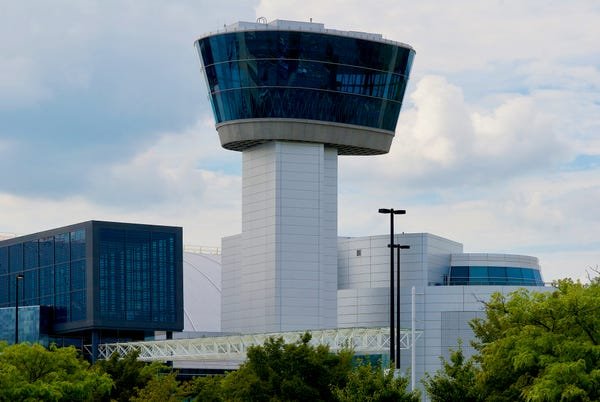
The museum takes advantage of its proximity to the airport with the Donald D. Engen Observation Tower.


Inside the Donald D. Engen Observation Tower.

Inside the Donald D. Engen Observation Tower.

Talia Lakritz/Business Insider

At 164 feet tall, the observation tower educates visitors about the history of Air Traffic Control and provides a 360-degree view of the modern airport in action.

Inside the tower, I watched planes take off and land at Dulles Airport while listening to live Air Traffic Control audio.

The Mary Baker Engen Restoration Hangar gives a behind-the-scenes look at how the museum restores historic aircraft.


The Mary Baker Engen Restoration Hangar at the National Air and Space Museum's Steven F. Udvar-Hazy Center in Chantilly, Virginia.

The Mary Baker Engen Restoration Hangar.

Talia Lakritz/Business Insider

Visitors can watch restoration work happen in real time from a balcony with floor-to-ceiling windows overlooking the hangar.

Among the works-in-progress are “Flak-Bait,” a Martin B-26 Marauder that flew 202 combat missions during World War II and participated in D-Day, and a Sikorsky JRS-1 seaplane that was present at Pearl Harbor when it was attacked on December 7, 1941.

The B-29 bomber Enola Gay, which dropped the atomic bomb on Hiroshima during World War II, is in the museum’s collection.


The Enola Gay viewed from an elevated platform at the National Air and Space Museum's Steven F. Udvar-Hazy Center.

The Enola Gay.

Talia Lakritz/Business Insider

On August 6, 1945, the Boeing B-29 Superfortress bomber Enola Gay dropped the first-ever atomic bomb used in warfare on Hiroshima, killing at least 70,000 people.

The “Little Boy” atomic bomb weighed 9,700 pounds, forcing the aircraft to remove most of its protective and defensive armament in order to carry the enormous weight.

The Enola Gay exhibit sparked controversy when the plane was first displayed in 1995, as veterans’ groups and anti-war activists debated how the historical narrative around the use of the atomic bomb should be presented.

The Boeing 367-80 Jet Transport, the only model of its kind ever built, was the prototype that led to the development of the Boeing 707 jetliner.


The Dash 80.

The Boeing 367-80 Jet Transport.

Heritage Images/Heritage Images via Getty Images

In the 1950s, Boeing set out to build a jet aircraft that could function as a passenger aircraft, a cargo plane, or a tanker used for mid-air refueling.

Boeing began building this prototype jet in 1952, and it flew for the first time two years later. It traveled 100 miles per hour faster than the de Havilland Comet, the world’s first jetliner developed in the UK, and had a range of over 3,500 miles, revolutionizing the air travel industry.

Known as “Dash 80,” the developed version of the aircraft entered service as the first jetliner in the US, the Boeing 707.

The museum also featured a Concorde supersonic commercial jet that was operated by Air France.


An Air France Concorde supersonic passenger jet.

An Air France Concorde supersonic commercial jet.

Talia Lakritz/Business Insider

The governments of Britain and France collaborated to create the first supersonic commercial jets, which operated commercially from 1976 to 2003.

Traveling at twice the speed of sound allowed the planes to cross the ocean in record time. Concorde’s fastest flight from New York City to London lasted just 2 hours, 52 minutes, and 59 seconds.

The museum’s Concorde jet, which flew for Air France, measures 202 feet and 3 inches long with a wingspan of 83 feet and 10 inches.

One of the museum’s centerpieces is a Lockheed SR-71A Blackbird, the world’s fastest aircraft propelled by air-breathing engines.


A Lockheed SR-71A Blackbird.

A Lockheed SR-71A Blackbird.

Talia Lakritz/Business Insider

The Lockheed SR-71A, a supersonic reconnaissance aircraft, was designed to fly high and fast enough to avoid Russian missiles during the Cold War. It was capable of flying at an altitude of over 85,000 feet at speeds of over three times the speed of sound, or approximately 0.7 miles per second.

The aircraft became known as “Blackbird” for its black paint that was capable of absorbing radar signals.

This Blackbird logged 2,801.1 hours of flight time over 24 years of service before retiring in 1990.

The entrance to the James S. McDonnell Space Hangar, with the space shuttle Discovery placed front and center, stopped me in my tracks.


The space shuttle Discovery.

The space shuttle Discovery.

Talia Lakritz/Business Insider

It’s hard to capture the full scale of Discovery in a photo, but I found it awe-inspiring to see such an enormous, historically significant spacecraft in person.

The shuttle measures 122 feet long, 78 feet wide, and 57 feet tall, towering over the other artifacts in the hangar. When fully loaded for missions, the orbiter weighed around 250,000 pounds.

Discovery was NASA’s longest-serving orbiter and flew 39 missions — more than any other space shuttle orbiter.


The space shuttle Discovery at the National Air and Space Museum's Steven F. Udvar-Hazy Center.

The space shuttle Discovery.

Talia Lakritz/Business Insider

Discovery flew its first mission in 1984 and returned from its last in 2012, spending a total of 365 days in space.

Among its many historic accomplishments, Discovery deployed the Hubble Space Telescope in 1990 and became the first space shuttle to dock with the International Space Station in 1999.

Hanging above Discovery was the Manned Maneuvering Unit that astronaut Bruce McCandless used during the first untethered spacewalk in 1984.


The Manned Maneuvering Unit, then and now.

The Manned Maneuvering Unit in action.

Talia Lakritz/Business Insider ; Encyclopaedia Britannica/UIG Via Getty Images

The backpack propulsion device, powered by nitrogen jets, allowed McCandless to fly around 300 feet away from the space shuttle Challenger. His untethered spacewalk was immortalized in an iconic photo of the lone astronaut floating above the Earth.

The Udvar-Hazy Center is worth the detour from the National Mall.


The space shuttle Discovery at the National Air and Space Museum's Steven F. Udvar-Hazy Center.

The space shuttle Discovery at the National Air and Space Museum’s Steven F. Udvar-Hazy Center.

Talia Lakritz/Business Insider

My phone’s step counter recorded nearly 10,000 steps on the day I visited the museum. There’s an incredible amount of ground to cover and objects to see.

I can’t believe I didn’t know that the National Air and Space Museum even had a second location when I started planning my visit to Washington, DC. Now, I’m recommending it to all of the air and space enthusiasts I know.


Source link

I-visited-the-Rikers-jail-kitchen-I-left-shaken-by.jpeg

I visited the Rikers jail kitchen. I left shaken by what I’d seen.

  • Rikers Island jail in New York City holds nearly 7,000 detainees, who consume about 7 million meals a year.
  • I wanted to see how the operation works, so I visited its largest kitchen.
  • I was surprised by how much is made from scratch, and by the constant state of readiness for the worst-case scenario.

Rikers Island, New York City’s most notorious jail complex, sits in the water between the Bronx and Queens.

When I visited the complex in April 2025, I expected it to be hard to reach — and I wasn’t wrong. There’s just one small, mile-long bridge for everyone entering and exiting the facility.

Nearly 7,000 detainees are in custody at Rikers. In 2024, the city spent $19 billion to feed them all, amounting to 7 million meals. I wanted to learn why the price tag is so high and how the operation works.

Here, chefs — not detainees — do the cooking. When they’re on shift, the cooks are locked in, too.

Visiting Rikers shook me more than I expected, and I couldn’t help but wonder how the chefs and officers carry it every day.

The larger of the two kitchens at Rikers is in the Anna M. Kross Center.

No detainees were housed here at the time of filming.

Abby Narishkin

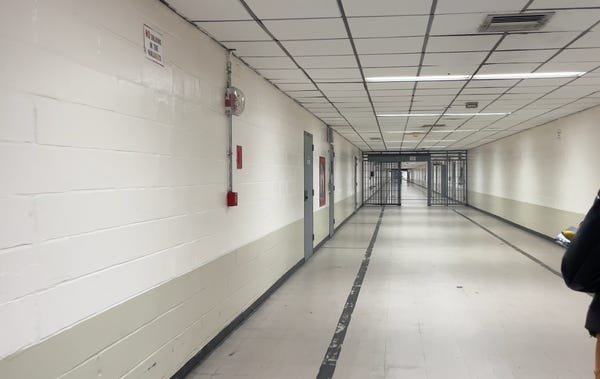
After traversing the mile-long bridge, we passed through three security gates. I was surprised to learn that many chefs rely solely on public transportation to get to work, often traveling two or more hours each way.

Once inside AMKC, we went through metal detectors. This building hasn’t held detainees since 2023. It was an eerie 10-minute walk down the silent, seemingly endless hallways.

Eight guards watch over the kitchen.


Rikers PIC

Five chefs were cooking while five people in custody washed dishes.

Adam Miller

People in custody wash dishes, push carts, and serve food.

They can’t have any infraction tickets. They must be serving time for nonviolent offenses and be approved by custody management to work here.

Everything’s cooked in huge batches.


Rikers tartar sauce

This vat of tartar sauce was for the next day’s dinner.

Adam Miller

There are no open fires here. They cook chicken in rotisserie ovens.

I was shocked to see how many dishes chefs made from scratch. Tartar sauce started as mayo and pickles. Pepper steak, a favorite among detainees, started as blocks of frozen beef.

There are security cameras everywhere in the kitchen.


Rikers security cameras

Cameras are monitored from a guard’s office, inside the kitchen.

Adam Miller

Inside the kitchen, it still felt like a jail. I felt the cameras everywhere.

Guards watched over the detainees and checked every incoming shipment of food for contraband. They frisked down detainees before they entered the kitchen, and again before they left.

Dull knives are chained up.


Knives in rikers

Guards lock the knives onto the massive cooking vats or stainless steel tables.

Adam Miller

Knives are kept on chains for their protection. When a chef needs the knife at a different location, they have to get a guard from the office to come unlock it and move it.

The chefs told me it felt awkward at first, the chain brushing against their hands, but they eventually got used to it.

Still, they say it can be tricky. I watched one chef wrestle the chain into position before cutting into a large frozen block of beef.

Chefs also secure the lids they remove from cans.


Can lids Rikers

A mechanical can opener quickly removes the lids, and then chefs slide them down this caged trash can.

Mark Miller

Even things I wouldn’t normally consider dangerous — like cans of green beans — are treated as potential threats. Chefs are required to throw them away immediately.

Cans go into wagons, and lids go into a caged trash can. Officers told us they have to be cautious about everything. Even small pieces of plastic, wood, and metal can be turned into weapons. That goes for spoons and ladles, too.

Spoons, ladles, and whisks are kept in a locked box in the guard’s office.


Rikers guards office

All tools are kept behind lock and key in the guard’s office when they’re not in use.

Mark Miller

Whenever a chef needs a ladle or whisk, they have to get a guard to unlock a box in the office.

I couldn’t help but think how tedious that must be. “It’s for security,” the chefs reminded me.

Despite all the security measures, I was surprised at how relaxed the chefs seemed.


Packing food carts Rikers

Mr. Ageda is the senior cook on staff.

Mark Miller

Chef Ageda was cracking jokes and laughing with me. He didn’t seem phased by the detainees in the kitchen. He said he can’t be friends with the people in custody because he knows why they’re here. But he said he treats them all with respect.

In an email statement to Business Insider, the Department of Corrections said, “violent incidents that occur in our kitchens are extremely rare.”

Getting a job in the kitchen is a coveted role among people in custody (PICs).


Nadine Leach Rikers

Nadine Leach has worked in the kitchen for 17 months.

Mark Miller

Nadine Leach was a chef before serving time at Rikers. She’s one of the detainees approved to push food carts to the housing units.

At the time of filming, Leach earned $1.45 an hour. She’s saving money for her grandkids, she told me.

Officers check the wagons for contraband and pat down detainees.


pat-down rikers

Guards pat down every PIC before they leave the kitchen area.

Mark Miller

Leach has worked in the kitchen longer than any other person in custody, clocking 56 hours a week by choice, she said. She calls the kitchen her “sanctuary” because she doesn’t feel like she’s in jail while working there.

But even in her sanctuary, officers pat her down, along with all the other people in custody, before they deliver food to the housing units.

There’s a delicate relationship between officers, chefs, and detainees.


hallway rikers

As an officer accompanies Leach after a food delivery, she passes through metal detectors every few paces.

Mark Miller

One moment, Leach is telling me about her grandkids and her goals when she gets out. Then reality sinks in, and she’s up against the wall.

She says she understands the officers are doing their jobs and that she’s doing her time. They’re living in two different worlds.

Leach is one of the people in custody allowed to serve food.


lunch is served Rikers

Leach serves up lunch in the women’s housing unit.

Mark Miller

A dinner might include grilled chicken or pepper steak, which smelled delicious.

The day I visited, pasta salad and tuna were on the lunch menu. It didn’t look particularly appetizing, but it was way better than I expected. There were multiple veggies, from coleslaw to the beets.

In 2024, a Department of Corrections representative told the City Council that each meal costs about $9.

Rikers Island is legally required to close by 2027.


Rikers island aerial

Rikers sits in the waters between the Bronx and Queens. A runway at LaGuardia Airport is only a few hundred feet away.

John Moore/Getty Images

In October 2019, NYC’s city council voted to close Rikers for good, citing years of violence and unmanageable conditions. The deadline to cease all jail operations on the island was 2027.

However, a 2025 report from the Independent Rikers Commission found that the city likely won’t meet that deadline. One criminal justice reporter I spoke to said 2031 was more likely.

I left the day pretty shaken by what I’d seen.


Abby Narishkin in front of rikers

We spent three days inside Rikers. This was me after filming in the kitchen at AMKC. I didn’t feel like smiling.

Abby Narishkin

Obviously, this is jail. I knew it was going to be tough to see life inside Rikers. On one hand, the chef and officers’ ease helped me relax. But it was clear — simmering just beneath the surface — that there was a constant readiness for the worst-case scenario.

It was like this huge elephant in the room. We were laughing with the chefs, talking with Leach about her grandkids — but I never forgot where we were. I could feel the cameras. I could always spot an officer in the corner of my eye.

I left Rikers wondering how chefs and officers return to their normal lives every night. Are they able to shake that alertness?

I left thinking about Leach, and my heart sank. Every second she’s watched. Every time she leaves a room, she’s patted down.

Even so, she maintains a positive outlook, telling me she plans to open up a restaurant when she gets out. A goal I hope she achieves.


Source link

I-visited-Polymarkets-free-grocery-store-It-was-more-impressive.jpeg

I visited Polymarket’s free grocery store. It was more impressive than Kalshi’s similar stunt.

  • Polymarket launched a limited time grocery store pop-up in the West Village. I checked it out.
  • Attendees could take as many groceries as they could fit in a Polymarket tote bag.
  • Compared to Kalshi’s grocery pop-up, Polymarket’s seemed more planned out and polished.

Free groceries in New York? It feels like an impossibility — and yet, I saw it twice in two weeks.

It’s all thanks to a good old-fashioned marketing battle.

Prediction markets Polymarket and Kalshi are in a two-week grocery war, both propping up short-term free supermarket stunts in New York. Last week, Kalshi took over a Westside Market for a day. On Thursday, Polymarket debuted its own store.

I stepped inside the store two hours before it officially opened as part of a press preview. The store was pristine, unmarked by the what I assume would be the rampant foot traffic that would soon occupy it.

It looked like a miniaturized Trader Joe’s.

The experience also seemed more planned out than Kalshi’s similar marketing stunt. While Kalshi took over an existing supermarket for one day, offering $50 in free groceries, Polymarket designed its own pop-up scheduled to be open for five days (though free groceries will only be available on three of those days — more on that later).

Polymarket is also accepting community donations for local charities, and donated $1 million to Food Bank for NYC.

I came out impressed — even if it was a week behind its competitor. Here’s what I saw.

The West Village has a new pop-up.

The Polymarket flag waved in the wind of a warm(ish) winter day.

Henry Chandonnet/Business Insider

I arrived at The Polymarket (get it?) at 11:30 a.m., a half hour before the originally planned opening time of noon. (The company later pushed it back to 2 p.m., confusing some attendees.) The front of the shop was a circus of organizers, media, and everyday rubberneckers.

New York establishments love to call themselves the “first” or the “best.” Is The Polymarket really New York’s “first free grocery store”? Likely not, especially if you count the hundreds of food pantries across the city.

One attendee, Milla Jackson, arrived at 7:30 a.m.


Milla Jackson is pictured waiting in line for the Polymarket

“I looked through the window, and I saw they had some good products,” Jackson said.

Henry Chandonnet/Business Insider

I chatted with some folks in line, including Milla Jackson, a school aide from Staten Island. On hour four of her wait, she was grateful for her warm winter jacket.

Jackson heard about the pop-up in the newsletter “NYC for Free.” She spotted some olive oil inside that she was excited to pick up.

“I just found out about Polymarket,” she said. “I looked it up last night. I’m like, ‘Oh, I definitely want to show up.'”

Victoria Plaza arrived at 11 a.m.


Victoria Plaza is pictured in line for the Polymarket.

“I can’t imagine it will be sustainable for more than four days,” Plaza said.

Henry Chandonnet/Business Insider

Victoria Plaza was around Grand Central Terminal when Polymarket announced the location on social media. She expected that those ahead of her had been in the neighborhood.

The financial planning advisor came mostly out of curiosity. What would she take inside? “Whatever I can carry,” she said.

The Polymarket team was keeping everyone warm.


A staffer hands out cups of hot chocolate to those waiting in line for the Polymarket.

Polymarket staff handed out hot chocolate and coffee.

Henry Chandonnet/Business Insider

At 34° and sunny, Polymarket got lucky with a nicer opening day than Kalshi. They also handed out hot drinks (which Kalshi had) and put up heat lamps (which Kalshi did not have).

One of the day’s oddities: a painted-over sign.


A man is pictured painting over the Polymarket logo.

Why were they painting over the Polymarket logo?

Henry Chandonnet/Business Insider

A few minutes before making it inside, a man stationed his ladder on the front door and began painting over one of the Polymarket signs. No one seemed to know why.

The store’s schedule was pasted on a window.


A schedule for the Polymarket is pictured.

The Polymarket’s schedule included a Valentine’s Day celebration.

Henry Chandonnet/Business Insider

For those seeking out free groceries, Polymarket will offer them up on Thursday, Friday, and Sunday. Those days also have community donation hours.

Saturday is Valentine’s Day, when The Polymarket will have a “community celebration” with free flowers and cards. Monday is the final day for donations.

Inside, the first thing I noticed was a disclaimer.


A sign at the Polymarket demonstrating that we are being recorded is pictured.

Nestled behind a basket of Kind bars was a reminder that we were being filmed.

Henry Chandonnet/Business Insider

Inside the store, there were several framed notices that our movements would be filmed. It was a reminder: as much as The Polymarket is about free groceries, it’s also about a marketing stunt.

“Take what you need” (that can fit in a tote bag).


Free tote bags are pictured at the Polymarket.

How much can you take from The Polymarket? As much as fits in a tote bag.

Henry Chandonnet/Business Insider

No, you can’t roll up to The Polymarket with a huge trash bag and clear off all the shelves. There are unsurprisingly some limits.

At Kalshi’s pop-up, it was a cost ceiling: no more than $50 worth of goods. At the expensive Westside Market, $50 meant only a few items.

At The Polymarket, it’s a constraint of physical space. Attendees get one branded tote bag and can leave with as much as it will fit.

Offerings were limited but classic.


Boxes of pasta and jars of tomato sauce are pictured at the Polymarket.

The Polymarket had both regular and gluten-free pasta.

Henry Chandonnet/Business Insider

The Polymarket focused on pantry staples. Oil, rice, seasonings, peanut butter, beans, the list goes on. There were no fancy premade meals, like at the Kalshi pop-up.

I also noticed more branding at Polymarket’s pop-up than at Kalshi’s. Here’s a digital sign advertising Polymarket above the gluten-free pasta. The flowers were wrapped in Polymarket-branded tissue.

There was a lot of fresh produce.


Produce is pictured at the Polymarket.

Produce filled bins on the floor and fridges in the back.

Henry Chandonnet/Business Insider

Carrots, avocados, bell peppers, you name it. The Polymarket put produce front and center. They looked idyllic in their wooden crates — though I’m not sure how long that sheen will last after the public opening.

Polymarket can’t escape the hype bro reputation.


Prime energy drinks are pictured at the Polymarket.

Spotted: Logan Paul’s energy drink.

Henry Chandonnet/Business Insider

The Kalshi grocery store was swarmed with crypto influencers and online betters. While that crowd hadn’t yet arrived at The Polymarket from what I could see, there were some signs of an overly online presence. The fridges were stocked with Logan Paul’s Prime Energy, for example.

Kerrygold? In this economy?


Kerrygold butter is pictured at the Polymarket.

Polymarket shelled out for their butter choice.

Henry Chandonnet/Business Insider.

Most of the items in The Polymarket were fairly low-cost, though they all had name brands. One exception: the butter. Kerrygold is expensive! I was surprised to see a fridge full of them, ready for the taking.

One thoughtful touch: socks.


Socks are pictured at the Polymarket.

The Polymarket had cleaning products and tampons.

Henry Chandonnet/Business Insider

Socks are often the most requested items at homeless shelters. That’s especially true in the cold, cold winter. It was a nice touch to see a shelf full of them.

Why The Polymarket felt more thoughtfully designed than Kalshi’s grocery pop-up.


A sign on the Polymarket is pictured.

“This one’s on us!” a sign at The Polymarket promised.

Henry Chandonnet/Business Insider

Leaving The Polymarket, I thought it was better planned out than Kalshi’s pop-up.

Where Kalshi had unlimited options but a tight overall budget of $50, I felt The Polymarket was more tailored to what people might want from a free-grocery stunt in the winter months. I found the staff was generally friendlier, and the whole thing was a bit less confusing. The emphasis on donation also made it feel less like a shiny corporate branding exercise.

Even Mayor Zohran Mamdani, a fan of affordability but not prediction markets, seemed to begrudgingly applaud Polymarket’s move.

Who knows what will happen over the next few days, as The Polymarket opens. Maybe the shelves will run dry. Either way, Polymarket seemed to know what it was doing at the jump.

Plus, the heating lamps were a nice touch.


Source link

I-traveled-for-a-year-and-hiked-in-every-European.jpeg

I traveled for a year and hiked in every European country I visited. There are 4 trails I’d revisit, and 3 I wouldn’t.

  • I spent a year hiking in 11 countries, visiting some of the world’s most beautiful natural regions.
  • My favorite trails, including the Lago di Sorapis in Italy, had stunning views and less traffic.
  • Although I enjoyed every hike, there were some trails that I wouldn’t revisit because of the crowds.

Exploring the mountains is my favorite way to see a new place.

So, when I spent a year as a traveling winemaker and nomadic freelance writer in Europe and Oceania, I set out to hike in every country I visited.

I traversed narrow, rocky paths in the Dolomites, meandered through Scotland’s sweeping green valleys, and trekked past kangaroos in the Australian bush.

Now, over a year later, I can say I’ve hiked in some of the most awe-inspiring corners of the world. There are four trails I’d return to in a heartbeat, and three ticketed ones that felt crowded and overhyped.

I’d love to hike in Leutasch, Austria, again.

I hiked the Rotmoosalm-to-Wettersteinhütte loop, and found the experience so worthwhile.

Sierra Newell

In the Austrian Alps, just south of the iconic Zugspitze mountain, lies Leutash, a lush, pristine alpine valley with an immense network of trails.

The circular Rotmoosalm-to-Wettersteinhütte tour was tough — the full loop is around 9 miles with over 3,000 feet of elevation gain — but in my opinion, it condensed the most idyllic aspects of the Austrian experience into one hike.

I saw dense forests, stunning craggy peaks, green meadows, mountain streams, ice-blue lakes, and traditional mountain huts, all in one day.

My hike to Lago di Sorapis in Italy was worth the effort.


The writer standing with a backpack at Lago Sorapis in Italy, with a mountain in the background.

I’m still thinking about my hike in the Dolomites.

Sierra Newell

After traveling through the Dolomites last October with my boyfriend, I still dream about our 7.5-mile hike to Lago di Sorapis.

Carved into the rockface with a dramatic dropoff to the autumnal forest below, the technical out-and-back trail definitely required some steady footing on the ascent.

That said, the lake’s opaque turquoise waters, contrasted by pale rocky mountains, made it well worth the journey.

I’d definitely hike to the Kozjak waterfall in Slovenia again.


Icy blue water, mist, and trees in Slovenia.

I loved my experiences hiking in the Soča Valley.

Sierra Newell

My best friend and I road-tripped through Slovenia in the fall, traveling north to south along the Italian border. Deep within the magical Soča Valley is Slap Kozjak, a 49-foot emerald waterfall tucked inside an open gorge.

Just over 2 miles, the waterfall loop follows a scenic route along a cliff’s edge, over a wooden suspension bridge, and through ankle-high forest creeks.

Although I usually prefer longer, more challenging hikes, I loved that this route was easy enough that I still had energy to explore the area.

The iconic Hérisson waterfalls in France were stunning.


A waterfall and trees at the Cascades du Hérisson in France.

My hike to the Hérisson waterfalls was unforgettable.

Sierra Newell

Over the summer, I traveled to the Jura region of France and hiked the iconic 4.3-mile trail that tours past a steep succession of seven unique waterfalls.

I found that this was the perfect time to visit — I loved watching the dappled sunlight filter through the bright green tree canopy, and almost glitter against the trail’s flowing rivers.

It’s a popular hike, though. Next time, I would start earlier to avoid the crowds and enjoy the picturesque views in solitude.

On the other hand, I’d skip the Italian Dolomites’ Tre Cime di Lavaredo next time — or plan my visit more strategically.


The writer standing in front of the Italian Dolomites.

The Tre Cime di Lavaredo is a famous hike, but I was surrounded by tons of tourists.

Sierra Newell

Most famously known as the Three Peaks of Lavaredo, this UNESCO World Heritage Site lies in the heart of the Dolomites.

I thoroughly enjoyed my fall visit here, but I made the mistake of starting in the early afternoon, and the hordes of visitors made my €40 parking fee much less worthwhile.

Even during the Dolomites’ low season, the popular, 6.3-mile trail was already filled with hikers, climbers, and beer drinkers by the time I started it.

I found the Eisriesenwelt in Austria to be too overcrowded.


A view from the Eisriesenwelt in Austria, with other tourists and hikers visible.

This short ice-cave hike was memorable, but very crowded.

Sierra Newell

The Eisriesenwelt was the first — and arguably the most memorable — hike I completed after moving abroad in August 2024.

South of Salzburg, it’s a relatively short but steep climb along an open rock face that leads to the largest ice cave in the world.

Although this hike was a fascinating and unique experience, it’s also easily accessible by cable car, which — in my experience — meant large crowds and long wait times.

The Fairy Glen trail in Scotland’s Isle of Skye was beautiful, but I wouldn’t go back.


A view of people hiking to the top of Fairy Glen in Ireland.

The Fairy Glen was an easy, picturesque trail, but not one I’d necessarily visit again.

Sierra Newell

My sister and I walked the Fairy Glen trail on the Isle of Skye during our Thanksgiving road trip through Scotland.

It’s an easy, mile-long path up grassy hills, past unusual rock formations and herds of roaming sheep. The views were beautiful and fairy-tale-like, but the small paid car park became flooded with visitors as the day progressed.

Between that, the short trail length, and the wet, gray weather that turned the trails into mud, I’d prefer to explore Scotland’s more dramatic and remote long-distance trails.


Source link

Ive-visited-Las-Vegas-several-times-—-the-best-part.jpeg

I’ve visited Las Vegas several times — the best part of every trip is less than an hour outside the city

“One time is enough.”

That’s what I’d heard countless times about visiting Las Vegas before making the trip myself. I’d always wanted to go, if only to have that once-in-a-lifetime experience.

Turns out, one time wasn’t enough. I’ve been five times now, and I have no doubt there will be a sixth. The nightlife and gambling aren’t what keep me coming back, though.

These days, I skip the casinos and explore nature instead — and one of my favorite places is about 45 minutes outside the city: Valley of Fire State Park.

There was no turning back once I found a side of Vegas I didn’t know I was missing


Atlatl Rock in Valley of Fire

Valley of Fire has some incredible sandstone formations.

Erin Sanchez


In 2013, I went to Vegas to celebrate surviving grad school with a couple of friends.

Being first-timers, we wanted to see everything the Las Vegas Strip had to offer. About 28,000 steps and a midday shoe change later, we felt we’d seen all we could in a single day.

That first trip was a whirlwind of neon lights and shirtless men dancing on tabletops (they don’t call it “Sin City” for nothing). It was fun, but I wondered if there was even more to experience in the area beyond the sensory overload of the Strip.

Flying into Las Vegas from Seattle, I’d noticed the rugged, desert mountains surrounding the city. Those same mountain ranges also caught my eye from the mayhem of the Strip.

A couple of years later, when I returned to the city with my husband, I’d finally get to see them up close.


Arch rock in  Valley of Fire

Valley of Fire State Park looks otherworldly.

Erin Sanchez


After a day on the Strip, the two of us decided to get out of the city and visit the Valley of Fire. We didn’t know much about the park, but the impressive Google images and proximity were enough to convince us to check it out.

We rented a car, then headed northeast of Las Vegas and found ourselves in a sea of sand and rocky red outcroppings within an hour.

After paying a small entry fee, the booth attendant gave us a detailed map and tips for avoiding heatstroke. Then, we spent the entire day exploring the geologic wonders of the Mojave Desert.


Petroglyphs on Atlatl Rock

We even spotted markings on some of the rocks in Valley of Fire State Park.

Erin Sanchez


The 40,000-acre recreation area had awe-inspiring sandstone formations, ancient petroglyphs, and hiking trails with Instagram-worthy photo ops around every corner.

Besides roaming the richly saturated — often gravity-defying — petrified sand dunes, we also spotted lizards scurrying across the trails and hordes of adorable ground squirrels in the picnic areas.

Out here, I didn’t hear the constant dinging from slot machines, the mashup of strangers’ conversations, or the evangelists along the Strip admonishing passersby through megaphones.

I found everything I was looking for in a weekend getaway: sun, serenity, and spectacular scenery. Now I make it a point to escape to the Valley of Fire whenever I visit Las Vegas.

Vegas can be the perfect getaway, though maybe not in the way you might expect


Author Erin Sanchez standing among red rocks in Valley of. Fire

I’ve now visited the Valley of Fire State Park several times.

Erin Sanchez


One time in Vegas might be enough for some people, but not for me.

In addition to offering endless food and entertainment options, the city has no shortage of beautiful nearby spots for nature lovers and outdoor adventurers.

For those of us on the West Coast, Vegas is the perfect destination for a quick trip. It’s just a short flight away, and you can find great deals on resorts, especially when you travel during the less crowded summer and winter months.

If you’re looking to add more than Valley of Fire State Park to your desert itinerary, you can also easily make day trips to places like the Hoover Dam and Red Rock Canyon.

And as for whether I’m already planning my next trip — you can bet on it.


Source link