
After-living-in-South-America-for-7-years-theres-just.jpeg

After living in South America for 7 years, there’s just one region I always recommend to first-time visitors

In 2018, I moved to Ecuador for a “short time,” only to find myself captivated. I stayed for over seven years.

During my time in Ecuador, I was lucky enough to travel across the country, and though I was awed by the lush life in the Amazon rainforest, wowed by the coast, and truly amazed by the famous Galápagos Islands, the part that really captured my heart was the Andean Highlands.

One of the most impressive mountain ranges in the world passes through Ecuador. The Andes Cordillera is full of incredible sights, unique ecosystems, and unforgettable experiences. I believe there’s something here for everyone, from vibrant cities to towering volcanic peaks.

When making their itinerary for a trip to Ecuador, many people carve out most of their time for the jungles and the coast, and though these are great destinations, people are (literally) skipping over a real jewel: the Highlands.

Quito is so much more than a stopover city


Colorful buildings in Quito's historic center.

It’s easy to spend several days exploring Quito.

AscentXmedia/Getty Images


Ecuador’s capital city, located in the Highlands, is home to many beautiful parks and sights, museums and galleries, and world-class restaurants and artisanal breweries.

With elaborate churches, colonial architecture, and plenty of restaurants with stellar views, it’s easy to spend a few days exploring.

I love driving to The Panecillo, a small mountain topped with a massive Virgin Mary statue, which offers gorgeous views of the historic center below.

I also recommend visiting at night to enjoy the sprawling city lights while drinking a traditional canelazo, a hot beverage made with naranjilla fruit and cinnamon.

On top of all that, Quito has a rich history. You can learn all about it at its historical center, which just so happens to be one of the first UNESCO World Heritage sites.

There are also other great towns and cities to visit in the region

Quito might be the largest city in the region, but there are tons of other places worth exploring, too.

A few of my favorites are Otavalo, Papallacta, and Baños de Agua Santa. Otavalo is only two hours north of Quito, and is known for its colorful markets and scenic landscapes. There is also plenty of great traditional food to be found here — make sure you try a locro de papa, an amazing cheese-and-potato soup.

Papallacta, just an hour from Quito or from the airport, is a smaller town, but one that’s famous for its wonderful hot springs nestled among lush mountain tops. The public hot springs have many pools for relaxing, as well as cold plunges.

Baños is around four hours south of Quito, on the border where the Andes start to turn into the Amazon. I find this town to have the perfect mix of access to nature and adventure, lovely hotels and restaurants, and nightlife.

If you love the outdoors, this region is a must-visit


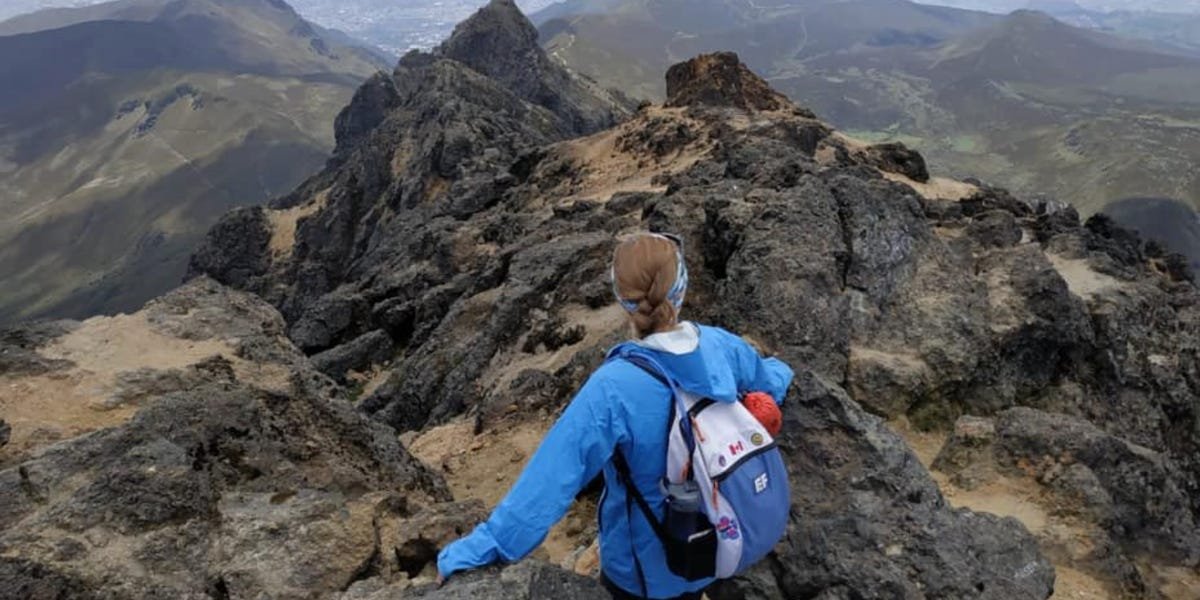
The writer posing on a cloudy hike in the Ecuador Highlands.

The hiking here is unlike anywhere else.

Kirstynn Joseph


For those who, like me, enjoy spending time in nature, the scenic route here is even more special. With most hikes even starting at heights of over 9,000 feet above sea level, the mountains — many of them volcanoes — still tower over you.

Rugged rocks and gleaming glaciers dominate the peaks; you’ll spot lots of bright green cushion plants and fields of golden grasses swaying in the winds. Bright-orange chuquiragua plants, found only at these high altitudes, dot the landscape.

One of my favorite hikes is Rucu Pichincha. After riding the Telefériqo cable car to the base camp — which has an incredible view of Quito, a lovely café, and many great spots for photo ops — you can begin to hike up the trail.

Here, you will experience the biodiverse páramo ecosystem and finish at more than 15,000 feet above sea level.

Elsewhere, in different directions but all within a few hours of Quito, the Antisana, Cayambe, and Cotopaxi volcanoes are sky-high with towering peaks covered by glistening glaciers that not even the equatorial sun can melt.


The view of turquoise water from a Quilotoa hike.

The Quilotoa crater lake is a must-visit.

Kirstynn Joseph


Last but not least, Quilotoa volcano, which is in the same province as Cotopaxi and just a bit further away, holds a turquoise crater lake where you can kayak — one of my absolute favorite things I’ve done here.

I may be biased, but I believe this region is one of the most underrated places in the world. If you find yourself in South America, it is absolutely worth it to set some time aside to get to know the Andes and everything they have to offer.

Just be careful on your journey there — you, too, may also find yourself staying just a bit longer than you planned.


Source link

Ive-lived-in-Switzerland-for-5-years-Here-are-the.jpeg

I’ve lived in Switzerland for 5 years. Here are the 6 biggest mistakes I see first-time visitors make over and over.

  • After living in Switzerland for five years, I’ve watched tourists make a lot of the same mistakes.
  • Don’t try to see too many places in one trip, and try visiting some smaller mountain villages.
  • Become at least a little familiar with the local languages and book your train tickets in advance.

Though I’m a US citizen, I’ve spent the past five years living in Switzerland.

As a semi-recent transplant, I know there’s much more to this amazing country than what visitors typically come to see. It’s one best experienced thoughtfully and authentically — not by mindlessly racing through “Top 10 ” lists.

In terms of mistakes tourists make, here are a few things I suggest you know — and avoid — before visiting Switzerland for the first time.

You’ll probably regret only visiting the Instagram-popularized spots.

Lucerne is incredible, but it’s not the only great place to visit in Switzerland.

Peter Shaw/Getty Images

Zermatt, Lauterbrunnen, Interlaken, and Lucerne are popular, jaw-dropping locations, but they’re not the only spots worth visiting in Switzerland.

Instead of only seeing the few places on every tourist’s list, consider branching out to smaller, lesser-visited ones for at least a day trip. Fortunately, many are easily accessible by public transportation out of some of the area’s main hubs.

For example, close to Interlaken are the mountain villages of Frutigen, Kandersteg, and Adelboden, which offer gorgeous alpine views combined with fewer crowds and more authentic experiences.

Don’t assume the dining-out culture and prices will be what you’re used to back home.


Vegetables on plate

Eating out in Switzerland can be expensive, but I’ve found the prices to be justified.

Ashley Franzen

In Switzerland, dining out can seem expensive — in part because the cost of production, labor, and relevant service charges are typically already included in the price of the meal.

Personally, I find the prices easier to stomach when I remember you’re often paying for high-quality, regional fare, and restaurant staff here are typically earning a fair wage.

And although tipping servers 15% to 20% of a bill is standard practice in places like the US, it’s not the norm here. If you enjoyed the meal and the service, it’s customary to round up a few francs or leave a tip between 5% and 10%.

Make your train reservations in advance.


Train tour sign in Switzerland

Not making reservations in advance could mean missing out on some special experiences.

Ashley Franzen

Switzerland is a popular travel destination throughout the year, and its major attractions can fill up quickly — especially seats on our world-famous scenic routes.

If you plan on riding the Glacier Express or Bernina Express, book your train tickets as far in advance as possible.

However, don’t fret if you realize it’s too late to book a seat on a scenic route. You’ll be just fine on our “regular” trains, which tend to run faster, not book up as quickly, and still offer beautiful views.

Speaking of trains, don’t get fined for sitting in the wrong class.


First-class train car in Switzerland

Make sure you follow your ticket.

Ashley Franzen

When traveling by train, it’s important to double-check your ticket class and location. (And, if you have a paper ticket, get it validated.)

Signage indicating first or second class can be found both outside and inside each car. Oftentimes, the class is also noted on the headrests of the seats themselves.

Ticketing agents on board will not hesitate to issue an on-the-spot fine for tourists seated in the wrong class. In addition to a fine of about 100 francs, you’ll also have to pay the difference in price for the ticket.

Also, pay attention to where your seats are before entering each car so you won’t have to lug an oversized suitcase through the entire train.

Switzerland is small, but I don’t advise trying to cram everything into a short trip.


Snowy mountain views on way to St Moritz

While in Switzerland, take your time to experience the culture and stunning views.

Ashley Franzen

Switzerland is one of the smallest countries in Europe, at about 16,000 square miles. However, I’ve seen tourists mistakenly assume they can just zip through and see everything it has to offer in just three or four days.

For example, Zurich may seem close to Geneva on a map, but they are actually about three hours apart by train. Sure, you could also opt for a one-hour flight — but my point is that trying to see so many cities in a short period won’t allow you to truly get a feel for each.

Travel is about experiencing a place, not just visiting to check it off a bucket list. If you’ve only got a week in Switzerland, I suggest you limit yourself to exploring two or three cities instead of trying to cram six or seven single-night stays in new places into your itinerary.

Become at least a little familiar with the local languages and commonly used symbols.


Recycling bins in Switzerland

The Swiss take recycling seriously.

Ashley Franzen

Switzerland is composed of 26 cantons, and each of these administrative regions has its own distinct culture, government, and history. They also don’t all speak the same languages.

Although you’ll find English speakers throughout the country — especially in popular tourist areas — Switzerland actually has four official languages: German, French, Italian, and Romansh.

It’s helpful to learn a few basic greetings in those major languages and ensure you use them in the appropriate region.

Also, it’s handy to become familiar with some of the commonly used symbols — especially when it comes to trash cans.

The Swiss are conscientious recyclers, so take a beat to look up the symbols printed on the bins before tossing something in them if you are confused. Your mindfulness will be appreciated


Source link