
Line chart

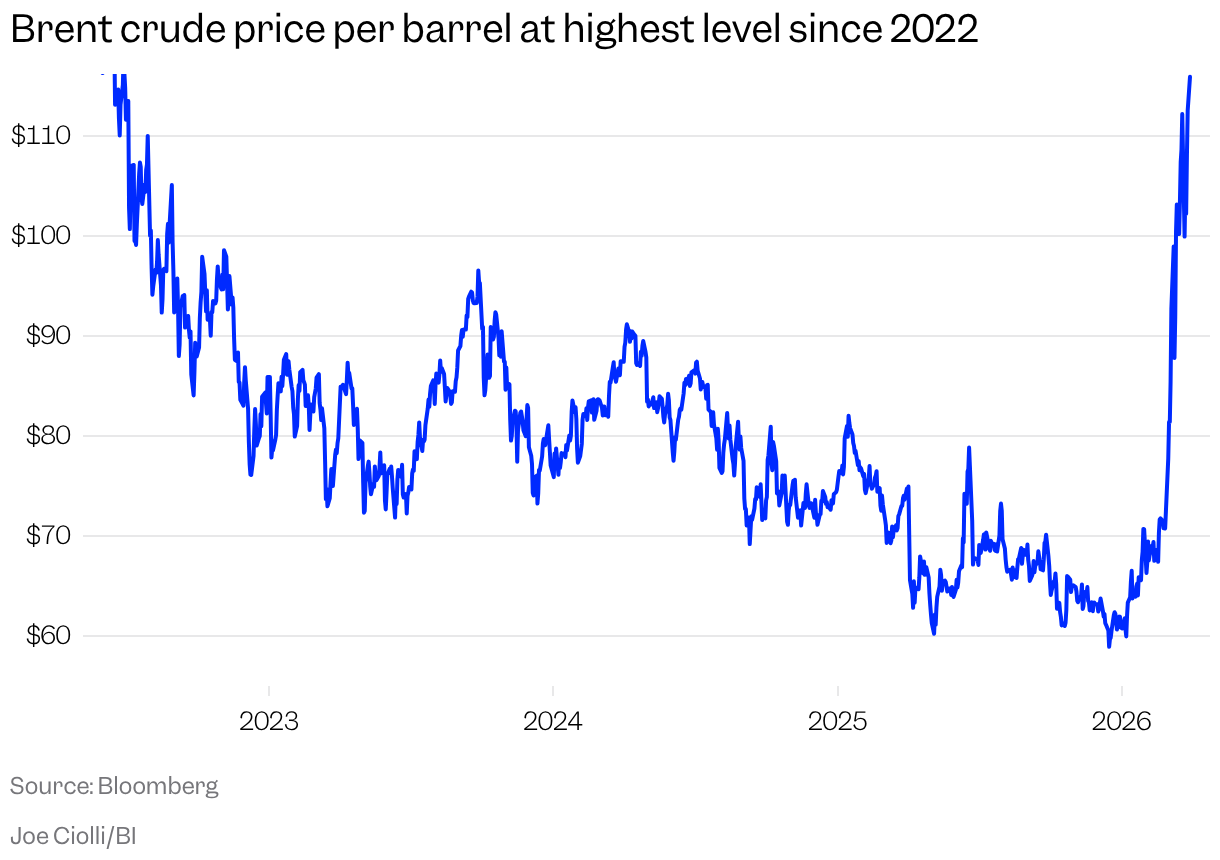
Oil prices rise again as the Iran war enters its 5th week

Oil prices rose on Sunday as some Middle East officials gathered in Islamabad to discuss de-escalation efforts to end the US and Israel’s war on Iran.

Brent oil reached $115.73 a barrel when markets reopened, a $3 increase from its Friday high of $112.57. Western Texas Intermediate hit $103.13 a barrel on Sunday.

Oil prices have surged since the US and Israel began bombing Iran at the end of February, and Iran retaliated by essentially closing the Strait of Hormuz. About 20% of the world’s oil supply and liquified natural gas passes through the waterway off Iran’s coast. Major oil hubs across the Middle East have also been damaged during the conflict, further straining the global supply chain.

For Americans, that translates to higher gas prices. The national average was $3.98 on Sunday, up from $2.98 in February. The International Energy Agency has released 400 million barrels of oil from a strategic reserve to ease economic uncertainty.

Although US Energy Secretary Chris Wright said on March 8 the war wouldn’t be “long-term,” the Trump administration and Iranian officials have not yet signaled an exit plan. On Saturday, The Washington Post reported that the Pentagon is preparing for weeks of ground operations in Iran.

Many global leaders are urging de-escalation, including Pakistani Foreign Minister Mohammad Ishaq Dar, who is meeting with foreign ministers from Egypt, Saudi Arabia, and Turkey in Islamabad on Sunday and Monday.

Dar said the group had a “very detailed and in-depth discussion” about the regional situation in a statement shared to X.

“We also discussed the possible ways to bring an early and permanent end to the war in the region,” Dar said. “We agree that the war is not in favour of anyone and would only lead to death and destruction.”

Dar added that the US and Iran have “expressed their confidence in Pakistan” to assist with peace talks.

“We have remained actively engaged with the US leadership as well, as part of our efforts to de-escalate the situation and find a peaceful resolution of the conflict,” Dar said. “In this context, Pakistan is very happy that both Iran and the US have expressed their confidence in Pakistan to facilitate these talks.”


Source link

Oil-prices-climb-as-the-US-and-Israels-war-on.jpeg

Oil prices climb as the US and Israel’s war on Iran enters its 3rd week

Oil futures climbed in early trading on Sunday as the US and Israel’s war with Iran entered its third week, disrupting the global supply chain.

Brent oil reached $106.33, up nearly $3 from when the market closed on Friday. West Texas Intermediate hit $101.19 on Sunday.

For Americans, surging oil prices mean spending more at the pump. The national average price for gasoline hit $3.69 on Sunday. Gas prices have surpassed $3 in all 50 US states for the first time since 2023.

The International Energy Agency said last week the war has caused the largest oil market disruption in history, and that global oil supply will drop by 8 million barrels per day in March.

Kevin Hassett, the US director of the National Economic Council and a top aide to President Donald Trump, said Sunday on CBS News’ “Face the Nation” that the US is working to minimize the fallout for American consumers.

“The big problem right now would be energy prices, and we’re watching and monitoring closely,” Hassett said.

Much of the instability in the oil market stems from the near-closure of the Strait of Hormuz, which Iran controls and through which about 20% of the world’s petroleum passes. Trump has called on other nations to help secure the strait, but has so far received either lukewarm replies or none at all.

Attacks on major oil hubs are also likely driving up prices. Trump said late Friday that the US had “totally obliterated” military targets on Iran’s Kharg Island, where refineries process almost all of the nation’s oil exports.

The president threatened to target oil infrastructure on the island if Iran continued to prevent ships from passing through the Strait of Hormuz. An attack on the key Iranian oil center would further destabilize the global oil market.

In response, Iran said that ports, docks, and “American hideouts” in the United Arab Emirates could be targeted. Fire later broke out near the Port of Fujairah in the United Arab Emirates, the only multipurpose maritime facility on the UAE’s east coast and a major oil depot, on Saturday. The local government said an intercepted drone caused the fire.

Any end to the conflict, meanwhile, appears to be a long way off. Iran’s foreign minister, Abbas Araghchi, said on Sunday that there has been no discussion of a ceasefire.

“We are only defending our people from this act of aggression,” Araghchi said on “Face the Nation.”We don’t see any reason why we should talk with Americans, because we were talking with them when they decided to attack us, and that was for the second time.”


Source link

FCC-chair-threatens-to-pull-licenses-of-broadcasters-airing-distortions.jpeg

FCC chair threatens to pull licenses of broadcasters airing ‘distortions’ about the Iran war

Federal Communications Commission Chair Brendan Carr warned broadcasters Saturday that they could lose their licenses if they air what he described as misleading coverage of the war involving Iran.

In a post on X, Carr said broadcasters spreading inaccurate reporting should “correct course” before coming license renewals.

“Broadcasters that are running hoaxes and news distortions — also known as the fake news — have a chance now to correct course before their license renewals come up,” Carr wrote. “The law is clear. Broadcasters must operate in the public interest, and they will lose their licenses if they do not.”

He did not specify which broadcasters may be at risk.

Carr’s comments included a screenshot of a Truth Social post from President Donald Trump accusing major newspapers of misrepresenting developments in the war, which began with US and Israeli strikes on Iranian targets and has since escalated across the region.

Trump wrote that headlines reporting that Iranian strikes had destroyed tanker aircraft at a Saudi base were “intentionally misleading,” saying the planes were not destroyed and that most were already back in service. Trump singled out The New York Times and The Wall Street Journal, writing that their coverage was “the exact opposite of the actual facts.”

The FCC regulates broadcast television and radio stations and grants them licenses to use public airwaves, which must be renewed periodically. The warning reflects a broader pattern of the FCC under Carr taking a more aggressive posture toward broadcasters’ content, and comes amid heightened tensions between broadcasters and the FCC over how political content is handled on air.

Since becoming chair during Trump’s second term, Carr has repeatedly pointed to the agency’s “public interest” standard and a rarely invoked “news distortion” policy as potential tools to scrutinize stations’ programming.

Earlier this year, CBS opted not to air a scheduled interview with Texas state Rep. James Talarico on “The Late Show with Stephen Colbert” after network lawyers warned the appearance could trigger the FCC’s “equal time” rule, which requires stations to provide comparable airtime to political candidates. The commission has recently signaled that late-night talk shows may not qualify for a long-assumed exemption to the rule and has also pursued enforcement actions related to a similar interview on ABC’s “The View.”

Critics, including former FCC officials and lawmakers, have warned that using those authorities to challenge editorial decisions risks pressuring news organizations over their coverage, while Carr has defended the approach as ensuring broadcasters meet their legal obligations.

Carr’s warning contrasts with comments he made earlier in his career. In a 2019 post on X, the then-commissioner wrote that “the FCC does not have a roving mandate to police speech in the name of the ‘public interest,'” a statement critics have resurfaced as he increasingly invokes that standard to scrutinize broadcasters’ programming.


Source link