TSAs-leader-warns-so-many-agents-have-quit-that-airports.jpeg

TSA’s leader warns so many agents have quit that airports will be clogged during June’s World Cup

Even if the partial government shutdown ends soon, the fallout at the Transportation Security Administration could spill into the summer’s marquee event.

In a House testimony on Wednesday, acting TSA administrator Ha Nguyen McNeill said that so many officers have quit since their pay stopped in mid-February that the agency can’t get replacements fast enough to adequately staff airports ahead of the World Cup in June.

She said TSA officers spend four to six months in training before working checkpoints, but the games — which will take place across 16 cities in the US, Canada, and Mexico — start in just 80 days.

“This is a dire situation,” she said, adding that more than 480 officers have quit so far. “We are facing a potential perfect storm of severe staffing shortages and an influx of millions of passengers at our airports.”

TSA agents haven’t been paid for nearly six weeks, yet are deemed “essential” and expected to work during the shutdown, with back pay promised afterward. Their annual pay starts at around $40,000 and averages $60,000 to $75,000 a year with experience.

Still, many live paycheck to paycheck and can’t afford to work unpaid for months at a time — quitting and finding another job or doing gig work is often their best option.

Mass TSA agent quits and callouts amid the shutdown, compounded by peak spring break travel, have already created hourslong security lines and stranded travelers. It’s a preview of the chaos that could repeat when an estimated 6 million fans descend on potentially understaffed airports for the World Cup.

“If we see any spikes [in attrition], we’re going to have to pivot and assess how we are going to staff the FIFA locations adequately,” McNeill said.

Passengers traveling to the scheduled World Cup games in San Francisco and Kansas City, however, are likely safe from staffing chaos.

Both city airports use private security officers employed by contract companies instead of TSA, meaning their agents are being paid despite the shutdown.

It’s not just the TSA sounding the alarm

Former Republican Sen. from Oklahoma, Markwayne Mullin — who was confirmed as the new head of the Department of Homeland Security on Monday after Kristi Noem’s ousting in early March — said in a Senate hearing last week that the US is “behind” on World Cup preparations and the shutdown is making it worse.

“It’ll take four months once funding comes in to start replacing those that we’ve lost for training before we can get them out in the field; we don’t have four months with FIFA,” he said. “How do we expect these people to stay on the job and work? We’re losing institutional knowledge, we’re losing people we’ve already trained.”


A TSA agent surveys the security line at New York LaGuardia airport.

TSA agents have been working without pay. Many are calling out or quitting, causing lines to pile up at airports across the US. 

CHARLY TRIBALLEAU / AFP via Getty Images


The mass quits are exacerbating a problem that was already flagged last year.

A February 2025 report from the US Travel Association — long before the shutdown’s impact could be factored in — warned that the TSA may not be efficient enough to handle surging travel volumes during the World Cup.

On its busiest days, the agency screened about 3 million passengers. During the games, the organization said that level of traffic would be the norm.

Lawmakers are still negotiating a funding deal to reopen DHS and end the partial shutdown.


Source link

Trump-warns-of-more-US-troop-deaths-after-3-American.jpeg

Trump warns of more US troop deaths after 3 American service members were killed in the Iran conflict

Three American service members have been killed and five seriously wounded as part of combat operations against Iran, the US military said on Sunday.

It is the military’s first acknowledgement of any US losses since American forces began striking Iran alongside Israel on Saturday.

“Several others sustained minor shrapnel injuries and concussions — and are in the process of being returned to duty,” said US Central Command, which oversees Middle East operations.

CENTCOM did not specify how or where the service members were killed and wounded or whether the losses were sustained during offensive or defensive operations. It declined to offer additional information.

“The situation is fluid, so out of respect for the families, we will withhold additional information, including the identities of our fallen warriors, until 24 hours after next of kin have been notified,” CENTCOM said in a statement, adding that combat operations will continue.

President Donald Trump on Sunday vowed vengeance for the service members killed.

“As one nation, we grieve for the true American patriots who have made the ultimate sacrifice for our nation, even as we continue the righteous mission for which they gave their lives,” he said.

“And sadly, there will likely be more,” Trump added. “Before it ends. That’s the way it is.”

Trump had said on Saturday that the US could suffer losses as a result of the conflict with Iran.


A missile launches from a US warship during operations against Iran.

The US military did not say where or how the casualties occurred.

US Central Command


“The lives of courageous American heroes may be lost, and we may have casualties. That often happens in war,” Trump said in a video address to the nation. “But we’re doing this — not for now — we’re doing this for the future, and it is a noble mission.”

Dozens of people have been killed and wounded by Iranian strikes in Israel and the United Arab Emirates, and hundreds of people in Iran have been killed and wounded by US and Israeli strikes, according to local authorities.

The Israeli military said on Sunday that it has killed 40 senior Iranian commanders, as well as the country’s Supreme Leader Ayatollah Ali Khamenei.

A wide range of American forces — on land, in the air, and at sea — have participated in the airstrikes against Iran, targeting the Islamic Revolutionary Guard Corps’ (IRGC) command and control facilities, air defenses, missile and drone launch sites, and military airfields.

US forces have also been involved in air defense operations to shield American assets and allies across the Middle East from hundreds of Iran’s retaliatory missile and drone attacks.

Iran has fired missiles at US forces based in Qatar, Kuwait, Bahrain, and the UAE and has also targeted other Middle East countries, including Israel, Saudi Arabia, Oman, and Iraq.


Source link

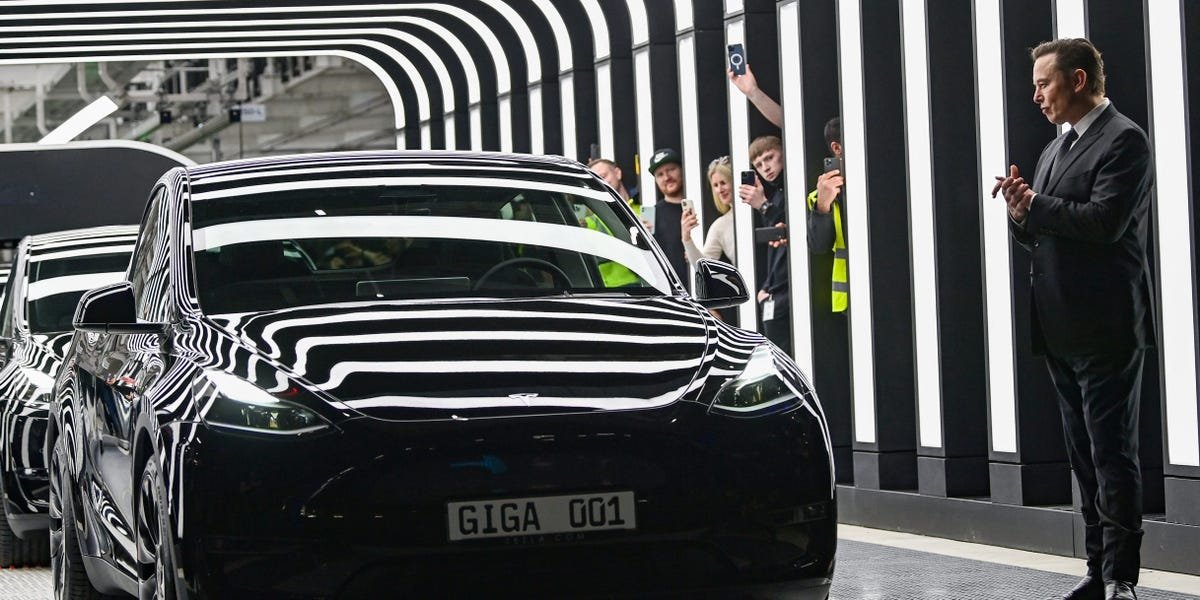
Elon-Musk-warns-Tesla-employees-over-future-of-German-megafactory.jpeg

Elon Musk warns Tesla employees over future of German megafactory ahead of union election

Tesla’s sales in Europe are plummeting — and now Elon Musk has a warning for employees at the company’s German megafactory ahead of crucial union elections.

In an interview with Giga Berlin senior director Andre Thierig posted on X on Thursday, Musk said Tesla would “ideally” expand its only European gigafactory and start production of its battery cells, Cybercab robotaxi, and Optimus robot at the site.

Asked if he had any advice for the team at Giga Berlin to work toward that vision, Musk said any expansion was contingent on Tesla being free from interference from “outside organizations.”

“Things certainly get harder if there are outside organizations who are pushing Tesla in the wrong direction,” said Musk.

“It’s difficult to say that then we would expand, if we had outside organizations who were making things very difficult. We’re not going to shut down the factory, but we wouldn’t expand it either,” said the Tesla CEO.

The billionaire’s comments come ahead of a crucial vote at Tesla’s German factory next week, with powerful German union IG Metall pushing to gain control of the site’s work council — an elected body of employees required by local laws that negotiates pay deals and working hours with management.

German publication Handelsblatt first reported Musk’s comments, which it said were screened for employees on Wednesday.

Tesla clashes with union

The run-up to the election has been marked by fierce disputes between the union and Tesla’s executives. Earlier this month, Tesla filed a criminal complaint against an IG Metall representative, accusing them of secretly recording an internal meeting.

IG Metall, which has frequently clashed with Tesla over working conditions at Giga Berlin over the past few years, denied the allegation and responded with its own complaint accusing Thierig of defamation. The union said Thursday that both sides had agreed on a truce ahead of the works council elections.

The debate over Giga Berlin’s future comes as Tesla’s sales in Europe have collapsed. The US automaker saw registrations of its EVs fall nearly 38% in the EU last year, as it was hit by backlash over Musk’s political interventions and backing of German far-right party AfD.

In January, Tesla’s European sales dropped to just 8,000 units, according to data from the European Automobile Manufacturers Association, less than half the number sold by Chinese rival BYD.

Musk also said in the interview that Tesla expects to receive approval to sell Full-Self-Driving driver assist technology in the Netherlands on March 20.


Source link

Katherine Li, West Coast breaking news reporter at the Business Insider.

The author of a viral AI report warns that blue-collar jobs won’t be safe from an AI-driven recession

The coauthor of an AI research paper is speaking out after his work triggered a global stock sell-off.

Citrini, a firm focused on thematic equity investing, alongside Alap Shah, CEO of Littlebird.ai, theorized a future where, instead of transforming the economy in a positive way, the AI boom erases white-collar jobs and severely reduces the spending power of those workers, and eventually stunts economic growth.

On Monday, Shah told “TBPN” podcast hosts John Coogan and Jordi Hays that despite how well it seems to be going for blue-collar jobs at the moment in terms of growth and the lack of mass layoffs, these jobs won’t be safe if white collar jobs go away because ultimately, there is only “one labor market.”

“Let’s say in our scenario, we talk about 5% of folks might get fired in a couple of years,” said Shah. “Those 5%, if there aren’t white collar jobs for them to relocate into, then they’re going to have to move into the gig economy and the blue collar labor force.”

“And so that puts pressure on the entire labor market, not just the white collar one,” Shah added.

Shah and Citrini published a report on Sunday, written from a futuristic point of view set in 2028, that predicts a negative domino scenario triggered by the AI boom. The research theorizes that AI will kick off a mass white-collar layoff too quickly, which will then deal a blow to the metro housing and mortgage market, and eventually lead to a global stock sell-off and a widespread recession in all sectors. In this scenario, the paper said, AI growth could also lose momentum due to a lack of funding.

“The system turned out to be one long daisy chain of correlated bets on white-collar productivity growth,” the paper theorizes. “The November 2027 crash only served to accelerate all of the negative feedback loops already in place.”

Shah elaborated on these concerns on “TBPN.” When asked what he thinks of the current growth in the health and education sectors, Shah said most of it could be spurred by government spending, which would go away if personal income declines.

“Those sectors continue to grow because government spending grows,” said Shah. “But again, gets very circular if government spending is coming primarily from taxes and primarily payroll taxes because the average worker pays a lot more in taxes per dollar than the average corporate does.”


Source link

AI-CEO-warns-AIs-disruption-will-be-much-bigger-than.jpeg

AI CEO warns AI’s disruption will be ‘much bigger’ than COVID: ‘The people I care about deserve to hear what is coming’

It’s never a good sign when a CEO warns something more disruptive than COVID is heading our way.

In an essay titled “Something Big Is Happening,” Hyperwrite CEO Matt Shumer said AI can now do all of his technical work — and he thinks your job could be next.

“I’m writing this for the people in my life who don’t… my family, my friends, the people I care about who keep asking me ‘so what’s the deal with AI?’ and getting an answer that doesn’t do justice to what’s actually happening,” Shumer wrote in his nearly 5,000-word post published Tuesday on X.

As of Wednesday morning, Shumer’s post had 40 million views and 18,000 retweets.

Shumer said that the reason people in tech “are sounding the alarm” is that they have already experienced what’s coming for everyone else.

“We’re not making predictions,” he wrote. “We’re telling you what already occurred in our own jobs, and warning you that you’re next.”

Shumer said that many people outside tech wrote off AI years ago after a clunky experience with an early edition of ChatGPT.

“The models available today are unrecognizable from what existed even six months ago,” he wrote. “The debate about whether AI is ‘really getting better’ or ‘hitting a wall’ — which has been going on for over a year — is over.”

It’s not the time to panic, Shumer said. Instead, the best thing to do is to become deeply familiar with AI. “This might be the most important year of your career,” he wrote.

“I don’t say that to stress you out. I say it because right now, there is a brief window where most people at most companies are still ignoring this,” he wrote. “The person who walks into a meeting and says ‘I used AI to do this analysis in an hour instead of three days’ is going to be the most valuable person in the room.”

He’s far from alone in sounding the alarm. Despite disagreement from other tech leaders, Anthropic CEO Dario Amodei remains adamant that AI could wipe out up to half of white collar, entry-level jobs in the next one to five years.

xAI CEO Elon Musk and others have warned that if your job doesn’t involve physical labor, it’s likely to be replaced by AI much more quickly, a view that dovetails with a growing base of economic research.

Shumer’s essay struck a chord, especially with those in tech. Reddit cofounder Alexis Ohanian replied, “Great writeup. Strongly agree.”

“Great advice for how to get ahead in your job at any large company right now,” A16z general partner David Haber wrote.

While the response to the post has been overwhelmingly positive, some X users pointed out the limitations still present in many current AI products, like hallucinations and general inaccuracies.

What changed Shumer’s mind

Shumer said that this moment feels like February 2020, when in a short span of time, news of a spreading pandemic gave way to a worldwide upheaval unseen in modern times that continues to reverberate to this day.

The potential of what AI will change, he wrote, is “much bigger than Covid.”

For Shumer, this moment of realization came with the recent dueling releases of Anthropic’s Opus 4.6 and OpenAI’s GPT-5.3 Codex. Both models are primarily aimed at software engineering. OpenAI said in its release notes that GPT-5.3 Codexis our first model that was instrumental in creating itself.”

“It wasn’t just executing my instructions,” Shumer wrote of his experience with OpenAI’s latest Codex model. “It was making intelligent decisions. It had something that felt, for the first time, like judgment. Like taste. The inexplicable sense of knowing what the right call is that people always said AI would never have.”

AI is now so intelligent, Shumer said, that he can tell the agent what he wants and “walk away from my computer for four hours, and come back to find the work done. Done well.”

In a post on LinkedIn Wednesday morning, Shumer addressed his viral X post.

“Every time someone asks me what’s going on with AI, I give them the safe answer,” he wrote on Wednesday. “Because the real one sounds insane. I’m done doing that.”


Source link

Google-warns-some-visa-employees-not-to-leave-the-US.jpeg

Google warns some visa employees not to leave the US due to ‘significant’ return delays of up to a year

Google has advised some employees on visas not to travel outside the US due to delays at embassies, Business Insider has learned.

The company’s outside counsel BAL Immigration Law sent an email on Thursday advising staff who require a visa stamp to re-enter the US not to leave the country because visa processing was taking longer than usual, according to a copy of the memo reviewed by Business Insider.

“Please be aware that some US Embassies and Consulates are experiencing significant visa stamping appointment delays, currently reported as up to 12 months,” the memo read. It was recommended that employees avoid international travel as they would “risk an extended stay outside the US.”

American consulates and embassies around the world are seeing delays with routine visa appointments following the introduction of a new social media screening requirement, which applies to H-1B visa workers and their dependents, as well as students and exchange visitors.

On Friday, a spokesperson for the Department of State told Business Insider it was conducting “online presence reviews for applicants.” The department said it may move appointments as resources change, with applicants able to request expedited slots on a case-by-case basis.

“While in the past the emphasis may have been on processing cases quickly and reducing wait times, our embassies and consulates around the world, including in India, are now prioritizing thoroughly vetting each visa case above all else,” the State Department spokesperson said. Appointments in Ireland and Vietnam have also been postponed, according to immigration firm Reddy Neumann Brown PC.

Google’s lawyers said in the memo that the delays were affecting H-1B, H-4, F, J, and M visas. The advisory did not specify what anyone on a visa already outside the country with a postponed appointment should do.

A Google spokesperson declined to comment.

How enhanced visa vetting can complicate a routine trip abroad

Google’s warning echoes a wave of internal travel advisories that swept through corporate America in September, as the Trump administration imposed a $100,000 fee on new H-1B visas.

The H-1B visa typically lasts up to three years and can often be extended. If someone needs a new H-1B visa stamp, they typically must apply at a US embassy or consulate in their home country or a country where they have lawful residence.

As a general matter, said immigration attorney Jason Finkelman, who focuses on employment and family immigration, foreign nationals should be able to return to the US after travel abroad if they have a valid visa stamp and aren’t subject to any entry restrictions, including the Trump administration’s expanded travel ban, which the White House says takes effect January 1.

That’s where enhanced vetting can complicate an otherwise routine trip. If an H-1B worker leaves the US to get a new visa stamp and their consular appointment is canceled or delayed — sometimes by months — they can be stuck abroad until the visa is issued.

“My advice to clients is that if travel isn’t essential right now, better to stay put,” Finkelman said.

A spokesperson for the Department of State said consular officers “do not issue a visa unless the applicant can credibly demonstrate they meet all requirements under US law — including that they intend to engage only in activities consistent with the terms of their visa.”

The H-1B program, which is capped at 85,000 new visas a year, serves as a core pipeline for employers hiring skilled foreign workers. Tech giants have long been among the largest users of the visa, with companies such as Amazon, Google, Microsoft, and Meta topping the lists of approved new H-1B petitions in recent years. 

Under the Trump administration, the program has become a political flash point, with the White House framing H-1Bs as a threat to American jobs and rolling out measures that critics and employers say make it harder and more expensive to hire new workers.


Source link