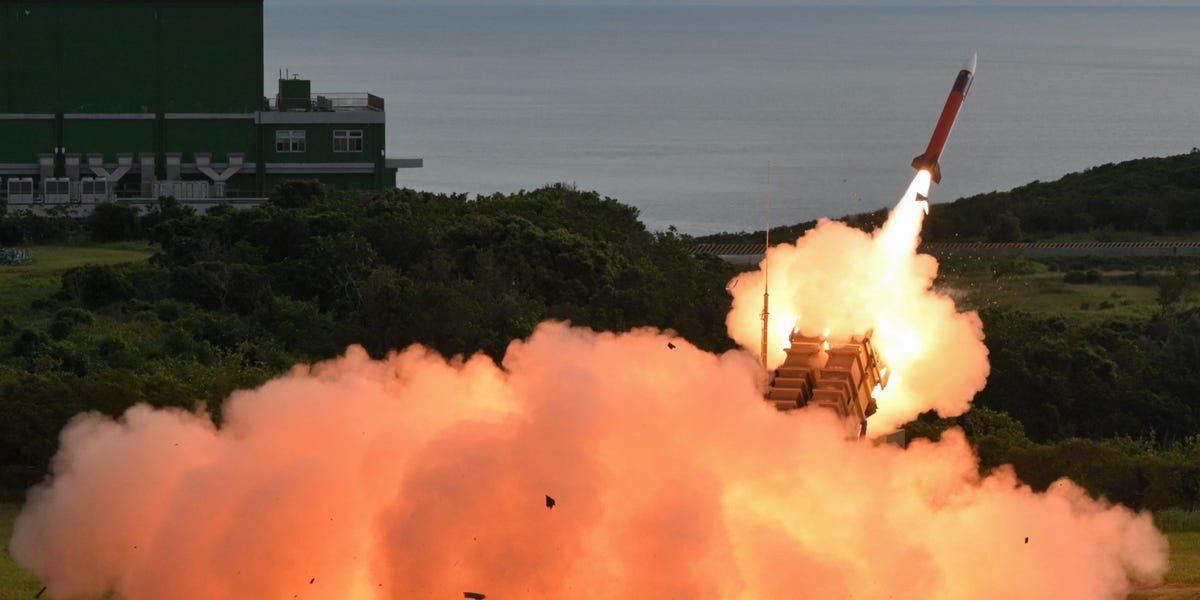
President Donald Trump said on Monday that wars “could be fought ‘forever,’ and very successfully” solely with munitions stockpiles, as the US engages in major combat operations against Iran.
In a late-night Truth Social post, Trump praised the US’ supply quantities of “medium and upper medium grade” weapons. It’s not immediately clear exactly which munitions or weapons he was referring to.
“As was stated to me today, we have a virtually unlimited supply of these weapons. Wars can be fought ‘forever,’ and very successfully, using just these supplies (which are better than other countries finest arms!),” he added.
His comments come amid global uncertainty over how long the US and Israel’s war with Iran will last.
Earlier on Monday, Trump told reporters that the campaign could last four to five weeks, but that the White House was prepared “to go far longer than that.”
Every time Matthew publishes a story, you’ll get an alert straight to your inbox!
Stay connected to Matthew and get more of their work as it publishes.
Washington and Tel Aviv pummeled Iran with hundreds of strikes on Saturday, killing Iranian Supreme Leader Ayatollah Ali Khamenei in the first wave of attacks.
Iran and its allies have responded by launching ballistic missiles, rockets, and drones at Israel and Gulf nations known to host US military bases. The fighting has plunged residential and tourist areas into chaos, disrupted hundreds of flights, and sent oil prices spiking.
In his Truth Social post, Trump admitted that weapons stockpile quantities are “not where we want to be.”
“Much additional high grade weaponry is stored for us in outlying countries,” he added. It’s unclear if the president was implying that the war with Iran may require munitions from other theaters.
The White House did not respond to a request for comment sent outside regular business hours by Business Insider.
The strike campaign on Iran has raised questions in some circles about remaining US stockpiles of long-range munitions, such as the Tomahawk cruise missile. There are fears that the Pentagon may need these weapons to deter a potential conflict with other adversaries, chiefly China.
US officials said they had used a wide variety of munitions, including drones, offensive missiles, and interceptors, against Iran.
The US and Israel’s fight with Iran shows just how key air defenses have become in higher-intensity modern wars, conflicts increasingly defined by long-range missile and drone attacks.
The conflict, which killed Iran’s Supreme Leader, has been heavily focused on air defenses, either knocking them out to permit air operations or leaning hard on them to shield bases from retaliatory strikes.
The US and Israel said their strikes focused on Iran’s air defenses and missile launch sites, and US and partner forces in the countries attacked in response relied on a mix of air defenses to fend off Iranian weapons.
Kuwait, home to installations like Ali Al Salem Air Base that hosts US troops, reported on Sunday that it had faced 97 ballistic missiles and 283 drones. Defeating this kind of barrage demands deep air defense arsenals.
When air defenses fall short
US Central Command on Saturday said the strikes on Iran aimed to “dismantle the Iranian regime’s security apparatus” and prioritized locations “that posed an imminent threat,” listing Iranian air defense capabilities, missile and drone launch sites, and military airfields as targets.
US Central Command shared footage of strikes on Iranian targets, including Iranian air assets.
US Central Command/X
The Israel Defense Forces said that they had “dismantled the majority of the aerial defense systems in western and central Iran” and are “paving the way towards establishing aerial superiority over the skies of Tehran.”
On Saturday, Israel used around 200 jets to drop hundreds of bombs on 500 targets on Saturday, including Iran’s air defense systems and missile launchers.
Having insufficient air defenses can leave a country severely vulnerable in a war of ranged strikes by creating a permissive environment for enemy airpower, as well as munitions, to find their targets, be they military installations or senior leadership. Over the past day, Iran has suffered serious losses to both.
Air defenses matter in a missile fight
Air defenses have been critical for the US and its allies this weekend.
CENTCOM said it was able to defend against hundreds of Iranian missile and drone attacks, with no casualties. A US official told Business Insider that US-made MIM-104 Patriot surface-to-air missile systems and Terminal High Altitude Area Defense, or THAAD, batteries were used to protect the Middle East from Iran’s retaliatory strikes. Warship-launched interceptors and aircraft were also involved, as they’ve been in other engagements involving big Iranian missile barrages.
Nations attacked by Iran, countries like Qatar, the United Arab Emirates, and Bahrain, said they were largely able to intercept Iran’s missiles, sometimes stopping entire waves. Details are still emerging, but damage appears minimal. Casualties, likewise, have been extremely limited thus far, at least compared to what they might have been otherwise.
Some of Iran’s retaliatory strikes were successful, but countries reported intercepting entire waves of attacks with air defenses.
Stringer/REUTERS
That was only day one though. Iran has a large missile arsenal, and it has pledged to continue its attacks. Continued large barrages will put tremendous strain on air defense arsenals.
Along with other current and potential conflicts, Iran is yet more evidence that much of modern war has become ranged missile fights. If you don’t have good air defenses, you may very well lose.
This is a very different way of war compared to the fights against terrorists and insurgencies that the US and its allies waged for decades in the Middle East.
More would be needed for higher-end threats
China and Russia both field substantial missile arsenals that they are continuing to expand. The West is aware, but the war in Ukraine, where Russia bombards Ukrainian cities nightly with massive mixes of missiles and drones, has been a real wake-up call.
Ukraine has been developing its own air defenses while seeking additional options from partners. Each barrage is extremely demanding. In one engagement, Ukraine expended nearly $100 million in interceptors fighting off Russian attacks.
Much of the West has allowed air defense arsenals to atrophy, but there are significant new investments in air defense across the NATO alliance.
The NATO chief pledged a fivefold increase in air defenses, driven by the alliance’s increased spending. Established manufacturers are increasing production, and new systems are being created. President Donald Trump wants his Golden Dome missile defense system to protect against complex attacks from Russia and China.
But air defense systems and their missiles are expensive and time-consuming to make, and the industry is struggling to keep up with increasing demand, even with companies boosting output.
Mick Ryan, a retired Australian major general and strategist with a focus on future war, said that the heavier demand could cause new problems. Patriot interceptor missiles are critical to Ukrainian defenses, but are in heavy demand at present in the Middle East,” he wrote on Saturday.
Russia, he said, will want to “exploit any temporary Ukrainian capability gaps while American attention and production capacity focuses on Iran.”
The US will also need to maintain a strong air defense posture in both Europe and the Pacific as well, even as it fights Iran.
Ryan warned that concentrating US missile defense assets in the Middle East could degrade its deterrence in the Pacific: “Every carrier in the Gulf, every squadron in Europe, every missile defence battery protecting Middle Eastern countries represents capacity unavailable for containing Chinese expansion.”
Uber Eats might end up playing a key role in its parent company’s robotaxi business, Uber CEO Dara Khosrowshahi said.
The ride-hailing app is working with multiple companies, such as Alphabet-backed Waymo, to make self-driving cars available through its app. Waymo’s robotaxis have already proven more efficient than most human Uber drivers in cities such as Atlanta and Austin, Uber has said.
One big question hanging over robotaxis, though, is what happens to the vehicles during times of the day when demand for rides is low, Khosrowshahi said on Uber’s fourth-quarter earnings call on Wednesday.
He pointed to one solution: Have them drive orders to customers through Uber’s food delivery and freight businesses.
Some delivery services, such as DoorDash, are also experimenting with robotaxis for food deliveries. Uber offers both ride-hailing and delivery, meaning robotaxis on its network could shift between the two as demand for each changes, Khosrowshahi said on Wednesday.
Every time Alex publishes a story, you’ll get an alert straight to your inbox!
Stay connected to Alex and get more of their work as it publishes.
“Having delivery and freight as part of our logistics ecosystem gives us an opportunity to actually use these vehicles at a structurally higher utilization than anyone else,” Khosrowshahi said.
While ride-hailing accounted for over half of Uber’s revenue in the fourth quarter, its delivery business grew by 29%, a faster clip than the 18% growth rate its ride-hailing segment posted in the same period.
How efficiently companies use the autonomous vehicles that they put on the streets is one of the challenges hanging over the technology.
Safety is another. Last month, a Waymo car injured a child near a school in Santa Monica, California, the latest in a series of accidents involving self-driving cars. Waymo said it is cooperating with a federal probe into the accident.
While it doesn’t operate self-driving cars directly, Uber is experimenting with ways to train the AI behind robotaxis using data it collects from human drivers, Khosrowshahi said. Uber has a partnership with Nvidia to collect that data, for instance. Last month, Uber said it would launch AV Labs, an arm focused on similar training efforts.
Khosrowshahi said the goal is to make self-driving cars more reliable and avoid situations such as last year’s Waymo blackout in San Francisco, when a power outage prompted the company to suspend services. “The real world can create unexpected circumstances,” he said.
Robotaxis also require infrastructure to store, charge, and repair. Some companies, such as startup Voltera, are building depots for those purposes in anticipation of a robotaxi boom in the coming years.
Have a tip? Contact this reporter at abitter@businessinsider.com or via encrypted messaging app Signal at 808-854-4501. Use a personal email address, a nonwork WiFi network, and a nonwork device;here’s our guide to sharing information securely.
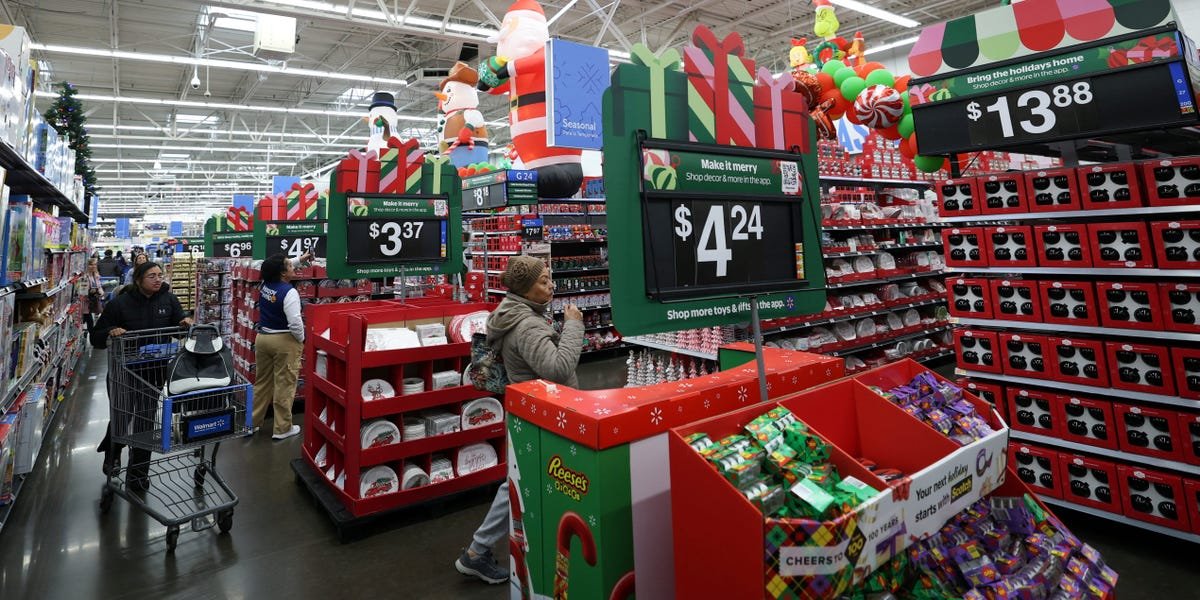
As Christmas approaches, Walmart is giving shoppers something pretty much everyone can use: a little more time.
Imagine you’re just arriving to Christmas Eve dinner with your in-laws and your niece says she’s been wanting a talking plush Bluey doll.
You find it in your Walmart app, place the order in a tap, and by the time dessert is ready, your gift is at the doorstep. (You can even get the whipped cream you forgot to bring for the pie, too.)
Such last-minute shopping options are becoming increasingly possible as major retailers make a big push into ultrafast delivery.
Case in point: Walmart told Business Insider exclusively that its shoppers will be able to place store-fulfilled express delivery orders as late as 5 p.m. local time on Christmas Eve — a full hour later than last year.
“More people are using Express Delivery to get their items faster, and December is when it truly shines,” Walmart’s chief e-commerce officer David Guggina said in a statement. “No one delivers for customers like Walmart, from the first Holiday deal to the final gift on Christmas Eve.”
The retail giant can now reach 95% of US households in three hours or less, and the company has said that more than a third of shoppers opt to pay extra for three-hour-or-less delivery.
Those express delivery numbers jump by 2.5X in December compared with the year’s average, the company said.
The company also told Business Insider that it recently rolled out a new “Get it Now” option in the Walmart app, which shows shoppers an estimated number of minutes to receive an item, and lets them place the order in one tap.
Walmart said earlier this month that it fulfilled its fastest Black Friday order in 10 minutes, with big increases in both the volume and speed of deliveries fulfilled from its stores.
But Walmart isn’t the only player in the ultrafast delivery game: Amazon and Target are also racing to offer last-minute fulfillment options on Christmas Eve.
Target says customers can get orders within two hours via curbside or in-store pickup, or opt for same-day delivery for a $9.99 fee, with stores closing at 8 p.m. on Christmas Eve.
And Amazon will show an “Arrives before Christmas” message on items that can be delivered as late as Christmas Eve via delivery or one of the company’s 25,000 pickup locations.
Correction, December 9, 2025 — An earlier version of this story misstated the delivery category that more than a third of Walmart shoppers opt to pay for — it is three-hours-or-less delivery.