Oil prices roseon Sunday as some Middle East officials gathered in Islamabad to discuss de-escalation efforts to end the US and Israel’s war on Iran.
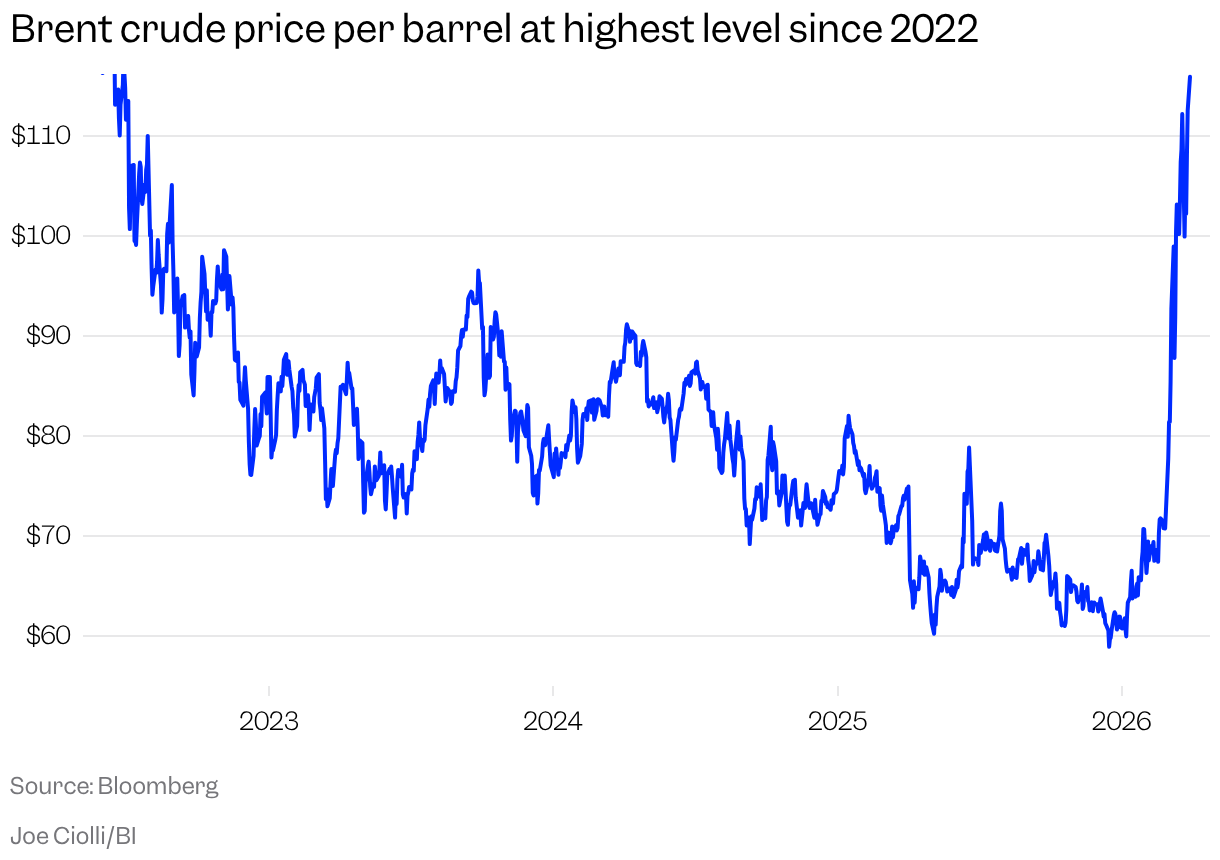
Brent oil reached$115.73 a barrelwhen markets reopened, a $3 increasefrom its Friday high of $112.57. Western Texas Intermediate hit $103.13 a barrelon Sunday.
Oil prices have surged since the US and Israel began bombing Iran at the end of February, and Iran retaliated by essentially closing the Strait of Hormuz. About 20% of the world’s oil supply and liquified natural gas passes through the waterway off Iran’s coast. Major oil hubs across the Middle East have also been damaged during the conflict, further straining the global supply chain.
For Americans, that translates to higher gas prices. The national average was $3.98 on Sunday, up from $2.98 in February. The International Energy Agency has released 400 million barrels of oil from a strategic reserve to ease economic uncertainty.
Although US Energy Secretary Chris Wright said on March 8 the war wouldn’t be “long-term,” the Trump administration and Iranian officials have not yet signaled an exit plan. On Saturday, The Washington Post reported that the Pentagon is preparing for weeks of ground operations in Iran.
Many global leaders are urging de-escalation, including Pakistani Foreign Minister Mohammad Ishaq Dar, who is meeting with foreign ministers from Egypt, Saudi Arabia, and Turkey in Islamabad on Sunday and Monday.
Dar said the group had a “very detailed and in-depth discussion” about the regional situation in a statement shared to X.
“We also discussed the possible ways to bring an early and permanent end to the war in the region,” Dar said. “We agree that the war is not in favour of anyone and would only lead to death and destruction.”
Dar added that the US and Iran have “expressed their confidence in Pakistan” to assist with peace talks.
“We have remained actively engaged with the US leadership as well, as part of our efforts to de-escalate the situation and find a peaceful resolution of the conflict,” Dar said. “In this context, Pakistan is very happy that both Iran and the US have expressed their confidence in Pakistan to facilitate these talks.”
Nvidia’s GTC conference has become its biggest stage for outlining the future of AI.
The annual event increasingly attracts a broader crowd. At past gatherings, with Denny’s pop-ups and Taiwan-inspired night markets, Nvidia CEO Jensen Huang has unveiled sweeping product roadmaps for its GPUs and other AI chips. It’s also announced major pacts with tech giants and governments alike.
This year’s event comes on the heels of a blockbuster earnings report that barely nudged the company’s stock and raises questions about how long the AI spending boom can last.
Polymarket users are even wagering how many times Huang will utter phrases like “GPU” onstage.
Here’s what analysts and investors will be watching:
1. A new inference chip
Inference, or running trained models, is AI’s next act. Expect Nvidia to make a big statement as competitors — from cloud giants to a slew of chip startups — encroach on this space.
Huang previously teased “several new chips the world has never seen before,” and The Wall Street Journal reported in February that Nvidia is readying an inference-focused product incorporating technology from AI startup Groq, with OpenAI expected to be a key customer.
The chip’s design could have big supply chain implications. Inference relies heavily on memory, and with high bandwidth memory (HBM) in tight supply, investors will see whether Nvidia leans more on SRAM — a fast, on-chip memory used in inference designs — rather than solely relying on HBM.
Sid Sheth, founder and CEO of inference chip startup d-Matrix, said that while Nvidia will stay dominant in training, “inference is a different ballgame.”
He added that CUDA, Nvidia’s software that underpins most AI training and has locked developers into its ecosystem, is less of a moat in inference. Developers can turn to competitors other than Nvidia because running finished AI models doesn’t require the same kind of programming as training them, he said.
2. Life after Rubin
Nvidia has announced its next-generation Rubin Ultra systems. Rubin is expected to require far more power than past generations, and investors will eagerly see how Nvidia manages the transition and whether cloud giants will support it, said Sebastien Naji, a research analyst at William Blair.
Naji is also listening for what comes next: the Feynman generation. The big architectural breakthrough expected here is “copackaged optics,” or the use of light — not electricity — to move data between chips. This reduces power consumption and enables larger AI infrastructure clusters.
Earlier this month, Nvidia announced it secured multibillion-dollar supply agreements with optical component companies Coherent and Lumentum, signaling how central the technology could become in future systems.
3. Can agents and robots keep the AI Gold Rush alive?
As Nvidia matures, investors increasingly focus on durability rather than breakneck growth, said Brian Mulberry, chief market strategist at Zacks Investment Management.
Huang has emphasized agentic AI as the next driver of inference demand, a trend that recently reverberated across software stocks. Sheth, the d-Matrix CEO, says that’s only the beginning, with voice, video, and multimodal agents that have yet to show their potential.
“We haven’t even started,” he said of a forthcoming inference wave.
Robotics could add yet another layer, said Daniel Newman, CEO of The Futurum Group. Sometimes seen as a longer-term bet, he noted that Nvidia reported roughly $6 billion in robotics-related revenue last quarter and is predicting an “aggressive” timetable for humanoids.
4. The geopolitics of GPUs
Huang has entered the political fray at past GTCs, and the landscape is shifting rapidly.
Nvidia halted production of H200 chips for China and shifted capacity to its next-generation Rubin platform, The Financial Times reported. At the same time, the US is weighing export restrictions on AI chips that could turn it into a gatekeeper for international sales.
With China constrained, Newman said international markets are meaningful to Nvidia, pointing to massive AI infrastructure commitments in Saudi Arabia and the UAE — though conflicts in the Middle East have raised questions about sovereign demand, supply chains, energy costs, and the pace of data center buildouts.
In a world where AI is becoming a geopolitical tool, policy could shape Nvidia’s future as much as demand.
Have a tip? Contact this reporter via email at gweiss@businessinsider.com or Signal at @geoffweiss.25. Use a personal email address, a nonwork WiFi network, and a nonwork device; here’s our guide to sharing information securely.
This as-told-to essay is based on a conversation with Luana Ribeira, founder ofDauntless PR. It has been edited for length and clarity.
Little about my relationship with Al is traditional. For starters, Al was my former husband’s best friend. After my husband and I divorced, I moved to Portugal, where Al was living. I was planning on spending time with Al as a friend, but the second time we hung out, he called my ex to say, “There’s something here.” Luckily, my ex gave his blessing.
I started dating Al soon after, in 2017. In 2020, we moved to the UK, where I’m from. That’s when we decided to have separate bedrooms. We both were having trouble sleeping at the time, and enjoyed having our own space. We had a spare room, so Al started sleeping in there.
Eventually, we wanted even more space from each other. At the time, my two teenage daughters were living with us, and the house was loud. Al craved quiet, and that was fine with me — I wanted him to take care of himself. He converted an existing warehouse on our property into a bedsit (similar to a studio apartment). He slept there and used it when he needed quiet time to create art or watch TV.
We wanted different settings for our home
Last June, we moved back to Portugal, with our 4-year-old son, Celyn. By that point in our relationship, Al and I recognized that we live completely opposite lifestyles at home. I like creature comforts and wanted my dream lakeside home in Portugal. Al was interested in becoming even more self-sufficient, living off-grid if possible.
Al already owned about an acre of land in Portugal. He put a yurt on the land, and now lives there without running water and with only limited solar power. The one modern amenity I insisted on was wifi, so I can get a hold of him and Celyn.
I meanwhile rent a two-bedroom home with a pool. I can see a nearby lake from my windows. I’m still in a rural area, but nowhere near as rural as Al.
We follow a strict weekly schedule
We have a family schedule that might look familiar to separated parents, though Al and I are very much together. On Sunday nights, Al and Celyn go to the yurt. I work long days on Monday and Tuesday, and also have time to swim and make any appointments I need to.
On Wednesday morning, I pick Celyn up. That’s my favorite part of the week, seeing him run down the lane toward me. I have Celyn on my own until Friday night, when Al comes to spend the weekend with us. That family time always happens at my house, since it’s more comfortable.
Our weekends as a family are sacred to us. It’s also nice to have one-on-one time with our son and to have alone time built into the week.
This arrangement lets us be ourselves
Our homes are about 50 minutes apart right now. If something pops up with work, I can’t just send Celyn to his dad’s on a whim. Sometimes I feel like I’m driving all the time, so I’ll probably move closer to Al in the future.
Financially, there’s not a huge expense involved with having two homes. Al already owned his land. I’m the sole earner in our relationship, so I bought the yurt, and I finance projects on the land as they come up. Luckily, there are a few bills with an off-grid homestead.
I know this isn’t for everyone, but I’m glad that Al and I can do what’s right for us. We want to support each other, and don’t want to ask our partner to change who they are. Living apart gives us the space we need to be ourselves, while still being a family.
This story is available exclusively to Business Insider
subscribers. Become an Insider
and start reading now. Have an account? .
New York Fashion Week runs from February 11 to February 16 this year.
Celebrities including Anne Hathaway, Pamela Anderson, and Elle Fanning have attended so far.
The best looks have sparkled and stood out, while some of the worst were mismatched and understated.
The best of fall and winter fashion is officially on display in the Big Apple.
The first New York Fashion Week of 2026 kicked off on February 11 and will continue through February 16.
Designers like Ralph Lauren and Coach have showcased their new styles, while celebrities, including Anne Hathaway, have made fashionable appearances at runway shows.
Here’s a look at the best and worst A-list looks we’ve seen.
Anne Hathaway was stunning in a black Ralph Lauren gown.
Anne Hathaway at the Ralph Lauren fall runway show during New York Fashion Week. Lexie Moreland/Getty Images
She attended the designer’s fall runway show wearing a high-neck halter gown made from gauze-like fabric.
It wrapped around her body, creating a subtle see-through effect, and its skirt extended into a short train.
She wore it with a fuzzy jacket that she carried around her waist.
Pamela Anderson’s black-and-white outfit missed the mark.
Pamela Anderson at the Tory Burch fall/winter runway show during New York Fashion Week. Dimitrios Kambouris/Getty Images
She made an appearance at the Tory Burch fall/winter runway show wearing a preppy look from the brand. It comprised a white pleated skirt with a black, button-up blouse tucked in.
Unfortunately, the two pieces sat loosely on Anderson and appeared too formal.
Her leather belt, sheer tights, pointed heels, and black purse added some fun to the look, but the base layers were ultimately too simple for them to work.
Lili Reinhart was chic in a statement skirt.
Lili Reinhart at the Ralph Lauren fall runway show during New York Fashion Week. The Hapa Blonde/Getty Images
While entering the Ralph Lauren show, Reinhart was photographed wearing a brown tweed blazer as a top with a thick brown belt holding it closed at the waist.
She also wore a long black skirt covered in leather fringe, which added texture and contrast to the ensemble.
High black boots and a small brown purse completed the fun, fashion-forward look.
Ana Amelia Batlle Cabral had a sharp fashion moment, but Marcello Hernández’s look needed one tweak.
Ana Amelia Batlle Cabral and Marcello Hernández at the Tory Burch fall/winter runway show during New York Fashion Week. Dimitrios Kambouris/Getty Images
The couple attended the Tory Burch show together in contrasting outfits.
Cabral, an architect, wore a blue pleated skirt atop a darker, unbuttoned blazer, and brown Tory Burch heels with silver embellishments. The look was stylish and sharp.
Then there was Hernández, the “Saturday Night Live” comedian, who opted for khaki pants, suede sneakers, and a two-toned sweater.
Though the latter two pieces looked great on him, his trousers could have benefited from a bit of steaming and tailoring.
Amanda Seyfried’s mixed metals worked for her.
Amanda Seyfried at the Tory Burch fall/winter runway show during New York Fashion Week. The Hapa Blonde/Getty Images
Also at the Tory Burch show, Seyfried wore a golden, long-sleeved blouse atop a blue midi skirt with silver stripes. She also wore white heels with silver adornments and carried a blue purse.
The mix of two metallic shades with blue tones created a unique, fun color combination that complemented her hair and skin tone.
Suni Lee’s multicolored look overwhelmed her.
Sunisa Lee at the Tory Burch fall/winter runway show during New York Fashion Week. The Hapa Blonde/Getty Images
Outside the Tory Burch runway show, the Olympic gymnast was photographed wearing an oversize blue jacket with a form-fitting wrap skirt in a vibrant red shade.
The two pieces were drastically different in style, and they overwhelmed her petite frame. They also didn’t match the lime-green top she wore or her black accessories.
Caleb McLaughlin was cool and casual at the Coach show.
Caleb McLaughlin at the Coach fall runway show during New York Fashion Week. Gilbert Flores/Getty Images
The “Stranger Things” actor attended the show in blue jeans, a button-up top, and a leather jacket that matched his sneakers and Coach purse.
The latter piece was especially fun. It featured a prominent pocket reminiscent of a coin purse and two keychains that looked like miniature books.
McLaughlin has been one of the best-dressed men at New York Fashion Week so far.
Elle Fanning’s outfit had potential, but it needed a change.
Elle Fanning at the Coach fall runway show during New York Fashion Week. The Hapa Blonde/Getty Images
Fanning entered the Coach show in a white gown with a mesh, star-print overlay. It was fun, feminine, and the perfect piece to pair with her cropped leather jacket and brown purse.
That said, she also wore thick white boots with the outfit. A simple pair of heels or flats would have been more in line with the look.
Kelsey Merritt stood out at the Carolina Herrera show.
Kelsey Merritt at the Carolina Herrera fall runway show during New York Fashion Week. Gilbert Flores/Getty Images
The model sat in the stands wearing skinny black pants with a billowing blouse. The semi-sheer white garment had a high neckline, balloon sleeves, and extra fabric at the waist that extended into a train.
The top piece was dramatic and memorable, while her pants were perfectly tailored to highlight her dramatically pointed heels.
Ben Platt needed more color variety in his New York Fashion Week look.
Ben Platt at the Michael Kors fall/winter runway show during New York Fashion Week. TheStewartofNY/Getty Images
For the Michael Kors runway show, the actor wore an all-white ensemble that included trousers, a loose-fitting blouse, sneakers, and a trench coat.
The outfit would have worked for him if it featured more than one color. Because the entire ensemble was stark white, each piece blended into the others, creating the illusion that he was wearing a baggy jumpsuit.
When I first found out I was pregnant, I frankly didn’t put much thought into long-term childcare plans. Living in New York City, my husband and I knew we wouldn’t have the traditional village available to us — my parents, while local and thrilled to get a first grandchild, are older and weren’t particularly eager to volunteer for solo babysitting, while his parents live thousands of miles away.
But we were in a uniquely lucky situation: We both happened to have flexible, largely remote jobs.
For the first few months of my surprisingly generous parental leave, my husband and I, cocooned in newborn bliss (and perhaps slightly delirious from sleep deprivation), didn’t stress about what would happen when I went back to work. I figured we could make it work through a combination of creative time management and strategically scheduled naps — at least until our daughter was eligible for 3-K, free schooling available in New York City for kids the year they turn 3.
My husband became the primary parent
Surprisingly, this plan ended up working, for the most part, and for just shy of a year, we managed a fairly even 50-50 split in parenting duties. As time went on and my own work ramped up and the baby potato turned into a sprinting toddler, it became clear that my husband would need to become the primary parent.
It wasn’t something either of us had considered before having a child, but it made the most sense: He found far greater fulfillment in being a father than he’d ever found in his career, whereas I had always defined myself by my work as a writer and editor. He kept his job but scaled back, working largely in the evenings and weekends so he could be free during the day for stay-at-home parenting.
As our daughter became a toddler, she blossomed under my husband’s full-time care, with constant adventuring and frequent playdates keeping her days busy. We didn’t need outside childcare — but as it turned out, she did.
I’d considered traditional childcare, but couldn’t stomach the cost
New York City has notoriously high childcare costs.
The author says traditional childcare was too expensive in New York City.
Courtesy of Michael Matassa
In the interim between our delicate balancing act and deciding my husband would drastically scale down his work, I considered a number of different options, from traditional daycares (upward of $2,500 a month in my neighborhood for full-time programs) to nanny-share arrangements with other local families (maybe slightly cheaper, but a pain to coordinate).
We were lucky in that we were able to avoid childcare costs, which would have effectively canceled out one of our salaries, though I still toyed with the idea of enrolling her somewhere part time to get her used to the idea in case our situation changed.
Enter Barnard College’s Center for Toddler Development.
I first heard about the program in a local moms’ book club I’d joined. One of our first reads was “How Toddlers Thrive” by Tovah P. Klein, a prominent child psychologist — and incidentally the then-director of the Toddler Center. Another mom in the book club with a daughter two years older than mine mentioned she was now applying.
I was frankly flabbergasted when she explained the details. It’s part research program, where the toddlers are minded by teachers and selected students from the college’s graduate program and observed for published research purposes from behind a one-way mirror, and part “school,” albeit an extremely part-time one, with each “class” of toddlers meeting only twice a week for two hours each day for the duration of the school year.
I was intrigued by the program’s unique “gentle separation period” and its said mission to help toddlers have a positive first school experience while supporting healthy social and emotional development through hands-on, child-guided play.
At that point, my daughter was only 18 months old (the halfway point to our 3-K end goal), but I’d already started to suspect that separation might be an eventual issue. With two working-from-home parents, she was used to having us around constantly — and had never had a babysitter.
The few times we’d tried to step out to grab a coffee and handed her to a grandparent, she would shriek like she was being abandoned. Over the next several months, she also grew more shy, coinciding with her stranger danger peaking.
We paid $7,500 for our 2-year-old
Convinced our future would be filled with school refusals and drop-off meltdowns, I hardcore pitched the Toddler Center to my husband for the coming school year. We didn’t need it for childcare, but I became convinced we did need it to help give our daughter the gentlest, most gradual introduction to being away from us. He was less convinced, sure she would grow out of it and be OK with separating by 3-K, but agreed in the end.
If the program details were mind-boggling, the price point was eye-watering. Though there isn’t a set, publicly announced tuition rate, the Toddler Center offers sliding-scale tuition and payment plans to make the program accessible to a broader range of the population. According to its website, a third of Toddler Center families pay tuition on a sliding scale (I assume the higher-profile alum parents like Amy Schumer, Sarah Jessica Parker, and Robert De Niro paid full sticker price for their kids to attend).
After submitting a sliding-scale tuition application, which required forking over the previous year’s tax returns to prove we were indeed not flush with cash, we landed on $7,500 as the final figure for our almost 2-year-old to take her first baby steps toward school.
At first, it was torturous
It did not go well.
The author says at first, her daughter wasn’t comfortable with either of her parents leaving.
Courtesy of Michael Matassa
The first few weeks of the program allowed the parents in the classroom, gradually moving us farther from it (a separate, no-toys-allowed room in the back, meant to be unappealing to the kids) to encourage the toddlers to ignore them and play in the main classroom area. That trick didn’t work on our daughter, who simply sat next to the chair of whichever of us had taken her in that day, chattering happily as we tried to gently encourage her to go away.
As I’d dreaded, the initial actual separation — when parents would bring their kids into the classroom and tell them they were leaving — was horrendous. The Toddler Center mandated that only one parent or caregiver drop off their child each morning.
For the first few weeks after separation, we could both sit in the observation room, where we were treated to a front-row show of our daughter sobbing hysterically and trying to reason with the grad students to open the door she was convinced we were right behind. It was excruciating, and plenty of tears were shed on our end as well.
There was virtually no improvement for months, which was far longer than I expected. And I felt an immense amount of guilt for having come up with this idea in the first place: Were we actually traumatizing her instead of helping her? Had I epically miscalculated this? Did I pay $7,500 to torture my toddler and myself?
I was wracked with doubt, and we debated withdrawing her from the program before the first semester had even finished. It was particularly hard on my husband, who, as the primary parent, was typically the one dropping her off and dealing with the meltdowns — and who also really missed her on school days.
Suddenly, though, and for no particular reason at all, it got better. A lot better.
Instead of sobbing by the door for a full hour and a half, she started interacting with the other kids. She found a favorite grad student she’d attach herself to. She played happily on the classroom slide. And eventually, she comforted the other toddlers during their hard separation days, assuring them their mommies or daddies would be back.
The Toddler Center was expensive, but extremely worth it for us
While it was difficult for my husband to be apart from his little buddy for the few hours a week she was at the program, they turned it into an opportunity for new adventures. In the spring semester, he began biking with her to school, stopping to pick up flowers on the way there and back. Another tradition became that he would bring her a blueberry muffin from a local café every day at pickup. These small rituals helped them bond even more.
The author says the $7,500 she spent was worth it.
Courtesy of Michael Matassa
I don’t pretend to have a handle on the intricacies of toddler psychology, and I can’t tell you what the flipped-switch moment was where it finally clicked for my kid that being left at school with her teachers didn’t mean we were gone forever. And yes, for the record, she still cried during drop-off the first few weeks of 3-K.
But I am convinced that completing the Toddler Center program drastically reduced her adjustment period for “real school.” Tossing her into the deep end for six hours a day, five days a week, was simply not the right option for our family.
In the end, I’m glad I listened to my gut, dug into our pockets, and toughed out the tears — and I’d like to think my daughter, somewhere deep down in her toddler brain, is too.
I didn’t set out to follow a political diet, or any diet at all, really. But it was January, the new food pyramid was out, and according to the people in charge, it was healthy and easy to do on the cheap. Plus, I like a challenge.
At the start of the year, Health and Human Services Secretary Robert F. Kennedy, Jr. announced the federal government’s new dietary guidelines for how Americans should aspire to eat. The gist: meat, full fats, and whole foods are in; sugars, processed foods, and excess carbs are out. After complaints that the recommendations leaned toward pricier food categories, the Secretary of Agriculture said you could follow the new protocol for as little as $3 a meal. I had my doubts, given grocery prices and inflation. Apparently she (or her staff) did, too, because Rollins later amended her indications to $15.64 a day.
Despite my reservations, I decided to try it myself. For seven days, I would follow what I came to think of as the “RFK diet” on a $15-a-day budget to see just how realistic this whole thing was. Would I have regrets? Of course. Would I learn something? Honestly, yes — among other things, that spices are my friend, that I don’t like apples that much, and that food is more political and emotional than we realize. Our identities, beliefs, and social statuses are wound up in every single decision we make, including what’s for breakfast, lunch, and dinner.
The Shopping Trip
I am not used to making a weekly grocery haul. One of the blessings of living in New York City is that there’s usually a store close enough that it’s fine to make multiple trips a week. This makes up for one of the curses of NYC, which is that most people don’t have a car, so whatever you buy, you carry. So I enlist AI’s help to ensure I don’t miss anything and to make my spending calculations easier. I input the new guidance, explain my financial constraints, and the machine spits out a shopping list. As I scribble it down, I decide that a line from ChatGPT will be my shopping philosophy: “This is not maximal pleasure. This is maximal compliance + realism.”
Once I’ve hit the aisles, I adopt a second shopping philosophy: undershoot the budget. I can spend up to $105, but I wind up paying $70.31, leaving myself a $34.69 emergency fund in case things go awry. I’m actually pretty close to that initial $3-a-meal estimate, which would have left me with a $63 weekly budget.
Since, besides the federal government, I am the one making the rules here, I decide on some adjustments. I’ll use the olive oil, butter, salt, pepper, and spices already in my apartment because part of thrift is utilizing the resources you already have. The same goes for my already-owned instant coffee that will serve as a vehicle for whole milk. Moderate alcohol consumption is not an official budget consideration, but it seems fine since Dr. Oz says it’s allowed and Dry January is passé. Price, quality, and availability are a delicate balance — I buy the cheapest peanut butter and ignore the ingredients list, which is surely not RFK Jr.-approved.
After making some tough calls, this is my haul:
1 bag potatoes
1 bag onions
1 can chickpeas
1 loaf whole grain bread, or the closest the store had to it
1 head cabbage
1 jar peanut butter
1 bag apples
1 block sharp cheddar cheese
½ gallon whole milk
2 dozen eggs
1 bag baby carrots
1 bag lentils
1 bag brown rice
1 bag frozen mixed vegetables
1 bag frozen peas
1.5 lbs ground beef
3 lb 8-piece cut chicken that I don’t think I understood what it was
Honestly, not a bad haul for $70.31.
Emily Stewart/Business Insider
Day 1: Tuesday
It would have made more sense to start this on a Monday morning, but there was a big snowstorm over the weekend, so Tuesday night kickoff it is. I start with some manageable basics, meaning I boil six eggs and rice and put them in the fridge, and I pick an easy recipe. Spoiler alert: I’m a terrible cook, so this is going to be a journey.
I’ve never been much of a food prepper (or life prepper), so I’m pretty impressed with myself for what I’d imagine others might consider a pathetic performance. My dinner is decent. ChatGPT has armed me with a plan for my leftovers. I have not yet over-potatoed, nor am I aware that sentiment is on the horizon.
Dinner: Roasted chicken breast with potatoes and carrots
The vibe: Cautiously optimistic, until I remember this plan does not allow for dessert.
One of the reasons I am bad at cooking is that my kitchen is tiny.
Emily Stewart/Business Insider
Day 2: Wednesday
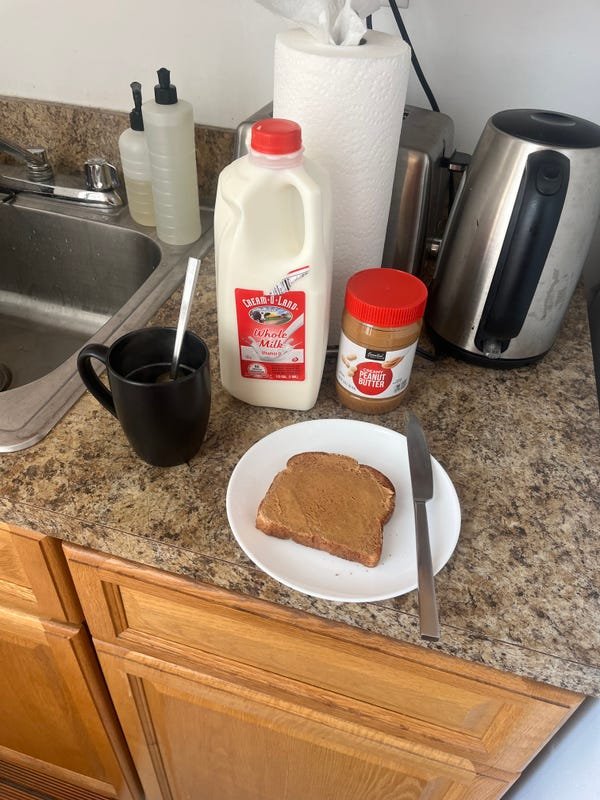
My AI-assisted meal plans tell me I have a variety of breakfast options. My heart tells me I have only one — bread with peanut butter — which I fear may be the culinary highlight of my week. A midday trip to the dentist and the accompanying novocaine make me nervous about the lunch situation, but luckily, my meal is basically mush — chicken, rice, and peas. I make a different combination of ingredients into what appears to be a largely identical plate of mush for dinner, and set aside the leftovers from my lunchtime mush for the office tomorrow.
At some point during all of this, I realize that I have the ingredients for an actual good mush: mashed potatoes. This is very exciting. Post-dinner, I notice a coworker’s Instagram story of his New York Times-inspired creamy lasagna soup creation, which fits neither my diet nor my budget. My excitement fades.
Breakfast: 1 piece of toast with peanut butter, coffee with milk
Lunch: Chicken breast, rice, and peas
Snack: 1 apple, 2 slices cheddar cheese
Dinner: Ground beef skillet with onion, carrot, cabbage, and rice
The vibe: This is a lot like how I ate when I was broke in my 20s. I remember why I’m not a big fan of peas. Thank God for cheese.
Breakfast. Emily Stewart/Business Insider
Food prep. Emily Stewart/Business Insider
The cheese <3. Emily Stewart/Business Insider
Day 3: Thursday
I’ve reached the “bargaining” stage of this endeavor quicker than I thought. I catch myself looking at the new and improved food pyramid multiple times throughout the day to see if there’s something affordable but delicious that I’m missing. Broccoli? An avocado? The official guidelines list kimchi, which seems like the coastal political elite seeping through. Also, it’s $10 in the grocery store, so no.
ChatGPT assures me the free seltzer water in my office is allowed, which is a treat. When someone in the office announces there are free Girl Scout cookies on her desk, I don’t bother asking the robot if that’s OK, because I already know the answer. I meet a friend for drinks after work and, somewhat ashamedly, explain that I can’t stay for dinner because I pitched what I have now definitely decided was a very stupid idea. I will probably cheat sooner rather than later, but not yet.
Breakfast: 2 hard-boiled eggs, coffee with milk
Lunch: Chicken, rice, and peas
Snack: 1 apple that I spent $1 on because I did not plan and forgot to bring one from home
Dinner: Ground beef skillet with onion, carrot, cabbage, and rice
Vibe: I have to find a way to mix this up tomorrow.
Mush 1. Emily Stewart/Business Insider
Mush 2. You can see the problem. Emily Stewart/Business Insider
Day 4: Friday
The point of food isn’t just nourishment — it’s pleasure. This is a sensation that this diet is severely lacking.
In the midst of my desperation, I text Morgan Dickison, a registered dietitian at Weill Cornell Medicine, to ask for advice. The first thing she asks after I show her my food diary is whether I’m hungry, which I’m not — I’m having some pretty big portions, and the food isn’t exactly triggering additional cravings. She suggests seeking out some herbs, spices, and flavored oils, budget permitting. This prompts me to take a harder look at the spices in my cabinet to see what I might be able to incorporate. Her most specific recommendation: Rao’s tomato sauce — it’s not ultra-processed, and there’s no added sugar. (This is not the case, unfortunately, with Rao’s pesto.) She also low-key recommends I cool it on so much red meat. I wonder what RFK would say.
I head to the grocery store to buy Rao’s, but over the course of my five-minute walk, I forget why I’m there. I leave with chicken, an avocado, broccoli, two tomatoes, and corn tortillas, totaling $12.62. I have $22.07 left. Plus the $1 apple, so $21.07. Despite blanking on the sauce, the Morgan consultation/pep talk inspires what has been my best meal yet. Things may be looking up.
Breakfast: 1 piece of toast with peanut butter, coffee with milk
Lunch: Beef skillet with onion, carrot, and lentils
Snack: Hard-boiled egg, 2 slices cheddar cheese
Dinner: Grilled chicken breast with mashed potatoes
Vibe: Real live dietitian >>>>> AI.
This tastes better than it looks.
Emily Stewart/Business Insider
Day 5: Saturday
I am pretty committed to this bit, but I also don’t want to be a freak. After a glass of wine at the Westminster dog show agility preliminaries (which is awesome), I realize I have to eat something, lest I be too buzzed to enjoy the amateur canine obstacle courses. I get an $8 chicken empanada, which almost certainly breaks the rules. I decide the day has no more rules and go out for dinner.
Breakfast: 1 corn tortilla with 2 slices of cheddar cheese, in a quesadilla-type situation
Lunch: 1 chicken empanada
Dinner: Don’t worry about it
Vibe: Between the very agile dogs and my cheat meal, I have had a great day.
The dog show empanada and, more importantly, a dog on the agility course, about to do “the weave.”
Emily Stewart/Business Insider
Day 6: Sunday
I wake feeling more confident about this experiment, thanks to my Friday dinner semi-success and probably the glow of Saturday’s rule-breaking. I make an actually good brunch-type situation, and by “I make” I mean I generally start some things and then my boyfriend, a much better cook, takes over.
For dinner, it’s too cold to go to the store, so I manage to scrounge up the ingredients from my boyfriend’s brothers’ apartment to make pasta and homemade pasta sauce. I use it to concoct the chicken Parmesan I’ve been thinking about since my failed Friday Rao’s trip. I’m not sure if this is completely allowed, with the pasta (which is organic!) and also chicken breading, but I’m following along in spirit.
Part of what set this exercise in motion was comments from Agriculture Secretary Brooke Rollins, where she recommended a meal composed of a piece of chicken, a piece of broccoli, a corn tortilla, and “one other thing.” This is what I choose for my lunch finale, adding a quarter of an avocado as my “other thing.” It’s pretty good, though I have to embiggen it from the description to make it actually filling.
Breakfast: 1 corn tortilla with 2 slices of cheddar cheese, ¼ avocado
Lunch: The Brooke Rollins Special — 1 corn tortilla, chicken, broccoli, and ¼ avocado
Dinner: Ground beef and chickpea skillet with broccoli
Vibe: Victory.
Thank you, Secretary Rollins, for the inspiration. Honestly, it was pretty good.
Emily Stewart/Business Insider
So what did I learn from the diet?
Doing the RFK diet on a $105-a-week food plan was not as hard as I thought it would be. I came in under budget by $13, even with the mid-week grocery trips and the dog show empanada (and not counting the Sunday freebies or Saturday cheat meal). But being on such a strict diet and budget did lead to some notable limitations. My regimen lacked any appreciable amount of variety, and it made eating into an act focused almost exclusively on survival.
I ask Dickison, the dietitian, for a final rating of my adventure once I wrap it up. She says that, like a lot of people, I have room for improvement with fruits and veggies, commends my integration of chickpeas and lentils, and says I did a good job with protein at every meal, even if I was too heavy on ground beef. The budget piece of this undertaking is the hardest part, she says. It makes it challenging to incorporate some of the new food pyramid recommendations, such as berries, fresh vegetables, and fish, and it’s not aligned with how people live. “When I’m speaking with patients, we talk about all the different ways that you get food,” she says. Sure, sometimes it’s cooking at home, but it’s also fast casual at the office, a restaurant on a night out, or delivery when people are pressed for time. “The more convenient the option, the more expensive it gets,” she says.
What’s also unrealistic: The ability to religiously follow such a rigid diet for an extended period of time. Hunger levels and cravings matter. “It can be really difficult to manage those biological drives and also this premeditated budget, even if you did have the best intentions,” Dickison says. I wish I could text her every day for food advice, but I fear she would block my number.
This funny little food journey of mine has coincided with a giant internet debate about some people using DoorDash too much and others scolding them for not cooking more at home. After a week of being bound to team cook-at-home, I’m overly sympathetic to team DoorDash, if only because I’ve spent the past week envisioning the treat I’m about to get myself — via my delivery app of choice, Seamless — now that this is all over. Variety is, as the eye-rolling adage goes, the spice of life. Being able to switch up not only the dish but also the delivery method from time to time is part of that.
The experience has made clear the sacrifices we constantly make around affordability, sustenance, and gratification when it comes to food. The cheapest option is never the healthiest option. The healthiest option is never the most thrilling option. The most thrilling option may be the cheapest, but it’s usually bad for you.
It’s an economic issue as much as it is cultural and political. When people on the lower end of the income spectrum — or public benefits — are told to focus on whole-food basics, they’re told to give up on ease and joy as well. When people rely too much on delivery, they’re almost certainly overspending, but they do so because it saves time and energy compared to an elaborate kitchen production. It’s true that it’s generally better to cook real meals with fresh ingredients at home. It’s also true that life is complicated, and for a variety of reasons, that’s not always possible. I probably could have stretched my budget just as far, if not farther, with frozen, preprepared options.
Ultimately, for most of us, dinner is less of an ideological project than it is a daily logistical problem — one that has to be solved, night after night, in perpetuity.
Emily Stewart is a senior correspondent at Business Insider, writing about business and the economy.
Business Insider’s Discourse stories provide perspectives on the day’s most pressing issues, informed by analysis, reporting, and expertise.
This as-told-to essay is based on a conversation with Harry Luu, owner ofPlantZaddyTherapy. It has been edited for length and clarity.
I’ve always been a gardener and enjoyed being around plants. While I was in graduate school studying math, my collection of houseplants grew. There’s an attention to detail and a hyperfocus that I found in both mathematics and plants, so my hobby complemented my academic career.
During the pandemic, my interest in rare plants blew up. I started getting a bigger collection and trading up for more valuable plants.
Eventually, my hobby transformed into a business. I finished my graduate degree and started teaching math in California, but three years ago, I left academia to sell plants full-time.
My academic career was a safety net for my family of 8
I grew up in Vietnam, and I’m the embodiment of the American dream for my family. They put all their eggs in my basket, which allowed me to come to America and study. Now, I feel it’s fair to return their investment. I support not only myself and my husband, but also my parents, my brother, my sister-in-law, my niece, and my nephew.
Every time Kelly publishes a story, you’ll get an alert straight to your inbox!
Stay connected to Kelly and get more of their work as it publishes.
Leaving my job while supporting a family of eight in California might seem risky, but it was calculated. I had reached the point where I saw the potential for financial freedom from investments I had made during grad school that had very good returns. I had years of data on plant sales, and also knew I could return to academia if needed, so I had a safety net.
I price based on rarity and desirability, without going too high
I was already connected to the rare plant community, so selling increasingly expensive plants felt like a natural progression. I grew my platform on Palmstreet, an online marketplace.
This year, I had two record-breaking sales in one day. I sold a $16,000 plant (an Anthurium Variegated Forgetii x Heinz, one of only two in the world), then a $26,000 plant (the only specimen of the True Variegated Lux Albo Mother Plant).
A $16,000 plant sold on Palmstreet by Harry Luu
Courtesy of Palmstreet
I’m a math person, so I use a formula to price. I calculate rarity and desirability and compare them with price data from the previous three years. These plants were both very rare and highly desirable, which drove prices up. However, I didn’t want to price them too high, because I’m thinking about the long-term viability for my brand: people have to be able to purchase what I’m selling. Given how rare the plants were, their five-figure prices weren’t too big a splash.
I want to be able to connect with the community more
Despite those big numbers, the business’s income fluctuates dramatically. My best single week was over $200,000 in sales, but other weeks I might have no sales. The market is seasonal, and winter is slow. I’ve had to adapt to not having a steady, reliable income.
The money comes and goes, but the work never stops. Right now, I spend about 100 hours a week on the business. We have plants in our home, and also a large greenhouse on our property. My brother does some of the maintenance care for the plants, but all the breeding decisions are made by me.
I’m on the cusp of the company being able to sustain itself without me working so much. I look forward to that — when I can step back from the business side and focus more on the joy of growing. I would like to share my knowledge about rare plants and take the plants on the road to connect with my community more, since that’s what got me hooked on growing in the first place.
This as-told-to essay is based on a conversation with Maddi Thimont, 37, based in London. It has been edited for length and clarity.
I always wanted a big career in law. I finished my law degree in 2007 with first-class honors and got my big break at a private law firm, gaining experience in corporate law.
It was very busy, with long hours, but it was amazing training, so it suited me really well at the time.
Securing my next role in corporate counsel at a Big Tech firm was a real career high. It was intense, but the experience really shaped me. But then, I became a mother of two, and at first, the perks of working for such a big brand were indisputable. Despite that, I started wondering if I could really have it all.
I wanted a 4-day week
This company had a great plan allowing a phased return from maternity leave, so both times, I did two and a half days a week for eight weeks. Being able to gradually get back into my career while still spending time with my children was priceless. Then, for the second half of the year, I worked a four-day workweek.
That was when it started to get tricky, and when I began to question: can I have it all? I had hoped that I could make a four-day workweek my new normal, but there wasn’t much of a precedent for it in my team, so I felt like I’d be navigating uncharted territory on my own.
Maddi Thimont says her weekends start at 3:10 p.m. on Fridays.
Courtesy of Maddi Thimont
And based on the pace I was already familiar with, I anticipated that I would have just had to fit a full-time load into less time. The thought of that didn’t thrill me, so that’s when I started to think about other opportunities.
I took a job that allowed me to have a shorter workday
I booked a call with a life coach to talk about what I wanted to do. I told her my ideal job would involve being intellectually stimulated during the day, but then to be around for my children, now aged 3 and 5, in the evening.
I started manifesting, in a way, by looking for my dream job as a senior lawyer that I could do during school hours. I did a double take when I saw a head of legal role advertised on LinkedIn for data analytics company Sagacity for 25 hours a week.
Just before Christmas 2023, I had an interview with the outgoing general counsel there. She talked about how she gave up her legal career for 15 years while raising her kids, and when she wanted to get back into it, someone gave her a chance in a part-time role. She wanted to pay that forward.
I did the math with my husband, and with our eldest close to starting school — meaning we’d have lower day care fees to pay — we were confident that we could make my new part-time salary work. I started my new job in March 2024 as Sagacity’s head of legal, working 10 a.m. to 3 p.m., five days a week. A year later, I was promoted to general counsel.
I have clear priorities and processes
What helps is having a really clear “ticket” system at the company for anyone who needs legal support. They raise a ticket, which goes into our legal dashboard with a deadline and a priority level (high, medium, or low). My team and I then provide an anticipated response date.
I’ve also created more templates and FAQs so people can be empowered to not have to come to legal for every single thing.
I am now on the senior leadership team and have frequent one-to-ones with other members to help prioritize my work. Then, obviously, if the CEO needs something, it usually takes priority.
I’m also very efficient with my time. If someone asks for a half-hour meeting, I try to cut it down to 15 minutes. I won’t accept a meeting without an agenda, either. I also don’t tend to have many coffee breaks or lunches with colleagues. I know it might sound a bit sad, but every minute counts.
I get to have a big career and be with my kids
I recognize that I’m in a privileged position to do this, as my husband is a lawyer too and works full-time as a partner at a firm. But I honestly feel so lucky, because our lives have totally changed.
Now, I still get to be a senior lawyer, and I can take the kids to their afternoon activities, like swimming and piano, and I can see how well they’re doing, which I love being part of. On Fridays, we just chill. I always say that our weekend starts at 3:10 p.m. on Friday.
With my shorter working hours, I have also found time to fit in additional opportunities. For example, I recently passed a well-recognised GDPR data protection qualification. I was also able to train for and complete the London Marathon.
Without this way of working, I would have likely continued on the corporate path with the long hours, paying for nannies, and after-school clubs. The alternatives may have been to take a demotion or find a part-time job doing something else, or just not work at all – none of which were right for me.
Committing to both work and the kids can feel intense at times – but I think the positives outweigh the negatives. Our family life is quite calm, so everything feels fulfilling.
As a registered dietitian, Lena Beal first learned about nutrition from her own family.
“My great-grandparents were farmers, so they grew nearly everything they ate, made their own preserves, the whole thing,” Beal, a cardiovascular dietitian at Piedmont Atlanta Hospital and spokesperson for the Academy of Nutrition and Dietetics, told Business Insider.
Her roots inspired her profession. “It was generational wisdom,” she said. “The foods that give us the most nutrients, the most pleasure, they’re the most sustainable and practical.” In her own life, she focuses on a minimally processed, plant-packed diet, incorporating chicken, fish and eggs on occasion.
Still, it doesn’t mean there isn’t room for flexibility.
Once a week, Beal eats what she calls “joy foods”: things she enjoys, like sweets and alcohol, which are best consumed in moderation. A Christian, Beal links joy foods to her Sabbath, or day of rest.
Eating her joy foods on Sundays is her version of the 80/20 diet, helping her stay on track with eating mostly heart-healthy foods — with the occasional treats. “That way, I can enjoy them intentionally, but without feeling like I’m constantly negotiating with myself,” she said.
Beal shared what she eats in a week to get enough protein — and what a typical Sunday of fun looks like.
She leans on plant-based protein sources
Beal includes lots of beans and legumes to get extra protein.
vaaseenaa/Getty Images
Given her focus on cardiovascular health, Beal said she has always focused on heart-healthy foods to keep her fueled throughout the day.
“It’s subliminal,” she said. “Those things are extremely important to me: making sure I have hearty, fiber-rich, high-omega-3 foods with those macronutrients.”
On a typical day, her meals look like this:
A high-protein, fiber-rich breakfast such as oatmeal with nuts and fruit
Lunch, her biggest meal of the day, is usually a hearty salad, grain bowl, or soup. She focuses on plant-based protein sources like legumes, dried beans, and chickpeas, but will sometimes include chopped egg or a piece of fish.
Snacks such as mixed nuts, granola bars, or fresh berries with yogurt
A light, mostly plant-based dinner such as steamed cabbage with brown rice and black-eyed peas
She focuses a lot on protein because she works out at least 3 to 4 days a week, including resistance training, brisk walking, and yoga. She said her target is reaching 150 minutes of moderate physical activity a week, the recommended goal for most people.
Her diet helps her stay on track. “Because my eating pattern is relatively consistent, it supports strength, energy, and flexibility,” she said.
Cutting down on red meat
Beal was never interested in intentionally following a strict vegan or vegetarian diet. Instead, her diet evolved over the past eight years to naturally involve less red meat.
“I wasn’t a heavy red meat-eater in the first place.” she said. “I no longer enjoyed it. It was heavy for me.” Having it once a week was easier for her because it didn’t feel like much of a sacrifice.
On occasion, she’ll eat leaner animal-based protein sources like chicken or turkey during the week, which have less saturated fat.
Joy meals include mimosas and French toast
One of Beal’s favorite joy meals is French toast.
Grace Cary/Getty Images
When Sunday rolls around, she doesn’t exactly go all out on sugar or cocktails, either. She still aims to stick to her normal habits, like eating a light dinner, because it ties into better sleep.
“I don’t go too far out of bounds,” she said. Treating herself might look like French toast, a mimosa, or fish in a richer cream sauce than she would pick during the week.
It’s been the easiest way to keep a balance in her life. Beal, who’s taught weight management classes in the past, said that words like “diet” or “cheat foods” can bring up a lot of negative feelings for people.
“I shy away from that language,” she said. “I call them ‘joy foods’ because they absolutely fit if you leave room for them intentionally.”
She focuses on flexibility
Beal takes a few supplements — vitamin D and iron — based on recommendations her doctor made, given her age and medical history.
Otherwise, she gets all her nutrients from her diet, which she feels is easy to maintain because she eats whole foods she loves during the week, while being flexible enough to enjoy a sweet treat or glass of wine, too.
“Healthy eating works best when it leaves room for living,” Beal said. “It ought to feel like when you get up from a meal that you have good feelings, whether it’s nostalgic, whether it satiates you. That’s what food is.”