

A headshot of Insider's Pete Syme

After weeks of huge lines, TSA waits at America’s busiest airport plummet from 4 hours to 5 minutes

It looks like the worst of the airport chaos is coming to an end.

Wait times at security checkpoints have plummeted at Atlanta’s Hartsfield-Jackson International Airport, which was one of the hardest hit by Transportation Security Administration staffing shortages.

While last week it warned passengers of four-hour lines, its website listed waits of less than five minutes at all checkpoints just after 6:20 a.m. ET.

The airport had previously suspended this feature during the peak of the staffing shortages, instead displaying a message telling people to expect four-hour waits in line.

Delta Air Lines’ main hub, Hartsfield-Jackson, is also the world’s busiest airport by passenger numbers, handling over 100 million last year.

It’s an especially busy time for flying, too, as people travel for Spring Break.

Atlanta is not the only place where TSA wait times have dropped sharply this week. Houston’s George Bush Intercontinental Airport also suffered from four-hour wait times last week. But on Tuesday morning, its website showed lines of a maximum of 30 minutes.

New York’s John F. Kennedy and LaGuardia airports have also restored their websites’ estimated wait-times feature. Lines at JFK were the longest of any airport monitored by Business Insider, with a wait of 43 minutes, while Newark had 20-minute lines.

Baltimore airport, which handles around 13 million passengers annually, said on social media that it had seen a “return to normal” on Monday.

“The normal, quick and efficient checkpoint operations we’re known for have returned today,” the airport said in an X post.

Lines began to improve after President Donald Trump signed an executive order on Friday to pay TSA agents, bringing many back to work.

The workers hadn’t been paid since mid-February, when a partial government shutdown began. Up to 11% of TSA agents called out of work on the worst-affected days.

While the Senate approved a deal early Friday to fund most of the Department of Homeland Security, it was opposed by Republicans in the House of Representatives who want more funding for Immigration and Customs Enforcement. Democrats want ICE to be reformed in the wake of January’s violence in Minnesota.

TSA agents began receiving paychecks on Monday, though the shutdown is still ongoing. Plus, Congress has gone on recess for two weeks, while the two parties remain at loggerheads.



Source link

Lauren Edmonds Profile Photo

The US secretary of energy says Iran is not a war but a ‘temporary movement’ and that gas prices will go down in weeks

US Energy Secretary Chris Wright made the morning show rounds on Sunday to downplay concerns about surging gas and oil prices, assuring Americans that the war with Iran isn’t “long-term.”

“What you are seeing is emotional reactions and fear that this is a long-term war,” Wright told “Face the Nation” on CBS News. “This is not a long-term war. This is a temporary movement.”

Wright made similar remarks in an interview with Fox News Sunday.

“The run-up on prices doesn’t have anything to do with any shortage of barrels of oil or natural gas. It’s just fear and perception, the unknown that this could be some long, drawn-out crisis, but it won’t be,” Wright said.

After the US and Israel launched airstrikes on Iran on February 28, the Islamic Republic moved quickly to shut down the Strait of Hormuz, a narrow waterway critical to the movement of oil around the world. About 20% of the globe’s petroleum liquids pass through the Strait.

Although there are storage tanks across the Gulf, they are already nearing capacity after a week of conflict and limited shipping options, forcing producers to reduce operations. Iraq’s oil output has shrunk by 60% since last week, Bloomberg reported. Other countries, like Kuwait and the United Arab Emirates, have also reduced output.

All of this means higher gas prices for Americans. The US Energy Information Administration says gas prices averaged $2.93 on February 23. By March 2, they were at $3.15. On Sunday, they were $3.40.

During his media tour on Sunday, Wright said regular ship traffic through the Strait of Hurmoz could resume in “a few weeks,” meaning gas prices could ease sooner rather than later.

“We want it back below $3 a gallon, and it will be again before too long,” Wright told CNN’s “State of the Union.” “You never know exactly the timeframe of this, but, in the worst case, this is a weeks, this is not a months, thing.”


Source link

After-weeks-of-getting-bashed-two-software-giants-can-make.jpeg

After weeks of getting bashed, two software giants can make the case for why AI won’t kill them

After being marked for dead, software companies have a chance to tell their side of the story.

Excluding Canada’s Olympic hockey teams, no one has had a tougher go recently than software companies. Everyone faces some fear over AI, but software’s diagnosis has been more dire than most. (Author Nassim Taleb was the latest to write software’s eulogy, although he’s not known for his optimism.)

Two software giants — Salesforce and Snowflake — get to make the case for why they’re still very much alive. Both companies report earnings after the bell and will be interested in changing a narrative that’s helped push their stocks down 27% (Salesforce) and 26% (Snowflake) this year.

(Workday, another software company that’s been getting hammered, made the case yesterday why AI is friend, not foe.)

A major problem for software companies is that their opponent is largely hypothetical. Even if both companies report blockbuster earnings, there’s still the counterargument that AI will eventually eat their lunch.

Anthropic has played this game masterfully. The startup has strategically rolled out product announcements for its AI chatbot, Claude. The news has devastated entire industries despite there being no evidence of widespread adoption yet.

Here’s what to look out for from Salesforce and Snowflake when they report:

Salesforce: Marc Benioff’s company is the prototypical enterprise software company. Customer relationship management systems are all about workflow and rely heavily on seat-based subscriptions. That makes Salesforce a prime target for AI automation and a bellwether for other software companies.

Benioff has sought to address competitors head-on with Salesforce’s own AI agents and even contemplated a name change to acknowledge the shift. But Agentforce has had its share of challenges. An internal survey showed that most employees feel AI is increasing their productivity, but Salesforce will want the same positivity coming from outside its walls.

These days, AI might not even be Salesforce’s biggest headache. An off-color joke from Benioff at a recent employee event has outraged many workers and even prompted fellow Salesforce executives to speak out.

Snowflake: The data-warehousing giant might seem like a major beneficiary of AI. Models need tons of data to function. Snowflake helps companies organize and analyze massive amounts of data. Everybody wins!

The potential future isn’t as rosy. Snowflake’s business might not face the direct risk that other software companies struggle with, but it could slide down the totem pole of customers’ tool set. Instead of being considered a crucial software, it could become just another piece of back-end infrastructure.

Snowflake’s own CEO warned of this future, saying models’ desire to have easy access to all types of data means “everything else, the world, is just a dumb data pipe that feeds into that big brain.”

And unfortunately for Snowflake, the value you provide to customers as a “dumb data pipe” is a lot lower, meaning you can’t charge as much.


Source link

My-company-announced-a-return-to-office-policy-a-few-weeks-ago.jpeg

My company announced a return-to-office policy a few weeks ago. It’s already affecting my relationship with my partner.

I hadn’t always been a believer in working from home. When remote work first became part of my life, I resisted it. I missed the structure of an office, the separation between work and everything else. Home felt like the wrong setting for serious work.

Then, slowly, it didn’t. I found a rhythm I hadn’t expected. Mornings became mine. I cooked real lunches. I thought more clearly.

More importantly, my girlfriend and I have been living together in London for a year, and we have built a life around being home together that feels chosen rather than forced. I’ve stopped seeing remote work as a compromise and started seeing it as the better version of my day.

So when the email came from work that said I’d have to return to office, it wasn’t just a scheduling change. It was a disruption to something we had spent months building, a routine that had come to feel like the foundation of everything else.

It has only been a few weeks since the announcement, and already, almost nothing looks the same — especially my relationship.

My partner and I both worked from home, so we had to rethink everything

The first thing we’ve had to confront was practical. Two people who both work from home occupy a shared space in a very specific way. That balance had taken time to calibrate. We had never sat down and designed it. It had just formed, organically, around our needs. The return-to-office policy exposed how deliberate that accidental life actually was.

My girlfriend still works remotely, so the shift hasn’t been symmetrical. I now leave each morning to head into a version of London we rarely engaged with during the week — the commuter version, the structured version — while she stays inside the life we’d built together. That asymmetry requires more honest conversation than either of us expected.

We’ve had to redesign things we never explicitly designed in the first place. What do mornings look like now? Who handles what, and when? The small, invisible agreements that hold a shared life together suddenly need to be spoken out loud. That process, still ongoing after just a few weeks, has been more revealing than disruptive. But it has required real effort.

Commuting in London comes with a price, and it goes beyond the cost of a train ticket

The financial reality surfaced quickly. Commuting to London isn’t cheap, and the daily arithmetic of transport, lunches, and the small expenses that accumulate when you’re out of the house adds up faster than expected. We had saved money by being home — on food, on travel, on the general inefficiency of city life when you’re moving through it daily. That buffer has started to shrink almost immediately.

But the more significant cost has been time. The commute is carving hours out of the day that had previously been ours. Mornings that once felt spacious have become logistical, and evenings are now shortened. The long, unhurried romantic dinners that had been a quiet anchor in our week are starting to require more effort to protect. Time, it turns out, had been our most abundant resource when we were both at home. We hadn’t noticed until it started running out.

There is also an energy cost that is harder to quantify. Offices are stimulating in ways that are both useful and exhausting. I now come home differently — more depleted, less present. After just a few weeks, my girlfriend has already noticed the shift before I fully named it myself. The version of me that walks through the door at the end of the day is not quite the same one that used to simply close the laptop and call it done.

Going back to the office has asked something new of our relationship

What surprised me most wasn’t the logistics. It was how much our new relationship had quietly depended on proximity: a shared lunch, a passing conversation in the kitchen, the low-level awareness of each other that comes with being in the same space. Those things weren’t dramatic, but their absence has been.

We are now trying to be more intentional. Dinners that used to happen naturally now need to be protected. Check-ins that once occurred organically require more deliberate effort. It isn’t a strain exactly; it’s a recalibration.

The return-to-office policy hasn’t damaged anything between us. But it is revealing how much of our relationship had been built on the life we’d created around being home. Losing some of that structure forced us to be more conscious about what we actually wanted, and more honest about what we weren’t willing to give up.

We have only been doing this for a few weeks. Something tells me the real adjustments are still ahead.


Source link

Wall Street employees

Elite investment bank settles case that put Wall Street’s 100-hour weeks on trial


Momo Takahashi, Business Insider

  • A junior banking analyst sued her former firm over its unpredictable, grueling work hours.
  • A settlement in the case was reached just before the case was set to go to trial.
  • The terms of the settlement were not disclosed.

Centerview Partners and former junior banker Kathryn Shiber have reached a settlement, ending a closely watched lawsuit about Wall Street work culture that was set to go to trial in Manhattan federal court.

The case centered on allegations that the boutique investment bank violated disability discrimination laws when it fired Shiber in 2020 after she said she needed eight to nine hours of sleep each night because of an underlying mood and anxiety disorder.

Court filings and depositions in the case offered a rare look into the grueling demands placed on first-year analysts, including testimony that they typically work between 60 and 120 hours a week and that “in some projects, you are working 24 hours a day.”

Centerview has denied wrongdoing.

“Centerview has said all along that Ms. Shiber’s legal claims have no merit,” a Centerview spokesperson told Business Insider in a statement. “We were ready to prove that in court, and are confident we would have prevailed at trial. But we are nonetheless happy to put this distraction behind us and focus on delivering for our clients.”

The resolution means a jury will not weigh in on questions about Wall Street’s long hours and workplace accommodations.

Terms of the settlement were not disclosed. Lawyers for Shiber did not respond to requests for comment from Business Insider.


Source link

Anthropic-says-its-buzzy-new-Claude-Cowork-tool-was-mostly.jpeg

Anthropic says its buzzy new Claude Cowork tool was mostly built by AI — in less than 2 weeks

Anthropic’s new working agent was largely built by Claude itself — the latest example of AI coding tools speeding up product development.

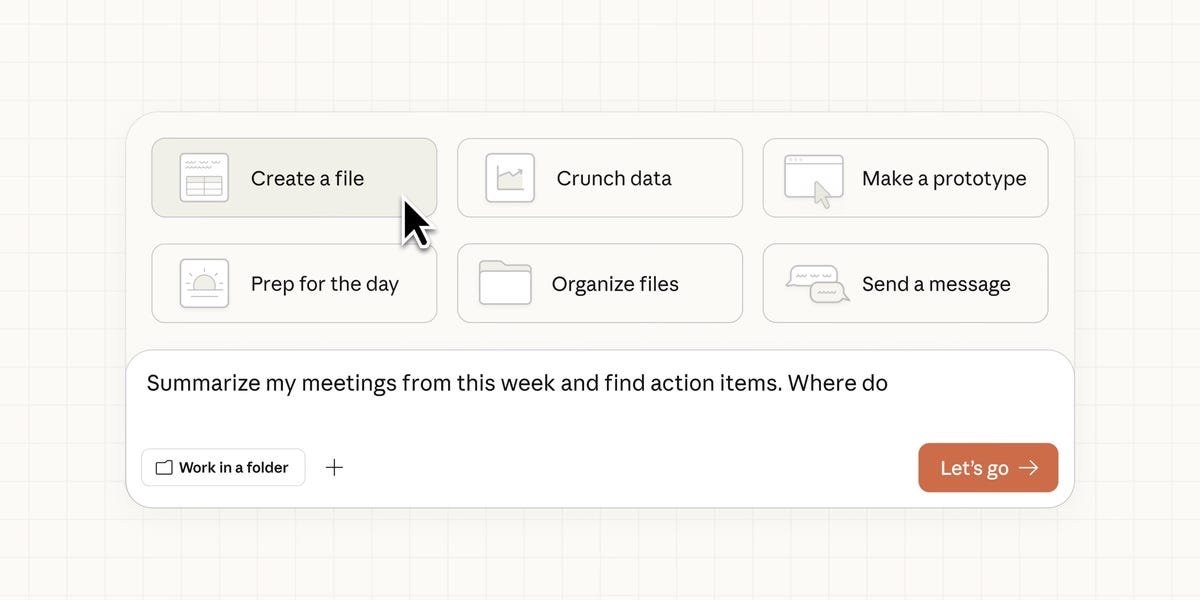
On Monday, Anthropic announced the release of Cowork, a “more approachable” AI tool accompanying Claude Code that’s geared toward fulfilling users’ requests that are unrelated to programming. Users grant the agentic AI tool access to specific files on their computer and prompt it to complete tasks.

Boris Cherny, head of Claude Code, said that Anthropic’s AI coded “pretty much all” of Cowork.

“@claudeai wrote Cowork,” Product Manager Felix Rieseberg wrote on X. “Us humans meet in-person to discuss foundational architectural and product decisions, but all of us devs manage anywhere between 3 to 8 Claude instances implementing features, fixing bugs, or researching potential solutions.”

As a result, Rieseberg said the first edition of Cowork came together quickly.

“This is the product that my team has built here, we sprinted at this for the last week and a half,” he said during a livestream with Dan Shipper.

Over the holidays, Rieseberg said that Anthropic saw its customers using Claude for an increasing number of non-coding-related tasks.

“This sort of like the research preview, very early Alpha, a lot of rough edges, as you’ve already seen, right?” he said.

Cowork is initially available to Claude Max subscribers on the Mac app.

The launch has made a splash in the tech world, with many online users praising the product and its accessibility.

“I think that’s a really smart product,” Datasette co-creator Simon Willison wrote in a blog about his experience. “Claude Code has an enormous amount of value that hasn’t yet been unlocked for a general audience, and this seems like a pragmatic approach.”

“This is big,” Reddit cofounder Alexis Ohanian wrote on X.

Because granting an AI agent access and the ability to take action on specific computer files comes with risk, Anthropic cautions that Cowork users should be careful.

“By default, the main thing to know is that Claude can take potentially destructive actions (such as deleting local files) if it’s instructed to,” the company said. “Since there’s always some chance that Claude might misinterpret your instructions, you should give Claude very clear guidance around things like this. “

The latest in a flurry of AI announcements

AI companies wasted no time in launching new offerings and partnerships to kick off the new year.

On Sunday, Anthropic announced Claude for Healthcare, a major addition to its healthcare and life sciences offerings. Its release came on the heels of rival OpenAI signaling its investment in the healthcare space with ChatGPT Health.

Amid AI bubble chatter and scrutiny on the increasing AI investments made by tech companies, Anthropic CEO Dario Amodei has argued that Anthropic has built a more sustainable business model that allowed it to make more educated bets on its future build-out. While he did not name OpenAI or CEO Sam Altman directly, he made some thinly veiled criticisms of his former company throughout the event.

“I think because we focus on enterprise, I think we have a better business model,” Amodei said at The New York Times’ Dealbook Summit. “I think we have better margins. I think we’re being responsible about it.”

Google, which some experts saw as overtaking OpenAI at the end of 2025, announced a major deal with Apple to have Gemini power Siri’s artificial intelligence capabilities.


Source link