A-judge-just-offered-the-clearest-breakdown-yet-of-whats.jpeg

A judge just offered the clearest breakdown yet of what’s at stake in Anthropic vs. the Pentagon. Read her remarks in full.

On Tuesday, lawyers for Anthropic and the Department of Justice met in a San Francisco courtroom to argue over the AI company’s request to block the Pentagon from labeling it a national security risk.

Before the hearing began, Judge Rita Lin read prepared remarks that broke down the complex case — and what’s at stake — in unusually clear terms. In the process, she ripped into the Pentagon’s action, saying it looks like an effort to “cripple” a company that went public with a contract dispute.

We’re sharing her remarks in full because they get to the heart of a fight that could change the AI landscape. A ruling is expected any day now.

Read what she said in full here:

“Good afternoon to both of you. Yesterday, I disclosed a list of questions that I asked counsel to be prepared to answer today. Before we go down that list, I thought it might be helpful for the attorneys to hear kind of a general overview of my tentative thoughts on the case so far, and you’re welcome to sit down for that if you’d like. Then, I’ll invite you back up to address the questions.

I will say that I do think this case touches on an important debate. On the one hand, Anthropic is saying that its AI product, Claude, is not safe to use for autonomous lethal weapons and domestic mass surveillance. Anthropic’s position is that if the government wants to use its technology, the government has to agree not to use it for those purposes. On the other hand, the Department of War is saying that military commanders have to decide what is safe for its AI to do, not a private company.

It’s a fascinating public policy debate, and it’s not my role to decide who’s right in that debate — that is Secretary Hegseth’s call. The Department of War decides what AI product it wants to use and buy. And everyone, including Anthropic, agrees that the Department of War is free to stop using Claude and look for a more permissive AI vendor.

I don’t see that as being what this case is about. I see the question in this case as being a very different one, which is, whether the government violated the law when it went beyond that.

After Anthropic went public with this contracting dispute, defendants seemed to have a pretty big reaction to that. They took three actions that are the subject of this lawsuit. First, the president announced that every federal agency, not just the Department of War, would immediately ban Anthropic from ever having another government contract. So, that would include the National Endowment for the Arts using Claude to design its website — not allowed.

Second, Secretary Hegseth announced that anyone who wants to do business with the US military has to sever their commercial relationship with Anthropic. So, if a company uses Claude to have a customer service chatbot, now they can’t do any defense work.

Third, the Department of War designated Anthropic as a ‘supply chain risk.’ That label applies to adversaries of the US government who may sabotage its technology systems. It’s typically directed at foreign intelligence, terrorists, or other hostile actors.

What is troubling to me about these three actions is that they don’t really seem to be tailored to the stated national security concern. If the worry is about the integrity of the operational chain of command, DOW could just stop using Claude. It looks like defendants went further than that because they were trying to punish Anthropic.

One of the amicus briefs used the term ‘attempted corporate murder.’ I don’t know if it’s murder, but it looks like an attempt to cripple Anthropic. And specifically, my concern is whether Anthropic is being punished for criticizing the government’s contracting position in the press.

Defendants say they were doing this because Anthropic’s ‘sanctimonious rhetoric’ was an attempt to ‘strong-arm the government.’ DOW’s records say that it designated Anthropic as a supply chain risk because it was ‘hostile in the press.’ So it looks like DOW’s punishing Anthropic for trying to bring public scrutiny to this contracting dispute, which, of course, would be a violation of the First Amendment. So I have a lot of concern about that, and I would like to hear more from the government about that.

I also have a lot of questions about — one, whether Congress gave defendants the authority to do this in the first place, and two, whether defendants violated Anthropic’s due process rights by not giving them notice and an opportunity to respond.

The questions I put out yesterday really go more to those latter two topics. So, I want to start going through those questions, but I will just say that at the end of the questions, I’ll give both parties an opportunity to address the court. You can give me your reaction to the tentative thoughts that I gave you, and you can also just let me know anything else you think is important that I know about the case before I take it under submission.

So let me just invite counsel back up to the podiums, and we’ll just go through the questions.”




Source link

As-a-father-of-2-young-kids-I-dont-worry.jpeg

As a father of 2 young kids, I don’t worry much about screen time. I’m more concerned about what’s actually on the screen.

I didn’t know what chocolate ganache was before watching reruns of an old Food Network pre-teen baking championship with my kids. But I did spot an opportunity to talk with them about how one contestant kept building her cake after it crumbled. We talked about the word perseverance.

That’s the thing about “screen time” as a modern parenting panic: the same rectangle can either be a sedative or a springboard.

But my wife and I are still fairly new at this — our kids are under 5 — so we talk with other parents about evolving opinions on the use of phones, tablets, computers, and TVs.

From those conversations and our own parenting experience, we’re slowly realizing that it’s not about screen time, but more about what type of content we’re letting our kids watch.

We try to keep screen time to a minimum in our house

My wife, kids, and I live in a Philadelphia rowhome. We’ve kept TV out of our bedrooms and devices out of our daily routine. On trips in the car, bus, and subway, we rely on music and games (I’ve come to loathe “I spy”).

In good weather, we enjoy long walks and frequent visits to our neighborhood rec center. Forced into boredom at home, our kids have developed their own imagined worlds: singing karaoke on the couch, lava-ringed obstacle courses, and preparing elaborate meals in a play kitchen.

But especially on freezing days, when you’re stuck indoors, and everyone’s energy is somehow both too high and already spent, screens help. What’s become clear to me is that a screen’s value depends on what we watch.

Governments are cracking down on youth screen time

In recent years, the global discourse has turned aggressively anti-screen.

Governments are now intervening not just in social media but in screens more broadly. France, for example, has prohibited screen exposure for kids under 3 in childcare settings, and Virginia has moved to make schools “cell phone-free.”

Meanwhile, the American Academy of Pediatrics has long advocated against the simplistic yardstick of screen time, noting there isn’t enough evidence for a single universal time limit, emphasizing family context and habits instead.

It’s more important to me to monitor what my kids are watching than how much

It seems to me that no one can agree on what the maximum screen time should be for children, so that’s why I’m focusing less on time and more on the content.

Watching a kids’ baking show as a family, especially when we can connect the events to our own lives, can be healthy. I’ve seen the positive effects of a great show on my own kids.

For parents of young kids, the difference between cartoons like “Bluey” and “Cocomelon” is obvious: In one, characters develop over seven to 10 minutes, and in the other, brightly colored, computer-animated characters sing hypnotically rhythmic songs in short bursts.

This holds true for older kids, too. With the right guardrails, I think that screens can be genuinely social and developmental, like collaborating with friends in a shared Minecraft world, building a Roblox obstacle course over a week, or editing a goofy video together that takes planning and patience.

I see “good” screen time often involves characters, cause-and-effect, enough plot for us to talk about it together, and a bonus for when it’s social. I don’t see why there should be a time limit on any of that.


Source link

Jamie Heller, incoming Editor-in-Chief

What’s the future of the software business look like? Our top tech columnist weighs in.

The future of software

Software stocks had a brutal week, aside from a Friday rally, extending what has been a rough year for the industry. I touched base with our tech columnist, Ali Barr, the best I know on AI business models. He also wrote this piece in the midst of the selloff.

Ali, you’ve been covering AI adoption and costs by big business since you started our Tech Memo newsletter. What’s your gut on whether the recent selloff was overblown?

Software business models have underpinned the tech industry for decades. Companies invest heavily upfront to build software, but each additional copy costs almost nothing to distribute. So revenue scales faster than costs, driving fat profit margins. That dynamic helps explain why Microsoft, the world’s largest software company, is so valuable.

AI challenges this model. If this new technology makes employees more productive, companies may need fewer software subscriptions. And as AI tools improve, businesses could replace existing software with AI-driven workflows or even build their own software using AI coding tools. Finally, if software companies embrace AI, that could make their services more expensive to run than traditional software. That would mean rising usage doesn’t automatically translate into soaring profitability.

If software in the AI era becomes less profitable and grows more slowly, then it’s logical that the stock prices of software companies might fall. A lot.

Big Tech spending on AI data centers and other infrastructure is set to soar again this year. How will these companies generate a return on these huge investments?

The numbers are breathtaking. Just two companies, Google and Amazon, are planning capex of almost $400 billion in 2026. A couple more years of the same, and that’s more than $1 trillion.

To get a return on this, they will have to come up with new revenue of well over $1 trillion in future years. AI is amazing and really useful, but it’s hard for some investors to see how this happens. Even if new AI products are awesome, do consumers and companies have enough money to buy all this stuff? I don’t know. One outcome could be that Big Tech giants make do with slimmer profit margins in an AI future. That’s similar to the concerns that have hammered software stocks lately.

Who are the most-interesting people to watch in the sector?

I pay attention to Andrej Karpathy. He was director of AI at Tesla and a founding member of OpenAI. He’s pretty independent nowadays, which means what he says about AI can be trusted more. Bonus: He coined the term “vibe coding.”

Aditya Agarwal was Facebook’s first head of product engineering. He was also CTO and VP of engineering at Dropbox. He’s a coding powerhouse. Recently, he used Claude to do some coding and was stunned by the power of this tool. “I am filled with wonder and also a profound sadness,” he wrote on X. “We will never ever write code by hand again. It doesn’t make any sense to do so. Something I was very good at is now free and abundant.”

I’m usually skeptical, but the start of 2026 feels like a moment of highly disruptive — and destructive — change.


Source link

I-tried-14-high-protein-drinks-so-you-dont-have-to.jpeg

I tried 14 high-protein drinks so you don’t have to. Here’s what’s actually worth buying.

Just checking in — yup, it seems everyone is still obsessed with protein.

The new year means new health goals, and the government’s new dietary guidelines echoed what many have been calling a widespread protein obsession.

The Dietary Guidelines for Americans, released Wednesday, emphasized the role of protein and dairy products in its recommended daily diet, although dietitians have cautioned against protein-maxxing at the expense of other nutrients.

Whether it’s thanks to social media gym bros or Ozempic, more people are reaching for ultra-high-protein products, and if you remember the 1990s’ meal-replacement milkshake craze, this might feel a bit familiar.

Nutritional shakes — whether they’re used by athletes seeking nutrients on the go, parents to supplement their growing children’s diets, or adults with dietary needs seeking to pack in as many nutrients in a compact, easily digestible form — aren’t new to everyone’s diets.

As high-protein products, from protein pasta to protein beer, continue to take over grocery stores, the list of high-protein drinks continues to grow.

To better understand the high-protein drinks on sale today, I visited two New York City grocery stores and picked up every drink that advertised its protein content, with the lowest having 12 grams of protein, which is as much as two eggs.

I tried every brand’s chocolate flavor to best compare their taste and ranked all 14 based on flavor, as well as taking into consideration their nutritional content.

In general, I looked for drinks that tasted chocolatey, were sweet enough to serve as a sweet treat without going overboard, and were overall enjoyable to drink on their own.

It’s worth noting that many shakes on the market are considered ultra-processed foods, which the new government guidelines recommend avoiding.

Here’s how I ranked them, from lowest to highest.

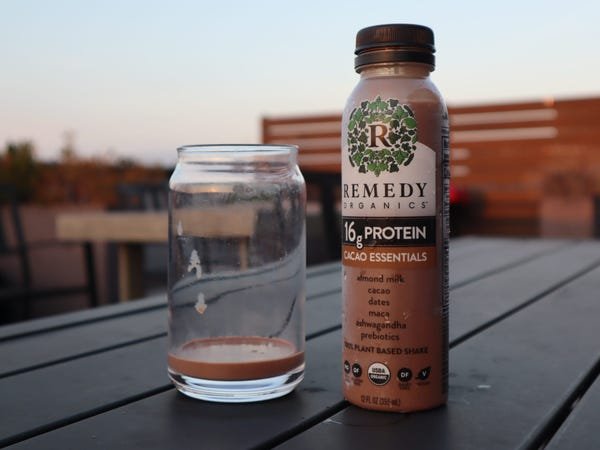
14. Remedy Organics Cacao Essentials Protein Shake

Remedy Organics Cacao Essentials Protein Shake had my least favorite flavor in the ranking.

Kristine Villarroel/Business Insider

Cost: $4.99 for 12 fluid ounces

Calories: 210 calories

Protein: 16 grams

Added sugar: 7 grams

The taste of the Remedy Organics Cacao Essentials Protein Shake was what I could best describe as healthy.

The date-sweetened drink is packed with plant-based ingredients, including adaptogens like ashwagandha and maca root powders as well as tapioca prebiotic powder.

But taste-wise, they weren’t as sweet-treat-like as some of the other shakes. It tasted strongly of cacao, but it felt a little chalky, and seemed saltier than it did sweet.

While I liked the drink’s ingredients, I really disliked the taste. If you’re looking for a plant-based, adaptogen-full drink that will also help you reach protein goals, this could be an option for you — but don’t go into it expecting a sweet chocolate milk type of drink.

Flavor rating: 1/10

Overall rating: 6/10

13. Muscle Milk Zero Sugar Chocolate Protein Shake


muscle milk zero sugar taste test

I found the Muscle Milk Zero Sugar Chocolate Protein Shake to be overly sweet.

Kristine Villarroel/Business Insider

Cost: $3.99 for 14 fluid ounces

Calories: 170 calories

Protein: 25 grams

Added sugar: 0 grams

When I first poured the Muscle Milk Zero Sugar shake, I noticed just how dark and thick it was. Tasting it, I found that it was way too sweet for my taste. This, combined with the thick texture, made for a pretty interesting drinking experience — I had to wash down the shake with some water to follow up the sweet taste left in my mouth.

Although I couldn’t finish drinking the small taste I’d poured myself, it also had the fewest calories and grams of sugar in the ranking, the highest fiber, and I felt like the protein payoff was great, which made the overly sweet taste feel more like a trade-off.

If you’re trying to get half of your daily protein in as few calories as possible while also watching out for sugar content, this drink might be good to have on your radar … but you’ll have to remind yourself of the nutrients in every sip.

Do it for the protein, bro.

Flavor rating: 3/10

Overall rating: 6/10

12. Koia Cacao Bean Protein Shake


koia protein drink taste test

I also did not love the taste of the Koia Cacao Bean Protein Shake.

Kristine Villarroel/Business Insider

Cost: $4.99 for 12 fluid ounces

Calories: 190 calories

Protein: 18 grams

Added sugar: 4 grams

Compared to some of the other protein drinks, I found Koia’s Cacao Bean protein shake to be very thin and light in color when I first poured it.

Its flavor, as the name would indicate, is very cacao-bean forward. To me, it tasted exactly like cacao nibs, which can lean more nutty and earthy than chocolate-y.

In a statement to Business Insider, Koia said the Cacao Bean protein shake is “crafted to highlight cacao’s naturally bold, slightly bitter profile rather than masking it with excessive sweetness or artificial flavoring,” resulting in a flavor that “may be less sweet than traditional protein shakes.”

The almond-based, monk-fruit-sweetened drink, which isn’t too sweet and packs in plant-based ingredients like rice, pea, and chickpea protein and a prebiotic blend, wasn’t one of my favorites for taste, although it was fairly competitive with the other options in terms of nutrients.

Flavor rating: 4/10

Overall rating: 5/10

11. Chocolate Sport Shake


sports shake protein drink taste test

Although enjoyable and tasty, Sport Shake’s high sugar content wasn’t a worthy trade-off for me.

Kristine Villarroel/Business Insider

Cost: $2.00 for 11 fluid ounces

Calories: 350 calories

Protein: 12 grams

Added sugar: 39 grams

I found the flavor of the chocolate Sport Shake to be one of the most enjoyable in the ranking, and it reminded me a lot of plain chocolate milk — it was very, very sweet. I also liked that it didn’t taste too much like dairy, something that bothered me with other drinks in the lineup.

However, the drink’s sweet and tasty flavor was overshadowed by its ultra-high added sugar content of 39 grams, or more than 9 teaspoons.

While the drink has some fiber in it, coming in with 3 grams, and it was the cheapest of the ranking, I couldn’t justify that much sugar. I will probably not reach for this again.

Flavor rating: 8/10

Overall rating: 1/10

10. Nesquik Chocolate Low Fat Milk


nesquik drink taste test

The Nesquik Chocolate Milk was a fun and nostalgic add to this lineup, although it wasn’t the best for protein.

Kristine Villarroel/Business Insider

Cost: $2.50 for 14 fluid ounces

Calories: 250 calories

Protein: 14 grams

Added sugar: 18 grams

I was shocked when I learned that Nesquik’s classic chocolate milk could be considered a nutritional drink.

At 14 grams of protein, as advertised on the bottle, the drink has more grams of protein per serving than other drinks labeled as protein drinks.

Tasting it was just as nostalgic as expected. Compared to some of the other drinks, however, I noticed it had a stronger dairy taste and was very sweet, with a total of 18 grams of added sugar.

I also noticed that the bottle recommended a portion of half a bottle, probably due to the drink’s high sugar content, which would also result in half the protein intake overall.

I probably wouldn’t have reached for this in adulthood if not to compare it here, and I probably won’t really reach for it again.

Flavor rating: 6/10

Overall rating: 4/10

9. Muscle Milk Pro Knockout Chocolate Protein Shake


msucle milk protein taste test

The Muscle Milk Pro packs an impressive 40 grams of protein.

Kristine Villarroel/Business Insider

Cost: $5.99 for 14 fluid ounces

Calories: 220 calories

Protein: 40 grams

Added sugar: 0 grams

Like its low-sugar version, the Muscle Milk Pro looked dark and thick. Taste-wise, the drink was sweeter than chocolate-y, and I didn’t love the flavor.

Although the drink packs an impressive 40 grams of protein in 14 ounces and 220 calories, has the highest ratio of protein to fluid ounces, and also has the highest fiber content in the list, the taste was one of my least favorites, and I had to wash it down with some water after tasting, as it had such a lingering flavor on the tongue.

When considering the nutritional aspects of the drink, however, I felt like the taste was a solid trade-off for one of the most protein-efficient drinks in the ranking, having the second-highest amount of grams of protein in a single bottle.

But if you’re strictly going for the ultra-high-protein option, the Fairlife Core Power Elite — which comes later in this ranking — might be a better bet for flavor.

Flavor rating: 4/10

Overall rating: 7/10

8. OWYN Pro Elite Chocolate Protein Shake


owyn protein taste test

I felt that the plant-based OWYN Pro Elite tasted a bit weird for my taste.

Kristine Villarroel/Business Insider

Cost: $4.49 for 12 fluid ounces

Calories: 200 calories

Protein: 32 grams

Added sugar: 0 grams

When I first poured the OWYN — which stands for Only What You Need — Pro Elite Protein Shake, it looked much thicker than some of the other drinks in the ranking.

It tasted vastly different from the others, too. The ingredients gave some clues as to why: The main ingredients — water, pea protein, pumpkin protein, and flaxseed oil — were completely different from the other shakes.

The plant-based, dairy-, soy-, and wheat-free drink, which contains 3 grams of prebiotics, uses monk fruit extract to sweeten its cocoa-heavy flavor, and also has a greens blend that includes spinach, kale, and broccoli.

I figured that the odd flavor I experienced was perhaps due to some of its most health-forward ingredients, like the greens blend.

In a statement to Business Insider, OWYN said that the exclusion of artificial sweeteners and sugar alcohols in the formula “sometimes means a more natural, earthy taste profile,” when compared to their regular shake, which uses a blend of organic cane sugar and monk fruit.

Ultimately, I wasn’t a fan of the taste and probably wouldn’t reach for this drink again, although nutrition-wise, it was a solid ultra-high-protein plant-based option.

Flavor rating: 5/10

Overall rating: 6/10

7. Fairlife Core Power Elite Chocolate High Protein Milk Shake


corepower elite shake taste test

I found the Fairlife Core Power Elite to have a very strong dairy taste that I didn’t love.

Kristine Villarroel/Business Insider

Cost: $5.99 for 14 fluid ounces

Calories: 230 calories

Protein: 42 grams

Added sugar: 0 grams

One of three protein shakes in Fairlife’s line, the Core Power Elite shake was a bit thinner than many of the other drinks I tried.

It was less sweet than Fairlife’s regular chocolate milk, which I didn’t mind. However, it had a much stronger dairy taste — I don’t love the taste of dairy milk, so this worked against the drink for me.

Still, its insane amount of protein — as much as a whole chicken breast — earned it extra points in my ranking.

This drink was something I didn’t mind drinking, even if I wouldn’t usually go for it. Even as a non-gym-bro, I would probably reach for this drink if I were trying to get well over half of my needed protein for the day in a single serving.

Flavor rating: 5/10

Overall rating: 8/10

6. Chocolate Nutrament


nutrament protein drink taste test

The chocolate Nutrament was tasty, although packed in added sugar.

Kristine Villarroel/Business Insider

Cost: $2.50 for 11 fluid ounces

Calories: 330 calories

Protein: 15 grams

Added sugar: 29 grams

When I poured the chocolate Nutrament, I noticed its consistency was among the runniest in the ranking.

The drink, the second-cheapest drink in the lineup, tasted just like chocolate milk, although it was still a bit too sweet for me.

I also noticed it had a long ingredients list with many unfamiliar terms, but on closer inspection, some seemed to be added vitamins and minerals. The drink also had the second-highest added sugar content at 29 grams.

The high sugar and comparatively low protein knocked this drink down a few points for me, and although I enjoyed it, I probably wouldn’t reach for this.

Flavor Rating: 9/10

Overall Rating: 5/10

5. Fairlife Chocolate Ultra-filtered Milk


fairlife protein drink taste test

Fairlife’s chocolate milk has 23 grams of protein in a 14-ounce bottle.

Kristine Villarroel/Business Insider

Cost: $3.29 for 14 fluid ounces

Calories: 250 calories

Protein: 23 grams

The second in Fairlife’s line, its chocolate ultra-filtered milk, was another nostalgic offering.

It was very sweet, but if I were craving chocolate milk, this is definitely the option I would choose.

While it’s not marketed as a protein drink, it contains 23 grams in a 14-ounce bottle and has the second-lowest cost per gram of protein.

Flavor rating: 7/10

Overall rating: 7/10

4. Rich Chocolate Boost Plus Nutritional Drink


boost protein drink taste test

Aimed at weight gain or maintenance, Boost Plus is a tasty and enjoyable option.

Kristine Villarroel/Business Insider

Cost: $18.99 for a six-pack of 8-ounce bottles (or $3.17 for 8 fluid ounces)

Calories: 360 calories

Protein: 14 grams

Added sugar: 18 grams

While some of the drinks in this lineup are aimed at the ultra-protein-efficient crowd and others are more directed at children, the Boost nutritional drink line is marketed toward adults with specific nutritional needs. The Boost Plus product, specifically, is aimed at adults hoping to gain or maintain weight.

Taste-wise, this was one of my favorites. The sweet and rich drink was very chocolatey, and it felt like a nice sweet treat.

With the product’s purpose in mind, the drink’s higher calories didn’t bother me, and I was pleased to see its nutrition label flooded with vitamins and minerals.

Out of many of the options, this is one I could see myself reaching for solely based on its taste, even though I wish it had a higher protein content.

Flavor rating: 9/10

Overall rating: 7/10

3. Nesquik Protein Power Chocolate Milk Beverage


nesquik protein taste test

I liked the taste of Nesquik’s Protein Power more than its classic chocolate milk.

Kristine Villarroel/Business Insider

Cost: $3.00 for 14 fluid ounces

Calories: 290 calories

Protein: 23 grams

Added sugar: 18 grams

When I poured this drink, I was surprised by how runny it was compared to some of the other options. I really enjoyed the taste, even if it wasn’t exactly the same as the nostalgic chocolate-milk flavor of Nesquik’s classic option.

In fact, I actually liked this one more, even before factoring in the added nutritional value. It was adequately sweet, not too dairy-tasting, and it didn’t have the aftertaste that had put me off the classic option.

With 23 grams of protein, this drink could compete with some of its more nutrition-leaning counterparts. At $3 for a bottle, it was also one of the cheapest options with the highest protein content.

I could totally see myself reaching for this.

Flavor rating: 8/10

Overall rating: 8/10

2. OWYN Dark Chocolate Protein Shake


owyn taste test protein

The OWYN Dark Chocolate Protein Shake was my favorite plant-based drink and my second-favorite overall.

Kristine Villarroel/Business Insider

Cost: $4.29 for 12 fluid ounces

Calories: 180 calories

Protein: 20 grams

Added sugar: 4 grams

Compared to the higher-protein drink on OWYN’s line, the regular protein shake wasn’t as dark or as thick when I poured it.

While the OWYN Pro Elite had a taste I didn’t like, the OWYN Dark Chocolate Protein Shake had a simpler flavor that reminded me of chocolate milk.

It was very tasty and chocolatey, and I liked that it also had 3 grams of fiber.

Overall, this felt like a very solid option that I could see myself reaching for. It was also my favorite plant-based drink.

Flavor rating: 8/10

Overall rating: 10/10

1. Fairlife Core Power Chocolate High Protein Milk Shake


core power protein taste test

Fairlife’s Core Power shake was my favorite overall.

Kristine Villarroel/Business Insider

Cost: $4.99 for 14 fluid ounces

Calories: 170 calories

Protein: 26 grams

Added sugar: 0 grams

While this drink didn’t exactly feel like a dessert or chocolate milk since it leaned more chocolatey and cocoa-tasting than sweet — and it did have somewhat of a dairy taste — I still found it very enjoyable and a very nice pick for both taste and protein.

Tied with the Muscle Milk Zero Sugar for the lowest calories in the ranking, I found the Fairlife Core Power shake much more enjoyable and even winning by a gram in the protein category.

Overall, this drink had the best balance between flavor and nutrition, and I can see myself reaching for it whenever I need a quick post-workout pick-me-up or just want to get a significant portion of my daily protein on the go.

Flavor rating: 8/10

Overall rating: 10/10


Source link

Ayelet Sheffey

Trump’s sweeping student-loan repayment overhaul goes into effect in the new year. Here’s what’s changing.

The new year is bringing a host of new changes for millions of student-loan borrowers.

Beginning in July 2026, the student-loan provisions signed into law in President Donald Trump’s “big beautiful” spending legislation are set to begin taking effect. Those provisions include rolling out new student-loan repayment plans, new borrowing caps, and eliminating existing income-driven repayment plans, which could result in higher monthly payments for borrowers.

Here’s what the Trump administration has in store for student-loan repayment in 2026.

New student-loan repayment plans

Beginning in July, the Department of Education plans to begin its process of eliminating existing income-driven repayment plans and replacing them with two options: a standard repayment plan and a new Repayment Assistance Plan.

The standard repayment plan would set fixed payments for borrowers over a 10 to 25-year period based on the borrower’s original balance. The Repayment Assistance Plan would serve as the income-based option for borrowers; it would set payments at 1% to 10% of the borrower’s income, with a minimum monthly payment of $10 and forgiveness after 30 years.

It’s less generous than the existing income-based repayment plan, which forgives balances after 20 or 25 years, and former President Joe Biden’s SAVE plan, which would forgive balances after as few as 10 years of payments.

Borrowers who took out loans before July 1, 2026, will have until 2028 to enroll in RAP before the other plans phase out. Borrowers who take out loans after July 1, 2026, will only have RAP and the standard repayment plan as available repayment options.

Borrowing caps for advanced degrees

In addition to new repayment plans, Trump’s spending legislation eliminated the Grad PLUS program, which allowed graduate and professional students to borrow up to the full cost of attendance for their programs.

It also implemented new borrowing caps for borrowers seeking advanced degrees. Graduate students would have a cap of $20,500 a year or $100,000 over a lifetime, and professional students would have a cap of $50,000 a year and $200,000 over a lifetime.

The Department of Education also proposed instituting a revised definition of a “professional” program, which included 10 programs that would qualify for the higher borrowing cap, including medicine, law, and dentistry. The new definition was a key point of contention with stakeholders who negotiated the terms with the department because the revised definition leaves out advanced programs like nursing, some of which have tuition that is above the proposed caps.

Eliminating the SAVE plan

Trump’s spending legislation included eliminating the SAVE plan as part of its phase-out of existing income-driven repayment plans by 2028. However, his administration announced a proposed settlement with the state of Missouri in December that would end the SAVE plan as soon as the court approves the settlement.

It means that the 7 million borrowers enrolled in SAVE would have a limited period of time to find a new repayment plan and restart their monthly payments at a higher amount. Additionally, the department said that it would deny pending applications to SAVE, which would include 450,000 borrowers who have expressed interest in enrolling in the plan.

Expanding eligibility for income-based repayment

The Department of Education is expanding eligibility for income-based repayment plans by removing the requirement of partial financial hardship. Prior to Trump’s spending legislation, borrowers seeking to enroll in an IBR plan were required to have a monthly payment based on their income that was less than the amount needed to pay off their full balance over 10 years.

Removing that requirement, which the department said would be completed in December 2025, means that borrowers with higher incomes would be eligible to enroll in IBR. Additionally, the department said that servicers would hold IBR applications that would otherwise be denied, and the applications would be processed once the updates to IBR were completed.


Source link

The-home-design-trends-that-will-be-everywhere-in-2026-—.jpeg

The home-design trends that will be everywhere in 2026 — and what’s going out of style

  • Zillow analyzed millions of listings to identify the features that people are searching for most.
  • It identified seven design trends it predicts will be popular among homebuyers in 2026.
  • Buyers are obsessed with eco-friendly homes and vintage aesthetics.

Another year is on the way, and with it comes a fresh wave of home design trends. Zillow analyzed hundreds of design styles and home features across millions of for-sale listings in 2025, and identified the top emerging home trends for 2026.

“Listing descriptions are short, so every word counts,” said Zillow’s home trends expert Amanda Pendleton. “When we see a sharp increase in certain features being mentioned in listings on Zillow, whether it’s spa-inspired bathrooms or bespoke artisan craftsmanship, it’s a clear signal that these details are capturing buyers’ attention right now and hint at what’s next in home design.”

While some of 2025’s biggest home trends, such as eco-friendly homes and spa-style wellness amenities, will carry into 2026, new ones are also emerging.

Here are seven home trends to watch in 2026 according to Zillow, from the evolution of the “man cave” into immersive sports spaces, to the growing demand for cozy reading nooks.

1. Colorful homes are in, and white and gray are out.

Today’s homeowners prefer color over the beige and gray of the past.

hemul75/Getty Images

Millennial gray is so 2020. There’s a whole rainbow out there, and today’s homeowners want bold, vivid color in their homes.

Zillow found that “color drenching” will be one of the hottest interior design trends in 2026. That’s when the interior surfaces — from walls to floors and sometimes even the furniture — are all the same hue, typically a vibrant statement shade.

Mentions of the trend have increased by 149% since 2025, according to the company.

2. Buyers want eco-friendly homes that help lower their bills.


A man and a young child gaze at a home with solar panels on the roof.

A home with solar panels on the roof.

Halfpoint/Getty Images/iStockphoto

Zillow found that words like “sustainable” and “green” are appearing 21% more often in listings, suggesting that buyers are increasingly seeking out eco-friendly homes.

Eco-friendly homes do more than help the planet. They can also help homeowners save hundreds or even thousands of dollars by cutting energy use and, in turn, lowering utility bills.

Mentions of zero-energy-ready homes — which are built to minimize energy use and maximize renewable production with features like advanced insulation and high-performance windows — are up 70%.

Listings mentioning whole-home batteries, which store solar energy and provide backup power, are also up 40%, while references to electric-vehicle charging have climbed 25%.

3. Safety from natural disasters is a top priority.


Homes and cars are submerged in water after a flood.

A Florida neighborhood during a flood.

Bilanol/Getty Images

From the Palisades wildfires to the Texas Hill Country floods, this year’s natural disasters have claimed many lives and cost the US government and its citizens billions of dollars.

So it’s no surprise that many buyers are seeking homes that offer better protection during extreme weather conditions. According to Zillow, 64% more listings mention flood protection, and references to elevation in relation to flooding have increased by 26%.

Buyers are also increasingly worried about fire risk. Zillow data shows fire-safety features are appearing more often in listings, with mentions of defensible-space landscaping up 36% and fire-protection systems up 28%.

4. People don’t want to leave home for self-care.


A woman covered in a towel lies down in a sauna.

Saunas and cold plunges have become popular home-wellness amenities in recent years.

Oleg Breslavtsev/Getty Images

In a culture built on convenience, anything you can get at home quickly becomes something you expect at home.

Many homeowners have moved beyond standard home-wellness amenities, such as home gyms and basketball courts, and into upgrades like saunas and cold plunges — features once limited to luxury spas but now increasingly attainable through thoughtful home design.

Wellness is set to remain a key driver of home design in 2026. According to Zillow, mentions of wellness features in listings are up 33%, and spa-inspired elements are appearing 22% more often on the site.

5. Home libraries are also increasingly popular.


A reading nook, next to a bookshelf, and a couple of couches.

Cozy reading nooks are in demand with buyers.

Jennifer A Smith/Getty Images

News flash: reading is cool again.

If you’ve been on social media lately, you’ve probably seen the chic home libraries that young, design-minded homeowners are putting together. Big or small, they tend to be cozy and highly Instagrammable.

Buyers are taking note as we head into next year. Zillow found that mentions of “reading nooks” are appearing 48% more often in its listings.

6. Buyers want homes with character.


A 1970s-styled home.

A 1970s-styled home.

Westend61/Getty Images/Westend61

Buyers are increasingly moving away from generic, copy-and-paste interiors in favor of homes that reflect their personalities.

According to Zillow, mentions of vintage accents, whimsical details, and artisan craftsmanship are up 17%, 15%, and 21%, respectively.

7. The “man cave” is getting a makeover.


A man in front of a golf simulator.

The “man cave” is out — homeowners want amenities like golf simulators and pickleball courts instead.

Nadzeya Haroshka/Getty Images

The once-ubiquitous “man cave” is finally fading, with Zillow data showing mentions in listings down 10% from last year — but spouses shouldn’t celebrate just yet.

Buyers don’t just want a room to watch the game anymore; they want spaces that let them fully immerse themselves in their favorite sports.

Zillow found that golf simulators are appearing 25% more frequently in listings on its site, while mentions of pickleball courts are also up 25%. Even batting cages are becoming more popular, with references rising 18%.


Source link