I-used-Anthropics-Claude-to-pick-Oscar-winners-at-a.jpeg

I used Anthropic’s Claude to pick Oscar winners at a party. It made odd mistakes, but still beat everyone else.

I tried something different at my friends’ annual Oscars party this year: I outsourced my ballot to Anthropic’s Claude.

It beat around the bush at first, so I asked it to just give me the winners. Claude obliged, delivering confident picks across nearly every category. And it worked.

I won the pool and walked away with a box of chocolates and bragging rights.


Alistair Barr used Anthropic's Claude to make Oscar picks

Alistair Barr used Anthropic’s Claude to make Oscar picks 

Alistair Barr/Business Insider


But here’s the twist: Claude didn’t even complete the assignment fully.

It failed to pick a winner for Casting, a new Oscar category this year. Maybe the model didn’t register the addition?

And in a couple of other award categories, Claude picked candidates who weren’t even on those shortlists. Check out the photo above to see where it went wrong.

Even so, my Claude-powered ballot still outperformed everyone else’s at the party.

That feels like a glimpse of the jagged edge of AI: systems that are clearly powerful, occasionally brittle, and still good enough to win.

Next year, I doubt I’ll be the only one showing up with an AI-generated ballot.

Sign up for BI’s Tech Memo newsletter here. Reach out to me via email at abarr@businessinsider.com.


Source link

What-79-best-actress-winners-wore-to-accept-their-Oscars.jpeg

What 79 best actress winners wore to accept their Oscars

  • The 98th Academy Awards will be held on March 15, 2026.
  • This year’s best actress nominees are Jessie Buckley, Emma Stone, Rose Byrne, Kate Hudson, and Renate Reinsve.
  • We went back to 1930 to see how red-carpet fashion has changed over the decades.

Besides being a night to recognize talent both in front of and behind the camera, the Oscars are also a night for fashion.

The style of the nominees in the best actress category is perhaps the most scrutinized, analyzed, and remembered by the general public — it’s their coronation moment as the reigning queens of Hollywood.

We went all the way back to 1930 to see what (almost) every best actress winner has worn on their big night, from Ginger Rogers to Faye Dunaway to Julia Roberts to Mikey Madison.

Kirsten Acuna contributed to a prior version of this article.

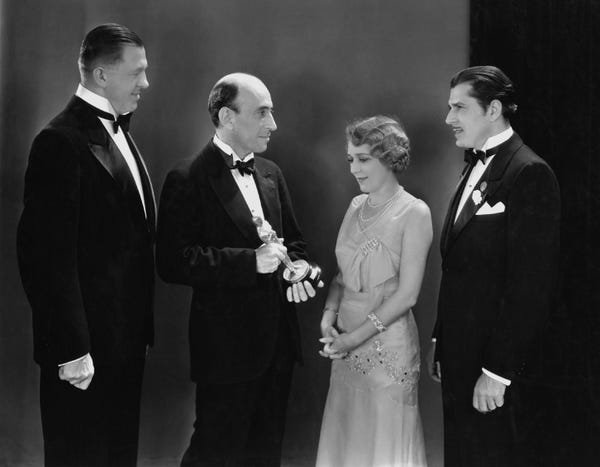
1930: Mary Pickford

Hanns Kraly, William C. deMille, Mary Pickford, and Warner Baxter.

FPG/Getty Images

Pickford wore a bedazzled dress, a large diamond bangle, and a few strings of pearls when she won for “Coquette.”

There were actually two Academy Awards in 1930; one in April and then another in November.

1930: Norma Shearer


norma shearer oscars 1930

Norma Shearer.

AP

Shearer wore a jacket with fur-lined sleeves over her dress when she won the Oscar for her role in “The Divorce.”

She finished her outfit with red lipstick, wavy hair, and several pieces of dainty jewelry.

1931: Marie Dressler


marie dressler oscars

Marie Dressler and Norma Shearer.

AP

Dressler received the Oscar for her part in “Min and Bill.” She wore a dark shift dress and a long necklace.

1932: Helen Hayes


Louis B. Mayer and Helen Hayes at the 1932 Oscars

Louis B. Mayer and Helen Hayes.

Getty Images/Getty Images

Hayes wore a classic black dress paired with a pearl necklace and gloves to win best actress for her performance in “The Sin of Madelon Claudet.”

1935: Claudette Colbert


Claudette COLBERT congratulating Shirley TEMPLE

Shirley Temple and Claudette Colbert.

Keystone-France/Gamma-Keystone/Getty Images

Colbert won best actress for “It Happened One Night.” She wore a gray suit with a large flower pinned to the lapel and a black hat.

1936: Bette Davis


Bette Davis and Victor McLaglen are shown after winning their Oscars at the 1935 Academy Awards banquet held at the Biltmore Bowl, Biltmore Hotel in Los Angeles, Ca., on March 5, 1936

Bette Davis and Victor McLaglen.


AP Photo


Davis wore a patterned ensemble when she took home the award for best actress for her work in “Dangerous.”

She was so convinced that she wouldn’t win the Oscar that she wore “an old costume” to the ceremony, Harper’s Bazaar reported.

1937: Luise Rainer


luise rainer oscar

Paul Muni, Luise Rainer, and Frank Capra.

AP

Rainer wore an elegant white coat and styled her hair in an updo to win the Oscar for her portrayal of Anna Held in “The Great Ziegfeld.”

1938: Luise Rainer


Luise Rainer at the 1938 Oscars

Luise Rainer.

Michael Ochs Archives/Getty Images

Yes, Rainer won back-to-back Academy Awards. Her second win came for her performance as O-Lan in “The Good Earth.” For her second win, she wore a high-necked gown with bell sleeves.

1939: Bette Davis


Spencer Tracy, Bette Davis, and another guest at the 1939 Oscars.

Spencer Tracy and Bette Davis.

Eric Carpenter/Getty Images

Bette Davis won her second best actress Oscar for her role in “Jezebel.” She wore a black gown with a cloud-like collar embellishment. 

1940: Vivien Leigh


vivienne leigh oscars

Spencer Tracy, Vivien Leigh, and Thomas Mitchell.

AP

Leigh wore a patterned dress while accepting the Oscar for playing Scarlett O’Hara in “Gone with the Wind.” She completed her outfit with a single pendant, dark lipstick, curled hair, and tons of mascara.

1941: Ginger Rogers


Jimmy Stewart and Ginger Rogers at the 1941 Oscars

Jimmy Stewart and Ginger Rogers.

Silver Screen Collection/Getty Images

Rogers accepted the Oscar at the 13th annual Academy Awards for “Kitty Foyle” in a brown dress with lace details.

In 1921, attendees were advised to wear “muted tones” because of the ongoing war, The Telegraph reported.

1942: Joan Fontaine


joan fontaine

Joan Fontaine and Gary Cooper.

AP

Fontaine won best actress for “Suspicion.” She wore a lacy black dress, which she paired with a matching hat and several pearl necklaces.

1944: Jennifer Jones


Paul Lucas, Jennifer Jones, Katina Paxinou, and Charles Coburn at the 1943 Oscars

Paul Lucas, Jennifer Jones, Katina Paxinou, and Charles Coburn.

Bettmann/Bettmann Archive/Getty Images

Jones (second from left) won her Oscar for “The Song of Bernadette.” She wore a unique dark gown with white, puffy sleeves and a flower embellishment at the collar.

1945: Ingrid Bergman


ingrid bergman bing crosby

Bing Crosby and Ingrid Bergman.

AP Photo/Harold P. Matosian

Bergman wore a dark skirt and blouse when she won the Oscar for her role in “Gaslight.” The star finished her outfit by sweeping her hair away from her face.

1947: Olivia de Havilland


Olivia De Havilland And Ray Milland In 1947

Olivia De Havilland and Ray Milland.

Keystone-France/Gamma-Keystone/Getty Images

De Havilland took home the gold for her role in “To Each His Own.”

The actor wore a strapless floral gown, complemented by large curls and a pearl necklace.

1948: Loretta Young


loretta young

Loretta Young.

AP

Young wore a green satin gown with matching gloves to accept the award for “The Farmer’s Daughter.” Her tiered dress had plenty of ruffles. 

1949: Jane Wyman


jane wyman

Jane Wyman.

AP

Wyman kissed her best actress Oscar for her role in “Johnny Belinda.” She wore a white gown with an embellished collar.

1950: Olivia de Havilland


Broderick Crawford, Olivia de Havilland, Robert Rossen, Mercedes McCambridge, and Dean Jagger at the 1950 Oscars

Broderick Crawford, Olivia de Havilland, Robert Rossen, Mercedes McCambridge, and Dean Jagger.

AP

De Havilland (second from left) embodied ’50s style when she accepted the Oscar for her role in “The Heiress.” The actor paired her flower-embellished gown with matching gloves.

1953: Shirley Booth


Shirley Booth and Frederic March at the 1954 Oscars

Shirley Booth and Frederic March.

Bettmann/Bettmann Archive/Getty Images

Booth won best actress at the 25th Academy Awards for her performance in “Come Back, Little Sheba” in a patterned, long-sleeve dress with matching gloves.

This ceremony was held simultaneously in Hollywood and New York City, and was also the first to be televised.

1954: Audrey Hepburn


audrey hepburn academy awards 1954

Audrey Hepburn.

AP

Hepburn wore a belted Givenchy dress as she accepted the award for her performance in “Roman Holiday.” She finished the look with classic eyeliner and lipstick.

1955: Grace Kelly


Edmond O'Brien and Grace Kelly at the 1955 Oscars

Edmond O’Brien and Grace Kelly.

Silver Screen Collection/Getty Images

Kelly accepted the award for her role in “The Country Girl.” The future princess of Monaco topped off her pale-green ensemble with elbow-length gloves, dainty earrings, and an updo.

1958: Joanne Woodward


Joanne Woodward and Paul Newman at the 1958 Oscars

Joanne Woodward and Paul Newman.

Darlene Hammond/Getty Images

Woodward, Oscar winner and wife of Paul Newman, accepted her award for “The Three Faces of Eve” in a strapless gown embellished with sewn-on flowers. She kept her hair and makeup simple, allowing her outfit to stand out. 

1959: Susan Hayward


Susan Hayward at the 1959 Oscars

Susan Hayward.

Bettmann/Bettmann Archive/Getty Images

Hayward wore a black dress to take home the Oscar for “I Want to Live!” She also sported a voluminous blowout, white gloves, and red lipstick.

1960: Simone Signoret


simone signoret oscars

Simone Signoret and Charlton Heston.

AP

Signoret won the Oscar for “Room at the Top,” wearing an off-the-shoulder black dress.

1961: Elizabeth Taylor


Elizabeth Taylor 1961

Elizabeth Taylor and Eddie Fisher.

AP

Taylor went floral in a Christian Dior gown to accept her award for “Butterfield 8.” Her high-volume hair and white gloves added some serious glamour to her outfit.

1965: Julie Andrews


Julie Andrews, Rex Harrison, and Lila Kedrova at the 1965 Oscars

Julie Andrews, Rex Harrison, and Lila Kedrova.

Bettmann/Bettmann Archive/Getty Images

Julie Andrews hugged her Oscar for “Mary Poppins” in a pale-yellow gown. The “My Fair Lady” actor topped off her simple dress with a statement necklace and gloves.

1966: Julie Christie


julie christie oscars

Lee Marvin, Julie Christie, Shelley Winters, and Martin Balsam.

AP

Christie wore a shiny gold dress to match the Oscar she won for “Darling.” She finished her outfit with a feathery blowout. 

1969: Barbara Streisand


Barbara Streisand 1969

Barbra Streisand.

AP

Streisand didn’t realize her Arnold Scaasi pantsuit was see-through under the lights as she accepted the Academy Award for “Funny Girl.” She finished her sequined pantsuit with a sleek bob and lots of eyeliner.

This year featured a rare tie: Streisand shared her award with Katharine Hepburn for “The Lion in Winter,” but Hepburn famously attended the Academy Awards only once, to present.

1972: Jane Fonda


Gene Hackman and Jane Fonda at the 1972 Oscars

Gene Hackman and Jane Fonda.

Bettmann/Bettmann Archive/Getty Images

Fonda accepted the Oscar for “Klute” in a black Yves Saint Laurent suit. She parted her sleek, shoulder-length hair to the side to complete her mod ensemble.

1973: Liza Minnelli


Liza Minnelli

Liza Minnelli.

AP

Minnelli shone in a bright-yellow Halston dress to accept the award for her role in “Cabaret.” She paired her outfit with a colorful choker and a matching bracelet.

1976: Louise Fletcher


Jack Nicholson and Louise Fletcher at the 1976 Academy Awards

Jack Nicholson and Louise Fletcher.

Ron Galella/Ron Galella Collection/Getty Images

Jack Nicholson and Fletcher posed together after their Oscar wins for “One Flew Over the Cuckoo’s Nest.” Fletcher wore a delicate Champagne-colored gown by Alfred Fiandaca.

1977: Faye Dunaway


Faye Dunaway at the 1977 Oscars

Faye Dunaway.

Tony Korody/Sygma/Getty Images

Dunaway wore a black Geoffrey Beene dress with a rope belt to accept her award for “Network.” She finished her dark outfit with several pieces of gold jewelry.

1978: Diane Keaton


Diane Keaton at the 1978 Oscars

Diane Keaton.

ABC Photo Archives/Disney General Entertainment Content/Getty Images

Keaton accepted the award for “Annie Hall” in a unique Ruth Morley suit. She went for a muted color palette with her layered outfit.

1979: Jane Fonda


Jane Fonda at the 1978 Oscars.

Jane Fonda.

ABC Photo Archives/Disney General Entertainment Content/ Getty Images

Fonda wore a gorgeous James Reva gown to accept her trophy for “Coming Home.” The two-time winner embraced the trends of the ’70s in a flowy floral dress.

1980: Sally Field


Sally Field and Dustin Hoffman at the 1980 Oscars

Sally Field and Dustin Hoffman.

Bettmann/Bettmann Archive/Getty Images

Field embodied spring in a white Bob Mackie dress with sheer floral cover as she accepted the award for “Norma Rae.” She added to the look with lots of eyeliner and teased, voluminous hair.

1981: Sissy Spacek


Sissy Spacek at the 1981 Oscars

Sissy Spacek.

Fotos International/Getty Images

Spacek took the award for “Coal Miner’s Daughter” in a black jumpsuit and kept the rest of her look simple.

1983: Meryl Streep


Meryl Streep at the 1983 Oscars

Meryl Streep.

Barry King/WireImage/Getty Images

Streep won the Oscar for “Sophie’s Choice” in a gold Christian Leigh dress while she was pregnant with her second daughter, Mamie (familiar to fans of “We Were Liars”). She finished her outfit with a pink-brown shade of lipstick and curled hair. 

1984: Shirley MacLaine


Shirley MacLaine at the 1984 Oscars

Shirley MacLaine.

William Nation/Sygma/Getty Images

MacLaine wore a Fabrice pale-pink suit when she won for “Terms of Endearment.” The suit was embellished with an intricate embroidered pattern.

1985: Sally Field


F. Murray Abraham and Sally Field at the 1985 Oscars

F. Murray Abraham and Sally Field.

ABC Photo Archives/ABC/Getty Images

Field cried out her famous, “You like me! You really like me!” in a strapless black dress as she won for “Places in the Heart,” her second win in five years. She finished off her outfit with a necklace that looked like a bow.

1986: Geraldine Page


William Hurt and Geraldine Page at the 1986 Oscars

William Hurt and Geraldine Page.

ABC Photo Archives/ABC/Getty Images

Page, who won the Oscar for her work in “The Trip to Bountiful,” layered a deep-purple velvet cape over her dress. She completed her outfit with chandelier earrings and a warm shade of lipstick.

1987: Marlee Matlin


Marlee Matlin at the 1987 Oscars

Marlee Matlin.

Ron Galella/Ron Galella Collection/Getty Images

Matlin paired her pink dress with a floral headpiece when she won for her role in “Children of a Lesser God.” She paired her mixed-material gown with peachy lipstick.

1988: Cher


cher 1988 oscars

Cher.

Lennox McLendon/AP Photo

Cher famously wore a sheer Bob Mackie ensemble to accept the award for “Moonstruck.” From her headdress to her sandals, the star sparkled.

1989: Jodie Foster


Jodie Foster at the 1989 Academy Awards

Jodie Foster.

Ron Galella, Ltd./Ron Galella Collection/Getty Images

Foster wore a light-blue gown when she took home the Oscar for her role in “The Accused.” She kept her hair and makeup simple, letting the ruched gown speak for itself. 

1990: Jessica Tandy


Jessica Tandy at the 1990 Oscars

Jessica Tandy.

CHRISTOPHE D YVOIRE/Sygma/Getty Images

Tandy sparkled in a two-piece getup by Giorgio Armani as she accepted the award for her performance in “Driving Miss Daisy.” She finished her outfit with a pair of statement earrings. 

1991: Kathy Bates


kathy bates 1991

Kathy Bates.

Bob Galbraith/Associated Press

Bates wore a black gown with shoulder pads to accept her award for “Misery.” Her earrings matched the glitzy details on her dress.

1992: Jodie Foster


Anthony Hopkins and Jodie Foster at the 1992 Academy Awards

Anthony Hopkins and Jodie Foster.

Ron Galella, Ltd./Ron Galella Collection/Getty Images

Foster took home the gold statue again for her role in “The Silence of the Lambs.” This time, she opted for a cream Armani jacket and paisley crystal-encrusted trousers, and went old school with matching gloves. Foster also wore a red pin on her lapel for HIV/AIDS awareness.

1993: Emma Thompson


Emma Thompson at the 1993 Academy Awards

Emma Thompson.

Ron Galella, Ltd./Ron Galella Collection/Getty Images

Thompson wore an emerald Caroline Charles jumpsuit when she won for “Howards End.” She completed her look with red lipstick and curled ringlets.

1994: Holly Hunter


Tom Hanks and Holly Hunter at the 1994 Academy Awards

Tom Hanks and Holly Hunter.

Frank Trapper/Corbis/Getty Images

Hunter wore a black and gray Vera Wang dress with a hint of sparkle when she won for “The Piano.” She matched her earrings and bracelet to the glimmering details on her dress.

1995: Jessica Lange


Jessica Lange at the 1995 Oscars

Jessica Lange.

Ron Galella/Ron Galella Collection/Getty Images

Lange wore Calvin Klein when she won the award for “Blue Sky.” She added a touch of color to her dark, mesh-paneled gown with her bright lipstick. 

1996: Susan Sarandon


susan sarandon oscars 96

Susan Sarandon.

Reed Saxon/Associated Press

Sarandon wore a bronze Dolce & Gabbana gown when she was recognized for “Dead Man Walking.” She finished off her outfit with tousled hair.

1997: Frances McDormand


Frances McDormand at the 1997 Academy Awards

Frances McDormand.

Ron Galella/Ron Galella Collection/Getty Images

McDormand wore a simple blue dress when she won for “Fargo.” She kept her accessories minimal, opting for just one ring and a pair of earrings, a style she still goes by to this day.

1998: Helen Hunt


Helen Hunt at the 1998 Oscars

Helen Hunt.

Ron Galella/Ron Galella Collection/Getty Images

Hunt stunned in a strapless blue dress by Tom Ford for Gucci when she won for “As Good as It Gets.” She finished off her outfit with a matching wrap, frosty makeup, and a diamond bracelet.

1999: Gwyneth Paltrow


Gywneth Paltrow at the 1999 Academy Awards

Gywneth Paltrow.

Kevin.Mazur/WireImage/Getty Images

Paltrow wore a baby-pink Ralph Lauren princess gown when she took home the Academy Award for “Shakespeare in Love,” one of the most iconic Oscar looks of all time. She topped off her dress with a sheer, tulle wrap, a statement necklace, bright-pink lipstick, and a touch of blush.

2000: Hilary Swank


Hilary Swank at the 2000 Oscars

Hilary Swank.

Jim Smeal/Ron Galella Collection/Getty Images

Swank wore a strapless green Randolph Duke dress when she accepted the award for “Boys Don’t Cry.” She glammed up her dress with a dazzling statement necklace.

2001: Julia Roberts


Julia Roberts at the 2001 Oscars

Julia Roberts.

Mirek Towski/FilmMagic/Getty Images

Roberts wore a black Valentino gown with white accents when she won for “Erin Brockovich.”

2002: Halle Berry


Halle Berry 2002 Oscars

Halle Berry.

AP

Berry wore one of the most memorable Oscars dresses when she accepted her award for “Monster’s Ball” in a floor-sweeping Elie Saab gown. Her dress had a mesh, floral-embroidered top and a contrasting satin skirt.

2003: Nicole Kidman


Nicole Kidman at the 2003 Oscars

Nicole Kidman.

Robert Mora/Getty Images

Kidman accepted her Oscar for “The Hours” in a black Jean Paul Gaultier dress that had an unexpected, edgy neckline.

2004: Charlize Theron


Charlize Theron at the 2004 Oscars

Charlize Theron.

Christopher Polk/FilmMagic/Getty Images

Theron rocked a glittering Gucci dress when she won for “Monster.” The actor looked very old Hollywood with her hair styled in glamorous waves.

February 2005: Hilary Swank


hilary swank oscars 2005

Hilary Swank.


Chris Pizzello/AP Photo


Swank accepted her Oscar for “Million Dollar Baby” in a fully backless Guy Laroche dress. She completed the look with shimmering makeup and a sleek hairdo.

2006: Reese Witherspoon


Reese Witherspoon at the 2006 Academy Awards

Reese Witherspoon.

J. Vespa/WireImage/Getty Images

Witherspoon looked radiant in a Christian Dior gown when she won for her performance in “Walk the Line.” She completed her outfit with a smoky eye, a simple hairdo, and earrings that matched her dress.

2007: Helen Mirren


helen mirren 2007 oscars

Helen Mirren.

AP Photo/Kevork Djansezian

Mirren wore a Christian Lacroix gown when she accepted the Oscar for “The Queen.” It looks like she layered a patterned tulle skirt over her lacy, embellished gown. 

2008: Marion Cotillard


Marion Cotillard Oscars 2008

Marion Cotillard.

Frazer Harrison/Getty Images

Cotillard took home the Oscar for “La Vie En Rose.” The actor looked glamorous, with sleek curls and a mermaid-inspired dress by Jean Paul Gaultier.

2009: Kate Winslet


kate winslet oscars 2009

Kate Winslet.

AP Photo/Matt Sayles

Winslet took home the Oscar for “The Reader” in a one-shouldered, blue-gray Yves Saint Laurent gown. Winslet complemented her two-toned dress with a smoky eye.

2010: Sandra Bullock


Sandra Bullock at the 2010 Oscars

Sandra Bullock.

Jason Merritt/Getty Images

Bullock wore a silver Marchesa dress as she accepted the award for her role in “The Blindside.” The actor brought some color to her look with bright-pink lipstick. 

2011: Natalie Portman


natalie portman 2011

Natalie Portman.

Jason Merritt/Getty Images

Portman wore an off-the-shoulder Rodarte dress while accepting the award for “Black Swan.” Portman’s shoes and earrings perfectly matched her dress. Fun fact: She was four months pregnant at the time!

2012: Meryl Streep


Meryl Streep at the 2012 Academy Awards

Meryl Streep.

Jason Merritt/Getty Images

Streep matched her Oscar for “The Iron Lady” in a gold Lanvin dress. From her accessories to her makeup, she appeared to be dripping in gold.

2013: Jennifer Lawrence


jennifer lawrence oscars 2013

Jennifer Lawrence.


Jason Merritt/Getty Images


Lawrence, who won for “Silver Linings Playbook,” may have tripped on her way to the stage, but she still looked flawless in this white Christian Dior gown.

2014: Cate Blanchett


cate blanchett

Cate Blanchett.

AP

Blanchett wore an embellished Armani Privé gown when she took home the award for “Blue Jasmine.” She completed her look with delicate curls and large sunburst earrings.  

2015: Julianne Moore


Julianne Moore at the 2015 Academy Awards

Julianne Moore.

Jeff Kravitz/FilmMagic/Getty Images

Moore wore a strapless Chanel gown when she accepted the award for “Still Alice.” The custom, detailed gown took over 900 hours to make, according to People.

2016: Brie Larson


brie larson oscars 2016

Brie Larson.

Jordan Strauss/Invision/AP

Larson accepted the Oscar for “Room” in a belted, royal-blue Gucci dress. The intricate gown was in the works for two months, per ABC.

2017: Emma Stone


Emma Stone

Emma Stone.

Getty Images

Stone wore a vintage-inspired gown when she won the award for her performance in “La La Land.” She finished her golden-toned dress with big waves and classic red lipstick.

2018: Frances McDormand


frances mcdormand

Frances McDormand.

Kevin Winter/Getty Images

McDormand won the award for her role in “Three Billboards Outside Ebbing, Missouri,” wearing a black dress with a gold pattern. During her acceptance speech, McDormand asked every female nominee in the audience to stand and discussed the importance of inclusion riders.

2019: Olivia Colman


Olivia Colman at the 2019 Academy Awards

Olivia Colman.

Kevork Djansezian/Getty Images

Colman wore an emerald-green Prada gown that took months to create as she accepted the award for “The Favourite.” Colman’s gown was draped with a silk organza cape, tied into a giant bow at the back, and covered in Swarovski crystal flowers.

2020: Renée Zellweger


renee zellweger 2020 oscars

Renée Zellweger.

Jennifer Graylock/PA Images via Getty Images

Zellweger won her second Oscar — her first best actress Oscar, for “Judy” — in a custom white Armani Privé gown.

Though tough to see, according to Entertainment Tonight, the gown was covered in beads with pale pink and blue thread. 

2021: Frances McDormand


frances mcdormand oscars 2021

Frances McDormand and director Chloé Zhao.

Matt Petit/A.M.P.A.S. via Getty Images

McDormand wore a navy-blue gown with a feathered bottom and feathered sleeves to win her third acting Oscar for “Nomadland.”

With her win, McDormand tied Meryl Streep and Ingrid Bergman with the most Oscar wins for acting. Katharine Hepburn holds the record with four best actress statues.

2022: Jessica Chastain


essica Chastain, winner of the Actress in a Leading Role award for ‘The Eyes of Tammy Faye’ poses in the press room during the 94th Annual Academy Awards at Hollywood and Highland on March 27, 2022 in Hollywood, California

Jessica Chastain.

Mike Coppola/Getty Images

Chastain dazzled in a sparkly ombré Gucci gown that transitioned from rose gold to lavender as she accepted her first Academy Award for “The Eyes of Tammy Faye.”

2023: Michelle Yeoh


Michelle Yeoh attends the 95th Annual Academy Awards on March 12, 2023 in Hollywood, California.

Michelle Yeoh.

Kevin Mazur/Getty Images

Feathers accented the angelic Dior Couture gown. The “Everything Everywhere All At Once” star paired the look with a Moussaieff diamond headband and earrings, along with a Richard Mille watch.

2024: Emma Stone


Emma Stone at the 2024 Academy Awards

Emma Stone.

Rodin Eckenroth/Getty Images

Stone accepted her second best actress Oscar (this one for “Poor Things”) in a mint-green peplum gown designed by Louis Vuitton, but she made sure to point out during her speech that the zipper had broken at some point during the ceremony.

She blamed Ryan Gosling’s spirited performance of “I’m Just Ken.”

2025: Mikey Madison


Mikey Madison at the 2025 Academy Awards

Mikey Madison.

Scott Kirkland/Disney via Getty Images

Madison, who won for “Anora,” went for an Old Hollywood look at the 2025 Oscars, wearing a two-toned pink and black satin dress with a bow. It was designed by Dior.


Source link

Chong Ming Lee, Junior News Reporter at Business Insider's Singapore bureau.

The CEO of a $15 billion AI company says the biggest AI winners won’t be software — they’ll be mines, farms, and trucks

AI’s biggest impact will likely happen far from laptops, says the CEO of a $15 billion AI company.

Qasar Younis, the cofounder and CEO of Applied Intuition, said on an episode of “Lenny’s Podcast” published Sunday that “the real impact of AI in the next 5 to 10 years” would show up in physical industries, like “in farming, in mining, in construction, in self-driving trucks.”

Applied Intuition develops software to test and power autonomous vehicles and other machines. The company said in June that it raised $600 million in a funding round, valuing it at $15 billion.

Software tools like Moltbook and OpenClaw may excite developers, but Younis said they touch only a small slice of society.

“I love the stuff that’s happening on these platforms, but it’s still segregated to, like, frankly, developers,” he added.

Instead, he said the biggest shift will come from adding intelligence to machines already embedded in the physical economy.

“More pragmatically, it’s actually just putting intelligence into things that already exist all around us.”

Industries like trucking and farming urgently need that kind of autonomy, he said.

“People are not fighting for those trucking jobs,” Younis said. The average farmer is already in their late 50s, meaning many will retire in the coming decade, potentially worsening labor shortages.

AI is more likely to help fill labor shortages in these industries than replace them entirely, he added.

The company has tested autonomous trucks in Japan, where an aging workforce means a driver shortage, and it’s working on AI in mining safety and efficiency.

AI’s impact on blue-collar industries

Earlier this year, Wall Street grew worried that new AI tools and agents could replace some software products entirely.

A research paper by Citrini, an investment firm focused on thematic equity investing, triggered a global stock sell-off last month after researchers outlined a scenario in which the AI boom wipes out white-collar jobs and ultimately slows economic growth.

Against that backdrop, some industry leaders say physical industries could end up benefiting from the technology.

For instance, robots could help address labor shortages in manufacturing. Daniel Diez, the chief business officer of Agility Robotics, told Business Insider in a report published on Sunday that manufacturers globally “simply can’t find the people to do this work.”

Ford CEO Jim Farley said last year that AI-powered augmented-reality tools are helping technicians repair trucks more efficiently, though he warned that automation could still reshape jobs across the broader economy.

Business Insider reported last year that some Gen Z workers are increasingly considering trade and blue-collar careers as automation and AI create uncertainty around traditional white-collar professions.


Source link

Chong Ming Lee, Junior News Reporter at Business Insider's Singapore bureau.

A Japanese toilet maker and seasoning giant are unlikely winners of the AI boom

The AI boom isn’t just lifting chipmakers and Big Tech. In Japan, it’s flushing gains into a toilet manufacturer and a seasoning giant.

As demand for AI chips surges, investors are piling into companies that sit inside the semiconductor supply chain — even if they’re better known for bathrooms and soup stock.

Toilet maker Toto, famous for its high-tech bidets and heated seats, has drawn investor attention. The company makes electrostatic chucks, which are critical components used in the production of NAND memory chips.

Memory prices have climbed sharply in recent months, driven by AI-related demand.

Last week, UK-based activist fund Palliser Capital called Toto “the most undervalued and overlooked AI memory beneficiary,” according to reports by Bloomberg and the Financial Times.

After news broke on Tuesday that Palliser Capital had taken a stake and was pushing Toto to promote its chip-parts business, the toilet maker’s stock jumped more than 5%. Its shares are up more than 54% over the past year.

It’s not just Toto. Japanese food giant Ajinomoto, better known for its umami seasonings and soup bases, has become an unlikely AI infrastructure play. The company produces an insulating material used in advanced semiconductor packaging.

Ajinomoto’s latest financials point to strength beyond its core food business. For the nine months ended December, the company reported an 8.9% rise in net profit, while operating profit increased 5.6% year-on-year. The gains were partly driven by its “Healthcare and Others” segment which includes electronic materials used in semiconductors, the company said in a February earnings statement.

After Ajinomoto posted its earnings on February 5, the company’s stock rose 13%. Its shares are up more than 56% over the past year.

Not all non-tech companies are benefiting equally from the AI boom. Daikin, best known globally for its air conditioners, supplies high-purity chemical materials used in semiconductor manufacturing. It recently trimmed its outlook, citing uncertainty over US tariffs as a drag on demand.

The Japanese air conditioning maker reduced its operating profit forecast by about 5% to 413 billion Japanese yen, or $2.6 billion, for the fiscal year ending in March.

“Operating profit was significantly affected by the decline in semiconductor demand, decreasing by 44.6% year over year to ¥18,102 million,” the company said in its financial report in February.

“Net sales of fluoropolymers fell year over year, despite focused Group efforts to capture strong new demand in the data center field, and was due to the stagnation in the construction markets of the United States and China and the significant overall impact of delays in the recovery of semiconductor demand,” it added.

The company said it plans to cushion the blow through price increases and cost reductions.

Daikin’s stock dropped as much as 8.4% in Tokyo following its financial results.


Source link

The-unexpected-winners-of-the-AI-slop-boom-Word-nerds.jpeg

The unexpected winners of the AI slop boom: Word nerds

In the generative AI boom, vibe coding and AI expertise have become in-demand résumé skills. But tech companies are also looking to pay a premium for expertise in people who have a skill that predates AI: the art of communication.

Andreessen Horowitz launched its New Media team last year to help founders learn what they “need to win the narrative battle online.” Adobe is looking for an “AI evangelist” to lead the company’s “artificial intelligence storytelling.” Netflix, a company that sells stories to your living room, recently posted a director of product and technology communications role with a salary range of up to $775,000. Microsoft began publishing a print magazine, Signal, last year, calling it an “antidote to the ephemeral nature of digital.” Anthropic tripled the size of its communications team last year, growing to about 80 people and is still hiring five more, each offering salaries of around $200,000 or higher. OpenAI has several open communications jobs boasting salary listings of more than $400,000. The average director of communications in the US makes $106,000, according to Indeed.

Three years after the mainstream adoption of ChatGPT, results have been mixed: Within tech firms, vibe coding is nixing the need for entry-level software developers, while some workers across industries are foisting rapidly generated, verbose, and sloppy AI nonsense onto their colleagues, leading to wasted time and a breakdown of trust. Even Sam Altman said last year that people have started to affect a sort of AI accent when speaking, and now some social platform discourse “feels very fake.”

Amid all chatter about gen AI taking jobs, the ease with which gen AI spits out content has ironically revved the demand for human communicators.

Because AI generates so much content, “you would think that actually the job of the comms person or the storyteller would be fewer and farther between,” says Gab Ferree, founder of Off the Record, a community for communications professionals, and former vice president of global communications at Bumble. But that’s not what’s happening. Tech companies are hiring writers, editors, chief communications officers who work closely with CEOs, and so-called “storytellers.” The Wall Street Journal recently reported that the percentage of job postings on LinkedIn mentioning “storyteller” doubled between 2024 to 2025.

In a competitive industry where startups fight to survive and Big Tech rivals campaign for market dominance, a good story is a selling point. One theory behind the push, Ferree says, is “there’s just so much garbage out there that people want to pay a premium for someone who can claim that they can cut through the noise.”


The trend of storytelling and lucrative comms jobs has been “percolating for a while,” says Jenna Birch, founder of SISU, a communications consultancy for startups and VCs. As Silicon Valley’s influence ballooned over the past two decades, tech companies could offer staggering salaries just as more newspapers were bleeding more and more writers. Content marketing became popular, and building a company’s brand on social media and surfacing blog posts in Google search results became essential.

More recently, the role of the comms pro has continued to expand, as they have to understand large language models, company blogs, how to craft a larger narrative to set a company apart from competitors, and how to write in a CEO’s voice on LinkedIn and Substack. The number of chief communication officer roles that encompass not just traditional comms duties but also take on another responsibility, like marketing or or human resources, at Fortune 1000 companies grew from 90 in 2019 to 169 in 2024, according to a report from the Observatory on Corporate Reputation. The median pay for a CCO at a Fortune 500 company is now between $400,000 and $450,000, a $50,000 jump from 2023, according to a survey from consultant firm Korn Ferry.

If everyone’s a writer, then nobody’s a writer, and I think it’s very evident right now.Cristin Culver, founder of Common Thread Communications

As the job changes and demand for narrative communications and storytellers rises, the number of communications experts able to work under rapidly evolving conditions and with a wide remit may be small, comms experts tell me, leading companies to offer hefty compensation packages in war for the best talent. A similar trend is unfolding among the few people who are AI experts, driving tech companies to offer astounding salaries to poach top talent from rival firms. While not of the same nine-figure caliber, in their own right, creatives are becoming “the high value person in tech now,” Birch says.

For much of the tech boom, that high-value person was a software developer. Universities and coding bootcamps rushed to fill employment gaps and train up the next generation of tech workers. Young people were told coding would be a path to a lucrative, stable career. As of 2023, the most recent year the Federal Reserve Bank of New York released data for, computer science recent graduates faced an unemployment rate of 6.1%, while communications majors’ unemployment rate sat at 4.5%. The number of open job posts for software engineers dropped by more than 60,000 between 2023 and late 2025, according to data from CompTIA, a nonprofit trade association for the US IT industry. The best defense against automation, some argue, will be a liberal arts degree.

Words might be easy to generate with AI, but good writing isn’t ready for automation.

“If everyone’s a writer, then nobody’s a writer, and I think it’s very evident right now,” says Cristin Culver, founder of communications firm Common Thread Communications. LinkedIn is full of posts written by AI in a similar style that makes eyes glaze over as they scroll. “I think AI is both aiding and making storytelling much harder,” Culver says. “Ironically in this era of AI, some of the most poignant storytelling belongs to the people who’ve realized that everything is sloppified and they’ve pivoted to very tactical storytelling.”

Anthropic has been leaning heavily into that tactical, and tactile, storytelling. In the fall, the company created a pop-up Claude Cafe in New York to position the chatbot as a thinking and problem solving partner, marketing the space as one for showing up in person, connecting, and being surrounded by books and magazines over screens (although the company has also destroyed and scanned millions of books to train Claude, which a judge ruled last year was not a copyright violation).

“Claude is definitely a prominent team member for everyone, but comms people are sort of like BS detectors,” Sasha de Marigny previously told Axios last May, months before she was promoted from head of communications to become the company’s first CCO. “Critical thinking is still a huge comparative advantage for humans. I’m looking for excellent strategists — people who understand the new world order and know how to develop holistic plans to cut through to the audiences we care about.” Anthropic declined to speak more about its comms strategy for this story.

“It’s a golden age for people who really enjoy the craft of communications,” says Steve Clayton, CCO of Cisco, who formerly worked at Microsoft and launched the company’s print publication. When he first tried ChatGPT, Clayton says he worried his career was done. He’s since become an AI optimist, seeing gen AI as a tool and opportunity for communicators and so-called storytellers to stand out with content that feels authentic content projects that strike people. “In an environment where nobody’s sat at their desk today saying: God, I wish I had more email, or I wish I had more websites I could visit, or I wish I had more podcasts — the challenge is, how do you create something that is worthy of people’s time and worthy of their attention?”

Jobs where brands build out their own newsrooms are “going to be one of the last places where AI is replacing writers,” says Noah Greenberg, CEO of Stacker, a content distribution company. Unlike traditional media, which relies on clicks, advertising, and subscription to make money off a constant stream of content, “when brands are investing in the strategy, they’re not thinking about: ‘Do I break even on an individual piece of content?’ They’re thinking about: ‘How do I create five or 10 really incredible stories every month that get our story out there, that prove and turn us into the authority as a respected party in this space?””

As with coding and image generation, LLMs are likely to keep getting better. LLMs may write with more voice or sound more human eventually. But the chatbots and agents don’t think. They generate creative content without cycling through a creative process. A 2025 Columbia Business School study found LLMs have a bias for “Option A,” preferring the first choice when given a list and asked to pick. For people working in comms, AI might be more friend than initially imagined foe — at least because it makes their work stand out.


Amanda Hoover is a senior correspondent at Business Insider covering the tech industry. She writes about the biggest tech companies and trends.

Business Insider’s Discourse stories provide perspectives on the day’s most pressing issues, informed by analysis, reporting, and expertise.



Source link

A-Venezuela-oil-revival-could-set-up-winners-—-and.jpeg

A Venezuela oil revival could set up winners — and losers — in US energy

Not all American energy companies stand to benefit from a potential revival of Venezuela’s oil industry following the US’s capture of Venezuelan leader Nicolás Maduro.

Energy stocks rose on Monday as investors priced in potential gains from renewed US access to Venezuela’s massive oil reserves. But analysts say smaller companies could struggle to benefit from a recovery in the country’s energy sector.

Additional Venezuelan oil supply over the coming years could be “negative for shale producers” that don’t have a footprint in Venezuela, Daan Struyven, the head of oil research at Goldman Sachs, said on the firm’s “Exchanges” podcast, published on Tuesday.

That’s because prices and volumes could come under pressure if supply growth over the next five to 10 years comes from Venezuela rather than from US shale, he added.

The potential strain on shale reflects a key difference in oil quality. Venezuelan crude is heavy and sulfur-rich, while US shale production is dominated by lighter oil. Many US Gulf Coast refineries were originally designed to process heavier crude, making Venezuelan barrels a better fit.

Greater access to Venezuelan crude could therefore benefit refiners while undermining demand for lighter shale barrels.

While light shale oil and heavy crude like Venezuela’s are not directly interchangeable, increased supplies of heavy oil can still reshape refinery demand and pricing across the broader market. That kind of change would indirectly pressure US shale producers, who have long been the engine of America’s shale revolution.

“In the US, the first casualties would likely be some oil producers, particularly smaller shale firms with high debt and thin margins,” Philippe Le Billon, a professor at the University of British Columbia who studies the political economy of natural resources, wrote in The Conversation on Sunday.

Furthermore, oil prices have already been under pressure in recent years due to ample supply and sluggish demand growth.

US benchmark West Texas Intermediate crude futures are trading around $56 a barrel, while Brent futures are around $60 a barrel. Both are down around 2% so far this year after falling 20% last year.

Even an increase in Venezuela’s oil production in the medium term could put downward pressure on oil prices, making it harder for higher-cost US shale producers to justify new drilling, researchers at Columbia University’s Center on Global Energy Policy said in a Sunday post.

That dynamic could intensify the pressure on US shale producers.

“This complicates the notion that the US would unambiguously ‘win’ from a Venezuelan oil revival. Energy geopolitics creates winners and losers on all sides,” wrote Le Billon.


Source link