Disruption may be hitting Hollywood hard, but it’s not slowing down Jason Blum, whose powerhouse studio, Blumhouse, is behind many of the most popular — and most profitable — horror films of the past 10 years.
In conversation with Chief Correspondent Peter Kafka, Blum unpacked how AI is changing the entertainment industry and how his unique business approach allows Blumhouse to thrive in a time where consumer behaviors are shifting. The two spoke at Business Insider Live’s The Long Play event in San Francisco.
Crude futures are tumbling thanks to the US-Iran ceasefire, but don’t expect the price of a tank of gas to plunge overnight.
West Texas Intermediate futures for May fell about 16% to below $95 a barrel early Wednesday, as investors cheered President Trump’s two-week truce with Iran.
Wholesale gasoline futures for May (RBOB), a bellwether for future gas prices, dropped 10% to just under $3 a gallon.
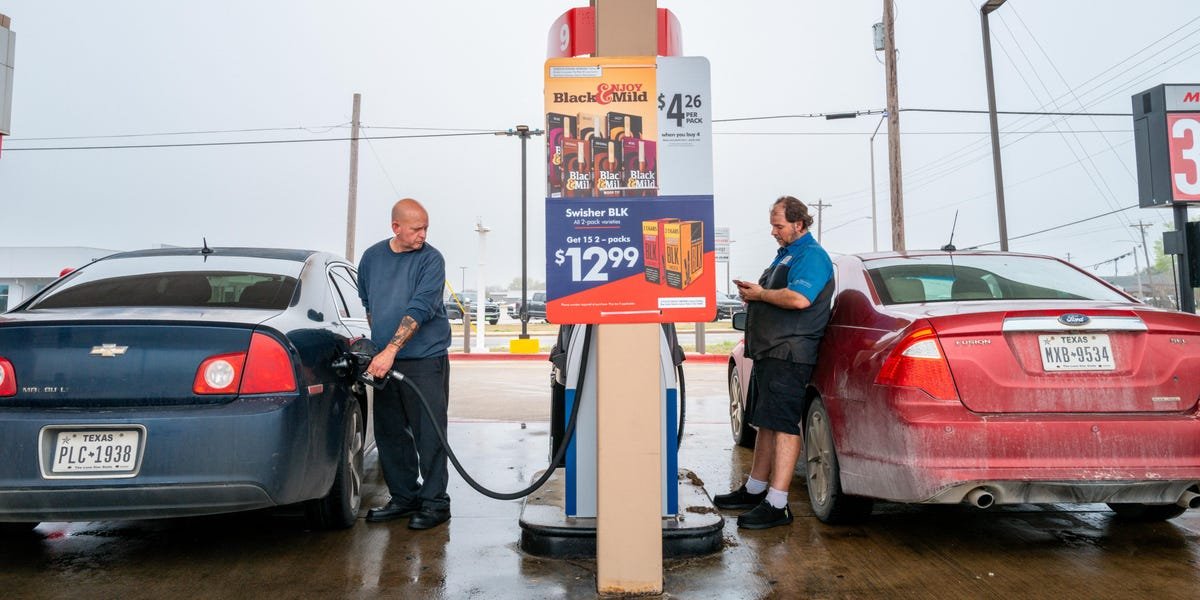
Those are welcome moves for American consumers, who’ve seen regular gas prices jump from under $3 a gallon before the war to over $4.15, per AAA’s price guide. Similarly, diesel has surged from under $3.90 a gallon to over $5.60.
But it’s worth underscoring that WTI futures are still up by more than 60% in 2026, and RBOB is up by more than 70%. The two benchmarks stood at around $58 and $1.71, respectively, at the start of January.
In other words, gas prices are still much higher than even a few weeks ago — and they could remain elevated for a while, analysts say.
A key reason is that it typically takes a couple of weeks to refine crude oil into gasoline, transport it through pipelines, tankers, and trucks, and deliver it to gas stations.
Many gas stations also buy fuel in advance, so even if their latest shipment is cheaper, they’re likely to seek to sell their costlier inventory before materially cutting prices.
Price cuts could take even longer this time, given the massive disruption to the global energy supply chain from Iran’s conflict with the US and Israel.
A key issue has been the virtual closure of the Strait of Hormuz, through which 20% of global oil and gas flows normally pass. Trump’s ceasefire promises to open the shipping channel, but it remains to be seen on what terms.
Saxo Strategy Team wrote that even “if the ceasefire holds, a return to ‘normal’ could still take months given the time it takes to reopen shuttered wells, and before crews and vessels are in the right places, and refineries are fully repaired and restocked.”
The bank’s team said that more than 800 vessels are stranded in the Persian Gulf, and their captains and owners might still shy away from traversing the Strait of Hormuz until they’re confident it’s safe.
Susannah Streeter, Wealth Club’s chief investment strategist, wrote in a morning note that “allowing more tankers through won’t relieve the energy squeeze immediately,” as damage to oil-and-gas facilities across the Gulf has curbed refining capacity, and it “could take years” for supply to return to pre-conflict levels, given the extensive repairs that need to be carried out.
“So, although prices at the pumps may ease off in the coming weeks, they still could remain stubbornly high if oil prices hang around this level,” she added, noting they’re still around 35% higher than in mid-February.
Iran is also reportedly charging ships to pass through the Strait of Hormuz, which could lead companies to pass on those higher costs to customers by charging higher prices for oil and gas products.
Oil prices have surged after fresh conflict in the Middle East raised fears of supply disruptions through the Strait of Hormuz — a move that would normally be a windfall for Russia.
But this time, it may not be enough, according to an analyst.
“The current temporary spike, filtered through sanctions discounts and an unfavorable exchange rate, is unlikely to change the fundamental arithmetic,” wrote Alexander Kolyandr, a senior fellow at the Center for European Policy Analysis, in a Wednesday post.
International benchmark Brent crude and US West Texas Intermediate were more than 3% higher, trading around $84 and $77.50 per barrel respectively late on Wednesday. Both grades are around 35% higher this year.
Russia is one of the world’s largest energy exporters, and its federal budget — and by extension President Vladimir Putin’s war in Ukraine — relies heavily on oil and gas revenue.
Every time Huileng publishes a story, you’ll get an alert straight to your inbox!
Stay connected to Huileng and get more of their work as it publishes.
Yet Moscow does not receive international benchmark prices for its crude. Its Urals oil trades at a sanctions-driven discount, and the strong ruble means each dollar of oil revenue converts into fewer rubles for the budget.
As a result, Brent above $80 does not automatically deliver the revenue Russia needs.
Oil and gas revenues plunged 50% in January from a year earlier, falling to levels last seen during the pandemic shock in 2020. Meanwhile, the federal budget ran a deficit of 1.72 trillion rubles — about 0.7% of GDP, according to Russian Finance Ministry data.
“Unless oil prices stay higher for longer and the ruble weakens significantly, the Kremlin’s budget problems are here to stay,” Kolyandr wrote.
Kolyandr’s analysis comes as investors weigh whether the latest Middle East escalation will trigger a sustained oil shock, particularly for Asian countries that are reliant on heavily reliant on Middle Eastern energy.
China and India — now two of the biggest buyers of Russian crude — still source a large share of their oil from the Middle East, leaving both exposed to disruptions in the Strait of Hormuz.
Any prolonged disruption in the Strait of Hormuz could shift trade flows, potentially increasing scrutiny on whether Asian importers turn further to discounted Russian oil.
Markets have been volatile following the US and Israeli attacks on Iran over the weekend. On Wednesday, stocks in Asia slumped on energy security fears before rebounding on Thursday.
Lawmakers appear to be at an impasse after the failure of a bipartisan bill that would have mandated something most airline cockpits still lack: a real-time view of other aircraft.
The ROTOR Act failed in the House by a single vote. It had passed with bipartisan support in the Senate and backing from families of crash victims of the January 2025 collision involving an American Airlines jet. It also had the support of pilot and flight attendant unions, airlines, and the National Transportation Safety Board.
Advocates say they will oppose a new GOP bill that does not mandate cockpit monitors.
Families were unhappy with the bill’s failure to garner the two-thirds majority needed to pass a procedural measure on Tuesday: “It was defeated by eleventh-hour objections built on misleading technical claims the NTSB’s own investigators have publicly refuted,” they said in a joint statement.
Rep. Don Beyer, a Virginia Democrat who supported the ROTOR Act, speaks during a news conference to discuss aviation safety legislation. He’s surrounded by families of the victims.
AP Photo/Mariam Zuhaib
The bill split House Republicans, with some of the 132 opponents saying the additional monitoring systems would be expensive and were unproven; some are advocating for an alternate bill, the ALERT Act, that leaves air traffic controllers primarily responsible for collision alerts and allows some military flights to opt out of transmitting their positions.
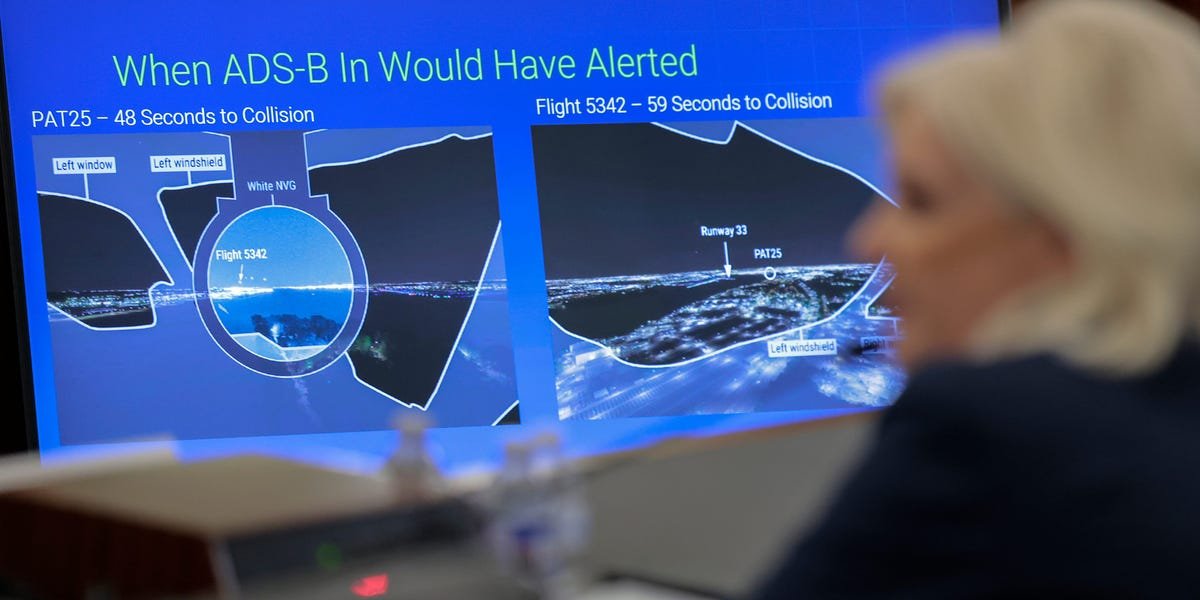
At the heart of the debate was a proposed requirement to equip commercial aircraft with GPS-based “ADS-B In,” which would display nearby air traffic on the flight deck screen — potentially closing the gap revealed by last year’s AA crash with an Army helicopter near Ronald Reagan National Airport that killed 67 people. Overstretched air traffic controllers had struggled to track the mix of commercial and military flights in DC’s crowded airspace that day.
Commercial aircraft have been required to carry the sister technology, “ADS-B Out,” since 2020, which feeds their position to air traffic control. Think of it like ADS-B Out is talking and ADS-B In is listening. ADS-B Out has drastically improved safety by being more precise than radar and enhancing pilot situational awareness.
Example of a generic Garmin ADS-B traffic monitor in an aircraft.
Garmin
Supporters of the ROTOR Act — which would also require certain military planes to broadcast their position in civilian airspace — argued that adding these monitors would allow pilots, as the last line of defense, to react to hazards when seconds count.
In comments shared with Business Insider, Syracuse University professor and aviation safety expert Kivanc Avrenli said the use of ADS-B In on the American jet would have given its pilots 59 more seconds to react before impact. In reality, the traffic-avoidance collision alert came only 19 seconds before, he said, and maneuver instructions weren’t possible due to altitude limits.
“In dense airspace, that extra 40 seconds can be the difference between having time to sort out a conflict and having no real options left,” he said. “Delaying these upgrades means continuing to rely on systems that simply were not built for this kind of scenario.”
ADS-B In would not only help in flight but also on the ground, where a series of runway incursions has exposed the limits of what controllers can handle in real time. In the months after the January accident, two separate military aircraft had close calls with US passenger jets.
The Pentagon initially supported the original bill. On Monday, it changed its position and said the technology risks “significant unresolved budgetary burdens and operational security risks affecting national defense activities.” Some Republicans came out against the bill and threw their weight behind a different effort.
House Republicans Mike Rogers and Sam Graves, who voted no to ROTOR, have instead pushed a revised version of the bill.
Families of the victims supported the ROTOR Act.
Heather Diehl/Getty Images
During a Senate hearing on Monday, Graves said ALERT would be a “comprehensive package” that would enhance military coordination and pilot training and address all 50 NTSB recommendations. He said the ROTOR Act only addresses two of the recommendations.
ALERT would not require ADS-B use — essentially maintaining the current system that relies on air traffic controllers to detect potential conflicts in and around airports and communicate with pilots. It would also absolve military aircraft of having to use the anti-collision technology in certain airspaces, citing security risks.
Graves added that ADS-B In would be a burden to implement on the 5,500 planes in the sky, would “unintentionally lead to an operational crisis in 2031,” and be an “unworkable” mandate.
NTSB Chair Jennifer Homendy — who oversees the research and writing of the agency’s recommendations — said on Thursday that the House’s ALERT bill is “watered down” and won’t do enough to prevent future accidents, adding that the bill doesn’t address all of the NTSB’s recommendations because it takes out the ADS-B In requirement.
The NTSB has recommended ADS-B In on cockpit displays since 2008. The Federal Aviation Administration has never mandated it, partly because it lacks a clear funding mechanism. Regulators have argued that the system, which provides visual and audio alerts, would impose a cost burden on airlines and on private plane owners who may not operate in congested airspace.
Homendy told a Senate Committee in February that American Airlines paid less than $50,000 per plane to retrofit roughly 300 Airbus A321s, as an industry example. That adds up fast across hundreds of aircraft. She said general aviation planes could carry portable receivers that cost as little as $400.
Some airlines, including American and JetBlue, have voluntarily added ADS-B In to their planes.
After being marked for dead, software companies have a chance to tell their side of the story.
Excluding Canada’s Olympic hockey teams, no one has had a tougher go recently than software companies. Everyone faces some fear over AI, but software’s diagnosis has been more dire than most. (Author Nassim Taleb was the latest to write software’s eulogy, although he’s not known for his optimism.)
Two software giants — Salesforce and Snowflake — get to make the case for why they’re still very much alive. Both companies report earnings after the bell and will be interested in changing a narrative that’s helped push their stocks down 27% (Salesforce) and 26% (Snowflake) this year.
(Workday, another software company that’s been getting hammered, made the case yesterday why AI is friend, not foe.)
A major problem for software companies is that their opponent is largely hypothetical. Even if both companies report blockbuster earnings, there’s still the counterargument that AI will eventually eat their lunch.
Anthropic has played this game masterfully. The startup has strategically rolled out product announcements for its AI chatbot, Claude. The news has devastated entire industries despite there being no evidence of widespread adoption yet.
Here’s what to look out for from Salesforce and Snowflake when they report:
Salesforce: Marc Benioff’s company is the prototypical enterprise software company. Customer relationship management systems are all about workflow and rely heavily on seat-based subscriptions. That makes Salesforce a prime target for AI automation and a bellwether for other software companies.
Benioff has sought to address competitors head-on with Salesforce’s own AI agents and even contemplated a name change to acknowledge the shift. But Agentforce has had its share of challenges. An internal survey showed that most employees feel AI is increasing their productivity, but Salesforce will want the same positivity coming from outside its walls.
These days, AI might not even be Salesforce’s biggest headache. An off-color joke from Benioff at a recent employee event has outraged many workers and even prompted fellow Salesforce executives to speak out.
Snowflake: The data-warehousing giant might seem like a major beneficiary of AI. Models need tons of data to function. Snowflake helps companies organize and analyze massive amounts of data. Everybody wins!
The potential future isn’t as rosy. Snowflake’s business might not face the direct risk that other software companies struggle with, but it could slide down the totem pole of customers’ tool set. Instead of being considered a crucial software, it could become just another piece of back-end infrastructure.
Snowflake’s own CEO warned of this future, saying models’ desire to have easy access to all types of data means “everything else, the world, is just a dumb data pipe that feeds into that big brain.”
And unfortunately for Snowflake, the value you provide to customers as a “dumb data pipe” is a lot lower, meaning you can’t charge as much.
The coauthor of an AI research paper is speaking out after his work triggered a global stock sell-off.
Citrini, a firm focused on thematic equity investing, alongside Alap Shah, CEO of Littlebird.ai, theorized a future where, instead of transforming the economy in a positive way, the AI boom erases white-collar jobs and severely reduces the spending power of those workers, and eventually stunts economic growth.
On Monday, Shah told “TBPN” podcast hosts John Coogan and Jordi Hays that despite how well it seems to be going for blue-collar jobs at the moment in terms of growth and the lack of mass layoffs, these jobs won’t be safe if white collar jobs go away because ultimately, there is only “one labor market.”
“Let’s say in our scenario, we talk about 5% of folks might get fired in a couple of years,” said Shah. “Those 5%, if there aren’t white collar jobs for them to relocate into, then they’re going to have to move into the gig economy and the blue collar labor force.”
“And so that puts pressure on the entire labor market, not just the white collar one,” Shah added.
Every time Katherine publishes a story, you’ll get an alert straight to your inbox!
Stay connected to Katherine and get more of their work as it publishes.
Shah and Citrini published a report on Sunday, written from a futuristic point of view set in 2028, that predicts a negative domino scenario triggered by the AI boom. The research theorizes that AI will kick off a mass white-collar layoff too quickly, which will then deal a blow to the metro housing and mortgage market, and eventually lead to a global stock sell-off and a widespread recession in all sectors. In this scenario, the paper said, AI growth could also lose momentum due to a lack of funding.
“The system turned out to be one long daisy chain of correlated bets on white-collar productivity growth,” the paper theorizes. “The November 2027 crash only served to accelerate all of the negative feedback loops already in place.”
Shah elaborated on these concerns on “TBPN.” When asked what he thinks of the current growth in the health and education sectors, Shah said most of it could be spurred by government spending, which would go away if personal income declines.
“Those sectors continue to grow because government spending grows,” said Shah. “But again, gets very circular if government spending is coming primarily from taxes and primarily payroll taxes because the average worker pays a lot more in taxes per dollar than the average corporate does.”
This as-told-to essay is based on a conversation with Steven Polito, 49, a drag performer from New York with the stage name Hedda Lettuce. The following has been edited for length and clarity.
I am a native New Yorker who lives in Puerto Vallarta during the winter.
As a drag performer, it’s a great place to be — it’s a very LGBTQ+ friendly community here. There’s a lot of theater, a lot of cabaret, and great restaurants. It’s also walkable, which I love.
The moment you leave the house here, it’s like one big “hello.” That’s what’s really special about this place.
It’s why I come here — and why I’m still going to come back. Being part of a community means staying when things are tough.
There was burned-out car after burned-out car
I went to the gym at 8:30 a.m. and I was struck by how unusually quiet it was. Then, my friend at the gym told me the city is under attack by a cartel and I had to stay put.
When I left around 10:00 a.m., it was a very different scene.
Everyday life was juxtaposed against horrendous property damage. There was an older woman sweeping leaves in the street, while burned-out car after burned-out car was in flames.
My neighborhood was particularly hard-hit. One neighbor pointed out a burned out car that belonged to another neighbor who’s an Uber driver with two young children. That was the bulk of his income.
My nerves are shot a bit from the sensory overload of all of it. I’ve had some tough experiences, but never anything like this.
The strong community keeps Puerto Vallarta going
As I walked home from the gym, I saw a restaurant that I go to three, four times a week. They offered me coffee. Despite everything, they were trying to be good neighbors.
I saw people were cleaning up the burnt out cars: it’s neighbors taking care of neighbors.
I could go back to New York City, but we have to think in a less cavalier way. People who live here don’t have the luxury of getting up and going.
During COVID, I stayed in Puerto Vallarta the entire time instead of going back to the States. We all thought it was going to just crumble around us. But somehow, everyone found their way and part of that was through the community.
The strength of the community, that’s what’s so great about Puerto Vallarta.
I’ve experienced it firsthand and that’s what keeps it going. People persevere here.