Line chart

Dell continues to quietly shrink its workforce

Mass layoffs are all the rage in the tech industry.

This year alone, Amazon has cut 16,000 jobs, Jack Dorsey’s fintech firm Block has slashed half its workforce, and the software company Atlassian has laid off 4,000 employees — about 10% of staff. Next up, Meta is reportedly preparing cuts of 20% or more.

The PC giant Dell is taking a different approach, quietly but systematically shrinking its head count.

In its latest 10-K filing, published on Monday, Dell said that it had roughly 97,000 employees as of January 31, 2026. The number marks an 11,000 reduction in the company’s workforce in the last year.

The number includes both attrition and layoffs, but a clear pattern is emerging — it’s the third year in a row that Dell’s workforce has shrunk by 10%.

The company now has 36,000 fewer employees than in February 2023 — a 27% decline over three years.

The company said that throughout its 2026 fiscal year, it had reduced costs through measures including “employee reorganizations, limitation of external hiring, and other actions to align our investments with our announced strategic and customer priorities.”

Dell did not immediately respond to a request for comment.

Job cuts across tech are being linked to AI

This year’s headline-grabbing tech layoff announcements share a common thread: companies are tying job cuts to AI transformations.

Memos from both Block’s and Atlassian’s CEOs highlighted profound shifts in how they see technology reshaping work and, therefore, how many workers they’ll need in the years to come.

Dell may be less overt about announcing employee cuts, but, like others in the industry, it is undergoing a major modernization push as it prepares for an AI-driven future.

In its 10k filing, Dell said it had been committed to “cost management in coordination with our ongoing business modernization initiatives.”

In its latest annual results, revenue in Dell’s Infrastructure Solutions Group (ISG), which sells servers and storage infrastructure, rose 40% in its 2026 fiscal year, and the company said it expected AI-optimized server revenue to double in 2027.

Internally, Dell is preparing to roll out standardized processes across its operations and launch a single enterprise platform, an initiative it has called One Dell Way. In a January memo, Dell told staff the systems overhaul would be the “biggest transformation in company history,” Business Insider exclusively reported.

In line with other tech industry trends, Dell has also been tightening workplace policies for its remaining 97,000 employees, first with a 5-day RTO mandate for workers living near offices and, most recently, in February, introducing a tougher compensation system for sales staff.

Have a tip? Contact this reporter via email at pthompson@businessinsider.com or Signal at Polly_Thompson.89. Use a personal email address, a nonwork WiFi network, and a nonwork device; here’s our guide to sharing information securely.




Source link

AI logo

Atlassian lays off 10% of its global workforce and attributes the cut to the ‘AI era’


Dado Ruvic/REUTERS

  • Atlassian announced plans to cut 1,600 jobs to focus on AI and enterprise growth initiatives.
  • CEO Mike Cannon-Brookes cited AI’s impact on workforce needs as a reason for the layoffs.
  • 30% of the job cuts impact Atlassian employees based in Australia, reflecting global changes.

Another tech company is making job cuts and attributing them to AI.

Atlassian, an Australian-American proprietary software company, said on Wednesday that it is cutting about 1,600 jobs, roughly 10% of its global workforce, as the company restructures to focus on AI and enterprise growth.

In a filing with the US Securities and Exchange Commission, the Sydney-headquartered company said the layoffs are part of a broader effort to reposition the business for what CEO Mike Cannon-Brookes described as the “AI era.” About 30% of the affected roles are based in Australia.

In a message to employees, Cannon-Brookes acknowledged the growing influence of AI on the company’s workforce needs.

“It would be disingenuous to pretend AI doesn’t change the mix of skills we need or the number of roles required in certain areas. It does,” Cannon-Brookes wrote.

“I believe this is the right decision for Atlassian. But that doesn’t mean it’s easy. Far from it,” Cannon-Brookes added. “I know this has a huge impact on each of you, and it weighs heavily on me and Atlassian today.”

This is a developing story. Check back for updates.


Source link

Chong Ming Lee, Junior News Reporter at Business Insider's Singapore bureau.

I’m a 78-year-old retiree who’s vibe coding. Being out of the workforce doesn’t mean we can’t use AI like tech pros.

This as-told-to essay is based on a conversation with Lewis Dickson, a 78-year-old retiree and technology consultant. It’s been edited for length and clarity.

I’ve been in technology for a long time. I worked for IBM in the late 1970s. I did technology consulting for a Fortune 500 company in Atlanta from 2015 to 2024. I’ve taught many engineers and customers over the years.

I’m in semi-retirement mode now. Technology isn’t work to me — it’s fun.

When ChatGPT came out, I jumped on it. About six or eight months ago, when vibe coding became hot, I said, “Well, I need to try this out.”

I researched and found Emergent. What I liked is that they had the full stack. I didn’t have to connect anything or get my developers on the line to handle the back-end. I could just get on there and start.

I began with a couple of simple things. Now I’ve probably done a dozen or more vibe-coded apps.

The last two were for this AED company. They wanted the ability to access their existing camera provider’s website and extract their data. So I vibe-coded an app that would do that — pull that data in.

I also vibe-coded an AI voice app for them. It’s a web app, so you go to it on your phone, hit a button, and ask, “What’s our AED status?” It checks the database, then returns the information.

When I first showed the CEO a demo, he lit up. He thought it was the coolest thing he’d ever seen.

Older people can move fast

Most people think an old guy like me would have a flip phone.

When I started as a ham radio operator at 13, I was using Morse code on tubes, transmitters, and receivers. To go from that to what we’ve gone through with phones and cellphones, and then to watch that transition over the years into AI and be closely involved, I just love the technology — both the hardware and the software.

A lot of young kids today are into software but don’t know much about the hardware piece. Having a wide background comes in handy.

There’s often an assumption that gray hair means outdated technology skills. I understand where that perception comes from, but it’s not always accurate.

Many of us have moved just as quickly with the rise of AI as younger professionals. The advantage we bring is perspective: decades of experience that allow us to apply AI strategically, not just technically.

Some people would say older people retire and lose purpose. I’ve never had that problem because I’ve always had a passion for doing technical things.

I’m constantly on my laptop and phone, doing something related to AI and learning. You’ve got to watch a lot of YouTube and social media, learn what’s coming and what’s new.

How seniors can use AI for everyday life

I’m teaching AI to seniors now. In my class back in November, we were talking about data centers, what’s behind AI.

There’s a lady named Sue who’s 100 years old. Near the end of the class, Sue came up and asked, “What’s a semiconductor?”

I have a hardware background, so I answered her question at a very high level. She listened intently and wrote down a few notes.

After that class, I thought, “I need to do more for her.” So I used AI to create a video that went through the evolution of tubes in the 20s and 30s — things they could relate to — and old radios and TVs. Then we went to transistors in the late 40s and 50s, and what that meant.

The seniors I taught have now learned enough to take over their internal resident newsletter and use AI to help write it. They also created images for the newsletter with AI.

They are using AI to shop, check for bargains, and research their items.

I’ve shown them how to recognize different plants and birds with AI. They’ll walk through their garden area, take a picture, and ask ChatGPT or Gemini.

Do you have a story to share about vibe coding? Contact this reporter at cmlee@businessinsider.com.


Source link

Lloyd Lee

These robots are coming for the jobs no one wants — and could fill workforce gaps

Backflipping robots make for splashy demos and viral videos, but Agility Robotics sees humanoid bots doing something simpler — solving an urgent global labor issue inside manufacturing plants.

The Oregon-based startup has so far deployed its humanoid robot, Digit, at Amazon, Schaeffler Group, and GXO, a logistics company. The startup announced in February that a few Digit robots would be deployed in Toyota’s massive manufacturing plant in Canada, marking yet another automaker betting on bipedal bots.

Daniel Diez, Agility’s chief business officer, told Business Insider that there’s a common thread at the companies he visits around the world. In Germany, Korea, Japan, or the US, manufacturers just don’t have enough people who want to work mundane, repetitive jobs.


Headshot of Daniel Diez, chief business officer of Agility Robotics

Daniel Diez, Agility Robotics’ chief business officer, said there’s a labor gap in manufacturing that will require automation.

Courtesy Agility Robotics


“It’s the same exact issue: Labor gaps in these highly repetitive physical tasks,” Diez said. “They simply can’t find the people to do this work.”

There is no shortage of manufacturing roles. According to the Bureau of Labor Statistics, there are more than 400,000 job openings in the sector in the US as of December 2025.

In addition to vacancies, talent retention remains a top concern for manufacturers, according to a 2024 survey of more than 200 companies conducted by The Manufacturing Institute and Deloitte.

Diez said there are “compounding effects” to the so-called labor gap.

A significant share of the manufacturing workforce is 55 and over, he said, meaning they’re approaching retirement. BLS’s Current Population Survey clocks the number at a little over 25%.

Add to that the Trump Administration’s push to bring onshore manufacturing back, which Diez said will only create more jobs and a greater need for automation.

“This re-shoring of manufacturing in the US is going to only occur through a combination of human employment and automation technology, like humans and robotics,” he said.

Automakers are notably bracing for this shifting tide. Tesla, Volkswagen, Ford, Mercedes-Benz, and Hyundai, among others, have made significant investments in humanoid robots with the prospect that they’ll work the assembly lines in the near future.


A humanoid robot stands

Atlas, Boston Dynamics’ humanoid robot, will be deployed in Hyundai’s factory in 2028.

Lloyd Lee/BI


Boston Dynamics in January unveiled a new iteration of Atlas, an all-electric humanoid, that the startup aims to deploy in Hyundai’s Georgia factory in a few years.

The company’s former CEO, Robert Playter, previously told Business Insider that Boston Dynamics is helping companies brace for population decline and increased manufacturing demand.

At Toyota Motor’s manufacturing plant in Ontario, the automaker is starting with three Digit bots that will do the simple task of moving totes, or plastic containers, from one spot to another.


Digit robot moves a tub

Courtesy Agility Robotics


There are robots out there that could execute much more complex tasks, while some industry insiders say humanoids, or bots with two legs and arms, are still years away from scaling. Part of the pitch for the bipedal form factor is easier integration into existing or older factories, Diez said.

“At this moment in time, it feels like an ideal solution for brownfield facilities,” he said, referring to underutilized industrial facilities that tend to have a baked-in layout. In other words, with humanoids, manufacturers can automate their properties without making significant changes to the factory layout and workflow.

Diez said that any industry with highly repetitive tasks is ripe for the adoption of humanoid robots. The industries Agility Robotics is seeing with the most “inbound” requests are coming from warehouse logistics, e-commerce fulfillment, automotive, and pharmaceutical manufacturing, he said.

“We’re not having to convince people that this is a technology need,” Diez said. “We have more than enough hand-raisers who are coming to us.”


Source link

Morgan-Stanley-is-cutting-3-of-its-workforce-in-core.jpeg

Morgan Stanley is cutting 3% of its workforce in core business lines, including banking, trading, wealth

Morgan Stanley is reducing its global workforce by 3%.

The reductions are expected to impact roughly 2,500 positions out of the about 83,000 the firm reported at the end of 2025, a person familiar with the situation confirmed to Business Insider, adding that they will take place in early March. The Wall Street Journal first reported Morgan Stanley’s cuts on Wednesday afternoon.

The cuts will be global and span the firm’s three primary business units: Institutional Securities, Wealth Management, and Investment Management. The rationale for the reduction is a combination of shifting business priorities, a revised global location strategy, and individual performance reviews, the person added, saying that the action is set to affect both front-office, revenue-generating roles and back-office support positions.

Notably, the person said that, while the firm’s respected wealth management division is affected, the cuts in that business line are focused on corporate “home office” roles. Financial advisors in field offices are not affected by this round of layoffs, the person continued.

The move follows a similar round of cuts last spring, when the bank reportedly trimmed approximately 2,000 roles. However, the current reductions come at a more optimistic moment for the firm’s bottom line. In its most recent earnings report, Morgan Stanley posted record full-year 2025 revenues of $70.6 billion, with investment banking revenues surging 47% in the final quarter of the year.

The layoffs come as the broader financial industry prepares for an anticipated windfall in corporate dealmaking, and some rivals are touting how they’re bulking up — not pulling back — on head count to meet the moment. Still, while Morgan Stanley is reducing head count in specific areas, the person with knowledge of the bank’s thinking said, it’s still planning for long-term growth and intends to add resources in some sectors while trimming in others.


Source link

Polly Thompson

Deloitte is overhauling job titles for its US workforce — here’s why

In the consulting industry’s era of AI upheaval, even job titles aren’t safe.

The Big Four firm Deloitte is rolling out a sweeping overhaul of how it refers to its US workforce and introducing a new class of leader.

“All professionals will receive a new title that we will start to use internally and externally on June 1, 2026,” said a presentation shared with employees during a meeting on Wednesday morning, which Business Insider has seen.

Deloitte plans to tell employees their new job titles on January 29, before they take effect at the start of the firm’s next financial year in June.

The meeting, hosted by Mo Reynolds, Deloitte US’s chief people officer, was held for the consulting division, but the changes apply to all Deloitte’s US divisions, the presentation said. Deloitte had 181,500 employees in the US as of May 31, 2025.

The firm also announced a new leadership role during Wednesday’s meeting.

Currently, the most senior titles at the firm are partners, principals, and managing directors — known as PPMD. Starting in June, a role titled “leaders” will join the group, according to the presentation.

“We are modernizing our talent architecture to provide a more tailored experience reflective of our professionals’ broad range of skills and the work they do,” a Deloitte spokesperson told Business Insider.

The overhaul of titles comes as Deloitte and its peers face existential questions posed by AI in the consulting industry. The technology is changing what it means to be a consultant, affecting long-held talent structures, pricing models, and the work that clients want from their consultants.

Why change job titles?

In the internal presentation, Deloitte frames the changes as a necessary modernization for a changing market.

After a slide titled “why now?” the firm explains that its current talent architecture is “outdated” and unable to “support our business of tomorrow.”

The current structure was designed for “a more homogenous workforce of ‘traditional’ consulting profiles,” according to the presentation. “But so much has changed.”

Deloitte’s workforce and business have grown, employees are seeking more tailored talent experiences, and “our clients are demanding new skills and capabilities,” the presentation said.

By redesigning its talent architecture, Deloitte aims to better match employees’ work with their titles, clarify career levels, and give people doing similar work more consistent experiences.

Day-to-day work, leadership, and the firm’s “compensation philosophy” will all stay the same, according to the presentation.

What’s changing at Deloitte?

Consultants at Deloitte have traditionally followed a progression path of analyst, senior analyst, consultant, senior consultant, manager, and senior manager, before promotion to the top echelons of the firm.

Under the new system, these titles will become more specific and include reference to a “job family” and “sub-family,” which are another new feature introduced in the talent overhaul.

In an example from the presentation, an employee with the current job title of “senior consultant” could become “senior consultant, functional transformation,” “software engineer III,” or “project management senior consultant” on June 1.

Internally, employees will also be assigned an alphanumeric reference to indicate their job level, such as L45 for what is currently a senior consultant and L55 for current managers.

These more specific titles will “drive greater clarity and market relevancy,” according to the presentation.

Have a tip? Contact this reporter via email at pthompson@businessinsider.com or Signal at Polly_Thompson.89. Use a personal email address, a nonwork WiFi network, and a nonwork device; here’s our guide to sharing information securely.


Source link

JPMorgan-says-office-renovations-are-coming-to-accommodate-the-banks.jpeg

JPMorgan says office renovations are coming to accommodate the bank’s ballooning workforce

JPMorgan says it’s going to do something about its desk problem.

America’s biggest bank, which called its roughly 320,000-person-strong global workforce back to the office five days a week last year, has previously experienced internal tensions over desk availability and parking at some sites, like its major tech campus in Columbus, Ohio.

Now, the firm says it will tackle its office woes head-on.

“If you think about what’s happened to the head count of the company over, say, the last five or six years, it’s grown a lot,” Jeremy Barnum, the firm’s chief financial officer, told shareholders during the bank’s Tuesday earnings call.

“There was the whole return to the office, hot desking, remote work, all the stuff,” he added. “The amount of real estate square footage over that period grew a lot more slowly than headcount.”

But the lack of ample space didn’t deter the company from pushing ahead with its full-time office mandate.

“We’ve realized that it’s obviously the case that we need to provide employees a reasonable in-office experience and that, in some cases, means a little bit of de-densification and catching up on some space renovations around the world,” Barnum continued.


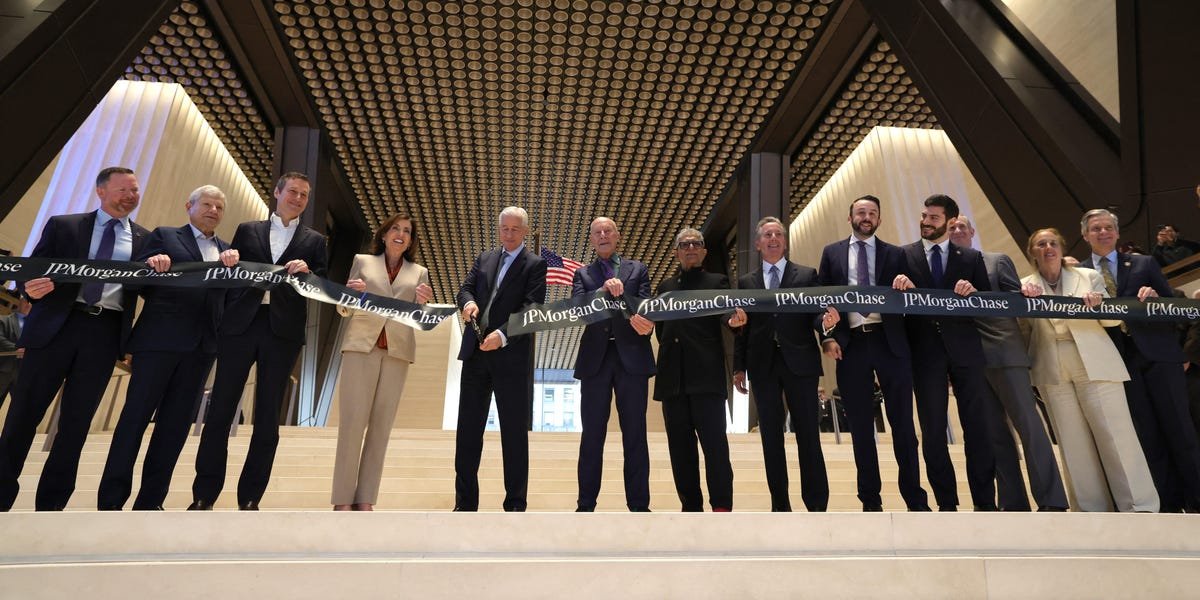
Jamie Dimon stands alongside New York Governor Kathy Hochul and others as he cuts a ribbon to mark the opening of the new JPMorgan Chase global headquarters at 270 Park Avenue.

Jamie Dimon cut the ribbon to mark the opening of JPMorgan’s new global headquarters at 270 Park Avenue on Tuesday.

TIMOTHY A. CLARY/AFP via Getty Images


On the call, CEO Jamie Dimon chimed in.

“Don’t scare them,” he told Barnum, presumably about alarming analysts about rising spending. “Real estate,” Dimon said, “is very small numbers.”

The firm has already opened a new state-of-the-art headquarters at 270 Park Avenue in Manhattan — a cutting-edge skyscraper featuring a bevy of restaurants, a luxurious fitness center, and tech that even remembers how you like the temperature when you reserve a conference room.

The bank’s five-day-per-week return-to-office policy proved a heated flashpoint last year, with Dimon famously telling some of the 12,000 staffers at the Columbus site that he suspected remote workers were texting one another during meetings and not completing tasks.

Last spring, a JPMorgan spokesperson told Business Insider that the firm was “working hard to ensure our sites have the capacity and amenities employees need to return full-time.”


Source link

My-husband-and-I-left-our-jobs-to-travel-full-time.jpeg

My husband and I left our jobs to travel full-time in our 30s. Transitioning back into the workforce has been hard.

When one of my favorite graduate school professors died just weeks into her retirement, it hit me: I didn’t want to spend my life working toward a future I might never get to experience.

I started my career in education as a high school counselor. My husband, Sam, was a self-published author who could work from anywhere, so we took full advantage of my school holidays and long summer breaks, jetting off to new places whenever we could. We created a travel blog, ForgetSomeday, to share our stories.

But the trips we took during school breaks left me yearning for more, and I approached my husband about taking a year off from our careers to travel full-time.

It didn’t take much convincing. We didn’t own a home and hadn’t yet started a family, so the timing seemed right.

I submitted a request for a year of leave, but it was denied due to pending budget cuts. We decided to move forward with our plan anyway, not wanting to wait until retirement to make this dream a reality.


Man in a campervan in Scotland.

The couple’s adventures included a road trip through Scotland.

Provided by Toccara Best


Time for an adventure

Over the next year, we slashed our spending and saved more than $30,000 by cutting out anything nonessential.

We sold our car for $5,000 and brought in a bit more by selling smaller items, storing the rest in a 10×10 unit because we thought we’d be gone for just a year.

By June 2015, we had about $40,000 in the bank, walked away from our lease, and flew to Prague on one-way tickets.

We ate our way through Central and Eastern Europe and Southeast Asia, partaking in bucket-list festivities like Oktoberfest in Munich and St. Patrick’s Day in Dublin along the way.


Two women doing crafts in Mai Chau Village, Vietnam.

Best visited more than a dozen countries, including Vietnam (pictured).

Provided by Toccara Best


We visited more than a dozen countries — island-hopping in Croatia, Thailand, and Portugal; exploring Cambodia’s temples; soaking in Hungary’s thermal baths; and driving 500 miles through Scotland in a campervan.

From hiking in Austria and Slovakia to swimming with seals in Sweden, the year became a crash course in adventure travel.

As our official gap year came to an end, our bank account was still surprisingly healthy, thanks to housesitting opportunities and blog partnerships that helped stretch our budget. And because I didn’t have a job to go back to, we decided to keep traveling.

Little did we know, our biggest adventure was right around the corner: 6 months later, we found out we were expecting.


Pregnant woman posing in Iceland with snow in the background.

Iceland was Best’s final stop before returning to the US.

Provided by Toccara Best


And then we were three

We returned to the US to have our son, but just a few months after his birth, we began traveling full-time again, this time exploring America.

By his third birthday, my son had already visited 27 states. Eventually, the pandemic put a halt to our full-time travels, and we took that as a sign to settle down.

We returned to California five years after the adventure started.

When we planned our gap year, it was supposed to be just that, a year. But as time went on, the gap on my résumé grew, and my motivation to return to the career I once loved began to fade. My husband was also trying to figure out what he wanted to pursue next.


Small boy walking down a trail at Quinault Rain Forest, Olympic National Park, Washington.

The couple continued to travel around the US after having their son.

Provided by Toccara Best


Reentering the workforce

We didn’t realize that our global adventure would end with such a hurdle — a career pivot after five years away, right in the middle of a global pandemic.

Maybe it was the break we both needed to reevaluate our next steps, but it has taken us both quite a while to get back in the saddle.

Once our son started preschool, I transitioned back into the workforce as an executive personal assistant for a busy entrepreneur, putting my organizational skills to good use.

When the executive moved out of state just over a year later, I quickly found a new role as operations manager at a nonprofit organization, where I’ve worked part-time for nearly four years. I’ve been searching for meaningful full-time employment for the past year and a half, which has been especially challenging in today’s competitive job market.

Was our gap year impulsive? Not exactly. We spent a year saving and planning. Was it risky? Definitely. More so than we imagined. Would we do it all over again? Absolutely.

That said, if we were to do it again, we’d probably just stick to a year.

Do you have a story about taking a gap year that you want to share? Get in touch with the editor: akarplus@businessinsider.com.


Source link

How-AI-can-identify-skill-gaps-in-the-workforce.jpeg

How AI can identify skill gaps in the workforce

As technology continues to advance and companies look to remain competitive in meeting market demand, the skills that employees will need are also evolving. A growing number of companies are exploring how to address these skills and workforce gaps with artificial intelligence.

HR can use AI to reveal “patterns and gaps” and benchmark “current workforce skills against evolving business needs or industry trends,” said Lauren Winans, CEO and principal human resources consultant at Next Level Benefits.

What AI offers in this realm isn’t exactly new, said Will Howard, practice lead of HR trends and AI at McLean & Company. HR teams have long collected and analyzed workforce data manually, he said, but AI can make the process more “feasible and efficient” through automation.

Here, HR experts share four factors to consider when using AI to identify workforce and skills gaps:

1. Organize your data


Headshot of Sanmay Das

Headshot of Sanmay Das, associate director of AI for Social Impact at Virginia Tech.

Virginia Tech


Organizations have troves of HR data, such as job advertisements, performance reviews, and employee job histories and training, that can be mined to uncover skills gaps, said Sanmay Das, associate director of AI for Social Impact at Virginia Tech. But this data often lacks “quality and completeness,” Winans said.

Before adopting AI, organizations must embrace “good data hygiene” by ensuring the data they plan to analyze is accurate, current, and consistent, said George Denlinger, operational president of US technology talent solutions at Robert Half.

Otherwise, AI insights will be limited or inaccurate. “The phrase ‘garbage in, garbage out’ rings especially true here,” Howard said.

Companies need a clear and consistent process for collecting, maintaining, and updating workforce data, Howard said. For instance, standardize job descriptions, including specific skills, knowledge, and activities, so that AI can make accurate comparisons.

2. Analyze the insights


Headshot of George Denlinger

Headshot of George Denlinger, operational president of US technology talent solutions at Robert Half.

Robert Half


Large language models, like ChatGPT and Microsoft Copilot, can summarize and report on data, Das said. But, for a deeper analysis, companies often need specialized AI tools designed for HR, including workforce planning and analytics, Howard said. Workday and Disco are some examples.

Ultimately, AI tools can leverage your existing data and identify strengths and weaknesses in your workforce, Denlinger said.

For example, with data on employee performance for a specific project and sales forecasts, AI could suggest the skills or roles necessary to meet the organization’s future demands, Howard said. Examining an employee’s job and training history, AI could quantify their capacity to acquire new skills via upskilling or reskilling, Winans said.

IBM, for example, uses an AI system that analyzes its employees’ digital footprints within the company to identify their skills and predict skill proficiency levels. The company then uses that analysis to offer employees personalized educational opportunities and career coaches, helping them identify job opportunities and new career paths. In 2024, IBM reported that the approach had boosted employee engagement by 20%.

3. Understand AI’s limitations

While AI can analyze data, it may overlook nuances and the human aspects of what makes a role successful, such as small tasks not listed in a job description, soft skills, or the behind-the-scenes efforts employees put in, Das said.

Companies should also focus on data privacy, trust, and employee buy-in, Winans said. Employees may worry about how their data is being used and how it could impact them, such as changes to their roles or responsibilities. She suggested communicating transparently about what data will be used, how it will be used, and why.

Data literacy is another challenge: HR teams must know what to do with the AI results, Howard said. “Even the most advanced AI technology still requires a human to put the results into a business context and communicate and take action on the insights within the organization.”

For instance, the AI analysis on skills gaps should inform decisions about new roles the company needs to create or the training necessary for existing employees, Winans said.

4. Refine your strategy

“Skill requirements evolve rapidly,” Winans said. Using AI to uncover skills gaps should be a “continuous process, not a one-time audit,” she added.

While AI can be useful for tracking ongoing skills gaps, Denlinger said this is still an emerging use of the technology that will likely evolve.

Al also isn’t a “silver bullet that can take you from zero to best in class,” Howard said. “Organizations shouldn’t view AI as a shortcut. It still requires the foundational skills and structures that have always been there,” such as clean data and employees confident in using the technology.

Then, he said, AI “becomes the cherry on top that can take your workforce planning and data analysis to the next level.”


Source link