
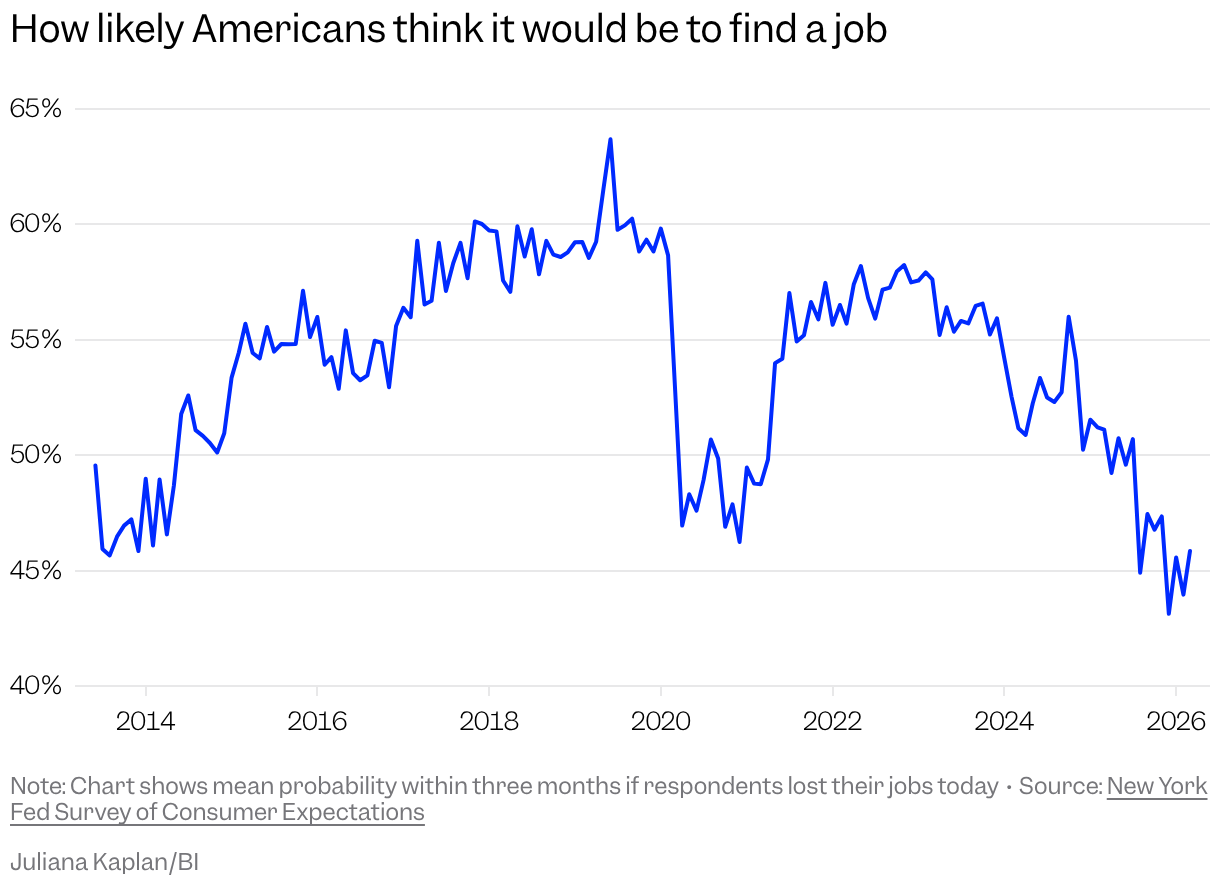
Line chart

Americans feel worse about the economy than ever before

Americans’ economic mood can be succinctly described in one word: Terrible.

While inflation soars as conflict with Iran drags on and shows up at the gas pump, consumer sentiment is plummeting. University of Michigan’s Consumer Sentiment Index, which tracks how American consumers feel about economic conditions, fell to 47.6 in April — a record low and a nearly 11% decline month-over-month.

The overall sentiment index combines views of how the economy is doing right now with what Americans think is going to happen in the near future, and both crashed this month.

“Demographic groups across age, income, and political party all posted setbacks in sentiment, as did every component of the index, reflecting the widespread nature of this month’s fall,” Joanne Hsu, University of Michigan’s director of surveys of consumers, said in a release.

It’s not the first time in recent years that sentiment has tanked at the same time costs spike. The last low was in June 2022, at 50, when inflation rose to 9.1%, and gas prices hit record highs amid Russia’s war in Ukraine and a broader inflationary spiral.

Now, sentiment is worse than the plunges seen in the wake of the Great Recession and the COVID-19 pandemic. Some of that can likely be chalked up to the very real, immediate price hikes showing up at the pump. New consumer price index data showed gas prices increased by a record 21% over the month in March, and accounted for about three-fourths of the overall monthly CPI increase of 0.9%.

“Much higher gasoline prices, the lower stock market, and volatile news headlines are biting down on consumer sentiment,” said Nationwide economist Oren Klachkin. “We don’t see sentiment recovering in short order since high gas prices are likely to stick around at least in the short term, adding to ongoing cost of living frustrations.”

Beyond gas, the trickle-down effect of rising oil and energy prices has shown up in everyday purchases and has tampered with Americans’ vacation planning — something likely to lead to a more dreary outlook.

“Airlines are raising prices because of higher jet fuel,” Gbenga Ajilore, chief economist at the Center on Budget and Policy Priorities, said. “Transportation costs are rising because of higher diesel prices which filter into the goods we pay for with Amazon, UPS, FedEx.”

The general malaise may also be exacerbated by a dreary jobs outlook. Consumers’ assessments of their own personal finances fell by 11%, according to the University of Michigan’s survey, and Americans surveyed by the Federal Reserve Bank of New York increasingly don’t think they’d find a new job in the next three months if they lost theirs today.

Dreary sentiment might be here to stay as the effects of the conflict with Iran keep prices high and drag on the economy.

“Even if the prices of gasoline and diesel start to come down after the conflict resolves, the effect on the economy will be more long-lasting,” Stephen Kates, a financial analyst at Bankrate, said. “Fuel prices will not fall as quickly as they rose.”

Do you have a story to share about how rising prices and volatility are affecting your economic outlook? Contact these reporters at jkaplan@businessinsider.com and mhoff@businessinsider.com.



Source link

Headshot of Peter Gelling

‘Big Short’ investor Michael Burry says AI is turning Big Tech into a worse business

Michael Burry, the investor made famous by “The Big Short,” says the era of Big Tech turning relatively small investments into huge profits is ending.

And he says AI is to blame.

In a recent Substack exchange with tech podcaster Dwarkesh Patel, Burry said the most important metric AI industry investors should be watching isn’t revenue growth, hiring, or even market size, but return on invested capital, or ROIC.

ROIC is a measure of how efficiently a company turns the money it puts into its business into profit.

“The measure to beat all measures is return on invested capital (ROIC), and ROIC was very high at these software companies. Now that they are becoming capital-intensive hardware companies, ROIC is sure to fall, and this will pressure shares in the long run,” Burry wrote.

AI, Burry said, is pushing companies like Microsoft, Google, and Meta away from their historically asset-light software models and toward a far more capital-intensive future defined by data centers, chips, and energy.

Even if AI expands Big Tech’s addressable market, he said, falling ROIC could pressure stock prices for years to come.

Burry rose to fame after his bet against the mid-2000s housing boom was chronicled in “The Big Short.” Outside the occasional cryptic social media post, Burry, for a long time, spoke publicly only rarely.

That changed late last year when he closed his hedge fund to outside cash and began writing financial analysis on Substack.

Perhaps most notably, he has recently compared the AI boom to the late-1990s dot-com bubble, calling OpenAI the “Netscape of our time.” Netscape’s IPO marked the beginning of dot-com hype in 1995. Five years later, the bubble burst.

Burry’s hedge fund, Scion Asset Management, has made large bets against Nvidia and Palantir Technologies, two darlings of the AI era, according to a regulatory filing released in September last year.

Leading AI companies, like OpenAI, Anthropic, Google, and Meta, are spending big to build out the infrastructure they need to support their energy- and data-intensive chatbots and other AI applications. Debt and equity investors have lined up to back these projects.

So far, however, those companies have not shown significant profit returns on their AI products, leading investors like Burry to sound the alarm that AI is a bubble on the verge of bursting.

“At some point, this spending on the AI buildout has to have a return on investment higher than the cost of that investment, or there is just no economic value added,” Burry wrote in the Substack post.


Source link

Theron Mohamed — Profile Picture

Warren Buffett resigning as CEO but not chairman, said retiring worse than death

Warren Buffett is days away from stepping down as Berkshire Hathaway’s CEO, but at age 95, he’s skipping retirement to stay on as chairman. That’s not a shock from the investor who “tap dances to work.”

After revealing his resignation plans to Berkshire shareholders in May, Buffett said he would “still hang around” and “could conceivably be useful” to his successor, Greg Abel.

“I’m not going to sit at home and watch soap operas,” Buffett told The Wall Street Journal after his big reveal. “My interests are still the same.”

In his Thanksgiving letter, Buffett said he still works at Berkshire’s Omaha headquarters five days a week, and sometimes has a “useful idea” or gets approached with an offer.

Buffett’s lasting dedication isn’t surprising, as he’s famously devoted to Berkshire. Since taking control in 1965, he has transformed it from a failing textile mill into a world-beating conglomerate that owns scores of businesses such as Geico and NetJets, and huge stakes in public companies including Coca-Cola and Kraft Heinz.

“We’ve got the best job in the world,” Buffett said about himself and the late Charlie Munger during Berkshire’s annual meeting in 2000. “We get to work with people we like and admire and trust every day of the year. We get to do what we want to do, the way we want to do it.”

Investing Berkshire’s capital inside and outside the company is the “most enjoyable thing to do in the world,” Buffett said during the 2012 meeting. “I get to paint my own painting,” he continued, adding that he has “a lot of fun” with his coworkers.

Buffett has said for decades that retirement doesn’t appeal to him, and he much prefers to keep working as long as possible.

“Berkshire is my first love and one that will never fade,” he wrote in his 1991 shareholder letter, recalling that when a student asked when he planned to retire, he replied: “About five to 10 years after I die.”

Buffett said during Berkshire’s 1996 meeting that the idea of retiring was “unthinkable” for him: “That would be the worst. I think death would be second.”


Source link