Amanda Goh

He turned 50 and realized the entrepreneur grind wasn’t worth it. 2 years later, he retired to Thailand.

When Arinjay Jain turned 50, he was sitting in yet another meeting when it hit him: “What am I doing here?”

Jain hadn’t always questioned the grind.

He had moved from India to Singapore in 2013, when the IT company he worked for opened a local office. After changing jobs a few times, he cofounded a small IT services startup in 2016.

He originally planned to build the company, sell it, and cash out. But as the years passed, the finish line felt increasingly distant.

“I thought, this is looking like several years away still, and I will have to work very hard to make it happen,” Jain, now 53, told Business Insider.

At that point, he was no longer sure the stress of running his own company justified the reward. Around the same time, several real estate investments Jain had made in India appreciated significantly, giving him the financial security to consider stepping away.

“So then, why am I wasting my years?” he said.

Soon after, he began researching where he might want to spend the next chapter of his life. He knew he didn’t want to go back to India.


Man sitting on a couch, smiling for the camera.

Turning 50 led him to rethink his priorities. 

Amanda Goh/Business Insider


While researching where to retire in Southeast Asia, a friend encouraged him to check out Chiang Mai, a city in northern Thailand he’d never visited.

In April 2023, five days in the second-largest Thai city sold him on the idea, and he threw himself into research about retirement visas and living costs.

By October 2023, when his lease was up for renewal, he decided against staying in Singapore.

Jain spent a couple of months visiting family and traveling around Asia. In February 2024, he arrived in Chiang Mai.

A new base in northern Thailand

February is often considered the start of the burning season in Chiang Mai, where farmers burn agricultural waste to clear their fields, often causing haze to drift into the city.

“I landed here in the worst possible time, but I still loved it,” Jain said.


The living room in an apartment in Chiang Mai, Thailand.

Jain arrived in Chiang Mai in February, at the start of the “burning season.” 

Amanda Goh/Business Insider


Thailand offers several long-stay visa options, and Jain holds a retirement visa.

While the Thai government publishes overall foreign resident figures, it does not appear to release a regular public count of retirement visa holders.

The latest civil registration data shows that 163,036 foreigners — not just retirees — lived in Chiang Mai in 2024, a level broadly comparable to a decade ago. That amounts to about 9% of the province’s roughly 1.8 million residents.

Jain connected with a real-estate agent through Facebook and viewed several units before choosing his current one-bedroom condo near Nimman, a trendy, cosmopolitan neighborhood known for its café scene, chic boutiques, and international restaurants.

Rent is 14,000 Thai baht, or about $425, each month. His apartment building comes with a pool and a gym.


A bedroom in an apartment in Chiang Mai, Thailand.

While many expats retire in Chiang Mai for its lower cost of living, for someone like Jain, who grew up in India, it’s actually more expensive. 

Amanda Goh/Business Insider


Jain says he tries to keep his monthly expenses between 40,000 and 45,000 Thai baht. In months when he travels, his expenses can reach around 60,000 Thai baht.

“For a lot of people from Western countries, the cost of living is a major attraction,” he said. “For somebody from India, it’s two or three times what I spent back home.”

Still, Jain said his decision was driven more by lifestyle than money. He’s grown comfortable with Chiang Mai’s slower tempo, its sense of safety, and what he describes as a culture of respect and patience.


The pool.

Jain says he appreciates the slower pace of life in Chiang Mai. 

Amanda Goh/Business Insider


“Everybody likes to avoid stress, right? I’m very happy not to have stress living here,” he said.

Life after the grind

That slower rhythm now shapes his days as a retiree.

Jain starts most mornings at the gym, then prepares a quick breakfast at home and does some household chores. Some afternoons, he plays golf at a nearby driving range. On other days, he joins a hiking group and heads out to explore waterfalls and trails around Chiang Mai.


A man on a hike in Thailand.

Jain enjoys hiking, playing golf, and going to the gym. 

Provided by Arinjay Jain.


In the evenings, he enjoys going for walks at nearby Chiang Mai University, whose scenic campus is a popular spot not just for students, but also locals across the city.

While he enjoys being around people, building deeper connections with locals has been more challenging, in part due to the language barrier.

Even though the city has a thriving expat scene, many tend to gravitate toward others from their own countries or from similar backgrounds.

Jain says he occasionally joins activity groups to stay social.

“But ideally, what I would like to do is become part of the local communities,” he said. “That takes time, and the effort has to come from my side in terms of learning the language, but it’s not easy.”


A man posing on a diving boat in Koh Tao.

He hopes to integrate locally, although he said the language barrier has made that difficult. 

Provided by Arinjay Jain.


Jain said he expects to stay in Chiang Mai for the foreseeable future, but he knows there are variables he can’t control.

Visa rules can change, and retiring early means planning for decades ahead in an era of longer life expectancy.

“I have to plan for like 35 to 40 years,” Jain said. “Look at all the changes that have happened in the last 20 years. It’s difficult to imagine what might happen in the next 20 years.”

For now, he said, he’s content where he is.



Source link

Amanda Krause headshot

A woman spent $25 on a quirky cat statue at an estate sale. It turned out to be an Italian art piece worth $3,000.

When Jordan Piluso went to a New Jersey estate sale in late January, she had one goal: to purchase a porcelain rabbit from the designer brand Herand.

She’d learned about the sale online and viewed photos of the items available. She didn’t plan to buy any other decorative animals.

But her mission quickly changed.

“When I walked into the house, this [ceramic] cat was sitting on a piano right in the entryway,” the 34-year-old stay-at-home mom told Business Insider. “No one was looking at it, so I just grabbed it. I thought it was such a whimsical, out-there decor piece, and that’s my style.”

She later purchased the $25 cat decoration, along with a few other pieces. She didn’t know it at the time, but her secondhand find was actually an Italian art piece from Fornasetti.

“I love very eclectic, conversational pieces, and I just thought: I’ve never seen anything like this cat,” she added.


Jordan Piluso and the Fornasetti cat she bought at an estate sale.

Jordan Piluso and the Fornasetti cat she bought at an estate sale.

Jordan Piluso


Hidden in plain sight

When Piluso purchased her cat statue, she didn’t immediately look for markings or a signature indicating the artisan who made it.

“I picked it up and was like, ‘You’re coming with me,'” she said. “It was just a no-brainer.”

The people running the estate sale were equally unaware of its origins.

“They were just happy to get rid of it,” she said.


The Fornasetti cat decor piece that Jordan Piluso bought at an estate sale.

The Fornasetti cat that Jordan Piluso found at an estate sale.

Jordan Piluso


It wasn’t until Piluso got home and did a Google image search that she realized it might be valuable. She saw photos of similar cat pieces by the Italian artist Piero Fornasetti and noticed that each had a stamp at the base of its tail.

Sure enough, her cat statue has one too. It reads “Fornasetti Milano, Made in Italy” and features an image of a hand holding a paintbrush.


The Fornasetti stamp on the ceramic cat purchased by Jordan Piluso.

The Fornasetti stamp at the base of the cat statue.

Jordan Piluso


Cats have been a signature motif for the late artist and his brand for decades.

Its modern feline pieces retail between $73 (€62) and $2,353 (€2000) each, while vintage cat statues like Piluso’s have sold for upward of $2,500 on secondhand sites.

Piluso confirmed with the brand via email that it’s authentic and was hand-painted between the late 1950s and early 1960s. Business Insider reviewed the email exchange.

Ken Farmer, an antique and fine-art appraiser, told Business Insider that Fornasetti created over 13,000 designs during his career and aimed to bring art into ordinary homes.

“This playful, smiling cat ceramic figure with black leopard spots on a white field, circa 1960, is likely worth $1,000 to $1,500 at auction and $3,000 retail,” he said.

Valuable, but priceless

The potential profit she could gain from her Fornasetti piece doesn’t matter much to Piluso. She has no intentions of selling it.

“It’s something that brings me so much joy,” she said. “I’m always going to be able to talk about this when people come over. I can tell my kids the story someday.”

“To me, that is a far more valuable gift than the monetary value this cat could bring,” she continued.

Her husband, a dog person, was less convinced that they should keep the decor piece when Piluso originally brought it home. However, he’s since come around, she said.

The couple is keeping the ceramic cat, which doesn’t have a name, on a tall mantle out of reach of their toddler.

Secondhand treasures

Don’t worry — Piluso didn’t leave the estate sale without the pink-and-gold embellished bunny she had initially gone there for.

She purchased the rabbit piece for $600 and a ceramic tiger for $50 — both of which will be displayed prominently in her home.


The ceramic pieces Jordan Piluso bought at an estate sale.

The decor pieces Jordan Piluso bought at a recent estate sale.

Jordan Piluso


Piluso said she’s relatively new to shopping secondhand. She was looking for a hobby after having her second child, and eventually landed on decorating her home with vintage pieces.

She said she loves the charm vintage decor adds to her home and the stories she can share with guests. That’s why her husband encouraged her to create a TikTok account to share her finds with a wider audience.

And clearly, she’s a natural at finding hidden gems.

“When you go to estate sales or thrifting, don’t be afraid of the oddities,” she said. “They can be the coolest, and in this case, some of the most valuable things you can find.”


Source link

We-sold-our-house-in-Utah-to-rent-in-Denver.jpeg

We sold our house in Utah to rent in Denver. The move was a big financial risk, but it was worth it.

Sometimes, a decision doesn’t make sense on paper, but it just feels right to your soul. That’s what my family’s big move was like.

Last year, our family of five sold our affordable home in rural southern Utah to move into a more expensive rental in a Denver suburb.

We had wanted a change for a long time, and the timing finally felt right. We could’ve stayed where we were “safe” financially, but all our family members were struggling in different ways.

I couldn’t shake the feeling that nothing would really get better until we were brave enough to make a big change — so we did.

Moving from Utah to Denver was a difficult financial decision

One of the hardest parts to accept about moving was leaving our extended family and a house that we had lived in for 13 years.

Even more difficult was that our house in Utah was affordable. We were privileged to buy a house when prices were reasonable, and mortgage rates were low. We would have moved a long time ago, but we felt stuck in a home we had outgrown because it was cheap.

We knew that if we sold our house, we would be paying a lot more elsewhere. But the decision still felt right for our family.

We figured Denver was worth the price increase

We chose a Denver suburb because we love the outdoors and also miss the opportunities that a city provides. We have friends in the area, so we knew we would have a community once we arrived.


Katy Anderson's kids in nature in denver

The author’s kids enjoy Denver’s nature.

Courtesy of Katy Anderson


We chose an area known for its “small town feel.” As soon as we moved in, I immediately fell in love with the neighborhood. We are surrounded by an abundance of mature trees, and are within walking distance of wonderful trails for walking and biking.

I’ve been amazed at the wildlife around us, especially considering we live in a Metro area.

Just walking the trails in our neighborhood, we’ve seen rabbits, coyotes, elk, raccoons, turkeys, and many different species of birds. We feel closer to nature here than we did in rural Utah.

After living here for a few weeks, we decided to purchase e-bikes so we could ride much farther along the trails, including to coffee shops, restaurants, city gardens, and parks.

This area also provides us with access to shopping, museums, concerts, and sporting venues. After living in a secluded town for so many years, having these amenities feels like a luxury.

We’re saving money in other ways

Our rent is high in Denver, and that has been the biggest adjustment.

Before we made the move, I was also worried about the cost of living, but I have been pleasantly surprised. Our kids even get free school lunch thanks to a statewide Healthy School Meals for All program. My kids have all commented that the food is of better quality. They actually want to eat the school lunches here.

We are paying much less for gas in Colorado, as we are driving substantially less. In Utah, we lived on the outskirts of town and had to drive 15 to 20 minutes to get to work or to the nearest grocery store.

When we moved to Colorado, we also immediately ended most of our subscriptions and streaming services. We’ve cut down on our discretionary spending and are eating more family meals at home.

We also chose jobs that would help us adjust to our new housing costs

We knew we would be paying more for housing no matter where we moved, so we chose a location with ample work opportunities. My husband is a psychiatric nurse practitioner, and I have picked up a part time job in addition to my freelance writing business.

We are all making more money in Colorado than we could in Utah, where the minimum wage is still $7.25 per hour. Two of my teenage sons were amazed when they realized how much more they could earn in their new city.

Right now, we are enjoying the freedom of renting. Buying a home in this economy feels daunting, and we want to take our time exploring Colorado to see where we may want to buy if it feels right.

For now, I am grateful that my kids have a chance to experience living in a bigger city with more diversity and opportunities. Overall, I feel like we fit in here in a way that we never did in our old town, and that is priceless.


Source link

My-husband-and-I-moved-in-with-my-grandparents-to.jpeg

My husband and I moved in with my grandparents to save money. The temporary adjustment period was worth it.

I grew up spending weekends, school breaks, and holidays in my grandparents’ home, but moving into it years later with a husband wasn’t something I ever pictured.

We moved into my grandparents’ basement not long after we got married in spring 2025. We both traveled as kids and have gone on a few short adventures as a couple, but we’d never done any long-term.

With our lease ending in the fall, it felt like the perfect time to make a big change, and we started looking at flights to Japan.

I eventually came across a deal on December plane tickets that we couldn’t pass up, but the opportunity left us with a two-month gap to fill before moving away.

Short-term rentals and Airbnbs were too expensive to commit to, especially with a big move ahead. So, when my grandparents suggested we stay in their basement, only 40 minutes away from where we’d been living, it was easily the most practical option.

Being back in my grandparents’ home reminded me how much of my childhood still lives here


Decorations at the writer's grandparents' house, including a fan from Japan, painted handprints, and Polaroids of the writer.

Moving in with my grandparents as an adult brought me right back to my childhood.

Alessa Hickman


Even before we started unpacking, the house instantly brought me back to my childhood. My grandparents have moved a few times over the years, but no matter the location, their home always feels the same.

The dishes and teacups I grew up using are still in the cupboards. The same family photos and decorations are on the fridge and walls, with new additions that have been layered in over the years.

Then there’s Crash, my grandparents’ herb-loving budgie bird, who has a habit of landing on people (and plates) without warning. They’ve only had him for a few years, but their home has always included animals, so even a new bird felt completely natural.

Being surrounded by the memories, familiar faces, and sense of home that shaped my childhood felt grounding during this period of change.

Moving here as an adult meant learning how to fit our lives together differently


The writer's husband with a blue bird on his shoulder.

We had to adjust to new routines, boundaries … and my grandparents’ budgie bird, Crash.

Alessa Hickman


Living with my grandparents came with a series of practical adjustments.

As my husband and I prepared to move abroad, we packed up or sold almost everything we owned, and now found ourselves living outside the city, setting up temporary workstations, and cooking for four instead of two.

Before long, the basement had boxes tucked into corners, the kitchen cabinets were full of our spices and small appliances, and my plant collection had completely taken over the front entrance table.

Moving in also meant navigating new boundaries and having conversations about topics that didn’t come up when I was younger — like finances, household responsibilities, and how much space to give each other.

One of the first conversations we had was about food. Cooking is one of my love languages, so even before we moved in, I told my grandparents that I wanted to take on the family meals.

After so many years of being cared for in their home, it felt important to give something back in a way that came naturally to me.

Because I work remotely, we also had to have conversations about my work-from-home schedule. I had work deadlines to meet and calls to take, which meant setting expectations around when I would be working and when I would be free.

That adjustment took some time on all sides, but those early conversations ultimately helped us find common ground.

This time with my grandparents gave me a chance to appreciate family in a new way


The writer and her grandmother posing for a selfie and smiling in her grandparents' house.

The experience turned into a meaningful chapter of my life.

Alessa Hickman


As I’ve grown older and gotten busier, my time with family has naturally become shorter and much more spread out.

Between work, different homes, relationships, and planning a move abroad, so many visits have been quick moments squeezed in on birthdays, holidays, or weekend check-ins.

Having a stretch of time with family like this isn’t something that comes up often, and it made the simple moments with my grandparents feel more meaningful — sitting down for dinner together, cooking a meal we used to eat when I was little, or laughing at the stories we’ve all heard a thousand times.

This in-between season has been filled with memories, lessons, and changes that taught me how much growth can happen in familiar spaces.

As we start this new chapter abroad, I’m grateful that this time with my grandparents was part of our journey. It reminded me to embrace the unexpected moments, make the most of every experience, and start our next adventure with an open mind.


Source link

I-found-a-Bottega-Veneta-bag-at-the-thrift-store.jpeg

I found a Bottega Veneta bag at the thrift store. I paid $8, and it’s worth $3,000.

This as-told-to essay is based on a conversation with Kristen Boelen, the founder of Lunch Break Vintage. It has been edited for length and clarity.

I have been thrifting since the moment I could drive. Back then, I was into higher-end things that were out of my budget, and I’d go thrift shopping to find similar items that I could afford. That habit carried on through college and beyond, including when I was most recently working as an art director for a wine and spirits company. While working there, I’d thrift on my lunch breaks.

I’d find stuff for myself, as well as one-of-a-kind items that didn’t fit. I wanted someone to take that stuff. So I began selling items on Whatnot.

I’d thrift on my lunch break from work, and then on the weekends I’d go live and sell my pieces. My business grew from there, and I named it Lunch Break Vintage, which I began full time in February 2025.

I scored a luxury designer bag during a recent shopping trip

In December 2025, I was at a thrift store in the San Francisco Bay Area. It was a normal Wednesday, which is the day this particular thrift store opens for the week, and when I always try to go. It was very empty that day.


Woman posing for photo on mirror

Kristen Boelen thrifts three times a week every week.

Courtesy of Kristen Boelen


Two woven leather bags caught my eye. You see woven leather bags all the time. There are so many Bottega Veneta dupes. I didn’t really think much about it, just that one of them looked exceptionally nice.

I first noticed the hardware, then the leather slouching and hanging. I could tell it was soft leather. When I picked it up, it was heavy — designer leather bags have a weight to them because of the hardware. I opened it up and saw the logo. You can see in the video that I posted that’s the moment my jaw drops. The leather inside was really soft and buttery too; that’s always a sign a bag is legitimate.

I know they sort through and send a lot of the higher-end pieces to an online audience. It seemed unrealistic that someone wouldn’t have set it aside. I thought, if they had put it out there, it must not be real.

I used technology to help confirm my suspicions

I took a photo of it and put it into Google Lens, and found on Vestaire Collective there was the exact same bag and color. That clued me into the style name and that it had been retired. There’s a video of me going, “Oh my God, oh my God, oh my God,” once I figured out where the serial tag was. I got out of there as quickly as possible, paying $8 for the bag.


Bottega Veneta purse

Kristen Boelen found a $3,000 purse for $8.

Courtesy of Kristen Boelen


I later had it authenticated through an app I use called Authentic Detective. It will give you a certificate of authenticity. Online research says the bag is valued at around $3,000.

I’m keeping the bag for myself. It’s something that will be passed down for generations. I had so many comments on the video saying that the bag was ugly, but I love it.

Scoring finds at the thrift store takes a little skill — and luck

I thrift all the time because I now do this for a living, but I think consistency is key. I thrift at least three times a week, every week. It’s also important not to just pick up what is trending. A good secondhand item has to check all the boxes for me, and I really care about quality, always looking for natural fibers. I focus on what makes people feel elevated and the kinds of secondhand pieces they can keep in their closets forever.

Don’t believe that middle-of-nowhere places are garbage. Some of my best, coolest, most unique pieces have come from middle-of-nowhere stores.


Source link

Im-set-to-inherit-my-childhood-home-abroad-Im-not.jpeg

I’m set to inherit my childhood home abroad. I’m not sure it will be worth the headache.

This as-told-to essay is based on a conversation with Katarina Polonska, a relationship scientist and coach who will be inheriting her childhood home in Slovakia. Vancouver-based Polonska, 36, said the home needs a lot of work, and it may not be worth managing renovations from abroad. The conversation has been edited for length and clarity.

I’m going to be inheriting my childhood home where I was born. I love it, and it’s very precious to me. But I don’t have any right to it yet.

It’s mostly used as a family holiday home, but ultimately when my mother passes, it’s going to be given to me.

My mother owns it, and there’s no plan to sell it — the value of the home isn’t very high, in fairness. It’s a two-bedroom, one-bathroom. It’s not worth much at all; maybe $80,000 CAD. I don’t think the money would go very far in Canada.

Also, selling it would require a lot of renovations. It’s very old school and needs a lot of TLC, and my mother doesn’t live in Slovakia, she lives in England. So from her perspective, she’s thinking, “Why would I invest 30,000 or 50,000 euros (about $35,245 or $58,742) in a property that I go to a few times a year max? What’s the point?”

She also knows it would to be really complicated to sell it from abroad, having to navigate viewings and trusting realtors and all of this stuff.

The reality is, I’m going to own this foreign property when she passes.

My husband is in a similar situation with a Barbados property

My husband is also waiting to inherit. His mother inherited a property in Barbados from her parents, though she never lived in Barbados.

His mother had to wait to take over the Barbados property, and by the time she took it over, it had declined a little bit and there are always complications with it.


A man and a woman taking a selfie with a mountain range behind them.

Polonska and her husband.

Courtesy of Katarina Polonska


I’ve actually never seen it myself, but I know that there’s a lot of work to be done with the house. But his mother has been holding onto it saying, “You can inherit it and you and Kat can enjoy it.”

But he’s like, “We don’t go to Barbados enough.” It’s just more hassle having to manage and protect a property when you’re not physically in the country.

I think from my perspective, because I’m naive about it, I’m like, keep it, it’d be really nice to have it. But his argument is that the place isn’t in the area of Barbados that I would necessarily want to go to.

He’s really wary. He doesn’t want to be managing the property and he would rather sell it and then distribute the money within his family.

So we both know that there’s going to be this new responsibility on our heads and, candidly, I think life is difficult enough as it is.

The home in Slovakia needs so much work that I probably can’t rent it out as-is

I’m not going to rent the Slovakia home out because it’s from, like, the 1980s. It’s not been renovated. It’s ancient; the wallpaper’s faded.

While Slovakia is kind of an up-and-coming country from a tourism perspective, I don’t think anyone would want to stay in this place as an Airbnb unless it was literally advertised as a historical relic: “Come stay in this ancient old-school apartment!”


The exterior of a residential building in Slovakia.

Polonska’s property in Slovakia.

Courtesy of Katarina Polonska


My husband and I have talked about how we’re probably going to have to renovate it. We know that at some point, we’re probably going to have to take a couple of months to be there physically to renovate it. But when is that going to happen? We both work, and getting to Slovakia is like a 20-hour journey from here.

I think, more realistically, we could just keep the place and treat it as a little getaway to escape to. There is really lovely nature nearby and I don’t have any other properties, so there is merit psychologically to knowing that there is a place that’s home, even if it is halfway across the world.

There needs to be more dialogue between parents and children about inheritances

When it comes to inheriting property, I think there needs to be more dialogue between the parent and the child of, “What do you actually want to do?”

I think a lot of parents have this assumption that leaving a kid the property is the ultimate goal; we’ve made it, we’ve paid off the mortgage, we have this home, and now the kid gets it. Those days are kind of gone.

We don’t live in a world where everyone grows up and lives in the same town or city as their parents. We live in a really global economy. People are moving, people are more transient, and the world has become smaller. It’s also become a lot more expensive, and home ownership isn’t what it used to be.

Parents need to recognize that the world we’re in is very different, and Millennials are not an anxious generation for no reason. We have a lot of stresses. It makes more sense to have a dialogue with your kid around what they want.

I wish parents would ask, “What do you want? Where are you at with your life, and what kind of inheritance makes sense?”

Is it, in fact, a lump sum of cash, because maybe you’re a busy entrepreneur and you don’t have time to sell? Maybe you actually would prefer the parent to sell, which is annoying for the parents, but maybe the kid would prefer that.

Thank you for the inheritance — that’s very generous. But I think quite a lot of kids would probably say it’s not worth it. Either enjoy the money, mom and dad, or cash out, downsize, and just give us a down payment or something.


Source link

I-tried-14-high-protein-drinks-so-you-dont-have-to.jpeg

I tried 14 high-protein drinks so you don’t have to. Here’s what’s actually worth buying.

Just checking in — yup, it seems everyone is still obsessed with protein.

The new year means new health goals, and the government’s new dietary guidelines echoed what many have been calling a widespread protein obsession.

The Dietary Guidelines for Americans, released Wednesday, emphasized the role of protein and dairy products in its recommended daily diet, although dietitians have cautioned against protein-maxxing at the expense of other nutrients.

Whether it’s thanks to social media gym bros or Ozempic, more people are reaching for ultra-high-protein products, and if you remember the 1990s’ meal-replacement milkshake craze, this might feel a bit familiar.

Nutritional shakes — whether they’re used by athletes seeking nutrients on the go, parents to supplement their growing children’s diets, or adults with dietary needs seeking to pack in as many nutrients in a compact, easily digestible form — aren’t new to everyone’s diets.

As high-protein products, from protein pasta to protein beer, continue to take over grocery stores, the list of high-protein drinks continues to grow.

To better understand the high-protein drinks on sale today, I visited two New York City grocery stores and picked up every drink that advertised its protein content, with the lowest having 12 grams of protein, which is as much as two eggs.

I tried every brand’s chocolate flavor to best compare their taste and ranked all 14 based on flavor, as well as taking into consideration their nutritional content.

In general, I looked for drinks that tasted chocolatey, were sweet enough to serve as a sweet treat without going overboard, and were overall enjoyable to drink on their own.

It’s worth noting that many shakes on the market are considered ultra-processed foods, which the new government guidelines recommend avoiding.

Here’s how I ranked them, from lowest to highest.

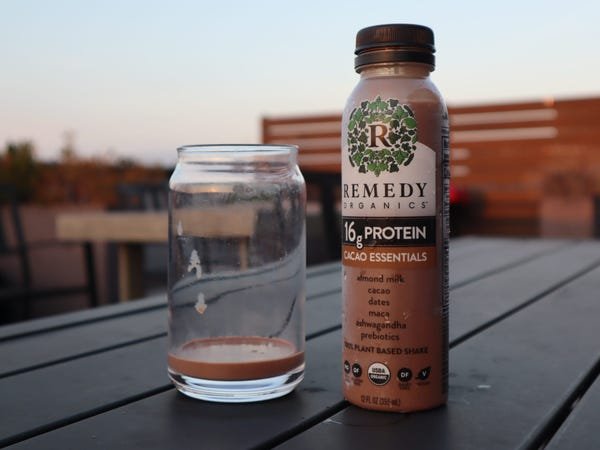
14. Remedy Organics Cacao Essentials Protein Shake

Remedy Organics Cacao Essentials Protein Shake had my least favorite flavor in the ranking.

Kristine Villarroel/Business Insider

Cost: $4.99 for 12 fluid ounces

Calories: 210 calories

Protein: 16 grams

Added sugar: 7 grams

The taste of the Remedy Organics Cacao Essentials Protein Shake was what I could best describe as healthy.

The date-sweetened drink is packed with plant-based ingredients, including adaptogens like ashwagandha and maca root powders as well as tapioca prebiotic powder.

But taste-wise, they weren’t as sweet-treat-like as some of the other shakes. It tasted strongly of cacao, but it felt a little chalky, and seemed saltier than it did sweet.

While I liked the drink’s ingredients, I really disliked the taste. If you’re looking for a plant-based, adaptogen-full drink that will also help you reach protein goals, this could be an option for you — but don’t go into it expecting a sweet chocolate milk type of drink.

Flavor rating: 1/10

Overall rating: 6/10

13. Muscle Milk Zero Sugar Chocolate Protein Shake


muscle milk zero sugar taste test

I found the Muscle Milk Zero Sugar Chocolate Protein Shake to be overly sweet.

Kristine Villarroel/Business Insider

Cost: $3.99 for 14 fluid ounces

Calories: 170 calories

Protein: 25 grams

Added sugar: 0 grams

When I first poured the Muscle Milk Zero Sugar shake, I noticed just how dark and thick it was. Tasting it, I found that it was way too sweet for my taste. This, combined with the thick texture, made for a pretty interesting drinking experience — I had to wash down the shake with some water to follow up the sweet taste left in my mouth.

Although I couldn’t finish drinking the small taste I’d poured myself, it also had the fewest calories and grams of sugar in the ranking, the highest fiber, and I felt like the protein payoff was great, which made the overly sweet taste feel more like a trade-off.

If you’re trying to get half of your daily protein in as few calories as possible while also watching out for sugar content, this drink might be good to have on your radar … but you’ll have to remind yourself of the nutrients in every sip.

Do it for the protein, bro.

Flavor rating: 3/10

Overall rating: 6/10

12. Koia Cacao Bean Protein Shake


koia protein drink taste test

I also did not love the taste of the Koia Cacao Bean Protein Shake.

Kristine Villarroel/Business Insider

Cost: $4.99 for 12 fluid ounces

Calories: 190 calories

Protein: 18 grams

Added sugar: 4 grams

Compared to some of the other protein drinks, I found Koia’s Cacao Bean protein shake to be very thin and light in color when I first poured it.

Its flavor, as the name would indicate, is very cacao-bean forward. To me, it tasted exactly like cacao nibs, which can lean more nutty and earthy than chocolate-y.

In a statement to Business Insider, Koia said the Cacao Bean protein shake is “crafted to highlight cacao’s naturally bold, slightly bitter profile rather than masking it with excessive sweetness or artificial flavoring,” resulting in a flavor that “may be less sweet than traditional protein shakes.”

The almond-based, monk-fruit-sweetened drink, which isn’t too sweet and packs in plant-based ingredients like rice, pea, and chickpea protein and a prebiotic blend, wasn’t one of my favorites for taste, although it was fairly competitive with the other options in terms of nutrients.

Flavor rating: 4/10

Overall rating: 5/10

11. Chocolate Sport Shake


sports shake protein drink taste test

Although enjoyable and tasty, Sport Shake’s high sugar content wasn’t a worthy trade-off for me.

Kristine Villarroel/Business Insider

Cost: $2.00 for 11 fluid ounces

Calories: 350 calories

Protein: 12 grams

Added sugar: 39 grams

I found the flavor of the chocolate Sport Shake to be one of the most enjoyable in the ranking, and it reminded me a lot of plain chocolate milk — it was very, very sweet. I also liked that it didn’t taste too much like dairy, something that bothered me with other drinks in the lineup.

However, the drink’s sweet and tasty flavor was overshadowed by its ultra-high added sugar content of 39 grams, or more than 9 teaspoons.

While the drink has some fiber in it, coming in with 3 grams, and it was the cheapest of the ranking, I couldn’t justify that much sugar. I will probably not reach for this again.

Flavor rating: 8/10

Overall rating: 1/10

10. Nesquik Chocolate Low Fat Milk


nesquik drink taste test

The Nesquik Chocolate Milk was a fun and nostalgic add to this lineup, although it wasn’t the best for protein.

Kristine Villarroel/Business Insider

Cost: $2.50 for 14 fluid ounces

Calories: 250 calories

Protein: 14 grams

Added sugar: 18 grams

I was shocked when I learned that Nesquik’s classic chocolate milk could be considered a nutritional drink.

At 14 grams of protein, as advertised on the bottle, the drink has more grams of protein per serving than other drinks labeled as protein drinks.

Tasting it was just as nostalgic as expected. Compared to some of the other drinks, however, I noticed it had a stronger dairy taste and was very sweet, with a total of 18 grams of added sugar.

I also noticed that the bottle recommended a portion of half a bottle, probably due to the drink’s high sugar content, which would also result in half the protein intake overall.

I probably wouldn’t have reached for this in adulthood if not to compare it here, and I probably won’t really reach for it again.

Flavor rating: 6/10

Overall rating: 4/10

9. Muscle Milk Pro Knockout Chocolate Protein Shake


msucle milk protein taste test

The Muscle Milk Pro packs an impressive 40 grams of protein.

Kristine Villarroel/Business Insider

Cost: $5.99 for 14 fluid ounces

Calories: 220 calories

Protein: 40 grams

Added sugar: 0 grams

Like its low-sugar version, the Muscle Milk Pro looked dark and thick. Taste-wise, the drink was sweeter than chocolate-y, and I didn’t love the flavor.

Although the drink packs an impressive 40 grams of protein in 14 ounces and 220 calories, has the highest ratio of protein to fluid ounces, and also has the highest fiber content in the list, the taste was one of my least favorites, and I had to wash it down with some water after tasting, as it had such a lingering flavor on the tongue.

When considering the nutritional aspects of the drink, however, I felt like the taste was a solid trade-off for one of the most protein-efficient drinks in the ranking, having the second-highest amount of grams of protein in a single bottle.

But if you’re strictly going for the ultra-high-protein option, the Fairlife Core Power Elite — which comes later in this ranking — might be a better bet for flavor.

Flavor rating: 4/10

Overall rating: 7/10

8. OWYN Pro Elite Chocolate Protein Shake


owyn protein taste test

I felt that the plant-based OWYN Pro Elite tasted a bit weird for my taste.

Kristine Villarroel/Business Insider

Cost: $4.49 for 12 fluid ounces

Calories: 200 calories

Protein: 32 grams

Added sugar: 0 grams

When I first poured the OWYN — which stands for Only What You Need — Pro Elite Protein Shake, it looked much thicker than some of the other drinks in the ranking.

It tasted vastly different from the others, too. The ingredients gave some clues as to why: The main ingredients — water, pea protein, pumpkin protein, and flaxseed oil — were completely different from the other shakes.

The plant-based, dairy-, soy-, and wheat-free drink, which contains 3 grams of prebiotics, uses monk fruit extract to sweeten its cocoa-heavy flavor, and also has a greens blend that includes spinach, kale, and broccoli.

I figured that the odd flavor I experienced was perhaps due to some of its most health-forward ingredients, like the greens blend.

In a statement to Business Insider, OWYN said that the exclusion of artificial sweeteners and sugar alcohols in the formula “sometimes means a more natural, earthy taste profile,” when compared to their regular shake, which uses a blend of organic cane sugar and monk fruit.

Ultimately, I wasn’t a fan of the taste and probably wouldn’t reach for this drink again, although nutrition-wise, it was a solid ultra-high-protein plant-based option.

Flavor rating: 5/10

Overall rating: 6/10

7. Fairlife Core Power Elite Chocolate High Protein Milk Shake


corepower elite shake taste test

I found the Fairlife Core Power Elite to have a very strong dairy taste that I didn’t love.

Kristine Villarroel/Business Insider

Cost: $5.99 for 14 fluid ounces

Calories: 230 calories

Protein: 42 grams

Added sugar: 0 grams

One of three protein shakes in Fairlife’s line, the Core Power Elite shake was a bit thinner than many of the other drinks I tried.

It was less sweet than Fairlife’s regular chocolate milk, which I didn’t mind. However, it had a much stronger dairy taste — I don’t love the taste of dairy milk, so this worked against the drink for me.

Still, its insane amount of protein — as much as a whole chicken breast — earned it extra points in my ranking.

This drink was something I didn’t mind drinking, even if I wouldn’t usually go for it. Even as a non-gym-bro, I would probably reach for this drink if I were trying to get well over half of my needed protein for the day in a single serving.

Flavor rating: 5/10

Overall rating: 8/10

6. Chocolate Nutrament


nutrament protein drink taste test

The chocolate Nutrament was tasty, although packed in added sugar.

Kristine Villarroel/Business Insider

Cost: $2.50 for 11 fluid ounces

Calories: 330 calories

Protein: 15 grams

Added sugar: 29 grams

When I poured the chocolate Nutrament, I noticed its consistency was among the runniest in the ranking.

The drink, the second-cheapest drink in the lineup, tasted just like chocolate milk, although it was still a bit too sweet for me.

I also noticed it had a long ingredients list with many unfamiliar terms, but on closer inspection, some seemed to be added vitamins and minerals. The drink also had the second-highest added sugar content at 29 grams.

The high sugar and comparatively low protein knocked this drink down a few points for me, and although I enjoyed it, I probably wouldn’t reach for this.

Flavor Rating: 9/10

Overall Rating: 5/10

5. Fairlife Chocolate Ultra-filtered Milk


fairlife protein drink taste test

Fairlife’s chocolate milk has 23 grams of protein in a 14-ounce bottle.

Kristine Villarroel/Business Insider

Cost: $3.29 for 14 fluid ounces

Calories: 250 calories

Protein: 23 grams

The second in Fairlife’s line, its chocolate ultra-filtered milk, was another nostalgic offering.

It was very sweet, but if I were craving chocolate milk, this is definitely the option I would choose.

While it’s not marketed as a protein drink, it contains 23 grams in a 14-ounce bottle and has the second-lowest cost per gram of protein.

Flavor rating: 7/10

Overall rating: 7/10

4. Rich Chocolate Boost Plus Nutritional Drink


boost protein drink taste test

Aimed at weight gain or maintenance, Boost Plus is a tasty and enjoyable option.

Kristine Villarroel/Business Insider

Cost: $18.99 for a six-pack of 8-ounce bottles (or $3.17 for 8 fluid ounces)

Calories: 360 calories

Protein: 14 grams

Added sugar: 18 grams

While some of the drinks in this lineup are aimed at the ultra-protein-efficient crowd and others are more directed at children, the Boost nutritional drink line is marketed toward adults with specific nutritional needs. The Boost Plus product, specifically, is aimed at adults hoping to gain or maintain weight.

Taste-wise, this was one of my favorites. The sweet and rich drink was very chocolatey, and it felt like a nice sweet treat.

With the product’s purpose in mind, the drink’s higher calories didn’t bother me, and I was pleased to see its nutrition label flooded with vitamins and minerals.

Out of many of the options, this is one I could see myself reaching for solely based on its taste, even though I wish it had a higher protein content.

Flavor rating: 9/10

Overall rating: 7/10

3. Nesquik Protein Power Chocolate Milk Beverage


nesquik protein taste test

I liked the taste of Nesquik’s Protein Power more than its classic chocolate milk.

Kristine Villarroel/Business Insider

Cost: $3.00 for 14 fluid ounces

Calories: 290 calories

Protein: 23 grams

Added sugar: 18 grams

When I poured this drink, I was surprised by how runny it was compared to some of the other options. I really enjoyed the taste, even if it wasn’t exactly the same as the nostalgic chocolate-milk flavor of Nesquik’s classic option.

In fact, I actually liked this one more, even before factoring in the added nutritional value. It was adequately sweet, not too dairy-tasting, and it didn’t have the aftertaste that had put me off the classic option.

With 23 grams of protein, this drink could compete with some of its more nutrition-leaning counterparts. At $3 for a bottle, it was also one of the cheapest options with the highest protein content.

I could totally see myself reaching for this.

Flavor rating: 8/10

Overall rating: 8/10

2. OWYN Dark Chocolate Protein Shake


owyn taste test protein

The OWYN Dark Chocolate Protein Shake was my favorite plant-based drink and my second-favorite overall.

Kristine Villarroel/Business Insider

Cost: $4.29 for 12 fluid ounces

Calories: 180 calories

Protein: 20 grams

Added sugar: 4 grams

Compared to the higher-protein drink on OWYN’s line, the regular protein shake wasn’t as dark or as thick when I poured it.

While the OWYN Pro Elite had a taste I didn’t like, the OWYN Dark Chocolate Protein Shake had a simpler flavor that reminded me of chocolate milk.

It was very tasty and chocolatey, and I liked that it also had 3 grams of fiber.

Overall, this felt like a very solid option that I could see myself reaching for. It was also my favorite plant-based drink.

Flavor rating: 8/10

Overall rating: 10/10

1. Fairlife Core Power Chocolate High Protein Milk Shake


core power protein taste test

Fairlife’s Core Power shake was my favorite overall.

Kristine Villarroel/Business Insider

Cost: $4.99 for 14 fluid ounces

Calories: 170 calories

Protein: 26 grams

Added sugar: 0 grams

While this drink didn’t exactly feel like a dessert or chocolate milk since it leaned more chocolatey and cocoa-tasting than sweet — and it did have somewhat of a dairy taste — I still found it very enjoyable and a very nice pick for both taste and protein.

Tied with the Muscle Milk Zero Sugar for the lowest calories in the ranking, I found the Fairlife Core Power shake much more enjoyable and even winning by a gram in the protein category.

Overall, this drink had the best balance between flavor and nutrition, and I can see myself reaching for it whenever I need a quick post-workout pick-me-up or just want to get a significant portion of my daily protein on the go.

Flavor rating: 8/10

Overall rating: 10/10


Source link

I-tried-on-coats-at-Gap-Banana-Republic-and-Old.jpeg

I tried on coats at Gap, Banana Republic, and Old Navy. The experience reminded me that a great piece is worth investing in.

  • I tried on similar black peacoats at Gap, Banana Republic, and Old Navy.
  • I compared each winter coat based on the design, fabric, price, and overall quality.
  • I wasn’t a fan of how the Gap coat felt, but really loved the option from Banana Republic.

I recently moved from Southern California to the more chilly and gloomy Bay Area. In other words, I was in dire need of a good winter coat.

So, I turned to three trusted Gap Inc. retailers — Gap, Banana Republic, and Old Navy — to find a one that’ll keep me warm throughout this season and beyond.

I compared similar styles based on the design, fabric, price, and overall quality. Here’s how it went.

I started my day with a trip to Gap.

I had no trouble finding what I was looking for at Gap.

Chloe Caldwell

I started my search for a stylish and well-constructed peacoat at Gap.

When I walked in, I appreciated that the store was easy to navigate and neatly organized. Plus, I found the coat I was looking for almost immediately.

However, I wasn’t blown away by this option.


Chloe wears a long black peacoat in a fitting room.

I thought this coat looked a bit like a bathrobe.

Chloe Caldwell

I tried on the wool-blend wrap coat and could tell right away that it offered a nice shape and structured fit that would fit easily over layers.

I liked the thick-notch lapels, and thought the material (52% recycled wool, 40% recycled polyester, 8% other) felt warm without being overly bulky. However, the wool blend felt a bit itchy, especially around the neck area where it directly touched my skin.

Plus, there were no buttons and the pockets were hidden, making it look somewhat like a bathrobe.

Although it was a good, basic option, I wanted something with a little more flair. I also had a hard time justifying the price of $248 for a coat that was 40% polyester.

Next, I went to Banana Republic.


Coats, jeans, and shirts hanging at Banana Republic.

The Banana Republic store I visited was well-organized.

Chloe Caldwell

After striking out at Gap, I decided to try Banana Republic for another option. The store was neatly organized, and I was able to locate a black peacoat easily.

This coat was pricey, but I think it would be worth the investment.


Chloe wears a long black peacoat in a fitting room.

The coat was made of a blend of wool and cashmere.

Chloe Caldwell

When I saw the $550 price tag on the Italian-wool cashmere wrap coat, I thought, “There is absolutely no way I would pay that much for a coat.” But after trying it on, I reconsidered.

I could immediately tell that the quality of the material (made with 91% wool, 6% cashmere, and 3% other materials) was thick and warm, with no polyester in sight. The inside lining was also silky and smooth, and the overall fabric felt soft and comfortable without itching.

I also loved the overall design of this coat. The pointed collar and large pockets added chic touches that were flattering yet functional.

This try-on reminded me that it’s important to invest in pieces that will actually last a long time. I know this coat is something I would wear every winter for years.

I made one last stop at Old Navy before heading home.


Racks of coats, pants, and dresses on display at Old Navy.

It took me a few minutes to find a peacoat at Old Navy.

Chloe Caldwell

I’m a big fan of Old Navy because it offers both basic and trending styles for an approachable price.

However, my local Old Navy was less organized than the other stores I visited, so it took me a bit longer to find a black peacoat. Thankfully, I was able to find one and brought it to the fitting room.

I didn’t love how the Old Navy option felt.


Chloe wears a long black peacoat in a fitting room.

I wish this coat had a waist tie to add some shape to it.

Chloe Caldwell

The first thing I noticed when trying on the oversized twill overcoat is that it didn’t have a waist tie, which, to me, feels like a must for adding shape and style to any peacoat.

The coat was also made of 100% recycled polyester, so I’m not sure how warm it would actually keep me during winter. The fabric also felt less flexible than the others I tried on, leaving less room for layers underneath.

I did like the overall style, though — it had a spread lapel and the buttons featured an eye-catching texture.

This was my least favorite coat out of the three, but for $90, I think it’s a solid option for anyone shopping on a budget.

I’d be most likely to buy the coat from Banana Republic.


A composite image of Chloe wearing three different long black peacoats.

The Banana Republic coat checked all my boxes.

Chloe Caldwell

Overall, the Banana Republic coat impressed me most, thanks to its durable fabric blend, comfortable fit, and elegant design.

This shopping day reminded me that high-quality staple pieces are worth investing in.


Source link