
I-meditated-with-a-Japanese-Zen-monk-who-works-with.jpeg

I meditated with a Japanese Zen monk who works with Fortune 500 companies. I had meditation all wrong.

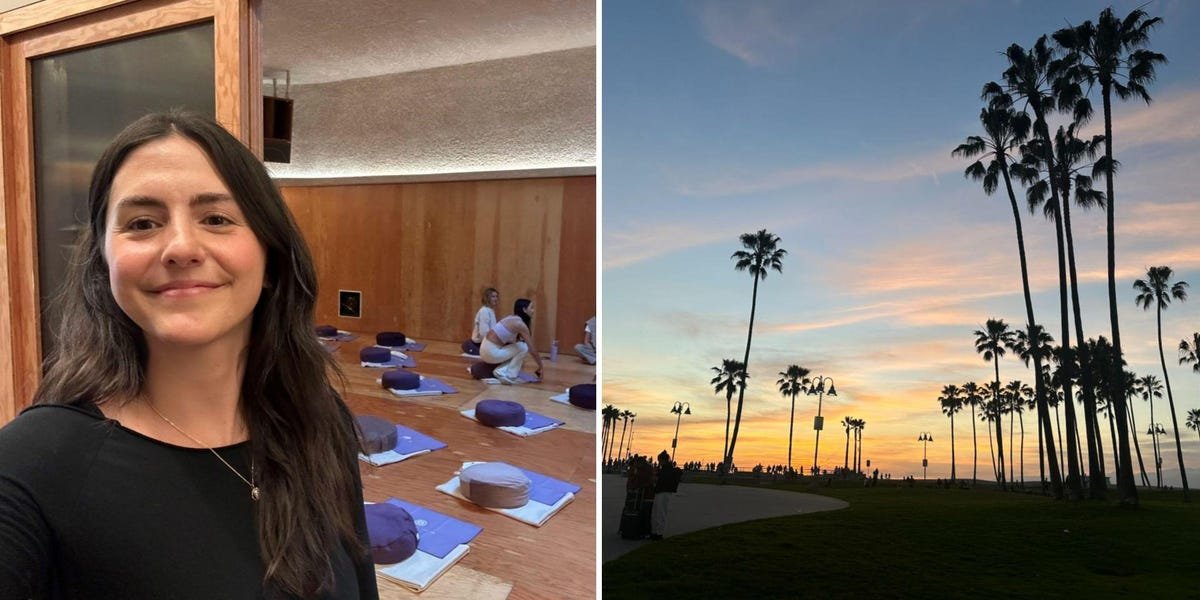
It was a scene you’d expect at a Wednesday afternoon wellness class in Los Angeles. About 40 people with matching athleisure sets, iced matcha lattes, Salomon sneakers, and at least one Fendi baguette filed into a meditation studio tucked in an alley just off the Venice boardwalk.

Toryo Ito, a Japanese Zen Buddhist monk, was already seated at the front of the room. A sculptural, oblong skylight cut into the ceiling, casting a beam of sunlight onto the floor. He sat cross-legged, wearing a black robe, with a set of small tools laid out before him: an incense holder, a spray bottle, and various blocks and mallets made with metal or wood.

Ito is the vice abbot of Ryosokuin Temple in Kyoto, which dates back over 600 years. His modern approach to Zen has made him something of an ambassador for mindfulness in the corporate world, leading meditation workshops for companies like Meta and Salesforce.

Marc Benioff, Jack Dorsey, Alex Karp, and other business and tech leaders have embraced mindfulness practice. Meditation apps have raised hundreds of millions in funding, and companies are increasingly offering programs to employees to combat burnout and improve performance.

As a business reporter living in California, the wellness capital of the US, my prior experience with meditation mostly consisted of adding it to the list of habits I’d like to start each new year, and then proceeding to complete a handful of five-minute sessions sporadically, primarily as a means to squeeze in a little sun time before a full day at my desk. Maybe a class with a real-life Zen monk would be just the motivation I needed.

What I’d actually find was that my concept of meditation was way off and that it’s a lot simpler — and more attainable — than I’d made it out to be.

Meditation does not mean thinking about nothing

The class was held at the Venice studio of Open, a mindfulness startup, and organized by Tatcha, a luxury skincare brand whose founder has her own corporate-to-mindfulness origin story. Vicky Tsai worked on Wall Street as a credit derivatives trader before quitting to start Tatcha. She met Ito in 2016 during a class at his temple in Japan. He became the company’s first-ever “global well-being mentor” in 2021.


Toryo Ito seated at the front of a meditation studio fill of guests.

Toryo Ito sat still and at ease while most of us fiddled with our phones.

Kelsey Vlamis


Attendees — Tatcha fans who had signed up for the class through their socials — took photos of the room and spoke quietly to one another. Some set up cameras to record themselves. One attendee took an especially aesthetic flat-lay shot of her Tatcha-branded mat and towel alongside her purple shoulder bag, which matched perfectly.

I was immediately struck by the contrast between Ito and the rest of us.

Ito sat erect but calm, doing nothing. Sometimes he looked around the room and smiled. Other times, he looked ahead or softly closed his eyes. He didn’t fidget. Meanwhile, the rest of us were on our phones, taking photos, scrolling, anything but simply sitting still.

After about 10 minutes, the room quieted, and all attention shifted to him.

He welcomed us and asked if anyone had been to Kyoto, seeming surprised when a good chunk of the room raised their hands. He said Zen emphasizes two concepts: mindfulness and expanding the boundary of the self in order to dissolve it.

Ambitious, I thought, but intriguing.

Ito said that while there’s no perfect meditative state, we should focus on paying attention. The class was broken into three rounds of meditation, each lasting 10 minutes, give or take, during which we sat in silence with our eyes closed.

For the first session, he told us to pay attention to what we heard and smelled: the chime he rang to start the session, the birds chirping on the nature soundtrack playing in the studio, the air conditioner kicking on, the sound of a spray bottle, and the earthy smell that followed. He rang another chime at the end of the session, which felt like it flew by as I tried to focus on my senses.

For the second session, he told us to focus on the sensations in our bodies and had us lift one arm, hold it in place, then the other. Lastly, he asked us to meditate on a series of questions related to self-love: What color do you associate with self-love? “Light pink,” I thought. What drink? “Sparkling water.”

It was more involved than I expected. I thought the point of meditation was not to think about anything. What Ito taught me was that it’s actually about noticing.

“Intentionally disrupt that autopilot,” Ito told me after the class, adding that he prefers dynamic meditation, like walking, where you can feel the grass beneath your feet. He said he’d spent time earlier that day walking through Venice Beach.


Venice beach boardwalk.

The Open studio was a short walk away from the Venice boardwalk.

Walter Cicchetti/Getty Images


For people with high-stress jobs, Ito said meditation can be practiced in small moments throughout the day, for 10 minutes or even just one. He recommends lighting incense and actually paying attention to the smell. When you drink coffee, notice the taste.

Doing these little practices of just noticing things you previously missed can bring the benefits of mindfulness, which he said include stress management, increased creativity, and openness to new ways of thinking.

Small moments of noticing

When the class ended, the first thing I noticed was how different the attendees seemed.

There was a newfound stillness that had previously been missing, and very few immediately reached for their phones. We sat in silence, no one rushing to get up, as several people shared how they felt with the whole class. One busy mom said she felt “at peace.”

I did not become a perfect meditator that day — although Ito would likely say there’s no such thing — but what I learned was that I actually meditate, or practice mindfulness, more than I realized.

Each time I take a walk without headphones and notice the smell of jasmine. Or when I’m camping and zone out in front of the fire, doing nothing but observing the movement, warmth, and sound of the flames.

Which also might explain why, after each of these experiences, I feel some of the benefits that ancient wisdom and modern science have associated with meditation: lower stress, better sleep, and an overall sense of calm.

Since the class, I’ve been a bit more lenient with myself about what counts as meditation, which has helped me prioritize and appreciate these small moments of noticing.

The idea of noticing the taste of your coffee as a mindfulness practice might feel a bit silly. Then again, it’s a bit silly that I’ll weigh and grind my own beans, pull espresso in my expensive machine, and drink it in front of my computer, without even noticing once I’ve finished.



Source link

I-used-to-think-living-at-home-as-an-adult.jpeg

I used to think living at home as an adult meant going backward. Losing my dad made me realize I was wrong.

Growing up, when I imagined my 20s, I pictured living in a huge city apartment on my own, with a partner or a quirky group of roommates. I’d decorate my home with chic art pieces, paint the walls a dusty rose, and host dinner parties for my friends.

I was desperate to begin my life. I thought adulthood started when you moved out; anything else felt like going backward.

Then, my dad died, and my entire reality shifted.

Living with family as an adult is often framed as a “failure to launch,” but navigating grief at home with my mom and younger sister helped me rethink growth.

Living at home in my 20s wasn’t easy at first


The writer posing while skiing with her dad and sister.

Initially, I was eager to move out of my parents’ house and live with my boyfriend.

Maya Kokerov


After I finished college at 22, I moved in with my parents while I figured out what my long-term plan would be.

I hoped this would be a very brief stint. Impatient to be more “independent” and worried I was falling behind my peers, I vowed to rent an apartment with my boyfriend as soon as we could afford one.

Before I had a chance to move out, though, the COVID-19 pandemic pushed us into a lockdown. I settled back into living with my family until further notice. There were practical benefits, such as saving money, but I still felt restless.

In ways, I reverted back to a teenager: whispering on FaceTime, sending messages on Snapchat, even sneaking out of my window to meet up with my partner after everyone had gone to sleep. At 22, I felt emotionally crowded and missed the freedom I’d experienced at college.

More than a loss of privacy, though, I was ashamed that I was still “waiting” to reach what I saw as the first big marker of adulthood.

After my dad died, living together became a lifeline


The writer posing on vacation with her parents and sister.

Losing my dad shifted my priorities.

Maya Kokerov


Four years after I moved back home, my dad suddenly passed away.

We couldn’t properly say goodbye. Instead, we sat in fear for months. His chair was empty, leaving a hole in our home.

As guilty as I felt for not always appreciating the years I’d spent with him, I realized how lucky I was to have gotten to spend his last few years at home with him.

Many fathers who get to grow old may never spend as much time with their children as I did with mine, precisely because I stayed home.

My dad had moved out of his house at a young age and lived in four countries. In one of our last one-on-one conversations, shortly before he was admitted into the hospital, he told me how everyone keeps moving to find their place, but everywhere is virtually the same. The main difference is the people that you’re leaving behind.

Looking back, those extra years at home were convenient, yes, but they were also the happiest I’ve ever been. Now, having my mom and sister by my side gives us space to grieve together and mutually support each other.

Memories and rituals reshaped how I define adulthood

As a very tight-knit family, we built our life around traditions, from holidays and vacations to sports and movie nights.

My dad’s favorite activity was spending time with us. He taught us skills like skiing, languages, and playing tennis.

Healing came from returning to the traditions he loved. Although it was challenging at first, we forced ourselves to engage with his hobbies and rituals, reliving our memories together. We cooked his favorite food, sang songs he loved, and played lots of tennis.

With time, the sadness became more tolerable as we created new rituals while preserving treasured old ones.

This wasn’t the “20-something” life I had envisioned, but this version of home became a symbol of my growth precisely because of how much I loved my past. I realized that living at home at 27 isn’t a lack of maturity or a so-called “failure to launch.”

If anything, grief sharpened my sense of responsibility. Adulthood can be communal, and I feel lucky to have familial support. Grief has made living with my family more meaningful, grounding, and empowering than ever.


Source link

jill robbins smiles in front of a tree

I’m a seasoned cruiser, but I still booked the wrong room for my family of 4 on a recent sailing

As our family’s primary vacation planner, I’ve found we get the most mileage out of cruises. The “most things included” pricing is easy on our budget, and we like the wide range of activities and dining options.

My kids are in high school, and we’ve been cruising together since they were in first grade. Still, I managed to make a rookie mistake with our most recent seven-night Western Caribbean Princess cruise.

I had booked it while on a Princess Alaskan cruise with my husband and got a great rate. However, I had a moment of panic when we boarded the Regal Princess weeks later and got a first look at our stateroom.

Although I’d selected a “cabin that sleeps four,” I only saw two twin beds.

Everyone ended up having a bed, but the setup was far from ideal


Two twin beds in Princess cruise cabin

When I got our first look at our stateroom on the Regal Princess, I had a moment of panic when I saw two twin beds.

Jill Ribbons


Despite the initial shock, we quickly realized our 222-square-foot cabin could indeed sleep four people. Our steward told us there were two additional beds stored in the ceiling that he would pull out every evening.

We asked if the two twin beds on the ground could be converted into a queen for my husband and me, and were told they could, but there would be no place to put the ladder for the upper bunks.

So, we left the arrangement as it was.


Beds from ceiling with ladders leading up to them

We ended up putting the ladders against the wall to give us some more room to walk.

Jill Ribbons


On the bright side, we had sufficient sleeping space, and my kids didn’t have to share a bed. Our steward set up the beds each evening while we were at dinner and put them up again after breakfast.

Despite being small, the beds were comfortable, and we all got decent sleep.

The biggest issue was that there was no room to sit up and read or watch TV in bed — the upper bunk was that close to the ceiling. The ladders also made moving around the cabin a game of Tetris, especially at night.


Beds from ceiling with ladders leading up to them

With the beds and ladders out, our path to the bathroom was incredibly narrow.

Jill Ribbons


Casualties included one head bump (me, the first night) and one kid stepping on my legs when he skipped the ladder. After that, we adjusted.

On the bright side, having a small balcony (albeit one with an obstructed view of the ocean) meant we had easy access to natural light, fresh air, and a bit of extra space, which made a difference.

Despite the drawbacks, we still had a great time


Author Jill Robbins and husband smiling with drinks on balcony on Princess Cruise

My husband and I spent some time on our obstructed balcony.

Jill Robbins


In the end, we got a good enough discount on the room that I didn’t mind a little extra inconvenience.

Though I would’ve liked a bigger bed and more room, our small stateroom didn’t stop us from enjoying the cruise. We were only in the room to sleep and shower, and after a day or two, the bunks didn’t feel like a big deal.

This was the first time my kids had sailed on Princess, and our postcard-sized digs didn’t affect how we felt about the cruise overall.

We’d 1000% do this cruise with teenagers again — just not in this stateroom.

Admittedly, I made a rookie mistake — and I know just how I’ll avoid it next time


View off of balcony on Princess cruise with lifeboat blocking part of the view

We booked a cabin with an obstructed-view balcony.

Jill Ribbons


Looking back, I can see what led me to choose the wrong cabin for our family.

While booking with a sales rep on a previous cruise, I got caught up in the moment and the good deal. I didn’t think to ask detailed questions, like the specifics of the bed arrangements.

My biggest mistake was assuming. On cruises I’ve been on with Disney and Carnival, cabins that sleep four are configured differently, with a queen bed and a couch that converts into bunks across the room.

I should’ve asked more questions and watched fellow cruisers’ cabin tour videos online before booking anything. Had I done that, I likely would’ve chosen a different cabin or adjusted my reservation before our departure.

By the time we’d boarded, our cruise was full, and even if a larger cabin had been available, it would’ve cost more.

Next time, I’d be more prepared, or just book my cruise at home, where it’d be easier to review the details on my own.

A travel advisor familiar with cruising could also have steered us toward a better option for a family of four with teens. Though I recommend them to first-timers, I don’t usually use one for cruises.

At the end of the day, even though I should have known better, I couldn’t help but laugh at myself.


Source link

A woman in glasses wearing a blue dress standing in front of a bush.

I took my 5-year-old to the wrong birthday party. It taught me a lesson about the grace of strangers.

My son, Bobby, had always been a shy person. When he started kindergarten, I was hoping he’d make a lot more friends.

I was delighted when I saw an Evite in my inbox from a mom inviting him to a classmate’s 6th birthday party. The little boy’s name was Nathan.

The event took place at a retro slot-car raceway, where you raced tiny, electric-powered replicas of full-size cars on narrow tracks with “grooves,” known as “slots.”

Neither of us had been to one before, and we were excited to accept the invitation. I was also looking forward to finally meeting the other parents.

I didn’t buy a physical gift

I didn’t know anyone, partly because Bobby attended a school in a different suburb, about five miles from ours.

He took the bus, so my husband and I never did pick up or drop off. We worked in the city, so there was no waiting at the school gate and chatting with fellow moms and dads.

Nathan’s mother asked people to give half the money we’d have spent on gifts to an animal shelter. She’d use the other half to buy something big that he really wanted.

I ignored red flags

I was relieved that I didn’t have to go out of my way to purchase a present, so I donated $20 online.

As a result, Bobby and I arrived, empty-handed, at the slot-car venue at 11 am on a rainy Sunday morning. The hostess greeted us at the door.

“Is that Nathan?” I asked, pointing to the child I assumed was her son. The boy had a giant rosette on his sweater. “You mean, Oliver,” she replied. It was the first red flag that I ignored.

My son had a lot of fun

I’ve always been forgetful and apologized profusely. Bobby and I sat down by the racetrack and grabbed his remote control. A dad showed us how to work the cars.

Time went by, and Bobby had a lot of fun. He didn’t interact much with the other children, and they didn’t interact much with him either. I thought nothing of it because he was often withdrawn in busy settings.

I introduced myself to many of the parents. They talked animatedly in groups and clearly knew each other well. Still, they included me by asking me how Bobby liked the teacher.


A group of children at a slot-car racing track.

The author’s son, far left, thoroughly enjoyed himself at the party.

Courtesy of the author.


“Oh yes, he loves her,” I told one of the moms, mentioning the teacher’s name. She looked puzzled. It was another red flag, but I didn’t see it waving right in front of my face.

I spotted a large pile of presents on a table nearby. Wasn’t it odd, I thought, that so many guests bought gifts when Oliver’s mom had wanted us to make donations instead? Still, the penny didn’t drop.

It was time to cut the birthday cake. I helped hand out the slices. I wanted to leave a good impression. One mom said how nice it was of me. I joked that I was expecting a tip. She laughed politely.

Something was off

We left 15 minutes later. “Did you have a good time?” I asked Bobby. He nodded,

Fast forward a week, and I looked through my email and clicked on the Evite from Nathan’s mom. I intended to write down her number and see if her son would be interested in a playdate.

“Come to Nathan’s 6th birthday celebration,” the invitation said. I thought it was Oliver’s party. Something was off. I looked at the date. Nathan’s slot-car racing took place at 11 am the previous Saturday, not 11 am the previous Sunday. We missed his party by 24 hours.

Worse, we’d shown up at the wrong party. Most of the kids were much bigger than Bobby. Now I knew why.

We had crashed a party

I recalled the moment when Oliver cut his cake. I was fairly certain there were more than six candles on top.

No wonder there were so many presents on that table. No wonder the woman looked at me strangely when I mentioned the teacher’s name.

I cringed. What on earth had Oliver’s mom thought of me? I was the bonkers party crasher who showed up uninvited with their kid. I didn’t even bring a gift. What if the other parents gossiped about me and sniggered behind my back? It was mortifying.

My negative reaction shifted

After I called Nathan’s mom to apologize for missing his party, I took a breath and reflected on what had happened. It was actually quite amusing. My negative reaction shifted. Bobby thoroughly enjoyed himself, which was a promising outcome for someone so shy.

The hostess might have wondered who the heck I was, but she was too considerate to ask and embarrass me in front of people.

Everyone at the party had been warm, kind, and full of goodwill. It didn’t matter who I was. They welcomed me with open arms. Those strangers taught me a lesson in grace.


Source link

I-thought-the-best-holidays-were-going-to-be-when.jpeg

I thought the best holidays were going to be when my kids were little. I was wrong.

My daughter-in-law called me recently to ask about Secret Santa. She was wondering if everyone would get involved, if I had any thoughts on stocking stuffers, and if there was anything in particular I might want, other than the Costco-sized jar of peanut M&Ms I had mentioned about 1,000 times.

My youngest son texted not long after to let me know he got three full days off for Christmas. He’ll be bringing his cat for a visit. We’ll all buy him cat treats. We will prepare casseroles and cookies, as well as overnight cinnamon rolls for the morning. We will wait to watch the main event, the Christmas movies, until we are all together.

This is my Christmas with adult kids. The kind of Christmas I dreaded when my four sons were little and I thought I had just those magical 18 holidays with them before it would all end.

I thought the best times were when they were little

I thought those Christmases were the best I would ever see as a mom because I think that’s the story we are sold. Christmas is for kids. It’s better with kids. It’s more fun, more magical, more everything. And I’ll tell you that I really wrung every second of joy out of Christmas when my kids were little in an absolute panic of memory-making.


Four boys during the holidays

The author pushed herself to make the holidays super special for her sons when they were little.

Courtesy of the author


I pushed the Santa agenda far longer than was socially acceptable. I baked every day, built gingerbread houses, and attended every Christmas concert. I bought the matching pajamas, I collected special ornaments and kept them in boxes for the boys to hang on our tree every year, no matter what.

I think I idolized the holidays, like a good Christmas might make up for any other shortcomings during the rest of the year. I overlooked how tough it really was on me in favor of the good mom checkmark I might get at the end of it all.

I can finally admit it was hard

And it was hard on me. I can admit this finally. Not just because I was on my own with my sons or because we were living right around the poverty line. But because I genuinely believed that the only Christmases that mattered happened when my kids were little. It was like a Doomsday clock was ticking down on my every year, tied up with a neat red bow. I had to build memories for them at any cost so they would have happy childhood memories and not look back on our life together as a failure.

I wish I could go back and talk to the stressed-out mom I was then. I would tell her that she could stop spending important January bill money on December toys. I would tell her that her kids will be OK. And yes, they want a few toys, but they will remember about one quarter of them by the next year.

Most of all, I would tell her that she has way more fun holidays ahead than she thinks. I would even argue that Christmas with adult kids is better than it is with little kids. The pressure is off. Right or wrong, they are grown now. I don’t have to keep any kind of special magic alive for them; they’ve seen behind the curtain, and they know I was back there all along.

It’s not all just on me

They see me. They appreciate me. Best of all, they are back behind the curtain with me now, too. They provide, along with me, trips to the grocery store for forgotten spices, coffee cream, and extra napkins. They buy gifts and tell me not to worry about anything. They lighten my load. I’m no longer the keeper of Christmas; we all are. Bringing a different kind of magic to whatever days we might have together over the holidays.

We bring in the old traditions from when they were kids, but also leave the door open for new things. New recipes, new ideas on how to celebrate. Chinese takeout for Christmas Eve one year or homemade pizza, depending on everyone’s work schedule. A little Baileys in our coffee while we open stockings. All of us together. The five of us, along with new partners, are perhaps the best Christmas gift of all. New family members who bring their own family traditions. We stay up late, we play cards with fun playlists full of music that’s new to me. I sleep happily.

I miss my boys being little. I always will. But these men and their partners and our holidays together? This feels like the real reward.


Source link