After-living-in-South-America-for-7-years-theres-just.jpeg

After living in South America for 7 years, there’s just one region I always recommend to first-time visitors

In 2018, I moved to Ecuador for a “short time,” only to find myself captivated. I stayed for over seven years.

During my time in Ecuador, I was lucky enough to travel across the country, and though I was awed by the lush life in the Amazon rainforest, wowed by the coast, and truly amazed by the famous Galápagos Islands, the part that really captured my heart was the Andean Highlands.

One of the most impressive mountain ranges in the world passes through Ecuador. The Andes Cordillera is full of incredible sights, unique ecosystems, and unforgettable experiences. I believe there’s something here for everyone, from vibrant cities to towering volcanic peaks.

When making their itinerary for a trip to Ecuador, many people carve out most of their time for the jungles and the coast, and though these are great destinations, people are (literally) skipping over a real jewel: the Highlands.

Quito is so much more than a stopover city


Colorful buildings in Quito's historic center.

It’s easy to spend several days exploring Quito.

AscentXmedia/Getty Images


Ecuador’s capital city, located in the Highlands, is home to many beautiful parks and sights, museums and galleries, and world-class restaurants and artisanal breweries.

With elaborate churches, colonial architecture, and plenty of restaurants with stellar views, it’s easy to spend a few days exploring.

I love driving to The Panecillo, a small mountain topped with a massive Virgin Mary statue, which offers gorgeous views of the historic center below.

I also recommend visiting at night to enjoy the sprawling city lights while drinking a traditional canelazo, a hot beverage made with naranjilla fruit and cinnamon.

On top of all that, Quito has a rich history. You can learn all about it at its historical center, which just so happens to be one of the first UNESCO World Heritage sites.

There are also other great towns and cities to visit in the region

Quito might be the largest city in the region, but there are tons of other places worth exploring, too.

A few of my favorites are Otavalo, Papallacta, and Baños de Agua Santa. Otavalo is only two hours north of Quito, and is known for its colorful markets and scenic landscapes. There is also plenty of great traditional food to be found here — make sure you try a locro de papa, an amazing cheese-and-potato soup.

Papallacta, just an hour from Quito or from the airport, is a smaller town, but one that’s famous for its wonderful hot springs nestled among lush mountain tops. The public hot springs have many pools for relaxing, as well as cold plunges.

Baños is around four hours south of Quito, on the border where the Andes start to turn into the Amazon. I find this town to have the perfect mix of access to nature and adventure, lovely hotels and restaurants, and nightlife.

If you love the outdoors, this region is a must-visit


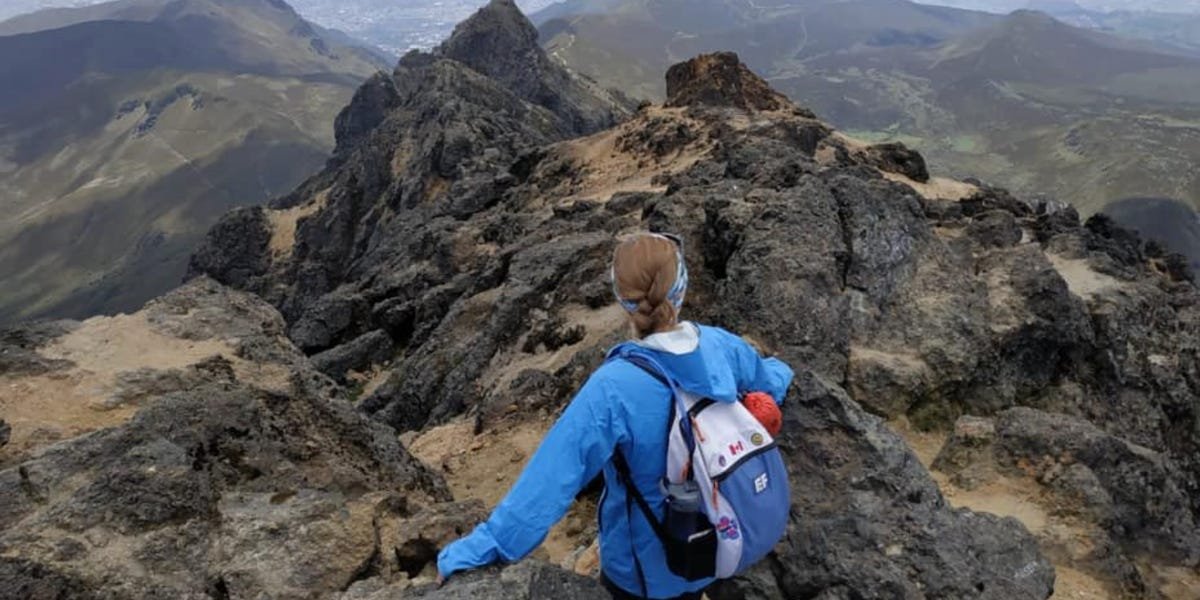
The writer posing on a cloudy hike in the Ecuador Highlands.

The hiking here is unlike anywhere else.

Kirstynn Joseph


For those who, like me, enjoy spending time in nature, the scenic route here is even more special. With most hikes even starting at heights of over 9,000 feet above sea level, the mountains — many of them volcanoes — still tower over you.

Rugged rocks and gleaming glaciers dominate the peaks; you’ll spot lots of bright green cushion plants and fields of golden grasses swaying in the winds. Bright-orange chuquiragua plants, found only at these high altitudes, dot the landscape.

One of my favorite hikes is Rucu Pichincha. After riding the Telefériqo cable car to the base camp — which has an incredible view of Quito, a lovely café, and many great spots for photo ops — you can begin to hike up the trail.

Here, you will experience the biodiverse páramo ecosystem and finish at more than 15,000 feet above sea level.

Elsewhere, in different directions but all within a few hours of Quito, the Antisana, Cayambe, and Cotopaxi volcanoes are sky-high with towering peaks covered by glistening glaciers that not even the equatorial sun can melt.


The view of turquoise water from a Quilotoa hike.

The Quilotoa crater lake is a must-visit.

Kirstynn Joseph


Last but not least, Quilotoa volcano, which is in the same province as Cotopaxi and just a bit further away, holds a turquoise crater lake where you can kayak — one of my absolute favorite things I’ve done here.

I may be biased, but I believe this region is one of the most underrated places in the world. If you find yourself in South America, it is absolutely worth it to set some time aside to get to know the Andes and everything they have to offer.

Just be careful on your journey there — you, too, may also find yourself staying just a bit longer than you planned.




Source link

Step-inside-the-Gilded-Age-mansion-that-just-sold-for.jpeg

Step inside the Gilded Age mansion that just sold for $34.5 million after years in bankruptcy

  • Bidding has closed on a 1901 mansion where Oleg Cassini designed fashions for Jacqueline Onassis.
  • On Wednesday, a bankruptcy judge approved a $34.5 million top bid for the Gilded Age townhouse.
  • Look inside the Beaux-Arts beauty and read about its contentious, sometimes violent history.

A 20-room Gilded Age mansion, once the atelier of fashion designer Oleg Cassini, is under contract at a bargain discount: $34.5 million.

A federal bankruptcy judge signed off on the mystery buyer’s winning bid on Wednesday, approving a price tag for the 18,000-square-foot Manhattan townhouse that’s nearly half the original asking price of two years ago.

The bankruptcy — in which two octogenarian sisters, one of them Cassini’s widow, were forcibly removed from the home by federal Marshals — caps a history of transformation.

Built steps from Fifth Avenue’s “Millionaire’s Row” as a stockbroker’s statement mansion in 1901, the stately limestone home was subdivided into apartments throughout the ’60s and ’70s.

And before his death in 2006, Cassini sketched wardrobes for longtime client Jacqueline Kennedy Onassis by the light of a towering window spanning the six-story home’s two topmost floors.

As the new buyer prepares to move in as early as next month, let’s take a look at the stunning rooms and tumultuous history of 15 East 63rd Street.

The 125-year history of the House of Cassini begins and ends with unwelcome intrusions.

The limestone facade of the House of Cassini, a 1901 Gilded Age mansion on Manhattan’s Upper East Side.

Evan Joseph for Sotheby’s International Realty

For all its serene style, the story of the House of Cassini begins and ends with a violent forced entry.

Its first owner, a millionaire broker and banker, was bludgeoned and robbed by armed burglars who broke in soon after his Beaux-Arts beauty was built.

A century later, its most recent owner — Cassini’s 85-year-old sister-in-law, Peggy Nestor — would be physically pulled from the home by federal Marshals, who busted open the brass front door to enforce a bankruptcy judge’s 2024 eviction order.

“They put me on the street in a robe!” Cassini’s widow, Marianne Cassini, also in her 80s, told the judge of being evicted along with her sister and their niece.

The sisters battled in the courts for a decade to manage rising debts.


A fireplace mantle featured a photo of fashion designer Oleg Cassini with longtime client Jacqueline Kennedy from back in her days as First Lady.

A fireplace mantle featured a photo of fashion designer Oleg Cassini with longtime client Jacqueline Kennedy when she was First Lady.

Evan Joseph

For the past decade, the two sisters have battled in state and federal court to keep the home they purchased together in 1984, 12 years after Marianne’s secret marriage to the designer (the union was revealed only after Cassini’s death). Nestor, Cassini’s sister-in-law, took sole title in 2016, according to court papers.

The sisters ultimately lost their battle against the eviction and the bankruptcy judge’s final 2024 order that the home be sold to satisfy more than $30 million of Nestor’s mortgage debts and liens.

“Enough, enough, enough — we’re done,” a frustrated-sounding Judge Michael E. Wiles told the protesting sisters in approving the sale at a hearing on Wednesday.

“It’s in the court file, for heaven’s sake,” Wiles said, rejecting the pair’s repeated claim that they remain co-owners and that rent-stabilization laws somehow bar their eviction from the single-family residence.

In the two years since the eviction, the home’s sale price had plummeted — from $65 million under Sotheby’s International Realty, to $39.5 million under its latest listing with Brown Harris Stevens, to the current $34.5 million purchase agreement.

First stop on our look inside: an ornate and unusual vestibule.


The House of Cassini entryway features an unusual vestibule of marble, brass and curved glass.

The House of Cassini entryway features an unusual vestibule of curving marble, brass, and glass.

Evan Joseph for Sotheby’s International Realty

Before diving into the home’s tumultuous history and tranquil interior, it’s worth pausing at the front door, where the original vestibule still greets visiting guests.

Built of curving marble, brass, and glass, the unusual structure served as an airlock — a buffer against the cold in a home warmed by 14 fireplaces.

Marble, glass, and brass bend together to frame the vestibule.


A closeup of the Cassini mansion vestibule shows its unusual, turn-of-the-century curve of marble, brass and glass.

A close-up of the Cassini mansion vestibule shows its turn-of-the-century beauty.

Evan Joseph

In the summer, the vestibule helps keep in the central air conditioning, a much later and controversial addition.

In 2006, next-door-neighbor Neil Diamond sued Nestor, saying her new rooftop cooling unit illegally added 13 feet to the height of her building.

The “Sweet Caroline” and “Song Sung Blue” singer sought $2 million in damages for the obstruction of views from his terrace. They settled for an undisclosed sum in 2010.

The 1901 mansion was a wealthy stockbroker’s statement home, steps from Manhattan’s “Millionaire’s Row.”


The first floor boasts white marble floors and a sweeping marble staircase.

The first floor has white marble floors and a sweeping marble staircase.

Evan Joseph for Sotheby’s International Realty

The home’s story begins with Wall Street stockbroker Elias Asiel, who purchased 15 East 63rd Street in 1885 as a new Victorian brownstone.

Asiel had grander plans. He hired one of the top architects of the day, John H. Duncan, to reimagine the 25-foot-wide property as a limestone-clad mansion to rival any on the nearby stretch of Fifth Avenue known as “Millionaire’s Row.”

Duncan had just finished the General Grant National Memorial — a mausoleum for the 17th president and Civil War hero, overlooking the Hudson River — when he went to work for Asiel in 1897.

Entering Duncan’s design tour-de-force, guests can cross a 46-foot, marble-tiled gallery to an oval-shaped dining room, or climb a sweeping, curved staircase to the parlor level.

The dining room was the first stop for a pair of burglars in a 1906 break-in.


This view of the House of Cassini's dining room shows its stunning mirrors and the toll taken by time upon the carved wood paneling.

This view of the House of Cassini’s dining room shows its stunning mirrors and the toll time has taken on the carved wood paneling.

Evan Joseph

The dining room, enclosed by pocket doors, mirrors, and fading, carved wood paneling, played a role in a 1906 break-in that left Asiel bloodied and bereft of his silverware.

The pre-dawn, gunpoint robbery was front-page news. “Elias Asiel Pounded Insensible with Brass Knuckles in Bedroom,” blared a headline in the evening edition of the Sun.

According to accounts in four city newspapers, the two robbers broke into the basement service door with a saw and a diamond glass-cutting blade.

Awakened upstairs in bed, Asiel was no easy mark.

He got in a good punch or two before being beaten with brass knuckles and bound at the wrists and ankles “with stout pieces of cord.”

He also refused to give up the combination to his safe, which contained “a fortune in gems” — heirloom jewelry he would bequeath to his daughter, asleep one floor up.

Struggling free in his bedroom, Asiel cut short the robbery.


The sitting room adjoining the mansion's master bedroom, site of a violent struggle a century ago.

The sitting room adjoining the mansion’s master bedroom.

Evan Joseph for Sotheby’s International Realty

“Would one of you please wipe the blood out of my eyes?” the trussed broker asked as the pair ransacked his bedroom.

The younger burglar paused to wet a cloth in the adjoining bathroom and gently wiped Asiel’s eyes, an act of kindness that later swayed a judge to impose a mere five-year sentence.

The robbers pocketed Asiel’s $250 gold watch, 12 of his pearl-and-sapphire scarf pins, and $90 in cash. They then headed back downstairs to the dining room, where they’d left Asiel’s silver in a pile to grab on the way out.

The two managed to pack up just three dozen forks and four dozen spoons when they were interrupted. Wriggling free of his ties, Asiel pulled a bedside bell cord to wake the seven sleeping servants, and was shouting for help out the window.

The thieves fled into nearby Central Park, leaving most of the silver on the sideboard. They were caught and convicted some two years later.

On the second floor — a library and drawing room.


This view of the Cassini mansion's second floor library shows its wood and marble paneling and one of two windows overlooking 63rd Street.

The Cassini mansion’s library overlooks 63rd Street.

Evan Joseph for Sotheby’s International Realty

The mansion’s two most exquisite spaces — a wood-clad library and a bright drawing room — are at either end of the mansion’s second level, the “parlor floor,” where the ceilings are 17 feet high.

The wood and marble-clad library faces the front of the building, its two tall arching windows overlooking leafy East 63rd Street.

The library’s ceiling is the nesting site of four pairs of winged and clever cherubs.


This photo shows the ceiling of the Cassini mansion's library, where owls stand watch and pairs of winged cherubs gazing upon Latin-inscribed scrolls.

The library’s ceilings are populated by watchful owls and pairs of cherubs gazing upon Latin-inscribed scrolls, the room’s only reading material.

Evan Joseph/Sotheby’s International Realty

Photos of the library show no bookshelves. But there is reading material, if you’re a cherub.

Pairs of the erudite tykes roost in each corner of the elaborately coffered ceiling, holding scrolls enscribed in Latin.

“Malo Esse Quam Videri,” reads one, paraphrasing Cicero — “I would rather be than seem.”

The drawing room is a bright sanctuary.


The House of Cassini's second floor drawing room looks like a wedding cake, frosted with garlands and roses.

The House of Cassini’s drawing room looks like a wedding cake, frosted with garlands and roses.

Evan Joseph for Sotheby’s International Realty

The second-floor drawing room is a bright sanctuary where sunlight from the terrace floods inside through two French doors and alights mirror to mirror.

The room resembles an intricate wedding cake, frosted with garlands of roses.


Garlands of plasterwork roses ring the second floor's sunny drawing room.

Garlands of plasterwork roses ring the second floor’s sunny drawing room.

Evan Joseph for Sotheby’s International Realty

A profusion of plasterwork decorates the ceiling and walls, ringing the space in garlands of budding and full-flower blooms.

The effect is like standing atop a wedding cake, under a rose bower, and enclosed by a house of mirrors all at once.

“Elegance upon elegance upon elegance,” Louise Beit, the mansion’s previous broker, enthused of the drawing room, in a YouTube tour of the home last year.

A spacious gallery connects the library and drawing room, and features a balcony for “string quartets” to perform.


The Cassini mansion's second floor gallery connects the library and the drawing room.

The Cassini mansion’s second-floor gallery connects the library and the drawing room.

Evan Joseph for Sotheby’s International Realty

A spacious gallery connects the second floor’s library and drawing room.

“Standing here in the gallery, you can feel how they love lavish entertaining in the Gilded Age,” said Beit, of Sotheby’s International Realty.

“You can greet your guests at the top of the steps with a string quartet entertaining you from the balcony.”

Asiel died in his bedroom in 1920, at age 69.


Another view of the Cassini mansion library shows light from East 63rd street streaming in through a pair of tall, arched windows.

Another view of the Cassini mansion library shows light from East 63rd Street streaming in through a pair of tall, arched windows.

Evan Joseph for Sotheby’s International Realty

Asiel and his two children — his daughter would marry a Bloomingdale — enjoyed the mansion through the nineteen-teens.

In 1920, a year after his retirement, the broker died at home at age 69, missing the stock market crash by nine years.

The robbery was his most lasting claim to fame. His obituary in The New York Times noted that he “gained high praise from the police for his coolness and bravery in a single-handed battle with two burglars.”

In the ’60s and ’70s, the home was divided into seven rent-stabilized apartments.


The sweeping staircase of the House of Cassini spirals up toward its added sixth floor and skylight.

The sweeping staircase of the House of Cassini spirals up toward its added sixth floor and skylight.

Evan Joseph

City records show that in the ’60s and ’70s, the home was owned by a California development company and had been divided into seven rent-stabilized apartments.

In 1984, it was purchased by Nestor and Marianne Cassini, the designer’s secret wife.

The sisters spent the next 30 years taking out mortgages, renovating, evicting the old tenants, and running the designer’s businesses — Oleg Cassini, Inc. and Cassini Parfums, Ltd., both in receivership since 2015.

The winning, anonymous bidder pledged $34.5 million and may need to spend many millions more to renovate.


The front entrance to the Cassini mansion.

The mystery buyer’s architect estimates that renovating the home will cost $25 million and take three to four years.

Evan Joseph

The next owner — named only as “15 East 63rd Street, LLC” in court papers — is now poised to inherit an architectural gem, rich in history and potential.

“It appears that it has been a significant number of years since the townhouse was last comprehensively renovated,” Brown Harris Stevens broker Sami Hassoumi said in a court document on Tuesday.

The mystery buyer’s architect estimates that fully renovating the home will cost $25 million and take three to four years, Hassoumi said.


Source link

I-grew-my-tech-income-to-over-250000-in-8.jpeg

I grew my tech income to over $250,000 in 8 years. 1 move has helped me negotiate a higher salary.

This as-told-to essay is based on a conversation with Brian Jenney, 42, who lives in California. The following has been edited for length and clarity.

When I got into tech in my early 30s, I had no clue how crazy lucrative the industry was.

I started as a web application developer in 2015, earning roughly $60,000 a year.

Over the years, I became savvier at negotiating my salary, and by 2023, I was making over $250,000.

I’ve earned more than I could have ever imagined, without working in Big Tech, where people often assume the big money is made.

Here’s what I’ve learned along the way.

1. It was dumb not to negotiate a starting salary because it already sounded impressive

I used to have addiction issues, so I didn’t really work from the ages of 25 to 30 and lost knowledge that people gain from white collar jobs at this stage of life.

I was naive about the salary potential of my industry, and when people in tech said they were on $150,000, it blew my mind, and I began to feel underpaid.

In 2017, after two years in the web developer role, I landed a job at a startup. I was so impressed when I was offered $120,000 that I didn’t negotiate my salary, which was dumb in retrospect.

The environment was extremely fast-paced and high-caliber. I struggled with imposter syndrome as one of the team’s more junior members. I felt like one of the worst developers there and that I was already being paid more than I deserved. It discouraged me from asking for a raise.

In 2019, I joined the media intelligence company Zignal Labs. I was so happy about the job offer that I didn’t negotiate the salary, so my pay initially stayed roughly the same as in my previous job. It felt like I had plateaued, even though I had more money than I needed. An unfortunate symptom of working in tech is that you get drawn to wanting more.

Choosing this role turned out to be the right move, though. I had more room to grow and was in a better learning environment at a larger company.

During the tech hiring spree of 2020, my peers said they were getting crazy offers, and I didn’t want to miss out. That August, I joined The Clorox Company, a manufacturing firm, as a software engineer. By 2023, I was making over $250,000: the peak of my earnings in tech.

In 2024, I was laid off, and I’ve continued to work in various software engineering roles. I bought a business in 2023, and my focus has shifted to seeking out flexibility and time to build it, instead of maximizing corporate compensation.

2. I prepare for the pressure of job interviews by practicing with strangers

Interviews are like a carnival game where you can win big money by performing well, and you can’t get to the negotiation stage without passing them. They’re structured, learnable, and winnable with the right preparation.

When I have job interviews lined up, I do technical practice and use a platform called Pramp, which pairs you with strangers for practice interviews. I’ve found this helps simulate the nerves and pressure of real interviews better than practicing with friends.

I’ll try to do at least two mock interviews before an interview I really care about.


Brian Jenney is standing on a stage giving a talk.

Jenney uses a platform called Pramp to practice job interviews.

Courtesy of Brian Jenney


3. I learned to ‘play the game’ of salary negotiation. Now I ask for at least 10% more.

Over the years, I’ve benefited a lot from people in tech being open about their salaries and career paths, which helped me understand what was possible and gave me confidence to negotiate and aim higher.

I’ve learned that salary negotiation is a game you have to play, and if you don’t, you lose money.

I began consistently negotiating pay in the late 2010s. I usually tell the employer that I’m really excited to start the job, but that I was hoping to come in at a higher salary range, usually 10 to 20% more.

I’ve found this to be very effective, and it has never gone badly for me. If an employer sounds firm on their offer, I usually try to explore whether a sign-on bonus is possible instead, but I don’t push aggressively beyond that.

I have more money than I need, even though I never worked in Big Tech


Brian Jenney is pointing at a wall with computer code written on it.

Jenney said a salary of $150,000 is more than enough for him.

Courtesy of Brian Jenney


I’ve interviewed with but never been hired by the Big Tech companies. Besides, I like working at smaller startups and non-tech companies where I think you can have a greater impact.

Big Tech employees are going to “beat me” on pay because their stock compensation will outpace my earnings. But I see my current lifestyle as comparable to theirs. I believe there’s a reason software engineers aren’t driving around Mountain View in Ferraris: they can’t cash out all their stock money yet.

There’s always more you can earn, but when my salary hit the $150,000 mark, I knew it was more than I needed. I’d rather prioritize jobs where I’m happy, I’m learning, and I can cover my needs while still saving. That’s all I really need.

Do you have a story to share about growing your salary in tech? Contact this reporter at ccheong@businessinsider.com


Source link

After-a-breakup-I-put-my-belongings-in-storage-and.jpeg

After a breakup, I put my belongings in storage and traveled full-time for 3 years. It was the best chapter of my life.

Three and a half years ago, I stood in my New Jersey apartment, surrounded by boxes I was about to put into storage. Tears streamed down my cheeks.

I’d recently ended a two-year, live-in relationship. We loved each other deeply, but just weren’t the right fit — and although the split was a gut-wrenching decision, we both knew it was the right move.

I had just accepted a fully remote job, which allowed me to explore moving out of the New York City area — something I had been considering for about a year.

I planned to just travel for a few months before settling down somewhere, but I ended up spending the next three years as a nomad.

Although it wasn’t quite what I’d pictured when I said goodbye to the apartment I shared with my ex, it turned into one of the most important chapters of my life.

My brief stint abroad turned into a longer chapter


A shot of a building and Mexican flag in Mexico City.

My time in Mexico City taught me about my own resourcefulness and independence.

Samantha Caffrey


My post-breakup plan was to put all of my belongings into a storage unit and spend a few months in Tulum.

After that, I would travel to Miami and Los Angeles, “interviewing” both cities as candidates for a longer-term move. I was about seven months into this plan when I learned my role was going to be eliminated.

Luckily, I was able to secure freelance work, so I decided to continue my travels since I wasn’t needed in one particular place for my job.

From Tulum, I headed to Mexico City. After just a few days, I fell in love with the food, vibrancy, people, and culture. My one-week vacation turned into an almost three-month stay.

During my time in Mexico City, I explored art galleries and museums, learned some Spanish, made friends, went on dates, visited small shops, and tipped local people well.

These little moments helped me learn how adaptable I truly was. I realized I could make friends anywhere, stay disciplined with my work even while exploring a new place, safely navigate dating as a solo traveler, and be extremely resourceful.

I kept exploring. I took the nomad life slowly, spending about four or five months abroad at a time in places like Paris, Lisbon, Málaga, London, Melbourne, Miami, and Tulum.

Between travels, I’d spend a few months recharging in a sublease (or a friend’s apartment) in New York City.

I felt my confidence grow as I navigated new cities and connected with inspiring women from all over the world


The writer roaming a hallway in Versailles.

I traveled the world, from France to Mexico to Australia.

Samantha Caffrey


When traveling solo, every choice you make is yours, from where you eat to how you spend your days. I felt immensely grateful for this freedom — every day, it struck me how lucky I was to have every minuscule decision be solely my own.

That’s not to say I felt lonely, though. With each new city and country I stayed in, I was delighted by the magic of connecting with strangers.

One time, I struck up a conversation with another woman at a particularly intense yoga class in Tulum. She was visiting from Canada, and we ended up spending a whole day together.

I had another memorable experience in Europe. I had been traveling by myself for about three years at that point, and although it was incredible, I was exhausted. I felt ready to return to New York City, but I wasn’t sure I could afford to do so.

Then, one afternoon, my spirits were lifted when I found myself in a café in Paris, enjoying a chocolate-chip cookie and a latte. An older woman started chatting with me, and soon, another young woman traveling solo from Korea joined in.

We all shared stories and giggled as we sipped our coffees. As the older woman left the café, she said, “You two girls exchange numbers now, and spend time together.”

We laughed at the gentle demand, but wound up spending that evening — and the next day, too — exploring the city as a pair. I may or may not ever see her again, but she told me that if I ever visit Seoul, I’ll be welcomed with open arms.

Best of all, this time in my life helped me stay open and live in the moment


The writer standing in front of buildings in London on a sunny day.

One of the best parts of traveling was connecting with people from around the world.

Samantha Caffrey


I learned that not every place has to be a permanent home, and not every relationship has to last forever; in fact, some friendships might just last for the span of a trip.

The memories I made during this time will stick with me, though I’ve since emptied out my storage unit and settled into a one-year lease in New York City.

My nomadic chapter is closed for now, but my encounters with strangers, small moments in new cities, and solo time with myself left me changed for the better — and will surely inspire my next adventure.


Source link

John F. Kennedy Jr. and Carolyn Bessette Kennedy in black tie attire

JFK Jr. and Carolyn Bessette died in a plane crash 27 years ago. It fueled rumors of a ‘Kennedy curse.’

John F. Kennedy Jr. and his wife, Carolyn Bessette Kennedy, attended the Municipal Art Society Gala in 1998.

  • John F. Kennedy Jr., his wife, and her sister died in a 1999 plane crash near Martha’s Vineyard.
  • Rumors of a “Kennedy curse” were fueled by multiple family tragedies over the decades.
  • JFK Jr. and Carolyn Bessette’s relationship is now the topic of an FX series, “Love Story.”

The Kennedy family has been subjected to many tragedies over the years, including two assassinations and a plane crash that took the lives of John F. Kennedy Jr. and two other passengers.

Nearly 27 years ago, on July 16, 1999, John F. Kennedy Jr., his wife Carolyn Bessette-Kennedy, and her older sister Lauren Bessette were killed in a plane crash off the coast of Martha’s Vineyard in Massachusetts. There were no survivors from the accident.

The relationship between John F. Kennedy Jr. and Carolyn Bessette-Kennedy is now the topic of an FX series executive-produced by Ryan Murphy, “Love Story.”

Their deaths became a major news story and perpetuated rumors of a “Kennedy curse.”

JFK Jr.’s father, former President John F. Kennedy, was assassinated in 1963. His uncle, Robert “Bobby” Kennedy, was assassinated five years later in 1968. And two years before JFK Jr.’s death, his cousin Michael Kennedy also died after hitting a tree while skiing in Aspen, Colorado.

Here’s what we know about the plane crash that killed John F. Kennedy Jr. and two others.

John F. Kennedy Jr. frequently made headlines throughout the 1990s.
John F. Kennedy, Jr. addresses the Democratic National Convention in 1988
John F. Kennedy, Jr. at the Democratic National Convention in 1988.

As the son of a president and a member of one of America’s most prominent political dynasties, John F. Kennedy Jr. was destined for the spotlight.

JFK Jr. was born on November 25, 1960, just two weeks after his father was elected president. His father was assassinated on November 22, 1963, just three days shy of JFK Jr.’s third birthday.

JFK Jr., affectionately nicknamed “John-John” by the public, attended the funeral on his birthday and was famously photographed saluting his father’s casket.

Throughout much of his adolescence and adulthood, he mostly remained out of the public eye.

However, his public image began to change after he introduced his uncle, Ted Kennedy, at the Democratic National Convention in 1988.

In September 1988, People named Kennedy, who was then a 27-year-old third-year law student at NYU, the “Sexiest Man Alive.”

JFK Jr. also dated a few celebrities throughout the 1990s, including “Sex and the City” star Sarah Jessica Parker, Cindy Crawford, and Daryl Hannah.

John F. Kennedy Jr. began dating Carolyn Bessette, a publicist for Calvin Klein, in 1994.
John F. Kennedy Jr. and Carolyn Bessette-Kennedy in 1995
John F. Kennedy Jr. and Carolyn Bessette-Kennedy in 1995.

They met in the fitting room at Calvin Klein, where Bessette helped JFK Jr. pick out wardrobe items, Elizabeth Beller wrote in “Once Upon a Time: The Captivating Life of Carolyn Bessette-Kennedy,” cited by People.

Tall, sophisticated, and beautiful, JFK Jr.’s new girlfriend captivated the public.

After two years of dating, the pair married in an intimate ceremony on Cumberland Island, Georgia, People reported.

While their wedding ceremony was private, their relationship was anything but, thanks to the prying eyes of the paparazzi.
John F. Kennedy Jr. and Carolyn Bessette in New York City and the front cover of the October 7, 1996, Daily News picturing the couple and the headline

The media attention may have even inspired Kennedy to get his pilot’s license in 1998.

“That was some of the happiest times he ever had. Floating around with the buzzards in his Buckeye [plane]. It was the freedom,” his close friend Robbie Littell told “JFK Jr: An Intimate Oral Biography” author RoseMarie Terenzio, according to People.

“He said, ‘It’s the only place I can go where no one is bothering me. I have complete silence, and no one can get to me except the air traffic controllers.’ Maybe that gives you insight into what he was really dealing with on the ground,” his college friend Gary Ginsberg said, People reported.

John F. Kennedy Jr. was traveling to Martha’s Vineyard with his wife and her older sister when their plane was reported missing.
The hangar where John Kennedy Jr. kept his Piper Saratoga airplane and a similar model plane.
The hangar where John Kennedy Jr. kept his Piper Saratoga airplane.

The Washington Post reported that Kennedy departed Essex County Airport near Fairfield, New Jersey, at around 8:38 p.m. on Friday, July 16, 1999. The sun was already beginning to set and “hazy conditions,” which had been reported earlier in the evening, were getting worse, People reported.

Kennedy planned to drop his sister-in-law Lauren Bessette on Martha’s Vineyard before traveling to his family’s compound in Hyannis Port with Carolyn. The couple was due to attend his cousin Rory Kennedy’s wedding the following day, according to People.

However, the plane never landed in Martha’s Vineyard.

An unidentified driver reported the plane had failed to arrive at Martha’s Vineyard Airport as expected, according to the Post, citing an NBC report. It kicked off a search for the missing aircraft in the early hours of July 17.

The Kennedy family notified the Cape Cod Coast Guard that the couple had not made it back to Hyannis.
A Coast Guard helicopter lifts a rescue swimmer after the swimmer jumped into the water on July 17, 1999, to look for debris from John Kennedy Jr.'s plane
A Coast Guard helicopter searching for debris from John Kennedy Jr.’s plane.

The Washington Post reported that the Coast Guard then began investigating whether the plane had landed at another airport.

By 4 a.m., the Coast Guard began searching for the missing plane, and by 7:30 a.m., the Air Force and Coast Guard had launched 20 aircraft vehicles and two boats to search the area between Long Island and Martha’s Vineyard, according to the Post’s timeline.

On Sunday afternoon, what was presumed to be debris from the plane was found on Philbin Beach on Martha’s Vineyard. Among the debris was a headrest that was later concluded to be from the missing aircraft and a black suitcase that contained Lauren Bessette’s business card.

Rory Kennedy’s wedding, scheduled for 6 p.m. that night, was put on hold as the family awaited more news.

The Washington Post reported that after more debris was found in the days to follow, the search-and-rescue mission became a search-and-recovery mission.

All three of the plane’s passengers were now presumed dead. John F. Kennedy Jr. was 38 years old. Carolyn Bessette-Kennedy was 33, and her sister Lauren Bessette was 34.

Five days after the crash, the bodies of John F. Kennedy Jr., Carolyn Bessette-Kennedy, and Lauren Bessette were recovered.
Massachusetts State Police divers left Menemsha on Martha's Vineyard on July 19, 1999.
Massachusetts State Police divers left Menemsha on Martha’s Vineyard on July 19, 1999.

The debris field was identified off the coast of Martha’s Vineyard, relatively near the estate once owned by Jacqueline Kennedy Onassis, Kennedy’s mother, The New York Times reported. (Kennedy Onassis died in 1994.)

The bodies of John F. Kennedy Jr., Carolyn Bessette-Kennedy, and Lauren Bessette were discovered by Navy divers on July 22, 1999, after an extensive search approved by President Bill Clinton.

The bodies of the crash victims, which were ”near and under” the main body of the aircraft, were still strapped in, according to the Times.

Details began to emerge about what led to the crash.
A television technician holds up the official handout map of the search and rescue area off Martha's Vineyard
A television technician holds up the official handout map of the search and rescue area off Martha’s Vineyard.

Kennedy had only flown about 72 hours without a flight instructor, and had only about 300 total hours of flying experience, The New York Times reported in July 2000. He had reportedly rejected an offer to have a flight instructor accompany the group on their journey.

As a newly trained pilot, Kennedy was not licensed to fly and navigate the air using flying instruments. Instead, he had only trained to fly using sight alone, which would have been extremely difficult in dark or hazy conditions such as those on the night of July 16.

Warren Morningstar, a spokesman for the Aircraft Owners and Pilots Association, told the Times that “flying at night over featureless terrain or water, and particularly in haze or in overcast, is a prime setup for spatial disorientation.”

About an hour into the trip, the plane’s flight path became irregular as it began its descent into Martha’s Vineyard, indicating that the pilot may have become disoriented by the darkness of the sky and the water, the National Transportation Safety Board concluded.

“His flight path into the water is consistent with what is known as a graveyard spiral,” Jeff Guzzetti, an NTSB investigator in the accident, told Terenzio, according to People. “The airplane makes a spiral nose down … kind of like going down a drain. The plane went into one final turn and it stayed in that turn pretty much all the way down to the ocean.”

The aircraft went down in the water about 7 miles from its intended destination of Martha’s Vineyard.
A mourners cries as people pay respects at the floral shrine outside of the building where John F. Kennedy Jr. and Carolyn lived in 1999.
Mourners pay respects at the floral shrine outside of the building where John F. Kennedy Jr. and Carolyn lived in 1999.

The Washington Post reported that the plane did not send out a distress call. Instead, it made its final descent and crashed into the Atlantic Ocean in under 30 seconds.

Kennedy, Kennedy-Bessette, and Bessette’s bodies were cremated and buried at sea off the coast of Martha’s Vineyard on July 22, 1999.

“We are filled with unspeakable grief and sadness by the loss of John and Carolyn and Lauren Bessette,” Ted Kennedy said in a statement on behalf of the Kennedy family. “John was a shining light in all our lives and in the lives of the nation and the world that first came to know him as a little boy.”

As the country mourned the loss, rumors of a “Kennedy curse” were reignited.
John F. Kennedy, Jr. gives his wife Carolyn a kiss on the cheek during the annual White House Correspondents dinner
John F. Kennedy, Jr. and Carolyn Bessette-Kennedy attended the White House Correspondents dinner in 1999.

The extensive search captured the nation’s attention, as did the tragedy of the three young passengers’ deaths. Yet another tragic accident for the Kennedy family, the plane crash only added to rumors of a Kennedy family curse.

“I’ve looked high and low and cannot find another family since the ancient Greek House of Atreus that has suffered more calamities and misfortunes than the Kennedys,” Edward Klein, the author of “The Kennedy Curse: Why Tragedy Has Haunted America’s First Family for 150 Years,” said, according to The Washington Post.

While there are many logical reasons for the fateful plane crash, it’s nevertheless poignant that the Kennedy family, one of the wealthiest and most influential political families in the world, has suffered so much tragedy throughout the last 100 years.

“The humanity of their story is what keeps us engaged,” Kennedy family biographer J. Randy Taraborrelli told NBC News in 2019.

“We peer behind the scenes of their wealthy lifestyle, and we see, for all the advantages they have, tragedy can still happen.”

Read the original article on Business Insider

Source link

Photos-show-presidents-official-White-House-portraits-over-the-last.jpeg

Photos show presidents’ official White House portraits over the last 100 years

Updated

  • The White House released a new official portrait of President Donald Trump in June.
  • The dramatically lit photo shows Trump against a dark backdrop with a serious expression.
  • Unlike most contemporary presidential portraits, the background doesn’t include an American flag.

President Donald Trump’s official White House portrait does not feature an American flag in the background — it’s the first presidential photo in over 60 years without one.

Taken by chief White House photographer Daniel Torok, the dramatically lit photo shows Trump against a dark backdrop with a serious expression. The style hearkens back to the past presidential portrait styles of Presidents Franklin D. Roosevelt, Herbert Hoover, and Calvin Coolidge, who also appeared unsmiling against dark backgrounds.

And while there is no flag behind Trump in his new portrait, he is wearing an American flag pin on the lapel of his blue suit, a tradition that began with President George W. Bush’s photo.

A portrait of Trump released earlier last year, which did feature an American flag, was taken during the presidential transition period and “was always meant to serve as a placeholder,” a White House official told Business Insider.

The new photo is one of several aesthetic changes Trump has made to the White House in his second non-consecutive term. In the Entrance Hall, he moved President Barack Obama’s painted White House portrait across the hall and replaced it with a painting depicting his raised fist following an assassination attempt. He has also added numerous gilded gold furnishings to the Oval Office and paved over the lawn in the Rose Garden to create a terrace he said would be better suited for large events.

Take a look at how presidential portraits have changed through the years.

President Calvin Coolidge, 1923

A portrait of President Calvin Coolidge.

Library of Congress

President Herbert Hoover, 1929


President Herbert Hoover's official White House portrait.

A portrait of President Herbert Hoover.

Underwood & Underwood

President Franklin D. Roosevelt, 1933


An official portrait of President Franklin D. Roosevelt.

An official portrait of President Franklin D. Roosevelt.

Elias Goldensky/Library of Congress

President Harry Truman, 1945


President Harry Truman's official White House portrait.

President Harry Truman’s official White House portrait.

Keystone-France/Gamma-Keystone via Getty Images

President Dwight Eisenhower, 1953


President Dwight Eisenhower's official White House portrait.

President Dwight Eisenhower’s official White House portrait.

Keystone-France/Gamma-Keystone via Getty Images

President John F. Kennedy, 1961


John F. Kennedy's official White House portrait.

President John F. Kennedy’s official White House portrait.

Bachrach/Getty Images

President Lyndon B. Johnson, 1963


President Lyndon B. Johnson's official White House portrait.

President Lyndon B. Johnson’s official White House portrait.

Official White House photo

President Richard Nixon, 1969


President Richard Nixon's official White House portrait.

President Richard Nixon’s official White House portrait.

Official White House photo

President Gerald Ford, 1974


President Gerald Ford's official White House portrait.

President Gerald Ford’s official White House portrait.

Official White House photo

President Jimmy Carter, 1977


President Jimmy Carter's official White House portrait.

President Jimmy Carter’s official White House portrait.

Official White House photo by Karl Schumacher

President Ronald Reagan, 1981


President Ronald Reagan's official White House portrait.

President Ronald Reagan’s official White House portrait.

Official White House photo

President George H.W. Bush, 1989


President George H.W. Bush's official White House portrait.

President George H.W. Bush’s official White House portrait.

Official White House photo by David Valdez

President Bill Clinton, 1993


President Bill Clinton's official White House portrait.

President Bill Clinton’s official White House portrait.

Official White House photo

President George W. Bush, 2001


President George W. Bush poses for his official portrait in the Roosevelt Room in a blue tie.

President George W. Bush’s official White House portrait.

Official White House photo by Eric Draper

President Barack Obama, 2009


Barack Obama's official White House portrait.

President Barack Obama’s official White House portrait.

Official White House photo by Pete Souza

President Barack Obama, 2013


President Barack Obama's second official White House portrait.

President Barack Obama’s second official White House portrait.

Official White House photo by Pete Souza

President Donald Trump, 2017


Donald Trump's first White House portrait.

President Donald Trump’s first White House portrait.

Official White House photo by Shealah Craighead

President Joe Biden, 2021


President Joe Biden's official White House portrait.

The official portrait of President Joe Biden, taken in the Library room at the White House.

Official White House photo by Adam Schultz

President Donald Trump, 2025


Donald Trump's presidential portrait.

President Donald Trump’s second official White House portrait.

Official White House photo by Daniel Torok

President Donald Trump, 2025


Donald Trump's new White House portrait.

Donald Trump’s new White House portrait.

Official White House photo by Daniel Torok


Source link

My-grandparents-have-been-married-for-54-years-Their-relationship.jpeg

My grandparents have been married for 54 years. Their relationship has taught me 3 lessons about love I plan to follow.

My grandparents, whom I call Papa and GG, have been together since they were teenagers and married for 54 years.

As I’ve grown up, I’ve realized the secret to their lasting love hasn’t been perfection or grand gestures. Instead, it’s in finding joy and meaning in life’s small, everyday moments.

Their marriage has taught me how powerful a gentle, consistent love can be, and how beautifully it can shape everything around it.

Here are three of the biggest lessons I’ve learned from them that I hope to bring into my own relationships.

To maintain the “spark,” nurture curiosity


The author's grandparents posing for a photo together.

My grandparents still discover new things about each other, more than 50 years into their marriage.

Sierra Newell


Whether it’s by going on a spontaneous camping trip or navigating retirement together, my grandparents delight in discovering new things about each other.

Both avid readers, they often will sit beneath their orange tree and share quotes from their books. After long Sunday walks through the park, they also like to continue their running card game of gin rummy, laughter, and nostalgic stories tumbling between them.

Even after decades together, they also eat dinner with each other nearly every night, eager to unravel each other’s thoughts, feelings, and experiences.

Find creative, consistent ways to express your love


A collection of

My Papa has clipped many “Love Is…” comics over the years.

Sierra Newell


My grandparents have found a variety of ways to show each other they care.

Every morning, for example, my Papa clips the “Love Is…” comic strip from the newspaper and places it on the kitchen counter for GG. He also writes poems, scribbled on notepads, painted on rocks, or sent as random texts throughout the day.

Meanwhile, GG often sends photos of heart-shaped stones or leaves she finds on her walks, and they both leave handwritten notes in each other’s suitcases when they travel.

Physical affection anchors it all, though. There’s rarely ever a moment when they aren’t holding hands or resting a head on a shoulder. They often seem to do it without even realizing, as though one another is as constant and grounding as gravity.

Remember to prioritize your own happiness, too


The author and her grandpa posing together.

I appreciate how each of my grandparents still pursues their own interests.

Sierra Newell


In my opinion, one of the reasons their relationship still feels so alive is because they never stopped making room for their individual interests.

GG started playing mahjong in retirement and now competes in tournaments, and Papa likes to play golf around the world.

Instead of resenting or fearing change, they celebrate each other’s passions, and watching each other reinvent themselves sustains their mutual excitement.

The common thread is joy

These days, it can be hard to sift through the barrage of conflicting advice on how to find and cultivate long-lasting love.

Still, witnessing my grandparents build a life out of tiny kindnesses — notes slipped into suitcases, breakfast cartoons, and shared laughter — has shown me the recipe is simpler than we think.

I see how extraordinary it is to share life’s simplest joys, to choose a partner who is real, steady, and kind. That level of devotion is an everyday miracle, and I try to weave those threads into my own relationships.

I send handwritten letters back and forth with my friends and family, and my boyfriend and I collect concert tickets, printed menus, and postcards from trips and dates we’ve experienced.

These items are arranged in a collage in my apartment, ink-stained and wrinkled, but tangible proof of the love my grandparents have taught me to sow.


Source link

Im-81-years-old-and-I-still-love-going-to.jpeg

I’m 81 years old, and I still love going to the gym. It’s helped me stay social and physically healthy.

When our family moved to Oregon from Southern California in 1974 for my husband’s new job, I fell in love with the Pacific Northwest. But there was one problem: There wasn’t enough sunshine or swimming pools — both of which I had enjoyed in California.

When the community college where I taught offered free memberships at a new gym, I quickly signed up. I expected exercise, but I got so much more.

Over 30 years later, I’m 81, and still going to the gym every other day. It’s still an important part of my health routine.

I found that the gym isn’t just for young people

The weight room is full of young people lifting weights, and they pound their feet on treadmills like the start of the Kentucky Derby.

But the gym is also filled with older people. There’s the 87-year-old woman who runs up and down the stairs “because it feels good,” while her 91-year-old husband maintains a steady pace on the treadmill.

As a swimmer, I’ve met several people around my age, welcoming each other into the pool.

With a somewhat older crowd, I am pleasantly surprised at how disabilities and imperfections are of no consequence in the pool. Surgery scars, including mastectomies and even amputations, are not worthy of the slightest stare or question. The miracle of being in the water is that handicaps and age disappear.


Cynthia Wall and her friends in the pool at her gym

The author says she’s stayed healthy thanks to the pool at her gym.

Courtesy of Cynthia Wall


Even those who enter the pool in a lift achieve equality once they are buoyant. I’ve witnessed physical challenges that make me realize how insignificant my own are.

I was surprised to find deep friendships at the gym

When I first came to the gym to exercise, I didn’t expect to make friends — acquaintances, yes, but not friendships that mattered.

But then I met Maria, an 80-year-old Austrian with an infectious laugh. I heard her in the locker room as she shared a recipe for Wiener Schnitzel with someone. I had seen her in the pool, swimming with her head held high to keep her beautifully coiffed hair dry. I smiled and said goodbye as I left. The next day, I swam alongside her. I switched to a slow breaststroke so I could keep my head out and hear her story — and what a story it was.

A well-to-do Austrian, married to a doctor, she, her husband, and three children were reduced to refugee status under the Russian occupation at the end of World War II. In 1957, they were able to emigrate to the US. Because of their belief in the American Dream, they thrived. Maria often commented on their good fortune; she also taught me European history. She taught me a little German and showed me that laughter is the best antidote for any problem.

Soon, our casual acquaintance became a dear friendship that lasted until her death at 103 in 2022. We spent over 20 years together at the gym, four days a week. I made other friends as well. All of us loved and admired Maria.

I believe moving my body and socializing are keeping me young

Going to the gym multiple times a week has kept me more than young; it’s kept me moving into my 80s.

I have fairly severe scoliosis, and it hurts. Without swimming and core strengthening at the gym, I don’t want to think about how much worse it would be.

Over the years, I’ve learned that going to the gym is the best thing I can do for myself.

I am stronger than yesterday — stronger in my body, stronger in friendships, and stronger in optimism.


Source link

Eddie-Bauer-through-the-years-from-outdoor-apparel-icon-to.jpeg

Eddie Bauer through the years, from outdoor apparel icon to bankruptcy watch

  • Eddie Bauer faces potential store closures and a looming bankruptcy filing.
  • The outdoor apparel retailer dates back more than a century.
  • The brand was founded in 1920 by outdoorsman Eddie Bauer.

For more than a century, Eddie Bauer has been synonymous with American outdoor adventure apparel. Now the iconic brand is facing the possible collapse of most of its brick-and-mortar business as a bankruptcy filing looms.

The retailer’s roughly 180 stores across the United States and Canada could soon be shuttered amid plans for a Chapter 11 bankruptcy filing tied to the brand’s North American store operations.

Eddie Bauer, one of the oldest brands in American outdoor apparel, has a storied history. It’s also faced bankruptcy twice before.

The brand was founded in Seattle in 1920 by outdoorsman Eddie Bauer, who two decades later patented the first quilted goose-down jacket in the country.

At its height, Eddie Bauer had more than 500 stores worldwide, including hundreds across North America and additional locations in Japan and Germany.

Today, Eddie Bauer’s retail footprint has shrunk to roughly 200 stores — most of which could soon be on the chopping block as the entity operating the retailer’s stores in the US and Canada prepares a bankruptcy filing, sources familiar with the situation have told Business Insider.

Here’s a look back at the Eddie Bauer brand through the years:

Eddie Bauer, an outdoorsman and businessman

Eddie Bauer.

Associated Press

The late Bauer patented the iconic water-resistant, bomber-style “Skyliner” jacket in 1940. He was inspired to create the coat after a near-fatal experience with hypothermia during a winter fishing trip in Washington state.

”I was climbing a very steep hill when I started to get sleepy,” Bauer said in a 1981 interview with The New York Times while describing the encounter. ”I reached to touch my back and it was ice. I realized I was freezing to death.”

Apparel built for harsh conditions


Black and white photo showing two people in front of an Eddie Bauer store.

An Eddie Bauer storefront in 1990.

Dave Buresh/Denver Post via Getty Images

Over the years, the Eddie Bauer brand cemented its place in the outdoor apparel industry through durable, innovative gear and clothing designed to withstand extreme conditions.

Eddie Bauer outfitted the first American ascent of Mount Everest


Climber Peter Whittaker in an Eddie Bauer coat.

Climber Peter Whittaker wore Eddie Bauer gear to the summit of Mount Everest.

Cyrus McCrimmon/The Denver Post via Getty Images

Eddie Bauer gear has long been used by adventurers.

In 1953, Bauer created his first mountaineering parka for the American team attempting the first ascent of K2 mountain in Pakistan.

In the decades that followed, the Eddie Bauer brand continued outfitting elite climbing teams with parkas and other cold-weather gear, including the first American team to reach the summit of Mount Everest in 1963.

General Mills once owned Eddie Bauer


A cereal box showing General Mills.

General Mills played a role in Eddie Bauer’s history.

Al Drago/Getty Images

General Mills Inc. is a big part of Eddie Bauer’s history.

The cereal maker and food conglomerate owned the outdoor apparel brand from 1971 to 1988.

General Mills built up Eddie Bauer into a prominent retail brand, expanding it to about 60 stores before selling it to Spiegel Inc. for $260 million.

A longtime partnership with Ford


Eddie Bauer Ford Expedition.

Eddie Bauer partnered with Ford.

Scott J. Ferrell/CQ-Roll Call, Inc via Getty Images

Eddie Bauer and Ford Motor Company partnered in the early 1980s to launch special edition Eddie Bauer vehicles. That collaboration lasted for nearly three decades.

Under the partnership, models like the Ford Explorer, Expedition, and F-150 featured Eddie Bauer trim branding and upgrades, including leather interiors and two-tone exteriors.

The Eddie Bauer Ford Explorer was particularly popular.

“Customers come in and ask to see the Eddie Bauer version, and it’s almost sold on sight,” a general manager of an Ohio car dealership told The Plain Dealer newspaper in 1991.

Eddie Bauer’s environmental advocacy


Alec Baldwin & Billy Baldwin.

Brothers Alec Baldwin and Billy Baldwin didn’t stay dry at the event.

Evan Agostini/Getty Images

In 2000, Eddie Bauer partnered with the environmental organization Riverkeeper on the Eddie Bauer-Riverkeeper Kayak Challenge held on the Hudson River near Manhattan’s Chelsea Piers.

Actor brothers Alec Baldwin and Billy Baldwin were among the participants at the event. Photos from the challenge show that the Baldwin brothers got soaked.

Two bankruptcy filings


Eddie Bauer store with a store closing sign.

Nearly 200 Eddie Bauer stores may soon face closure.

Tim Boyle/Getty Images

Eddie Bauer has previously been through two Chapter 11 bankruptcy restructurings.

The first time was in 2003 when its then-parent company, Spiegel, filed for bankruptcy. Eddie Bauer emerged from that bankruptcy two years later as a stand-alone company.

Facing mounting debt, the retailer filed for Chapter 11 in 2009 and was acquired by private equity firm Golden Gate Capital later that year through a bankruptcy auction.

The brand was later acquired by Authentic Brands Group, in partnership with SPARC Group (which has since become Catalyst Brands), in 2021.


Source link

I-started-a-list-of-Black-owned-businesses-in-Maine-6.jpeg

I started a list of Black-owned businesses in Maine 6 years ago. I took it down when ICE showed up.

This as-told-to essay is based on a conversation with Rose Barboza, founder of Black Owned Maine. It has been edited for length and clarity.

In the summer of 2020, I started a directory of Black-owned businesses in Maine. I was looking for a way to support the Black community for people who couldn’t attend protests. I also wanted to make a longer-term economic impact.

It immediately took off. These were my neighbors and local businesses that I just hadn’t heard about. That’s the thing: People joke about Maine being the whitest state, but there are actually plenty of Black-owned businesses here. They’re just not in Maine’s heritage industries, so they don’t necessarily get a lot of attention.

The directory took off like a rocket ship. Black Owned Maine now has four employees, including me, and an annual operating budget of about $250,000. In addition to the directory, we host events and business advising to support Black Business owners. As of late 2025, we had 423 businesses on the list, including a gym, beauty salons, restaurants, translation services, and more. About half of them were owned by immigrants.

I felt the directory became too dangerous when ICE arrived in Maine

I’ve always worried about what could happen if the list got into the wrong hands. My concern grew as there were rumors of ICE coming to Maine to do a large-scale raid. I was worried about agents being able to scrape our website and target the businesses that were listed.

My community was hesitant to bring the list down. Many businesses rely on us for free advertising. One beauty salon owner recently told me she got four new clients in one week after we featured her on our social media. I didn’t want to take that away if I didn’t need to.

When ICE arrived in Maine in January, I decided it was too unsafe to have a public-facing list of Black businesses. We took down the directory in late January.

We’re considering putting the list behind a paywall

Creating Black Owned Maine is the biggest thing I’ve ever done, aside from having children. Taking it down felt like a defeat of my life’s work.

When I feel discouraged — which is often these days — I have to remind myself we’re not at the end. There’s a path forward from here, and we just have to see what it is.

One option we’re looking at is putting the directory behind a paywall. It’s expensive to run this nonprofit, and in recent years, grants for this type of work have been hard to come by. We believe people should be compensated for doing social justice work, and charging to access the directory feels like a way to practice what we preach about economic empowerment.

It would take about $100,000 to rebuild the website in a way that can keep information secure. That includes the cost of staff needed to operate it for about two to three years. Still, it’s a lot of money to ask for. Right now, we’re encouraging people who have used our list to donate.

Despite everything, I’m still hopeful

Maine is such an accepting place. And yet, I’ve had business owners reach out to ask me to take down social media posts featuring them. People are scared. It feels like they’re being forced into hiding.

I’m hoping people will continue to support Black and immigrant communities in Maine. Recently, I booked an appointment with a new dentist, an immigrant from Southeast Asia. Her clinic is a little further away, but I want to support her. If we’re all more intentional about where we spend our money, we can make a difference.

Sometimes I think, “Why are we even doing this?” But underneath the difficulties, I’m still hopeful.

Editor’s note: Business Insider reached out to ICE for comment.


Source link