Two years before our son was born, my partner, Liv, and I moved to New York City to immerse ourselves in the city that never sleeps. She was working full-time and pursuing a master’s degree at Columbia, while I was figuring out what it meant to be human after I quit my tech job.
We dreamed of the community and opportunity that awaited us in that glorious place of concrete and glass. After the loneliness COVID brought, I fantasized that we’d meet other adults who shared enough of our values to create a tight community in New York City, one that was more than just friends.
But everything changed after our son was born.
We moved to New York City to live our dream life
My sister-in-law, her boyfriend, and a handful of friends already lived in New York City. The region’s high population density came with the promise of new close relationships.
Within six weeks, we sold our house in suburban Maryland and moved into a New York City apartment, sight unseen.
Living in NYC is like gripping life’s volume knob with both hands and cranking it up past the breaking point. The city offers an unmatched variety of sights, sounds, smells, tastes, and feelings to the privileged people who can afford it.
Some nights over the next year, I sat on our windowsill, admiring the twinkling cityscape teeming with life. I was making new friends, but I wasn’t seeing a path to the fantastical relationships with other adults that I thought would come easily.
The question of whether or not to expand our biological family also hung heavily in my mind.
After an errand to the Financial District, I shared a transformative conversation with a tourist couple from rural Germany. We talked about their children, and I revealed my ambivalence about having my own.
The man’s response was warm and adamant: Having children is the best. There’s never going to be a right time. Just do it.
The author’s frequent meditation spot, overlooking Brooklyn and Manhattan.
Courtesy of Zachary Fox Photography
We hugged, took a selfie, and parted ways. Six months later, having learned countless lessons from the city and its people, Liv was pregnant with our first child.
Our priorities shifted after the birth of our son
Shortly after our son was born and I became a stay-at-home dad, our family reached a decision point. We could not afford to live in New York City and enjoy our preferred lifestyle. We needed more space and more help.
A house in my in-laws’ neighborhood was put up for sale at an attractive price. Liv’s desire burned for this home and the comfort of neighbor-parents, but I was unconvinced. Leaving my community and moving to Slower Lower Delaware felt like a massive downgrade.
As our son’s eyes opened and he began to crawl, my priorities shifted toward my growing family. Whenever my mother-in-law trekked up to the city to help with childcare, I felt rested and loved. If we moved, her love and nurturing spirit would be just down the road.
I chose to be excited about the move, focusing on the reasons it felt good, like the familial help, lower financial pressure, and quieter calm.
We bought the house and moved after our son’s first birthday.
An unexpected step toward a dream come true
I am fortunate enough to both love and like my family, including the family I inherited from Liv. With this type of love comes a web of commitment to the well-being of all members of our system. Societal norms make the depth of this commitment far more accessible to family than it is to friends.
In an alternate universe, there’s a version of myself whose hyperlocal community consists of friends and family, where our children have sprawling chosen families and roam freely between homes. In this imaginary village, shops and services are walkable, and what we make transcends money. I thought we might make this happen in New York City. Maybe it can for others, but it didn’t for me.
Perhaps that idealized universe is actually this one, only set a few years in the future. The open-door policy we happily share with my in-laws is a part of the dream made real.
In 1987, when Donald Trump was first flirting with running for president, he told an audience in New Hampshire that the United States should attack the “horrible, horrible country” of Iran, “and take over some of their oil.” In the years since, Trump talked about grabbing control of the natural resources of Venezuela, Iraq, Syria, Kuwait, and Libya, too.
For a long time — including during Trump’s first term — this smash-and-grab idea to corner the global energy supply was treated as something of a joke by outside analysts and political opponents. In this second administration, a version of it has become a building block of American power projection, both at home and abroad.
That policy is one of the reasons why the US captured Venezuela’s president. It’s the same reason why this White House now feels like it can choke Cuba so hard that Havana might cough up its leaders. And it’s why the Trump administration was bragging in the run-up to this past weekend’s massive American-Israeli assault on Iran that it could do so without upending the global economy.
The policy hasn’t received much attention, though it’s been hiding in something like plain sight. It goes by an almost comically-macho name, “energy dominance.” To vastly oversimplify, the plan boils down to three steps: maximize America’s share of the world’s energy supply, especially its fossil fuels; leverage the hell out of ’em; and then make rivals both foreign and domestic bend the knee.
Or, as President Trump put it in a speech he gave in Corpus Christi, Texas the day before he ordered this new attack on Iran, he’s “cementing America’s status as the number one energy superpower by far anywhere on earth.” The offensive includes strikes on a hospital and on a girls’ elementary school that left at least 60 dead, and possibly as many as 115, The New York Times reported.
Previous presidents from both parties encouraged more and more and more drilling, all in the name of weaning America off others’ fossil fuels. Now the US produces so much gas and oil — more oil than Russia and Saudi Arabia combined, according to the Energy Department — that it can turn that dynamic on its head. American-controlled fossil fuels can be used to try to push other countries into compliance with our petrostate.
American-controlled fossil fuels can now be used to try to push other countries into compliance with our petrostate.
“Our oil, our gas, our minerals, our coal,” Rich Goldberg, who last year helped set up the administration’s National Energy Dominance Council (NEDC), tells me. “If you can unlock those assets, that’s trillions of dollars and an incredible amount of power projection and leverage over our adversaries.”
Take Iran. Before the president ordered the bombing of Tehran’s nuclear facilities last year, he got a little jumpy. Iran had repeatedly threatened the global energy market, with its mines and drones and fast-moving attack boats stationed around the strategically-located Strait of Hormuz. “EVERYONE, KEEP OIL PRICES DOWN,” he posted on his social media site. “DRILL, BABY, DRILL!!! And I mean NOW!!!”
Trump’s advisers told him not to worry. The US and its allies now controlled so much of the world’s oil, Iran couldn’t make that much of an impact. Sure enough, crude didn’t rise too high for too long, peaking at $79 per barrel before settling back down to $66 two days later. In part, that was because of all of that cheap American and allied crude on the market. Energy Secretary Chris Wright later chalked it up as “perfect evidence of Trump’s energy dominance agenda, you know, growing production in the United States” — and a sign that the US could keep on attacking Iran with minimal economic blowback.
“It’s not going to change the price of the pump, because guess what? The US, we don’t get any oil anymore out of the Strait of Hormuz,” Secretary of the Interior Doug Burgum, considered one of the administration’s leading voices on energy, said last fall. “We didn’t have to worry about it. Other people in the world did. And this is the degrees of freedom and power that you have.” (We’ll see how long the optimism holds this time; almost all energy analysts are predicting a short-term bump in prices, with some foreseeing a jump to $100 per barrel.)
Then there’s Venezuela. When American forces grabbed Caracas’ dictator Nicolas Maduro in early January, Trump declared that the US was going to “run the country.” He wanted to do it by controlling Venezuela’s oil: where it flowed, and who profited from it. Wright and other US officials locked arms with Maduro’s business-friendly deputy, Delcy Rodríguez, rather than Edmundo González, the opposition leader the US recognized as the president-elect after the 2024 vote.
“CO2 was never a pollutant,” US Secretary of the Interior Doug Burgum said earlier this month.
ANNABELLE GORDON / AFP via Getty Images
Caracas’ oil was immediately cut off to what had previously been Venezuela’s closest ally, the communist government in Cuba. That deepened an economic crisis so severe that talk of another regime change in Latin America is now in the air. “If I lived in Havana, and I was in the government,” Secretary of State Marco Rubio said in January, “I’d be concerned.”
Oil isn’t the only explanation for Trump’s increasingly belligerent actions across the globe, though it explains a lot, as I noted in an essay for The New York Timesa few months back. “Since day one, President Trump has been unleashing American energy dominance to ensure the United States is not reliant on geopolitics and tensions around the world. This has resulted in record-high oil and gas production as well as stabilized oil prices,” Taylor Rogers, a White House spokeswoman, says in an email.
This drive towards energy dominance shows few signs of slowing down. Venezuela is one of 12 members of OPEC, the global oil cartel which has held sway over world’s energy prices for decades. One top analyst, David Doherty of Bloomberg New Energy Finance, laid out a scenario for me in which Trump leverages Venezuela to gain backdoor control of — or at least serious influence over — OPEC, which accounts for about half of all of the oil on the international market. Trump may already have some of that leverage. Immediately after the new round of attacks on Iran, the OPEC countries agreed to open their spigots a bit, a move that traditionally helps cool prices. Russia, Iran’s traditional ally, even agreed to up production by 62,000 barrels per day. “That’s like the ultimate energy dominance, right?” Doherty says. “Because it’s not just America’s energy anymore. It’s the world’s.”
But that dominance is not total, and the Trumpists see China as the biggest threat to it. Beijing’s solar, wind, and battery tech has become so efficient and cheap that it’s undercutting the appeal of US-controlled fossil fuels. What makes it all so galling, the Trump team says, is that the Chinese are doing so while dressing themselves as global good guys, working to stave off a planet-wide climate emergency. Beijing is now at the center of international climate talks, even as it continues to be the world’s polluter-in-chief. China exported more than $222 billion in cleantech last year. Its carmakers exported 2.6 million electric vehicles, worth more than $70 billion. US automakers sold about half of that — at home and abroad.
Goldberg, now with the Washington-based Foundation for the Defense of Democracies, calls Beijing’s play a “psyop” — a way for China to appear like a savior, all while connecting the world’s grid to its unreliable and possibly hackable equipment. “You couldn’t invent a better way to defeat the United States.”
If it’s a psyop, it’s a strange one, because the Chinese are simultaneously pulling it on themselves. While China continues to build coal plants — as much as 95% of the world’s new coal construction is happening there — renewable power is coming online in China even more quickly. China’s emissions have been flat or falling for the last 21 months straight. Bloomberg New Energy Finance expects solar to make up more than 30% of China’s power generation by 2030.
These are the kinds of changes Burgum used to celebrate, back when he was governor of North Dakota. In 2020, he boasted that more than a quarter of the state’s power was coming from wind; in 2021, he pledged his state would be “carbon-neutral” by the end of the decade.
These days, Burgum makes fun of people who worry about carbon dioxide as a greenhouse gas. “CO2 was never a pollutant. When we breathe, we emit CO2. Plants need CO2 to survive and grow. They thrive with more CO2,” he told Fox Business in February.
Burgum was the keynote speaker at a Foundation for the Defense of Democracies event in Washington the day after his Fox appearance celebrating the one-year anniversary of the National Energy Dominance Council. He was giddy about another event happening across town: Trump and his Environmental Protection Agency chief, Lee Zeldin, announcing the end of the EPA’s so-called “endangerment finding,” which declared greenhouse gases like carbon dioxide to be a public health threat, and formed the bedrock of two decades of climate regulation.
President Donald Trump signs an executive order directing the military to purchase electricity from coal-fired power plants during a “Champion of Coal” event at the White House in February.
SAUL LOEB / AFP via Getty Images
“Imagine if you could use AI to build the world’s largest house of cards, and then the president and Lee Zeldin both have one little finger, and they go like this today,” Burgum said, making a flicking motion.
Now, Burgum added, the National Energy Dominance Council would be freer than ever to do its work — cutting deals to further expand America’s oil and gas exports, sawing through the regulatory crust keeping the United States from building out its energy and power infrastructure. In January, for instance, the council announced an agreement to add $15 billion in power-generation projects to the mid-Atlantic grid.
Brittany Kelm, a former Shell and Valero Energy staffer now with the NEDC, said on a podcast last summer that the council acts as a “concierge, white-glove service” for energy companies looking to overcome the bureaucratic inertia that can overtake large-scale developments. Like the massive, 800-mile Alaska natural gas pipeline, stuck in planning and permitting limbo for decades, that’s now on track to be built before the end of Trump’s term, and will eventually supply 3.5 billion cubic feet of natural gas per day. I talked to a solar energy supplier’s rep who had good things to say about the NEDC, despite the administration’s overall hostility towards renewables.
“We’re not here to talk,” NEDC executive director Jarrod Agen, said at the Foundation for the Defense of Democracies event in Washington. “We are here to get deals done.”
Energy dominance is a blueprint for rewiring the American economy for the age of AI before China can do the same.
And they have to be done in a hurry, the Trumpists insist, because energy dominance is more than simply an instrument of geopolitical leverage. It’s a blueprint for rewiring the American economy for the age of AI before China can do the same. AI data centers require massive amounts of power, and the only way to reliably supply it at the scale required, the administration has claimed, is with fossil fuels. Wind and solar power are too susceptible to the elements.
“We can take Pennsylvania natural resources like gas, turn it to electricity, turn it to intelligence, and that intelligence lifts every single industry, not just one industry, not just the company that owns the data center,” Burgum told a gathering of AI and energy executives in Pittsburghlast July.
Big Tech is only kinda-sorta on board with that vision. These companies are plowing an unimaginable pile of cash into data centers and have jumped on the Trump administration’s narrative of an energy competition with the People’s Republic of China with both feet. In a late October letter to the White House, for example, OpenAI’s chief global affairs officer Chris Lehane warned of a widening “‘electron gap’ with the PRC” that could jeopardize the “greatest national economic opportunity since electricity drove the latter half of the Industrial Age.”
The fossil-fuels-or-bust part — that’s where the AI giants hop off. Renewables are just too cheap to pass up, even if they can’t operate 24/7/365. Natural gas plants take too long to build, with wait times of up to seven years for the turbines required. New nuclear operations take even longer. That’s why OpenAI is investing in both “natural gas and solar projects,” Lehane wrote. In February, Google signed up for another gigawatt of solar capacity in Texas. Microsoft just announced that it identifies renewable sources for all of its electricity consumption worldwide. According to Trump administration statistics, 93% of all utility-scale electrical generation in this country will come from renewables this year. Wind, hydropower, and solar already account for 27% of data centers’ global energy supply, according to the International Energy Agency. Such power sources will continue to grow, the agency predicts, as will a resurgent nuclear industry.
The Trump administration’s reactions to this trend towards renewables have been, for the most part, predictably hostile. At a February meeting in Paris, Wright gave an ultimatum to the International Energy Agency, which has provided authoritative data and policy guidance for a half-century. Either the agency stops focusing on “climate stuff,” or the United States quits, Wright demanded. Months earlier, the Trump administration was reportedly accused of threatening Asian and Caribbean diplomats as part of its successful campaign to torpedo a 100-nation agreement curbing emissions from cargo ships.
In fact, the demands to comply with Trump’s energy dominance agenda started before he took office. “I told the European Union that they must make up their tremendous deficit with the United States by the large scale purchase of our oil and gas. Otherwise, it is TARIFFS all the way!!!” he posted in December 2024. Washington has since elbowed out Moscow as Europe’s leading natural gas supplier.
The production site of Offshore Oil Engineering in China. Beijing is now at the center of international climate talks, even as it continues to be the world’s polluter-in-chief.
Costfoto/NurPhoto via Getty Images
Foreign allies weren’t the only ones getting the Biff Tannen treatment. In December,the Trump administration froze work on a wind farm off Long Island, until New York Gov. Kathy Hochul OKed a local natural gas pipeline. Burgum then announced the Trump administration was blocking it again, this time for “national security” reasons. The rationale was never quite spelled out. The NEDC team is looking to revive a second pipeline project, this one connecting New York to Pennsylvania’s gas country. New York and other northeastern states get too much of their gas from “foreign sources,” the NEDC’s Agen says, and by foreign, he means Canada. “You could make a national security case” that dependency presents a serious risk to the region, he adds.
“If that’s your policy priority, to build natural gas pipelines in this country so that we can deliver low-cost natural gas to all parts of the country as needed — and you have a blue state government that stands in the way — now you have to find ways to pressure the blue state governor,” says Goldberg. As the NEDC cleared the way for more fossil fuel projects, Burgum had been holding up federal approvals on hundreds of solar and wind farms that are designed to power millions and millions of homes.
Burgum claims this combination of AI-driven demand and politically-constricted supply hasn’t hurt consumers one bit. “No one’s electric bill has gone up because of a data center. It’s gone up because of the climate fantasy versus the energy reality,” he told Fox News. A recent Bloomberg analysis concluded the opposite: Electricity costs in areas near major data centers are up as much as 267% over the last five years.
Trump bragged during the State of the Union about forcing the “ratepayer protection pledge” he’s forcing tech firms into accepting, one that pushes the companies to “provide for their own power needs.” On the same day, the White House said that it had “jumpstarted the US nuclear sector,” to provide “clean, reliable baseload power.” Greenwire then reported that Burgum is beginning to review six of the “utility-scale” solar projects that the Interior Department previously held up. MAGA figures like Elon Musk and former White House official Katie Miller are touting solar as the cost-effective energy of the future. Meanwhile, there’s an effort underway to, shall we say, reinterpret the president’s previous blanket hostility towards renewables. Because the vision of energy dominance that centers around fossil fuels is colliding with the reality of spiking prices.
Despite the administration’s strongarming, and despite the favors Team Trump is doing for Big Oil, the economics of US fossil fuel production are unlikely to change, not in a way that’s transformative enough for the AI future. Prices are too low to make new oil drilling worth it. While America’s natural gas supply is increasing, according to the Energy Department, the amount of crude produced in the United States is slated to go down over the next few years. Coal is cratering much, much faster. Trump may have “thought that if he gave the industry everything they’d been asking for, then “new supply would pretty quickly follow, along with lower prices,” says Clay Siegle, a long-time energy market analyst now with the Center for Strategic and International Studies,” That one was never really in the cards… because it’s not really policy that sets us oil supply. It’s Wall Street and the capital markets.”
The impact of the Trump administration’s energy policies on the economy could take years to unwind, says Democratic Rep. Sean Casten, who spent decades in the sector before going to Congress. “It’s hugely slowing down people’s willingness to invest in the United States,” he adds. “Even if Trump was gone tomorrow, if you’re [the energy company] Orsted, and you went through all these headaches with the offshore wind operations — billions of dollars of investments in the US and thousands of jobs — why would you do that again?”
Burgum, who spent decades in business himself, is surely aware of at least some of this. Which makes some analysts wonder whether he is just doing this to please his boss, who has publicly expressed his opinion that windmills are “killing all your birds,” causing “cancer,” and ruining the views from his golf course in Scotland. Some outside experts wonder whether this whole energy dominance thing isn’t just a collection of Trump impulses: the kooky windmill conspiracies; the promotion of “clean, beautiful coal”; the attempts to undermine electric cars; the very understandable desire to hold down gas prices; the longtime impulse to seize other countries’ oil. “It’s pandering to the president. That’s clearly it,” says Ed Hirs, the Houston-based energy economist.
Perhaps so. But at a time when the Trump administration is openly contemplating decapitating more governments, pushing one-time allies towards America’s biggest rival, sabotaging projects that could supply power to millions, and upping the chances of a climate catastrophe — all in the name of energy dominance — maybe it doesn’t matter how coherent the theory of the case is. Maybe all that matters is how dangerous it’s proving to be.
“I’ve got a lot of things going on now. We have a big decision to make,” Trump said in Corpus Christi, the day before the attacks that have killed hundreds of Iranians, including the top tier of their political leadership. “I’d rather do it the peaceful way, but they’re very difficult people. I want to tell you that. They’re very dangerous people.”
In front of Trump were a pair of placards. They read: “America’s energy dominance.”
Noah Shachtman is a contributing editor at WIRED and a veteran reporter on global security issues. He previously served as the editor-in-chief of Rolling Stone and The Daily Beast.
Business Insider’s Discourse stories provide perspectives on the day’s most pressing issues, informed by analysis, reporting, and expertise.
I thought I was on track — until the year everything fell apart.
Just weeks into January 2023, I was blindsided by an unexpected breakup. In the months that followed, I moved through my days on autopilot, watching the year continue to unravel.
That May, I was laid off from my job coordinating large conferences and corporate travel. I took a position at a family-run wedding business that was building out its travel department. I told myself things were starting to look up.
But between a 90-minute commute, sitting at a desk all day, and performing mundane tasks not listed in my job description, I began to spiral instead of heal.
Almost every day, I’d retreat to my car at lunchtime and break down in tears, overwhelmed by how unhappy I was.
The “American dream” began to feel like a trap
Since I was a kid, I’d treated success like a checklist built from American expectations I absorbed through school, TV, and social media. It seemed simple enough: Stay in line with peers, get married before turning 30, and buy a big house to raise a family in.
It was becoming clear that this narrative might not align with the life I wanted for myself.
Later that same year, I dealt with a toxic roommate, a serious health scare in my family, and a car accident. Then, just days before the New Year, I got one final surprise: another layoff. This time, however, I felt relief.
Walking out of that office for the last time allowed me to stop chasing a version of success I knew would never satisfy me.
Distance changed the pressure I was living under
As 2024 began, I set a clear goal for myself to sublet my apartment, sell my belongings, and board a one-way flight to South Korea by April 15. My plan was to begin an eight-month journey across Asia and Australia. After four months of careful planning, I boarded that flight.
Starting the trip with a friend in Seoul made the beginning — and the 15-hour flight over — feel safe and manageable. When she boarded her flight back to the US, and I headed off to Thailand alone, that distraction disappeared. I was officially left alone with my own thoughts.
Early on in Southeast Asia, I questioned what I was doing and where it would all lead. I cried in hostels and had panic attacks on the back of motorbikes. My anxiety was triggered by the blasting music of Bangkok’s Khao San Road and Ho Chi Minh City’s endless traffic.
Strum escaped the pressure she’d been living under while traveling through the mountains in northern Vietnam.
Provided by Macie Strum
The more I took note of my surroundings, the less the world around me matched the urgency in my head.
As I traveled the Ha Giang Loop in Northern Vietnam by motorbike, I realized that my idea of success was built upon a level of pressure that didn’t exist up in these Vietnamese mountains. Local life didn’t revolve around strict deadlines and productivity scales. Instead, it centered on routine, family, and staying present each day.
As I moved through each country, I connected with travelers of every age and background, many of whom were unemployed, exploring new paths, working online, or simply figuring things out as they went. Some were meticulous planners; others lived day to day.
In the jungles of Malaysian Borneo, I met a fellow American who was also redefining her life after a heavy breakup. I remember the first night we met, we talked for hours about life, expectations, and the fear of what would come next.
We ended up traveling together to Kuala Lumpur, meeting again in Penang, and later in Bali. Seeing her in so many different places reminded me how many others were navigating the same uncertainty.
It reframed my view of travel — not as a break from real life, but as an active part of it. For the first time, uncertainty no longer felt like failure.
She’s building her career in Sarajevo, Bosnia and Herzegovina.
Provided by Macie Strum
I’ve redefined success
When that trip came to an end, I felt no pull toward the life I’d left the year before.
I returned to the US briefly, but chose to keep traveling to explore what alternative versions of success could look like for me.
In 2025, that decision took me to 17 European countries. As I explored, I found myself falling in love with one of the continent’s most misunderstood regions: the Balkans.
Today, I live in Sarajevo, Bosnia and Herzegovina, building a career as a freelance journalist without sacrificing my ability to travel. While the life I’m creating may not match the version of success I was raised with, it’s more aligned with how I want to live: flexibly, deliberately, and with purpose.
While I don’t know exactly what comes next, that no longer scares me the way it once did.
Do you have a story to share about living abroad? Contact the editor at akarplus@businessinsider.com.
This as-told-to essay is based on a conversation with Steven Polito, 49, a drag performer from New York with the stage name Hedda Lettuce. The following has been edited for length and clarity.
I am a native New Yorker who lives in Puerto Vallarta during the winter.
As a drag performer, it’s a great place to be — it’s a very LGBTQ+ friendly community here. There’s a lot of theater, a lot of cabaret, and great restaurants. It’s also walkable, which I love.
The moment you leave the house here, it’s like one big “hello.” That’s what’s really special about this place.
It’s why I come here — and why I’m still going to come back. Being part of a community means staying when things are tough.
There was burned-out car after burned-out car
I went to the gym at 8:30 a.m. and I was struck by how unusually quiet it was. Then, my friend at the gym told me the city is under attack by a cartel and I had to stay put.
When I left around 10:00 a.m., it was a very different scene.
Everyday life was juxtaposed against horrendous property damage. There was an older woman sweeping leaves in the street, while burned-out car after burned-out car was in flames.
My neighborhood was particularly hard-hit. One neighbor pointed out a burned out car that belonged to another neighbor who’s an Uber driver with two young children. That was the bulk of his income.
My nerves are shot a bit from the sensory overload of all of it. I’ve had some tough experiences, but never anything like this.
The strong community keeps Puerto Vallarta going
As I walked home from the gym, I saw a restaurant that I go to three, four times a week. They offered me coffee. Despite everything, they were trying to be good neighbors.
I saw people were cleaning up the burnt out cars: it’s neighbors taking care of neighbors.
I could go back to New York City, but we have to think in a less cavalier way. People who live here don’t have the luxury of getting up and going.
During COVID, I stayed in Puerto Vallarta the entire time instead of going back to the States. We all thought it was going to just crumble around us. But somehow, everyone found their way and part of that was through the community.
The strength of the community, that’s what’s so great about Puerto Vallarta.
I’ve experienced it firsthand and that’s what keeps it going. People persevere here.
The Monday morning commute won’t be messy in New York City. It will be nonexistent.
New York City Mayor Zohran Mamdani declared a state of emergency and a travel ban during a press conference on Sunday as a giant winter storm bore down on much of the Northeast.
The National Weather Service said to expect blizzard conditions and up to 20 inches of snow over the next 24 hours. Parts of New Jersey, Rhode Island, and Massachusetts could get up to 25 inches.
“The state of emergency closes the streets, highways, and bridges of New York City for all traffic,” Mamdami said. The travel ban begins at 9 p.m. Sunday and lasts until 12 p.m. on Monday.
US airlines, meanwhile, are canceling and delaying thousands of flights. As of Sunday afternoon, airlines had canceled over 3,000 flights and delayed over 2,900, according to the flight-tracking website FlightAware.
Every time Lauren publishes a story, you’ll get an alert straight to your inbox!
Stay connected to Lauren and get more of their work as it publishes.
New York City’s John F. Kennedy and LaGuardia airports have the highest number of cancellations, followed by Newark Liberty International Airport, Philadelphia International Airport, Ronald Reagan Washington National Airport, and Boston Logan International Airport.
Anyone hoping to catch a flight in the region on Monday can also expect major disruptions, according to Cirium, an aviation analytics company. At LaGuardia Airport, for example, 82% of flights scheduled for Monday have been canceled.
Adding to what will likely be a chaotic 48 hours for travelers, the Department of Homeland Security announced Saturday night that it was suspending TSA PreCheck and Global Entry due to the partial government shutdown.
Despite the announcement, however, TSA Precheck and Global Entry lanes remained open at major airports on Sunday. In a statement, the Transportation Security Administration said it is evaluating the situation “case-by-case.”
“At this time, TSA PreCheck remains operational with no change for the traveling public,” a spokesperson said. “As staffing constraints arise, TSA will evaluate on a case-by-case basis and adjust operations accordingly.”
The federal government entered a partial shutdown earlier this month, delaying funding for some agencies, like DHS. TSA agents are essential workers, so they’re still working — for now. During the full government shutdown earlier this year, TSA agents and air traffic controllers went 43 days without a paycheck.
Warren Buffett’s Berkshire Hathaway bought one new stock in his last quarter as CEO: The New York Times Company. It’s a fitting final bet for the Buffett era.
The famed investor’s conglomerate scooped up around 5.1 million shares of the newspaper publisher, securing a stake worth $352 million at December’s close, a Tuesday filing revealed.
The position’s small size points to one of Buffett’s two investment managers at the time — Ted Weschler and the since-departed Todd Combs — making the purchase.
Read all about it
Buffett is a lifelong lover of newspapers. He delivered 500,000 papers as a teenager running multiple routes, and for years, he challenged shareholders to best him at newspaper tossing during Berkshire’s annual meetings.
He went from throwing newspapers to owning dozens of publishers, including The Buffalo News and The Omaha World-Herald. He was close friends with the late publisher of The Washington Post, Katharine Graham, and one of the paper’s biggest financial backers.
By 2010, the billionaire stock picker was openly worried about declining circulation and advertising revenues for newspapers.
During Berkshire’s 2010 meeting, he recalled looking at the circulation of major titles such as the San Francisco Chronicle, and said it “blows your mind how fast people are dropping it.”
“The world has really changed, in terms of the essential nature of newspapers,” he said.
In 1965 or 1970, there was “probably nothing looked more bulletproof than a daily newspaper where the competition had melted away,” he continued. “But it’s a form of distributing information and entertainment that has lost its immediacy in many cases.”
Buffett pointed out that people no longer rely on papers to find out how their stocks were performing, or whether their sports team won. The resulting decline in circulation made newspapers less attractive to advertisers, he noted.
“And so you get this chicken and egg thing that the newspaper becomes less valuable as the advertisers float away, and the advertisers float away as the subscribers diminish,” he said.
Warren Buffett made the newspaper toss a fixture at Berkshire Hathaway’s shareholder meetings.
Despite his concerns, he acquired 28 daily papers in the early 2010s.
“Charlie and I believe that papers delivering comprehensive and reliable information to tightly-bound communities and having a sensible Internet strategy will remain viable for a long time,” Buffett wrote in his 2012 letter to shareholders. “Charlie” referred to his late business partner, Charlie Munger.
“Newspapers continue to reign supreme … in the delivery of local news,” he added.
Buffett struck a far more bearish tone in 2019, telling Yahoo Finance that he expected only a few national titles, such as The New York Times, to survive, while the rest would “disappear.” He also bemoaned the demise of the newspaper ad business.
“It went from monopoly to franchise to competitive to … toast,” he said.
Berkshire’s surprise return
Buffett offloaded Berkshire’s newspapers to publisher Lee Enterprises in 2020. Given his long history in the newspaper business and eventual exit from it, it’s striking to see Berkshire return with its recent stock purchase.
One reason was undoubtedly The New York Times’ recovery in recent years. It grew revenues by 9% to $2.8 billion and its net income by 17% to $344 million last year, as subscription revenues rose 9% and advertising revenues jumped 12%.
A key driver was the paper’s addition of 1.4 million digital-only subscribers, which lifted its total subscriber count to 12.78 million as of December 31.
The publisher’s stock price has already seen some of the benefits. After collapsing from over $50 in mid-2002 to below $5 in early 2009, it has surged roughly 15-fold — including 50% in the past year — to trade at a record high of $74 at Tuesday’s close.
The shares gained another 3% in Wednesday’s premarket, perhaps marking one of the final cases of the “Buffett Effect,” where other investors mimic his buys and sells, moving markets.
The publisher’s comeback might explain why Buffett and his team decided to revisit one of his favorite industries so soon after turning the page.
This story is available exclusively to Business Insider
subscribers. Become an Insider
and start reading now. Have an account? .
New York Fashion Week runs from February 11 to February 16 this year.
Celebrities including Anne Hathaway, Pamela Anderson, and Elle Fanning have attended so far.
The best looks have sparkled and stood out, while some of the worst were mismatched and understated.
The best of fall and winter fashion is officially on display in the Big Apple.
The first New York Fashion Week of 2026 kicked off on February 11 and will continue through February 16.
Designers like Ralph Lauren and Coach have showcased their new styles, while celebrities, including Anne Hathaway, have made fashionable appearances at runway shows.
Here’s a look at the best and worst A-list looks we’ve seen.
Anne Hathaway was stunning in a black Ralph Lauren gown.
Anne Hathaway at the Ralph Lauren fall runway show during New York Fashion Week. Lexie Moreland/Getty Images
She attended the designer’s fall runway show wearing a high-neck halter gown made from gauze-like fabric.
It wrapped around her body, creating a subtle see-through effect, and its skirt extended into a short train.
She wore it with a fuzzy jacket that she carried around her waist.
Pamela Anderson’s black-and-white outfit missed the mark.
Pamela Anderson at the Tory Burch fall/winter runway show during New York Fashion Week. Dimitrios Kambouris/Getty Images
She made an appearance at the Tory Burch fall/winter runway show wearing a preppy look from the brand. It comprised a white pleated skirt with a black, button-up blouse tucked in.
Unfortunately, the two pieces sat loosely on Anderson and appeared too formal.
Her leather belt, sheer tights, pointed heels, and black purse added some fun to the look, but the base layers were ultimately too simple for them to work.
Lili Reinhart was chic in a statement skirt.
Lili Reinhart at the Ralph Lauren fall runway show during New York Fashion Week. The Hapa Blonde/Getty Images
While entering the Ralph Lauren show, Reinhart was photographed wearing a brown tweed blazer as a top with a thick brown belt holding it closed at the waist.
She also wore a long black skirt covered in leather fringe, which added texture and contrast to the ensemble.
High black boots and a small brown purse completed the fun, fashion-forward look.
Ana Amelia Batlle Cabral had a sharp fashion moment, but Marcello Hernández’s look needed one tweak.
Ana Amelia Batlle Cabral and Marcello Hernández at the Tory Burch fall/winter runway show during New York Fashion Week. Dimitrios Kambouris/Getty Images
The couple attended the Tory Burch show together in contrasting outfits.
Cabral, an architect, wore a blue pleated skirt atop a darker, unbuttoned blazer, and brown Tory Burch heels with silver embellishments. The look was stylish and sharp.
Then there was Hernández, the “Saturday Night Live” comedian, who opted for khaki pants, suede sneakers, and a two-toned sweater.
Though the latter two pieces looked great on him, his trousers could have benefited from a bit of steaming and tailoring.
Amanda Seyfried’s mixed metals worked for her.
Amanda Seyfried at the Tory Burch fall/winter runway show during New York Fashion Week. The Hapa Blonde/Getty Images
Also at the Tory Burch show, Seyfried wore a golden, long-sleeved blouse atop a blue midi skirt with silver stripes. She also wore white heels with silver adornments and carried a blue purse.
The mix of two metallic shades with blue tones created a unique, fun color combination that complemented her hair and skin tone.
Suni Lee’s multicolored look overwhelmed her.
Sunisa Lee at the Tory Burch fall/winter runway show during New York Fashion Week. The Hapa Blonde/Getty Images
Outside the Tory Burch runway show, the Olympic gymnast was photographed wearing an oversize blue jacket with a form-fitting wrap skirt in a vibrant red shade.
The two pieces were drastically different in style, and they overwhelmed her petite frame. They also didn’t match the lime-green top she wore or her black accessories.
Caleb McLaughlin was cool and casual at the Coach show.
Caleb McLaughlin at the Coach fall runway show during New York Fashion Week. Gilbert Flores/Getty Images
The “Stranger Things” actor attended the show in blue jeans, a button-up top, and a leather jacket that matched his sneakers and Coach purse.
The latter piece was especially fun. It featured a prominent pocket reminiscent of a coin purse and two keychains that looked like miniature books.
McLaughlin has been one of the best-dressed men at New York Fashion Week so far.
Elle Fanning’s outfit had potential, but it needed a change.
Elle Fanning at the Coach fall runway show during New York Fashion Week. The Hapa Blonde/Getty Images
Fanning entered the Coach show in a white gown with a mesh, star-print overlay. It was fun, feminine, and the perfect piece to pair with her cropped leather jacket and brown purse.
That said, she also wore thick white boots with the outfit. A simple pair of heels or flats would have been more in line with the look.
Kelsey Merritt stood out at the Carolina Herrera show.
Kelsey Merritt at the Carolina Herrera fall runway show during New York Fashion Week. Gilbert Flores/Getty Images
The model sat in the stands wearing skinny black pants with a billowing blouse. The semi-sheer white garment had a high neckline, balloon sleeves, and extra fabric at the waist that extended into a train.
The top piece was dramatic and memorable, while her pants were perfectly tailored to highlight her dramatically pointed heels.
Ben Platt needed more color variety in his New York Fashion Week look.
Ben Platt at the Michael Kors fall/winter runway show during New York Fashion Week. TheStewartofNY/Getty Images
For the Michael Kors runway show, the actor wore an all-white ensemble that included trousers, a loose-fitting blouse, sneakers, and a trench coat.
The outfit would have worked for him if it featured more than one color. Because the entire ensemble was stark white, each piece blended into the others, creating the illusion that he was wearing a baggy jumpsuit.
It’s open season for some New York City homeowners interested in building a tiny home in their backyard.
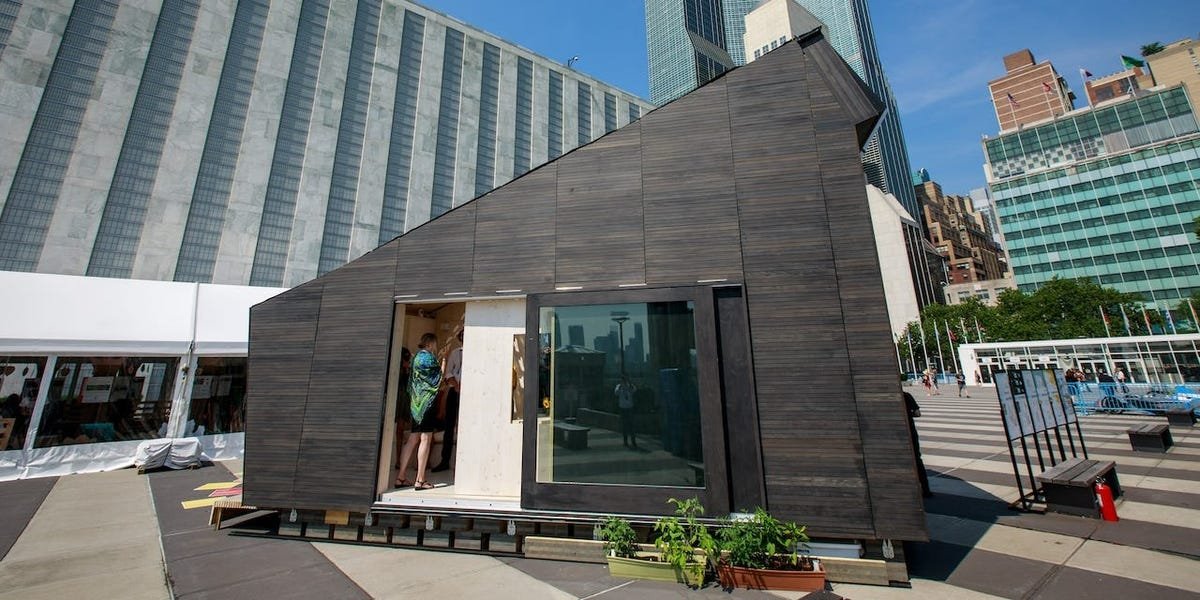
Under a sweeping zoning reform Mayor Eric Adams signed into law late last year, the city made it legal for certain one- and two-family homeowners to add an additional home, also known as an “ancillary dwelling unit” or ADU, to their property.
On September 30, 2025, the city finalized its rules for backyard and attic ADUs and began accepting applications from homeowners, although the government is still working on the rules for basement units. The city estimates that the reform — part of its City of Yes for Housing Opportunity package — will help create about 25,000 new homes in backyard cottages and converted garages, attics, and basements over the next 15 years. But the success of the reform will depend in large part on homeowners navigating high construction costs and regulations.
Wil Fisher has spent the last year preparing for this. The former city government employee founded a Queens-based firm, Unit Two Development, that helps homeowners determine whether their property is eligible for an ADU and connects them with contractors and others who can help them build one. Fisher said he and his team have identified well over 100,000 eligible individual properties, and they’ve talked with more than 100 of these homeowners, who largely live in Queens and Staten Island.
“The rules of the road are now written,” Fisher said. “It was a long process, but for the most part we’re off to the races.”
Most of the people Fisher has talked with are interested in adding an ADU to house a family member, including an aging parent or a relative with disabilities who needs care, or an adult child.
Maggie Ornstein is one of these homeowners. Ornstein, 47, lives with her mother in a house in western Queens that has been home to five generations of her family since the 1800s. She hopes to build an ADU for her mother, who’s undergoing treatment for cancer and is having difficulty navigating the stairs in their two-and-a-half-story home.
Ornstein, a public health geographer, has consulted with Fisher and determined that she could legally convert her garage into a home.
“My dream for an ADU on my property would be something that would be accessible, but might also have a second floor where a family member could potentially stay if they wanted to visit, or if I wanted to be with my mom in the ADU,” she said.
After months of planning and big picture discussions with potential clients, Fisher is starting to nail down the specifics of what his clients could build and what it might cost.
“Now is sort of the pivot from the conceptual to here’s exactly what it will take, and here are the cost implications of that,” he said.
Are you a New Yorker interested in building an ADU? Reach out to this reporter to share your experience at erelman@businessinsider.com.
Dealing with costs and regulations
One inevitable obstacle homeowners face is the steep price of building in the city. Fisher estimates that adding a backyard unit or converting a garage will start between $300,000 and $400,000, depending on the project’s size. That’s compared to the city’s median home price of $800,000.
The construction cost is out of reach for many homeowners who’d benefit most from adding an ADU to their property, said Thomas Yu, executive director of Asian Americans for Equality, an advocacy organization and affordable housing provider. Yu said there needs to be a much clearer and more affordable path to adding an ADU before the regulatory reform will unleash construction in lower and middle-income neighborhoods. He suggested tax abatements or grants for homeowners with more modest means.
Many of the New Yorkers Yu and his team work with live in overcrowded homes with multiple generations of their family. They could benefit from having a home for an older relative or an adult child who couldn’t otherwise afford to stay in the city.
“The ability for that generation to achieve independent homeownership is zero, particularly in New York City,” Yu said of younger New Yorkers. “So ADUs are the next half-step that’s needed for that.”
Ornstein said she’s been discouraged by the price tag on her potential project. She’s also turned off by how extensive and involved the construction would likely be, especially given her work schedule and caregiving responsibilities. She’s hoping to find some government funding to help pay for the project.
“It’s so much more expensive than I would have anticipated,” she said. “On the one hand, you wouldn’t be able to buy an apartment in New York City for what an ADU would cost to build. But on the other, it’s really a lot of upfront cost.”
The expense and hassle of adding an ADU might not make sense for homeowners who are just looking for rental income, Fisher said. But he expects the units will be easily rentable for those who want a tenant either immediately or in the future. Adding an ADU also tends to hike the property’s resale value.
“As far as I’m seeing, construction costs are a little too high for them to be a slam dunk rental investment from day one,” Fisher said. “But for folks who have a relative or an immediate need that exists within their own family or social network, these are going to be good investments in the long term.”
ADU construction is also limited by a slew of regulations. The units can’t be bigger than 800 square feet or take up more than a third of a homeowner’s backyard. The law also restricts basement ADUs in areas prone to flooding and prohibits them in attached homes, like townhouses.
The Regional Plan Association, a pro-housing nonprofit focused on the tri-state area, found that just 68,000 lots — 12% of the city’s one- and two-family properties — are eligible to add an ADU.
The city says it’s creating a “one-stop shop” full of information for homeowners interested in building an additional unit. The site will include a set of public, pre-approved backyard ADU designs submitted by architects, designers, and builders that homeowners can use to lower design costs and speed up the construction process.
“Efficiencies that can be built in are really going to be make or break for this market,” Fisher said.