
GabbyLandsverkpic

A longevity researcher changed his routine after visiting an island ‘Blue Zone’ where people live to 100

Steven Austad is a gym fanatic.

As the director of an anti-aging research nonprofit, he’s deeply aware that exercise might be the closest thing we have to a longevity cure-all.

That’s why he puts in about an hour a day on his bike or in the weight room as part of his longevity routine.

“I don’t take any supplements. I don’t even take a multivitamin, but I do spend a lot of time in the gym,” he told Business Insider

But on a recent research trip, Austad met with centenarians who stayed spry with a completely different style of exercise, and it changed how he thinks about working out.

“I met all these hundred-year-olds and talked to them and watched them,” he said. “They get a lot of exercise, but it’s not heavy exercise.”

Here’s what we know about the healthiest kind of movement — and why being a little bit lazy may be the key to a long, healthy life.

The best exercise for longevity

Sardinia, Italy is one of the few places in the world where people regularly live to be 100 (or even older).

Known as Blue Zones, residents in these regions have traditions that scientists suspect are linked to enduring good health. Despite being spread around the globe, from Okinawa, Japan to Nicoya, Costa Rica, Blue Zones tend to share lifestyle habits like staying active, eating simple, mostly veggie-based superfoods, and building strong social communities.

Austad traveled to Sardinia last year while working on a research paper about whether longevity hotspots live up to the hype. He wanted to test the theory that the high number of centenarians in Blue Zones is more about poor record-keeping than any exceptional anti-aging habits.


Dr Steven Austad, a longevity researcher, and a view of the hillside villages of Sardinia, Italy

Longevity researcher Steven Austad visited active centenarians in Sardinia, Italy, who get their exercise on their local hillsides instead of the gym.

Steven Austad/Getty Images — miroslav_1


What he found is that Sardinian elders are legit. Not only did he verify that residents of the island are active and vibrant into their 90s and 100s, but what he saw changed his own approach to healthy living.

Villages in Sardinia are dotted throughout the region’s rugged, mountainous terrain. As a result, people who live there are consistently hiking as part of their day-to-day activities to get around.

Combined with other household chores like gardening, Sardinians tick all the boxes of longevity exercise without ever setting foot in a gym: lots of easy cardio, a bit of high-intensity effort from walking uphill, and muscle-strengthening movements using a full range of motion.

Austad also spoke with a regenerative medicine doctor in the area, who specializes in staving off problems caused by injury or aging.

She told him that her patients are primarily young people who hurt themselves in the gym.

Austad was stunned. All the 90- and 100-year-olds he had met were vibrant and healthy, while the younger generations needed medical care for pushing themselves too hard.

“That’s just remarkable,” Austad said. “It convinced me that you don’t have to be fanatical about this stuff.”

Take it easy for a longer life

Coming back from his Italian excursion, Austad couldn’t help but rethink his own approach to exercise.


a group of family toasting with classes of wine at a dinner outside

Residents of Italy’s longevity hotspot are known for relaxing habits like drinking wine and socializing, along with their active lifestyles.

Connect Images/Zero Creatives/Getty Images


Previously, he liked hit the gym hard, leaning into the addictive rush of endorphins from intense exercise, and was constantly tempted to push for an extra set or more time working out. For him, rest days felt like a distraction.

“The occasional day off, it drives me nuts,” he said. “I’ve got this one bad knee, and if I overdo it with that knee, I pay the price. So that kind of keeps me real, tells me when I’m starting to overdo it.”

Austad still hits the gym regularly, with a mix of cardio and strength training that prioritizes core stability and everyday motions like pulling and pressing.

But since his recent studies on the Blue Zones, he said he’s more likely to give himself a break without stressing about it.

“It makes me feel a little bit less guilty on the days when I decide that I shouldn’t work out,” Austad said.


Source link

Scientists-finally-think-they-know-where-the-most-dangerous-part.jpeg

Scientists finally think they know where the most dangerous part of this US earthquake zone is and it’s bad news for Washington

Hidden off the US Western shore, beneath the Pacific Ocean, is the Cascadia Subduction Zone. This fault is capable of generating earthquakes larger than magnitude 8 that can be felt hundreds of miles away, and a recent study has pinpointed the most dangerous segment along its 700-mile-long stretch.

The results will help scientists assess earthquake and tsunami risk for this region, including one particularly vulnerable state: Washington.

“This has been a subduction zone that’s been under-studied with the kinds of tools that we have available now,” geophysicist Suzanne Carbotte, a Bruce Heezen Lamont research professor at Columbia University, told Business Insider.

Armed with state-of-the-art technology that can probe deep beneath the ocean floor and create images, Carbotte and her team produced the first comprehensive survey of Cascadia’s complex, below-ground composition. They published their work today in the peer-reviewed journal Science Advances.

The researchers discovered that Cascadia is broken up into at least four segments, which had been suggested by previous studies but never confirmed, Carbotte said.

The picture “before our study was a smooth surface with no obvious relationship to this segmentation,” Carbotte said. “But that smooth surface was based on very, very sparse data. And in places, no data.”

This new picture provides a much more accurate view of Cascadia’s complexity, and of the risk it poses to the US West Coast.

How the Cascadia Subduction Zone causes earthquakes


Diagram of the cascadia subduction zone

In the Cascadia Subduction Zone, the Juan de Fuca plate is slowly subducting under North America. As these two tectonic plates move against each other, it could trigger a giant earthquake.

USGS/Wikimedia commons


Cascadia is essentially the border between two tectonic plates: the massive North American continent, and the smaller Juan de Fuca plate.

The Juan de Fuca plate is gradually sliding (or subducting) eastward beneath the North American plate, which creates a megathrust fault: a place where tectonic plates move against each other in a dangerous way.

The stress that’s driving the Juan de Fuca plate under North America is continuous, Carbotte explained, but the plate’s movement is not. Sometimes, it gets stuck.

When locking up like this, the plates can only absorb stress for so long before they finally rupture, triggering an earthquake, she said.

This is what scientists think happened about 300 years ago when the zone ruptured offshore and the resulting earthquake formed a massive tsunami that slammed into the coast of Japan.

While Cascadia hasn’t produced a great earthquake since 1700, it’s only a matter of time.

Scientists can’t predict earthquakes but they can get a better idea of risk by understanding the fault’s complex structure deep below ground.

Carbotte and her team have moved the needle significantly on that front.

Zeroing in on risk


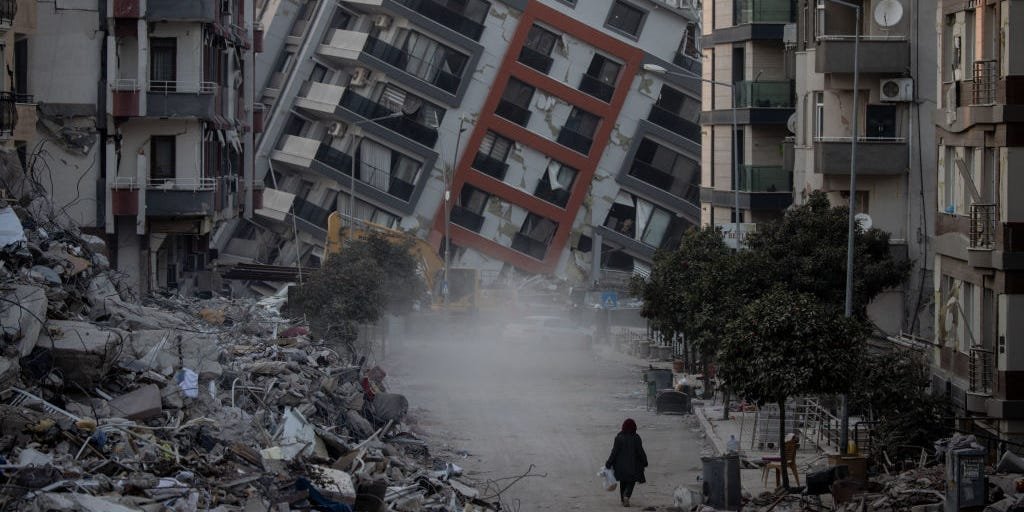
A partially collapsed building in Turkey after an earthquake

A partially collapsed building in Gaziantep, Turkey, after a 7.8 magnitude earthquake rocked the city. The Cascadia Subduction Zone can produce even larger, more dangerous quakes.

Chris McGrath/Getty Images


Carbotte and her team found lots of variability in the megathrust’s structure, which likely means that the hazard varies at different locations along the fault, said Janet Watt, research geophysicist at US Geological Survey Santa Cruz who was not involved in the study.

“It’s not a one-size-fits-all answer, but it gives us an appreciation for that complexity,” Watt, speaking about Carbotte’s results, told BI.

Additionally, understanding that Cascadia is broken up into segments is key to assessing earthquake hazard, Watt said. That’s because this segmentation means that the megathrust could rupture in pieces, rather than all at once. This could impact the size of future earthquakes, because shorter ruptures trigger smaller quakes.

What’s more, the unique characteristics of each of these segments means each one poses a different level of risk. Another key finding from Carbotte’s study is that one of Cascadia’s segments is probably more likely to produce a great earthquake than the others.

This particularly dangerous segment essentially spans the coast of Washington, running from the northern Oregon border to southern British Columbia. It’s flatter and smoother than the other segments, meaning it could trigger the largest earthquakes, Carbotte told BI in an email.

Plus, this segment likely extends further into the US than the others, which is bad news for the state of Washington. If this segment ruptured, Washington’s coastal communities could face the most extreme shaking, although the quake would extend far beyond state borders, Carbotte wrote.

Knowing that could help this state prepare for the worst-case scenario. “I think this is an example of a study that will lead to action in the future in terms of building resiliency along the coastline. And it’ll be exciting to see where the science takes us,” Watt said.

Carbotte’s research emerges in the context of many other studies that are currently working to bring our picture of Cascadia into sharper focus.

“This is one particular study of a larger community effort that is going on to [understand] the system, and then communicate what that means to communities on the coastline and inland, and how we can actually turn science into action,” Watt said.


Source link