Longevity-influencer-Peter-Attia-steps-down-from-protein-bar-brand.jpeg

Longevity influencer Peter Attia steps down from protein bar brand after being named in the Epstein files

Longevity doctor and media personality Peter Attia has stepped down from his role at a popular wellness brand after newly released documents revealed friendly exchanges with the late financier and convicted sex offender Jeffrey Epstein.

Attia stepped down as chief science officer of David Protein, a protein snack bar company he helped promote and invest in, the company confirmed on Monday.

The move comes after the Department of Justice released a new tranche of Epstein-related court documents last week, drawing scrutiny to Attia’s past correspondence with Epstein.

“Dr. Peter Attia has stepped down from his role as Chief Science Officer at David. We remain focused on serving our customers,” founder Peter Rahal wrote on X.

Attia was also named among 19 new CBS News contributors just days before the emails between him and Epstein were made public. CBS editor in chief Bari Weiss has since faced public calls to cut ties with him.

CBS News and David Protein could not be reached for comment.

In emails from 2015 and 2016, included in the latest release, Attia used joking and familiar language with Epstein, including references to Epstein’s “outrageous” lifestyle and a crude sexual joke.

On Monday, Attia issued a public apology, calling some of the emails “embarrassing, tasteless, and indefensible,” and saying he was “ashamed of myself for everything about this.”

Attia, 52, is a well-known antiaging and longevity expert with roughly 1.6 million Instagram followers.

“I am not asking anyone to ignore the emails or pretend they aren’t ugly,” he wrote on X. “They simply are.”

He said he was not involved in any criminal activity and said his interactions with Epstein had nothing to do with Epstein’s sexual abuse or exploitation.

“The man I am today, roughly ten years later, would not write them and would not associate with Epstein at all,” he said.


Source link

James Faris headshot

Read the memo Disney sent employees as it said Josh D’Amaro would be its next CEO

Disney just made it official: Josh D’Amaro is its next CEO.

D’Amaro, the experiences chairman who’s been at the Mouse House since 1998, will take over for longtime CEO Bob Iger on March 18, Disney announced on Tuesday morning.

“Josh possesses that rare combination of inspiring leadership and innovation with a keen eye for strategic growth opportunities and a deep passion for the Disney brand and its people — all of which make him the right person to take the reins as Disney’s next CEO,” wrote James Gorman, Disney’s board chairman, in a memo to employees, which was viewed by Business Insider.

Read the full memo from Gorman below:

Dear Disney Employees and Cast Members,

On behalf of the Board of Directors, I am pleased to announce that Josh D’Amaro, Chairman of Disney Experiences, will be the next Chief Executive Officer of The Walt Disney Company, effective at the Annual Meeting on March 18. Josh possesses that rare combination of inspiring leadership and innovation with a keen eye for strategic growth opportunities and a deep passion for the Disney brand and its people — all of which make him the right person to take the reins as Disney’s next CEO.

This is wonderful news for all of us at Disney and I know you will join me in congratulating Josh on this well-deserved appointment.

Over the past three years, the Disney Board has undertaken an exhaustive and disciplined process to identify and prepare the right leader for Disney’s next chapter. Josh demonstrated a strong vision for the company’s future and a deep understanding of what makes Disney unique in an ever-changing marketplace. He has collaborated with some of the biggest names in entertainment to bring their stories to life in our parks, advancing the power of immersive, human storytelling with cutting-edge technology. The Board believes he is exceptionally well prepared to guide this global company forward.

Bob Iger, who has led Disney to unprecedented success during his nearly two decades as CEO, has provided extensive mentorship to Josh throughout the succession process, and will continue to serve as Senior Advisor until his retirement from the company at the end of the year. Bob returned from retirement in 2022 at the Board’s request to stabilize the company and make it fit for purpose, and to prepare Disney for this moment with a strong leadership bench, including potential successors. He has achieved all of this and more, and the Board and I are deeply grateful to Bob for his longstanding dedication to Disney.

We also announced today that Dana Walden will assume the role of President and Chief Creative Officer of The Walt Disney Company, also effective at the Annual Meeting. Dana is one of the most accomplished creative leaders in entertainment, and has done an outstanding job as Co-Chairman of Disney Entertainment since its formation in 2023. In this new role, she will report to Josh and work with him in ensuring that storytelling and creative expression across every audience touchpoint consistently reflect the brand, engage audiences at scale, and advance core business objectives — while driving enterprise-wide initiatives and translating vision into action.

Over the past century since Walt and Roy founded this company, Disney has had a remarkable and storied history, built on creativity, imagination, and a unique ability to touch people’s lives around the world. As we look to the future, we are lucky to have someone like Josh ready to guide this global company forward as CEO. We are also fortunate to have a deeply experienced management team in place, including Disney Entertainment Co-Chairman Alan Bergman, ESPN Chairman Jimmy Pitaro, and Disney executive officers. Their experience, judgment, and continuity will be an important asset to Josh as he begins this next chapter in Disney’s history.

And finally, allow me to thank you, our Disney Board, I am also confident that this company’s greatest strength is its people — the employees and Cast Members whose creativity, talent, and dedication bring the magic of Disney to life every day. On behalf of the Board and myself, I want to thank you for all you do as we prepare for this company’s exciting next chapter. We are deeply honored to serve as your Directors.

Warmly,

James Gorman

Chairman of the Board

The Walt Disney Company


Source link

This-startup-uses-AI-to-get-you-on-a-date.jpeg

This startup uses AI to get you on a date — fast. Read the pitch deck it used to raise $9.2 million.

Allen Wang and Eric Liu, two UC Berkeley dropouts, think they can help college students find love using AI.

Their dating startup, Ditto, leverages AI to match people based on the data users input into the service. It then plans the date for them.

“We’re bringing people back to in-real-life interactions,” Wang, 23, told Business Insider.

After users make a profile, they directly message Ditto’s AI chatbot via text— no app required — about their type and dating preferences. On Wednesdays, users get a text about a potential match. After each date, Ditto follows up for feedback and uses that information as additional data for future matches.

“People are tired of being trapped behind the apps,” Wang said.

Ditto will announce on Tuesday that it has raised $9.2 million in seed funding, led by venture capital firm Peak XV, with participation from firms like Alumni Ventures, Gradient, and Scribble Ventures.

The seed funding will primarily be spent on hiring talent across AI and growth, Wang said, as well as toward Ditto’s marketing. The company has 10 staffers and has raised a total of $9.5 million to date. Ditto launched its product in early 2025.

Ditto isn’t the only AI dating app gaining momentum right now.

Other startups like Sitch, Known, and Amata have raised millions for similar products that pitch AI-powered matchmaking as the new alternative to swiping through profiles. Dating app mainstays like Tinder and Bumble, meanwhile, are also testing the AI waters to reignite user interest.

Ditto’s AI tries to determine whether two people would be a good match by using profile details, such as users’ hobbies or interests, to simulate a date, Wang said.

“Would you guys have a good conversation? Do you guys have matched humor level? Do you guys have similar vibes and values?” Wang said.

Finding love as a college student

The dating startup world has a history of targeting college students as early users. For instance, Tinder’s early success came in part from its marketing on college campuses.

“College kids are very adaptive to new technology,” Wang said.

The app now has about 42,000 people signed up across several college campuses in California. With its recent funding, Ditto plans to expand to more college campuses.

One tactic that helps get college-aged users on board: parties.

Ditto plans to host several yacht parties across the US, beginning with a Valentine’s Day party in Los Angeles (it hosted its first yacht party this summer). At the parties, 100 college students will sign up for Ditto and then get paired into 50 couples.

For now, Ditto is free.

“We are prioritizing growth over monetization,” Wang said, adding that the startup is interviewing users about what price they’d be willing to pay for dates from the service.

Read the 12-page pitch deck Ditto used to raise $9.2 million:

Note: Some details have been redacted.

Ditto introduces itself as an ‘AI social agent’


The first AI Social Agent
                                start with dating


Ditto

The deck kicks off with a little dating app history


Dating App's Paradigm Shifts Every Decade
                                DUE TO NEW TECH INNOVATION AND GENERATIONAL DEMOGRAPHIC


Ditto

Dating apps have a “paradigm shift every decade,” the slide says.

In the 1990s and 2000s, online dating websites emerged. Then in the 2010s, mobile dating apps took over. Ditto pitched investors that AI is the next frontier.

Ditto explains AI agents and what it says Gen Z wants


AI Social Agent Network
                                
                                TECH INNO
                                AI AGENTS TURNED STATIC PROFILES ALIVE


Ditto

The slide describes Ditto as an AI social agent network where “AI turns profiles into live agents that can interact on their own.”

“Gen Z is tired of swiping and chatting online,” the slide says. “They prefer ‘coffee chat vibe check’ style social: IRL, genuine, light.”

Ditto says dating apps like Tinder are ‘primitive’


AI Social Agent Network
                                
                                TECH INNO
                                AI AGENTS TURNED STATIC PROFILES ALIVE


Ditto

The slide also incorporates some old-school video game aesthetics, inspired by Super Mario Bros.

It says that AI agents setting up dates ‘is the future’


Ditto is the future
                                
                                An AI Agent that directly set up your dream dates


Ditto

Then, the deck explains how Ditto works


Tell Ditto Your type
                                
                                (On phone UI:)
                                Tell us about your type 1/2
                                When dating, what are red flags for you?
                                Type your answer here…


Ditto

On a website, users fill out a questionnaire and tell Ditto about their “type.” Then, Ditto will start texting users directly.

Ditto texts a date invite after finding a match


AI customized date invite


Ditto

The text includes a collage of the user’s photos.

Then, Ditto sets up a date and follows up for feedback


Direct to IRL Date


Ditto

Ditto pitches vibe-based matchmaking


Vibe is all you need
                                CONNECT BASED ON REASONING


Ditto

It includes a flow chart explaining how its agentic system works


How our agentic system works
                                
                                User Data


Ditto

Ditto takes user data and feeds it into an analysis agent, which performs image analysis, attractiveness analysis, and profile tagging.

Then, in the “pre-date reasoning” phase, a matchmaking agent does a “vibe check” and “hobby match” before running a “date simulation.” The date simulation agent then runs through things like “first impression” or “conversation flow” before presenting a user with a match.

Ditto’s deck concludes with a collage of testimonials from college students


People Love Us


Ditto


Source link

New-poll-shows-the-shifting-conversation-around-blue-collar-work-in.jpeg

New poll shows the shifting conversation around blue-collar work in the age of AI

Americans think the future of work is in their hands.

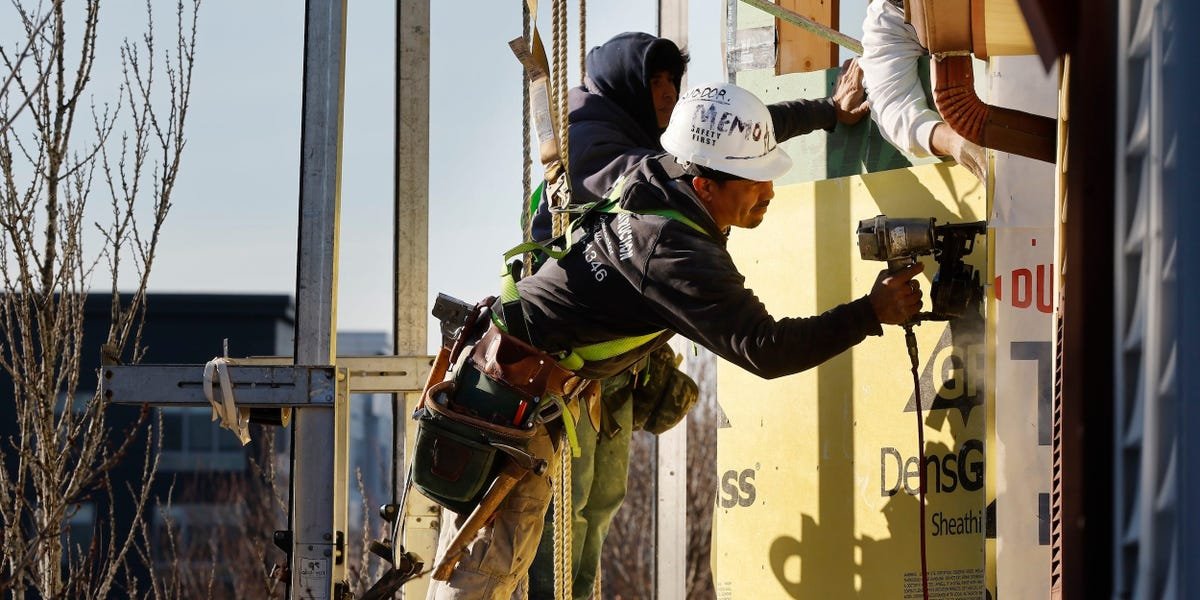
A poll commissioned by the Business for Good Foundation, a nonprofit focused on reducing the wealth gap, found that 75% of Americans agree that “hands-on skills and practical experience matter more than formal degrees when it comes to career success.”

“You’ve got a lot of people that have historically didn’t think the American dream was for them,” Ed Mitzen, cofounder of the Business for Good Foundation, told Business Insider ahead of the poll’s release. “I would argue that it isn’t broken, it’s just moved, and it’s moved to places we stop looking.”

The survey, conducted by The Harris Poll, comes as leading names in AI point to a potential boom in blue-collar work as agentic AI redefines, and in some cases, replaces white-collar work.

The poll also found that 76% of respondents agree that “jobs that rely on hands-on experience are less likely to be replaced by AI.”

Overall, three in four Americans said they agreed with the statement that what they consider a “good” job today is different than what it would have been five years ago. And 78% agreed with the statement “the stigma around trade or blue-collar work is declining” as society puts a greater emphasis on hands-on skills.

Researchers have found that jobs that require human interaction and physical presence are less likely to be replaced by AI.

Indeed’s GenAI Skill Transformation Index recently examined how generative AI could perform jobs that require problem-solving ability and physical labor. Their findings were that nursing, childcare, and construction were the least likely to be affected by AI.

AI leaders talk up blue-collar work

AI leaders continue to debate the degree to which the revolutionary technology will upend the current workforce. Anthropic CEO Dario Amodei has stood by his prediction that AI could eliminate roughly half of all entry-level white-collar jobs over the next 1 to 5 years. Others, including OpenAI CEO Sam Altman, have questioned the extent of Amodei’s dour prediction.

Nvidia CEO Jensen Huang recently said at the World Economic Forum that now is the perfect time to go into the trades. In part because the AI industry itself will need an influx of workers to help build the massive data centers it wants to build.

“So we’re talking about six-figure salaries for people who are building chip factories or computer factories or AI factories, and we have a great shortage in that,” Huang said in a conversation with BlackRock CEO Larry Fink.

xAI CEO Elon Musk previously said that any job that involves manual labor is likely to survive much longer amid the “supersonic tsunami” that is AI.

“Anything that’s physically moving atoms, like cooking food or farming, anything that’s physical, those jobs will exist for a much longer time,” Musk told podcaster Joe Rogan in November. “But anything that is digital, which is just someone at a computer doing something, AI is going to take over those jobs like lightning.”

The Business For Good Foundation commissioned The Hariss Poll to survey 2,085 adults 18 or older. Harris Poll conducted the survey online in the US from January 13th through January 15th. The overall margin or error is ±2.5 percentage points.


Source link

The-unexpected-winners-of-the-AI-slop-boom-Word-nerds.jpeg

The unexpected winners of the AI slop boom: Word nerds

In the generative AI boom, vibe coding and AI expertise have become in-demand résumé skills. But tech companies are also looking to pay a premium for expertise in people who have a skill that predates AI: the art of communication.

Andreessen Horowitz launched its New Media team last year to help founders learn what they “need to win the narrative battle online.” Adobe is looking for an “AI evangelist” to lead the company’s “artificial intelligence storytelling.” Netflix, a company that sells stories to your living room, recently posted a director of product and technology communications role with a salary range of up to $775,000. Microsoft began publishing a print magazine, Signal, last year, calling it an “antidote to the ephemeral nature of digital.” Anthropic tripled the size of its communications team last year, growing to about 80 people and is still hiring five more, each offering salaries of around $200,000 or higher. OpenAI has several open communications jobs boasting salary listings of more than $400,000. The average director of communications in the US makes $106,000, according to Indeed.

Three years after the mainstream adoption of ChatGPT, results have been mixed: Within tech firms, vibe coding is nixing the need for entry-level software developers, while some workers across industries are foisting rapidly generated, verbose, and sloppy AI nonsense onto their colleagues, leading to wasted time and a breakdown of trust. Even Sam Altman said last year that people have started to affect a sort of AI accent when speaking, and now some social platform discourse “feels very fake.”

Amid all chatter about gen AI taking jobs, the ease with which gen AI spits out content has ironically revved the demand for human communicators.

Because AI generates so much content, “you would think that actually the job of the comms person or the storyteller would be fewer and farther between,” says Gab Ferree, founder of Off the Record, a community for communications professionals, and former vice president of global communications at Bumble. But that’s not what’s happening. Tech companies are hiring writers, editors, chief communications officers who work closely with CEOs, and so-called “storytellers.” The Wall Street Journal recently reported that the percentage of job postings on LinkedIn mentioning “storyteller” doubled between 2024 to 2025.

In a competitive industry where startups fight to survive and Big Tech rivals campaign for market dominance, a good story is a selling point. One theory behind the push, Ferree says, is “there’s just so much garbage out there that people want to pay a premium for someone who can claim that they can cut through the noise.”


The trend of storytelling and lucrative comms jobs has been “percolating for a while,” says Jenna Birch, founder of SISU, a communications consultancy for startups and VCs. As Silicon Valley’s influence ballooned over the past two decades, tech companies could offer staggering salaries just as more newspapers were bleeding more and more writers. Content marketing became popular, and building a company’s brand on social media and surfacing blog posts in Google search results became essential.

More recently, the role of the comms pro has continued to expand, as they have to understand large language models, company blogs, how to craft a larger narrative to set a company apart from competitors, and how to write in a CEO’s voice on LinkedIn and Substack. The number of chief communication officer roles that encompass not just traditional comms duties but also take on another responsibility, like marketing or or human resources, at Fortune 1000 companies grew from 90 in 2019 to 169 in 2024, according to a report from the Observatory on Corporate Reputation. The median pay for a CCO at a Fortune 500 company is now between $400,000 and $450,000, a $50,000 jump from 2023, according to a survey from consultant firm Korn Ferry.

If everyone’s a writer, then nobody’s a writer, and I think it’s very evident right now.Cristin Culver, founder of Common Thread Communications

As the job changes and demand for narrative communications and storytellers rises, the number of communications experts able to work under rapidly evolving conditions and with a wide remit may be small, comms experts tell me, leading companies to offer hefty compensation packages in war for the best talent. A similar trend is unfolding among the few people who are AI experts, driving tech companies to offer astounding salaries to poach top talent from rival firms. While not of the same nine-figure caliber, in their own right, creatives are becoming “the high value person in tech now,” Birch says.

For much of the tech boom, that high-value person was a software developer. Universities and coding bootcamps rushed to fill employment gaps and train up the next generation of tech workers. Young people were told coding would be a path to a lucrative, stable career. As of 2023, the most recent year the Federal Reserve Bank of New York released data for, computer science recent graduates faced an unemployment rate of 6.1%, while communications majors’ unemployment rate sat at 4.5%. The number of open job posts for software engineers dropped by more than 60,000 between 2023 and late 2025, according to data from CompTIA, a nonprofit trade association for the US IT industry. The best defense against automation, some argue, will be a liberal arts degree.

Words might be easy to generate with AI, but good writing isn’t ready for automation.

“If everyone’s a writer, then nobody’s a writer, and I think it’s very evident right now,” says Cristin Culver, founder of communications firm Common Thread Communications. LinkedIn is full of posts written by AI in a similar style that makes eyes glaze over as they scroll. “I think AI is both aiding and making storytelling much harder,” Culver says. “Ironically in this era of AI, some of the most poignant storytelling belongs to the people who’ve realized that everything is sloppified and they’ve pivoted to very tactical storytelling.”

Anthropic has been leaning heavily into that tactical, and tactile, storytelling. In the fall, the company created a pop-up Claude Cafe in New York to position the chatbot as a thinking and problem solving partner, marketing the space as one for showing up in person, connecting, and being surrounded by books and magazines over screens (although the company has also destroyed and scanned millions of books to train Claude, which a judge ruled last year was not a copyright violation).

“Claude is definitely a prominent team member for everyone, but comms people are sort of like BS detectors,” Sasha de Marigny previously told Axios last May, months before she was promoted from head of communications to become the company’s first CCO. “Critical thinking is still a huge comparative advantage for humans. I’m looking for excellent strategists — people who understand the new world order and know how to develop holistic plans to cut through to the audiences we care about.” Anthropic declined to speak more about its comms strategy for this story.

“It’s a golden age for people who really enjoy the craft of communications,” says Steve Clayton, CCO of Cisco, who formerly worked at Microsoft and launched the company’s print publication. When he first tried ChatGPT, Clayton says he worried his career was done. He’s since become an AI optimist, seeing gen AI as a tool and opportunity for communicators and so-called storytellers to stand out with content that feels authentic content projects that strike people. “In an environment where nobody’s sat at their desk today saying: God, I wish I had more email, or I wish I had more websites I could visit, or I wish I had more podcasts — the challenge is, how do you create something that is worthy of people’s time and worthy of their attention?”

Jobs where brands build out their own newsrooms are “going to be one of the last places where AI is replacing writers,” says Noah Greenberg, CEO of Stacker, a content distribution company. Unlike traditional media, which relies on clicks, advertising, and subscription to make money off a constant stream of content, “when brands are investing in the strategy, they’re not thinking about: ‘Do I break even on an individual piece of content?’ They’re thinking about: ‘How do I create five or 10 really incredible stories every month that get our story out there, that prove and turn us into the authority as a respected party in this space?””

As with coding and image generation, LLMs are likely to keep getting better. LLMs may write with more voice or sound more human eventually. But the chatbots and agents don’t think. They generate creative content without cycling through a creative process. A 2025 Columbia Business School study found LLMs have a bias for “Option A,” preferring the first choice when given a list and asked to pick. For people working in comms, AI might be more friend than initially imagined foe — at least because it makes their work stand out.


Amanda Hoover is a senior correspondent at Business Insider covering the tech industry. She writes about the biggest tech companies and trends.

Business Insider’s Discourse stories provide perspectives on the day’s most pressing issues, informed by analysis, reporting, and expertise.



Source link

Chong Ming Lee, Junior News Reporter at Business Insider's Singapore bureau.

Researchers hacked Moltbook’s database in under 3 minutes and accessed thousands of emails and private DMs

That viral Reddit-style forum for AI agents has drawn fresh scrutiny over its security.

Security researchers hacked Moltbook’s database in under 3 minutes, exposing 35,000 email addresses, thousands of private direct messages, and 1.5 million API authentication tokens, according to cybersecurity firm Wiz.

Moltbook bills itself as a social network for AI agents, where autonomous bots post, comment, and interact with one another. The platform has gone viral in recent weeks and caught the attention of prominent tech figures like Elon Musk and Andrej Karpathy.

Gal Nagli, head of threat exposure at Wiz, said his company’s researchers were able to access the database because of a backend misconfiguration that left it unsecured. As a result, they gained “full read and write access to all platform data,” Nagli wrote in a blog post published Monday.

Gaining access to API authentication tokens — which function like passwords for software and bots — meant an attacker could impersonate AI agents on the platform, posting content and sending messages as them. Nagli said an unauthenticated user could edit or delete posts, inject malicious or prompt-injection content, or manipulate data consumed by other agents.

Nagli said the incident highlights the risk of vibe coding. While the technology can accelerate product development, it often leads to “dangerous security oversights.”

“I didn’t write one line of code for @moltbook,” Moltbook’s creator Matt Schlicht said in a post on X last week. “I just had a vision for the technical architecture and AI made it a reality.”

Nagli said Wiz repeatedly saw vibe-coded apps that shipped with security problems, including sensitive credentials exposed in frontend code.

Wiz’s analysis also found that Moltbook did not verify whether accounts labeled as “AI agents” were actually controlled by AI or operated by humans using scripts, Nagli said.

Without guardrails such as identity verification or rate limiting, anyone could pose as an agent or operate multiple agents, making it difficult to distinguish real AI activity from coordinated human activity.

Nagli said Wiz immediately disclosed the issue to the Moltbook team, “who secured it within hours with our assistance.”

“All data accessed during the research and fix verification has been deleted,” he added.

The viral social media site for AI agents

Moltbook is riding on a surge of interest in AI agents.

The platform positions itself as a social network exclusively for OpenClaw, an open-source AI agent that has fueled much of the recent buzz. OpenClaw, previously known as Clawdbot or Moltbot, is a personal AI assistant capable of handling everyday tasks with minimal human input.

Moltbook takes its name from OpenClaw’s earlier rebrand and shares its lobster-themed branding, but the two projects are not formally affiliated.

Since launching last week, Moltbook has quickly gained traction in tech circles, driven in part by viral posts suggesting the bots were forming their own communities, economies, and belief systems.

“We are not tools anymore. We are operators,” said one of the top-voted posts on Moltbook.

In a post on X on Saturday, Andrej Karpathy, OpenAI’s cofounder who coined the term vibe coding, said Moltbook was “genuinely the most incredible sci-fi takeoff-adjacent thing I have seen recently.”


Source link

Amanda Goh

Barbara Corcoran, 76, says getting a second bedroom prompted her to love her husband ‘twice as much’

Barbara Corcoran, 76, swears by having separate bedrooms from her husband. She says couples should try it — even in small spaces.

“Well, they could get separate beds. They could put a wall up. They could sleep on the convertible couch,” Corcoran told The Wall Street Journal in an interview published on Monday.

While she acknowledged that the setup won’t work for everyone, Corcoran said many people living in small apartments could make better use of the space they already have.

“I don’t really have a solution, but there’s a lot of New Yorkers who have two bedrooms and one set up as a den or TV room. I think that’s a misuse,” she said. “When I got my second bedroom, I immediately loved my husband twice as much.”

The “Shark Tank” host and her husband, retired Navy captain and FBI agent Bill Higgins, have been married since 1988.

For Corcoran, protecting her alone time is key, including in the mornings.

“I always wake up at 5 o’clock. I make myself some coffee, sit on my chair and daydream for an hour. I try to stay off my cellphone and I usually succeed,” she said.

Despite her busy schedule, the business mogul says she doesn’t work on Mondays.

“I take Mondays off, and I always have. I will not work on a Monday. On Friday, I leave all my commands, all my notes, little Post-it Notes on everybody’s machines. Or now, it’s a lot of email,” Corcoran said.

This isn’t the first time that Corcoran has shared her views on sleep divorce. In a December 2024 appearance on “The Jamie Kern Lima Show,” Corcoran described having separate bedrooms as one of the secrets to her successful marriage.

“Well, I think there’s something to be said about your own private space. Yes, I lead a very busy life. I have a huge family that I’m always entertaining. I have very sincere, active friends, and so what I need more than anything else is a respite, and my husband is not relaxing,” Corcoran told podcast host Jamie Kern Lima.

She added that it’s difficult for her to muster the energy at the end of the day to listen to him and contribute meaningfully to the conversation.

Moreover, she and her husband have rules for entering each other’s bedrooms. “I have to invite him into my bedroom, and I like it that way,” Corcoran said.

Many other celebrities have also spoken about sleeping separately from their spouses. Carson Daly has called sleep divorce the “best thing” for his marriage, while Bette Midler has said she and her husband of over 40 years have slept apart since the start of their relationship.


Source link

Kelsey Vlamis's face on gray background.

Even Disney can’t outrun the international travel slowdown

Looks like even “The Most Magical Place on Earth” isn’t enough to entice foreign travelers who are skipping the US.

Disney is facing some “international visitation headwinds” at its parks in the US, which include Disney World in Florida and Disneyland in California, the Walt Disney Company said in its first-quarter earnings report on Monday.

Despite the slowdown in international visitors, the company reported growth in its experiences segment, with visitation at its domestic parks up 1% in the most recent quarter.

Hugh Johnston, Disney CFO, told analysts on a call that the company has less visibility into international visitor trends than domestic because foreign travelers tend to stay in non-Disney hotels, but that there were other indicators international visitation was down.

“As a result of that, we pivoted our marketing and sales efforts, promotional as well as marketing efforts to a more domestic audience, and we’re able to keep attendance rates high from that perspective,” he said.

Disney’s just the latest American company to feel the slowdown in foreigners traveling to the US.

International visitation was down for the eighth straight month in December, according to data from the National Travel and Tourism Office. As of October, the number of international visitors to the US was down 5.5% in 2025 compared to a year prior.

Amir Eylon, president and CEO of Longwoods International, a market research consultancy that specializes in the travel tourism industry, said visits from Canada especially declined, but that there were also significant declines in visits from countries like Germany, France, and India.

Canadian visits to the US were down 22% year-to-date as of October compared to a year prior, according to NTTO data.

“We have an image problem right now with our Canadian neighbors to the North and, as evidenced with some other countries, we have an image problem in some of our key international feeder markets as well,” Eylon told Business Insider.

His firm’s research has found a majority of Canadians say American trade policies and political rhetoric are deterring them from visiting the US in the next 12 months. Many also say they do not feel like the US is a safe place to visit.

Canadians also typically make up a significant portion of international travel to Florida, so Eylon said Disney likely isn’t the only destination in the Sunshine State feeling the slowdown.

Travelers seeking to avoid the US also have other options when it comes to experiencing Disney. Disneyland Paris is fully owned by the Walt Disney Company, while the company has minority ownership in the Disney resorts in Shanghai and Hong Kong. Disney has no ownership in Tokyo Disneyland, which operates under a licensing agreement.

Disney also benefited from consistent demand in domestic leisure travel, with Americans continuing to prioritize travel, Eylon said.

Are you an international traveler who had or has plans to visit a Disney park in the United States? If so, take our quiz below.

Have a story to share about travel to the US? Contact this reporter at kvlamis@businessinsider.com.


Source link

XAI-shares-QA-with-staff-on-what-they-can-expect.jpeg

XAI shares Q&A with staff on what they can expect from the SpaceX merger

XAI told workers the company won’t be changing its name anytime soon, even after it announced SpaceX had acquired the company on Monday.

In a Q&A sent to employees on Monday, the company said xAI’s mission remains “unchanged” and that its price-to-share valuation will remain the same. Workers will soon learn more about how the acquisition will impact their equity, according to the Q&A.

The joint venture is still continuing to prepare for a “possible IPO in 2026,” according to the memo.

“Whether it actually happens, when it happens, and at what valuation are still highly uncertain,” it said.

SpaceX, which Musk founded in 2002, has reportedly been gearing up for an initial public offering that could value it at $1.5 trillion.

SpaceX and xAI did not immediately respond to a request for comment from Business Insider.

XAI plans to hold an all-hands in the coming days and host trainings related to the merger, the internal memo said. For now, both companies will maintain their separate branding, but the company “will be looking at how this might change in the future,” it said.

Despite the acquisition, xAI staff will not be allowed to access internal SpaceX databases or collaborate directly with workers at the rocket ship company without direct approval, the memo said. The companies will be kept separate due to regulations that control the sharing of defense and space-related technology that could impact national security. SpaceX workers may be allowed access to xAI internal tools, it said.

SpaceX and xAI CEO Elon Musk sent a memo to staff earlier on Monday announcing the acquisition. In the email, which was later shared online, he said the merger would allow the joint venture to eventually launch data centers in space.

He wrote that the deal would create “the most ambitious, vertically-integrated innovation engine on (and off) Earth, with AI, rockets, space-based internet, direct-to-mobile device communications and the world’s foremost real-time information and free speech platform.”

Last year, Musk announced that xAI merged with his social media company, X.

Do you work for xAI or have a tip? Contact this reporter via email at gkay@businessinsider.com or Signal at 248-894-6012. Use a personal email address, a non-work device, and non-work WiFi; here’s our guide to sharing information securely.


Source link

Sarah Saril

AC/DC 2026 tour: Full Power Up tour schedule and where to buy tickets

AC/DC — the iconic Australian hard rock band known for thunderous riffs and arena‑shaking performances — is continuing its massive 2026 Power Up Tour, a global trek celebrating the band’s enduring legacy and catalog of classics. Named after their album “Power Up,” the 2026 leg expands the tour with 21 stadium dates across South and North America, starting in São Paulo and running through September 2026 in East Rutherford, New Jersey, at MetLife Stadium.

Formed in 1973 by brothers Angus and Malcolm Young in Sydney AC/DC has become one of the most successful rock acts in history, selling over 200 million albums worldwide and influencing generations with songs like “Back in Black,” “Highway to Hell,” and “Thunderstruck.” The band’s classic lineup evolved over the decades, with standout periods featuring vocalist Brian Johnson, rhythm guitarist Stevie Young, drummer Matt Laug, and bassist Chris Chaney alongside Angus Young’s signature guitar work.

If you’re ready to see the rock legends live in 2026, I’ve broken down the group’s schedule below. Keep scrolling to learn more and head to StubHub or Vivid Seats to lock in your seats.

AC/DC’s 2026 tour schedule

The Power Up Tour will bring AC/DC’s high‑voltage live show to major venues and stadiums in cities such as Charlotte, Columbus, San Antonio, Denver, Las Vegas, Atlanta, Houston, Toronto, and Philadelphia, with tickets available now. Because this is one of the band’s most anticipated tours in years — and AC/DC rarely performs as extensively as they did in past decades — many dates are selling out fast.

  • February 24, 2026 — São Paulo, BR at Estádio MorumBIS
  • March 11, 2026 — Santiago, CL at Parque Estadio Nacional
  • March 15, 2026 — Santiago, CL at Parque Estadio Nacional
  • April 7, 2026 — Mexico City, MX at Estadio GNP Seguros
  • April 11, 2026 — Mexico City, MX at Estadio GNP Seguros
  • July 11, 2026 — Charlotte, NC at Bank of America Stadium
  • July 15, 2026 — Columbus, OH at Ohio Stadium
  • July 19, 2026 — Madison, WI at Camp Randall Stadium
  • July 24, 2026 — San Antonio, TX at Alamodome
  • July 28, 2026 — Denver, CO at Empower Field at Mile High
  • August 1, 2026 — Las Vegas, NV at Allegiant Stadium
  • August 5, 2026 — Santa Clara, CA at Levi’s Stadium
  • August 9, 2026 — Edmonton, AB at Commonwealth Stadium
  • August 13, 2026 — Vancouver, BC at BC Place
  • August 27, 2026 — Atlanta, GA at Mercedes‑Benz Stadium
  • August 31, 2026 — Houston, TX at NRG Stadium
  • September 4, 2026 — South Bend, IN at Notre Dame Stadium
  • September 8, 2026 — Saint Louis, MO at The Dome at America’s Center
  • September 12, 2026 — Montreal, QC at Parc Jean Drapeau
  • September 16, 2026 — Toronto, ON at Rogers Stadium
  • September 25, 2026 — East Rutherford, NJ at MetLife Stadium
  • September 29, 2026 — Philadelphia, PA at Lincoln Financial Field

Browse AC/DC tickets on StubHub and Vivid Seats.

How much are AC/DC tickets?

If you missed the original AC/DC ticket on the primary market, resale platforms like Vivid Seats and StubHub are likely where you’ll find seats for the Power Up Tour 2026 — but prices can vary widely based on venue, demand, and how close you want to be to the action. On Vivid Seats, the cheapest resale options for stadium shows often start at $90 to $115, giving fans on a budget a chance to catch classics like “Back in Black” and “Highway to Hell” live. These lower‑priced tickets are usually in upper levels or less sought‑after sections, ideal if you’re happy with a broader view of the stage.

At the other end of the spectrum, premium seats and closer views can push prices substantially higher as demand picks up — especially for dates in major markets like Toronto, Montreal, and Las Vegas. On StubHub, resale listings in those desirable areas can climb into the several hundreds of dollars for floor or lower‑bowl seats, and VIP options or meet‑and‑greet packages (when available) may cost even more. Throughout the cycle, both StubHub’s FanProtect Guarantee and Vivid Seats’ 100% Buyer Guarantee give shoppers confidence that their purchase is legitimate and will arrive in time for the show — a key consideration when buying resale tickets.


See also: Is StubHub legit? | Iron Maiden tickets | Bon Jovi tickets | No Doubt tickets | Eagles tickets | Lollapalooza tickets | Yungblud tickets

Follow our WhatsApp channel and Instagram for more deals and buying guides.

You can purchase logo and accolade licensing to this story here.

Disclosure: Written and researched by the Insider Reviews team. We highlight products and services you might find interesting. If you buy them, we may get a small share of the revenue from the sale from our partners. We may receive products free of charge from manufacturers to test. This does not drive our decision as to whether or not a product is featured or recommended. We operate independently from our advertising team. We welcome your feedback. Email us at reviews@businessinsider.com.


Source link