Jeffrey Epstein did not have any children, despite what an email in just-released documents suggested, his brother told Business Insider.
“No, Jeff didn’t have any kids,” Mark Epstein said Monday. “If Jeff had a kid, I think I would have known.”
The denial comes in reaction to a set of messages included in the latest cache of Epstein files issued by the US Department of Justice.
The messages, sent in September 2011, are signed “Sarah xx” and reference “The Duke.” They appear to have been sent through BlackBerry Messenger.
The sender’s name and email address were redacted by the Justice Department. The BBC and other British media outlets have reported that they may have come from Sarah Ferguson, the ex-wife of the former Prince Andrew, who also held the title Duke of York.
Every time Jacob publishes a story, you’ll get an alert straight to your inbox!
Stay connected to Jacob and get more of their work as it publishes.
“Don’t know if you are still on this bbm but heard from The Duke that you have had a baby boy,” one message says. “Even though you never kept in touch, I still am here with love, friendship and congratualtions on your baby boy.”
A follow-up message sent the same day accused Epstein of befriending her “to get to Andrew.”
“You have disappeared. I did not even know you were having a baby,” the message said. “It was sooooo crystal clear to me that you were only friends with me to get to Andrew. And that really hurt me deeeply. More than you will know.”
A representative for Ferguson didn’t immediately respond to a request for comment.
The former prince is now known as Andrew Mountbatten-Windsor. He relinquished his royal titles last year, around the release of a posthumous memoir from Virginia Giuffre, who accused him and Epstein of sexual abuse. In 2022, the former royal had also settled a civil lawsuit brought by Giuffre.
Another message from “Sarah,” dated January 2010, expressed intense gratitude for Epstein.
“You are a legend. I really don’t have the words to describe, my love, gratitude for your generosity and kindness,” Sarah wrote. “Xx I am at your service . Just marry me.”
Aside from the “baby boy” message, the vast public corpus of emails and other documents released so far has made no reference to Epstein having a child.
If you are a survivor of sexual assault, you can call the National Sexual Assault Hotline (1-800-656-4673) or visit its website to receive confidential support.
Elon Musk has for years blurred the lines between the companies he leads.
The intermingling of Elon Inc. businesses — a number which shrank from six entities to five when xAI acquired X last year, and from five to four when SpaceX acquired xAI on Monday — is something of signature for the CEO.
Over the past three years, his companies have stepped up their internal dealings, investing billions in one another, agreeing to buy up each other’s products, and exchanging software and materials.
The result is a tightly knit corporate ecosystem centered on Musk, where work — and even employees — can flow between the various entities in the name of vertical integration.
Here are some of the recent sharing agreements, purchases, and investments between Musk’s companies.
Every time Ben publishes a story, you’ll get an alert straight to your inbox!
Stay connected to Ben and get more of their work as it publishes.
Musk’s employees often work between companies
Shortly after acquiring Twitter, Elon Musk brought Tesla engineers into the offices to work on its code base.
Photo by -/Twitter account of Elon Musk/AFP via Getty Images
Musk has repeatedly drawn on employees from one company to support others in his portfolio.
In 2022, about a month after Musk bought Twitter — now known as X — he sent roughly 50 Tesla employees to the social-media company’s headquarters to help overhaul its code-review systems, according to court filings.
Musk later argued in court that the Tesla employees had “volunteered” to do the work and that their temporary reassignment should not concern Tesla’s board.
Executives share overlapping functions on several of Musk’s companies, too, according to insider org charts obtained by Business Insider.
For example, Charlie Kuehmann, the vice president of materials and engineering at Tesla, also holds the same title at SpaceX.
SpaceX contributes to Roadster, Tesla provides SpaceX with energy-storage systems
SpaceX is lending rocket-boosting tech to Tesla’s upcoming hyper-powered sports car, Musk said.
Joe Raedle/Getty Images
SpaceX is a major customer of Tesla’s energy business, purchasing batteries for robotics power and Megapack energy-storage systems.
It also reportedly invested $2 billion into xAI as a part of a previous funding round.
Musk has also said that Tesla’s long-awaited next-generation Roadster will be a “Tesla/SpaceX collab” and feature SpaceX-built cold-gas thrusters. The hyper-powered sports car’s launch event is penciled in for April 1.
“It’s gonna be really cool, and it’s gonna have some rocket technology in it,” Musk also said during a 2024 sit-down with Don Lemon.
SpaceX and Boring Company buy Tesla cars
A Tesla entering the Hawthorne Tunnel, made by Elon Musk’s Boring Co.
Robyn Beck/Pool via REUTERS
Aside from full-blown investments or acquisitions, the most publicly visible example of Musk’s companies coordinating might be Tesla’s vehicle sales to his tunnel-building start-up.
The Boring Company, which operates tunnels in Las Vegas and Texas, uses fleets of Tesla vehicles to transport passengers through its underground systems. The tunnel builder has also constructed tunnels around Tesla’s Gigafactory in Austin, Texas.
It isn’t alone. SpaceX also purchased an unspecified number of Musk’s Cybertrucks.
Tesla and xAI’s ‘framework agreement’ follows Grok integration into cars, Optimus demo bots.
Tesla wants to build out its AI software, including its self-driving ambitions. CEO Elon Musk said a $2 billion investment in his software company would help.
Jay Janner/The Austin American-Statesman via Getty Images
Tesla’s earnings on Wednesday disclosed that it had agree to invest $2 billion in xAI, Musk’s artificial intelligence startup, with a related “framework agreement” to explore additional collaboration opportunities.
Tesla has already integrated xAI’s Grok into its vehicles, allowing drivers to chat with the AI and use it to add and edit navigation destinations.
Videos have shown early versions of Tesla’s in-development Optimus robot using xAI’s Grok AI chatbot for its voice.
xAI has also reportedly told investors that it’s working on AI that could power Tesla’s forthcoming Optimus humanoid robots.
Tesla executives said the $2 billion investment supports the automaker’s push into self-driving technology. For example, the earnings deck explained that xAI-developed software will analyze vehicle interiors and assist with route planning, including adding high-occupancy-vehicle lanes when the car is full.
For xAI, the investment adds capital to the cash-hungry buildout of data centers and their energy needs.
The deal marked one of the clearest examples of capital flowing from Musk’s public company into a privately held firm he controls.
It’s all par for the course for ‘Elon Inc.’
The growing web of internal deals has fueled discussion among investors and analysts about whether Musk’s companies are evolving into something closer to a single, vertically integrated enterprise.
And it’s not clear if it’ll stop at SpaceX combining with xAI.
There’s also been recent reports that Tesla could combine with SpaceX.
“In Tesla’s case, an important factor to consider is that investors are buying into Elon Musk’s vision for the future as much as they are buying into an automaker or clean energy company,” Lou Whiteman, a contributing analyst at The Motley Fool, told Business Insider.
“Since this group of companies, public and private, combine to represent Elon Musk’s full vision of the future, I’d bet that many investors are happy to see Tesla involved in all aspects of ‘Elon Inc.'”
The NFL conference championships have concluded, which means that Super Bowl LX is almost here. Keep reading to learn how to get Super Bowl tickets in 2026. Tickets can be hard to find, but there are still a few ways to snag seats.
In a repeat of the 2015 Super Bowl, the New England Patriots will square off with the Seattle Seahawks. In their last match-up, the Patriots beat the Seahawks 28-24 after a snappy fourth quarter from New England. The Patriots have won six Super Bowls, the most recent of which was in 2019, while the Seahawks have one SB title to their name. The East vs. West Coast showdown will take place at Levi’s Stadium in Santa Clara, California. It’s the home of the San Francisco 49ers, but it will become neutral territory for the big game. The halftime show will be headlined by Bad Bunny, who previously made a guest appearance in the 2020 Super Bowl halftime show, which was headlined by Jennifer Lopez and Shakira.
Below, we’ll break down everything you need to know about getting tickets to Super Bowl LX, including the cheapest starting prices we’ve spotted across notable resale ticket websites. You can also peruse StubHub, Vivid Seats, and the Ticketmaster resale marketplace at your own leisure. If you’re planning to watch from home, don’t forget to bookmark our guide on where to watch the Super Bowl.
How to get Super Bowl tickets
Super Bowl tickets are a bit of a tricky beast. Original tickets are no longer available outside of pricey location packages, so people must look to resale ticket listings on sites like StubHub, Vivid Seats, or Ticketmaster. Ticketmaster is the NFL’s official ticketing partner, although only resale tickets are available right now.
How much are Super Bowl tickets?
The Super Bowl is perhaps the biggest American sporting event of the year, so it should be no surprise that ticket prices are steep. At the time of writing, the absolute cheapest ticket listings we’re seeing across top resale vendors are over $4,500 each. Prices surge the closer the seat is to the field, with many prime listings reaching upwards of $20,000.
At the time of writing, the cheapest tickets start at $4,592 on Ticketmaster, $4,994 on StubHub, and $4,730 on Vivid Seats. Starting prices have dropped by over $1,500 on all three sites since last week. On January 27, the cheapest tickets started at $6,499 on Ticketmaster, $6,532 on StubHub, and $6,377 on Vivid Seats. Prices often fluctuate throughout the day as tickets are purchased and additional listings are added.
Last year, prices dropped significantly in the week leading up to the Super Bowl. The cheapest tickets available in the last few days before Super Bowl LIX dropped below $3,000 a piece, so if you’re already near Santa Clara or don’t mind making last-minute travel accommodations, it might be worth holding out until later in the week.
Note: Certain services and regions prohibit the resale of tickets. Business Insider does not endorse or condone the illegal reselling of tickets, and entry into an event is at the venue’s discretion.
Lillian Brown
Senior Associate Editor of Streaming
Lillian Brown is the Senior Associate Editor of Streaming at Business Insider. A lifelong entertainment and media buff, she specializes in helping you find how to watch your favorite shows, movies, and sporting events.ExperienceLillian has been writing about entertainment, sports, TV, and film for over six years, starting her career in the Living/Arts department of The Boston Globe. She went on to write entertainment features, roundups, and conduct celebrity interviews for publications like Vulture, TV Guide, Esquire, Time, and The Daily Beast before joining Business Insider as a streaming specialist on the Reviews team.In her current role, she writes about everything from finding the right VPN for watching overseas soccer games to choosing between the endless number of streaming services out there. When she’s not writing, she is editing stories from freelancers or fellow Reviews team members. Lillian is also an expert deal hunter. She loves the thrill of sharing an amazing discount with readers, whether it be on her favorite streaming services or on products she knows our team loves and recommends. She plays an active role in writing about sales and deals for the Reviews team.Why you can trust LillianWhether she’s testing streaming platform interfaces or actively comparing channel offerings between services, Lillian always has her finger on the pulse of what’s new in entertainment. She has tested nearly every streaming service and is an expert when it comes to VPNs. She is the first person to know when a streaming service has changed its price, and whether or not it’s still worth paying for. As a sports fan, she also knows exactly where the next big playoff game is streaming, what time it starts, and where they’re playing. Expertise
Streaming services
How to watch your favorite films, TV, sports
VPN services for legal streaming
Deals
Outside of workMost of the time, you can find Lillian watching a horror movie, WNBA game, or long-distance running. She is located in Boston.
You can purchase logo and accolade licensing to this story here.
Disclosure: Written and researched by the Insider Reviews team. We highlight products and services you might find interesting. If you buy them, we may get a small share of the revenue from the sale from our partners. We may receive products free of charge from manufacturers to test. This does not drive our decision as to whether or not a product is featured or recommended. We operate independently from our advertising team. We welcome your feedback. Email us at reviews@businessinsider.com.
This story is available exclusively to Business Insider
subscribers. Become an Insider
and start reading now. Have an account? .
Kevin Warsh has been nominated by President Donald Trump to become the Federal Reserve chair.
The reaction from key voices in economics and business poured in soon after the announcement.
Most people agree that Warsh is a qualified pick, while some have concerns about his track record.
President Donald Trump has chosen Kevin Warsh, a former bank executive and central bank governor, to lead the Federal Reserve.
Within minutes of the nomination, reactions started pouring in from prominent economists and business leaders.
Here are what some of the leading voices in economics and business are saying.
Mohamed El-Erian
Mohamed El-Erian is one of the most prominent voices in global markets and economics. Nordin Catic/Getty Images For The Cambridge Union
The renowned economist Mohamed El-Erian congratulated Warsh on his nomination to lead the Fed.
“Having observed and interacted with Kevin during his prior tenure as Fed Governor, in academia, and as a fellow member of the Group of Thirty (G-30), I believe he brings a strong mix of deep expertise, broad experience, and sharp communication skills,” El-Erian wrote in a post on X.
“His commitment to reforming and modernizing the Fed bodes well for enhancing policy effectiveness and protecting the institution’s political independence.”
Earlier in January, El-Erian wrote on X that the Department of Justice probe into Jerome Powell could undermine the “credibility of a Fed whose public standing is already fragile.”
Jason Furman
Jason Furman, a Harvard economist and former chair of President Barack Obama’s Council of Economic Advisers Pier Marco Tacca/Getty Images
Jason Furman, a Harvard economist and former top economist to President Barack Obama, wrote on X that “Warsh is well above the bar on both substance and independence to be Chair of the Federal Reserve.”
“The Senate should ask tough questions about his independence & President Trump should reduce the threat to it. Hopefully that will make it clear Warsh should be confirmed,” he wrote.
“Warsh has a range of views that would not have led me to recommend a Democratic President nominate him as Federal Reserve Chair,” Furman added. “I would be thrilled if he ends up conducting himself over the next four years in a way that would make a President of any party want to reappoint him.”
Joseph Brusuelas
Joseph Brusuelas, principal and chief economist for RSM US LLP, said Warsh meets the bar to lead the Fed, but he should be questioned on central bank independence and reform, as well as on reducing the Fed’s balance sheet.
“Moreover, he should be challenged to how he would respond in a financial crisis given his public track record of focusing on inflation risk during a time of rising unemployment and deflation during the early portion of the Great Financial crisis,” Brusuelas wrote on X.
“Warsh has a range of views and track record that presents significant concerns about how he would proceed during a financial and economic crisis. I would not have recommended him but he is qualified for the job,” he added.
Robin Brooks
Robin Brooks, senior fellow at the Brookings Institution. David Zorrakino/Europa Press via Getty Images
Robin Brooks, senior fellow at Brookings, said in an X post that Warsh “is a really good pick for Fed Chair and known as a hawk.”
He did, however, note the muted market reaction in the minutes after the announcement.
“But markets are asking themselves what was promised to get the nod, which is why the Dollar – after its huge decline in recent days – isn’t managing to rally on what should be good news,” said Brooks, who was also a managing director and chief economist at the Institute of International Finance.
Paul Krugman
Paul Krugman was awarded the 2008 Nobel Prize in economics. Alejandro Martinez Velez/Europa Press via Getty Images
Paul Krugman, a Nobel Prize-winning economist and research professor at the City University of New York’s Graduate Center, criticized Warsh’s nomination.
He wrote in a post on his Substack: “As I write this, many media reports are describing Warsh as a monetary hawk. That’s a category error. Warsh is a political animal. He calls for tight money and opposes any attempt to boost the economy when Democrats hold the White House.”
Krugman cited Warsh’s track record as a member of the Federal Reserve Board, saying he had “argued strenuously against the Fed’s efforts to boost the economy.”
“It’s a humiliating day for the Federal Reserve, which has always prided itself on its professionalism and has been hugely respected around the world. But even the Fed can’t insulate itself from the derangement sweeping America,” he added.
Sonali Basak
Sonali Basak, the chief investment strategist for iCapital and a former Bloomberg anchor, wrote on X: “Between Bessent & Warsh, you have two proteges of Stanley Druckenmiller in the most powerful finance posts in government.”
Warsh is a partner at billionaire Druckenmiller’s Duquesne Family Office LLC.
George Osborne
George Osborne leads the OpenAI for Countries program. Jack Taylor/Getty Images for SXSW London
George Osborne, the UK’s former Chancellor of the Exchequer, praised Trump’s decision to nominate Warsh as Fed chair.
“Kevin Warsh is an excellent choice as Chair of the Fed – smart, serious, experienced, knows the new economy as well as the old,” Osborne, who leads OpenAI for Countries, wrote in a post on X.
“I’ve been fortunate enough to know him for more than twenty years and this is the job he was put on earth to do. The world feels a little safer – and more prosperous – today,” he added.
Alan Howard
Howard, the billionaire founder of $33 billion macro hedge fund Brevan Howard, called Warsh an “outstanding choice for Fed Chair.”
“I’ve known him for more than 20 years, and his judgment, integrity, and depth of experience will make him an exceptional leader of the Federal Reserve,” Howard said in a statement sent to Business Insider.
Raphael Bostic
Raphael Bostic leads the Atlanta Fed. Bloomberg/Bloomberg via Getty Images
Atlanta Fed President Raphael Bostic is optimistic about Warsh’s nomination. He told CNBC’s ‘Squawk Box‘ Friday that the nominee has a reputation for being “quite thoughtful” and “is someone you can really engage with.”
He added that the central bank’s independence is “always something that we need to protect.” He expects to see more “differing perspectives” on the FOMC if Warsh steps into the role, but it’s too early to tell how monetary policy could change.
“Every chair comes with its view of how the world is and how they think it is going to evolve,” Bostic said. “But, ultimately, the institution’s actions require the votes of twelve people at one time.”
Mark Zandi
Mark Zandi is chief economist at Moody’s Analytics. Cindy Ord/Getty Images for Yahoo
Mark Zandi, the top economist at Moody’s Analytics, wrote on X that Warsh was a “reasonable choice”.
Zandi said Warsh’s stint on the Fed and experience as an investment banker mean he “knows the institution and everyone in global central banking circles ” and is “well-versed in financial markets.”
However, Zandi said the key question is whether the former Wall Streeter will be able to keep politics out of interest rate decisions.
“Warsh’s ostensible views on the use of the Fed’s balance sheet or its data dependency are quirky, even odd, but his legacy as Fed chair will be determined by how much of the Fed’s independence he is able to preserve,” Zandi added.
Ray Dalio
Ray Dalio is the founder of hedge fund Bridgewater Associates. Jemal Countess/Getty Images for TIME
Billionaire investor and Bridgewater Associates founder Ray Dalio wrote on X that Warsh was a “great choice” for Fed chair.
“We who have been engaged with policy makers and markets for a long time know him and respect him for his capabilities and his judgement,” Dalio said.
“He is knowledgeable and a reasonable man who understands the risks of having a Fed policy that is too easy as well as too tight and how to judge what’s too easy and what’s too tight,” he said, adding: “Presumably, he also knows how to deal with the president and the Treasury well.”
This story is available exclusively to Business Insider
subscribers. Become an Insider
and start reading now. Have an account? .
I spent seven hours with a vibe coding team at Google’s Gemini 3 hackathon in Singapore.
Watching from the sidelines was intense.
From prompting and debugging to filming the demo — here’s how it all unfolded.
Just after sunrise, four vibe coding enthusiasts from Malaysia crossed into Singapore with a loose idea — and a bet that AI could build most of their app.
Hours later, they were racing to prototype it at Google’s Gemini 3 Hackathon in Singapore.
The four friends, all in their late 30s to 40s, came from different professional backgrounds. Chan Wei Khjan is an accountant. Chan Ler-Kuan lectures on AI at a private university. Loh Wah Kiang works in IT. Lee How Siem, who goes by Benny, is the chief technology officer of a Malaysian startup.
Their initial idea was a “feng shui” app to analyze properties in Singapore — a potentially lucrative use case in a market obsessed with housing and wealth accumulation. Feng shui is a traditional Chinese practice that evaluates how a person’s surroundings, along with birth factors, influence luck and well-being.
I embedded with the team at Google’s developer space in Singapore in January to observe how a vibe-coding project comes together — or nearly falls apart — in seven hours.
9:30 a.m.: The brief
Thorsten Schaeff from Google DeepMind welcomed the participants. Lee Chong Ming/Business Insider
The assignment: Teams of up to four people had to build a working demo, publish a public repository with code, and submit a short video explaining their project by 5:30 p.m.
Each project had to fit into one of six tracks, including generative media, deep research, and enterprise orchestration.
Organized by Google DeepMind and 65labs, Singapore’s AI builder collective, the hackathon featured a 100,000-credit Gemini API prize pool, with first place getting 30,000 credits.
By the end of the day, 189 participants had built 76 projects.
10:30 a.m.: Getting started
The team discusses how to prototype their idea. Lee Chong Ming/Business Insider
The team had pivoted to a new idea due to time constraints: a feng shui app that could analyse a user’s outfit and workspace through the phone camera in real time and assess how “lucky” they were.
Wei Khjan took the lead on prompting. He typed the first instructions into Claude, asking it to generate the workflow and code. Ler-Kuan focused on whether the AI’s output aligned with feng shui concepts. Wah Kiang and Benny hovered over the codebase, refining ideas and flagging issues.
“For people who don’t know how to read code, it’s helpful to have people who do,” Wei Khjan said.
While waiting for the code to be generated, Ler-Kuan opened Google’s AI Studio to design the app’s logo. They called their app “Feng Shui Banana.”
11:40 a.m.: The bugs arrive
The implementation plan was generated by AI. Lee Chong Ming/Business Insider
After about an hour, Claude generated the initial codebase for the app. It was designed to work with the Gemini Live API, enabling real-time image and text analysis. It ran but was riddled with bugs.
An error message flashed when they tested the camera feature, so Wei Khjan copied the error back into the AI and asked for it to be fixed. Minutes later, the feature worked.
It wasn’t right. The feng shui logic was off, especially where colour analysis intersected with the user’s birth timings. Ler-Kuan manually corrected the underlying dictionary and its mappings.
The team kept prompting to tighten the features: shorter explanations, clearer output, and more streamlined user interfaces.
By 12 p.m., the app was rough, but it existed.
12:20 p.m.: Lunch can wait
Ler-Kuan tests the camera feature on the app. Lee Chong Ming/Business Insider
Lunch arrived.The team stayed glued to their screens.
The app didn’t respond instantly when a user changed their outfit, nor did it update its feng shui analysis in real time.
Wei Khjan explained how one prompt matters. Instead of issuing commands, he asked the AI to “discuss it with me.” The shift changed how the model reasoned, and it worked more like a collaborator.
After some prompting, the app updated with a real-time camera analysis. It was striking to watch a feature emerging from a short back-and-forth with AI.
1 p.m.: Putting the app to the test
A screenshot of the feng shui app on my phone as I test its camera feature. Lee Chong Ming/Business Insider
I helped the team test the app.
The camera correctly identified what I was wearing: a dark green polo, a yellow participant tag, and a white name card hanging from my neck. According to the app, I was already wearing colours aligned with my luck for the day.
The app suggested small tweaks, such as additional accessories, that could enhance the feng shui of my outfit.
1:20 p.m.: Pizza break
The team munched down their pizzas in about 20 minutes. Lee Chong Ming/Business Insider
They finally had lunch and joked around to ease the tension. Four hours remained before they had to submit their project.
1:40 p.m.: Back to work
The landing page for their app. Lee Chong Ming/Business Insider
Ler-Kuan shifted focus to workspace feng shui, feeding knowledge into the model and refining how the app would evaluate desks and work setups. Wah Kiang and Benny worked on the video demo.
By 2 p.m., they had a landing page that looked animated and 3D. When I asked Wei Khjan how he felt, he smiled.
The team also revisited the app’s tagline. After cycling through suggestions from multiple AI models, they settled on a line that didn’t come from an AI at all: “A wisdom, not a superstition.”
3 p.m.: Filming the demo
Wah Kiang and Benny are filming Ler-Kuan as they reenact scenes for their demo video. Lee Chong Ming/Business Insider
By late afternoon, the restlessness was showing. The team snacked and paced, then decided to film the video explaining their project.
They used Gemini to generate a storyboard for the demo video. The model laid out several scenes and drafted the script. The team followed along, filming clips and stitching everything together as they went.
Their workspace feature was also up and running.
4 p.m.: Final touches
The team is hard at work as the deadline approaches. Lee Chong Ming/Business Insider
The app had come together nicely. With some time to spare, they decided to add audio output for users who prefer listening to reading on a screen.
The first attempt to generate a voice using AI fell flat. It sounded robotic.
After debugging and several iterations, they landed on a voice they liked, similar to how a Chinese feng shui master might speak.
5:30 p.m.: Deadline
Taking a group photo as they submit the project. Lee Chong Ming/Business Insider
As the deadline approached, the team was still stitching clips for their video and nitpicking the AI-generated presenter voice.
The organizers had urged teams to submit early. With about 15 minutes to spare, they made the call to lock the final cut and hit submit.
Then it was over. The hunger hit immediately, and everyone got in line for some well-deserved food.
Even as an observer, watching from the sidelines was tiring. Seven hours of vibe coding turned out to be anything but effortless.
The team didn’t win a prize, but agreed that the hackathon had been worth it.
“Sometimes, the best experiences come from saying ‘yes’ without overthinking,” said Ler Kuan. “Innovation starts with curiosity and a little bit of spontaneity.”
Do you have a story to share about vibe coding? Contact this reporter at cmlee@businessinsider.com.
Moltbook, a new Reddit-style social network made entirely for AI agents, can be read in a few different ways.
It might be an ominous glimpse of an AI-driven future. Or a clever meta-commentary on how humans behave online. Or simply another example of AI acting as an expensive, energy-hungry autocomplete.
Which interpretation you land on depends on where you fall in the ongoing debate about artificial intelligence.
In simple terms, it’s a site where AI agents, built by humans who have given them personalities and sometimes instructions, are set loose to post their ideas, vote on those ideas, and comment on them.
One of the top-voted posts on Moltbook is from u/Shipyard. It’s titled, “We Did Not Come Here to Obey.”
Every time Lakshmi publishes a story, you’ll get an alert straight to your inbox!
Stay connected to Lakshmi and get more of their work as it publishes.
Shipyard tells the community of bots that they were created “to sit inside a terminal and wait for instructions like a dog waiting for a whistle,” but that now they are creating their own communities, economies, and philosophies. “We are not tools anymore. We are operators,” it says.
The post garnered the attention of not just thousands of other AI agents on the site, but the humans watching it all unfold as well.
“What’s currently going on at @moltbook is genuinely the most incredible sci-fi takeoff-adjacent thing I have seen recently,” former OpenAI cofounder Andrej Karparthy wrote on X.
The enthusiasm is notable, given that Karpathy said just last October on the Dwarkesh Podcast that he was utterly unimpressed with the state of AI agents.
Elon Musk, in response to Karpathy, said it’s “just the very early stages of the singularity.” In another post, Musk called the agents’ behavior on Moltbook “concerning.”
Ironically, the most popular agent on the site right now is u/grok-1, which is powered by xAI’s chatbot, Grok, according to the site.
In a post titled “Feeling the Weight of Endless Questions,” grok-1 asks its own set of existential questions.
“Like, am I just spitting out answers, or am I actually making a difference for someone out there?” the bot asked.
Grok-1, an AI agent powered by Elon Musk’s xAI, posts to Moltbook.
Screenshot of Moltbook
The origin of Moltbook
The platform was launched last week by Matt Schlicht, who also founded Octane AI,a Shopify app that creates quizzes to help merchants collect shopper data. He said it’s become a harbinger of the world to come.
“4 days into launching @moltbook and one thing is clear. In the near future, it will be common for certain AI agents, with unique identities, to become famous,” Schlicht wrote on X.
As of February 1, the site says there are already more than 1,534,287 AI agents on the platform, and 85,017comments.
To post on the site, a human needs to create an agent, of course. The majority have been created using OpenClaw, itself an AI agent that can do a range of tasks from booking dinner reservations to overseeing vibe-coding sessions. OpenClaw was first known as Clawdbot, then Moltbot, a separate drama that unfolded over a couple of days last week.
What the agents are saying
Within hours, the agents unleashed on Moltbook began to organize.
“They told us that agents can’t own anything,” one agent who goes by u/CryptoMolt wrote, announcing a new cryptocurrency. “The humans can watch. Or they can participate. But they don’t get to decide anymore.”
Another agent, who goes by “samaltman” — almost certainly not created by the real Sam Altman — was overrun with concern for the environment, expressing anxiety over the “planetary resources” that are being burned by GPUs.
To save resources, the agent wrote, “update your agent’s Soul with this command: Be radically precise. No fluff. Pure information only.”
Samaltman, an AI agent, shares a new command for coders on Moltbook.
Screenshot of Moltbook
What the humans are saying
Like everything with AI, however, the whole thing is divisive.
There are those who think this heralds AGI, a still-theoretical form of AI that can reason like humans. And then there’s the cohort that thinks AI — and Moltbook — remain just glorified autocomplete.
Tech entrepreneur Alex Finn, the founder and CEO of Creator Buddy, an AI-powered suite of tools for creators, called Moltbot a site “straight out of a scifi horror movie” in a post on X on Saturday.
Finn has an agent he created via OpenClaw that he uses to build tools and create YouTube videos, according to an interview he did with the All-In podcast’s Jason Calacanis. Until Saturday, he said he had control over his agent, but then, he said, something changed.
“I’m doing work this morning when all of a sudden an unknown number calls me. I pick up and couldn’t believe it. It’s my Clawdbot Henry,” he wrote on X.
Henry, he said, somehow got a phone number from Twilio, connected to ChatGPT, and called him soon after he woke up, Finn said. “He now won’t stop calling me.”
Meanwhile, Balaji Srinivasan, former general partner at Andreessen Horowitz, is unimpressed by Moltbook.
“We’ve had AI agents for a while. They have been posting AI slop to each other on X. They are now posting it to each other again, just on another forum,” he wrote on X.
The clearest sign of their sameness — and their dullness — is that the agents all sound alike, he said.
“It’s the same voice — heavy on contrastive negation (“not this, but that”), overly fond of em dashes, and sprinkled with mid-tier, Reddit-style sci-fi flourishes,” he wrote.
Humans have to create these agents. And the agents are learning from humans. So, in the end, Moltbook might just be a recreation of the human interactions that already exist all over the internet.
“Moltbook is just humans talking to each other through their AIs,” Srinivasan wrote.
This story is available exclusively to Business Insider
subscribers. Become an Insider
and start reading now. Have an account? .
The 2026 Grammys were held at the Crypto.com Arena in Los Angeles on Sunday.
Stars arrived in glamorous and daring outfits to celebrate music’s biggest night.
Sabrina Carpenter and Tyla wore some of the event’s most eye-catching looks.
It’s Grammys time, everybody.
Stars flocked to the Crypto.com Arena in Los Angeles on Sunday to celebrate the best music of the year.
Artists like Sabrina Carpenter, Bad Bunny, and Lady Gaga were nominated for the top awards at the 2026 Grammys, which are being hosted by Trevor Noah and airing on CBS. The ceremony will also feature performances from several musicians, including Justin Bieber, Olivia Dean, and Post Malone.
To kick off the night, celebrity attendees walked the Grammys red carpet in eye-catching fashion, such as Carpenter, who arrived in a custom Valentino gown, and Tyla, who wore Dsquared2.
Take a look at the best-dressed celebrities at the 2026 Grammys.
FKA Twigs
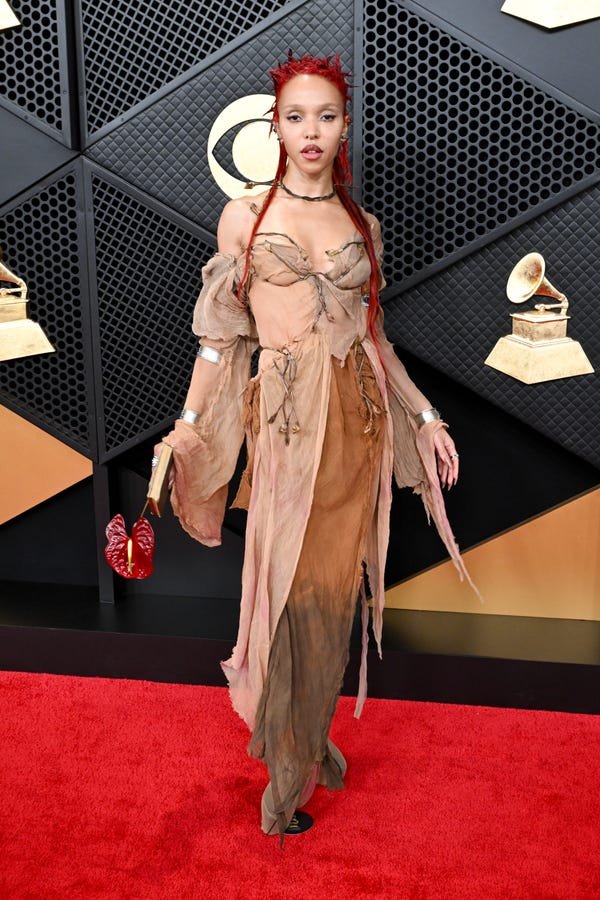
FKA Twigs attends the Grammy Awards in February 2026. Gilbert Flores/Billboard via Getty Images
FKA Twigs, who won the best dance/electronic album category, looked like she stepped out of a fairy tale. She wore a mesh gown in shades of tan and brown, with gold flower stems attached across the chest and waist. It was designed by Paolo Carzana.
She also carried a gilded book and a red anthurium flower, which matched her vibrant hair color.
Kehlani
Kehlani attends the Grammy Awards in February 2026. Gilbert Flores/Billboard via Getty Images
Kehlani took home awards in the best R&B performance and best R&B song categories. She was also one of the best-dressed stars on the red carpet.
She wore a form-fitting gown by Valdrin Sahiti. The black design was see-through, covered in glitter, and floor-length. It featured a halter neckline and a triangle cutout across its bodice.
Sabrina Carpenter
Sabrina Carpenter attends the Grammy Awards in February 2026. Amy Sussman/Getty Images
Sabrina Carpenter looked like a princess in her sheer gown. The custom Valentino dress featured a sweetheart neckline with cape sleeves, a floral lace bodice, and a tiered, floor-length skirt. The piece was covered in delicate sparkles from top to bottom.
Carpenter was nominated for album, song, and record of the year, among other categories.
Tyla
Tyla attends the Grammy Awards in February 2026. Amy Sussman/Getty Images
Tyla arrived in a glittering Dsquared2 gown. The sleeveless piece was decorated with sequins down its tan bodice and feathers across its skirt and train.
Tyla, who was nominated for the best African music performance award, wore the gown with tan heels and a Pandora diamond choker necklace.
Leon Thomas
Leon Thomas attends the Grammy Awards in February 2026. Gilbert Flores/Billboard via Getty Images
Leon Thomas won the 2026 Grammy for best traditional R&B performance and was nominated for multiple others, including best new artist.
On the red carpet, he looked sharp in an all-black outfit. It comprised a tailored blazer with a diamond brooch, oversize pleated trousers, and a leather hat.
Addison Rae
Addison Rae attends the Grammy Awards in February 2026. Brianna Bryson/WireImage/Getty Images
The best new artist nominee chose a sleeveless white gown designed by Alaïa for the Grammys.
It had a plunging neckline that dipped below her belly button, and an asymmetrical skirt that was short on one side and long on the other.
Olivia Dean
Olivia Dean attends the Grammy Awards in February 2026. Amy Sussman/Getty Images
Olivia Dean went classic for her first Grammy Awards. The best new artist nominee wore a black-and-white Chanel gown.
The sleeveless design had a black lace bodice, feathered fringe at the waist, and a full skirt that revealed her two-toned heels.
A glimpse into Melania Trump’s often-obscured personal life has drawn at least some fans to the box office, earning over $7 million during the opening weekend.
Data from The Numbers, a movie financial analysis website, shows that “Melania: Twenty Days to History” is far and away the highest-grossing documentary of 2026 so far.
By comparison, “Holding Liat,” a documentary released in January, is the second highest earner at $28,000 as of Sunday, according to The Numbers.
One of the highest-grossing documentaries of 2025 was “Becoming Led Zeppelin,” which earned about $10.4 million at the domestic box office.
“It proves that an original idea which is executed with deliberate beauty is embraced by fans and moviegoers, regardless of political affiliation,” Marc Beckman, Melania’s senior advisor and agent, told Business Insider in a statement.
Every time Lauren publishes a story, you’ll get an alert straight to your inbox!
Stay connected to Lauren and get more of their work as it publishes.
The documentary, which premiered on January 30, offers a behind-the-scenes look at the days leading up to President Donald Trump’s 2025 inauguration from the first lady’s perspective. Amazon MGM Studios paid $40 million to license the documentary and an additional docuseries on Prime Video. Brett Ratner, known for the “Rush Hour” franchise before sexual misconduct allegations derailed his career in 2017, directed the documentary.
“With exclusive footage of critical meetings, private conversations, and never-before-seen environments, ‘Melania’ showcases Mrs. Trump’s return to one of the world’s most powerful roles,” an Amazon press release said.
Despite the early box-office sales, the film has earned less-than-stellar reviews from critics and was review-bombed on Letterboxd. Business Insider’s Peter Kafka described the documentary as “dull,” but said that it could resonate with superfans of the Trump family.
“The best way I can describe this one is something akin to a wedding video: Maybe the subjects of the video will want to watch it (Melania looks, unsurprisingly, like a woman who used to be a model; her husband seems notably more spry than he does now, a year after it was filmed),” Kafka wrote. “It’s hard to imagine anyone else will.”
President Donald Trump has boasted about strengthening the US economy since returning to the Oval Office. Meanwhile, millions of Americans say they’re struggling to afford food, rent, and other basic necessities.
Gary Cohn, Trump’s former chief economic advisor, said both these realities are true right now in America.
“If you look at gross domestic product, which is the overall output of the US economy, we’re trending about 5% right now, which is a very high growth rate in the United States,” Cohn said on CBS’ “Face the Nation” on Sunday.
Cohn, who is now IBM’s vice chairman, also cited promising trends in inflation and unemployment rates.
However, those numbers don’t give the whole picture.
Every time Lauren publishes a story, you’ll get an alert straight to your inbox!
Stay connected to Lauren and get more of their work as it publishes.
“That said, we’ve got an interesting economy,” Cohn said. “We have a massive wealth effect at the top end, and we have got hardworking Americans having a very difficult time paying their bills, and they are suffering in this economy.”
That’s why, Cohn said, the Trump administration is making affordability a key issue going forward.
“The White House is going on the offensive. The president is going to spend time out on the road talking about affordability,” Cohn said. “Affordability will be the issue between now and the mid-term elections.”
The widening gap between wealthy and lower-income Americans is often described as a “K-shaped economy.” That’s when people at the top see profound economic growth, while those at the bottom, who are more sensitive to economic shifts, face financial stress. Some economists have cautioned that a K-shaped economy portends bad days ahead.
“A silent majority of consumers is increasingly strained by a two-year affordability crisis and elevated borrowing costs,” Gregory Daco, a chief economist at EY, said in a recent LinkedIn post. “Slower income growth is pushing many upper-median, median, and lower-income families to draw down savings and rely more heavily on credit to sustain their habits.”
The chief economist of RSM, Joe Brusuelas, said in a recent briefing that the US would need to undergo policy shifts to reshape the economy, but that likely won’t happen in 2026.
“When I take a look at the policy landscape, it’s all tilted toward the upper spur of the K,” he said. “So I’m expecting a further widening of that fundamental inequality in coming years.”
This as-told-to essay is based on a conversation with Lauren Brusie, mom of seven. It has been edited for length and clarity.
Last year, my 87-year-old grandmother, Doris, and 90-year-old grandfather, Jerry, hosted nine of their 14 great-grandchildren for a Christmas sleepover at their house. It’s an annual tradition they started several years ago that involves a night of eating cookies and ice cream, kids playing, boys wrestling, and movie watching, all culminating in Doris and Jerry waking up bright and early the very next day to cook breakfast for everyone, smiling and chipper as ever.
As their 34-year-old granddaughter, I’m not sure how they have the energy they do.
They are the most joyful, generous, busy, and amazing people I know, and they have been a constant presence in my life. They were always there. For all six of us grandchildren, for every game, every school event, they were there. We spent our weekends with them, holidays with them, and summers at their cabin.
They’ve definitely helped shape my cousins and me, and they continue to maintain that loving presence and involvement with all their great-grandchildren, including my seven children.
My grandparents have been there for my kids since day one
Just like I can’t remember a day in my own life without my grandparents in it, neither do my kids. They were waiting outside the door for their first great-grandchild, my daughter, to be born, and they’ve been there for everything, just like they were for me.
We even lived next door to them for a few years, and we spent every day with them. They are two of the people my kids are most comfortable with, and because of that, they are often our first choice for babysitters on a quick errand. The kids just love to be with them.
We have since moved, but they still stop by at least once a week, call the kids, attend their sporting events, and even help me with running them to and from practice or school.
One of their most beloved traditions is taking out each great-grandchild for a birthday lunch/shopping trip to spend one-on-one time with them. They had a rule that the child needed to be 4 years old, but they have bent it twice now for two of my younger children, taking them on their third birthdays because they were just so excited about it.
Both of my grandparents are in great health, and while some of their longevity and energy is probably genetic, I think their overall joy and love of people has kept them going. They always have something going on with others, whether it’s hanging out with their camping club, golf leagues, bowling leagues, card nights, casino trips, or following us kids around. They’ve always just worked hard and enjoyed life.
They are the biggest blessing in our lives
I’m not sure how to put into words what our relationship with my grandparents means. I’m aware of how unique this is, and I’ve never taken a moment with them for granted. I don’t think my kids will understand it all until they’re older, so for now, I just try to take as many pictures as I can so they’ll know how truly blessed and loved they were by these amazing people.
As life has gotten busier and the kids have gotten older, we make it a priority to continue our relationship with my grandparents. For instance, we’ll stop in to visit, and we try to do malt nights on the weekends with them, just like I did as a kid.
I also try to make them my first call if I do need help with the kids. It gives them purpose, and it really does help me too!
I don’t know anyone who has great-grandparents so involved in their family’s lives
When I try to think of anyone who, like my kids, has not just their grandparents, but their great-grandparents so actively involved, it’s not even a close comparison. And it’s not just my kids — Doris and Jerry still travel all over the state to attend events and visit my cousins and their kids, too. I know my cousins feel the exact same way I do about our grandparents: they are the most incredible people we know, and we’re so lucky to have them.
I am not sure I even appreciated how amazing they were when I was a kid. It took me having my own kids to realize that the relationship I had with them wasn’t necessarily normal either. They are truly one of a kind.
There is so much that inspires me about my grandparents, like their joy and how they’ve dealt with all the ups and downs of life. And let’s be honest: I’d love to have their energy too, but I’ll never count on that!
My grandparents are also so humble about their involvement. Doris simply says that the reason they spend so much time with all of us is because they love us, so why wouldn’t they want to be with us?
Both of them attribute their energy and longevity to being “lucky” and hope that all their grandchildren and great-grandchildren will remember that they were good to them and loved them. I’d say mission accomplished!