
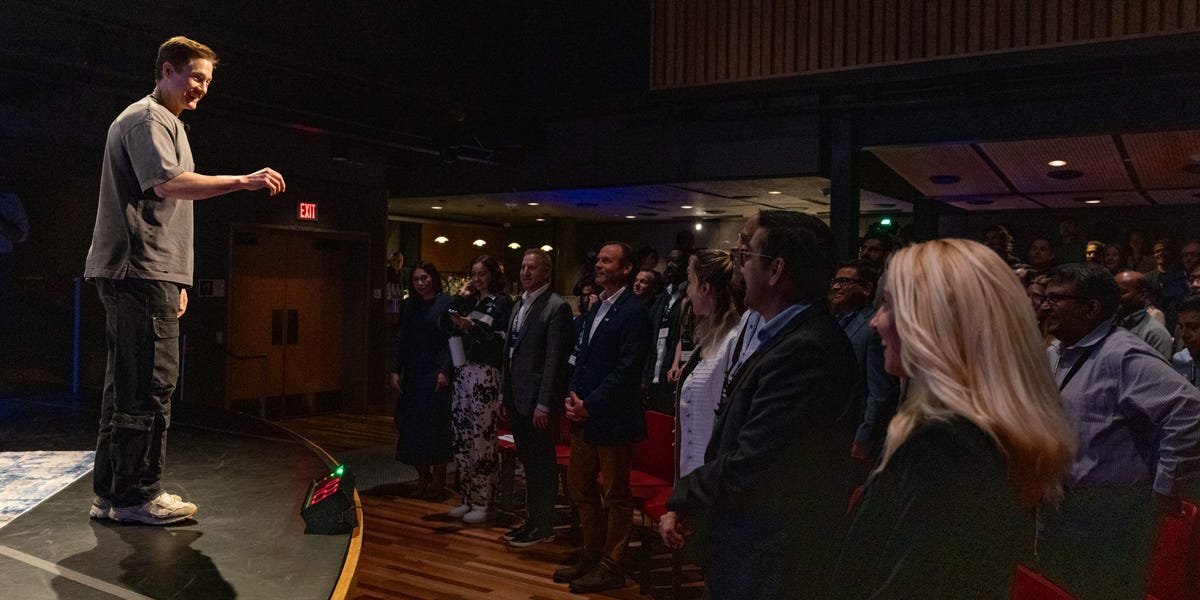
Bryan Johnson shared a simple longevity test at a Business Insider event.
Read the original article on Business Insider
Source link

Bryan Johnson shared a simple longevity test at a Business Insider event.
As a multi-sport athlete, I track my fitness through swim time trials, burnout lifts, and functional threshold power evaluations that push me to my mental and physical limit.
Bryan Johnson, the 48-year-old entrepreneur obsessed with longevity, has a much simpler and less grueling test as a proxy for how your body is aging, which may or may not match your chronological age.
Johnson led the exercise at Business Insider’s The Long Play event in San Francisco on Tuesday. You can do it anywhere with a timer.
The test: Start your timer, close your eyes, and stand on one leg. See how long you can avoid falling.
According to Johnson, if you stand for zero to seven seconds, your body is 60-80 years old. Seven to 15 seconds is 40-60 years old, and 15 to 30 seconds is 20 to 40.
“As you age, your brain atrophies, and your ability to maintain your balance goes away. That’s why when you get older, if you fall down, it’s no good,” Johnson said.
A small Mayo Clinic study of adults over 50 published in 2024 found that among several functional tests, one-leg balance time was most affected by age.
The Mayo Clinic researchers dubbed the one-legged test “a valid measure of frailty, independence, and fall status.”
Unlike Johnson’s version on Tuesday night, the study didn’t test people under 50, nor did it offer specifics about balance time matching biological age.
The balance test isn’t a new idea, and the Cleveland Clinic cautions that “it’s not a complete balance evaluation on its own” and it’s “far from a perfect indication of longevity.”
But by Johnson’s standards, my biological age — especially on my dominant, more stable left leg — is right where I should be.

The Uber-famous founder, Travis Kalanick, says a new golden age is coming — and it’s robots that are ushering it in.
Kalanick announced a new venture called Atoms on Friday in a 1,600-word screed in which he said the automation of the physical world is the next phase of the AI era.
“Software has automated tasks of language and math, but the complete automation of the physical world — autonomy — remains largely untouched territory, the principal unlock to the next era of progress and abundance,” he wrote. “History refers to this kind of moment of radical progress as a Golden Age.”
Kalanick said this “golden age” is emerging as production and transportation become driven primarily by computation, minerals, and energy. With autonomous machines building other machines and software constantly improving itself, he said, productivity could reach unprecedented levels.
“The organization of human capital becomes superhuman,” he wrote.
Kalanick later said on the tech talk show TBPN on Friday that Atoms has been operating in stealth mode for the past eight years. Now, the company aims to expand its delivery infrastructure beyond food into industries such as food service, mining, and transportation.
He said in his announcement that the company’s goal is to create “gainfully employed robots.” He defines these as “specialized robots with productive jobs that bring abundance to their owners and society at large.”
He also said humans should be careful about building robots in their own image. “I watched the half-marathon and couldn’t help but think how much better it would be if they just had wheels,” he wrote, referring to a competition in Beijing last year that pitted humanoid robots against each other.
Kalanick cofounded Uber in 2009. He led the company as CEO until 2017, when he stepped down amid reports of a toxic workplace culture and ongoing regulatory battles.
He isn’t the only tech executive who believes AI robots should extend beyond humanoid form.
The cofounder and CEO of World Labs, Fei-Fei Li, said on the No Priors podcast last year that building physical AI in a singular form is energy inefficient.
“Just an extreme and trivial example, if we put robots underwater, they should not be the shape of humans,” she said. “They better be in the shape of fish. Just think about energy efficiency. The same with flying.”

We’ve all done it: popped a multivitamin and thought “will this actually do anything?”
For decades, the answer you’d typically get from health experts was a big shrug, because of a lack of solid evidence that multivitamins have a meaningful, measurable impact on our overall health or our odds of living a longer, healthier life.
A study published Monday in Nature Medicine suggests that, for older adults, we might be getting closer to an affirmative nod that multivitamins do something, after it showed a daily pill slowed their aging clocks by about four months.
Experts say the finding is interesting, but the effect is very small and it’s premature to change your own supplement stack.
“This doesn’t mean that everyone should go out and start taking a multivitamin,” lead study author and supplement researcher Howard Sesso, an epidemiologist and associate professor of medicine at Harvard Medical School, told Business Insider. “Rather, this is starting to provide the connecting dots.”
The study is part of a growing body of evidence suggesting older adults might derive some small, marginal benefits from taking multivitamins, especially if they’re not getting enough nutrients in their diet. Another 2023 study published in the American Journal of Clinical Nutrition found that once-daily multivitamins helped improve people’s scores on common memory tests, just a bit.
Dobrila Vignjevic/Getty Images
The study, a large randomized control trial, followed 958 older adults (aged 70 on average: men over 60, women over 65). Half were asked to take a standard daily multivitamin for older adults for two years, while the others took a placebo pill. Those who reliably popped the multivitamin each day slowed down their biological aging by about four months over the course of the two years, when compared to their peers on the fake supplement.
The study was funded in part by the multivitamin maker Centrum — it provided the pills for the study cost-free to researchers — but the study was done at independent universities, and supported by federal grants from the National Institutes of Health. The study is more rigorous than most supplement trials out there.
The research team measured how the group aged using biological age clocks, also known as epigenetic clocks, including two called GrimAge and PhenoAge. They use a person’s blood or spit to measure DNA methylation, the changes in how our genes are expressed as we age. The clocks are designed to predict how well we are aging overall, instead of giving a snapshot of health in one area of the body, like a blood pressure reading, cholesterol level, or pulse check would do.
The study found that the faster someone was aging, according to the clocks, the more that taking supplements seemed to help slow the pace, suggesting the multivitamins might be more beneficial for older adults already lacking in nutrients or in poorer health.
Sesso said there could be something about the “interconnectivity” of the different vitamins and minerals in a daily multivitamin “that might be working together in ways that we just don’t fully appreciate.”
However, the study couldn’t show that the changes to biological age might make us feel better as we age, or determine how soon we’ll die.
“It might turn out that what this is actually measuring is not really improved healthspan, but something else,” the aging researcher Daniel Belsky, an associate professor of epidemiology at Columbia University, who was not involved in the study, told Business Insider. “Lots of things could cause variation in the epigenetic clocks that are not the biology of aging.”
After all, biological age clocks have shown accelerated aging in people undergoing surgery, and pregnant women, but those changes are temporary, and likely not meaningful indications of a person’s longevity.
Eva-Katalin/Getty Images
If the evidence that multivitamins can help older adults maintain their health by providing the essential nutrients becomes stronger, then it may become more common for doctors to recommend them to older adults.
Already, some doctors and scientists, including Sesso, have told Business Insider they have switched to taking multivitamins as a result of new research. Specifically, Sesso was impressed by a separate, decades-long study funded by the National Institutes of Health that showed men over 50 may reduce their risk of cancer and developing cataracts, just slightly, by popping a once-daily multivitamin tablet. So, when he turned 50, he started taking one.
“That’s all I take,” he said, cautioning against taking unnecessary supplements. “The scientific rigor overall for dietary supplements is not as good as it should be. And yet the public continues to take these willingly without knowledge of really what any benefits or even harms might be.”
Sesso tends to prioritize getting nutrients the old-fashioned way, through eating nutritious foods, plus incorporating other habits science shows can boost longevity, like staying active, and connecting to friends.
“I am a firm believer in diet, lifestyle and just healthy living, as best I can,” he said.
dikushin/Getty Images
The hope is, Belsky said, that as our understanding of what’s moving the needle on the “biological age” clocks develops, in a few years doctors could use it to help inform who gets supplements and when, tailoring people’s stacks to their biology.
“It’s looking good,” he said. “Answers are coming, they’re coming soon. They’re just not here yet.”

This as-told-to essay is based on a conversation with Christine Romeo, mother of “Love on the Spectrum” star Abbey Romeo. It has been edited for length and clarity.
Sometimes I look at pictures of my daughter Abbey when she was 3 or 4. She was just so, so cute. But I think — was I present for that? Did I enjoy that time, or was I too obsessed with therapies and my worries about her future?
It’s normal for anyone, especially parents, to fret about the future, but for parents of kids with disabilities, those worries can be overwhelming.
Abbey is now 27. When she was diagnosed with autism 25 years ago, I couldn’t have imagined that Abbey would be running two small businesses or appearing on reality TV. But along the way, we both learned to think outside the box, and that’s helped Abbey grow so much.
Abbey went to one of the best schools for autism. She had moderate setbacks, but her curriculum was still focused on academics. She was learning what typical kids were, like tectonic plates and world history, just at a slower pace.
Courtesy of Christine Romeo
I could see that wasn’t what she needed. It’s not helpful to learn Western Civilization if you can’t remember what you did yesterday. I would rather Abbey focus on life skills that could help her cope with her autism, like visual clues to help her access her short-term memory.
When Abbey was in eighth grade, I switched her to a vocational program that focused on job and life skills. I had to set my ego aside and do what was right for Abbey. She didn’t need a high school diploma — she needed skills to help her live her life.
There were moments throughout Abbey’s schooling when I knew I had made the right decision. One time, the teacher sent me a picture of Abbey rewiring a light. I was blown away.
Another was when I came in to see Abbey weaving in the textile program. She was operating this big machine with foot pedals and a large swatch of fabric, and it was regulating her. I had to leave the room, because I was crying.
With Abbey and her brother, who’s a year younger, I realized that as a parent, you don’t always get what you order. I’m determined to help both of them be who they are and be as successful as they’re meant to be.
Abbey excelled at weaving, and I realized selling her creations could be a job. I believe it’s important for everyone to have a sense of purpose, and Abbey had expressed that she wanted a “real job.”
I spoke with her school about creating a program to allow kids to sell their art and crafts. The teacher loved the idea, but the principal didn’t. When he said no, I thought about one of my favorite shows, Shark Tank, and how entrepreneurs don’t take no for an answer. I was determined to find a solution for Abbey, even when the system said there wasn’t one.
Courtesy of Christine Romeo
The teacher ended up coming to our home on Saturdays to teach Abbey advanced weaving. Soon, her business, Hats by Abbey, was born. She also has another business shredding people’s paperwork, which they pay for by the bag.
Today, Abbey has control over her days. She often makes hats from 9 to 12, then walks the dog before her voice lesson. She has the sense of purpose that we all need.
For a while, it was difficult for Abbey to connect with the idea of money. I found it helped when she could see cash. I started putting cash in her money box, and if she wanted to order something online, she had to give me the bills.
Charley Gallay/Getty Images for Netflix
The first thing Abbey ordered with her profits was a $160 stuffed lion. It challenged every fiber of my being to let her order that, but she had earned the money, and she got to decide how to spend it. Seeing the glee on her face when she opened the box was worth every obstacle we’ve had to jump over.
Abbey continues to grow so much. I’ve created opportunities, and she’s taken them. It’s been the most beautiful, amazing experience.

My 87-year-old mother has always been active, regularly golfing, cycling, and even rollerblading well into her 70s.
So when I, a 62-year-old trainer, asked her to do some mobility movements with me, I was surprised to see she struggled to get up from the floor.
With patience, I guided her through the steps until she could do it herself. After over 30 years of training together, it was one of the first times I consciously thought about how her movements have changed as she’s aged — along with how I want to age myself.
She’s shown me that she can be disciplined and committed to her health while still enjoying life, reinforcing my belief that mindset shapes how we age just as much as movement does.
Here’s how working out with her has shaped the way I view aging.
Long before I created Janet Osborne Fitness, my online fitness platform for all ages, or included my mom in my Instagram videos, we regularly exercised together.
When I was 34 and working as a personal trainer, she told me she wanted to be strong and independent as she aged, so I made her a 30-minute step-and-strength workout video. She consistently did it five days each week, inspiring me to create new programs for her.
Without either of us realizing it, this routine had become a meaningful part of our relationship. It gave us a reason to talk, check in with each other, and share something uniquely ours.
Now that she’s 87 and focused on longevity, I tailor her plan to prioritize strength, balance, mobility, and stretching so she can complete everyday tasks like getting in and out of a chair, walking up the stairs, opening heavy doors, carrying groceries, and even getting up from the floor.
Janet Osborne
Training an 87-year-old has taught me to meet her right where she is.
I offer modifications, guiding her through slow and small movements. For example, overhead presses aren’t comfortable for her, so she does front raises and lateral lifts instead.
She practices exercises between sessions to improve her form and then shows off her progress the next time I see her. After habitually practicing single-leg stands, she went from needing wall support to balance on one leg for 10 seconds to standing unsupported on one leg for 40 seconds straight.
She doesn’t always stack all of the moves in one long workout. I’ve noticed that she sprinkles movement throughout her day, whether she tests her balance while waiting for the elevator, squeezes in some calf raises in the kitchen, or pauses for a mobility break on her walk.
For years, my classes were very intense and lasted at least one hour, but working out with her has shown me that a shorter spurt of focused movement can also be effective.
It’s inspired me to go from chasing extremes and intensity to focusing on consistency.
We work hard on our fitness without taking ourselves too seriously.
My mom occasionally mixes up her right and left, and we often freeze mid-movement and burst into giggles. Her sense of humor is one of her greatest strengths, and I think it’s a big part of the reason she’s aging so well.
During our workouts, I’ll sometimes ask, “Are you smiling, Mom?” She’ll reply, “I’m concentrating!” before breaking into a huge grin.
Those moments — the laughing, gentle teasing, and shared pride — make every session feel special.
Janet Osborne
When it comes to diet, my mom prioritizes simplicity, and she’s always been this way.
When she was raising me, she made everything from scratch, from doughnuts to shepherd’s pie. She even grew vegetables in our backyard and built our meals around simple, whole foods.
At 87, she focuses on eating enough protein, getting plenty of fruits and vegetables, and drinking green tea daily. She works to fuel her body in a way that supports her energy and independence.
Looking back, her instinctive approach to food is what sparked my own interest in nutrition years later.
As I’ve gotten older, I’ve come to see food as a powerful tool to embrace rather than something to restrict. She’s proven that it can help keep a person feeling strong, energized, and independent as they age.
I’ve always viewed my mother as an inspiration. Even so, I was surprised by how deeply she inspired everyone else watching our workouts online.
When our first video gained traction, people left comments saying they saw their own parents, grandparents, or older selves in her.
Some said she gave them hope; others said she made them cry. Many told me they hadn’t exercised in years but were going to try again because of her.
I didn’t expect so many people to need to see someone in their 80s moving, laughing, modifying, and doing their best. She makes exercise feel possible again.
Working out with my mom has become one of the greatest joys of my life. It brings us closer, keeps her moving, and reminds both of us that it’s never too late to take care of our bodies.

A 20-room Gilded Age mansion, once the atelier of fashion designer Oleg Cassini, is under contract at a bargain discount: $34.5 million.
A federal bankruptcy judge signed off on the mystery buyer’s winning bid on Wednesday, approving a price tag for the 18,000-square-foot Manhattan townhouse that’s nearly half the original asking price of two years ago.
The bankruptcy — in which two octogenarian sisters, one of them Cassini’s widow, were forcibly removed from the home by federal Marshals — caps a history of transformation.
Built steps from Fifth Avenue’s “Millionaire’s Row” as a stockbroker’s statement mansion in 1901, the stately limestone home was subdivided into apartments throughout the ’60s and ’70s.
And before his death in 2006, Cassini sketched wardrobes for longtime client Jacqueline Kennedy Onassis by the light of a towering window spanning the six-story home’s two topmost floors.
As the new buyer prepares to move in as early as next month, let’s take a look at the stunning rooms and tumultuous history of 15 East 63rd Street.
Evan Joseph for Sotheby’s International Realty

Evan Joseph
Evan Joseph for Sotheby’s International Realty
Evan Joseph
Evan Joseph for Sotheby’s International Realty
Evan Joseph
Evan Joseph for Sotheby’s International Realty
Evan Joseph for Sotheby’s International Realty
Evan Joseph/Sotheby’s International Realty
Evan Joseph for Sotheby’s International Realty
Evan Joseph for Sotheby’s International Realty
Evan Joseph for Sotheby’s International Realty
Evan Joseph for Sotheby’s International Realty
Evan Joseph
Evan Joseph