Im-a-64-year-old-retiree-who-bought-a-tiny-home-after.jpeg

I’m a 64-year-old retiree who bought a tiny home after my divorce. It gave me a fresh start I could afford.

This as-told-to essay is based on a conversation with Margot Hollander, 64, a retired dance teacher and project manager. She lives in the Dutch tiny home village of Minitopia, Eindhoven. The piece has been edited for length and clarity.

After my divorce, I had to find somewhere to live. The rental market was tough, and as a retiree, my options for buying were limited without a mortgage.

I first came across Eindhoven’s Minitopia project in the news a few years back. When I started looking for a home in late 2023, at age 62, I found a tiny house there on a real-estate website. I booked a viewing and quickly made an offer.

I paid about $143,000 in cash for the tiny house, which was as much as I could afford. I moved into the Minitopia tiny village in January 2024. I’m very happy to have bought it at this point in my life.

Buying a tiny house was a chance to start fresh after my divorce


Margot Hollander

Hollander said her tiny home is spacious enough for her and her dog. 

Samira Kafala for BI


While I was very happy to move into a tiny home, there was a lot of downsizing involved, having moved from a regular-sized house also in Eindhoven. Even now, I’m still getting rid of clothes, shoes, and all the unnecessary things you accumulate over the years.

I think it’s good for your mind to downsize, and I’m happy to be living with less stuff.

It was a model home when I bought it, with the walls and floors finished, and the kitchen and bathroom already fitted. I enjoy interior design and added my own touches, such as shutters and new furniture.

I chose not to bring any furnishings from my old house. I wanted a fresh start. I’ve filled it with artwork that makes it feel like my own. That was important to me. After the divorce, moving here has given me independence.

I’ve found it easy to make friends

It’s easy to get to know people who live in Minitopia. The Eindhoven tiny home village is Minitopia’s largest, with space for 100 tiny houses. I meet people every time I take my dog out for a walk, and most are open and chatty.

You don’t need to make plans to go for a drink here; you can just easily fall into conversation with your neighbors. It’s the simple things, like making small talk on the way to the parking lot, that give me such a good feeling about living here.

I don’t come across too many other retired people like me. Minitopia Eindhoven is a real mix of young and old, single and married, and people with and without children. That diversity is what makes it feel like a proper community.

I wouldn’t want too many other retirees to move in. I don’t want it to become a retirement village.

As a retiree, it works well for me financially


Margot Hollander tiny home

Hollander’s tiny home was fitted out before she bought it. 

Samira Kafala for BI


I used to be a dance teacher and also worked in project management in the housing sector. Once you’re retired, it’s important to live within your means so you still have money left for other things.

The more you spend on housing, the less you have to put toward your hobbies. I like to spend my money on sports.

Financially, the tiny house works very well for me. I’ve found it’s much cheaper to run than the regular house I lived in before. I have solar panels, so I’m not paying for electricity at the moment. The ground rent at Minitopia, which is a few hundred euros a month, is far lower than what I’d have paid to rent a larger home.

I hope this is my forever home

While the house is relatively small, I have more than enough space for my small dog and me. It’s not somewhere you can easily host big dinners, but that’s what I like about it. I prefer one-on-one contact to large groups.

Overall, I see very few inconveniences to living here. I like my tiny house and the community very much.

I hope this will be my last home, though I hope I’ve got plenty of years left in it yet.



Source link

Madeline berg on grey background

Palantir’s Alex Karp has ties to a $46 million Miami mansion that was bought before his company’s HQ move

Several months before Palantir moved its headquarters to Miami, an entity with ties to the company’s billionaire CEO, Alex Karp, put down roots in the city.

In June, Hibiscus East LLC purchased a home on Miami’s San Marino Drive for $46 million, according to property records.

Like several of Karp’s other properties, the LLC is registered in Delaware. It is connected to an attorney’s office in Manchester, New Hampshire, and an accounting office in Bedford, New Hampshire, both of which appear on documents from previous real estate transactions that are linked to Karp.

The nearly 10,000-square-foot newly built home sits on San Marino Island, one of the exclusive Venetian Islands in Biscayne Bay. A YouTube video of the home posted by listing agent Dina Goldentayer showcases the property’s waterfront and pool.

Goldentayer declined to comment to Business Insider. Representatives for Palantir and an attorney for Karp did not respond to requests for comment.

Last month, Palantir announced it was moving its headquarters to Miami from Denver. The company has not revealed publicly why it’s making the move. Before setting up in Denver in 2020, Palantir was headquartered in Silicon Valley.

“Our company was founded in Silicon Valley,” Karp wrote in an investor letter that year. “But we seem to share fewer and fewer of the technology sector’s values and commitments.”

One of Karp’s Palantir cofounders, Peter Thiel, bought a home on one of Florida’s Venetian Islands in 2020, and his VC firm, Thiel Capital, later opened an office in Miami.

It’s not clear if Karp, who is worth $15.8 billion, according to Bloomberg, is moving to Miami full-time. He owns hundreds of acres of land in New Hampshire and, last year, made headlines for spending $120 million on a monastery outside Aspen, Colorado.

A handful of California billionaires have recently purchased properties in Miami, including Sergey Brin and Mark Zuckerberg. The real estate shopping spree comes amid an initiative in the state to get a wealth tax on November’s ballot. If passed, California residents with a net worth of more than $1 billion would be subject to a one-time 5% tax on their wealth.

Florida famously has a no-income tax policy written into its constitution.

“California’s a beautiful state, but now, because of all the political situations and all the tax laws, it’s just coming in our favor,” luxury real estate agent Saddy Abaunza Delgado previously told Business Insider.

Similarly, Howard Schultz, the former CEO of Starbucks, announced a move to Miami earlier this week — on the same day a millionaire’s tax passed Washington state’s House of Representatives.

The rush has caused prices to balloon in the 305. Zuckerberg’s $170 million purchase earlier this month on the island of Indian Creek set a Miami record.

“The influx of billionaires from California” will cause “escalation of the market,” Ana Bozovic, a founder of Analytics Miami, previously told Business Insider. “The market ceiling keeps rising,”


Source link

My-son-bought-a-2-car-and-learned-how-to.jpeg

My son bought a $2 car and learned how to fix it himself. It gave him the independence he was craving.

My eldest felt a strong urge to own a car for most of his teenage years. He would pop into the living room and show his dad and me his latest internet find, usually a 20-year-old jalopy with questionable reliability costing several thousand dollars.

Each summer break, he would talk about buying a car with us. Each time, we wouldn’t say no. We would just urge him to consider his situation as a full-time student with an uncertain future.

We provided transportation to and from school, and while there, he walked, rode a bike, and grabbed rides from friends. Each time, he decided on his own that it might not be the smartest time to invest a couple of thousand dollars in a car of questionable repair.

He got a deal from a family friend

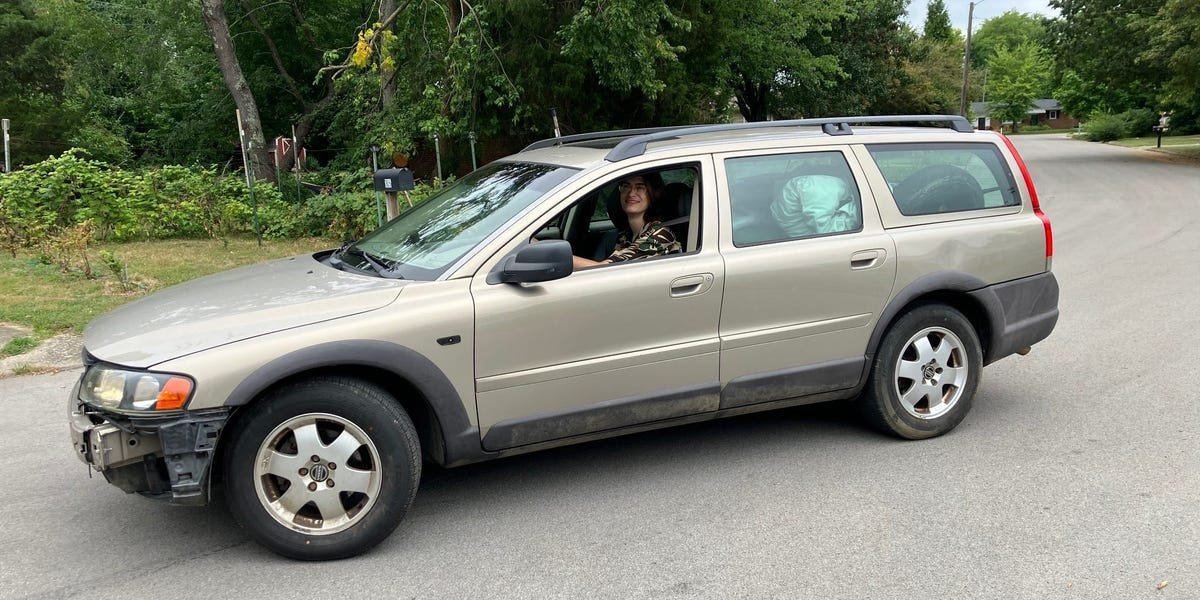
The summer before his junior year of college, however, a family friend offered him a deal he couldn’t pass up. It was a 20-year-old Volvo wagon that had a run-in with a deer. The front end was crumpled, it was undrivable, and he didn’t have the title. But the price was right — $2, twice the friend’s original purchase price of a buck.

In some ways, it was a bold move. My son didn’t have much experience in car mechanics. During that school break, he put money and time into repairs. He straightened the front radiator support with a winch so all the parts would fit again. He replaced the radiator and flushed out the intercooler. By the end, it stayed in motion long enough to limp to a storage barn for the winter.


Abandoned car

The author’s son learned how to fix the car with YouTube videos.

Courtesy of the author


The next summer, it was his main focus. He installed a new radiator fan, bought a new battery. Replaced two tires and had them aligned. Put in a new headlight and did more bodywork. He cleaned it, inside and out. And just a couple of days before returning to college, the crowning glory: a salvaged hood that perfectly matched the golden hue of his car.

He learned a lot from fixing the car

There was a fair amount of angst. Figuring out the process for issuing a new title. Hunting down the owner who last had it and arranging a meeting. Ordering the wrong or incomplete parts and having to send them back. Determining what needed to be fixed and how much it cost. Calculating how much he should spend, even after fixing it up, the car was probably only worth about $2,000.

He elected to do much of the work himself, spending hours at the “University of YouTube.” At one point, as he lamented the money he had spent so far, with the possibility that it would all be for naught, my husband asked him how much a college credit hour costs. My son looked it up. It was exactly what he had spent so far on the car. My husband said, “Haven’t you learned a lot?”


Young man posing with car

The author says her son learned so much from fixing his own car.

Courtesy of the author


That helpful reframing stuck: The night before he drove the car to college, my son commented, “Hey, I got a free car at the end of that college class.” We celebrated with him that evening, telling him how proud we were of his persistence and frugality, of his push to learn something new.

He got the independence he wanted

Seeing him drive off in that car left an indelible impression on me. Armed with his insurance’s roadside assistance, a toolbox gifted by his dad, and a bag of extra fluids in the passenger seat, he set out on the 8-hour, 57-minute drive to York College in Pennsylvania from our home in Kentucky. He couldn’t shake the small, satisfied smile on his face. I couldn’t shake my delight and my apprehension.

Being the mom that I am, I asked him to text whenever he stopped so we could track him on his journey. First stop: at the coffee shop halfway, our usual lunch break, and the new thrift store next door. Next, at a Civilian Conservation Corps museum, he saw signs along the highway. Finally, in the parking lot of his dorm. Even through text, I could sense the satisfaction and pride he felt for accomplishing that trip in his own ride.

In the ensuing months, the $2 car has safely delivered him each week to his internship and to a friend’s house for fall break. It has given him a measure of independence he didn’t have before. And it gave him something we, as parents, couldn’t, no matter how much we wanted to: a sense of self-sufficiency. That was something he had to earn.

We could only encourage him, support him, and talk him through his next steps, then see if he succeeded or failed. In the end, he knew that he could handle the road ahead by himself.


Source link

Lauren Crosby

I bought a house with my best friend. It’s the best living situation I’ve ever had.

This as-told-to essay is based on a conversation with Sarai Saez Rogers, a 36-year-old mom. It has been edited for length and clarity.

When Claire, my best friend for over 10 years, and I laid eyes on the late-18th-century duplex with a big front yard, we knew it was the perfect house to buy together.

We’d gotten to know each other in New Mexico, where both of our husbands were stationed while in the military. For 10 years, we were each other’s community. Neither of us had family around, so we had to make our own support systems.

We both got divorced

My husband and I divorced, and there was a six-month period when Claire’s husband was deployed. The two of us practically lived together for those six months. We cooked and ate together, picked each other’s kids up from school (she has two, and I have one), worked out together, and even had family sleepovers. I found that being a single mom didn’t mean I had to shoulder the load alone.

I moved to Maryland for a new job. I quickly found out how expensive it was to be a single parent, and relocated to upstate New York to live with my parents.

Claire and her husband then divorced, and she moved in with her parents in Wisconsin.

We stayed in touch, both dreaming about what it would be like to buy a house, but knowing we couldn’t afford it as single parents. Although we both appreciated living with our parents, it wasn’t an ideal situation after being used to living independently for so long.

We bought a house together

At some point during our phone calls, we considered moving in together. We trusted, respected, and liked each other. We’d both say that for the first time in a long time, we knew what it was to feel safe with another person, to be loved for who we were, rather than for who someone wanted us to be.

I had a steady income and credit, and Claire had savings, so we’d be a team if we were to buy a house together.


Friends jumping in front of house

Sarai Saez Rogers bought a house with her bestfriend.

Courtesy of Sarai Saez Rogers


In the summer of 2024, Claire visited us in New York, and on somewhat of a whim, we decided to look at houses for sale.

We saw a happy, yellow duplex, one that our real estate agent tried to dissuade us from viewing, as it was a bit odd, and both fell in love. It was built in the 1800s with period features, located on a quiet street, with a huge yard speckled with trees. It had originally been a farmhouse with different families, so it was a perfect setup for us. There are two bedrooms upstairs, and three downstairs, with a bathroom and kitchen on each floor.

We bought it, and every day, even on the days we have arguments, I’m so glad we made the decision to live together.

I get to live with my best friend

In a world where friendships aren’t always cherished because we’re too busy, I get to see my best friend every single day. We support, love, and are there for each other at the drop of a hat.

Recently, we had gin and tonics and watched “Mulan” together, belting each song. By bucking the trend that says our setup is reserved for youth, we’re experiencing the closeness many people have when they share rooms or houses in their early 20s.

One of the questions people have asked us is what we’ll do if we develop romantic connections. I tell them we both are in romantic relationships. Claire and I have boyfriends, but why should that impact our home situation? We don’t have to move in with partners out of necessity, but only if we choose to.


Women moving washer

Sarai Saez Rogers says her friendship with Claire is one of the deepest relationships she’s had.

Courtesy of Sarai Saez Rogers


We’ve also discussed the possibility of partners moving in — splitting the house right down the middle and having separate rather than shared living spaces.

Another question people ask is what happens if and when we argue. This is an easy one. I don’t think deep, authentic relationships can exist without conflict. In any relationship, romantic or platonic, there will be disagreements. It’s healthy if it’s dealt with in a caring, respectful way.

When we argue or get on each other’s nerves, we take space and then come back together to talk it through. It’s made us closer, rather than driving us apart.

I’m never taking friendships for granted

After my divorce, I thought a lot about how, for years, romantic love had been the epitome of a relationship, the most ideal love to build a life around.

Since living with Claire, I’ve realised I was wrong. My friendship with Claire is one of the deepest relationships I’ve ever had. Why would I not move in with her? Why would I not build a life alongside her? With her, with my friend, I feel like I’m not just surviving, but thriving.

Even though I am in a romantic relationship with someone else now, I’ll never take friendship for granted again.

Bucking convention, buying a house and living with my best friend has made me incredibly happy, happier than I ever have been.


Source link