

After-Jeff-Bezos-bought-the-Washington-Post-things-went-great.jpeg

After Jeff Bezos bought the Washington Post, things went great — for a while. I asked an insider what happened.

Lots of people are angry at Jeff Bezos because of the massive cuts he’s ordered at his Washington Post. But a decade ago, Bezos was widely celebrated for his ownership of the Post, which he had bought for $250 million in 2013.

Under Bezos’ ownership, the Post made huge investments in tech and staff. And readers loved the results — especially during the first Trump era, when the paper turned profitable.

Now things are very different: The Post says it has been losing gobs of money for the past few years, and Bezos has made a series of moves interpreted as a shift toward Trump — which spurred reader revolts, which made things even worse. And all of that led to this week’s cuts.

I talked to Erik Wemple, a New York Times media reporter who previously worked at the Post for 14 years, to try to reconcile the two eras of Bezos and the Post, and to get a sense of what might happen next. You can hear our entire chat on my Channels podcast; what follows is an edited excerpt from our conversation.

Peter Kafka: What shape was the Post in when Bezos bought it in 2013?

Erik Wemple: The Graham family, which had owned the Post forever, was an amazing steward for the paper. But they had to scale back their newsroom, because the internet had blown holes in classified ads. Classifieds used to be huge at The Washington Post.

At the time Bezos bought it in 2013, it was not dysfunctional. These were really good journalists, but the paper was in a bit of a funk. It wasn’t a reclamation project, but it had seen better days.

It was faded when he bought it.

Correct. And when Bezos came in 2013, he really wowed the staff. We all asked him questions. He answered those questions with tremendous enthusiasm and competence. He seemed really energized by this.

What did he think he was going to do?

When he came in, he was energetic, but deferential on the particulars of running the newspaper. He’s like, “You know what? I’m not in this business, but I do know how to organize discussions about the future of a business.” And that’s what he did. I was in one of them; it was really remarkable.

He had these things that he believed in. He was important in guiding conversations. And it was really remarkable because he backed it up with money. He invested in the newspaper. He invested in political coverage, big time. Investigative went up. International got a huge, huge boost. And the technology did too.

This is exactly what you want from your billionaire tech owner: Give us a bunch of money. Improve our tech. Also, stay away. Don’t tell us what to do.

That was exactly the sentiment. And one of the things you mentioned in there is really worth pausing on for a second, which is the lack of intervention, the lack of meddling. He just sort of looked on. And the newsroom really, really, really roared. Especially in the first Trump period.

So not only does this produce great journalism, it seems like it becomes a business success story — the paper becomes profitable again. Then, after Trump left the White House, there was a lot of hand-wringing about what happens after the Trump bump. People expected audiences to decline across lots of different publications, and that happened, so it makes sense that the Post would struggle a bit. But the numbers you hear about the reported losses — $77 million in 2023, $100 million in 2024 — are staggering. I still don’t understand how you can swing to losses like that just because your traffic goes down. What am I missing?

I share your knowledge gap.

One of the things that has been reported and pretty well substantiated is they may have over-indexed on staff growth. They vaulted up over a thousand in early 2021, up to 1,100. So I think they got ahead of themselves, and they had to pair that back. That’s one of the things.

Another consideration is that the digital advertising market sort of dried up, so that was a big deal.

It’s all somewhat of a mystery, but I don’t doubt that there are meaningful losses.

Can this just be as simple as the Post overhiring? Lots of companies have done that — the tech guys did during the pandemic.

No, I don’t think so. Especially if you look at the more recent past, when they tinkered with the opinion side and shot themselves in the foot.

In October 2024, the Post announced it would not be endorsing a candidate in the presidential election. And that happened after the Washington Post editorial board had drafted an editorial in favor of Kamala Harris. And hell broke loose — a subscription desertion of hundreds of thousands.

That’s an astonishing number. I remember thinking that it couldn’t be real.

The cause and effect could not have been more direct. People said, “No way. I’m not giving my money to this organization.”

The Post has continued to do lots of news reporting that is critical of the Trump administration. Which made me curious about this line in editor Matt Murray’s explanation of the cuts this week. He praises the work the paper has done, and then points out problems, and says “even as we produce much excellent work, we too often write from one perspective, for one slice of the audience.”

It almost sounds like what David Ellison and Bari Weiss say about remaking CBS News. Does that mean we should expect the Post’s news reporting to change in some sort of ideological way?

If Matt Murray or any of his top editors had actually edited that memo, they would’ve asked for specifics. And they would’ve put a big question mark alongside that and ask, “What the hell are you talking about here? Why are you speaking in such elliptical language? Why are you trying to whisper to the newsroom some message that you’re not willing to articulate?”

We need to ask him exactly what he’s saying. I think that that is coded language, and I think that could be political.

It’s a strange thing for the executive editor to be saying. It’s almost as if he’s asking for some force to adjust the newsroom cadence and its sensibility — when he has the power to do that.

(Editor’s note: Business Insider contacted the Post for comment, but didn’t hear back immediately.)

Why does Jeff Bezos own The Washington Post? It seems to be nothing but a headache for him the last few years. It doesn’t seem like it helps him curry favor with Donald Trump. It’s not like he’s using it to buy the “Melania” documentary for $75 million. What is the upside for him, and why does he continue to own it, do you think?

Erik Wemple: I have no idea. That is something all of us in the media trade have been trying to figure out. It is entirely a black box.

Many years ago, he seemed to be deriving a great deal of satisfaction from this. There was a close bond between The Washington Post Establishment and Bezos. I’m pretty sure it isn’t as strong as it once was.

So I think that the enjoyment he got from his association with his institution has probably faded.

But in 2024, he said, “We saved The Washington Post once, and we’re going to save it a second time.” So there’s another challenge, right? I guess that that would be something that he would derive some pleasure from. And I would imagine that if he wanted to get really involved and engaged, the way he was back in 2013-2015, the newsroom would welcome that.

A lot of the success stories we hear about in digital media these days are specifically publications that are focused largely or entirely on Washington, DC: Politico, Axios, Punchbowl, Semafor. Some of them have direct DNA from The Washington Post. Is there any chance of the Post reclaiming any of that, either through an acquisition or just by focusing on Washington and policy?

They have this Washington Post Intelligence thing now, which is sort of akin to that. But I don’t know if there are new streams of revenue opening up at the Post. And I think that that’s one of the reasons that the staff is so disaffected and so disappointed in the current management — they don’t see any sort of progress towards new business.

They’re just seeing cuts.

I think they’re seeing cuts. And also a fair amount of silence. I don’t think that they’re getting the feedback from management that they deserve.


Source link

Im-a-dietitian-on-the-Mediterranean-diet-who-loves-Costco.jpeg

I’m a dietitian on the Mediterranean diet who loves Costco. Here are the 10 best things I bought there this year.

  • I’m a dietitian, and some of the best Mediterranean-diet staples I got this year came from Costco.
  • Kirkland Signature blueberries and PuraVida fire-roasted root veggies were freezer staples for me.
  • My favorite Costco buys this year included the Ithaca x Graza hummus and Safe Catch yellowfin tuna.

As a dietitian and devoted follower of the Mediterranean diet, my love for Costco runs deep.

An eating pattern rooted in fresh, whole foods, and a warehouse store famous for its bulk buys may seem like an odd pairing, but hear me out.

The Mediterranean diet is all about nutrient-dense staples like olive oil, nuts, whole grains, legumes, fresh produce, lean proteins, and other heart-healthy fats.

It’s a flexible, flavorful way of eating that prioritizes balance and sustainability — values that align surprisingly well with some of Costco’s offerings.

In my experience, Costco is a goldmine for high-quality, affordable staples that make sticking to this lifestyle not only easier but also more delicious (and at times, more affordable).

Here are some of the best things I bought there this year.

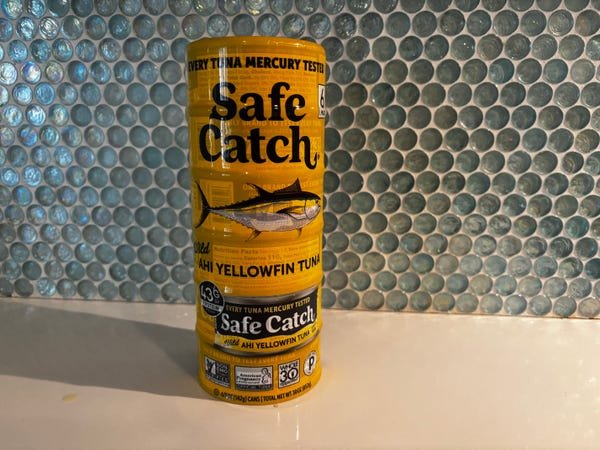
Safe Catch yellowfin tuna is great for quick meals.

At Costco this year, I was able to buy six-packs of 5-ounce cans of Safe Catch tuna.

Lauren Manaker

I get Safe Catch canned yellowfin tuna in bulk at Costco to use in easy, nutrient-packed meals, like salads or grain bowls.

Tuna is a solid source of protein and omega-3 fatty acids, which help support heart and brain health. Though I love enjoying a piece of fresh fish, on busy days, the canned stuff is exactly what I need.

I like buying from Safe Catch because the brand says it tests every fish’s mercury levels to ensure they are well below the FDA action limit.

I heat up a Red’s Egg’Wich for a quick breakfast without bread.


Red's turkey sausage egg-wich

I heat up a turkey-sausage Egg’Wich when I’m in a rush but want a breakfast with protein.

Lauren Manaker

Even dietitians have busy days where cooking meals from scratch isn’t an option.

Found in Costco’s frozen section, Red’s Egg’Wiches are my go-to for a quick breakfast with protein. Each turkey-sausage sandwich has 17 grams of protein and uses two cage-free egg patties instead of a traditional bun.

I like to pair one of these with fresh fruit whenever I’m having a hectic morning but need a balanced breakfast.

Pompeian Smooth & Fruity extra-virgin olive oil is perfect for everyday cooking.


Back of Pompeian olive oil bottle

I grabbed a 2-liter bottle of Pompeian Smooth & Fruity extra-virgin olive oil at Costco this year.

Lauren Manaker

A good extra-virgin olive oil is non-negotiable in a Mediterranean kitchen, and the limited-edition Pompeian Smooth & Fruity EVOO I picked up at Costco has been a standout this year.

Its smooth, fruity flavor makes it incredible for drizzling over salads, finishing roasted vegetables, or using as a dip with crusty bread.

High-quality olive oil provides antioxidants and “good” monounsaturated fats; this one also delivers an exceptional taste.

Pop & Bottle chocolate-pistachio lattes were one of the best ways I got my caffeine fix this year.


Pop and bottle dubai-style chocolate drink

The Pop & Bottle almond-milk lattes have a satisfying, decadent flavor.

Lauren Manaker

These Dubai-style lattes from Pop & Bottle have been perfect for when I want a decadent, satisfying treat that also gives me a caffeine boost.

Each 11-ounce bottle has 5 grams of fiber and 5 grams of protein, which is impressive for a ready-to-drink beverage. I also like that they’re made with quality whole ingredients, including almond milk, pistachio butter, and cacao.

PuraVida’s fire-roasted mix made it easier to eat more vegetables this year.


Pura Vida fire-roasted root vegetables

Vegetables are a key part of any balanced diet.

Lauren Manaker

I’ve been keeping this 64-ounce bag of sweet potatoes, parsnips, carrots, and onions from Costco in my freezer to use as a quick side dish alongside fish or chicken.

They’re simply seasoned with salt, pepper, and olive oil — and the fire-roasting process brings out a wonderful, deep flavor in the root vegetables.

This is definitely one of my favorite buys from Costco this year for creating a balanced meal with minimal effort.

Pure Flavor Poco Bites cucumbers are crunchy, fresh, and versatile.


Small cucumbers in bag

Poco Bites are small, crunchy cucumbers.

Lauren Manaker

Fresh, crunchy cocktail cucumbers are a staple in my kitchen.

Mostly water, they’re a hydrating, low-calorie way to add volume and nutrients (like Vitamin K) to any meal. I use them in everything from refreshing salads and hearty grain bowls to summery sandwiches and simple snack platters.

Costco usually has these Poco Bites at a great price point — $7.37 for a 1 ½-pound bag at the time of writing — so they’re easy for me to keep on hand.

POM Wonderful pomegranate juice is delightfully simple.


Bottle of POM pommegranite juice

I use POM Wonderful in cocktails and marinades.

Lauren Manaker

Pomegranates are a source of powerful antioxidants, and I use POM Wonderful’s juice to easily incorporate them into my diet.

Each bottle contains just the juice of whole-pressed pomegranates — no added sugars or fillers.

I love grabbing 64-ounce bottles of it at Costco because I know I’ll use it up, whether I’m mixing it in marinades to add a tangy, slightly sweet flavor to various proteins or pouring it into my favorite 3-ingredient cocktail.

My freezer has stayed stocked with Kirkland Signature frozen organic blueberries.


Kirklans Signature frozen organic blueberries

I often pick up frozen fruit, like Kirkland Signature organic blueberries, at Costco.

Lauren Manaker

Throughout the year, I’ve enjoyed the frozen Kirkland Signature organic blueberries, a solid source of fiber and antioxidants that are perfect for adding to oatmeal, yogurt, or smoothies.

Frozen fruit can be just as nutritious as fresh, and sometimes even more so since it’s typically picked and preserved at peak ripeness.

Plus, their shelf life is significantly longer than that of their fresh counterpart, which helps me avoid food waste.

I reached for Wonderful’s shelled sweet-cinnamon pistachios all year long.


Wonderful pistachios b

The fact that these Wonderful pistachios are pre-shelled is a convenient bonus.

Lauren Manaker

Finding a 22-ounce bag of this limited-edition Wonderful pistachio flavor at Costco was a delightful surprise.

Pistachios are a nutrient-dense nut, offering healthy fats, protein, and fiber. They’re one of the few plant-based protein sources that provide all nine essential amino acids your body can’t make on its own.

Plus, these pistachios have a pleasant hint of cinnamon that satisfies my sweet tooth, and their pre-shelled convenience makes them a perfect snack.

The Ithaca x Graza hummus tastes homemade and goes with everything.


Ithaca x Graza hummus with olive oil and sea salt

I snagged a 26-ounce container of the Ithaca x Graza hummus at Costco this year.

Lauren Manaker

Hummus is a classic Mediterranean dip, and this collaboration between Ithaca and Graza is exceptional.

I give this hummus bonus points for not containing any unnecessary fillers or artificial flavors. Made with high-quality ingredients, like Graza olive oil and chickpeas, it has a rich, smooth texture and bright, zesty flavor.

It’s a delicious way to add plant-based protein and healthy fats to my diet, whether I’m using it as a dip for fresh vegetables, spreading it into sandwiches, or scooping it onto grain bowls.


Source link

Im-61-with-16-grandkids-Instead-of-downsizing-we-bought.jpeg

I’m 61 with 16 grandkids. Instead of downsizing, we bought a bigger vacation home to finally make family trips work.

This as-told-to essay is based on a conversation with 61-year-old Doug Beachy, a Cincinnati-based business owner who bought a vacation home with Pacaso in 2022. Pacaso is a platform for fractional ownership of luxury vacation homes. The company allows multiple individuals to co-own a second home and share ownership of the property. This conversation has been edited for length and clarity.

I’ve been married to my wife, Jamie, for 37 years. We have four married children and 16 grandchildren. Our oldest grandchild is 12, and our youngest isn’t quite one yet.

Once our kids started having children, they all moved back closer to home in Cincinnati, where we live. We own a five-bedroom home that’s about 4,000 square feet. We’re empty nesters, so there’s plenty of space for us, but when the whole family is over, everyone is on top of each other.

We’ve converted one room into a kids’ playroom and another into a nursery, and we have a finished basement where the kids can play, but family gatherings are still a bit hectic.

In the past, to bring everyone together, we would either rent a large beach house or book a cabin-style retreat in the woods here in Ohio.

We did that about every other year because it’s hard to coordinate everyone’s schedules — especially with grandkids in school — and seasonal rates for a large home are expensive. It was a big chunk of money for just a week’s experience.

We bought a vacation home

Hilton Head Island has always been a fun family destination for us. It’s an island in the Lowcountry of South Carolina, just outside Savannah, Georgia, with about 12 miles of pristine beaches.

There’s so much to do here from a family activity standpoint, in addition to simply soaking up the sun and going to the beach — it’s just a great place to relax and unwind.

Homes here can be expensive, though. The average home is priced in the upper $700,000s, and properties can sell for as much as $10 million. For a while, I thought about buying a second, larger home here, but I’m not retired yet, and I realized that putting that much money into a house where I don’t live full time just didn’t make sense.


An aerial view of homes along the shore in Hilton Head.

Hilton Head Island, South Carolina.

EyeEm Mobile GmbH/Getty Images


In early 2022, I started exploring different homeownership options, including shared or fractional ownership. That’s when I found Pacaso online and saw they had some homes available in Hilton Head.

We ultimately settled on an about 5,000-square-foot home with six spacious suite-like bedrooms — five with king-sized beds, large walk-in closets, and private bathrooms, and one with several bunk beds for the children — and seven and a half bathrooms.

As you can imagine, taking 20 people out to eat all the time is not exactly fun, so we wanted a house with a large, well-stocked kitchen. Our kitchen almost occupies the entire second floor and, by my last count, it can seat 19 or 20 people. It also has a beautiful ocean view.

Co-ownership was the best fit for us

When we bought the home, it was valued at over $5 million. We own a 1/8 share — we made a 50% down payment on our portion of the home — and there are seven other owners, whom we don’t know.

Our friends will say, “It sounds like a timeshare.” But I think it’s much more transparent than a traditional timeshare. There are no extra markups or mystery fees added on top.

I also feel that, unlike a timeshare, which can leave you feeling stuck and lose value over time, this is a long-term investment. Of course, everything depends on the real-estate market, but I feel fairly confident this is an appreciating asset.


Doug Beachy's vacation home.

The Beachy vacation home.

Courtesy of Pacaso


I think going this route, instead of buying another second or vacation home, has eliminated all the concerns I had about upsizing — like having to maintain the home ourselves or deal with high HOA fees. We wanted a place we could share with family, and this setup works well for us at this stage of our lives.

We spend more time together as a family

Pacaso provides a house manager who handles everything. It’s essentially a concierge service — the home is clean when we arrive and fully stocked with towels, linens, soaps, and disposable items, such as paper towels and paper plates.

When we go, the only thing we really need to think about is what food we want to buy, depending on what we plan to cook — and we have a lot of good cooks in the family.

We have the home reserved for 44 nights a year, and we use nearly all of that time. Not everyone in the family is there for every stay, but they come as they please.

Our family gets together more often now, about twice a year. In the summer, during the high season when the kids are out of school, we typically reserve the house for a couple of weeks at a time.


Doug Beachy and his granddaughter.

Beachy and his granddaughter.

Courtesy of Doug Beachy


The grandkids look forward to each trip and talk about it all the time. Many of them are around the same age, and they love the opportunity to spend time with their cousins.

The house came with six beach cruiser bikes, which is perfect because there are plenty of biking trails on the island. It also has a private pool and hot tub, and the grandkids love that it’s fully stocked with games and puzzles.

Our favorite things to do with them are spending time in the pool, watching the sunrise, and hanging out on the beach. We also take a lot of bike rides and play pickleball. We just love how much more quality time we’re spending together as a family.


Source link