An-entrepreneur-is-transforming-a-Cold-War-era-nuclear-silo-into.jpeg

An entrepreneur is transforming a Cold War-era nuclear silo into an underground data center. Look inside.

A decommissioned nuclear silo near Denver, Colorado, that could once launch three 4.5-megaton nuclear missiles at a moment’s notice is now an entrepreneur’s pet project.

Nik Halik, an Australian venture capitalist, purchased the decommissioned Cold War-era nuclear missile silo from the US government in 2021 for more than $10 million. For the past five years, Halik has been overseeing its transformation into a modern, renovated facility, where he plans to house an AI data center.

The project is on brand for Halik, a self-described “thrillionaire” whose past endeavors have included skydiving over Mount Everest, training in Russia as a civilian cosmonaut, and diving 5 miles deep to the deck of the Titanic.

He said his interest in these types of structures pairs with his vision for what they could become.

“I’m immersed in the world of castles and underground bunkers,” Halik told Business Insider. “I’m a value-facturer. I like things that I can add value to.”

Halik took Business Insider on a tour of the facility. See what it looks like inside the roughly 75-year-old nuclear silo.

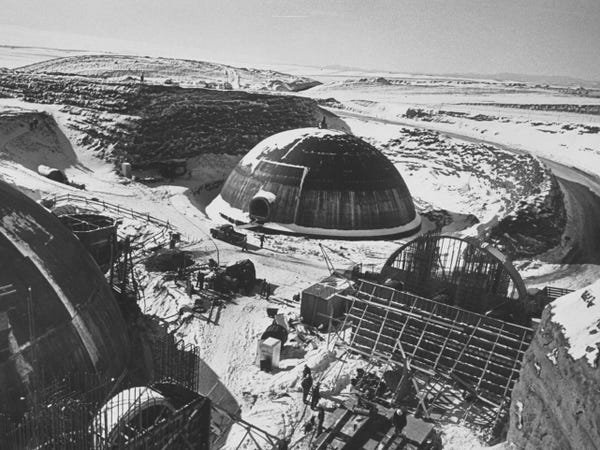
The facility was built in Colorado in 1959 for $47 million, or $350 million in today’s dollars.

Other Titan I silos like Halik’s were built in Colorado.

Carl Iwasaki/Getty Images

At the beginning of the Cold War, the US began developing intercontinental ballistic missiles (ICBMs) at a rapid pace. Following the US’ first operational ICBM, the SM-65 Atlas, the Titan I went under development in the mid-1950s.

According to the National Park Service, the Titan I missiles were 98 feet tall and could deliver a nuclear warhead over 6,000 miles.

Eighteen silos, like Halik’s and the one pictured, were built across the US to house these missiles during the Cold War.

Four large diesel engines powered the facility.


A person walking into a Titan I facility.

Another Titan I silo near Denver. Thanks to diesel power, the facilities could be powered without the grid.

Carl Iwasaki/Getty Images

Thanks to the silo’s use of diesel fuel, it had the ability to stay running without being connected to the electrical grid. The amount of fuel in the silo was enough to fuel around 2,000 houses for roughly 2 weeks.

Just one of the silo’s three diesel tanks has the capacity to hold about 50,000 gallons of fuel, Halik told Business Insider.

The missiles were removed from the silo less than a decade later.


A construction worker attached to a crane touching the tip of a missile.

All Titan I missiles were decommissioned in 1965.

Carl Iwasaki/Getty Images

In all, 54 Titan I missiles were operational between April 1962 and January 1965, according to the National Park Service.

Despite the impressive stature of the Titan I silos, they proved to be short-lived. All were removed by early 1965, becoming obsolete due to rapid technological developments that led to the Titan II and Minuteman I ICBMs.

In the years that followed, the US government removed valuable materials from the silos and sold off most of the facilities to public and private owners. Halik said after his bunker was decommissioned, it was used by government defense contractors and The Defense Advanced Research Projects Agency.

Today, Halik is renovating the silo at an estimated cost of $30 million.


Outdoor view of Halik's facility,

Halik’s facility is in an isolated area near Denver, Colorado.

Business Insider

Halik, with help from others, has been renovating the facility, located in a top-secret location in Colorado, for over four years.

Aside from the facility’s rusty metal scraps and loose wires, other hidden dangers lurk throughout the complex. The basement level, Halik said, is riddled with cyanide, lead paint, mercury, and asbestos.

The entrepreneur has taken a hands-on role in exploring and renovating the facility.


Halik holds a flashlight and points.

Halik has taken a large role in the renovation process despite safety risks.

Tyler Merkel

He’s documented every step of his journey in the facility on the YouTube channel Nuclear Bunker Living. The first episode, uploaded in September 2021, shows him exploring the bunker by himself for the first time.

As Halik’s videos show, he often jumps into the exploration and renovation headfirst, despite the safety risk. On one occasion, he crawled through a rusty pipe, only to realize later that it had a live wire running through it that he said could’ve electrocuted him instantly.

“There are so many variables of danger here,” Halik said in a video. “This place is unforgiving, and it always reciprocates with interest.”

The bunker totals 200,000 square feet.


View from the bottom of the bunker's stairs.

The bunker needed to be deep enough to house the 98-feet-tall Titan I missiles.

Tyler Merkel

The silo descends 165 feet below the surface, deep enough to house the missiles and the equipment necessary to launch them.

Seventeen distinct chambers make up the facility, connected by a network of tunnels spanning 4,500 feet.


A tunnel in Halik's complex.

A network of tunnels connects the complex’s rooms.

Tyler Merkel

Different launcher rooms, control domes, a power dome, and other areas make the facility a sprawling complex.

The most secure part of the complex can withstand a nuclear blast.


A sign reading

One part of the facility has strong concrete walls reinforced with steel.

Tyler Merkel

One portion of the facility was built by what Halik called “Hoover Dam-type engineering.” Featuring multiple layers of steel-reinforced concrete, each square inch of the wall could withstand roughly 15,000 pounds of pressure.

In this room, operators would stand ready to launch the missiles at a moment’s notice.


A desk from the control room of the facility.

Operators for the missiles would stand ready for a call from the Pentagon.

Nuclear Bunker Living/YouTube

The control room was where the missile operators would have pressed the fateful buttons to launch missiles that were 300 times more powerful than the bomb dropped on Hiroshima.

“The fate of the Western world was in the hands of these 21- to 22-year-olds who had the keys to the missiles, ready to employ them on the instructions of the Pentagon from the president,” Halik said.

Halik wants to turn one part of the facility into a museum.


An up-close shot of the launch deck.

Halik and his team found papers pertaining to the missile’s launch in the bunker.

Nuclear Bunker Living/YouTube

Many relics still remain in the control room and other areas, including pieces of the desk where a launch would’ve been programmed.

Recently, Halik and his team discovered papers containing launch codes, times, and other protocols.

For other rooms, he has more creative plans.


A large room that Halik said could be turned into a night club.

Halik wants to turn one room into a nightclub.

Nuclear Bunker Living/YouTube

In another room, Halik envisions a nightclub, complete with a DJ, bar, consumption lounges, and Cirque du Soleil dancers.

At a different decommissioned missile site in New Mexico, this vision may already be a reality. The Twistflower Nuclear Missile Silo in Roswell will host the ATOMIKA festival in November.

The festival, promoted by Halik, describes itself as an “experimental, annual gathering that fuses immersive art, deep inquiry, and powerful music.”

Chief among Halik’s plans is to turn part of the facility into a data center.


The facility's power dome

The facility’s power dome could once again be used to power a data center.

Tyler Merkel

Since AI requires large amounts of power, as well as a safe and reliable space for data, underground locations like Halik’s facility could prove to be prime locations.

A critical factor is the bunker’s cool temperature of 52 degrees Fahrenheit, even during the summer, which is optimal for the interior of a data center to prevent servers from overheating.

At some data centers, it can take more than 30% of a facility’s electricity to keep servers cool, the Pew Research Center reported.

“AI needs power,” Halik said. “AI needs safe environments to basically have all their computational processing power.”

The data center could be powered entirely in-house, without the grid.


Halik said he would install small nuclear reactors for power.

Halik said he would install small nuclear reactors for power.

Tyler Merkel

Halik said that to power the data center, he would swap the facility’s diesel infrastructure with small nuclear reactors in an attempt to avoid the hassles of refueling.

Halik said he has already gotten the attention of tech and AI companies.


View of one room with light bulbs and wires.

Companies are increasingly looking to house data centers underground.

Tyler Merkel

Although Halik didn’t disclose the specific companies interested, it aligns with a growing trend of underground data centers becoming more commonplace.

One company, called Iron Mountain, utilizes a former limestone mine in Pennsylvania for data processing and storage. The 220-foot-deep facility stretches 40 acres, about nine times the size of Halik’s bunker.


Source link

Trump-says-the-US-has-totally-obliterated-military-targets-on.jpeg

Trump says the US has ‘totally obliterated’ military targets on Kharg Island, the center of Iran’s oil empire

  • President Donald Trump said the US has destroyed military targets on Kharg Island.
  • The island, located off the coast of Iran, is central to the country’s oil empire.
  • Trump said the strikes did not damage the island’s oil infrastructure.

President Donald Trump said late Friday that the US had “totally obliterated” military targets on Kharg Island, an island off the coast of Iran that is central to its oil empire.

“Moments ago, at my direction, the United States Central Command executed one of the most powerful bombing raids in the History of the Middle East, and totally obliterated every MILITARY target in Iran’s crown jewel, Kharg Island,” Trump wrote.

“Our Weapons are the most powerful and sophisticated that the World has ever known but, for reasons of decency, I have chosen NOT to wipe out the Oil Infrastructure on the Island,” he added.

“However, should Iran, or anyone else, do anything to interfere with the Free and Safe Passage of Ships through the Strait of Hormuz, I will immediately reconsider this decision,” Trump continued. “Iran has NO ability to defend anything that we want to attack — There is nothing they can do about it!”

Representatives for CENTCOM and the White House did not immediately respond to requests for comment from Business Insider.

What is Kharg Island?

Kharg Island is a small island in the Persian Gulf, located roughly 300 miles from the Strait of Hormuz, which is known for its significance to Iran’s oil production.

Refineries on the island process nearly all of the nation’s oil exports. Disruption to the facilities there could have a significant impact on the global oil shortage, further driving up costs.

This is a developing story. Please check back for updates.


Source link

Oracle-to-investors-Dont-worry-about-data-center-spending-company.jpeg

Oracle to investors: Don’t worry about data center spending, company is ‘very, very good’ at cost-cutting

Oracle has two magic words for investors concerned with the company’s aggressive data center spending: fast and cheap.

Shares of the cloud giant rose as much as 10% on Tuesday after it surpassed investor expectations for the third quarter and raised revenue guidance to $67 billion for fiscal 2026.

Still, Oracle faced some questions about its AI data center buildout and how it plans to justify the billions of dollars it burns along the way. In February, Oracle announced a $50 billion debt raise to help fund its AI ambitions. In the last year, the company has announced major data center projects in Texas, New Mexico, and Michigan.

On Oracle’s third-quarter earnings call Tuesday, Bernstein analyst Mark Moerdler asked, “How comfortable are you with the values you’re creating from the AI data center business itself?”

Oracle co-CEO Clay Magouyrk reassured Moerdler that the company is focused on minimizing the cost of its data center buildout to maximize future profitability.

“We continue to get better and better at running these data centers, delivering them more cheaply, optimizing the amount of cost for networking and hardware spend, as well as power,” said Magouyrk.

He added that Oracle is focused on accelerating the time its buildings spend under construction.

“We’re very good at it,” he said.

“We’re very, very good at reducing those costs during that time period.”

He did not give any other details on how exactly Oracle manages its data center budget.

In 2022, Oracle undertook significant cost-cutting measures, laying off thousands of people in the wake of its $28 billion acquisition of medical records giant Cerner.

In January, Business Insider reported that Oracle was struggling to find financing for Stargate, its $500 billion data center initiative with OpenAI.

Lenders and investors told Business Insider they were growing weary of the project’s lofty ambitions as it races to keep up with the rest of Big Tech amid the AI race.

Amazon, Microsoft, Google, and Meta are on track to spend $600 billion on data centers and AI infrastructure in 2026 alone.


Source link

Police-arrested-a-man-at-a-meeting-to-discuss-a.jpeg

Police arrested a man at a meeting to discuss a proposed Oklahoma data center after exceeding his time limit by 30 seconds

Applause broke out during an Oklahoma man’s speech at a city council meeting on Tuesday to discuss a proposed data center. A minute later, shouts of disbelief rang out across the room.

“Disgusting!” one woman shouted as Claremore Police Department officers handcuffed and escorted Daniel Blanchard out of the room.

Authorities said they arrested Blanchard, whose speech exceeded the three-minute time limit, for trespassing.

Over 100 people, including Blanchard, had gathered in a ballroom at Rogers State University in Claremore to voice their opinions about the large data center project. The developer, Beale Infrastructure, is proposing a campus in the Claremore Industrial Park that includes data centers, supporting infrastructure, and office space.

Blanchard was among the residents who opted to speak during the public comment portion, which limits each person to three minutes. In his speech, Blanchard spoke about what he considered compliance issues related to the potential data centers.

“The Claremore Industrial Economic Development Authority has a fiduciary responsibility to the public, not to build infrastructure. And this act of overreach is putting the health and safety of members of this community at risk,” he said.

AI is driving a data center construction boom across the United States. While companies like OpenAI argue that building new data centers will reindustrialize the US economy and create jobs, residents of towns where developers are proposing new data centers worry about their impact on power grids, water resources, pollution, and overall quality of life.

In an investigation published in September, Business Insider reported that over 1,200 data centers had already been built or were approved for construction across the country.

The proposed data center in Claremore, a suburban hub of Tulsa home to about 20,000 people, has divided the town. During the three-hour meeting on Tuesday evening, dozens of residents spoke both in favor and against the project.

Blanchard exceeded his three minutes by about 30 seconds before police officers approached him. He gathered his notes and calmly followed the officers to the front of the hall, where town officials were sitting.

In a video of the meeting posted by the town on its YouTube channel, Blanchard appears to hand his notes to a council member. At that point, police arrested Blanchard, placing him in handcuffs. The crowd hollered in shock.

In a statement, the Claremore Police Department said officers aren’t responsible for enforcing city council rules and only become involved in city council meetings when an official orders them to remove an individual.

“The man’s position on the issues, what he said, or his unwillingness to follow rules of the meeting played no part in the officer’s decision to arrest him,” the statement said. “He was arrested for trespassing in compliance with the law and with the hope of restoring order to an important meeting.”

A local politician fighting the data center project posted to X on Wednesday that Blanchard has been released from jail. The next council meeting is scheduled for March 2.


Source link

Dan Geiger

Eric Schmidt-backed data center venture is negotiating a major deal with Google

Bolt Data and Energy, a data center development firm that was cofounded late last year by former Google CEO Eric Schmidt, is negotiating a deal that would allow it to begin construction on a large data center project it is planning in West Texas.

Schmidt’s firm is in discussions with Google, his former employer, according to two people with direct knowledge of the talks. The tech giant, one of the leaders in the race to develop and commercialize artificial intelligence, is considering a commitment of 250 megawatts, according to one of the people. The other person said it was too early to characterize the exact size of the potential transaction because it was still under discussion.

The sources spoke on the condition of anonymity because the potential transaction is still being arranged and the talks are confidential.

“We don’t comment on rumors,” a Google spokeswoman told Business Insider, declining to comment further. Google announced last year that it plans to build $40 billion of cloud and AI infrastructure in Texas by 2027.

The potential deal highlights how Big Tech is racing to secure the power, physical infrastructure, and land needed to fuel AI, even as the costs and financial risks of those bets loom.

In December, Bolt completed its first funding round, raising $150 million from investors, including $50 million from Texas Pacific Land Corporation, a public company that owns large tracts of land in West Texas. As part of the investment from TPL, Bolt will develop data centers on land in TPL’s portfolio.

A presentation detailing Bolt’s development plans, shared with Business Insider, said that TPL’s land would give it access to abundant power and water for cooling. These commodities have become increasingly strained as data center development has boomed around the country.

The presentation states that Bolt’s development would begin with an “initial 250 megawatt facility” and expand in 250-500 megawatt increments into a 5 gigawatt campus.

Bolt’s plan is one of several large-scale projects that have been envisioned in Texas to cater to the AI race. Fermi, a public company co-founded by former Texas governor and US Energy Secretary Rick Perry, has plans for an 11-gigawatt campus in Amarillo.

In December, Business Insider revealed that Amazon had pulled back a $150 million cash advance it had pledged as part of a preliminary deal to anchor the project. Fermi’s disclosure of the reimbursement of that advance caused its stock to fall by 50%. Fermi’s CEO, Toby Neugebauer, told Business Insider that although Amazon had reclaimed its advance, the negotiations for it to take space with Fermi were still ongoing.

Major bank lenders who extended $38 billion to finance the construction of data center campuses in Shackleford County, Texas, and Port Washington, Wisconsin, for Oracle and OpenAI, meanwhile, have had difficulty selling off pieces of the huge loan to other banks and investors. Those troubles stem, in part, from worries about whether Oracle’s credit will be strained by its massive AI spending.

To help allay concerns, Oracle announced it would raise as much as $50 billion in debt and equity in 2026 to continue to pursue its AI buildout while also maintaining “a solid investment-grade balance sheet.”

Last week, Alphabet, Google’s parent company, revealed in its fourth-quarter earnings report that it plans to spend between $175 and $185 billion on capital expenditures in 2026, roughly double its outlay in 2025. The spending is being done largely to pay for AI equipment and infrastructure.

A record wave of spending has been announced by big technology companies on AI this year, including Amazon’s disclosure during its earnings last week that it would spend $200 billion alone this year.


Source link

ICE-arrested-2-truck-drivers-heading-to-a-major-Meta.jpeg

ICE arrested 2 truck drivers heading to a major Meta data center project

  • ICE arrested two drivers on Wednesday near a Meta construction project in Louisiana, officials said.
  • The individuals were detained during a traffic stop inspection of vehicles heading to the site.
  • “ICE did not enter the Meta site at any time,” the local sheriff’s office said.

Meta’s new mega data center project had a brush with immigration authorities.

The Sheriff’s Office in Louisiana’s Richland Parish, where the massive Hyperion Data Center is under construction, said Wednesday that US Immigration and Customs Enforcement detained two dump truck drivers traveling to the site during a traffic stop inspection.

“During those stops, two drivers were arrested by ICE due to their immigration status,” the office said. The drivers were from Guatemala and Honduras.

“ICE did not enter the Meta site at any time,” the office said.

In a statement to Business Insider late Thursday, the Department of Homeland Security said that ICE did not target a Meta data center in Louisiana.

The DHS spokesperson said that the ICE agents had carried out a “targeted operation” to arrest the truck driver from Honduras, and had encountered another driver from Guatemala. It said both were arrested and are in ICE custody.

Meta declined to comment to Business Insider.

The Meta project is the largest of several multi-gigawatt data centers that CEO Mark Zuckerberg has said will come online as the company races to catch up on AI computing capacity.

Wednesday’s arrests crystallize an issue that companies have increasingly had to grapple with over the past year: how to prepare workers for an ICE encounter, whether on or off company property.

The action also follows a recent surge of ICE activity in cities and towns across the US, which has met some resistance in Democratic-led states.

Louisiana Gov. Jeff Landry has been a prominent supporter of President Donald Trump’s immigration policies. The state is receiving nearly $1 million a month to house detainees at its Angola prison, Axios reported, citing public records.

January 15, 11.25 p.m. E.T. — This story was updated to include comments from a DHS spokesperson.


Source link

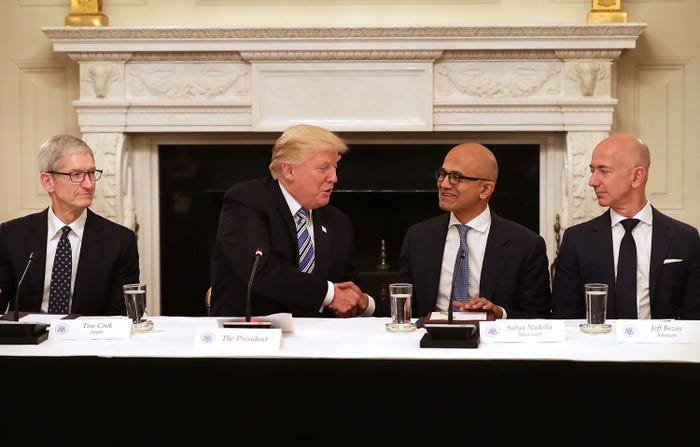
President Donald Trump speaks during an American Technology Council roundtable in the State Dinning Room at the White House in Washington, DC on Monday, June 19, 2017. From left, Tim Cook, Chief Executive Officer of Apple, Trump, Satya Nadella, Chief Executive Officer of Microsoft, and Jeff Bezos, Chief Executive Officer of Amazon. (Photo by Jabin Botsford/The Washington Post via Getty Images)

Trump says that Microsoft will ‘ensure’ Americans don’t ‘pick up the tab’ for its data center power consumption


Chip Somodevilla/Getty Images

  • President Donald Trump asks tech companies to “pay their own way” for their data centers.
  • Data centers drove up utility bills in at least 13 states, Business Insider previously reported.
  • Trump says that Microsoft will be the first to work with the White House to keep utility bills down.

President Donald Trump said on Monday that even though data centers are “key” to the AI boom, tech companies must “‘pay their own way,'” so that Americans don’t have higher utility bills.

“First up is Microsoft, who my team has been working with, and which will make major changes beginning this week to ensure that Americans don’t ‘pick up the tab’ for their POWER consumption, in the form of paying higher Utility bills,” Trump said on Truth Social, hinting at additional announcements “in the coming weeks.”

Data centers drove up utility bills in at least 13 states, Business Insider previously reported.

Over the past year, Microsoft has been planning for data centers in Wisconsin, Atlanta, Texas, and Michigan.

The White House and Microsoft did not immediately respond to a request for comment.

This is a developing story; check back for updates.


Source link