A-peek-inside-the-Feds-renovations-that-are-now-at.jpeg

A peek inside the Fed’s renovations that are now at the center of a DOJ probe

  • The Federal Reserve’s renovation project was expected to cost $1.9 billion. It now has a $2.5 billion price tag.
  • Lead paint and asbestos discoveries contributed to increased renovation expenses and delays.
  • Fed chairman Jerome Powell said a new DOJ probe is part of ongoing pressure from the Trump administration.

The Federal Reserve’s planned five-year renovation project is causing quite the stir in Washington.

Renovations began around 2022 on two Federal Reserve offices, the Marriner S. Eccles Building and the Federal Reserve Bank of East Building, which were first assembled in the 1930s, according to plans reviewed by the National Capital Planning Commission in 2021.

As workers gutted the aging structures, they uncovered lead paint and asbestos, pushing the cost of the renovations rose from $1.9 billion to $2.5 billion, as Federal Reserve chairman Jerome Powell described in a letter defending the renovation’s budget last year.

President Donald Trump has blamed the overruns on mismanagement and allegations of luxury additions. On Sunday, Kevin Hassett, director of the administration’s National Economic Council, told ABC’s This Week that the project became “the most expensive project in D.C. history.”

Later that day, Powell revealed the central bank now faces a potential Department of Justice investigation, and he’s facing a potential criminal indictment over the cost increases.

“No one — certainly not the chair of the Federal Reserve — is above the law,” Powell responded in a two-minute social media video. “But this unprecedented action should be seen in the broader context of the administration’s threats and ongoing pressure.”

As questions swirl around the renovations, Business Insider gathered images of the construction, floor plans for the renovations, and design mock-ups.

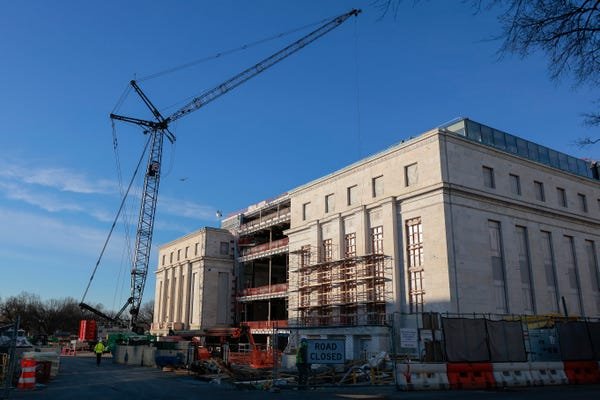
The Eccles and FRB-East buildings have been wrapped in scaffolding and cranes since 2022.

The Federal Reserve has been renovating its two buildings since 2022. The project is expected to wrap up by late 2027.

Heather Diehl/Getty Images

Construction workers broke ground on the renovations in 2022 on the 93- and 88-year-old buildings.

The Fed said the building has not had a modernization project in decades. A series of decades-old electrical, heating, plumbing, and air ventilation systems ran through the historic building.

The project was necessary to “address a critical backlog of upgrades, to respond to changes in building codes and regulatory requirements, and to meet requirements for information technology, building security, environmental sustainability, and energy efficiency,” according to plans produced by the Fed and released to the public in 2021.

Documents show the Fed’s proposed floor plans for both buildings.


A floor plan of both Federal Reserve buildings

The Federal Reserve’s modernization plans were mapped out in an exhaustive 87-page document, released in 2021. The document includes floor plans, mock-ups, and explanations of landscaping decisions.


Federal Reserve Board and Fortus


The Federal Reserve published floor plans for the expansion project in 2021. The plans plot out details like where new windows would be erected, why new shrubbery would be planted in specific areas on the lawn, how it would make offices more wheelchair accessible, and where historic marble will be reused.

Since the release of the plans, construction workers have uncovered asbestos and lead paint, resulting in higher-than-expected material requirements. Inflation has also increased the price of those goods.

A mock-up of the exterior, including plans to add some glass structures.


A mock-up of the exterior of the Fed building.

The Fed’s renovation plans include new glasswork that will surround the historic, stone elements of the building.


Federal Reserve Board and Fortus


The modernization project would expand some sections of the Fed buildings, including areas with new glass-covered atriums.

The Eccles building’s courtyard will be converted into an atrium.


A mock-up view from the second floor in the Eccles Atrium

The main building’s atrium is intended to mix “historically significant spaces and work space to balance preservation and modern office needs.”


Federal Reserve Board and Fortus


The courtyard at the center of the central bank’s main building would become a glass-enclosed atrium. The renovation would also include new accessible ramps, and the existing wooden oak doors would be stained a medium brown.

Both historic buildings’ interiors were finished with hand-carved wood in the 1930s. The woodwork will remain intact after the renovation.


Inside the renovated Eccles Building Level 4 Lounge

The renovation is designed to preserve historic architectural elements while updating the decades-old structure underneath. Here is an example of a fourth-floor lounge featuring salvaged woodwork and a marble floor.


Federal Reserve Board and Fortus


Much of the project is dedicated to balancing “preservation and modern office needs,” according to the plans. Several office spaces plan to reuse marble and wood from the original buildings.

The Eccles building’s center wing skylight would be moved to the fourth floor to let the light stream in.


A peaked natural light shaft with bronze beams lets light strem into the fourth floor.

The natural light shaft, which was constructed in 1977, is also getting an update that the Fed said would introduce more natural light to the fourth floor.


Federal Reserve Board and Fortus


A natural light shaft, shown above, has sat on the top of the building since 1977. The renovation would relocate the glass casing to the fourth floor, allowing more light to enter nearby offices.

The core architectural details of each building are important to preserve, the Fed said. It can help project financial power.


A statue of a bald eagle perched on top of the Eccles building.

The project is meant to update the building’s office capacity while maintaining its key architectural details, like the bald eagle perched atop the entrance.

Andrew Harnik/Getty Images

The Eccles building was designed to project stability during the Great Depression, with marble halls and bronze fixtures meant to inspire public confidence in the banking system. Those original details are being carefully restored, the Fed said in the plans.

White House officials have alleged the renovations include new VIP dining rooms and elevators, a vegetated roof, and millions of dollars in new marble. The Fed has denied those allegations in press releases.

The Eccles building has been in disrepair, the Fed says.


Ornate wood that was hand-crafted during the building's construction in the 1930s shows water damage

The Fed’s ornate architecture has endured nearly nine decades of wear, including water damage on the historic wood moldings, shown above.

ANDREW HARNIK/POOL/AFP via Getty Images

Water damage has been an issue for the historic buildings, according to images produced by Getty photographers in a July 2025 walk-through of the construction. Pictures of the historic building’s lobby show extensive damage to ornate wood carvings.

Asbestos and lead paint have been a costly issue. Inflation hasn’t helped either.


Tarp is wrapped over sections of the Fed building where asbestos was found

Workers have been clearing asbestos from the building for much of the past decade. This picture, taken in 2017, shows a construction site inside the Eccles building where workers found the dangerous material.


Federal Reserve


The Fed said it needed to make renovations to make its offices “safe, healthy, and effective places to work,” according to the Federal Reserve’s plans. For years, workers have uncovered asbestos throughout the historic buildings — a material now banned in most construction in the US.

As the project continues, more materials have had to be replaced than expected. Construction-sector inflation has made the overruns steeper.

Trump has seen the renovation project up close.


President Donald Trump and Chair Jerome Powell toured the Fed building in July 2025.

President Donald Trump and Federal Reserve Chair Jerome Powell tour the Eccles Building during its renovation.

Chip Somodevilla/Getty Images/Reuters

In July 2025, Trump toured the renovation project with Powell and Republican Sen. Tim Scott.

During a brief interview with reporters, Trump and Powell sparred over the cost of recent construction projects in the building.

The building is expected to be completed in late 2027.


A mock-up of the exterior lighting on the Eccles Building

Plans include new lighting to highlight the building’s historic features.


Federal Reserve Board and Fortus


This year, Fed press releases suggested construction workers would leave the building in the fall of 2027. Employees who have been working at temporary offices are expected to move in during the first quarter of 2028, if plans proceed accordingly.

Once staffers return to the office, the Fed said its new campus would save money.

“Over time, the Board has needed to lease space in several commercial office buildings to support its operations,” the Fed said in a July 2025 press release. “This project allows the Board to consolidate its operations and reduce expenses on leased space elsewhere.”


Source link

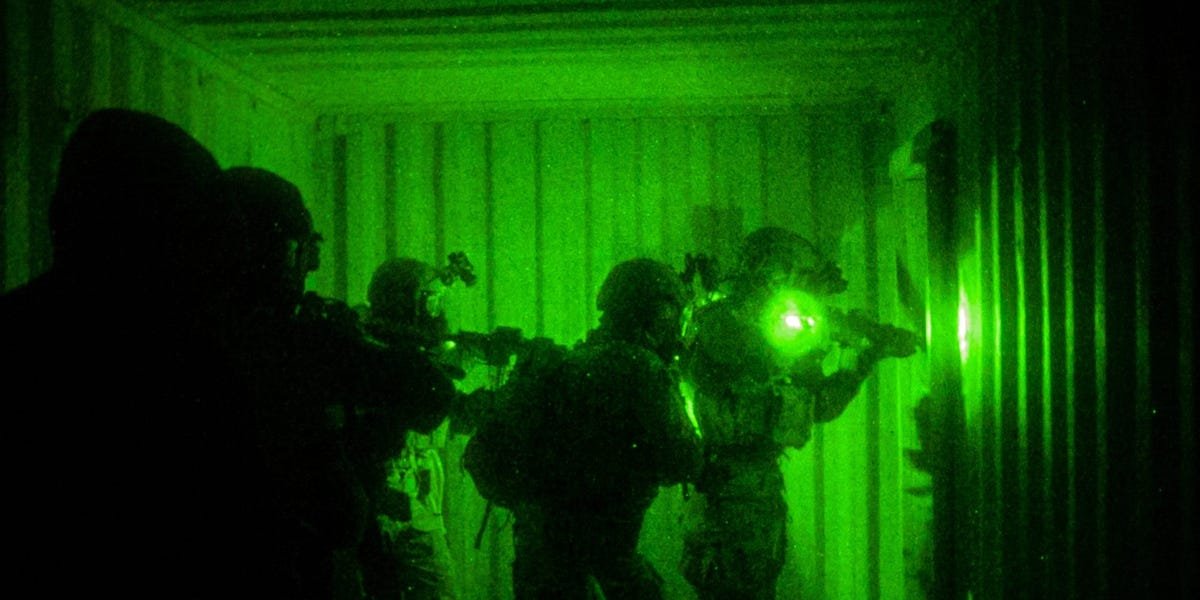
What-is-Delta-Force-The-elite-US-special-ops-unit.jpeg

What is Delta Force? The elite US special ops unit reported to be at the center of the raid to capture Venezuela’s Maduro

At the center of the US operation that captured Venezuelan President Nicolás Maduro and his wife was an elite and secretive special operations group, per multiple reports.

Citing officials, outlets like The New York Times and The Wall Street Journal reported that Delta Force, alongside law enforcement personnel, carried out the extraction of Maduro as part of Operation Absolute Resolve, a surprise nighttime raid of the Venezuelan leader’s compound in Caracas.

Business Insider wasn’t able to independently confirm the participation of the elite unit in the operation. The Pentagon directed BI’s queries to the White House.

In discussions of the complex operation, President Donald Trump said only that it was executed by “the most highly trained soldiers in the world,” adding that “there’s nobody that has their talent.”


Caracas at sunset

Caracas, the capital of Venezuela

Juan BARRETO / AFP via Getty Images


The president may have been speaking about all of the personnel involved. US officials said that the operation to grab Maduro included land, air, sea, space, cyber, and intelligence forces. But Trump’s language could easily apply to Delta Force, a top-tier special operations unit.

Here is what we know about this elite force.

An essential but highly secretive group

Delta Force, officially known as the 1st Special Forces Operational Detachment-Delta (SFOD-D), is tasked with capturing and eliminating high-value targets. Like other tier-one special mission units, such as SEAL Team 6, Delta Force tackles some of the US Army’s most covert and complex tasks.

The special operations unit, founded by Col. Charlie Beckwith in the 1970s for direct combat action, unconventional warfare, and counterterrorism, is headquartered at Fort Bragg in North Carolina, also home to other Army special operations forces.

Operators train for rapid infiltration and exfiltration, intense close-quarters combat, precision marksmanship, demolition, hostage rescue, and more. Unlike some other units, Delta pulls the best warfighters it can from across the US armed forces, though it mainly draws from Army special operations forces. Known as “quiet professionals,” Delta Force operators generally do not speak openly about their activities.

Much of the elite force’s work is highly classified, but some Delta missions are public knowledge.

Delta Force was involved in the US operation, Just Cause, that ultimately led to the capture of Panamanian dictator Manuel Noriega during the 1989 invasion of Panama. And the group distinguished itself during the 1993 Battle of Mogadishu, made famous by the book and film “Black Hawk Down.” Two snipers were posthumously awarded the Medal of Honor for their actions.

This century, this unit was among the US special operations forces that surged into Afghanistan immediately after the 9/11 attacks, played a role in the 2003 capture of former Iraqi President Saddam Hussein, and was involved in the death of the infamous Islamic State leader Abu Bakr al-Baghdadi in 2019.


Aircraft, explosions, and smoke were seen across Caracas, the capital of Venezuela, from about 2 a.m. The US carried out strikes and captured the nation's president, Nicolás Maduro.

Aircraft, explosions, and smoke were seen across Caracas, the capital of Venezuela, during the US operation.

Reuters


And now reporting indicates Delta Force, along with the 160th Special Operations Aviation Regiment, was instrumental in capturing Maduro.

The assault on Venezuela and raid on Maduro’s compound

The US president and other US officials shared details of the raid that captured Maduro on Saturday.

Dan Caine, chairman of the Joint Chiefs of Staff, said the apprehension team broke into a fortified compound to capture Maduro after months of planning. US intelligence agencies watched and studied his patterns of life, while other teams trained for the operation on a replica of Maduro’s home. The US used a similar tactic to ready for the 2011 raid on Osama bin Laden’s compound.

Reports indicate Delta Force was inserted into the target area by the 160th SOAR, the Night Stalkers famous for their ability to get special operators in and out of tough spots.

With fighters, bombers, electronic warfare planes, and more delivering strikes and providing air cover, Caine said the helicopters carrying the extraction team were able to reach their target with “totally the element of surprise.”

During the complex apprehension operation, American operators moved fast through the building to find Maduro and his wife, seizing them before they could get the door closed on a steel safe room.


Venezuelan President Nicolás Maduro arrives in New York.

Venezuelan President Nicolás Maduro arrives in New York.

Reuters


Trump said that Venezuela’s military was overwhelmed by US forces. Several American personnel were injured, the president said, and one of the helicopters was hit but remained flyable. No troops or equipment were lost in the operation.

The Trump administration is holding Maduro responsible for supporting narco-terrorism (drug trafficking) and other criminal activity. The recent operation is also about oil, with the administration accusing Venezuela of using oil revenue to fund malign activities. Maduro has denied the allegations.

Trump said on Saturday that the US would run Venezuela until a “safe, proper” election could occur. He also said that US oil companies would be entering the country, which has the world’s largest proven crude oil reserves.

To secure these operations, he said that he’s not ruling out putting US troops on the ground. He said the US military is ready to conduct more attacks if needed.

US Attorney General Pamela Bondi said Maduro and his wife were charged in New York with drug and weapons offenses. He is due to appear in court.


Source link