Mickey Lyons is holding off on booking her next vacation — at least until prices drop.
“I can’t believe I’m saying this,”the 53-year-old Detroit resident said. “But I’m considering driving across the border to Windsor, Ontario, and taking a 12-hour train ride to Montreal rather than deal with airport hassles.”
While Lyons is a case study for the burgeoning vacation debate of 2026 — Are you better off flying, driving, or staying put? — long security lines aren’t the only thing plaguing Americans. The sudden onset of the Iran war has scrambled prices, mortgage rates, and the overall economic outlook in what was supposed to be another boom year for the US economy.
In March, Business Insider heard from dozens of frustrated travelers, exhausted airport staff, concerned economists, and cautious investors dealing with the ongoing consequences of another war in the Middle East and a partial government shutdown. After a period of optimism about a stabilizing economy, one month threw the outlook for the rest of the year into turmoil. For those planning travel, looking to switch jobs, or buy a home, 2026 just took an unwelcome detour.
The economy’s March madness
Jobs, mortgage rates, and prices disrupted
Despite DHS saying it will resume paying TSA agents, it’ll take months to get back on track. Plus, spiking oil prices due to the Iran war are just the beginning of the ripple effects on inflation, as higher fuel costs raise prices for everything from flights and shipping to groceries.
Americans may have no choice but to tighten their belts. Costs could climb for food, electricity, and other goods if the war continues: The Organization for Economic Cooperation and Development said it expects US inflation to average 4.2% this year, nearly double the 2.4% annualized price growth recorded in February.
It’s part of why the Federal Reserve backpedaled on its recent economic optimism, and is likely to hold rates steady again in April to curb inflation.
In anticipation of hotter price growth, mortgage rates are climbing again after a steady decline in the 30-year fixed rate. Job seekers stuck in the low-hire “Great Freeze” market likely won’t feel relief anytime soon either. The latest jobs report showed shocking losses across a variety of white- and blue-collar sectors following months of growth.
On Wall Street, March has spurred whispers of a recession, especially if the Iran war and federal funding gaps continue. Household wealth is also set to dip as much as $1.5 trillion this quarter, one Pantheon Macroeconomics estimate said, as market swings take a hit to Americans’ portfolios and prompt decreased spending. A major consumer confidence indicator fell to its lowest level since December.
Each data point is a bellwether for America’s broader economic health, and all signs are pointing toward a rocky spring and summer. The DHS’s plan to pay TSA will slowly shorten security lines, but cost hikes will likelystick around for much longer.
For many travelers, the hardest part is the uncertainty of when it will all end. Bazela Malik, an accountant based in Florida, said her journey from LaGuardia to Fort Lauderdale turned into an over-24-hour nightmare involving two missed flights and several expensive Ubers. Megan Walsh, a copywriter from New York City, said she waited in a four-hour airport line while traveling back from New Orleans after her sister’s bachelorette vacation.
“You know the game, ‘Snake?’ It was like that — the line was eating itself,” Walsh said. “We couldn’t figure out where the end of the line was; there were loops and loops of people.”
I wish I had known about coworking spaces with attached childcare/preschools much sooner in my parenting journey. This community helped me solve a problem I had been stressing over for two years.
I’m a Chicago mom, an on-air contributor on “The Fred Show,” a nationally syndicated morning radio show, and the founder of The Mami Collective, a media platform for ambitious mothers. My workdays aren’t traditional, and they certainly don’t fit into a 9-5 schedule.
My mornings typically start at 4 a.m., and once the show ends at 10 a.m., the rest of my morning is packed with meetings, recordings, and deadlines. Once that’s wrapped up, it’s time to head home to relieve my mother-in-law or sister-in-law of childcare duties. My husband is a fireman for the city of Chicago and has a side gig, so I’ve become the primary caretaker of our 2-year-old daughter every day after work.
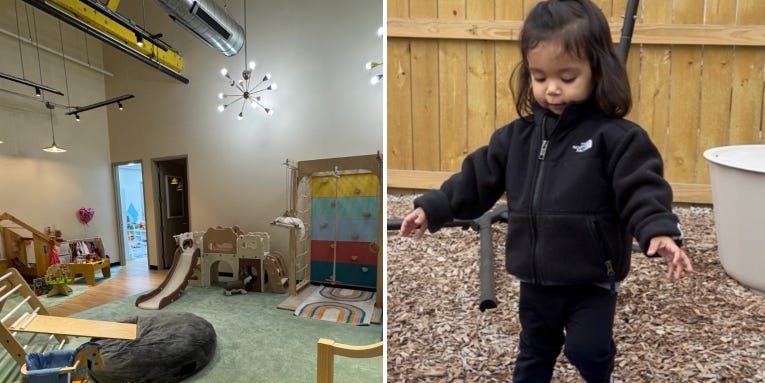
For a long time, childcare was the hardest piece to align with our reality. But when I came across a day care and preschool located inside a coworking space, everything shifted.
Traditional day care never worked for my family’s situation
Traditional day care assumes you can arrive by a specific time in the morning. They typically give you a window, and if you miss it, then you’re out of luck.
This kind of set-up works for families with predictable schedules. It doesn’t work when your mornings are spent inside a radio station or when your workday starts earlier than most schools open.
I also didn’t feel fully ready or comfortable dropping my 2-year-old off at day care, where she would spend most of the day without me.
A coworking space with a day care was the answer I needed
What makes this model work for us is flexibility. Because of my morning radio schedule, we don’t rush for the 8 a.m. drop-off. Instead, we arrive after lunchtime and nap (2 p.m. to be exact).
My daughter joins the other kids for the afternoon, where she learns within the Montessori curriculum, plays, and socializes until closing at 5 p.m.
The best part of this all? I get to be there on-site, five feet away from her classroom: working, taking Zoom calls, editing audio, or answering e-mails. That alone changed my life.
I no longer feel like my career and my childcare are working against each other. As a business owner, this setup gives me something I barely had before: carved-out time to get work done while my child is cared for in a structured, enriching environment.
The author works out of a coworking space.
Courtesy of Paulina Roe
I’m not squeezing work into nap windows or evenings. I’m not trying to build my business in fragments. When she’s in school, I’m working, fully present, focused, and calm.
There’s no anxiety around clock-watching. If a meeting runs long or someone is running late to our scheduled podcast recording, the entire day doesn’t get off track. This proximity creates a sense of stability I didn’t realize I was missing.
For my daughter, the benefits are just as meaningful
My child has consistency, peers (yay to friends her age), and caregivers who are fully focused on her development. Her day isn’t shaped by my stress or unpredictability. She gets the social and emotional structure of preschool without any disruption.
At home, socialization was a large missing component for her, so I’m grateful she has this opportunity now.
This isn’t about working while parenting at the same time. I’m not popping in and out of her classroom or blurring boundaries. If anything, I’ve found that this model reinforces them. When she’s in school, I’m getting work done. When we’re together, I’m fully present with her.
I live an unusual life, so I needed an unusual solution
I’ve come to realize that many childcare systems are still designed around a workforce that no longer exists: predictable hours, long commutes, and a default parent with endless availability.
My life just isn’t built like that. And I know I’m not alone.
Coworking preschools are not for every family. They don’t replace traditional childcare or solve every systemic issue. But for parents like me, other remote workers, entrepreneurs, and creatives, and people whose work is flexible but demanding, they provide an amazing option.
I didn’t become a better mother by trying harder. I didn’t become a better business owner by optimizing my calendar. Once my childcare reflected my reality, I showed up calmer, more focused, and present.
This isn’t childcare as a treat. It’s childcare that finally meets working parents where we are. My only regret is that I didn’t find it sooner.
Born and raised in Orange County, I never considered leaving California until I got married.
We wanted to buy a house and start a family, but generally, the ones we could afford were fixer-uppers in neighborhoods we didn’t love.
So, we began looking at other states where we had family. My husband, who moved from Michigan to Los Angeles in middle school, swore he would never go back — and I couldn’t identify Michigan on a map or tell you one fact about it.
We didn’t want to be beholden to a big mortgage, though, and in Michigan, we could purchase an affordable home in a town known for having some of the state’s top public schools. Even better, we’d be welcomed by my husband’s big Italian family, who lived nearby.
When we told our friends we were moving to Michigan, they were shocked. All any Californian knew about Michigan was that it was cold and snowy — why would anyone choose that?
Now, 20 years later, I can confidently say it was a great decision.
When I first moved to Michigan, I experienced some culture shock
At first, I had to adjust to the feeling of making small talk at markets and shops.
Kristi Valentini
In Orange County, I was the kind of person who would bury my nose in a magazine to avoid chatting with a hairdresser. I rushed through the checkout line and never said, “How are you doing?” to someone I didn’t know.
If small talk was ever forced upon me, I gave away as little about myself as possible. I never understood the point in discussing my life — or even something as simple as the weather — with someone I didn’t know.
In Michigan, though, small talk is unavoidable. I quickly learned that there’s no getting around friendly cashiers and shop owners. I was begrudgingly polite, but it initially took some effort to hide my impatience.
Chatting with neighbors feels much more commonplace here, too, especially because my subdivision doesn’t allow fences.
I was shocked to go from Orange County’s 6-foot cinder-block backyard walls to wide-open lawns and zero privacy, practically forcing me to interact with my new neighbors any time I gardened or enjoyed a glass of wine on the patio.
Over time, I noticed that having friendly neighbors and being a part of a community made me feel safer and more relaxed
My new neighborhood has less privacy than my old home did, but I’m glad I’ve gotten to know my neighbors.
Kristi Valentini
The kindness of Michiganders started to change me.
In my first year of living in Michigan, our mailbox got hit by a car while my husband and I were at the gym. Our neighbors had cleaned up the mess and gotten the driver’s info for us by the time we got home.
I was so surprised they would do that for us; it struck me as something that probably wouldn’t have happened back in California.
Then, when we had a baby three years into living here, another neighbor further down the street — one I hadn’t even met yet — brought us dinner just because she saw a baby announcement sign in our yard. I was touched that a stranger would go out of their way to do that for us.
When we started taking our kids trick-or-treating for Halloween, I discovered that Midwesterners do that differently, too. They didn’t just spoil the kids. They set up tables of spiked hot chocolate and Jell-O shots for the adults and invited people to warm up by their driveway bonfires. It became a community event.
Eventually, I found myself initiating connections with neighbors, too — and even starting up some small talk. It began with other dog-walkers in my neighborhood as our pups sniffed each other, and at the grocery store as a pleasant way to pass the time while being rung up.
Living in Michigan has changed what I value in a hometown
Living in Michigan has made me appreciate community in a new way.
Kristi Valentini
When I visited California to see friends and family a few years after living in Michigan, I could tell how much I’d changed already. It seemed rude to me when people didn’t say hi when passing me on a sidewalk, or when cashiers didn’t make chit-chat.
Because now, I’m the kind of person who makes caramel apples for my neighbors. I chat with fellow shoppers about candle scents in Crate and Barrel and know about my hairdresser’s children and chickens.
I even decorate my front porch — something I’ve noticed that nearly everyone in my neighborhood does. Seasonal wreaths and flowerpots, chairs with pillows and throw blankets, encourage people passing by to come on up and say hi.
I do sometimes miss California’s backyard privacy, and I’ll never stop using SoCal slang like “cool” and “dude.” Still, I’m glad I moved to a place that helped me become a friendlier person and taught me the value of community. I couldn’t imagine raising my children anywhere else.
For years, Brittany Nemandoust struggled to keep her small business afloat.
Chocbox, her DIY chocolate-making kit company, started as a pandemic project after shutdowns left her temporarily out of work as a dental hygienist. When she returned to the dental office, the business remained a side hustle.
Sales fluctuated, spiking over the holidays and slowing down during the spring and summer.
Around April 2024, she and her husband, Kevin, sat down to discuss whether it was time to shut it down. Sales weren’t enough to cover expenses, including rent for a small office in Los Angeles and payroll for a part-time employee, and Nemandoust had taken on credit-card debt to keep the company running.
On paper, closing made sense. But she wasn’t ready to give it up.
“I was really optimistic. I’m like, ‘I know that it’s going to happen at some point. It’s going to blow up,'” she told Business Insider. “I just had a feeling.”
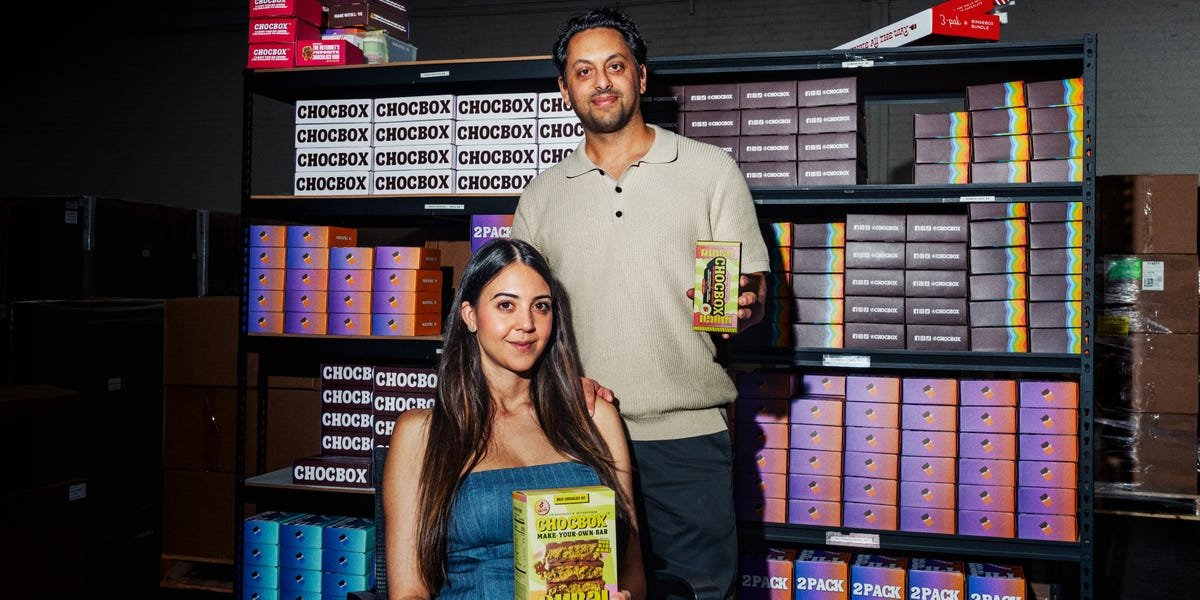
Each Chocbox kit includes a chocolate mold, pre-measured ingredients, and step-by-step instructions.
Ethan Noah Roy for BI
A few weeks later, an opportunity emerged. Nemandoust had noticed videos of a thick, pistachio-filled “Dubai chocolate” bar flooding TikTok. Influencers were trying to recreate it at home, and comment sections were filled with the same questions: Where do you get these ingredients? How do you make this?
Unlike most viewers, she already ran a chocolate kit business. Plus, years earlier, she had custom-designed a chocolate mold that was 20-30% thicker than standard molds — originally, she said, because she felt customers deserved a more substantial bar. That thickness turned out to be exactly what the viral Dubai bar required.
The couple went to a Middle Eastern grocery store in their neighborhood, bought pistachio cream and kataifi pastry, and tested their own version. Then, they filmed a video of the two of them breaking the bar in half and tasting it.
“It wasn’t a pretty video. It was just very raw,” she said, but the response was immediate.
Within 20 minutes, the video had 500 views, more than her videos typically received. Minutes later, the count doubled. By the end of the day, more than 100,000 people had viewed the video, and orders were pouring in. She hit TikTok’s daily cap for new sellers, 100 orders, that day and again the next.
There was just one problem: She didn’t have hundreds of kits ready to ship.
Managing quick growth after a viral moment
Going viral was exhilarating, but chaotic.
Two ingredients in particular — kataifi and pistachio cream — were difficult to source. Online suppliers were sold out, so she and Kevin started calling Turkish markets across Los Angeles. They even phoned gelato shops, knowing pistachio cream is often used in pistachio ice cream.
They also needed extra hands to pack orders, so they called friends, family, and anyone willing to pack boxes at odd hours.
“When you go viral, you need it now,” Nemandoust said. “You don’t have time to go through a hiring process or wait a week for a bulk order of items. You need it ASAP.”
Nemandoust launched Chocbox from her parents’ home during the pandemic. Today, she operates the business out of a 6,000-square-foot warehouse in Los Angeles.
Ethan Noah Roy for BI
In addition to pulling from every resource they had, they worked 15-hour days, waking up around 6 a.m. and finishing late at night. They often livestreamed their long days, which helped build their community that would be integral to sustained success.
“We would be up and just livestream at like 11 pm at night, blasting music, and I honestly think that’s how we started building our community — showing people the rawness of what it means to go viral,” she said.
As chaotic as that time was, the couple still focused on building systems to keep up with demand. They created instructions for assembling a kit, for how it should look when complete, and for packaging and labeling it correctly. They printed photos of finished kits and taped them to the walls, and recorded short videos demonstrating the packing process so new helpers and employees could avoid mistakes.
“The worst thing you can do when you go viral is not fulfill orders,” Kevin, who quit his corporate job in 2025 to help grow Chocbox, said. “People are dying for your product, and if you don’t send it, that can almost instantly kill your momentum.”
They also resisted the temptation to assume the viral spike would last forever. Instead, they focused on turning a moment into infrastructure: improving sourcing, tightening operations, and gradually expanding capacity. They moved from a 5-by-6-foot cubicle to larger office spaces in the same building, eventually upgrading to a 6,000-square-foot warehouse. Today, they employ eight people.
Strategies to build a lasting business
Going viral brought new customers, but didn’t guarantee customer retention. To create a lasting business, they’ve focused on building a community and creating the best possible product.
Nemandoust regularly hosts livestreams on TikTok to showcase products and connect with customers.
Ethan Noah Roy for BI
From the start, Nemandoust leaned into community-building. She livestreamed on TikTok, assembling kits in real time, answering questions, and interacting directly with viewers.
“I want people to think of me when they think of Chocbox,” she said. “I want to be part of the brand.”
The livestreams weren’t just sales channels. They became a means of building trust. Customers watched orders being packed, saw the behind-the-scenes scramble, and felt included in the growth.
Affiliates became another key pillar. TikTok’s native affiliate system allowed creators to tag Chocbox products in their videos and earn commissions. At first, influencers were simply buying the kits themselves and posting about them. Over time, the couple built a more intentional network of roughly 30 highly engaged affiliates, whom they call “Chocboxers.”
“We invest in them, and they invest in us,” Kevin said, noting that some of their affiliates earn thousands of dollars a month in commission. “They’re an extension of our brand.”
Beyond community, they’ve maintained discipline in their product strategy and kept a tight focus on a hero product: the chocolate-making kit. They later added refill kits and a jarred version of their pistachio filling, branded as “Dubai Dip,” but resisted flooding their website with dozens of flavors.
The Nemandousts in their Los Angeles warehouse.
Ethan Noah Roy for BI
“When we release products, they have to be really good,” Nemandoust said. “It’s never going to be mediocre.”
They’re constantly engaging with their customers, asking them what they want and using that feedback to create products that excite their community.
Today, both Brittany and Kevin work on Chocbox full time. Sales still fluctuate seasonally — peaking during the holidays and around Valentine’s Day, slowing in summer — and growth still comes with stress, but the conversation they had in April 2024 feels distant now.
They said the company recently surpassed 300,000 units sold on TikTok Shop. Just a couple of years ago, they were preparing to shut Chocbox down. From the outside, the milestone looks like an overnight success. It’s anything but, said Kevin: “If people really knew how hard it was behind the scenes, the amount of turbulence it took to get here is insane.”
That turbulence, the couple says, is the part most aspiring founders don’t see. At the end of the day, starting and maintaining a small business is “really hard,” he said. But if you want to do it, “the only thing getting in the way of starting a business is truly yourself. Just start.”
I thought I was on track — until the year everything fell apart.
Just weeks into January 2023, I was blindsided by an unexpected breakup. In the months that followed, I moved through my days on autopilot, watching the year continue to unravel.
That May, I was laid off from my job coordinating large conferences and corporate travel. I took a position at a family-run wedding business that was building out its travel department. I told myself things were starting to look up.
But between a 90-minute commute, sitting at a desk all day, and performing mundane tasks not listed in my job description, I began to spiral instead of heal.
Almost every day, I’d retreat to my car at lunchtime and break down in tears, overwhelmed by how unhappy I was.
The “American dream” began to feel like a trap
Since I was a kid, I’d treated success like a checklist built from American expectations I absorbed through school, TV, and social media. It seemed simple enough: Stay in line with peers, get married before turning 30, and buy a big house to raise a family in.
It was becoming clear that this narrative might not align with the life I wanted for myself.
Later that same year, I dealt with a toxic roommate, a serious health scare in my family, and a car accident. Then, just days before the New Year, I got one final surprise: another layoff. This time, however, I felt relief.
Walking out of that office for the last time allowed me to stop chasing a version of success I knew would never satisfy me.
Distance changed the pressure I was living under
As 2024 began, I set a clear goal for myself to sublet my apartment, sell my belongings, and board a one-way flight to South Korea by April 15. My plan was to begin an eight-month journey across Asia and Australia. After four months of careful planning, I boarded that flight.
Starting the trip with a friend in Seoul made the beginning — and the 15-hour flight over — feel safe and manageable. When she boarded her flight back to the US, and I headed off to Thailand alone, that distraction disappeared. I was officially left alone with my own thoughts.
Early on in Southeast Asia, I questioned what I was doing and where it would all lead. I cried in hostels and had panic attacks on the back of motorbikes. My anxiety was triggered by the blasting music of Bangkok’s Khao San Road and Ho Chi Minh City’s endless traffic.
Strum escaped the pressure she’d been living under while traveling through the mountains in northern Vietnam.
Provided by Macie Strum
The more I took note of my surroundings, the less the world around me matched the urgency in my head.
As I traveled the Ha Giang Loop in Northern Vietnam by motorbike, I realized that my idea of success was built upon a level of pressure that didn’t exist up in these Vietnamese mountains. Local life didn’t revolve around strict deadlines and productivity scales. Instead, it centered on routine, family, and staying present each day.
As I moved through each country, I connected with travelers of every age and background, many of whom were unemployed, exploring new paths, working online, or simply figuring things out as they went. Some were meticulous planners; others lived day to day.
In the jungles of Malaysian Borneo, I met a fellow American who was also redefining her life after a heavy breakup. I remember the first night we met, we talked for hours about life, expectations, and the fear of what would come next.
We ended up traveling together to Kuala Lumpur, meeting again in Penang, and later in Bali. Seeing her in so many different places reminded me how many others were navigating the same uncertainty.
It reframed my view of travel — not as a break from real life, but as an active part of it. For the first time, uncertainty no longer felt like failure.
She’s building her career in Sarajevo, Bosnia and Herzegovina.
Provided by Macie Strum
I’ve redefined success
When that trip came to an end, I felt no pull toward the life I’d left the year before.
I returned to the US briefly, but chose to keep traveling to explore what alternative versions of success could look like for me.
In 2025, that decision took me to 17 European countries. As I explored, I found myself falling in love with one of the continent’s most misunderstood regions: the Balkans.
Today, I live in Sarajevo, Bosnia and Herzegovina, building a career as a freelance journalist without sacrificing my ability to travel. While the life I’m creating may not match the version of success I was raised with, it’s more aligned with how I want to live: flexibly, deliberately, and with purpose.
While I don’t know exactly what comes next, that no longer scares me the way it once did.
Do you have a story to share about living abroad? Contact the editor at akarplus@businessinsider.com.
In 2023, my dad called to tell me he’d dropped down to four days a week at work.
He’d had a long career as an insurance underwriter, though it didn’t define him. At one point, he even left the profession to become a plasterer for a decade to better balance out his schedule. Still, it served him well enough.
“You really are getting old, then,” I joked. Dad laughed — he was only in his 50s.
We talked about his retirement and how he planned to wind down gradually over the next few years, before pulling the trigger and paying a full-time job’s worth of attention to the golf course.
That step was the first, and last dad took toward retiring. A year later, he told me he had cancer.
His diagnosis marked the beginning of a period in which I spent every day with him. He had been exceptionally fit, competing in triathlons, marathons, and Ironman races, but went from Hyrox to hospice care in just eight weeks.
Then on June 19, 2024, at the age of 56, Dad’s oesophageal cancer snatched away his future, and any prospect of a retirement.
I later realized our conversations during his illness were a textbook of the values by which he had lived his life. I’d heard him talk along similar lines in the past, but it wasn’t until I was lucky enough to spend each day for two months with him as his peer that I was able to distill them into three lessons.
Now, at the age of 32, these guide me in my career and life, and frame the way I think about retirement.
Live as if you might never make it
Dad while doing the Tour De Mont Blanc.
Callum Macauley-Murdoch
It may sound a morbid start, but I see this principle as both pragmatic and a call to action.
I see it as pragmatic because, of course, it is true: You might very well not make it to your retirement. And thinking about death in this way can help you take important practical steps, like ensuring you have an updated will and, at the very least, start thinking about granting powers of attorney.
And I see it as a call to action because, when loss helps you understand that life is precarious, it shines a light on how we often live without confronting the inevitability of death.
With that understanding, a more fulfilling life can emerge years earlier than it might otherwise have; one that, perhaps, you dreamed might come in retirement.
This principle led my dad to travel widely, a habit he passed to me. I’m due to visit New Zealand soon, the place he unknowingly took his final big trip. It also led him to take up the sports that piqued his interest over the years, and achieve a genuine sense of contentment.
It took me a lesson in the brutality of life, and the illuminating chaos of grief, to truly understand the importance of living it.
Build a life that gives you choices
Dad finishing an Ironman in Wales.
Callum Macauley-Murdoch
One of the pitfalls of the first lesson is that, if taken literally, it could lead to financial ruin.
If it were a certainty I’d never make it to retirement, I’d spend everything I had now. However, in a classic catch-22, living life like I’d never make it there would delay my retirement in perpetuity.
So instead, I keep an eye on the future and try to resist the urge to part with all my money in exchange for experiences now, so that I can have some freedom of choice when I retire.
For Dad, working hard and getting an education meant having choices, and that influenced many of my decisions in life, including the one to pursue a career in corporate law.
In the end, that didn’t align with the life I wanted, but the experience gave me the skills and financial backing to choose a different legal career for myself.
Because of my job and savings I’ve built up from it, I had choices when Dad died. I was able to pause, reassess my life, and temporarily step away from my busy career.
During that time, I thought about how he used to ask me about work and I’d sometimes tell him how I wished I could just retire now to travel the world and write. He’d remind me I had a long way to go.
But now, those passions I always thought I’d save for later, like planning a trip to New Zealand or getting my master’s in creative writing, have become present pursuits.
Soon enough, though, I’ll pick up some legal work again. Why? Because unless I write a bestselling novel by the end of the year, I still want choices in retirement, should I make it there.
Find the adventure in everything
My dad on a hike at Arthur’s Pass in New Zealand.
Callum Macauley-Murdoch
Dad took a keen interest in all aspects of life, and didn’t take much of it seriously — because of that, not in spite of it, he was still successful in much of what he did.
This lesson applies to every aspect of life, including retirement, which I’m viewing as simply another opportunity to experience a new pocket of life.
It even applies to terminal illness. When my dad was nearing the end of his life, he said something in an attempt to comfort me, which has ended up being the most transformative lesson of the three.
“Life is one series of adventures. This is just another one.”
That impacted me profoundly, and taught me to seek joy even in life’s darkest corners.
These days, I view my retirement, career, and life much differently
Dad and I at my wedding.
Callum Macauley-Murdoch
Losing Dad changed how I think about my life, career, and the very concept of retirement.
Most of all, it prompted me to stop deferring what I truly wanted to my final years while still setting myself up to have choices in the future.
Now that I’m taking incremental steps towards something I’d be happy to do well into my old age, the dream of retirement crosses my mind less often.
This is an as-told-to essay based on a conversation with David Ronca, a retired video systems engineer. He spent 12 years at Netflix and six years at Meta. This story has been edited for length and clarity.
My time at a startup in the early years of my engineering career was like a really bad relationship.
I joined a company that specialized in video playback around 2000. I loved working on video. I consider those seven years like going to school, and I came out with a Ph.D. in practical video systems. But it was the hardest seven years I’ve ever had in terms of work demands.
I was told when I joined that it would be really important that you’re seen around here a lot. So I would work until 7, 8, 9 — sometimes until 10 p.m. Then we started hitting delivery schedules, and I was getting to work around 10 in the morning and going home sometimes at 2:30 in the morning. We’re talking 14-hours days, six to seven days a week. Eighty hours a week would’ve been a break.
We didn’t have good direction. We’d be four or five months into solving a hard problem before leadership would stop us and say, “Go work on this instead.” It was madness.
We were using work hours to compensate for really bad decisions.
In January 2004, I started feeling ill. On a Sunday, I didn’t feel so good, and by midweek, I got worse.
On Friday night, January 17, my wife took me to the emergency room. The doctor told me, “This is likely colon cancer.” After the first surgery, he said, “There’s no way you have a tumor like this and it’s not cancer.”
Two weeks earlier, I had been running and feeling great. Within a week, I was in a hospital bed on machines.
It took another week before doctors could do the full surgery. And you spend that time with no idea what they’re going to find. That was a very dark week.
My mother died of breast cancer when she was 48. I was 16. Now, I’m in the hospital at 44. I remember thinking, “History doesn’t repeat, but it rhymes.”
My wife would bring the three kids. My oldest, who was seven, would sit quietly in the room with me. My youngest was two years old. He didn’t really know me.
I was looking at my young son, thinking he’s going to grow up without a dad.
After surgery, they told me it was stage 3 colon cancer. They removed 60% of my colon. There was lymph node metastasis. My five-year survival prognosis was about 25%.
‘I will not work like this’
I went back to work part-time at first.
I was told that I had used up all my sick leave and vacation and was put on California disability, which is around $200 a week.
By that time, this was a company I had spent four years working 24/7 for.
I told my boss, “I’m sorry, I will not do this. I still want to work here, but if I have to leave, I will quit. Because I will not work like this.”
From that point on, I didn’t. And that was the irony of it all.
I feel like I did some of my best engineering after that. The real change was that I was no longer wasting my brainpower and my thinking on junk.
You don’t do good work after 12 hours. You can’t work sustained all-nighters and be productive. The quality of your work is going to suck. I don’t care who you are. For most mere mortals, you try to work those hours, you’re just not going to be doing good work.
I also started making intentional decisions for life, not just work.
I coached soccer for all three of my kids. I went to their games. My daughter did ballet, and we were there all the time. We started planning and taking family vacations — hiking in the mountains, RV road trips, and Maui.
I realized you have to work to have a life, but you have to have a life to work. So you want to stand in the middle of those things.
Hours worked are not a performance metric
In 2007, after several clean scans, I joined Netflix. I delayed accepting the offer until I got my scan report. I didn’t want to change jobs yet because if you have positive liver metastasis, you’d be lucky to get two years.
In my interview, Patty McCord, the chief talent officer at the time, told me, “We don’t value 24/7 work. You won’t be successful here working all the time.”
That was almost foreign to me. But it also didn’t mean we didn’t work hard.
At Netflix, I was part of the early streaming team — maybe 12 to 16 people. We made aggressive schedules, and we didn’t miss them. We launched a Netflix app on the original iPad on Day One within two months.
The culture at the company was: If you have to work 24/7 for us to be successful, you’ve got a problem, and we’ve got a problem, and we’re going to fix it.
Even at Meta, my favorite poster had a silhouette of a rocking horse that said, “Don’t mistake motion for progress.”
In other words, high performance is not measured by how much work you do. It’s measured by how impactful your results are.
This is not to say that it’s wrong to work more than eight hours. Instead, you should understand why you’re working more hours. It should be intentional. Intentional exceptions.
If I were to tell my younger self anything, it would be to make work-life balance part of your DNA. Learn to take time off.
Don’t wait until you have cancer or some other near-death experience to realize this.
As the director of an anti-aging research nonprofit, he’s deeply aware that exercise might be the closest thing we have to a longevity cure-all.
That’s why he puts in about an hour a day on his bike or in the weight room as part of his longevity routine.
“I don’t take any supplements. I don’t even take a multivitamin, but I do spend a lot of time in the gym,” he told Business Insider
But on a recent research trip, Austad met with centenarians who stayed spry with a completely different style of exercise, and it changed how he thinks about working out.
Every time Gabby publishes a story, you’ll get an alert straight to your inbox!
Stay connected to Gabby and get more of their work as it publishes.
“I met all these hundred-year-olds and talked to them and watched them,” he said. “They get a lot of exercise, but it’s not heavy exercise.”
Here’s what we know about the healthiest kind of movement — and why being a little bit lazy may be the key to a long, healthy life.
The best exercise for longevity
Sardinia, Italy is one of the few places in the world where people regularly live to be 100 (or even older).
Known as Blue Zones, residents in these regions have traditions that scientists suspect are linked to enduring good health. Despite being spread around the globe, from Okinawa, Japan to Nicoya, Costa Rica, Blue Zones tend to share lifestyle habits like staying active, eating simple, mostly veggie-based superfoods, and building strong social communities.
Austad traveled to Sardinia last year while working on a research paper about whether longevity hotspots live up to the hype. He wanted to test the theory that the high number of centenarians in Blue Zones is more about poor record-keeping than any exceptional anti-aging habits.
Longevity researcher Steven Austad visited active centenarians in Sardinia, Italy, who get their exercise on their local hillsides instead of the gym.
Steven Austad/Getty Images — miroslav_1
What he found is that Sardinian elders are legit. Not only did he verify that residents of the island are active and vibrant into their 90s and 100s, but what he saw changed his own approach to healthy living.
Villages in Sardinia are dotted throughout the region’s rugged, mountainous terrain. As a result, people who live there are consistently hiking as part of their day-to-day activities to get around.
Combined with other household chores like gardening, Sardinians tick all the boxes of longevity exercise without ever setting foot in a gym: lots of easy cardio, a bit of high-intensity effort from walking uphill, and muscle-strengthening movements using a full range of motion.
Austad also spoke with a regenerative medicine doctor in the area, who specializes in staving off problems caused by injury or aging.
She told him that her patients are primarily young people who hurt themselves in the gym.
Austad was stunned. All the 90- and 100-year-olds he had met were vibrant and healthy, while the younger generations needed medical care for pushing themselves too hard.
“That’s just remarkable,” Austad said. “It convinced me that you don’t have to be fanatical about this stuff.”
Take it easy for a longer life
Coming back from his Italian excursion, Austad couldn’t help but rethink his own approach to exercise.
Residents of Italy’s longevity hotspot are known for relaxing habits like drinking wine and socializing, along with their active lifestyles.
Connect Images/Zero Creatives/Getty Images
Previously, he liked hit the gym hard, leaning into the addictive rush of endorphins from intense exercise, and was constantly tempted to push for an extra set or more time working out. For him, rest days felt like a distraction.
“The occasional day off, it drives me nuts,” he said. “I’ve got this one bad knee, and if I overdo it with that knee, I pay the price. So that kind of keeps me real, tells me when I’m starting to overdo it.”
Austad still hits the gym regularly, with a mix of cardio and strength training that prioritizes core stability and everyday motions like pulling and pressing.
But since his recent studies on the Blue Zones, he said he’s more likely to give himself a break without stressing about it.
“It makes me feel a little bit less guilty on the days when I decide that I shouldn’t work out,” Austad said.