
A-facial-injury-changed-my-appearance-—-and-my-life.jpeg

A facial injury changed my appearance — and my life. I’m strong and confident now, and I want others to feel the same.

This interview is based on a conversation with Sarah Hayles, 44, a mining engineer from Queensland, Australia. It has been edited for length and clarity.

In August 2008, at 26, I had routine surgery to remove a pterygium. It’s a tiny, non-cancerous growth on your eye, sometimes known as “surfer’s eye,” which, if left unchecked, could have affected my vision.

As soon as I woke up from the anesthesia, I knew that something wasn’t right. It was incredibly painful, but there was also a dullness in the area, and my eyeball seemed to move more slowly.

At first, it wasn’t too noticeable. But, as the weeks and months went by, my eyelid started to droop, and the eye began to turn.

I had an emergency MRI

I had repeated checkups that turned up nothing and was eventually referred to a top eye specialist in Brisbane, about 600 miles from my home in the Australian outback. He finally saw me in April 2010.

Within 15 minutes, he arranged an MRI for that same night. I asked what he thought could be wrong, and he said it could be something as serious as a brain tumor or multiple sclerosis.


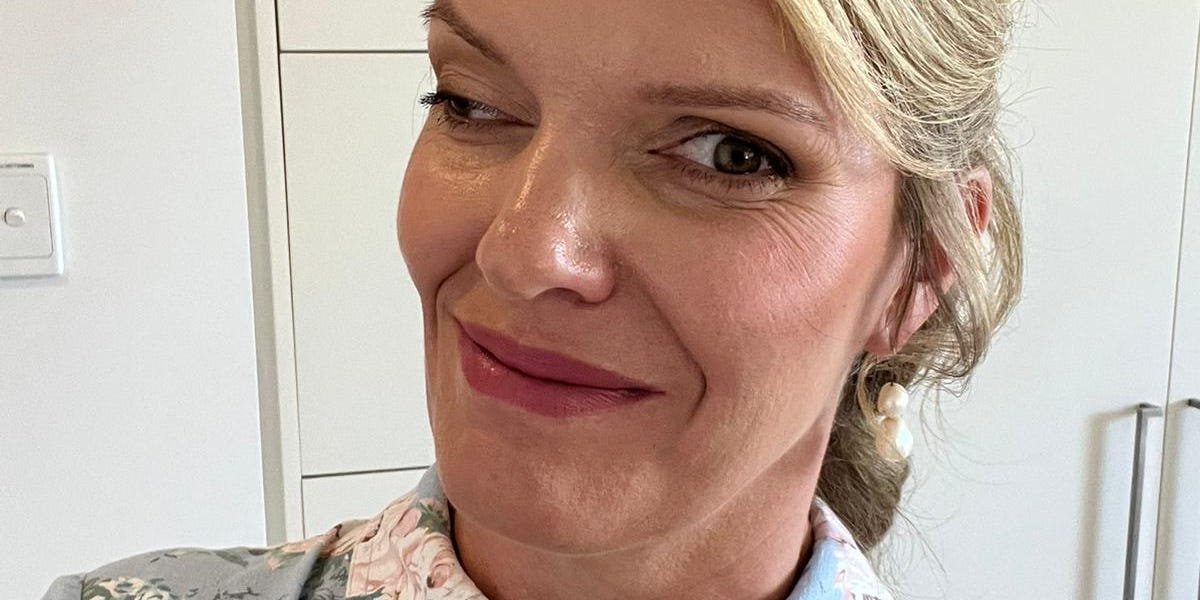
A woman with a facial difference

Hayles underwent eye surgery in 2008. 

Courtesy of Sarah Hayles


It was absolutely terrifying, but they found no evidence of a tumor and, after two years of testing, ruled out MS. To this day, I still haven’t been diagnosed with anything.

All I know is that I’ve been poked and prodded by doctors and consultants who have performed every test under the sun. Some were traumatic, such as being zapped with electricity to check for nerve damage and a lumbar puncture to analyze my spinal fluid.

The appearance of my eye deteriorated over time. I used to look in the mirror as a 30-something and think it was very noticeable. Still, compared to how it appears now, it wasn’t.

A kind doctor gave me good advice

The experience put me through the wringer. I refused to have my photo taken and thought nobody would want to date or marry me.

Then, in 2013, I saw a kind, grandfatherly doctor who all but held my hand during the appointment. He said that I was beautiful, healthy, and strong, and I needed to find a way to be OK with it.

His advice put an end to all the onerous testing and waiting for definitive results that never came. “I can do this and move on,” I thought to myself.


A man and woman at a sports game.

Hayles enjoying a sports game with her husband, Brian. 

Courtesy of Sarah Hayles


I had no psychotherapy or counseling, but I did my own research by reading books about having a positive mindset. Slowly, I became more confident.

I met my husband, Brian, 45, a diesel fitter, through mutual friends on Facebook in 2015. It was a whirlwind romance, and we got engaged and married in less than a year.

I’m so glad I have children

Our relationship taught me so much. Focusing on appearances is BS. If you do, you can easily miss the person within.

I’d always wanted to have kids, but in the years immediately following my injury, I changed my mind. I didn’t think I’d have the strength to deal with their school friends pointing at me.

Now that Brian and I have Jack, 8, and Astrid, 6, I can’t imagine life without them. In fact, I think they’ve indirectly benefited from what happened to me.


A family of four posing in front of a white wall.

Hayles is raising her kids not to judge people on appearances. 

Courtesy of Sarah Hayles


I’ve raised them not to judge people by the way they look. “It’s all about how someone behaves and how they make you feel,” I say.

Yes, I do get the occasional stare, especially from young children. Sometimes it’s awkward as their parents don’t know what to say, but I give them grace. Nobody is being malicious.

I want to normalize facial injuries

These days, I do a lot of keynote speaking about resilience and how I regained my confidence. I launched my Instagram account to help normalize issues like mine.

I know I could have allowed this facial injury to be something awful that ruined my life, or turned it into a positive. I’m glad I chose the latter.


Source link

I-work-at-a-coworking-space-that-has-an-on-site.jpeg

I work at a coworking space that has an on-site preschool. It’s completely changed my life and my parenting.

I wish I had known about coworking spaces with attached childcare/preschools much sooner in my parenting journey. This community helped me solve a problem I had been stressing over for two years.

I’m a Chicago mom, an on-air contributor on “The Fred Show,” a nationally syndicated morning radio show, and the founder of The Mami Collective, a media platform for ambitious mothers. My workdays aren’t traditional, and they certainly don’t fit into a 9-5 schedule.

My mornings typically start at 4 a.m., and once the show ends at 10 a.m., the rest of my morning is packed with meetings, recordings, and deadlines. Once that’s wrapped up, it’s time to head home to relieve my mother-in-law or sister-in-law of childcare duties. My husband is a fireman for the city of Chicago and has a side gig, so I’ve become the primary caretaker of our 2-year-old daughter every day after work.

For a long time, childcare was the hardest piece to align with our reality. But when I came across a day care and preschool located inside a coworking space, everything shifted.

Traditional day care never worked for my family’s situation

Traditional day care assumes you can arrive by a specific time in the morning. They typically give you a window, and if you miss it, then you’re out of luck.

This kind of set-up works for families with predictable schedules. It doesn’t work when your mornings are spent inside a radio station or when your workday starts earlier than most schools open.

I also didn’t feel fully ready or comfortable dropping my 2-year-old off at day care, where she would spend most of the day without me.

A coworking space with a day care was the answer I needed

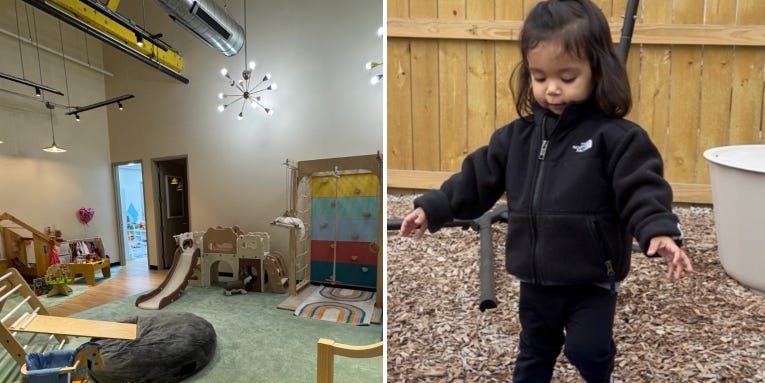
What makes this model work for us is flexibility. Because of my morning radio schedule, we don’t rush for the 8 a.m. drop-off. Instead, we arrive after lunchtime and nap (2 p.m. to be exact).

My daughter joins the other kids for the afternoon, where she learns within the Montessori curriculum, plays, and socializes until closing at 5 p.m.

The best part of this all? I get to be there on-site, five feet away from her classroom: working, taking Zoom calls, editing audio, or answering e-mails. That alone changed my life.

I no longer feel like my career and my childcare are working against each other. As a business owner, this setup gives me something I barely had before: carved-out time to get work done while my child is cared for in a structured, enriching environment.


a corowrking space with couches

The author works out of a coworking space.

Courtesy of Paulina Roe


I’m not squeezing work into nap windows or evenings. I’m not trying to build my business in fragments. When she’s in school, I’m working, fully present, focused, and calm.

There’s no anxiety around clock-watching. If a meeting runs long or someone is running late to our scheduled podcast recording, the entire day doesn’t get off track. This proximity creates a sense of stability I didn’t realize I was missing.

For my daughter, the benefits are just as meaningful

My child has consistency, peers (yay to friends her age), and caregivers who are fully focused on her development. Her day isn’t shaped by my stress or unpredictability. She gets the social and emotional structure of preschool without any disruption.

At home, socialization was a large missing component for her, so I’m grateful she has this opportunity now.

This isn’t about working while parenting at the same time. I’m not popping in and out of her classroom or blurring boundaries. If anything, I’ve found that this model reinforces them. When she’s in school, I’m getting work done. When we’re together, I’m fully present with her.

I live an unusual life, so I needed an unusual solution

I’ve come to realize that many childcare systems are still designed around a workforce that no longer exists: predictable hours, long commutes, and a default parent with endless availability.

My life just isn’t built like that. And I know I’m not alone.

Coworking preschools are not for every family. They don’t replace traditional childcare or solve every systemic issue. But for parents like me, other remote workers, entrepreneurs, and creatives, and people whose work is flexible but demanding, they provide an amazing option.

I didn’t become a better mother by trying harder. I didn’t become a better business owner by optimizing my calendar. Once my childcare reflected my reality, I showed up calmer, more focused, and present.

This isn’t childcare as a treat. It’s childcare that finally meets working parents where we are. My only regret is that I didn’t find it sooner.


Source link

I-moved-from-Southern-California-to-Michigan-so-I-could.jpeg

I moved from Southern California to Michigan so I could afford to buy a home. Living here changed me in surprising ways.

Born and raised in Orange County, I never considered leaving California until I got married.

We wanted to buy a house and start a family, but generally, the ones we could afford were fixer-uppers in neighborhoods we didn’t love.

So, we began looking at other states where we had family. My husband, who moved from Michigan to Los Angeles in middle school, swore he would never go back — and I couldn’t identify Michigan on a map or tell you one fact about it.

We didn’t want to be beholden to a big mortgage, though, and in Michigan, we could purchase an affordable home in a town known for having some of the state’s top public schools. Even better, we’d be welcomed by my husband’s big Italian family, who lived nearby.

When we told our friends we were moving to Michigan, they were shocked. All any Californian knew about Michigan was that it was cold and snowy — why would anyone choose that?

Now, 20 years later, I can confidently say it was a great decision.

When I first moved to Michigan, I experienced some culture shock


Fresh produce at a farmers market in Michigan.

At first, I had to adjust to the feeling of making small talk at markets and shops.

Kristi Valentini


In Orange County, I was the kind of person who would bury my nose in a magazine to avoid chatting with a hairdresser. I rushed through the checkout line and never said, “How are you doing?” to someone I didn’t know.

If small talk was ever forced upon me, I gave away as little about myself as possible. I never understood the point in discussing my life — or even something as simple as the weather — with someone I didn’t know.

In Michigan, though, small talk is unavoidable. I quickly learned that there’s no getting around friendly cashiers and shop owners. I was begrudgingly polite, but it initially took some effort to hide my impatience.

Chatting with neighbors feels much more commonplace here, too, especially because my subdivision doesn’t allow fences.

I was shocked to go from Orange County’s 6-foot cinder-block backyard walls to wide-open lawns and zero privacy, practically forcing me to interact with my new neighbors any time I gardened or enjoyed a glass of wine on the patio.

Over time, I noticed that having friendly neighbors and being a part of a community made me feel safer and more relaxed


A green backyard in Michigan with several trees.

My new neighborhood has less privacy than my old home did, but I’m glad I’ve gotten to know my neighbors.

Kristi Valentini


The kindness of Michiganders started to change me.

In my first year of living in Michigan, our mailbox got hit by a car while my husband and I were at the gym. Our neighbors had cleaned up the mess and gotten the driver’s info for us by the time we got home.

I was so surprised they would do that for us; it struck me as something that probably wouldn’t have happened back in California.

Then, when we had a baby three years into living here, another neighbor further down the street — one I hadn’t even met yet — brought us dinner just because she saw a baby announcement sign in our yard. I was touched that a stranger would go out of their way to do that for us.

When we started taking our kids trick-or-treating for Halloween, I discovered that Midwesterners do that differently, too. They didn’t just spoil the kids. They set up tables of spiked hot chocolate and Jell-O shots for the adults and invited people to warm up by their driveway bonfires. It became a community event.

Eventually, I found myself initiating connections with neighbors, too — and even starting up some small talk. It began with other dog-walkers in my neighborhood as our pups sniffed each other, and at the grocery store as a pleasant way to pass the time while being rung up.

Living in Michigan has changed what I value in a hometown


The writer posing with her two children in costumes on Halloween.

Living in Michigan has made me appreciate community in a new way.

Kristi Valentini


When I visited California to see friends and family a few years after living in Michigan, I could tell how much I’d changed already. It seemed rude to me when people didn’t say hi when passing me on a sidewalk, or when cashiers didn’t make chit-chat.

Because now, I’m the kind of person who makes caramel apples for my neighbors. I chat with fellow shoppers about candle scents in Crate and Barrel and know about my hairdresser’s children and chickens.

I even decorate my front porch — something I’ve noticed that nearly everyone in my neighborhood does. Seasonal wreaths and flowerpots, chairs with pillows and throw blankets, encourage people passing by to come on up and say hi.

I do sometimes miss California’s backyard privacy, and I’ll never stop using SoCal slang like “cool” and “dude.” Still, I’m glad I moved to a place that helped me become a friendlier person and taught me the value of community. I couldn’t imagine raising my children anywhere else.


Source link