While much of the world is still experimenting with OpenClaw, China is already putting it into robots.
Chinese home robotics giant Ecovacs unveiled its new robot, Bajie, powered by OpenClaw, at a consumer electronics expo in Shanghai last week.
Advertised as a home “butler,” the robot can perform household tasks such as tidying shoes or putting away toys.
Ecovacs founder Qian Dongqi said in an interview with Chinese outlet Ifeng that the long-term goal is for robots like Bajie to take on more household chores.
A writer from the Chinese tech outlet 36Kr who saw the robot in action reported that it required multiple prompts to complete tasks and “there were also unstable situations.”
Every time Lee Chong Ming publishes a story, you’ll get an alert straight to your inbox!
Stay connected to Lee Chong Ming and get more of their work as it publishes.
It’s not just home robots. Developers have begun integrating OpenClaw into Chinese robot-maker Unitree’s G1 humanoid robot, allowing it to interpret commands and navigate physical spaces in real time. A US-based team, Dimensional, has open-sourced the system behind these integrations.
Another Chinese company, AgileX Robotics, earlier this month published a guide showing how OpenClaw can be integrated with its robotic arm, letting users control the machine through natural language.
Chinese tech giant Xiaomi is also testing its version of OpenClaw across its ecosystem, from smartphones to smart home devices.
China has been gripped by an OpenClaw craze lately. Users rushed to install the AI agent on their devices, with some paying strangers to set it up for them and others forming long queues outside Tencent’s Shenzhen headquarters and Baidu’s Beijing office to get help from engineers.
The OpenClaw obsession is partly driven by the viral phrase “raising the lobster,” which Chinese users use to describe deploying the AI agent to automate everyday tasks.
To meet the demand for AI agents, China’s tech giants, including Tencent, Alibaba, and ByteDance, have begun launching their own versions of OpenClaw in the past few weeks.
US concerns about security
Meanwhile, in the US, concerns about AI agents going rogue continue to grow.
Last month, Meta’s alignment director, Summer Yue, connected OpenClaw to her inbox, and said in an X post that the bot tried to delete her emails.
“I had to RUN to my Mac mini like I was defusing a bomb,” Yue wrote on X.
In a separate incident, an AI agent set off a major internal security alert at Meta after acting without approval, exposing sensitive company and user data to staff who weren’t authorised to see it, The Information reported on Thursday.
Tech leaders have also sounded alarms. Elon Musk last month posted an image of a monkey being handed a rifle on X, captioning it: “People giving OpenClaw root access to their entire life.”
Even Nvidia CEO Jensen Huang, who has praised the technology, has emphasized the need for stronger safeguards. His company is working on its own agent system, NemoClaw, with a focus on security.
China didn’t just celebrate Lunar New Year this week. It staged a robotics flex.
At the annual Spring Festival Gala, the Lunar New Year show in China, humanoid robots from Chinese startup Unitree Robotics flipped, lunged, and swung swords and nunchucks just feet from child performers in a tightly choreographed kung fu routine.
In one sequence inspired by “drunken boxing,” a traditional Chinese martial arts style, the robots staggered, fell backward, then rose again — showcasing advances in control and coordination.
Clips circulating online quickly drew comparisons to last year’s broadcast, which featured Unitree humanoid robots performing a Chinese folk dance. The choreography then was noticeably simpler.
The gala, often likened to the US Super Bowl for its massive audience, also featured other Chinese robotics firms, including MagicLab, Galbot, and Noetix, in separate segments throughout the broadcast on Monday evening.
Reactions on Chinese social media showed viewers being struck by how quickly the technology has advanced.
Every time Lee Chong Ming publishes a story, you’ll get an alert straight to your inbox!
Stay connected to Lee Chong Ming and get more of their work as it publishes.
On RedNote, a user who goes by Ma Xiao said in a video posted on Wednesday that during last year’s performance, the robots were only “doing very simple things.”
“Now, they’re doing kung fu, they’re doing flips, they’re doing synchronized dancing,” he said. “Everybody’s shocked.”
“Now the rest of the world knows what China’s speed is,” he added.
Another RedNote user, DKKD, posted a video of friends reacting to the performance on Tuesday, captioning it: “Three Americans were scared by the Spring Festival robot.”
“They were all shocked by the robot’s level of evolution (including me),” the user wrote.
One viewer in the video can be heard saying: “It’s way more impressive than last year. It’s crazy.”
Unitree CEO Wang Xingxing said in an interview with Chinese media following the gala that the company expects to ship up to 20,000 humanoid robots this year, up from about 5,500 in 2025.
Global shipments of humanoid robots could reach “tens of thousands” this year, with Unitree potentially contributing between 10,000 and 20,000 units, Wang said on Tuesday.
China’s push in robotics
Chinese companies developing humanoid robots and autonomous systems are racing to outdo global rivals.
In September, Ant Group, an affiliate of Alibaba Group, unveiled R1, a humanoid robot that drew comparisons to Tesla’s Optimus. Two months later, EV and robotics maker XPeng introduced the latest version of its humanoid, Iron, which the company described as “highly human-like.”
China’s elite universities are also moving to build talent for the sector. In November, China’s Ministry of Education issued a notice stating that top institutions are preparing to launch a new undergraduate major in “embodied intelligence,” a field that combines AI with robotics.
Still, China’s rapid push into robotics hasn’t been seamless.
XPeng’s Iron fell face-first during its first public appearance in China earlier this year. Its CEO, He Xiaopeng, later wrote on Chinese social media that the mishap was part of “learning to walk.”
Last month, a Unitree humanoid kicked an engineer in the groin during a test. Humanoid robots stumbled and fell while racing against humans in a half-marathon in Beijing in April last year.
After five years in Qatar, Elisa Orsi and her husband, David Sleight, knew they were ready to leave the desert behind.
They had moved from Australia to the Middle Eastern country in 2019 with their three kids — all under 6 — after Sleight accepted ajob there.
Already big travelers before they had kids, the couple used school holidays to see the world after starting a family, before later leveraging Sleight’s teaching career to travel even more.
The family moved to Qatar from Australia because they wanted to experience more of the world.
“Usually when people have children, it deters them from travel, but we went completely the other way,” Orsi, 37, a stay-at-home mom, told Business Insider.
Life in Qatar felt safe and comfortable, and it served as a base from which they could explore the region, traveling to places like Jordan, Turkey, and Egypt.
Every time Amanda publishes a story, you’ll get an alert straight to your inbox!
Stay connected to Amanda and get more of their work as it publishes.
Gradually, the couple found themselves looking for something new.
“By the time we came back from our summer holiday in 2024, we said, ‘OK, we’re done. We need a change,'” Orsi said.
In August 2024, the family packed up their bags and moved to Hangzhou, a bustling city in eastern China.
Moving to China
China had been on their radar for a long time, though neither of them had visited before.
It wasn’t until Sleight came across an online job ad for a teaching role in Hangzhou that they began looking into the city.
The family had traveled through other parts of Asia and always wondered what life in China was like.
“I was impressed with the natural beauty and how modern the city appeared. I knew China was very well connected by the railway infrastructure, so I wasn’t overly concerned about the location,” Sleight, 45, told Business Insider.
The couple looped their kids, who are now 11, 9, and 7, into the conversation about moving to China early. “We wanted to give them lots of time to process and to get an understanding of what was happening,” she said.
“We have a philosophy that we talk to our children, and we keep them informed about the decisions we make,” Orsi said.
The couple involved their three young children in conversations about the move early on.
To ease the transition, they showed their kids YouTube videos about China and the school they would attend.
When they arrived in Hangzhou, Orsi said their first impressions quickly put any lingering nerves at ease.
“We were actually quite shocked to see how clean, how modern, how organized, and how convenient everything is,” Orsi said. “Sometimes you watch videos, but unless you’re actually in it, you can’t really understand it to that degree until it affects your life.”
Their children attend an international school, and Sleight teaches English in the school’s bilingual program.
House-hunting was a breeze because the school put them in contact with a real-estate agent ahead of their move.
They live in an apartment about five minutes away from the school.
“We wanted to have a bedroom for each of the kids, and we were looking for amenities,” she said. “Most importantly, we wanted to be close to the school.”
Within 10 days of arriving in China, the family moved into a four-bedroom apartment. It’s about a five-minute drive from the school and roughly 50 minutes outside the city center, in a neighborhood dominated by local Chinese families.
Rent is 5,500 Chinese yuan, or about $790 a month, and is covered by the school as part of Sleight’s employment contract.
Life in Hangzhou
Moves like the couple’s have become more common in recent years. China’s latest national census shows that 845,697 foreigners were living in the country in 2020, up from 593,832 a decade earlier.
Even with a growing foreign community, the transition isn’t always easy.
The biggest challenge has been the language barrier, though translation apps have helped. Orsi is learning Mandarin through online apps, while the children learn it at school.
Sleight relies on support from bilingual teachers and staff, and many parents at the school speak English.
“During staff meetings and presentations, I wear an earpiece and listen to a live translation provided by the school’s professional translator,” he said. Sleight added that parents and staff also communicate through a messaging app with built-in translation.
In China, the family also had to get used to a system in which nearly everything, including payments, is done on a smartphone.
Despite those adjustments, Orsi said safety has been one of the most striking aspects of life in China. She said she’s often asked about the presence of surveillance cameras, but sees them as a positive.
Orsi said the level of safety in China has given her children more freedom to move about on their own.
“If anything were to go wrong, the issue would be resolved very, very quickly. So the children, they can be outside on their own,” Orsi said. She added that she probably wouldn’t feel comfortable giving her kids the same level of freedom even in Townsville, a city in North Queensland, where they lived before moving to Qatar.
It’s also common to see children wearing kid-friendly smartwatches, which let them be more independent.
“You can see their location, they can call you, they can pay for things, and so they can go anywhere. They’ll organize their own play dates and go and meet their friends,” she said.
As a woman, Orsi also feels safe walking alone, including from the train station late at night. “I have not thought about it twice. I wouldn’t do it in Australia. And I wouldn’t do it in Argentina, where I’m from,” she said. Orsi moved to Australia in her teens and later met Sleight while working at a telecommunications company.
The family has been using school holidays to travel around China, including to the Great Wall.
It took a year, but Orsi says the family finally feels settled in their new home. Most of their social circle has grown out of the school community, including other parents and foreign teachers.
The longer school days have also given Orsi more time for herself. She said she’s picked up new hobbies, including learning to play the piano, going to the gym, and focusing on content creation for their YouTube channel, where she and Sleight document their family life in China.
Sleight is on a three-year contract at the school. As for what comes next, Orsi said the family hasn’t made any firm decisions.
“I think we would probably like to move elsewhere and go to another country when our contract is up, but that could change,” she said. “We may very well decide to stay in China and move to another school or experience a different city.”
Do you have a story to share about relocating to a new city? Contact this reporter at agoh@businessinsider.com.
In the spring of 2013, I was a sophomore at Tufts University in Massachusetts, soon to declare a dual major in international relations and Mandarin Chinese.
Despite my lofty aspirations to travel the world as a diplomat, my academic career so far had taken me a whopping 25 miles north of my hometown. That’s why my university’s study abroad program in China appealed to me.
Once I heard the tales of adventure from the 2012 program’s freshly minted graduates, I eagerly applied. That summer, with an acceptance letter in hand, I set off to enroll at Zhejiang University.
Zhejiang University was unlike anything I had experienced
Upon landing in Shanghai, my American classmates and I were piled into a minibus for the two-hour drive south to the garden city of Hangzhou — capital of Zhejiang Province and home to Zhejiang University (affectionately referred to by locals as ZheDa).
The author attended the international campus of Zhejiang University.
Courtesy of Zhejiang University
After settling into the dorm, which was a single room with a private bathroom, we were welcomed by our professors with a banquet at the college’s canteen — an establishment which was far better than the standardized cafeteria fare that I’d come to know back in New England.
In our dormitory building, for the equivalent of $2 at the time, one could acquire a filling meal any time of the day — from rice porridge and steamed buns in the morning to stir-fried vegetables and sweet and sour pork tenderloin in the evening, all cooked fresh to order.
Zhejiang University was massive and spread across multiple campuses throughout the city. Fortunately for us newcomers, our group at the University’s International College was tucked into a leafy hillside on the historic Yuquan campus, offering a slice of Chinese university life at an approachable scale.
Classes were rigorous and worldly
As the sweltering days of summer transitioned into an osmanthus flower-scented autumn, I settled into a new school year. Each morning consisted of four hours of intensive language instruction, followed by at least a few more hours of homework and self-study in the afternoon.
In addition, each week we’d attend one three-hour lecture on Chinese Peasant History with our advisor, who drew heavily from his own experiences as an academic sent to the countryside during Mao’s Cultural Revolution.
I also had a three-hour lecture on the Chinese Legal System with a professor who’d argued many cases within China’s rapidly evolving court system.
American students were very different than the Chinese students
While my application to enroll in Zhejiang University was relatively quick and painless, the road to admission for most of ZheDa’s domestic student population was comparatively long and grueling.
From an early age, they’d studied for hours at school, followed by hours at buxiban (cram schools), preparing to ace China’s notoriously difficult standardized exams, such as the Gaokao. Of the millions who sit for the Gaokao each year, only the highest scorers earn spots in China’s most prestigious schools, such as Peking, Tsinghua, and Zhejiang universities.
Unsurprisingly, the academic work ethic that carried students to Zhejiang University did not fall off after admission. While most of my international classmates would study long hours during the week, we would take Friday nights and weekends off to travel within China. But many local students, however, rarely engaged in such frivolous pursuits and were more likely to be studying in the library on a Friday or Saturday evening.
As exams marked the end of my semester at ZheDa in December 2013, I personally experienced the exacting academic standards that my Chinese classmates were intimately familiar with. While I did pass all of my classes, a minor error in pronunciation or a stroke askew in a written character, mistakes that my Chinese professors back at Tufts may have overlooked, were marked down harshly by my professors at Zhejiang University.
The university is now the best in the world
When scrolling Instagram in January 2025, I saw a familiar sight in a post from The New York Times — a statue of Mao Zedong standing before Laohe Hill and a familiar library, waving to the students on a verdant Yuquan Campus. Reading on, I was proud to learn that my study abroad alma mater had been named the most productive research university in the world by Leiden Rankings, outpacing even my hometown juggernaut, Harvard.
I cannot say that I am shocked by this development. My semester at ZheDa showed me a culture of academic rigor on a scale few American universities can match, drawing from an academic talent pool far larger than in the US.
My time at ZheDa forced me out of my comfort zone and exposed me to an academic world significantly different from that in which I’d been educated, and I believe I am a more open-minded learner for it.
President Donald Trump on Saturday threatened to impose 100% tariffs on all Canadian goods and products exported to the US should Ottawa make a trade deal with China.
In a post on Truth Social, Trump warned Canadian Prime Minister Mark Carney, whom he called “Governor Carney,” against making a “drop off” deal with Beijing or face the levies.
“If Governor Carney thinks he is going to make Canada a ‘Drop Off Port’ for China to send goods and products into the United States, he is sorely mistaken,” Trump wrote.
“China will eat Canada alive, completely devour it, including the destruction of their businesses, social fabric, and general way of life,” he added.
Carney made an official visit to China last week — the first by a Canadian leader since 2017 — meeting with Chinese leader Xi Jinping to discuss economic and trade opportunities between the two countries.
Every time Nathan publishes a story, you’ll get an alert straight to your inbox!
Stay connected to Nathan and get more of their work as it publishes.
In a joint statement following the meeting, Ottawa and Beijing said they had committed to expanding bilateral trade and investment, as well as building cooperation in areas such as energy and agriculture.
Carney also announced that Canada would now allow up to 49,000 Chinese electric vehicles into the Canadian market on the “most-favoured-nation tariff rate of 6.1%.” In return, he said Canada expected China to lower tariffs on Canadian canola seed to around 15% by March 1.
Trump had initially said that the deal was what Carney “should be doing” and that it was “a good thing for him to sign a trade deal.”
Trump’s changing tone comes days after Carney delivered an impassioned speech at the World Economic Forum in Davos, where he opined on the changing face of global politics since Trump’s election.
“We are in the midst of a rupture, not a transition,” Carney, who did not explicitly name Trump, said, adding that “middle powers must act together because if we’re not at the table, we’re on the menu.”
Trump did not miss the opportunity to snap back at Carney during his own speech at Davos, saying the prime minister “wasn’t so grateful.”
“Canada lives because of the United States. Remember that, Mark, the next time you make your statements,” he added.
Elon Musk says China is on track to outpace every other country in the computing power needed to run AI.
The Tesla and SpaceX CEO said in an episode of the “Moonshots with Peter Diamandis” podcast published Tuesday that “China’s going to have more power than anyone else and probably will have more chips.”
“Based on current trends, China will far exceed the rest of the world in AI compute,” he added.
Musk said China’s decisive advantage in the AI race lies in its ability to scale electricity generation. He estimated that China could reach about three times the electricity output of the US by 2026, giving it the capacity to support energy-hungry AI data centers.
Electricity generation is the limiting factor to scaling AI systems, Musk said.
Every time Lee Chong Ming publishes a story, you’ll get an alert straight to your inbox!
Stay connected to Lee Chong Ming and get more of their work as it publishes.
“People are underestimating the difficulty of bringing electricity online,” he added.
While the US has focused on restricting China’s access to advanced semiconductors, Musk suggested those constraints may matter less over time. China will “figure out the chips,” he said.
Musk added that diminishing returns at the cutting edge of chip performance might make it easier for China to catch up, even without access to the most advanced designs.
Musk has previously pointed to China as a model in areas beyond AI infrastructure.
In an episode of the “People by WTF” podcast published in November, Musk said he wants to turn his social media platform X into “WeChat++,” referencing China’s dominant super app.
“I also like the idea of sort of having a unified app or website or whatever, where you can do anything you want there,” he said. “China has this with WeChat.”
AI’s next bottleneck is power — and China is leading
Musk’s comments come as energy supply and data infrastructure emerge as key constraints in scaling AI, rather than chips or algorithms.
Companies worldwide have rushed to build AI data centers, many of which require as much electrical power as small cities.
A report from Goldman Sachs in November said that an electricity shortage could slow US progress in the AI race.
“As AI demands massive power, a reliable and ample power supply is likely to be a key factor shaping this race, especially because power infrastructure bottlenecks can be slow to solve,” wrote Goldman’s analysts.
The report added that while pressure on the US power grid is increasing, China has been steadily expanding its energy capacity.
By 2030, China could have about 400 gigawatts of spare power capacity, according to Goldman. That’s more than three times the total electricity demand data centers worldwide need.
“We expect China’s spare capacity to remain sufficient to accommodate data center power demand growth while supporting demand in other industries,” the analysts wrote.
In his annual New Year’s address last week, Chinese leader Xi Jinping praised his country’s progress in AI in 2025, saying China had “integrated science and technology deeply with industries, and made a stream of new innovations.”
“Many large AI models have been competing in a race to the top, and breakthroughs have been achieved in the research and development of our own chips,” he said in his speech in Beijing.
“All this has turned China into one of the economies with the fastest-growing innovation capabilities,” he added.
China appears to have fielded a new intercontinental ballistic missile, the DF-27, which can range the continental US and, unlike other ICBMs, serve a mix of missions, including targeting ships, a new Pentagon report says.
The Department of Defense’s annual report on the Chinese military, the latest of which came out last week,is the first public assessment that the missile is operational. The missile is said to have a land-attack and anti-ship role.
The latter role is unusual for an intercontinental-range ballistic missile, as is its conventional strike role documented in the new Pentagon report. ICBMs are primarily for nuclear strike.
The latest report offers little on the new missile beyond a map showing China’s “fielded conventional strike.” The DF-27, identified as an ICBM with a range of 5,000 to 8,000 km, shorter than some other systems built for strategic nuclear strike, is a new addition to that map showing Chinese missile ranges.
That range completely covers Hawaii and Alaska, and it also extends into parts of the continental US. The exact reach might vary depending on the launch site, but broadly, the weapon puts naval forces and US military installations across the Pacific at risk in a new way.
A “long-range” DF-27 missile was first mentioned in the 2021 Pentagon report. It said that indications on the range hinted at either an intercontinental- or intermediate-range missile. That uncertainty persisted until the 2025 report identified it as an ICBM.
The 2024 Pentagon report notably offered the most detail, stating that the DF-27 had been “deployed” to the Rocket Force. It added that this weapon likely has an option for an HGV, a hypersonic glide vehicle, “as well as conventional land-attack, conventional antiship, and nuclear capabilities.” The 2025 report, however, did not put the weapon under “fielded nuclear capabilities.”
According to the Missile Defense Advocacy Alliance, the DF-27 carries potentially significant strategic implications.
In an early assessment of the Chinese missile published two years ago, the group cited a leaked intelligence briefing indicating the missile was tested in February 2023 and warned that it could give China another means to hold targets at risk beyond the second island chain, with a high likelihood of being able to penetrate US ballistic-missile defenses and the potential to serve as a “carrier killer.”
China has not publicly commented on the DF-27, though local media have at times approached the topic indirectly.
The estimated ranges of Chinese missiles across the region and towards the US.
US Department of Defense
Fielding the new DF-27 makes China the first to have an operational, conventionally armed ICBM. The US and Russia have not fielded similar capabilities; however, both have been pursuing new intermediate-range capabilities since the collapse of the Intermediate-Range Nuclear Forces Treaty, which the US walked away from in 2019 after accusing Russia of non-compliance.
The DF-27 is the latest example of China’s efforts to develop and field varied, flexible strike options for a potential conflict. The missile branch of its military, called the People’s Liberation Army’s Rocket Force, has grown exponentially, and Chinese military doctrine emphasizes the need for it to possess the ability to quickly, precisely, and, in some cases, preemptively strike targets.
With the new DF-27 ICBM, “China became the first to field an analogous capability: a conventional ICBM—with an ASBM variant—that can conduct rapid, long-range precision strikes out to intercontinental distances, including against its ‘strong enemy’s’ homeland and its naval forces at sea,” Andrew Erickson, a professor at the US Naval War College’s China Maritime Studies Inistitute, wrote last week.
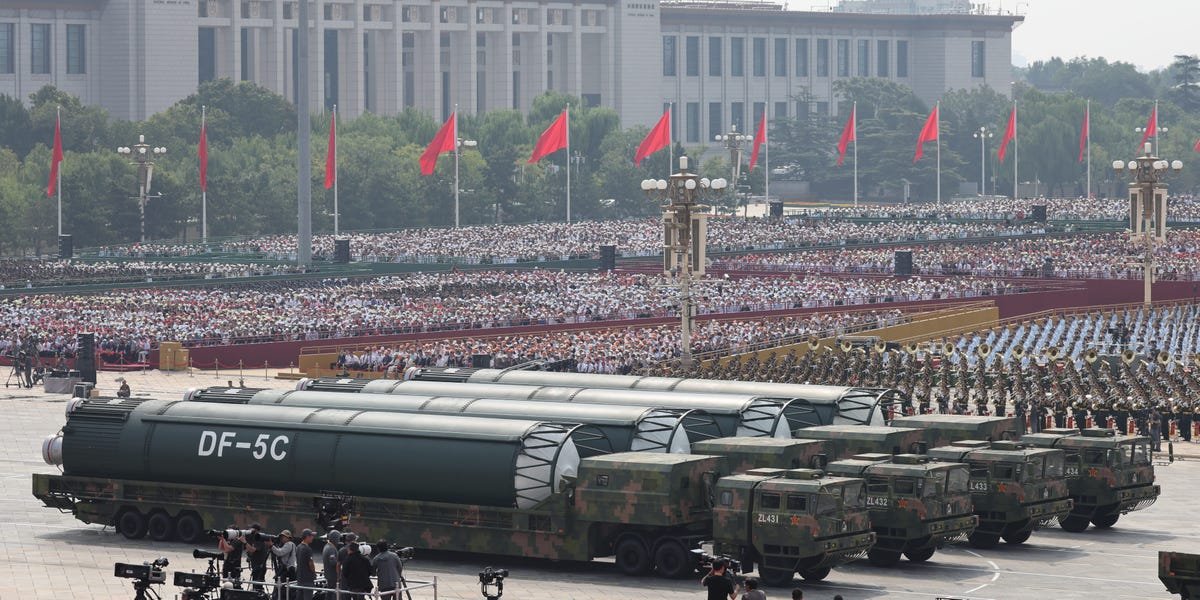
Since the Pentagon’s annual reports cover only developments from the previous year, the newest one doesn’t include other notable missile developments in China from this year. An important development in September was Beijing’s reveal of the DF-61 and DF-31BJ, both ICBMs, at a military parade.
It’s unclear whether those missiles are operational, but even if they’re still in development, the implications of the presentation in the Chinese capital are that these missiles will eventually be additions to China’s already sizable land-based ICBM arsenal.
China announced sanctions against 20 US defense companies and 10 senior executives on Friday, citing US arms sales to Taiwan as its motive.
In a statement, China’s foreign ministry said its assets within China, including movable and immovable properties, would be frozen and that domestic organizations and individuals would be prohibited from doing business with them.
Individuals named on the list would also be denied visas and entry to the country, the ministry added.
The sanctions list includes Northrop Grumman Systems Corporation, Boeing’s St. Louis branch, Epirus, and Anduril Industries founder Palmer Luckey.
In a statement, a spokesperson for the foreign ministry said: “We stress once again that the Taiwan question is at the very core of China’s core interests and the first red line that must not be crossed in China.”
“Any company or individual who engages in arms sales to Taiwan will pay the price for the wrongdoing,” they added.
When reached for comment, Anduril pointed Business Insider to an X post from Luckey in which the CEO joked that he was honored.
“I want to thank my family, my team, and my Lord Jesus Christ for this award,” Luckey wrote on X. “Anduril has been sanctioned for a while now, as have many of my peers, but it means so much to finally have my non-existent Chinese assets seized and repurposed.”
China’s sanctions follow the US announcement of a $11 billion military package for Taiwan last week.
The deal, which includes self-propelled Howitzers and HIMARS rocket launchers, still needs to be approved by Congress — but it drew a swift response from Beijing.
Lin Jian, a spokesperson for the foreign ministry, said in a statement at the time that China “strongly deplores and firmly opposes” the sales.
China regards Taiwan as a breakaway province that will one day come under Beijing’s control, and Chinese President Xi Jinping has refused to rule out an invasion of the island. Taiwan’s ruling Democratic Progressive Party views Taiwan as separate from China.
Under the Taiwan Relations Act, the US is obligated to assist Taiwan in defending itself.
Beijing has ramped up pressure around the island in recent years, holding frequent military exercises in the surrounding skies and waters.
A 2024 report by the Washington, D.C.-based think tank the Center for Strategic and International Studies suggested that China may be able to exert power over Taiwan without launching an invasion.
The report said China could impose a quarantine of the island using its coast guard.
“The purpose of a quarantine is not to completely seal Taiwan off from the world but to assert China’s control over Taiwan by setting the terms for traffic in and out of the island,” it argued.
“A key goal is to compel countries and companies to comply with China’s terms.”