I-landed-a-dream-job-after-college-but-it-was.jpeg

I landed a dream job after college, but it was in Seattle, far away from my close-knit family. I felt guilty leaving them behind.

Growing up in the suburbs of southern California, I knew a few things to be true about my family. Most importantly, I knew that all we had were each other. Unlike my friends at school, we did not have any extended family. There were no big Thanksgivings, hangouts with our cousins, or sleepovers at our grandparents’ house.

It was just us four, navigating the differences between the Western culture we lived in and the Eastern culture of our roots.

I grew up in Los Angeles as the eldest daughter of an immigrant family. My parents had left their motherland in search of new possibilities in this one. The only family they would have here was the one that they would go on to create: my little sister and me.

But all that changed when I landed a job in a different city after college.

My parents encouraged me to move

When I received my acceptance letter to a university in Los Angeles, I was reassured that I would not be too far from home. When I was not on campus, I was back in my childhood living room, catching up with my little sister over our favorite boba orders and proudly taking pictures of her high school theater performances. I was playing Chinese checkers with my mom on our dining room table, followed by walking our family pup with my dad under the palm trees.

Meanwhile, in college, my life was actively progressing. By the end of my degree, I landed a dream job that would be the first building block of my future career.

It was based in Seattle.

All my life, my parents had encouraged me to go where the opportunity is. After all, that is what led them to America, where they were able to give their children the childhood they never had. In their eyes, if Seattle was where the opportunity was, that is where I should go.

“The flight is not too far,” my mom said, “but we will miss you.”

I couldn’t shake the guilt of leaving my family

I felt a continuous wave of internal conflict. On one hand, I was excited to experience something new. On the other hand, I felt guilty for leaving my already small family.

When I asked my friends if they ever felt guilty about moving away from home, I was surprised by their responses. For most of them, it never even crossed their minds. They chose to move because they never saw themselves living in the same area they grew up in, and they knew it would not provide the industries they needed.


Sherri Lu in front of mt rainier

The author decided to move to Seattle.

Courtesy of Sherri Lu


They took possibly never living near their parents again as a given part of adulthood. Their parents share this belief and, like mine, encouraged them to carve out the life path that best suits them.

Perhaps my guilt stemmed from the fact that I was choosing to leave a city that could potentially offer similar career prospects. Would I feel the same guilt about moving away if my family were located somewhere I did not feel as warmly about?

Eventually, I did talk myself into taking the job. As I settled into Seattle, I thought about how my grandparents felt when their daughter moved across the ocean from China to America. By comparison, my living just a few states away felt minor.

“How did you feel when Mom told you she was considering leaving home?” I asked my grandma over video chat.

“She needed to make her own decisions on what she thought was best for her life, but I did secretly cry about it,” she told me. “I made sure your mother never saw because I did not want it to influence her decision.”

I made the right decision

Beyond my career, living on my own gave me the space to understand myself more deeply. I began sharing my self-discovery journey online with “Eldest Daughter Club” and grew it into a community of other women doing the same. I found different forms of family as I bridged the distance between my own.

I called my family often and planned routine trips back home. Although our in-person time was now more limited, I made sure that a larger percentage of it was true quality time.

Guilt was the feeling that encompassed the discomfort of leaving behind the familial support system that I had always counted on. In the end, support transcends location.

We must all make the decisions on what we think is best for our lives. Guilt is just a signal of what you cherish, but it does not tell your whole story. That is for us to build, wherever we decide to call home.



Source link

I-graduated-from-college-6-years-ago-and-have-already.jpeg

I graduated from college 6 years ago and have already moved 10 times. I never thought my post-grad life would be this unstable.

Growing up with limited money, I always viewed college as a safety net, an investment that would set me up for immediate success. I started saving for tuition in high school, worked full-time in college to avoid student loans, earned straight A’s, and did all I could think of to guarantee financial success.

I felt financially secure for a short time, but everything changed when I graduated. The stability I once felt walking around my safe college town vanished almost overnight, and I was completely unprepared.

Since graduating over six years ago, I’ve moved 10 times while navigating rent increases, job changes, and the financial realities of being a young adult.

I thought life after college would be stable, but I was wrong

It took 10 months to find a job after graduating. When I finally did, I moved out of my childhood bedroom only to live temporarily with friends, and then back with my parents, recovering from the embarrassment of not being able to afford housing on my entry-level salary.

After a few months and a decent raise, I tried again. I moved into an apartment with my boyfriend (now husband) and got a dog. Since then, we’ve lived in four different apartments, moving back in with family between each one.

I’ve changed addresses so many times that my GPS has given up on me. Rising rent, post-pandemic inflation, pay cuts, unexpected debt, and even a lost tax payment forced us back home multiple times. We were fortunate to have family to fall back on, but the repeated setbacks never felt easy.


Erin Wetten and her dog unpacking moving boxes

The author has faced many financial struggles since college.

Courtesy of Erin Wetten


Over six years later, I’m still not “settled” in the way I imagined. Each move taught me to handle setbacks with a little more confidence, yet, as someone who was so used to being prepared, I still felt like I was losing my sense of self.

I began to understand the emotional toll of feeling like a failure

I’ve spent my whole life measuring my self-worth in numbers — my SAT score, GPA, and items on my résumé. I planned my entire future in spreadsheets, bit my nails until they bled, and spent nights before big tests throwing up, even after weeks of studying.

That was me: an anxious, overachieving mess who crumbled at the thought of even a small failure.

Postgrad life quickly humbled me, teaching me that no amount of spreadsheets or A’s could protect me from the real world.

Every time I moved into a new apartment, I told myself, “This is it. I’ll save up, and the next move will be into a house of my own.” But it still hasn’t worked out that way. I’ve been forced to decide: Do I let that feeling drag me down, or accept that instability is a part of life and choose to enjoy the journey?

I had to find a ‘home’ within myself.

In my 20s, I’ve learned that life rarely unfolds the way we imagine, no matter how meticulously we plan. When I crossed the stage in cap and gown six years ago, I pictured a steady job, a white picket fence, and a stress-free existence waiting for me on the other side. I thought fulfillment would come from checking the right boxes in the right order, as I had always done.

Instead, I’ve never felt more fulfilled than I do now that I’ve thrown out the checklist altogether and stopped viewing life like a syllabus.

Over time, the weight of starting over lightened, and I learned to feel at home within myself, even as my physical space kept changing. Rather than feeling sorry for myself, I sought opportunity in each new set of blank walls, finding comfort and purpose from within.

My life hasn’t followed the simple, straightforward path I once expected, and I’ve come to believe that is for a reason. As someone with a Type A personality who was once consumed by anxiety over the smallest things, more rules and timelines weren’t what I needed. I needed freedom from my own expectations, and in my case, that meant getting knocked down enough times to finally loosen my grip on perfection.

No matter how many times I have to move or start over, I know I’ll be OK. I’m no longer chasing a timeline or striving for a perfect grade in life. I’m building a life that feels like mine, and letting its ups and downs shape me for the better.


Source link

Brad-Karp-resigns-from-the-Union-College-board-after-Epstein.jpeg

Brad Karp resigns from the Union College board after Epstein files fallout

  • Brad Karp has resigned from Union College’s board of trustees.
  • This news comes after Karp’s resignation as chairman of Big Law firm Paul Weiss earlier this month.
  • Karp is one of the elite names that appear in the Epstein files.

Top US lawyer Brad Karp has resigned from Union College’s board of trustees as he faces scrutiny from his ties to the late sex offender Jeffrey Epstein.

Karp has been removed from the list of trustees on his alma mater’s website, from which he graduated in 1981.

Union College’s board chair Julie Greifer Swidler could not be reached for immediate comment. In a statement to local media, Greifer Swidler said Karp had resigned from the board.

“The Board of Trustees and College leadership look forward to continuing our efforts to prepare our outstanding students to lead with wisdom, empathy and courage, while ensuring that Union thrives for decades to come,” she said.

Karp’s departure from the board follows his resignation as chairman of the Big Law firm Paul Weiss last week.

Karp is among the names to appear in 3 million documents released by the Justice Department from its investigation into Epstein.

“Recent reporting has created a distraction and has placed a focus on me that is not in the best interests of the firm,” Karp said in a statement in Paul Weiss’ news release announcing the news.

This story is developing. Please check back fror updates.


Source link

Ex-Microsoft-exec-says-college-curricula-need-a-revamp-—-heres.jpeg

Ex-Microsoft exec says college curricula need a revamp — here’s the curriculum to succeed in an AI world

Ex-Microsoft exec Craig Mundie has heard this question again and again — parents asking him a version of the same worry: Their kids are heading toward college, artificial intelligence is advancing fast, and jobs feel uncertain. What, exactly, should their kids be studying?

That question — what education will matter most in five years — reflects a deeper uncertainty about the future.

Mundie, who spent 22 years at Microsoft helping steer the company’s vision toward AI and retired as the company’s chief research and strategy officer in 2014, says that parents are simply asking the wrong question.

It’s not only the students who have to change to fit the new AI era — it’s the education system itself, said Mundie, who now advises other executives on AI and public policy.

Rather than chasing down the right job, Mundie urges families to prepare kids for a world where learning itself becomes continuous, personalized, and done in partnership with intelligent machines.

AI is altering the human experience

During an interview with Business Insider’s Reem Makhoul in June, Mundie said artificial intelligence and robotics are poised to reshape work more deeply than past technologies. See the edited cut of his interview below:

That shift, Mundie said, forces a bigger question than which job skills will survive. It challenges how societies define human value. This is something Mundie’s been pondering for over a decade.

In his 2015 book “Genesis,” Mundie, with co-authors Eric Schmidt and Henry Kissinger, examined how AI could alter the human experience. “What we say is we have to think differently about how we value ourselves and what we do.”

For much of history, he said, dignity has been tied to work because people had to work to survive. AI could loosen that link by automating more tasks across both physical and intellectual labor.

Meanwhile, humans will need to learn how to work alongside intelligent machines, and the traditional higher-education system doesn’t offer a clear path toward that, right now.

He described today’s education system as sharply divided between STEM and the humanities. The liberal arts emphasize reasoning, but at the expense of special technical skills you learn in STEM fields, Mundie said.

Students will need both skills moving forward. “If I could create a new curriculum in college, it would be a liberal education in technology,” and STEM, he said.

The classroom model itself is reaching its limits


An adult teaching children on a touch screen in a classroom setting.

Mundie says the future of education will be driven by individuals’ motivation to learn and not standardized curricula.

Hispanolistic/Getty Images


Mundie went further, questioning whether the classroom model that dominates education today still makes sense.

He traced that structure back to the printing press, which created a surge in written information and a need for mass literacy. Schools, he said, became an efficient “machine for teaching” because societies lacked enough individual tutors.

AI changes that constraint.

We can have scalable, polymathic teachers, Mundie said. “We can have as many teachers as we want now because the AI will be the teacher.”

He said this opens the door to a more personalized, Socratic model of learning, where students can interact continuously with an intelligent system that adapts to their curiosity, pace, and interests. Progress would be limited less by standardized curricula and more by a student’s motivation and capacity.

Schools and universities have been slow to embrace this shift. Early reactions often involved banning AI tools outright. “They’ve now given up on that,” Mundie said.

That resistance, he added, is typical of incumbent systems. “The natural tendency of the incumbent is to preserve the incumbent system,” or make only incremental changes, he added. But “when you get something as powerful as these AIs, most incumbent systems are not going to be preserved.”

He also pointed to early experiments on the right track, like versions of Khan Academy, an online non-profit educational platform founded in 2008 and headquartered in California. It uses an AI tutor, named Khanmigo, designed to guide students rather than simply give answers. In those systems, he said, the AI nudges students toward better questions and deeper understanding.

“So that’s the difference between sort of a broad chat about anything interface and an AI application that was specifically oriented around teaching,” he said, adding, “That’s just one tiny example of how people will build more and more apps on these common artificial intelligence platforms.”

“We will move beyond the specific generic interface to a world of millions of applications that are really customized in some clever way to guide people to solutions in the areas they care about,” he said. These agents may, in fact, do much of the work autonomously by interacting with others, he added.

Mundie said parents and older generations may have difficulty imagining this model, while children are likely to adapt quickly. The harder question, in his view, is whether educational institutions are willing to change.


Source link

12-high-paying-jobs-that-dont-need-a-college-degree-and.jpeg

12 high-paying jobs that don’t need a college degree and are projected to grow over the next decade

  • Business Insider looked at jobs projected to grow that typically pay at least $75,000 and don’t require a college degree.
  • First-line supervisors of construction trades and extraction workers ranked No. 1 based on our methodology.
  • Some of the jobs usually require related work experience.

Depending on the position, a high school diploma could be the ticket to a growing, high-paying job.

Business Insider looked at wages and growth projections for jobs that usually need a high school diploma, its equivalent, or a postsecondary nondegree award. We then took the geometric mean of the ones that pay at least $75,000, based on 2024 median annual wage data, and are expected to need more workers, based on projected employment growth from 2024 to 2034. We then ranked the jobs, with the larger the geometric mean, the better the rank.

Many of the top 12 fell into one of three job groups: construction and extraction; protective service; or installation, maintenance, and repair.

First-line supervisors of construction trades and extraction workers took the top spot. Employment of these supervisors is expected to grow by 49,000 from its 2024 level, and they typically make about $79,000 annually. It’s also one of the roles that typically don’t require a degree, but often require job seekers to have relevant experience.

Employers may be interested in candidates with higher educational attainment. The Bureau of Labor Statistics said commercial pilots usually need a postsecondary nondegree award, but some employers may prefer a degree or even require it.

Below are the top 12, along with information from the Bureau of Labor Statistics.

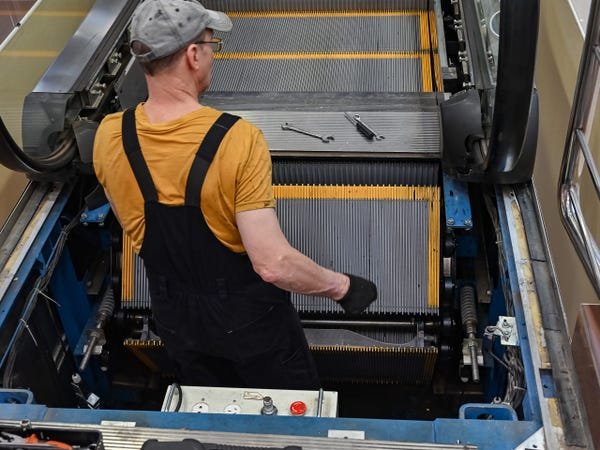
12. Elevator and escalator installers and repairers


Svetlana Verbitskaya/Getty Images

Median annual wage: $106,580

Job growth: 1,200

Typical education required: High school diploma or equivalent

11. Electrical and electronics repairers, powerhouse, substation, and relay


A worker with a hard hat is working in a power substation


Shinyfamily/Getty Images

Median annual wage: $100,940

Job growth: 1,300

Typical education required: Postsecondary nondegree award

10. Avionics technicians


Avionics technician checking an aircraft


Monty Rakusen/Getty Images

Median annual wage: $81,390

Job growth: 1,700

Typical education required: Postsecondary nondegree award

9. First-line supervisors of firefighting and prevention workers


Fire engine


carlofranco/Getty Images

Median annual wage: $92,430

Job growth: 3,400

Typical education required: Postsecondary nondegree award

8. Commercial pilots


Two pilots working


AlexeyPetrov/Getty Images

Median annual wage: $122,670

Job growth: 2,800

Typical education required: Postsecondary nondegree award

7. Aircraft mechanics and service technicians


Two people doing aircraft maintenance


Monty Rakusen/Getty Images

Median annual wage: $78,680

Job growth: 5,600

Typical education required: Postsecondary nondegree award

6. First-line supervisors of police and detectives


Yellow tape that says


kali9/Getty Images

Median annual wage: $105,980

Job growth: 4,600

Typical education required: High school diploma or equivalent

5. Electrical power-line installers and repairers


Electrical power line technician working outside and looking at a tablet


RyanJLane/Getty Images

Median annual wage: $92,560

Job growth: 8,400

Typical education required: High school diploma or equivalent

4. Transportation, storage, and distribution managers


People wearing hard hats are talking in a warehouse


MoMo Productions/Getty Images

Median annual wage: $102,010

Job growth: 13,100

Typical education required: High school diploma or equivalent

3. First-line supervisors of mechanics, installers, and repairers


Manager and technician with a vehicle


Nitat Termmee/Getty Images

Median annual wage: $78,300

Job growth: 19,100

Typical education required: High school diploma or equivalent

2. Police and sheriff’s patrol officers


Police vehicles


Douglas Sacha/Getty Images

Median annual wage: $76,290

Job growth: 22,000

Typical education required: High school diploma or equivalent

1. First-line supervisors of construction trades and extraction workers


Construction workers


Vukasin Stanojlovic/Getty Images

Median annual wage: $78,690

Job growth: 49,000

Typical education required: High school diploma or equivalent


Source link

The-20-best-college-towns-across-the-US-ranked.jpeg

The 20 best college towns across the US, ranked

Lively college towns are pinnacles of American higher education.

The communities immediately surrounding college campuses can define what a student’s college experience looks like, from having access to restaurants and bars to meeting students from nearby institutions.

When it comes to choosing a college or university to attend, location can be just as important as academics for some students.

In a recent study, WalletHub analyzed over 400 cities across the US and ranked them based on affordability, social scene, and academic prospects in 2025.

To analyze the cost of living (or “wallet friendliness”), WalletHub researchers examined data such as average housing costs, the cost of higher education, the share of rental units, and the average cost of pizza and burgers in each city.

Its social rank was determined by factors like the share of the population aged 18-35, the share of single people, the student gender balance, and cafes, breweries, food trucks, and nightlife per capita, among other factors.

WalletHub also looked at the quality of higher education, job-growth rate, earning potential for college graduates, and unemployment rate, among other factors, to determine each city’s academic and economic opportunity rank.

The study used data from federal agencies including the US Census Bureau, the Bureau of Labor Statistics, the Federal Bureau of Investigation, the National Center for Education Statistics, the Department of Housing and Urban Development, as well as data from companies like TransUnion, TripAdvisor, and Yelp, along with other WalletHub research.

The list of top college towns — defined by WalletHub as cities with a college student population of over 7,500 students — includes a range of major cities and small education hubs.

While some locations are major education hubs and house big universities alongside small private and public community colleges, we’ve listed the main flagship institution for each location.

See which college towns and cities made it to the top 20.

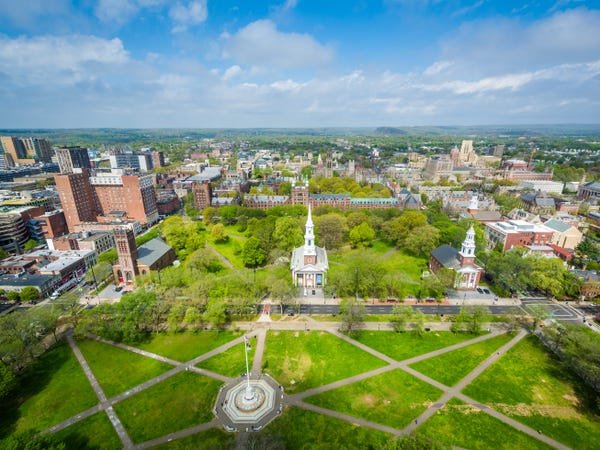
20. New Haven, Connecticut

New Haven, Connecticut, is home to Yale University and was ranked as the 20th best college town.

Jon Bilous/Shutterstock

School: Yale University

The home of Yale University, New Haven was ranked 38th in the study’s academic and economic opportunities list, and it came second overall for quality of higher education, only behind Princeton, New Jersey.

However, it also had the lowest rank out of top 20 cities in the study’s social environment rank, and WalletHub noted it had one of the highest costs for higher education.

19. Charleston, South Carolina


Charleston South Carolina

Charleston, South Carolina, was ranked as the 19th-best college town in the US.

Kevin Ruck/Shutterstock

School: College of Charleston

Ranked as the ninth-highest city in the study’s social environment ranking, Charleston had the sixth-highest social ranking out of the top 20 cities.

18. Madison, Wisconsin


Madison, Wisconsin

Madison, Wisconsin, was named the 18th-best college town in the US by WalletHub.

Jacob Boomsma/Shutterstock

School: University of Wisconsin-Madison

Madison, Wisconsin, home to the University of Wisconsin-Madison, was ranked as the 42nd-best city in terms of social environment in the study, which looked at 415 towns and cities.

17. Salt Lake City, Utah


Salt Lake City University of Utah

Salt Lake City is the home of the University of Utah and was ranked as the 17th-best college town.

Jacob Boomsma/Shutterstock

School: University of Utah

Salt Lake City, home to the University of Utah, was ranked as the 17th best college town in America.

Out of the top 20 cities, it had the lowest ranking on the study’s economic and academic opportunity rank, which considered factors such as job-growth rate, earning potential for college graduates, and unemployment rate.

16. Seattle


University of Washington Seattle

Seattle houses the University of Washington and was ranked as the 16th-best college town.

Cascade Creatives/Shutterstock

School: University of Washington

Despite its overall high ranking, Seattle was ranked as the lowest city in the top 20 in the wallet friendliness category, coming 360th out of the 415 places in the study.

15. Tallahassee, Florida


Tallahassee, Florida

Tallahassee, Florida, is the home of Florida State University and the state capitol.

Jacob Boomsma/Shutterstock

School: Florida State University

The capital city of Florida and home to Florida State University, Tallahassee, was the second-highest ranked city for wallet friendliness within the top 20, although it also had the second-lowest social rank out of the cities in the top 20.

14. Miami


Miami, Florid

Miami, Florida, is home to the private University of Miami and public Florida International University.

Cassanas Photography/Shutterstock

Schools: University of Miami, Florida International University

Miami was ranked as the 14th best college town in the country, and the city also received the third-highest social rank in the top 20, ranking fourth overall out of all cities in the study.

13. Scottsdale, Arizona


Scottsdale, Arizona

Scottsdale, Arizona, houses the Scottsdale Community College and was ranked the 13th best college town.

Tim Roberts Photography/Shutterstock

School: Scottsdale Community College

Scottsdale, Arizona, which houses the Scottsdale Community College and was ranked as the 13th best college town in the US, had the second-lowest ranking for wallet friendliness out of the top 20 cities.

WalletHub also noted it had the second fewest students per capita of all the 415 cities in the study, behind only Cape Coral, Florida.

12. Phoenix, Arizona


Phoenix Arizona skyline

Phoenix is home to Grand Canyon University and was ranked as the 12th-best college town.

Matthew James Ferguson/Shutterstock

Schools: Grand Canyon University

Phoenix was ranked the 12th best college town in the US. The city is home to Grand Canyon University and is near other major universities in nearby towns.

11. Pittsburgh, Pennsylvania


University of Pittsburgh

Pittsburgh is home to schools like the University of Pittsburgh and Carnegie Mellon University.

Wirestock Creators/Shutterstock

School: University of Pittsburgh, Carnegie Mellon University

Home to the University of Pittsburgh and Carnegie Mellon University among other institutions, Pittsburgh received the second-highest social rank out of top 20 cities, ranking third overall. The city was also ranked as the lowest out of the top 20 in the economic and academic opportunity rank.

10. Gainesville, Florida


Gainesville, Florida

Gainesville, Florida, is the home of the University of Florida.

Felix Mizioznikov/Shutterstock

School: University of Florida

The home of the University of Florida was the highest-ranked for wallet friendliness within the top 20 college towns.

It also had the fourth-lowest cost of higher education out of the 415 cities studied by WalletHub.

9. Charlottesville, Virginia


University of Virginia, Charlottesville

Charlottesville, Virginia, is home to the University of Virginia.

Bryan Pollard/Shutterstock

School: University of Virginia

Home to the University of Virginia, Charlottesville was ranked the third highest for academic and economic opportunity out of the top 20 college towns.

8. Reno, Nevada


University of Nevada, Reno

University of Nevada, Reno, is the flagship university of Reno, which was ranked as the eighth-best college town.

Jacob Boomsma/Shutterstock

School: University of Nevada, Reno

Ranked as the eighth-best college town in the US, Reno is home to the University of Nevada, Reno.

7. Atlanta


Atlanta, Georgia

Atlanta is home to over a dozen major colleges and universities.

Sean Pavone/Shutterstock

Schools: Georgia Institute of Technology, Georgia State University, Emory University, Spelman College, Morehouse College

Atlanta is home to over a dozen major universities and over 50 higher education institutions. The city received the highest social rank out of all the cities in the top 20, ranking second overall for all cities in the study.

6. Tempe, Arizona


Arizona State University, Tempe

Home to Arizona State University, Tempe, Arizona, ranked as the sixth-best college town.

Jacob Boomsma/Shutterstock

School: Arizona State University

Tempe, home to Arizona State University, was the fourth-highest ranking city within the top 20 in the academic and economic opportunity category.

5. Raleigh, North Carolina


Raleigh North Carolina

Raleigh, North Carolina was ranked as the fifth-best college town.

Real Window Creative/Shutterstock

School: North Carolina State University

The home of North Carolina State University was ranked as the fifth-highest out of the top 20 college towns for academic and economic opportunity.

4. Tampa, Florida


Tampa Florida

Tampa, Florida, is home to the University of South Florida.

Ramunas Bruzas/Shutterstock

School: University of South Florida, University of Tampa

Out of the top 20 college towns in the US, Tampa was the third-highest ranking for wallet friendliness and fourth-highest for social environment — where it ranked fifth overall out of all cities in the study.

3. Orlando, Florida


Orlando, Florida

Orlando is home to the University of Central Florida

Noah Densmore/Shutterstock

School: University of Central Florida

Orlando had the fifth-highest social rank out of the top 20 cities.

WalletHub reported that at $24,668 per year, Orlando also has the 14th-lowest tuition, including room and board, for in-state students.

2. Ann Arbor, Michigan


Ann Arbor, Michigan

Ann Arbor, Michigan, was ranked as the second-best college town in the US.

Sean Pavone/Shutterstock

School: University of Michigan

Home to the University of Michigan, Ann Arbor was the second-highest ranking out of the top 20 college towns for academic and economic opportunities.

It provides opportunities for social connections too, with 348 out of every 1,000 residents being students, per WalletHub.

1. Austin, Texas


Austin Texas

Austin, Texas, was ranked as the best college town in America.

Roschetzky Photography/Shutterstock

School: University of Texas at Austin

Austin is ranked as having the 10th-best academic and economic opportunities in the US — WalletHub noted the city has one of the lowest unemployment rates in the country.

Pizza prices are low, and there are plenty of attractions in the city to help students unwind, the report added.


Source link