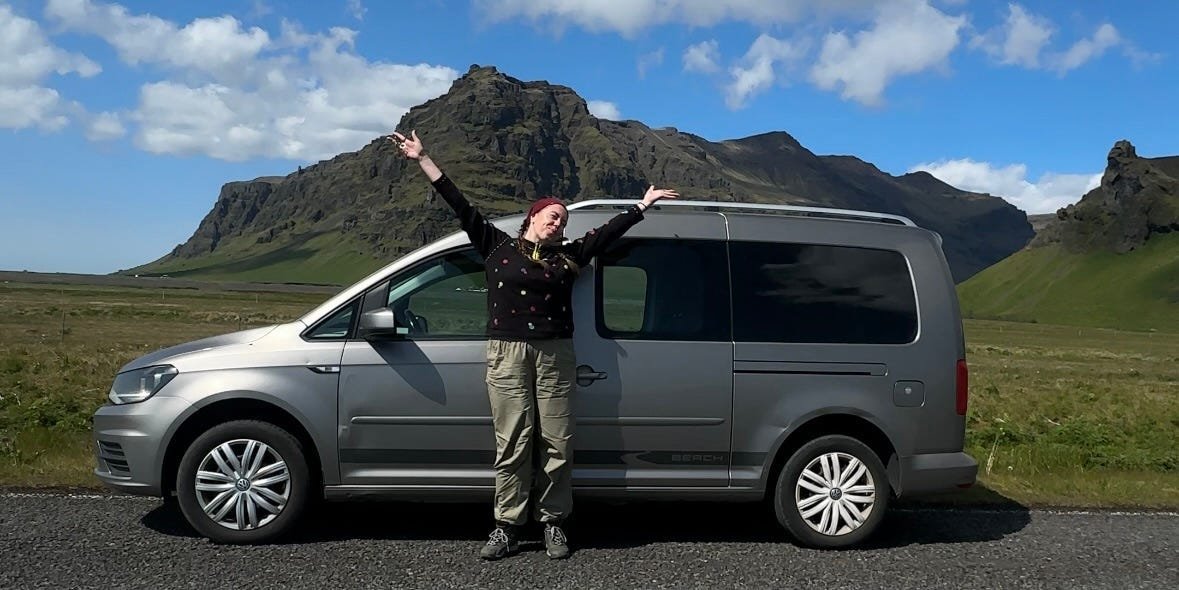
As I drove through Iceland’s dramatic landscape alone this past June, listening to Bon Iver’s “Holocene,” I started to cry.
I was crying in sheer awe at my surroundings and the lyrics of a favorite song, one about a man pondering his significance. Most of all, though, I was crying because I was proud of myself.
I had faced a fear of mine head-on, and it brought me to an emotional, yet blissful moment that I’ll never forget.
Taking my first solo trip showed me that what I perceived as a threat wasn’t really one after all — and it gave me the confidence to continue traveling alone.
After years of my anxiety holding me back, I planned a solo trip
For a long time, solo travel didn’t feel like an option.
Lily Voss
To rewind a bit, I’ve always been an anxious person, but it really manifested in my mid-20s when I started listening to true-crime podcasts.
Huge mistake. I know too much now about what horrific acts people are capable of. My mind would conjure scenarios in which something I’d just listened to could happen to me or a loved one.
This started to impact my life in different ways — if my boyfriend was on a work trip, I was scared to leave our apartment. When my mom moved into her new home, and we didn’t have an alarm system set up, I insisted I couldn’t stay the night there.
Anxiety had a tight grip on me at home, so the thought of solo traveling by myself? Absolutely not.
As I began researching where to go, Iceland often came up.
Lily Voss
Then, last January, I found myself freshly laid off, about to turn 30 in six months, with a long list of places I wanted to travel to that year.
I’m not sure what changed in me — maybe it was hitting a milestone age — but after many internal battles, I decided I’d visit at least one of them solo.
I settled on Iceland, which is regarded as one of the safest countries in the world. This made following through on my decision a bit easier.
I also told everyone — my family, friends, even my esthetician— about my travel plans because the more people who knew, the harder it would be for me to back out.
Then, I rented a campervan for three days, with a plan to explore Iceland’s Ring Road.
This trip didn’t entirely change me, but it gave me the confidence to keep solo traveling
Seemingly small experiences on my trip helped me build confidence and overcome anxiety.
Lily Voss
No, I didn’t return from Iceland as an entirely different person, nor did I have a transformative “Eat, Pray, Love” experience that changed the fabric of who I am.
Rather, I found that seemingly small experiences on my trip helped me build confidence and overcome so much of the anxiety I’d been struggling with.
I was able to go on my first hike alone and actually enjoy myself. I drove in Iceland’s notoriously high winds solo, staying calm as they shook my van.
Even just being able to sleep (soundly, I might add) in my van at campsites — something I wouldn’t have imagined happening a few years ago — made me feel stronger.
Facing my fears head-on may have even rewired my brain a bit.
After that three-day adventure, I booked another solo trip to Annecy, France, later that summer. I’m still looking forward to going on even more adventures by myself.
Is my anxiety still there? Definitely. However, taking that trip did help me deal with it in a healthier way.
Above all, facing this fear taught me that seeing what’s on the other side of my worries might actually lead me to some of life’s best experiences.
When I first found out I was pregnant, I frankly didn’t put much thought into long-term childcare plans. Living in New York City, my husband and I knew we wouldn’t have the traditional village available to us — my parents, while local and thrilled to get a first grandchild, are older and weren’t particularly eager to volunteer for solo babysitting, while his parents live thousands of miles away.
But we were in a uniquely lucky situation: We both happened to have flexible, largely remote jobs.
For the first few months of my surprisingly generous parental leave, my husband and I, cocooned in newborn bliss (and perhaps slightly delirious from sleep deprivation), didn’t stress about what would happen when I went back to work. I figured we could make it work through a combination of creative time management and strategically scheduled naps — at least until our daughter was eligible for 3-K, free schooling available in New York City for kids the year they turn 3.
My husband became the primary parent
Surprisingly, this plan ended up working, for the most part, and for just shy of a year, we managed a fairly even 50-50 split in parenting duties. As time went on and my own work ramped up and the baby potato turned into a sprinting toddler, it became clear that my husband would need to become the primary parent.
It wasn’t something either of us had considered before having a child, but it made the most sense: He found far greater fulfillment in being a father than he’d ever found in his career, whereas I had always defined myself by my work as a writer and editor. He kept his job but scaled back, working largely in the evenings and weekends so he could be free during the day for stay-at-home parenting.
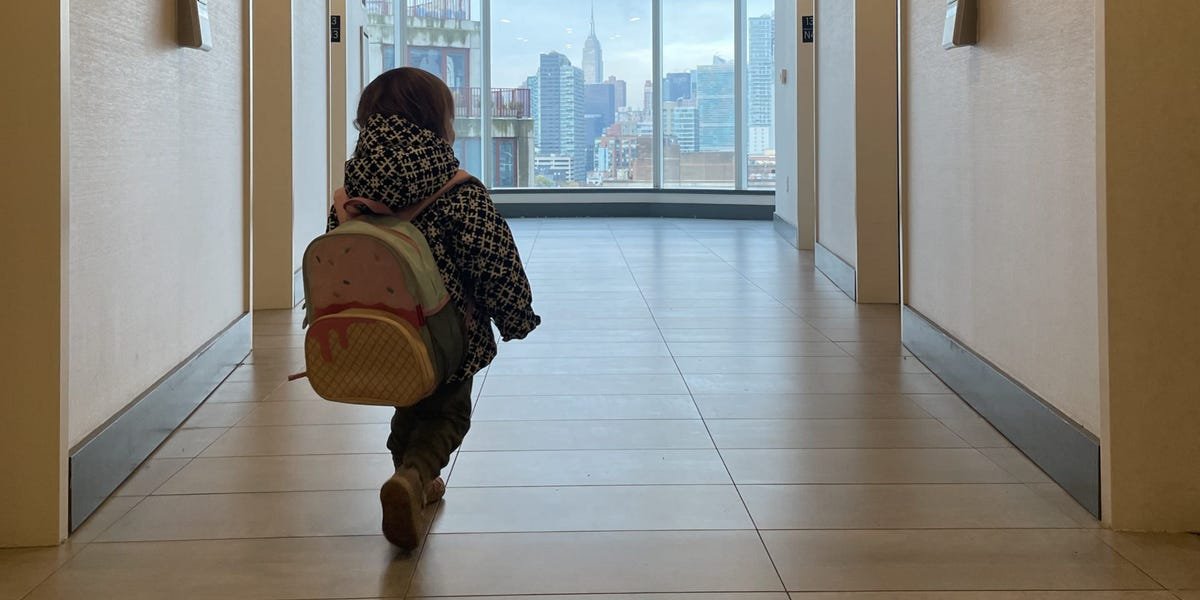
As our daughter became a toddler, she blossomed under my husband’s full-time care, with constant adventuring and frequent playdates keeping her days busy. We didn’t need outside childcare — but as it turned out, she did.
I’d considered traditional childcare, but couldn’t stomach the cost
New York City has notoriously high childcare costs.
The author says traditional childcare was too expensive in New York City.
Courtesy of Michael Matassa
In the interim between our delicate balancing act and deciding my husband would drastically scale down his work, I considered a number of different options, from traditional daycares (upward of $2,500 a month in my neighborhood for full-time programs) to nanny-share arrangements with other local families (maybe slightly cheaper, but a pain to coordinate).
We were lucky in that we were able to avoid childcare costs, which would have effectively canceled out one of our salaries, though I still toyed with the idea of enrolling her somewhere part time to get her used to the idea in case our situation changed.
Enter Barnard College’s Center for Toddler Development.
I first heard about the program in a local moms’ book club I’d joined. One of our first reads was “How Toddlers Thrive” by Tovah P. Klein, a prominent child psychologist — and incidentally the then-director of the Toddler Center. Another mom in the book club with a daughter two years older than mine mentioned she was now applying.
I was frankly flabbergasted when she explained the details. It’s part research program, where the toddlers are minded by teachers and selected students from the college’s graduate program and observed for published research purposes from behind a one-way mirror, and part “school,” albeit an extremely part-time one, with each “class” of toddlers meeting only twice a week for two hours each day for the duration of the school year.
I was intrigued by the program’s unique “gentle separation period” and its said mission to help toddlers have a positive first school experience while supporting healthy social and emotional development through hands-on, child-guided play.
At that point, my daughter was only 18 months old (the halfway point to our 3-K end goal), but I’d already started to suspect that separation might be an eventual issue. With two working-from-home parents, she was used to having us around constantly — and had never had a babysitter.
The few times we’d tried to step out to grab a coffee and handed her to a grandparent, she would shriek like she was being abandoned. Over the next several months, she also grew more shy, coinciding with her stranger danger peaking.
We paid $7,500 for our 2-year-old
Convinced our future would be filled with school refusals and drop-off meltdowns, I hardcore pitched the Toddler Center to my husband for the coming school year. We didn’t need it for childcare, but I became convinced we did need it to help give our daughter the gentlest, most gradual introduction to being away from us. He was less convinced, sure she would grow out of it and be OK with separating by 3-K, but agreed in the end.
If the program details were mind-boggling, the price point was eye-watering. Though there isn’t a set, publicly announced tuition rate, the Toddler Center offers sliding-scale tuition and payment plans to make the program accessible to a broader range of the population. According to its website, a third of Toddler Center families pay tuition on a sliding scale (I assume the higher-profile alum parents like Amy Schumer, Sarah Jessica Parker, and Robert De Niro paid full sticker price for their kids to attend).
After submitting a sliding-scale tuition application, which required forking over the previous year’s tax returns to prove we were indeed not flush with cash, we landed on $7,500 as the final figure for our almost 2-year-old to take her first baby steps toward school.
At first, it was torturous
It did not go well.
The author says at first, her daughter wasn’t comfortable with either of her parents leaving.
Courtesy of Michael Matassa
The first few weeks of the program allowed the parents in the classroom, gradually moving us farther from it (a separate, no-toys-allowed room in the back, meant to be unappealing to the kids) to encourage the toddlers to ignore them and play in the main classroom area. That trick didn’t work on our daughter, who simply sat next to the chair of whichever of us had taken her in that day, chattering happily as we tried to gently encourage her to go away.
As I’d dreaded, the initial actual separation — when parents would bring their kids into the classroom and tell them they were leaving — was horrendous. The Toddler Center mandated that only one parent or caregiver drop off their child each morning.
For the first few weeks after separation, we could both sit in the observation room, where we were treated to a front-row show of our daughter sobbing hysterically and trying to reason with the grad students to open the door she was convinced we were right behind. It was excruciating, and plenty of tears were shed on our end as well.
There was virtually no improvement for months, which was far longer than I expected. And I felt an immense amount of guilt for having come up with this idea in the first place: Were we actually traumatizing her instead of helping her? Had I epically miscalculated this? Did I pay $7,500 to torture my toddler and myself?
I was wracked with doubt, and we debated withdrawing her from the program before the first semester had even finished. It was particularly hard on my husband, who, as the primary parent, was typically the one dropping her off and dealing with the meltdowns — and who also really missed her on school days.
Suddenly, though, and for no particular reason at all, it got better. A lot better.
Instead of sobbing by the door for a full hour and a half, she started interacting with the other kids. She found a favorite grad student she’d attach herself to. She played happily on the classroom slide. And eventually, she comforted the other toddlers during their hard separation days, assuring them their mommies or daddies would be back.
The Toddler Center was expensive, but extremely worth it for us
While it was difficult for my husband to be apart from his little buddy for the few hours a week she was at the program, they turned it into an opportunity for new adventures. In the spring semester, he began biking with her to school, stopping to pick up flowers on the way there and back. Another tradition became that he would bring her a blueberry muffin from a local café every day at pickup. These small rituals helped them bond even more.
The author says the $7,500 she spent was worth it.
Courtesy of Michael Matassa
I don’t pretend to have a handle on the intricacies of toddler psychology, and I can’t tell you what the flipped-switch moment was where it finally clicked for my kid that being left at school with her teachers didn’t mean we were gone forever. And yes, for the record, she still cried during drop-off the first few weeks of 3-K.
But I am convinced that completing the Toddler Center program drastically reduced her adjustment period for “real school.” Tossing her into the deep end for six hours a day, five days a week, was simply not the right option for our family.
In the end, I’m glad I listened to my gut, dug into our pockets, and toughed out the tears — and I’d like to think my daughter, somewhere deep down in her toddler brain, is too.
When Bad Bunny took the field at the 2026 Super Bowl for a historic, joyful halftime show, he wore a jersey with his Latino heritage stitched into its very fabric.
It’s an apt metaphor for his performance, which eschewed explicit anti-ICE statements (he covered that at the Grammys, anyway) in favor of celebration with a side of symbolism.
Nods to the Puerto Rican singer’s motherland were peppered throughout the set, which was designed to evoke the US territory’s signature aesthetics, from sugar cane fields to a storefront labeled “La Marqueta” (a slang term for market) and various vendors selling tacos and piraguas (shaved ice). While performing “El Apagón,” a song about the frequent blackouts and infrastructure issues affecting Puerto Ricans, Bad Bunny brought this symbolism to the forefront, waving the Puerto Rican flag.
He also proclaimed in English, “God bless America,” and brandished a football printed with the phrase “Together, We Are America.” He added in Spanish, “We’re still here.” (Puerto Rico is a US territory, and Puerto Ricans are American citizens.)
It was a stark and knowing contrast to the Latinophobia and anti-immigrant messaging hawked by the Trump administration. So much so that President Donald Trump complained online about Bad Bunny’s performance and his choice to sing primarily in Spanish.
Every time Callie publishes a story, you’ll get an alert straight to your inbox!
Stay connected to Callie and get more of their work as it publishes.
“The Super Bowl Halftime Show is absolutely terrible, one of the worst, EVER! It makes no sense,” Trump wrote on Truth Social after Bad Bunny left the stage. “Nobody understands a word this guy is saying.”
For those who understand visual storytelling, however, Bad Bunny’s performance made perfect sense. He didn’t need to say “ICE out” or declare an explicit political opinion. In keeping with the recent tradition of Super Bowl halftime shows, Bad Bunny used iconography to take a stand instead.
Bad Bunny’s Super Bowl performance is part of a new halftime show tradition
Bad Bunny’s performance shares DNA with Beyoncé and Kendrick Lamar’s Super Bowl appearances, both of which used bold imagery to make strong statements.
Beyoncé’s surprise appearance at Coldplay’s 2016 Super Bowl halftime show became famous — and, to some, infamous — for the iconography present in her performance of her then-new single, “Formation.” In the midst of Trump’s first presidential campaign, Beyoncé and her backup dancers wore outfits that channeled the Black Panther Party, an organization formed amid the ’60s Civil Rights Movement that fought for Black liberation.
Beyoncé performs at the 2016 Super Bowl.
Robert Beck/Sports Illustrated via Getty Images
The song itself isn’t explicitly political. But as a celebration of identity and legacy that features lyrics about Beyoncé’s parents, her daughter, and her features (“I like my negro nose with Jackson 5 nostrils”), Beyoncé performing it — with visual references to the song’s themes in her and her dancers’ costumes, to boot — was innately political.
It’s not that Beyoncé is allergic to making explicit political statements: She famously performed in front of the word “Feminist” at the 2014 VMAs, and sang “Votin’ out 45, don’t get out of line” on her 2022 album “Renaissance,” referring to Trump as the 45th president. But when the NFL hosts musicians for the night, they’ve lately preferred make their statements symbolic rather than overt.
Last year, Kendrick Lamar followed suit during his own Super Bowl halftime show, outfitting himself and his dancers in red, white, and blue. Although Lamar kept the music focused on his own enemies and triumphs, he used audacious visual language to pose broader, poignantly relevant questions: Who’s allowed to claim patriotism? What does it mean to be an American, especially in times of oppression and conflict?
Bad Bunny’s performance raised similar questions, but offered simpler, more optimistic solutions. For the finale, he was surrounded by backup dancers, band members, and other performers holding flags from around the world; when he proclaimed “God bless America,” he listed out all the countries in both North and South America.
Bad Bunny is not a politician, nor can he single-handedly cure the world of hatred and division. Still, for a brief moment, on a small square of American turf, he chose to use the stage to show millions of people what that could look like.
Jeffrey Epstein did not have any children, despite what an email in just-released documents suggested, his brother told Business Insider.
“No, Jeff didn’t have any kids,” Mark Epstein said Monday. “If Jeff had a kid, I think I would have known.”
The denial comes in reaction to a set of messages included in the latest cache of Epstein files issued by the US Department of Justice.
The messages, sent in September 2011, are signed “Sarah xx” and reference “The Duke.” They appear to have been sent through BlackBerry Messenger.
The sender’s name and email address were redacted by the Justice Department. The BBC and other British media outlets have reported that they may have come from Sarah Ferguson, the ex-wife of the former Prince Andrew, who also held the title Duke of York.
Every time Jacob publishes a story, you’ll get an alert straight to your inbox!
Stay connected to Jacob and get more of their work as it publishes.
“Don’t know if you are still on this bbm but heard from The Duke that you have had a baby boy,” one message says. “Even though you never kept in touch, I still am here with love, friendship and congratualtions on your baby boy.”
A follow-up message sent the same day accused Epstein of befriending her “to get to Andrew.”
“You have disappeared. I did not even know you were having a baby,” the message said. “It was sooooo crystal clear to me that you were only friends with me to get to Andrew. And that really hurt me deeeply. More than you will know.”
A representative for Ferguson didn’t immediately respond to a request for comment.
The former prince is now known as Andrew Mountbatten-Windsor. He relinquished his royal titles last year, around the release of a posthumous memoir from Virginia Giuffre, who accused him and Epstein of sexual abuse. In 2022, the former royal had also settled a civil lawsuit brought by Giuffre.
Another message from “Sarah,” dated January 2010, expressed intense gratitude for Epstein.
“You are a legend. I really don’t have the words to describe, my love, gratitude for your generosity and kindness,” Sarah wrote. “Xx I am at your service . Just marry me.”
Aside from the “baby boy” message, the vast public corpus of emails and other documents released so far has made no reference to Epstein having a child.
If you are a survivor of sexual assault, you can call the National Sexual Assault Hotline (1-800-656-4673) or visit its website to receive confidential support.
My 17-year-old daughter told me that she’d been offered a special deal at the Verizon store: access to Apple Music for up to six people for $10 a month. She was desperate to take advantage of the promotion and said the streaming service had an amazing selection of songs.
I said no, not only because we have Spotify, but also because I’d had a rude awakening after New Year’s.
My husband and I were worried about how much we were charging to our credit cards, especially during the holiday period.
We decided to do a financial tune-up, and I was responsible for reviewing the Mastercard statement. We only used it as a secondary payment method if a merchant didn’t accept American Express.
I thought I’d been subject to fraud
As a result, I rarely looked at the bill. This time, however, I printed the statement covering November 11 to December 12, 2025, when we did most of our Christmas shopping.
Every time Jane publishes a story, you’ll get an alert straight to your inbox!
Stay connected to Jane and get more of their work as it publishes.
There were a few transactions for items like coffee at a little café that doesn’t take Amex and some co-pays for doctors’ visits, but there were others I didn’t recognize.
What on earth was Uexton? I’d paid them $19.99 on November 11. Then there was Sportelx, to whom I’d paid $29.55 on November 21. I’d never heard of it.
I Googled to find that Uxeton was a gaming website and Sportelx was a sports news service.
I’d been a victim of fraud on several occasions, and assumed it had happened again.
The author accidentally signed up for services she never used.
Lam Kraker/Business Insider
Then, I looked over the rest of the bill and saw payments of $29.99 to ESPN New York, $14.99 to Canva, and $11.95 to Audiobookstore.com. As far as I was concerned, neither my husband, kids, nor I had used any of them.
There was also a $25 fee to Rockin’ Jump, where my son went once a week before getting too old for a trampoline park. Why were we still paying for his membership?
I reviewed the last two months’ statements and realized the suspicious payments had occurred before, on the same day each month.
It wasn’t fraud. The recurring fees were subscriptions we’d signed up for before switching banks and credit cards. Some went back years. We had failed to cancel Rockin’ Jump. I didn’t know how the rest had come about.
Over the next few hours, I racked my brains trying to figure out where they came from. The only thing I could think of was that my spouse or I must have shared our credit card information at some point to get a trial subscription.
We’d wasted almost $1,600 annually
We must have forgotten to cancel at the end of the free or discounted period. The total of our unnecessary payments was $131.88 a month, the equivalent of a family cellphone plan.
Over the years, I calculated that we’d spent almost $1,600 annually on streaming and other services we didn’t touch. It was hard to blame the companies that use subscription models when I had been the one to drop the ball. I felt dumb and ashamed.
I sprang into action, canceling as many fees as I could. In most cases, I found it much more difficult to unsubscribe than to subscribe because of the hoops you have to jump through.
Still, the experience taught me a lesson. It’s no thank you to tempting — but ultimately useless — offers from now on.
This story is available exclusively to Business Insider
subscribers. Become an Insider
and start reading now. Have an account? .
Steve Martin has five Grammys for comedy and bluegrass music.
Former presidents Bill Clinton and Barack Obama have won Grammys for their audiobooks.
Martin Luther King Jr. and Jimmy Carter were awarded posthumous spoken-word Grammys.
When you think of music’s biggest night, you probably picture artists like Beyoncé and Paul McCartney, two of the top Grammy winners of all time.
But it’s not just singers and musicians who are honored by the Recording Academy. Comedians, politicians, and activists have also taken home Grammy awards.
Here are 17 people you might be surprised to learn have won big at the Grammys.
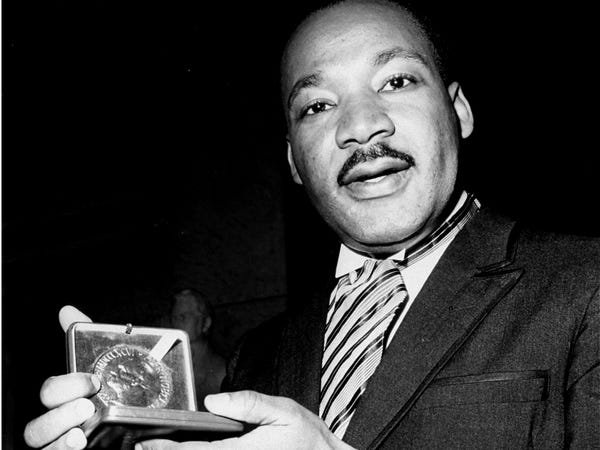
Martin Luther King Jr. was posthumously awarded a spoken-word Grammy.
Martin Luther King Jr. Associated Press
Martin Luther King Jr.’s speeches made American history, but you might not know that the minister and activist was posthumously awarded a Grammy. In 1971, King was honored with a spoken word award for his anti-war speech “Why I Oppose the War in Vietnam.”
Two of his more famous addresses, “I Have a Dream” and “We Shall Overcome,” were also nominated for Grammys.
Lily Tomlin won a Grammy for best comedy recording.
Lily Tomlin. Ron Galella/WireImage/Getty Images
Actor and former stand-up comic Lily Tomlin took home a Grammy for best comedy recording in 1972 for her album “This Is A Recording.” The album features her performance as telephone operator Ernestine, one of the most iconic characters she created.
Tomlin has been nominated a total of five times.
Steve Martin has five Grammys across multiple categories.
Songwriters Edie Brickell and Steve Martin at the Grammy Awards. Jason LaVeris/FilmMagic/Getty Images
Since 1978, actor and comedian Steve Martin has won a total of five Grammys. In addition to two awards for best comedy album, Martin, who is also a bluegrass musician, has garnered a handful of music awards for his country and roots tunes.
Most recently, Martin’s track “Love Has Come For You” won a Grammy for best American roots song at the 56th Annual Grammy Awards in 2014. He was also nominated in 2015 and 2017.
Zach Braff won a Grammy for the “Garden State” soundtrack.
Zach Braff. Steve Grayson/WireImage for The Recording Academy/Getty Images
“Garden State,” Zach Braff’s 2004 directorial debut, attracted a cult following. Part of the film’s appeal is its indie-driven soundtrack, which earned Braff, who starred in the movie with Natalie Portman, a Grammy at the 2005 awards.
Joaquin Phoenix’s performance as Johnny Cash in “Walk the Line” earned him a Grammy.
Joaquin Phoenix. Kevin Winter/Getty Images
Joaquin Phoenix starred in the 2005 musical biopic “Walk the Line” as Johnny Cash. Phoenix’s portrayal of the country singer earned him a Grammy for best compilation soundtrack for visual media.
President Bill Clinton has won two Grammy awards.
President Bill Clinton. Daniel Berehulak/Getty Images
Former President Bill Clinton won his first Grammy in 2004 in the category of best spoken-word album for children for his narration of “Peter and the Wolf: Wolf Tracks.” He won another Grammy for the audiobook narration of his memoir, “My Life,” in 2005.
He was nominated twice more for narrating his subsequent books, “Giving: How Each Of Us Can Change The World” and “Back To Work: Why We Need Smart Government For A Strong Economy.”
Hillary Rodham Clinton has also won a spoken-word Grammy.
Hillary Rodham Clinton at the Grammy Awards. Dave Allocca/DMI/The LIFE Picture Collection/Getty Images
Hillary Rodham Clinton won a spoken-word Grammy in 1997 for “It Takes a Village,” her non-fiction book about the future of children in America.
She was nominated again in the same category in 2004 for her White House memoir, “Living History.”
Orson Welles won three spoken-word Grammys.
Orson Welles. Hulton-Deutsch Collection/CORBIS/Corbis via Getty Images
Filmmaker Orson Welles won three spoken-word Grammys. The first was for “Great American Documents,” for which he read the Declaration of Independence. He also won the award for his masterpiece “Citizen Kane” and for the sci-fi radio play “Donovan’s Brain.”
“Weird Al” Yankovic’s comedic songs have won him multiple Grammys.
Weird Al Yankovic. TIMOTHY A. CLARY/AFP/Getty Images
For someone whose musical career is predicated on parody, “Weird Al” has made it big. The singer, known for hits like “Eat It” and “eBay,” has five Grammy wins and 17 nominations.
Earvin “Magic” Johnson has a spoken-word Grammy for his work in HIV/AIDS prevention advocacy.
Magic Johnson. Lisa Blumenfeld/Getty Images
Johnson won a spoken-word Grammy in 1993 for “What You Can Do to Avoid AIDS.” The basketball legend, who announced in 1991 that he had been diagnosed with HIV, has been a vocal advocate for HIV/AIDS prevention and education.
Stephen Colbert has two Grammys.
Stephen Colbert at the Grammy Awards. Michael Tran/FilmMagic/Getty Images
Late-night host Stephen Colbert has won two Grammys out of his three nominations.
At the 52nd Grammy Awards in 2010, Colbert won best comedy album for “A Colbert Christmas: The Greatest Gift of All!” Then, at the 56th Annual Grammy Awards in 2014, the recording of his book “America Again: Re-becoming the Greatness We Never Weren’t” won a spoken-word award.
President Barack Obama has won two spoken-word Grammys for his memoirs.
Barack Obama. Bill Pugliano/Getty Images
Former President Barack Obama won spoken-word Grammys for narrating the recordings of his books “Dreams From My Father” and “The Audacity of Hope: Thoughts on Reclaiming the American Dream.” He was nominated again in 2022 for narrating the audiobook of his presidential memoir, “A Promised Land.”
Michelle Obama has also won two spoken-word Grammys for her memoirs.
Michelle Obama. Jim Young/Reuters
The former first lady’s audiobook for her memoir “Becoming” won a spoken-word Grammy award in 2020. She won again in 2024 for “The Light We Carry.”
Maya Angelou won three spoken-word Grammys.
Maya Angelou. Mitchell Gerber/Corbis/VCG via Getty Images
In 1994, American poet Maya Angelou won her first spoken-word Grammy award for “On the Pulse of Morning,” which she wrote for Clinton’s inauguration. She also won the award for her poetry collection “Phenomenal Woman” and for the autobiography “A Song Flung Up to Heaven.”
Betty White also won a spoken-word Grammy.
Betty White. Frederick M. Brown/Getty Images
Betty White won a Grammy at the 54th Annual Awards in 2012. The “Golden Girls” actor received a spoken-word award for her autobiography, “If You Ask Me (And of Course You Won’t).”
Carrie Fisher won a posthumous spoken-word Grammy.
Carrie Fisher. Dimitrios Kambouris/Getty Images
At the 60th Annual Awards in 2018, Carrie Fisher was posthumously awarded a spoken-word Grammy for her memoir, “The Princess Diarist.”
President Jimmy Carter won three Grammys during his lifetime and one posthumously.
Jimmy Carter. Drew Angerer/Getty Images
The former president won Grammys for best spoken-word album for three of his books: “Faith — A Journey For All,” “A Full Life: Reflections at Ninety,” and “Our Endangered Values: America’s Moral Crisis.”
Carter, who died at the age of 100 in 2024, won again at the 2025 Grammys for the audiobook “Last Sundays in Plains: A Centennial Celebration.”