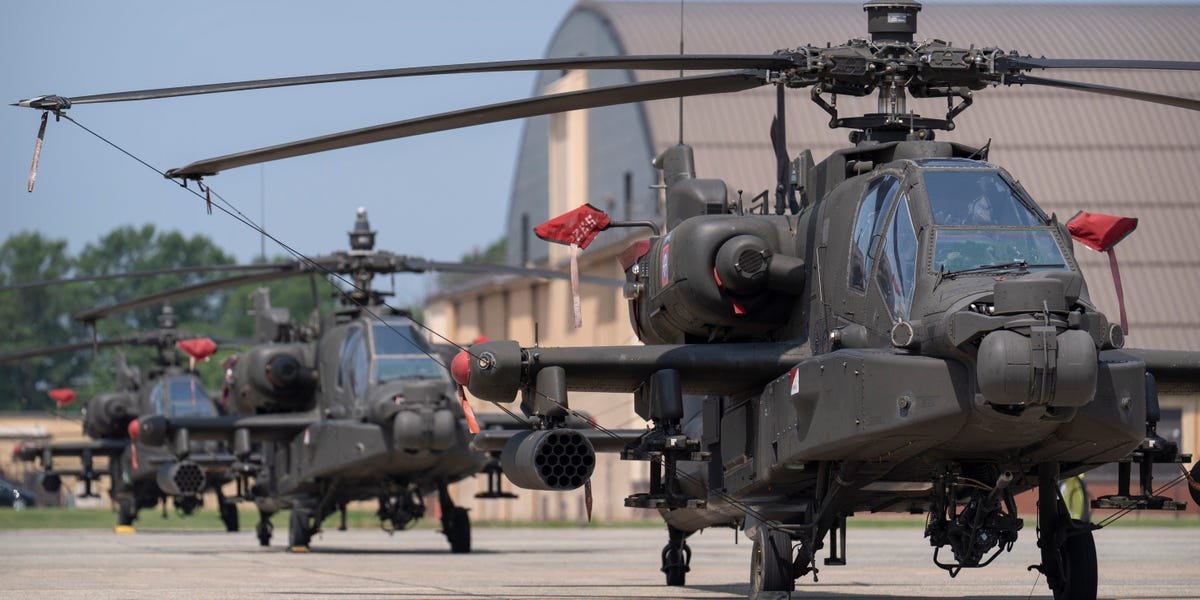
Defense Secretary Pete Hegseth said on Tuesday that the suspension of the flight crew members who hoveredApache helicoptersnear Kid Rock’s Nashville home over the weekend had been lifted.
Kid Rock, whose real name is Robert James Ritchie, is a vocal supporter of President Donald Trump. He posted a video on Saturday of an attack helicopter hovering near the poolside of his home in Nashville, while adding insults to the governor of California in his caption.
An Army spokesperson told Business Insider on Mondaythat the flyby maneuver would undergo an “administrative review” and that “appropriate action will be taken if any violations are found.’
On Tuesday, Army officials said the flight crew members involved in the matter were suspended while the investigation was conducted, an Army spokesperson told multiple outlets.
At 6:34 p.m. Eastern time, Hegseth wrote on X that there would be no probe and that the suspension was reversed.
“Thank you @KidRock. @USArmy pilots suspension LIFTED. No punishment. No investigation,” Hegseth wrote. “Carry on, patriots.”
A Pentagon spokesperson declined to provide further comment beyond Hegseth’s post. An Army spokesperson did not respond to a request for comment.
The AH-64 Apache is an attack helicopter equipped with Hellfire missiles, rockets, and a 30 mm chain gun. It is primarily used for anti-armor missions.
There’s no law that explicitly bars flying an attack helicopter near private residences. Training missions can include low-altitude flight in civilian airspace. The military’s aviation rulebook states that the aircraft are utilized for “authorized purposes only.”
Army spokesperson Maj. Jonathon Bless told the Associated Press that the helicopters were on a training mission when they hovered near Kid Rock’s home.
When asked about the incident during a press conference in the Oval Office, Trump said the crew members “probably shouldn’t have been doing it.”
“You’re not supposed to be playing games, right? But I’d take a look at it. They like Kid Rock. I like Kid Rock. Maybe they were trying to defend him, I don’t know,” Trump said.
A representative for Kid Rock did not respond to a request for comment.
Air travel is facing disruption due to long lines at airport security checkpoints.
Sunday and Monday saw hourslong waits at several airports, as Transportation and Security Administration officers missed their first full paycheck since the partial shutdown began.
At Houston’s Hobby Airport, travelers were warned to expect security lines stretching up to three hours. Delays were also reported at New Orleans, Atlanta’s Hartsfield-Jackson, and Miami International.
A political dispute over federal funding for the Department of Homeland Security has led to TSA officers working without pay.
Airport operations had largely avoided major disruption until Sunday, when some staff did not show up to work.
Every time Pete publishes a story, you’ll get an alert straight to your inbox!
Stay connected to Pete and get more of their work as it publishes.
While disruption seems to have moderated on Tuesday, travelers are being advised to arrive early and allow extra time to clear security, as wait times can shift depending on staffing levels and peak travel periods.
Here’s how you can stay prepared
One simple way to monitor conditions is to check the website of the airport you’re flying from.
Many airports, including major hubs like Atlanta, Houston, JFK, Newark, Philadelphia, Dallas-Fort Worth, and Denver, post live wait times on their websites.
These can also provide more specific insights. For example, DFW’s website shows the wait times at each checkpoint.
On Tuesday morning, all these airports had average wait times of under 30 minutes.
Most US airports also frequently update their own websites with travel advisories for passengers. For instance, on Tuesday morning, Houston Airports, which manages both Houston Hobby and George Bush International, has a notice telling travellers to arrive early.
You can also use the MyTSA mobile app. It provides estimated wait times in 15-minute intervals based on average checkpoint data.
It should be noted that the app says it sometimes uses historical data if the live data cannot be retrieved. The TSA also says it is not “actively” managing its sites during the partial shutdown, and so the app may not always be updated.
Alternatively, flight-tracking websites like Flightradar24 and FlightAware can also give insights into airport conditions.
FlightAware has a “Misery Map” which shows flight delays at airports around the country, which could be affected by the security lines.
Flightradar24 also shows the average delay for departing flights if you select an airport.
TSA PreCheck lanes remain open nationwide, though the agency has warned they could be suspended at individual airports if staffing shortages worsen.
This as-told-to essay is based on a conversation with Peter Wozny, head of legal at Btomorrow Ventures, the corporate VC arm of British American Tobacco. This piece has been edited for length and clarity.
I was flying home to Europe over the weekend from a business trip in China, connecting through Qatar, when my journey took an unexpected turn.
I landed in Doha in the early hours of Saturday morning, made my transfer, and boarded the onward flight. We took off as normal at 9:15 a.m. local time.
About an hour later, everything changed. As we approached the airspace between Israel and Iran, the plane abruptly turned around and headed back to Doha.
When we landed, we sat on the tarmac for roughly 90 minutes as the crew tried to figure out the next steps. Eventually, they sent us back into the terminal.
By then, anxiety had started to spread. Passengers were glued to their phones, reading reports that war had broken out that morning.
Peter Wozny boarded a flight to Warsaw at Doha’s Hamad International Airport early on Saturday morning.
Courtesy of Peter Wozny
Stranded in Doha
Inside the airport, it was chaotic.
Since I was traveling for work, I headed to the Al Mourjan Business Lounge, where I ran into my friend Stuart. We ended up waiting there for a few hours, trying to figure out what was happening.
While we were sitting there, we started hearing loud bangs outside. At first, I wasn’t sure what they were. Then it became clear they were missiles being fired. That’s when it really hit me — it felt ominous.
Stuart McClure and Peter Wozny at Doha’s International Airport’s lounge on February 28.
Courtesy of Peter Wozny
Qatar Airways moved us to the Fraser Suites in Doha’s West Bay area. It wasn’t great, so I decided to book my own room at the Mondrian Doha, where I’ve been staying since Sunday. It’s about $220 a night.
The authorities have said stranded passengers will be able to claim refunds for their hotel stays from Saturday until the airports reopen.
Once this is all over, I’ll need to submit expenses for flights, taxis, food, the hotel, and even basic things like toiletries and clothes.
For the first four days, we didn’t have our suitcases. I just had the clothes I was wearing and a rucksack with my work laptop.
The explosions woke me up
From the hotel, which overlooks Doha’s port, you can hear the explosions. You’ll be sitting there, and suddenly there are these loud bangs outside. Then you look up and see flashes lighting up the sky. It’s scary.
On Saturday night, I actually slept through most of the noise because I was exhausted.
But at 7:30 a.m. on Sunday, the noise woke me up. On other days, it’s sounded more distant, more muffled.
Sunday was noticeably quieter. From what I understand, Qatar has been intercepting missiles over the Gulf before they reach land. It’s not that they haven’t been fired — it’s that they’re being taken out at sea.
Even so, you can still hear them.
Stuart McClure and Peter Wozny in their hotel room on Tuesday.
Courtesy of Peter Wozny
It feels a little bit like Covid
It feels a bit like lockdown. I’m stuck, and I don’t know what’s going on. I look out on the streets, and there are barely any cars driving around.
I feel nervous. A bit unsettled. I do feel safe, but I just don’t know what’s happening.
I’m generally a glass-half-full person, but all my plans have been turned upside down. I don’t know whether it’s going to be a few more days or a few more weeks stuck out here.
Peter Wozny and other flight passengers received alert messages upon returning to Doha.
Courtesy of Peter Wozny
Reassuring friends and family
The hardest part has been friends and family constantly checking in. They’re obviously concerned and want to get updates.
They’re reading things in the news, and there’s misinformation out there. So you’re constantly responding to messages and telling everyone you’re OK.
That’s intense. But when you’re sitting in the hotel, and you’re just hearing explosions around, or you’re looking up, and you just see all the light, the sky kind of lighting up, it’s also a bit scary.
Peter Wozny is shown in the Mondrian Doha Hotel on Monday.
Courtesy of Peter Wozny
From my company’s perspective, the guidance has been straightforward: stay in touch, keep people updated, and don’t leave the hotel unless necessary.
Beyond that, we’re just waiting to see whether the situation escalates.
The last update from Qatar Airways was that there won’t be any flights out of Doha until at least Friday.
I’m now considering getting a car and driving to Riyadh in Saudi Arabia, and then flying to London from there.
For now, I’m just hoping it doesn’t escalate further, that no one gets hurt, and I can head home soon.
This as-told-to essay is based on a conversation with Kunal Trehan, a luxury interior designer. It has been edited for length and clarity.
We arrived in Dubai on February 20th to expand our business into the UAE, fully expecting to fly home to the UK on February 28th at 10:20 p.m. local time.
On Saturday, the day we intended to leave, we decided to chill by the beach connected to our hotel. Around midday, we heard what sounded like an explosion — a very faint but deep sound. My partner and I assumed it was demolition until an hour later, when people started messaging me on WhatsApp asking if I was OK. I couldn’t understand what they were worried about.
Kunal Trehan and his partner are stuck in Dubai after the airport closed.
Courtesy of Kunal Trehan
I quickly opened the Qatar Airways app and saw that our flight had been canceled. I started to freak out a bit, wondering if something was going on and how we would escape.
We heard more explosions
As we sat on the beach, still trying to figure out what was happening and what to do next, we could hear more explosions and see accompanying clouds of smoke in the distance. We rushed inside, with me telling my pragmatic self to stay calm and not to panic.
In the evening, more explosions could be heard. We could see the orange light of missiles racing across the sky. We didn’t know where they were being launched from or who was launching them.
I was getting increasingly nervous after looking at the news and social media online. Hotel staff told guests to come inside from their balconies and close their room curtains. Everyone obeyed.
By this point, the sky had become a large plume of smoke over the Fairmont hotel. In the lobby, people were notably panicked. It felt quite claustrophobic, unsettling.
We got emergency alerts on our phones
At midnight, my partner and I got ready to head to sleep when we heard yet another explosion. We opened our curtains, and it looked as if a missile was headed right towards us. Our phones started alarming with the emergency government message to take shelter. “What the hell do we do?” I asked my partner.
Kunal Trehan received emergency alerts on his phone.
Courtesy of Kunal Trehan
Hotel staff knocked, told us to gather our passports and valuables, and to make our way to the basement. The basement was a concrete-floored area. People were perched on the ground, the elderly in chairs. The staff was doing what they could to calm people and make them as comfortable as possible, providing pillows and blankets.
Even the staff, many of whom are locals, were alarmed. They’ve told us that they haven’t experienced this before. We’ve tried to calm others, to make sure they’re OK.
For three hours, we stayed in the basement, but eventually made our way back to the room as my sciatica was flaring up. We had two hours of sleep in our room before we were woken by another explosion around 9 a.m. on Sunday.
We are advised to stay inside the hotel
The hotel has continued to advise people to stay inside — although we know we aren’t directly being attacked, we are caught in the crossfire of a war, and who knows what could fall from the sky. We’ve followed the advice given to us and done what we can to stay safe.
Kunal Trehan had to take shelter in the hotel’s basement.
Courtesy of Kunal Trehan
We’ve asked to move hotel rooms to a first-floor room. If our hotel gets hit, we’d rather be able to get outside quickly. My partner and I keep reminding each other that, for right now, we are relatively safe.
But whereas yesterday, I felt a sense of purpose in helping others, today, I’m feeling very flat. We are incredibly fortunate, yet completely out of control, and have no idea when we will be able to get home.
We are paying $670 a night at the hotel
Fortunately, we have the funds to continue paying for our hotel room, which is about $670 a night, and to eat and buy necessities. Our meal tonight — just mains and water — came to about $120. We haven’t been told that any of this will be reimbursed by our travel insurance company.
Kunal Trehan and his partner moved to a first-floor room in case they need to evacuate.
Courtesy of Kunal Trehan
Over and over, my partner and I speak of how lucky we are. Lucky that we are safe. Lucky that we have money to stay here. Lucky that we didn’t attempt to go to the airport. And yet, we are still so worried. So many emotions — from fear to gratitude.
Our friends and family are so worried for us — we have had hundreds of messages asking how we are. No matter how much we tell them we are safe, their worry continues, and we can hear it in their message and voice notes.
We are hoping to fly out on Thursday, but nothing is set in stone. Just another thing out of our control for now.
I thought I was on track — until the year everything fell apart.
Just weeks into January 2023, I was blindsided by an unexpected breakup. In the months that followed, I moved through my days on autopilot, watching the year continue to unravel.
That May, I was laid off from my job coordinating large conferences and corporate travel. I took a position at a family-run wedding business that was building out its travel department. I told myself things were starting to look up.
But between a 90-minute commute, sitting at a desk all day, and performing mundane tasks not listed in my job description, I began to spiral instead of heal.
Almost every day, I’d retreat to my car at lunchtime and break down in tears, overwhelmed by how unhappy I was.
The “American dream” began to feel like a trap
Since I was a kid, I’d treated success like a checklist built from American expectations I absorbed through school, TV, and social media. It seemed simple enough: Stay in line with peers, get married before turning 30, and buy a big house to raise a family in.
It was becoming clear that this narrative might not align with the life I wanted for myself.
Later that same year, I dealt with a toxic roommate, a serious health scare in my family, and a car accident. Then, just days before the New Year, I got one final surprise: another layoff. This time, however, I felt relief.
Walking out of that office for the last time allowed me to stop chasing a version of success I knew would never satisfy me.
Distance changed the pressure I was living under
As 2024 began, I set a clear goal for myself to sublet my apartment, sell my belongings, and board a one-way flight to South Korea by April 15. My plan was to begin an eight-month journey across Asia and Australia. After four months of careful planning, I boarded that flight.
Starting the trip with a friend in Seoul made the beginning — and the 15-hour flight over — feel safe and manageable. When she boarded her flight back to the US, and I headed off to Thailand alone, that distraction disappeared. I was officially left alone with my own thoughts.
Early on in Southeast Asia, I questioned what I was doing and where it would all lead. I cried in hostels and had panic attacks on the back of motorbikes. My anxiety was triggered by the blasting music of Bangkok’s Khao San Road and Ho Chi Minh City’s endless traffic.
Strum escaped the pressure she’d been living under while traveling through the mountains in northern Vietnam.
Provided by Macie Strum
The more I took note of my surroundings, the less the world around me matched the urgency in my head.
As I traveled the Ha Giang Loop in Northern Vietnam by motorbike, I realized that my idea of success was built upon a level of pressure that didn’t exist up in these Vietnamese mountains. Local life didn’t revolve around strict deadlines and productivity scales. Instead, it centered on routine, family, and staying present each day.
As I moved through each country, I connected with travelers of every age and background, many of whom were unemployed, exploring new paths, working online, or simply figuring things out as they went. Some were meticulous planners; others lived day to day.
In the jungles of Malaysian Borneo, I met a fellow American who was also redefining her life after a heavy breakup. I remember the first night we met, we talked for hours about life, expectations, and the fear of what would come next.
We ended up traveling together to Kuala Lumpur, meeting again in Penang, and later in Bali. Seeing her in so many different places reminded me how many others were navigating the same uncertainty.
It reframed my view of travel — not as a break from real life, but as an active part of it. For the first time, uncertainty no longer felt like failure.
She’s building her career in Sarajevo, Bosnia and Herzegovina.
Provided by Macie Strum
I’ve redefined success
When that trip came to an end, I felt no pull toward the life I’d left the year before.
I returned to the US briefly, but chose to keep traveling to explore what alternative versions of success could look like for me.
In 2025, that decision took me to 17 European countries. As I explored, I found myself falling in love with one of the continent’s most misunderstood regions: the Balkans.
Today, I live in Sarajevo, Bosnia and Herzegovina, building a career as a freelance journalist without sacrificing my ability to travel. While the life I’m creating may not match the version of success I was raised with, it’s more aligned with how I want to live: flexibly, deliberately, and with purpose.
While I don’t know exactly what comes next, that no longer scares me the way it once did.
Do you have a story to share about living abroad? Contact the editor at akarplus@businessinsider.com.
Passengers flying from Japan to Europe endured a 14-hour-long flight to nowhere on Tuesday after an engine issue.
All Nippon Airways Flight 223 left Tokyo around 11 a.m. and was scheduled to land in Frankfurt, Germany, about 14 hours later.
However, over six hours into the journey, it turned around while flying over the Arctic Ocean, north of Alaska.
Flight-tracking data shows how the Boeing 787 then headed back to the Japanese capital.
It took another eight hours to reach Tokyo’s Haneda Airport, where Flight 223 touched down around 1 a.m.
The plane diverted due to a “low engine oil level,” an ANA spokesperson told Business Insider.
Engine oil differs from jet fuel and is used to lubricate and cool the moving parts inside the engine.Returning to Tokyo, the airline’s main hub, would mean more resources for maintenance and repair.
The spokesperson added that the flight departed again on Wednesday morning, with a change of aircraft and crew.
Data from Flightradar24 shows the new plane departed at around 7:30 a.m. and is supposed to land in Frankfurt around 1 p.m. local time. That’s about 20 hours later than passengers initially expected to get there.
“The safety of our passengers and crew is our top priority,” the spokesperson said. “We sincerely apologize for the inconvenience caused to our customers by this extensive delay.”
Since the plane turned around roughly halfway through a huge journey, it was a particularly gruelling flight to nowhere — but not the longest.
Last June, a Qantas flight to Paris returned to Perth after 15 hours. It was mid-flight when Iran launched strikes against a US air base in Qatar, closing some of the world’s most congested airspace.
And in 2023, Air New Zealand passengers had a 16-hour flight to nowhere after an electrical fire in a terminal at New York’s JFK Airport.
Air travel is showing more signs of recovery after Winter Storm Fern pummelled the country over the weekend.
There were around 1,300 canceled flights within, into, or out of the US as of 6:20 a.m. ET on Tuesday, according to data from FlightAware.
Dallas-Fort Worth International Airport led the charge with 276, followed by Charlotte Douglas with 138.
While more flights are likely to be canceled throughout the day, there were about 4,000 such cancellations early on Monday. The day ended with 6,250 canceled flights, per FlightAware.
That compares to Sunday’s 11,618 canceled flights.
Every time Pete publishes a story, you’ll get an alert straight to your inbox!
Stay connected to Pete and get more of their work as it publishes.
Sunday marked the worst day for air travel since the early days of the pandemic in March 2020, Transportation Secretary Sean Duffy said on Monday.
He added that the government expects flight schedules to return to normal on Wednesday.
“This storm is unique,” he said. “You get the ice, and you get the snow, and on top of that, we have now a cold weather snap that comes after it.”
Airport and airline workers have also struggled to get to work due to the state of the roadways.
On Monday evening, Heather Garboden, American Airlines’ chief customer officer, wrote to customers saying the storm “continues to present travel challenges across the country.”
American has been the most-affected airline each day, including over 1,900 cancellations on Sunday, per FlightAware.
Garboden added that five of the airline’s nine hubs were “significantly impacted,” including its largest at DFW, which saw “record-setting” weather conditions.
And as the storm affected cities that don’t generally experience such cold, many areas lacked the infrastructure to handle the heavy snow and ice.
This, in turn, has “led to staffing issues as team members, plus vendor and federal partners, struggle to make their way on the roads,” she said.
Airlines have waived change fees so that passengers have more flexibility to avoid disruption due to the storm.
However, while American’s waiver covers travel through Thursday, United Airlines’ is through Wednesday, and Delta Air Lines’ only continues through Tuesday.
By the time 33-year-old private jet flight attendant Kelley Lokensgard greets her VIP passengers on the tarmac, she has been working for hours.
“I grocery shop the night before, then arrive two hours before the flight; I load my flower arrangements, prep my boarding appetizers, and touch up the cabin,” Lokensgard, the chief cabin attendant at Silver Air Private Jets, told Business Insider. “People don’t realize how many fingerprints they leave behind.”
That behind-the-scenes work is part of serving wealthy vacationers, business executives, and celebrities who expect flawless service and discretion.
Lokensgard, what started in 2021, said the job can be nonstop: she’s on duty for up to 21 days a month, sometimes at a moment’s notice, and is responsible for catering meals and tailoring each flight to client preferences.
This is a level of invisible labor that few people outside private aviation ever see; it’s not the glitz and glamour that social media often portrays. But Lokensgard — whose background is in music, youth education, and fine dining — said she loves the grind.
Lokensgard visited the Golden Temple in Kyoto.
Courtesy of Kelley Lokensgard
“It’s a lot of schlepping and problem-solving and delicate communication with a lot of moving parts and people; you have to be a laborer to want to do this job,” she said. “I can’t imagine something that better suits my random scope of skills.”
Private flight attendants are a small but growing niche within aviation. Jobs, which are largely non-union, span from small and medium-sized private companies like Silver Air to mega operators like NetJets and VistaJet.
While many roles offer full-time benefits, as in Lokensgard’s case, others resemble gig work, which can allow for a flexible lifestyle but often comes with less predictability and fewer labor protections than at most US airlines.
The work often involves long, irregular hours, extended travel, and the demands of high-profile clients. And private flight attendants usually don’t have access to the free standby flights that commercial crew typically enjoy — meaning they only fly if a seat is available.
Still, there’s a significant payoff. Lokensgard gets to see the world through the destinations of her clients — essentially for free — while earning much more than most of her airline counterparts.
Lokensgard, who lives in Los Angeles, earns in the low six figures, though she said some veteran, freelance, and specially skilled VIP cabin attendants can make as much as $350,000 annually. Glassdoor puts the nationwide median annual salary at about $94,000.
By comparison, commercial flight attendants at American, Delta, and United typically earn a base salary between $30,000 and $80,000, depending on seniority, along with a per diem and additional pay opportunities like overtime, holidays, and international flying. Many senior crew members reach six figures after years of service.
An example of one of Silver Air’s G550s.
Silver Air Private Jets
To prepare for her role, Lokensgard completed five days of training and an online course: “There was so much to learn, it’s professionalism, luxury, service, and safety,” she said. Silver Air also sponsored culinary classes.
Her training is far shorter than the weekslong courses commercial flight attendants must complete, though that’s because the Federal Aviation Administration does not regulate corporate cabin attendant positions — its “flight attendant” rules apply to airlines and public charters, not private jets.
This means cabin training varies widely across private operators, though Lokensgard, as chief attendant, said she is incorporating more shadow flying and collaborative learning at her company.
Private aviation is not your normal 9-to-5
Lokensgard spends most of her days on the Gulfstream G550, a giant multimillion-dollar private jet with a bedroom and enough range to travel across oceans and continents. The plane has an owner but is also managed by Silver Air as a rental; Lokensgard serves whoever is on board.
She said these often long flights mean she is away from home for days at a time and must work early and late hours. A flight from the Los Angeles-area Van Nuys Airport to Tokyo, for example, would take about 11 hours and involve at least two meal services, she said.
Lokensgard must organize catering for the passengers, but is regularly asked to cook. She’ll meal-prep meats and vegetables the night before and has access to an approved skillet, oven, microwave, and chiller to work with on the plane.
“Sometimes our clients don’t want catering, and I will be told, ‘Hey, arrange steak, sushi, chicken tenders, french fries, salads, fruit platter, snacks, and desserts for the flight,'” she said. “I’ll shop at Erewhon, or I’ll ask a local steakhouse to sear a steak that I’ll finish off on the plane. Your head just explodes with ideas.”
Erewhon is the US’ most expensive grocery store and a hotspot for the LA elite.
Some meal examples include a green goddess salad sourced from an Italian farmers market and a Yucatan-style ceviche.
Courtesy of Kelley Lokensgard
Besides food service, Lokensgard said she must also perform safety checks, prepare meals for the pilots, and make the bed, among other duties. She added that there is surprisingly little time to rest, even on ultra-long-haul flights.
On the ground, Lokensgard is responsible for tasks like dishes, dry cleaning, and arranging catering for the next trip. After international flights, everyone clears customs, and Lokensgard must follow agricultural rules when disposing of food and trash.
Rest policies vary by operator. Lokensgard said her crew gets at least a day of rest after long-haul international flights; previously, Silver Air cabin attendants often finished such trips only to almost immediately hop on a commercial flight home. She receives a minimum of 10 hours of rest after shorter flights.
Lokensgard added that it sometimes makes more logistical sense for the crew to stay with the plane for a few days in its destination, giving her extra time to explore places ranging from major cities like London, New York City, and Nice to quaint ski towns in Austria.
“I make the most of it since we’re sacrificing time away from our families and communities,” she said. “We explore, see museums, and eat amazing food.” She also dedicates time to cultivating relationships with local chefs in the cities she visits for catering needs.
Lokensgard said her husband flew to the French Riviera to propose to her during one of her layovers. She said he’s supportive of her travel-heavy career.
Courtesy of Kelley Lokensgard
Once home, Lokensgard said the first thing she does is wash her clothes and repack her suitcase, adding that she keeps a spare uniform in her car: “I have my road wardrobe and toiletries and my home ones.”
That constant readiness is essential in private aviation.
For example, on one reserve day — when she’s on standby for last-minute flights — Lokensgard was called at 6 a.m. for a flight that had to take off by 8:30 a.m. But the plane was departing from Teterboro Airport in New Jersey, at least 30 minutes from the crew’s Manhattan hotel.
“We’re ripping back the covers and packing our bags,” she said. “We’re calling to get the fuel trucks ready; I’m DoorDashing food to the airport and studying the client’s eight-page portfolio, but we were in the air by 8:26 a.m. That really built trust with the client.”