

Lauren Edmonds Profile Photo

Blizzard triggers New York City travel ban as airlines cancel thousands of flights

The Monday morning commute won’t be messy in New York City. It will be nonexistent.

New York City Mayor Zohran Mamdani declared a state of emergency and a travel ban during a press conference on Sunday as a giant winter storm bore down on much of the Northeast.

The National Weather Service said to expect blizzard conditions and up to 20 inches of snow over the next 24 hours. Parts of New Jersey, Rhode Island, and Massachusetts could get up to 25 inches.

“The state of emergency closes the streets, highways, and bridges of New York City for all traffic,” Mamdami said. The travel ban begins at 9 p.m. Sunday and lasts until 12 p.m. on Monday.

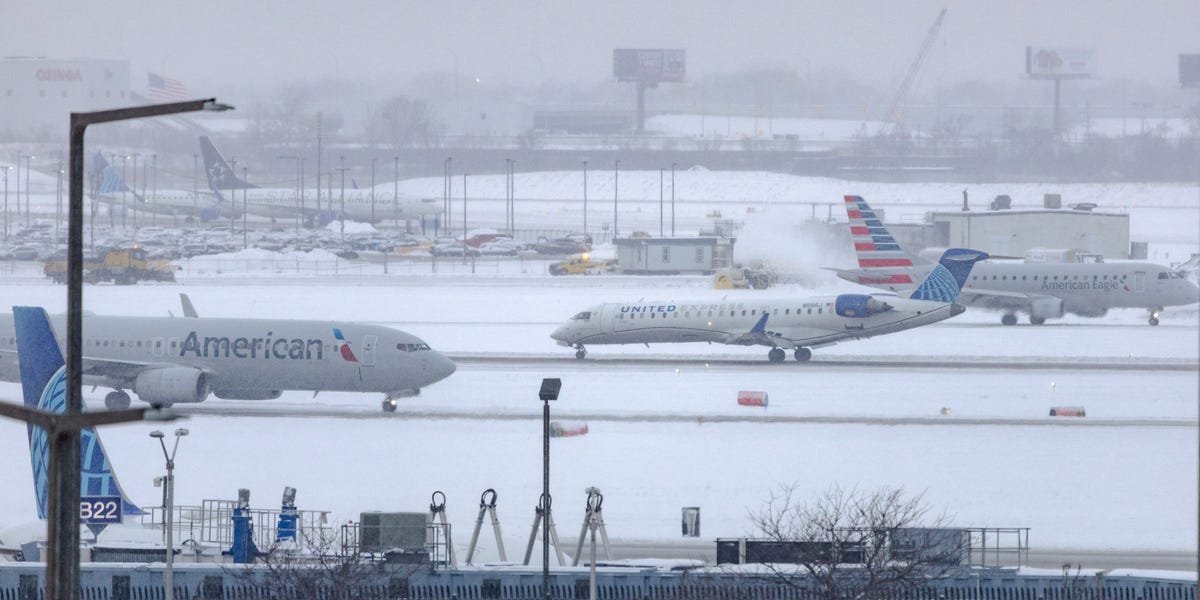
US airlines, meanwhile, are canceling and delaying thousands of flights. As of Sunday afternoon, airlines had canceled over 3,000 flights and delayed over 2,900, according to the flight-tracking website FlightAware.

New York City’s John F. Kennedy and LaGuardia airports have the highest number of cancellations, followed by Newark Liberty International Airport, Philadelphia International Airport, Ronald Reagan Washington National Airport, and Boston Logan International Airport.

Anyone hoping to catch a flight in the region on Monday can also expect major disruptions, according to Cirium, an aviation analytics company. At LaGuardia Airport, for example, 82% of flights scheduled for Monday have been canceled.

Adding to what will likely be a chaotic 48 hours for travelers, the Department of Homeland Security announced Saturday night that it was suspending TSA PreCheck and Global Entry due to the partial government shutdown.

Despite the announcement, however, TSA Precheck and Global Entry lanes remained open at major airports on Sunday. In a statement, the Transportation Security Administration said it is evaluating the situation “case-by-case.”

“At this time, TSA PreCheck remains operational with no change for the traveling public,” a spokesperson said. “As staffing constraints arise, TSA will evaluate on a case-by-case basis and adjust operations accordingly.”

The federal government entered a partial shutdown earlier this month, delaying funding for some agencies, like DHS. TSA agents are essential workers, so they’re still working — for now. During the full government shutdown earlier this year, TSA agents and air traffic controllers went 43 days without a paycheck.



Source link

A headshot of Insider's Pete Syme

Canadian airlines are pulling back from flights to the US, with one leaving the country entirely

Canadians are pulling back from visiting the US — and airlines are paying attention.

Montreal-based Air Transat will no longer fly to the US this summer, with its last flight across the border operating in early June.

In March last year, it operated nine routes to and from the US, but that number had dropped to three as of early 2026.

At the moment, Air Transat flies from Montreal to Orlando and to Fort Lauderdale, and from Quebec City to Fort Lauderdale.

Air Transat, which focuses on vacation travel, was named the world’s best leisure airline by Skytrax for the third year in a row in 2025.

An airline spokesperson told Business Insider that its presence in the US “remains very marginal today,” with only two of its 67 destinations in the US.

“This adjustment is part of a proactive management of our capacity, as we focus our efforts on markets where Air Transat is best positioned and that allow us to optimize the deployment of our resources,” they said.

The spokesperson added that its winter schedule “will be determined at a later date.”

WestJet, Canada’s second-biggest airline, is also slashing flights across the border for this summer.

It’s suspending 16 routes, including big city pairings like Boston to Vancouver and Los Angeles to Toronto.

The airline has reduced its “full-year transborder flying by close to 10%,” a spokesperson told Business Insider.

“We saw a notable decline in transborder travel demand throughout 2025,” they said.

“As such, WestJet has redeployed its fleet by increasing capacity on routes Canadians want to fly.”

Canadians’ travel demand has sunk since President Donald Trump took power early last year.

Last month, capacity was down 10% on flights from Canada to the US compared to a year earlier, according to data from Cirium, an aviation analytics firm.

Canadian residents made 1.6 million return trips from the US last month, down 24.3% from a year earlier, according to Statistics Canada.

Tensions flared when the US imposed a 25% tariff on imports from Canada and Mexico last March. It sparked a “Buy Canadian” movement and helped Prime Minister Mark Carney win last April’s elections.

Trump has also referred to Canada as the “51st state.” Following Canada’s trade talks with China earlier this year, he threatened a 100% tariff on Canadian goods and to block the opening of a bridge between Detroit and Ontario.


Source link

A headshot of Insider's Pete Syme

Jet fuel shortage in Cuba forces airlines to cancel flights and send empty planes to pick up passengers

Cuba has warned airlines that it has no jet fuel, forcing some carriers to cancel flights, add refueling stops, or carry extra fuel.

Cuban aviation authorities issued a monthlong advisory on Monday that said jet fuel is unavailable at all of the country’s international airports.

The country relies heavily on Venezuela for much of its jet fuel, but supplies have been hit by US sanctions that have constrained Venezuelan oil exports. President Donald Trump has also threatened tariffs on countries that sell oil or petroleum products to Cuba.

Because of this, the country is running out of jet fuel, and therefore, airlines cannot refuel their planes on the island.

From the US, American Airlines, Delta Air Lines, and Southwest Airlines all operate direct flights to Cuba.

American and Delta said they are operating as usual. In a statement to Business Insider, Southwest said that it was requiring any aircraft flying there to also carry enough fuel to reach its next destination.

Some Canadian airlines are canceling flights entirely.

Air Canada, which had operated 32 flights a week to and from Cuba before, said it would suspend service to the country on Monday.

It will send empty planes to pick up some 3,000 customers who have already traveled to the island. These flights will be loaded with extra fuel, although the airline said refueling stops on the return leg may also be necessary.

Canadian airlines WestJet and Air Transat also said they would operate empty aircraft to help their customers. Air Transat said it would suspend flights to Cuba until at least April 30.

Several international airlines serve Cuba, and many of them are still operating flights. However, some of these will have to stop to refuel elsewhere.

Air Europa, a Spanish airline, said its flights from Havana to Madrid would stop in Santo Domingo, in the Dominican Republic, about two hours away.

“We apologise for any inconvenience this situation, which is beyond Air Europa’s control, may cause you,” it said in a travel alert.

Iberia, the Spanish flag carrier, Air France, and Turkish Airlines also fly to Cuba. They did not immediately respond to requests for comment, although it seems likely the distance would necessitate a refuelling stop.


Source link

A map of the Caribbean with icons on each airport that had flights canceled on January 3, 2026, adjusted for size based on the number

Maps show the scale of the Caribbean air travel chaos — and how airlines are adding extra flights to rescue passengers

Almost 1,000 flights to and from the Caribbean were canceled on Saturday after the US raid on Venezuela.

The Federal Aviation Administration banned commercial aircraft from flying over Venezuelan airspace before expanding restrictions to much of the Caribbean.

Puerto Rico was the most affected, with 400 flights canceled to or from the main airport in San Juan.

There were also over 140 cancellations in the US Virgin Islands, and 91 in Aruba, which is only about 20 miles off the Venezuelan coast.

Using data from FlightAware, Business Insider put together this map to show the scale of the disruption. You can hover over an icon to see the number of cancellations at the airport.

After airspace restrictions ended early Sunday, airlines added dozens of extra flights to help passengers get where they needed to go.

The region is a particularly popular destination for vacationers seeking some winter sun over the New Year holiday.

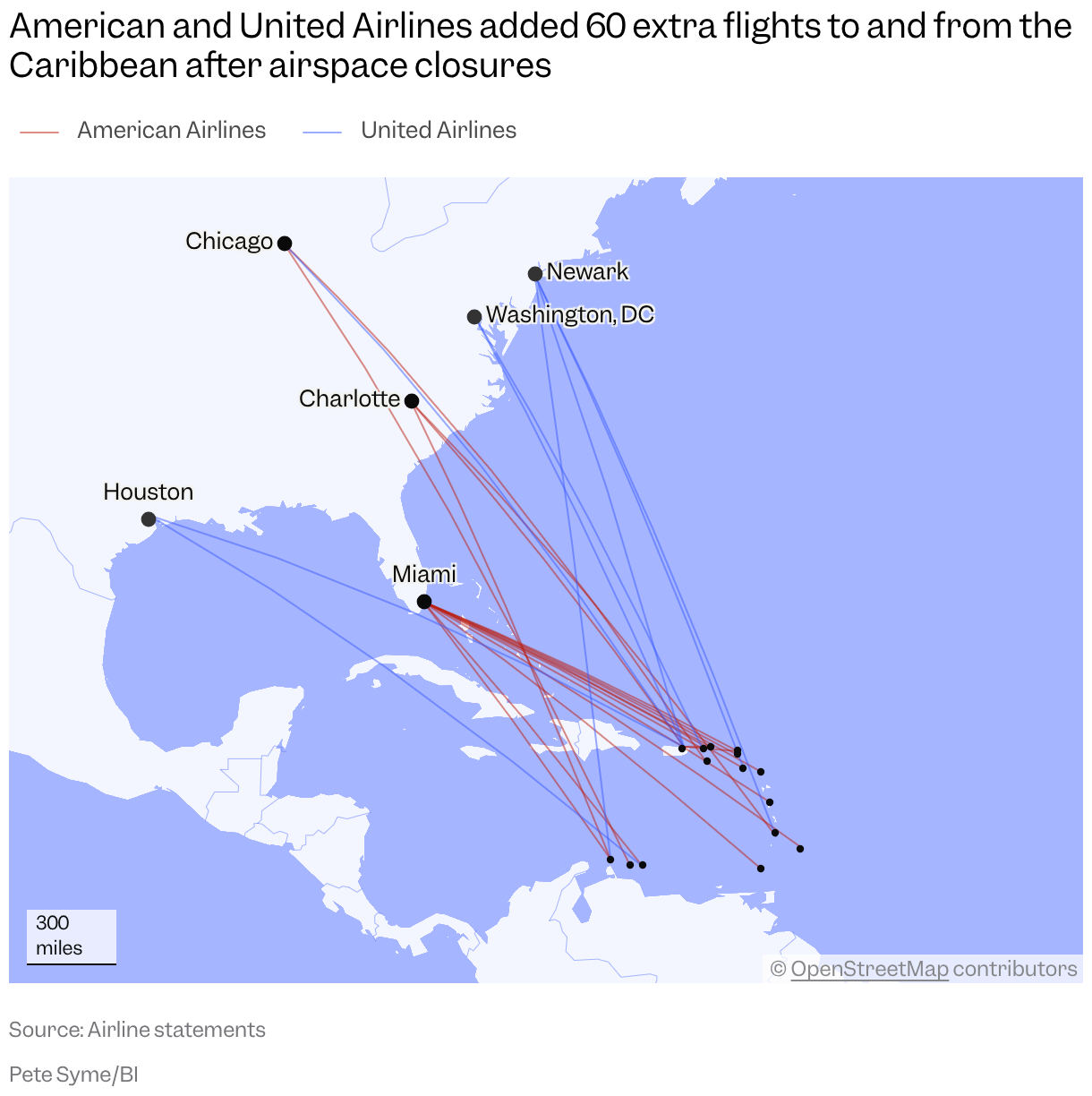
American Airlines added 43 extra flights on Sunday and Monday, with room for 7,000 passengers.

For the first time in over a decade, it operated interisland flights in the eastern Caribbean on Monday. Namely, to Puerto Rico from Anguilla and the British Virgin Islands.

American’s expanded schedule included deploying a Boeing 777-300, the largest model in its fleet, to ferry passengers between Miami and Puerto Rico.

United Airlines listed 17 additional flights scheduled for Sunday and Monday, to and from its hubs in Houston, Newark, and Washington, DC.

Delta Air Lines said that it has added space for 2,600 people on Monday. It didn’t immediately provide details of the extra flights it has scheduled.

Airlines have waived change fees and fare differences for passengers flying to or from the Caribbean, to rebook for flights later in the month.

Have you been affected by the travel disruption in the Caribbean? Reach out to this reporter at psyme@businessinsider.com or via Signal at syme.99


Source link

Misery-Map-shows-holiday-travel-chaos-on-both-coasts-with.jpeg

‘Misery Map’ shows holiday travel chaos on both coasts with canceled and delayed flights

A turbulent year for air travel isn’t over yet.

Snow and rainstorms hit multiple states on both coasts on Christmas Eve and Christmas Day, and are now heading for the Northeast, including New York, New Jersey, and Pennsylvania. Travellers are now having a difficult time getting home as major airports see mass delays and cancellations.

According to the “Misery Map,” published by FlightAware, which tracks real-time flight disruptions, there have been over 1,000 delays and more than 350 cancellations across the largest US airports as of 6:45 p.m. ET on Friday.

Here’s a look at the latest flight disruptions, and when you may expect to fly if your flight has been canceled.

The Midwest and the East Coast


Screenshot of Misery map

JFK International Airport is experiencing more than 369 cancellations and 210 delays.

Screenshot


The storm that first hit the Midwest is coming for the East Coast. New York City is set to see the most snow it has seen in years, since the last time it saw at least 4 inches of snow was January 2022. New Jersey and upstate New York will see similar weather conditions.

The NYC Emergency Management said in a press release that “snow is expected to develop Friday afternoon and intensify into steady, accumulating snow Friday night.” The National Weather Service has forecast 3 to 7 inches of snow with locally higher amounts possible.

According to FlightAware, JFK International Airport is experiencing 369 cancellations, with 210 on Friday alone. The situation at Newark Liberty International Airport is also not optimistic, with 244 cancellations and counting.

Based on the Misery Map, flights from airports around NYC to Chicago, Detroit, and Denver are seeing the highest number of delays and cancellations.

The West Coast


Misery map

Los Angeles International Airport is seeing a total of 283 delays and 41 cancellations.

Screenshot


The West Coast is slowly recovering from an exceptionally wet Christmas.

Over the past two days, most residents of California have received at least one weather warning as an atmospheric river accompanied by high winds, floods, and mudslides hit the Golden State. The NWS said that this Christmas season is the wettest one Los Angeles has experienced in 54 years.

The San Francisco International Airport said that 153 flights had been delayed on Friday morning due to windy conditions. To make matters worse, the police briefly shut down Terminal 1 due to a “suspicious package,” but then reopened it without explanation. By midday, FlightAware reports that a total of 381 flights from SFO have been delayed.

According to the Misery Map, flights from the Los Angeles International Airport to Seattle, Salt Lake City, Denver, and the East Coast are all experiencing disruptions. FlightAware counted a total of 283 delays and 41 cancellations.

The disruptions come at the end of a tough year for air travel.

High-profile plane accidents, including when an American Airlines Flight crashed into a Black Hawk helicopter, and the firing of hundreds of FAA employees by the White House DOGE office, triggered a newfound fear of flying among some Americans earlier this year.

The subsequent government shutdown also led to flying snags this year, as air traffic controllers who were left without pay called in sick, and some airports were paralyzed.


Source link

A-US-pilot-school-has-banned-solo-flights-for-trainees.jpeg

A US pilot school has banned solo flights for trainees at one of the world’s top airlines after a spate of incidents

An Arizona pilot school has stopped Cathay Pacific trainees from solo flights after several incidents that went unreported, Bloomberg first reported.

Cathay Pacific, the Hong Kong flag carrier, is one of the world’s best airlines — one of just 10 globally to be ranked five stars by Skytrax.

In an internal memo, the AeroGuard Flight Training Center in Phoenix said it saw “an alarming increase in solo incidents during cadet training,” per Bloomberg.

It added that the incidents involved a wingtip colliding with a fixed object, a “bounced landing” leading to a “substantial” propellor strike, and a complete runway excursion.

“While each situation was unique, in each case the concern was the same — required consultation did not occur,” the memo reportedly said.

Bloomberg also reported that the students didn’t properly report the damage in two of the three incidents.

In a statement shared with Business Insider, Cathay Pacific acknowledged the events and added, “We are taking them seriously.”

“These incidents involve our sponsored students, who will become our employees upon successful graduation from the training course,” it said.

“They will then need to undergo additional structured training before being assigned any flying duty.”

A source familiar with the situation told Bloomberg that the decision would affect around 150 of the 250 to 300 Cathay cadets training at the school.

The decision hinders Cathay’s ongoing plans to increase its number of pilots after the pandemic, when the airline instituted steep pay cuts.

Several pilots quit during that time, with some telling Reuters that strict COVID measures in Hong Kong were affecting their mental health.

In the statement, Cathay Pacific said, “Safety guides every decision we make, and we fully support the decision of the training school.”

“We will continue to prioritize the safety and well-being of our cadet pilots and crew members, and we remain dedicated to upholding the highest standards in our training programs,” it added.


Source link