
Lauren Edmonds Profile Photo

The US secretary of energy says Iran is not a war but a ‘temporary movement’ and that gas prices will go down in weeks

US Energy Secretary Chris Wright made the morning show rounds on Sunday to downplay concerns about surging gas and oil prices, assuring Americans that the war with Iran isn’t “long-term.”

“What you are seeing is emotional reactions and fear that this is a long-term war,” Wright told “Face the Nation” on CBS News. “This is not a long-term war. This is a temporary movement.”

Wright made similar remarks in an interview with Fox News Sunday.

“The run-up on prices doesn’t have anything to do with any shortage of barrels of oil or natural gas. It’s just fear and perception, the unknown that this could be some long, drawn-out crisis, but it won’t be,” Wright said.

After the US and Israel launched airstrikes on Iran on February 28, the Islamic Republic moved quickly to shut down the Strait of Hormuz, a narrow waterway critical to the movement of oil around the world. About 20% of the globe’s petroleum liquids pass through the Strait.

Although there are storage tanks across the Gulf, they are already nearing capacity after a week of conflict and limited shipping options, forcing producers to reduce operations. Iraq’s oil output has shrunk by 60% since last week, Bloomberg reported. Other countries, like Kuwait and the United Arab Emirates, have also reduced output.

All of this means higher gas prices for Americans. The US Energy Information Administration says gas prices averaged $2.93 on February 23. By March 2, they were at $3.15. On Sunday, they were $3.40.

During his media tour on Sunday, Wright said regular ship traffic through the Strait of Hurmoz could resume in “a few weeks,” meaning gas prices could ease sooner rather than later.

“We want it back below $3 a gallon, and it will be again before too long,” Wright told CNN’s “State of the Union.” “You never know exactly the timeframe of this, but, in the worst case, this is a weeks, this is not a months, thing.”

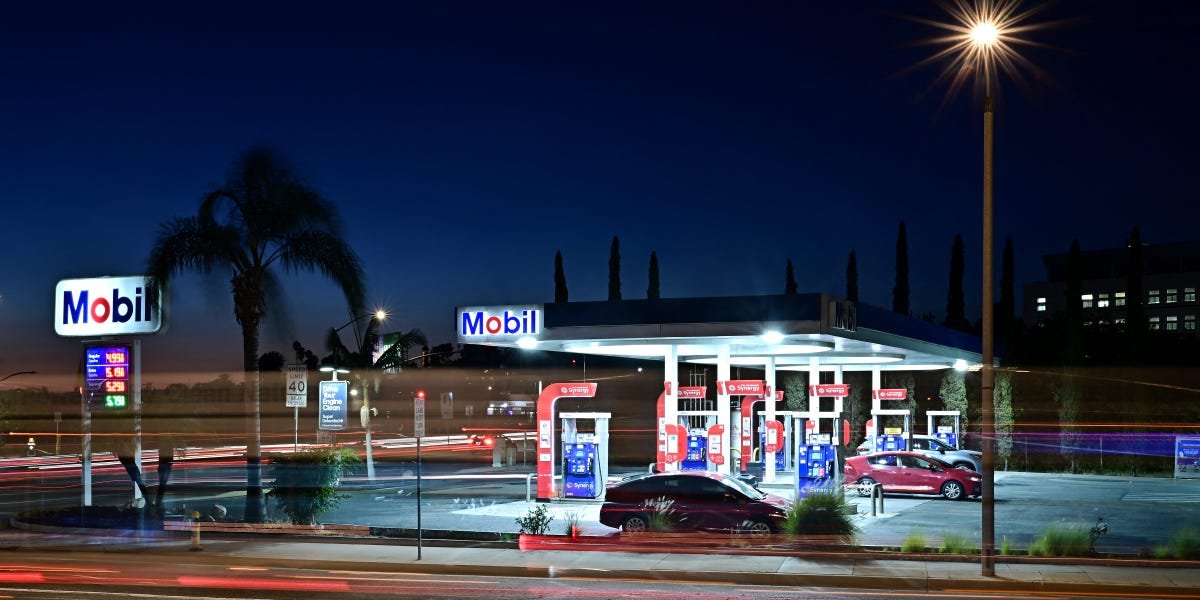


Source link

Line chart

US gas prices climb to the highest point in Trump’s second term. He says, ‘If they rise, they rise.’

Gas prices continued their ascent on Friday as the escalating conflict with Iran sends shockwaves through global energy markets.

The national average price for a gallon of regular gasoline climbed to $3.32 on Friday, according to AAA — that’s an 11.4% increase from last week’s price and the highest level since August 2024.

The jump follows a surge in crude oil prices after the United States and Israel launched strikes on Iranian targets last Saturday, prompting retaliatory attacks from Tehran.

Brent crude, the global benchmark, traded above $91 a barrel Friday morning, its highest level since mid-2024, according to GasBuddy.

US pump prices could continue to climb. BloombergNEF estimates that about half of the eventual increase in retail gasoline prices typically shows up within 10 to 13 days, with roughly 90% reflected within about 21 days.

The firm added that if crude rises by $10 a barrel amid escalating tensions, US gas prices could climb by roughly 30 to 40 cents per gallon in the short term.

Oil supply chains have been particularly sensitive to threats around the Strait of Hormuz, a narrow waterway along Iran’s southern coast that handles roughly one-fifth of global oil consumption.

Iran said it attacked a tanker passing through the waterway on Thursday.

Any disruption there could quickly drive oil prices higher — and those moves would show up at the pump within weeks.

Iran has also targeted regional energy infrastructure, including facilities tied to Qatar’s massive liquefied natural gas exports.

President Donald Trump downplayed the retail price increase when asked by Reuters about rising fuel costs this week, saying he does not “have any concern about it.”

“They’ll drop very rapidly when this is over, and if they rise, they rise, but this is far more important than having gasoline prices go up a little bit,” he said.

He has said that the US Navy will escort tankers passing through the Strait.

Retail analysts warn that the impact of higher energy prices could extend beyond drivers. Higher fuel costs raise shipping and distribution expenses for businesses and can weigh on consumer spending.

“As oil prices rise, gas prices follow,” Carol Spieckerman, an independent retail analyst, told Business Insider. “And with the administration promising lower prices and consumers laser-focused on the pump, this metric has been given arguably more political and psychological energy than any other economic variable.”

She added that the impact will stretch far beyond the gas station. Higher fuel costs can push up travel, delivery, and retail prices — including goods made with petroleum-based materials.

“The ripple effects of fuel prices are far-reaching and underestimated,” she said. “It’s a compounding effect that touches nearly every corner of retail.”


Source link

Americas-average-gas-price-saw-its-largest-single-day-jump-in.jpeg

America’s average gas price saw its largest single-day jump in 4 years

The drive to and from the office just got more expensive.

Prices at the gas pump jumped an average of 11 cents across the US on Tuesday morning, according to AAA. The national price for a gallon of regular gas climbed from $3.00 on Monday to $3.11 on Tuesday, while premium fuel rose from $3.86 to $3.98.

That’s the largest single-day price rise at the pump since March 2022, AAA told Business Insider. Every state except Hawaii experienced Tuesday’s price jump.

It’s also the first time the national average for regular gas has topped $3 a gallon in 2026.

The spike comes as Iran expands attacks in response to bombings by the US and Israel. In recent days, Iran has launched missiles and drones at Israel and at US bases in Bahrain, Iraq, the United Arab Emirates, and Qatar.

Those attacks have rattled oil markets and raised fears of supply disruptions.

On Monday, QatarEnergy throttled production of liquefied natural gas after drone attacks damaged one of its facilities.

Iran has also threatened ships traveling through the 21-mile Strait of Hormuz, where about 20% of the world’s crude oil supply passes through, Patrick De Haan, the head of petroleum analysis at GasBuddy, wrote in a note.

In response, Brent crude oil, the benchmark for global oil pricing, hovered above $80 a barrel on mid-day trading. That’s up about 4% from Monday.

There’s another pressure point for consumers: The summer driving season is about to start.

“Spring weather may be weeks away in much of the country, but the seasonal rise in gas prices is underway,” AAA wrote last Thursday. “Gas demand is also expected to increase next month as spring break season kicks off and more drivers take road trips.”

Higher demand, combined with fears of supply disruptions, is a historic recipe for rising prices.


Source link