Sydney Sweeney has unveiled her second American Eagle campaign using her now-signature move: a sly wink at the camera.
Nearly nine months after the brand’s “Great Jeans” campaign sparked online outrage, Sweeney reunited with American Eagle to promote its new denim shorts collection. The campaign, dubbed “Syd for Short,” hit socials and newsstands on Wednesday with a short video starring Sweeney in her element, looking as beautiful and inscrutable as ever.
“What brand am I wearing?” Sweeney asks the camera, positioned mid-frame against a blue-sky backdrop. With a shrug and a cheeky smile, she gives a non-answer to her own question: “Yeah, that one.”
The line only makes sense as a reference to Sweeney’s existing association with American Eagle. Their 2025 collaboration drew intense backlash for a pun that conflated Sweeney’s white, blue-eyed beauty with preferable genetics. Critics described the ad campaign as a “eugenics dog whistle,” while fans suggested it was a cheeky double entendre with little deeper meaning. Amid the discourse, American Eagle’s stock price soared, and Sweeney’s public profile along with it.
Whatever headaches the “Great Jeans” campaign may have caused Sweeney’s PR team, the headline-dominating discourse made her more of a household name — as did her refusal to apologize for being at the center of it.
Every time Callie publishes a story, you’ll get an alert straight to your inbox!
Stay connected to Callie and get more of their work as it publishes.
As PR experts told me at the time, Sweeney’s reputation for stirring up controversy is likely intentional. Whether she’s talking about her “great jeans” or hawking a soap that purports to be made with her actual bathwater, Sweeney has garnered a fan base not just for her acting work, but for her polite refusal to explain the reasoning behind her more controversial choices.
Her responses in a now-infamous November 2025 GQ interview where she addressed the “Great Jeans” campaign were either provocative or oblivious, depending on how you read her delivery.
“I’ve always believed that I’m not here to tell people what to think. I’m just here to kind of open their eyes to different ideas,” she told the magazine.
Two months later, Sweeney told Cosmopolitan that as a person “in the arts,” she shouldn’t be expected to comment on politics. Instead, she offered a platitude: “I believe we should all love each other and have respect and understanding for one another.”
With “Syd for Short,” Sweeney takes a page from the same playbook: gesture toward the mess, but don’t wade in. Let the fans and critics speculate on your intent.
Those following Sweeney’s moves have had plenty to dissect lately. The American Eagle campaign comes days after the season three premiere of “Euphoria,” in which Sweeney plays Cassie Howard, a young woman whose humiliating desperation for male attention has made her a lightning rod for thinkpieces since the series debuted in 2019.
The first episode of the new season sees Sweeney’s Cassie pursuing a career on OnlyFans dressed as a sexy puppy, complete with floppy ears, a heart-shaped nose, and a cleavage-baring brown corset.
While the internet lit up with debates over everything from the scene’s morality to what it says about Cassie’s increasingly shallow and fetishized characterization, Sweeney stayed silent.
Or perhaps she’d once again let the brands do the talking: the corset she wears in Cassie’s sexy puppy scene is reportedly from her own lingerie line.
President Donald Trump seems to be trying a new approach in his quest to take over Greenland: The president said Saturday the US would send a hospital ship to the territory.
“We are going to send a great hospital boat to Greenland to take care of the many people who are sick, and not being taken care of there,” the president wrote on Truth Social. “It’s on the way!!!”
Greenland, however, isn’t interested.
Greenland’s prime minister, Jens-Frederik Nielsen, said in a subsequent Facebook post that “it’s going to be a no thank you from here.” Greenland provides free universal healthcare for all permanent residents and citizens.
“We have a public health system where treatment is free for citizens. It’s a deliberate choice. And a basic part of our society. It’s not like that in the United States, where it costs money to go to the doctor,” he wrote. “We are always open to dialogue and collaboration. Also with the U.S. But talk to us now instead of just coming up with more or less random outbursts on social media.”
Every time Tristan publishes a story, you’ll get an alert straight to your inbox!
Stay connected to Tristan and get more of their work as it publishes.
Trump has had his sights set on the Arctic island, a semi-autonomous Danish territory, since his first term in office. Trump has suggested the US could buy Greenland or even take it by force.
The president says Greenland’s location makes it strategically important as the melting of Arctic ice opens up new shipping routes and intensifies competition with Russia and China.
The island is also rich in critical minerals and already hosts a key US military base, which American officials say is vital to missile defense and Arctic security.
Major European leaders, including those from France, Germany, the UK, Italy, Spain, Poland, and Denmark, released a joint statement last month defending Greenland.
“Greenland belongs to its people,” the statement said. “It is for Denmark and Greenland, and them only, to decide on matters concerning Denmark and Greenland.”
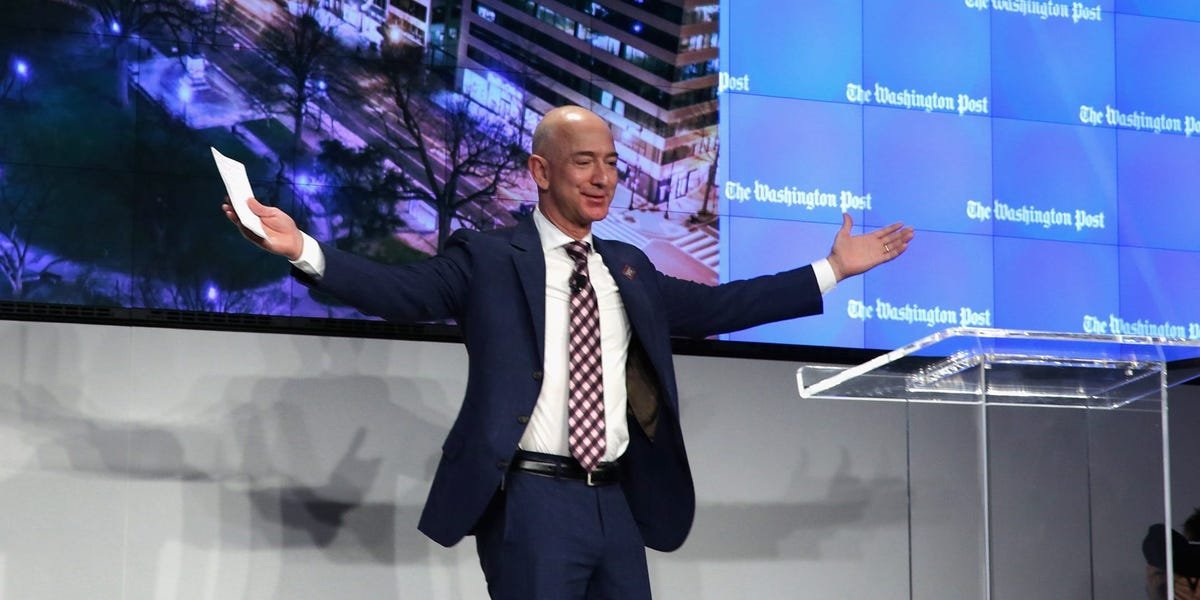
Lots of people are angry at Jeff Bezos because of the massive cuts he’s ordered at his Washington Post. But a decade ago, Bezos was widely celebrated for his ownership of the Post, which he had bought for $250 million in 2013.
Under Bezos’ ownership, the Post made huge investments in tech and staff. And readers loved the results — especially during the first Trump era, when the paper turned profitable.
Now things are very different: The Post says it has been losing gobs of money for the past few years, and Bezos has made a series of moves interpreted as a shift toward Trump — which spurred reader revolts, which made things even worse. And all of that led to this week’s cuts.
I talked to Erik Wemple, a New York Times media reporter who previously worked at the Post for 14 years, to try to reconcile the two eras of Bezos and the Post, and to get a sense of what might happen next. You can hear our entire chat on my Channels podcast; what follows is an edited excerpt from our conversation.
Peter Kafka: What shape was the Post in when Bezos bought it in 2013?
Erik Wemple: The Graham family, which had owned the Post forever, was an amazing steward for the paper. But they had to scale back their newsroom, because the internet had blown holes in classified ads. Classifieds used to be huge at The Washington Post.
At the time Bezos bought it in 2013, it was not dysfunctional. These were really good journalists, but the paper was in a bit of a funk. It wasn’t a reclamation project, but it had seen better days.
It was faded when he bought it.
Correct. And when Bezos came in 2013, he really wowed the staff. We all asked him questions. He answered those questions with tremendous enthusiasm and competence. He seemed really energized by this.
What did he think he was going to do?
When he came in, he was energetic, but deferential on the particulars of running the newspaper. He’s like, “You know what? I’m not in this business, but I do know how to organize discussions about the future of a business.” And that’s what he did. I was in one of them; it was really remarkable.
He had these things that he believed in. He was important in guiding conversations. And it was really remarkable because he backed it up with money. He invested in the newspaper. He invested in political coverage, big time. Investigative went up. International got a huge, huge boost. And the technology did too.
This is exactly what you want from your billionaire tech owner: Give us a bunch of money. Improve our tech. Also, stay away. Don’t tell us what to do.
That was exactly the sentiment. And one of the things you mentioned in there is really worth pausing on for a second, which is the lack of intervention, the lack of meddling. He just sort of looked on. And the newsroom really, really, really roared. Especially in the first Trump period.
So not only does this produce great journalism, it seems like it becomes a business success story — the paper becomes profitable again. Then, after Trump left the White House, there was a lot of hand-wringing about what happens after the Trump bump. People expected audiences to decline across lots of different publications, and that happened, so it makes sense that the Post would struggle a bit. But the numbers you hear about the reported losses — $77 million in 2023, $100 million in 2024 — are staggering. I still don’t understand how you can swing to losses like that just because your traffic goes down. What am I missing?
I share your knowledge gap.
One of the things that has been reported and pretty well substantiated is they may have over-indexed on staff growth. They vaulted up over a thousand in early 2021, up to 1,100. So I think they got ahead of themselves, and they had to pair that back. That’s one of the things.
Another consideration is that the digital advertising market sort of dried up, so that was a big deal.
It’s all somewhat of a mystery, but I don’t doubt that there are meaningful losses.
Can this just be as simple as the Post overhiring? Lots of companies have done that — the tech guys did during the pandemic.
No, I don’t think so. Especially if you look at the more recent past, when they tinkered with the opinion side and shot themselves in the foot.
In October 2024, the Post announced it would not be endorsing a candidate in the presidential election. And that happened after the Washington Post editorial board had drafted an editorial in favor of Kamala Harris. And hell broke loose — a subscription desertion of hundreds of thousands.
That’s an astonishing number. I remember thinking that it couldn’t be real.
The cause and effect could not have been more direct. People said, “No way. I’m not giving my money to this organization.”
The Post has continued to do lots of news reporting that is critical of the Trump administration. Which made me curious about this line in editor Matt Murray’s explanation of the cuts this week. He praises the work the paper has done, and then points out problems, and says “even as we produce much excellent work, we too often write from one perspective, for one slice of the audience.”
It almost sounds like what David Ellison and Bari Weiss say about remaking CBS News. Does that mean we should expect the Post’s news reporting to change in some sort of ideological way?
If Matt Murray or any of his top editors had actually edited that memo, they would’ve asked for specifics. And they would’ve put a big question mark alongside that and ask, “What the hell are you talking about here? Why are you speaking in such elliptical language? Why are you trying to whisper to the newsroom some message that you’re not willing to articulate?”
We need to ask him exactly what he’s saying. I think that that is coded language, and I think that could be political.
It’s a strange thing for the executive editor to be saying. It’s almost as if he’s asking for some force to adjust the newsroom cadence and its sensibility — when he has the power to do that.
(Editor’s note: Business Insider contacted the Post for comment, but didn’t hear back immediately.)
Why does Jeff Bezos own The Washington Post? It seems to be nothing but a headache for him the last few years. It doesn’t seem like it helps him curry favor with Donald Trump. It’s not like he’s using it to buy the “Melania” documentary for $75 million. What is the upside for him, and why does he continue to own it, do you think?
Erik Wemple: I have no idea. That is something all of us in the media trade have been trying to figure out. It is entirely a black box.
Many years ago, he seemed to be deriving a great deal of satisfaction from this. There was a close bond between The Washington Post Establishment and Bezos. I’m pretty sure it isn’t as strong as it once was.
So I think that the enjoyment he got from his association with his institution has probably faded.
But in 2024, he said, “We saved The Washington Post once, and we’re going to save it a second time.” So there’s another challenge, right? I guess that that would be something that he would derive some pleasure from. And I would imagine that if he wanted to get really involved and engaged, the way he was back in 2013-2015, the newsroom would welcome that.
A lot of the success stories we hear about in digital media these days are specifically publications that are focused largely or entirely on Washington, DC: Politico, Axios, Punchbowl, Semafor. Some of them have direct DNA from The Washington Post. Is there any chance of the Post reclaiming any of that, either through an acquisition or just by focusing on Washington and policy?
They have this Washington Post Intelligence thing now, which is sort of akin to that. But I don’t know if there are new streams of revenue opening up at the Post. And I think that that’s one of the reasons that the staff is so disaffected and so disappointed in the current management — they don’t see any sort of progress towards new business.
They’re just seeing cuts.
I think they’re seeing cuts. And also a fair amount of silence. I don’t think that they’re getting the feedback from management that they deserve.
My partner was my first relationship and first love. I thought he would remain simply “first,” but we’re happily in love nine years later.
Yet, there’s one big milestone that we haven’t reached: our first time living together. Unlike most couples, we’ve never shared a space for more than a few weeks.
People are always shocked when they hear how long we’ve been together. The first question they usually ask is, “Why hasn’t he proposed yet?” Their eyes widen even more when they find out I’m not going home to him.
We feel great about our living dynamic, though: Living apart has helped us maintain the same spark at 27 that we had when we met at 19.
Living apart keeps our relationship exciting
Because we don’t share a space, we’re very intentional about spending time together.
Maya Kokerov
We met in our first year of college, when we both lived on campus but in different accommodations.
When we moved back home at 21, three years into the relationship, we continued living apart for practical reasons. Our goal was to live with our families until we saved up enough money to buy a more permanent home.
At first, I missed my partner a lot, and living with my parents felt a bit claustrophobic. After the initial adjustment, though, I began feeling happier than ever.
My family and I have always been close, but staying with them as adults made us cherish each other even more. The dynamic started to feel great for my romantic relationship, too: We realized that living apart helped us date with more intention.
My partner and I would — and still do — schedule regular dates, prioritizing novelty and adventure. We’d splurge on special nights out each month and meet up for weekly creative activities, like painting and cooking.
Since our time together is limited, even ordinary things like driving home feel sacred. Our independence keeps a steady drip of excitement into our partnership, and we don’t take each other’s presence for granted.
Six years into our relationship, we were almost ready to move in together. Then, my family life abruptly changed, and our circumstances shifted again.
Losing my dad reshaped my priorities
After I lost my dad, I felt grateful for the years I spent living at home.
Maya Kokerov
When my dad unexpectedly died four years after I moved back home, I had a new perspective on my choice to live with my parents after college.
I was angry at the world for cutting my time with him short, but my one salvation was all the time that we had spent together. If I had moved out after college, like I originally wanted, I never would have had these extra four years with my dad.
Now, it’s been one year since I lost him. Living with my mom and sister, and leaning on them for support, has been bittersweet but invaluable — even if it means my plans to move in with my partner are once again on the back burner.
We’ll move in together someday, but we’ve learned not to rush cohabitation
We aren’t ready to move in together just yet, but we’re excited to eventually share a home.
Maya Kokerov
Now, I’ve finally saved up enough to buy a home, but I’m still not sure if it’ll be the place I share with my partner.
I’ve developed a different dream — securing a place for my mom and sister. My partner even suggested moving in with us and living as a unit to help us navigate our newfound fear of loss.
Some may say we’re delaying the inevitable, or that we can’t know if we’ll last if we don’t live together.
To that, I always say that cohabiting just doesn’t fit our lives yet. Life is as full of uncertainties as it is short. I found this out the hard way with my father.
Not only are we grateful to have nice places to live with our families as we wait for the right time to move in together, but by letting go of expectations, we’re still in the “honeymoon stage” almost a decade into our relationship.
One day, we plan to live together, get married, and start a family. For now, though, we’re building a partnership that keeps us close to both each other and the people we love.
Call it the Great Freeze — or the Great Frustration.
Business Insider spoke with dozens of job seekers across generations in 2025, some of whom have been unemployed for more than a year.
They voiced a wide range of frustrations about their searches — including slow hiring timelines, so-called “ghost jobs,”suspected ageism, employers going silent midway through the process, overwhelming competition for each role, and the belief that AI filters areoften screening their résumés before a human ever sees them.
Their job-finding journeys come at a time when employers are hiring at one of the lowest rates since 2013.
Whether the job seekers blame AI, corporate efficiency pushes, or broader economic uncertainty, they say it all adds up to a deluge of applications and a dearth of job offers. Still, through the frustration, they’ve also found ways to cope and connect with a community of fellow job seekers.
“I believe the hiring system is broken,” said Matthew English, who’s been looking for full-time work since October 2024 after a decadeslong career in accounting. Despite applying for hundreds of jobs — from accounting roles to the Chick-fil-A cow mascot — he’s been unable to secure a full-time offer. He said he’s burned through much of his savings, and that last Christmas, he couldn’t afford to buy gifts for his family.
“I have about drained my life’s savings,” said English, who is in his 60s and lives in Alabama. “Money that you’re expecting to use in retirement is now being used to survive.”
The New York Fed regularly asks people to estimate the likelihood that, if they lost their job today, they’d be able to find a new one in the next three months. In August 2025, that average probability dropped to its lowest level since the survey began in 2013 — and has only recovered slightly in the months since.
Kory Kantenga, the head of economics for the Americas at LinkedIn, said 2025’s labor market had “low momentum.”
“The cumulative effect of three years of slowdown — it’s completely understandable why they feel like this might be the worst labor market they’ve ever been in,” Kantenga said.
The frustrations of job hunting in 2025
Hilary Nordland began looking for work after being laid off from her marketing role in July 2024. To help pay the bills, she said she started donating plasma and drew on her retirement savings.
Nordland, who’s in her 50s and lives in Minnesota, said one of the most frustrating parts of her job search has been landing interviews — only to have opportunities fall through for unexpected reasons. She said she’s had interviews canceled the same day they were scheduled because the role was suddenly put on hold or filled internally. On one occasion, she said, an HR representative told her she’d be a great fit — but the rep was fired before they could schedule the interview.
“This job market is terrifying,” she said. “It’s a black hole that makes you question everything — and I don’t see a clear path through.”
Hilary Nordland said it’s been frustrating to see promising job opportunities fall through unexpectedly.
Hilary Nordland
US employers have announced 1.17 million job cuts so far in 2025, the most since 2020. While the unemployment rate remains relatively low by historical standards, it has risen to its highest level since 2021, when the economy was still recovering from pandemic-related disruptions.
High demand for jobs — combined with the rise of AI-assisted applications — has contributed to an influx of submissions for open roles, making it harder for qualified candidates to stand out. Last quarter, the average job posting received 242 applications, nearly three times the number in 2017, according to data from Greenhouse, a hiring software provider.
Aaron Terrazas, an independent economist, said job seekers’ frustration with this year’s labor market was justified.
“Just because the aggregate jobs data look stable, steady, slowing but stable, doesn’t mean that it hasn’t been very difficult for some people,” Terrazas said.
Heather Driscoll began looking for a healthcare management job after being laid off last year. She said she’s struggled to pay the bills and had to draw on her 401(k).
“The amount of time, research, enthusiasm — the dressing up, hair, makeup — just to sit on a Zoom call and get no feedback or rejection, is insane,” she said.
Driscoll, who’s in her 50s and lives in Colorado, said she has reached the final interview round multiple times but has been unable to secure an offer. She suspects that ageism and sexism could be working against her.
Giving up on job goals
A challenging job market has forced some job seekers to confront the possibility that their goals and aspirations may be out of reach.
At age 40, Kenneth Ferraro quit his job as a truck driver to pursue a bachelor’s degree in political science at New York University. He hoped it would set him up for a career in public service — but after struggling to find work, he returned to trucking last year. He said he’s stuck with more than $100,000 in student debt.
While having a college degree improved his credentials, Ferraro said he thought his age had held him back in the job market.
He recalled applying for an entry-level government position that seemed like a good fit. The early stages of the interview process felt promising, but he said things shifted after the in-person interview — and he suspects his age was a factor.
“As soon as the hiring manager saw me, his whole demeanor changed,” Ferraro said. “He ran through the questions and never truly engaged with me.”
Kenneth Ferraro said he believes his age has held him back in the job market after earning a bachelor’s degree in his 40s.
Kenneth Ferraro
Solomon Jones hoped that earning a college degree would open doors. After earning his bachelor’s degree in sports communication in May, he struggled to find employment. Jones said that some of the sports communications job postings he’d come across had attracted more than 1,000 applicants.
“The goal is to obviously get a job in the sports industry, but realistically, I know that life isn’t fair,” said Jones, who’s in his 20s and lives in New Jersey. “So at this point, I’m just trying to find a job, period.”
How job seekers are coping with the stress — and breaking through
Some job seekers Business Insider spoke with have leaned on others — including friends, family, professional contacts, and fellow job seekers — for support and solidarity during their job searches.
After being laid off by Microsoft in May, Ian Carter struggled to find a new job. He switched to a month-to-month lease on his Redmond, Washington, apartment, but eventually moved to Florida to save money by living with family while continuing his search.
Carter said he’s connected with others who’ve lost their jobs and visits the private “MSFT Survivors” Facebook group, which includes people who’ve been laid off throughout Microsoft’s history.
“Layoffs kind of affect people mentally,” said Carter, who’s in his 30s. “I’ve reached out to people so we can be each other’s support system.”
Ian Carter moved from Washington to Florida to live with his family after struggling to find work.
Ian Carter
In July, Sriram Ramkrishna was laid off by Intel for the second time. On his last official day with the company, his wife also lost her job. When he learned the news, his mindset shifted from “I’ll find a job when I can” to “I’d better find a job.”
But over the past few months, he’s struggled to make much headway. Ramkrishna said one of the things keeping him going is the support of his former Intel colleagues, who also lost their jobs.
“Many of us have been helping each other with our job searches — sharing opportunities and offering support,” said Ramkrishna, who’s in his 50s and lives in Portland, Oregon. “It feels like we’re all looking out for each other.”
Chris Martin, lead researcher at Glassdoor, said uncertainty helped drive this year’s low-fire, low-hire job market, such as businesses navigating the effects of tariffs and AI. Terrazas, the independent economist, doesn’t think uncertainty will fully fade next year, but said employers won’t be facing the initial shock of policy changes from a new administration.
Most job seekers can’t afford to put their searches on hold until conditions improve. Despite the challenges, some have managed to break through.
When Alexander Valen was laid off from his project manager role at Accenture, he was initially optimistic that his more than two decades of experience would help him land a new job. But after nearly two years of job searching — and falling behind on his mortgage — that optimism had vanished. Valen, who’s in his 50s and lives in Florida, said he and his wife, a stay-at-home mom, relied on DoorDash earnings, unemployment benefits, and help from family to get by.
But a few months ago, someone in his network recommended he explore roles at the freelance platform Toptal. Valen applied for a project manager role, went through the interview process, and landed the position, which he said fell within the $80 to $100 an hour compensation range he’d been targeting.
Valen’s top advice for other job seekers: Reframe how you view the process — and lean on others along the way.
“The search becomes far less discouraging when you treat it as an opportunity to grow rather than a verdict on your worth,” he said. “And in a market this competitive, networking isn’t optional — it’s the force multiplier that ultimately led me to my role.”
The leaders of several drone schools training Ukraine’s operators for the fight against Russia say they’re targets and they have to act accordingly — tightly protecting information and even moving around.
Throughout its invasion of Ukraine, Russia has launched huge drone and missile barrages at factories, training sites, and civilian infrastructure across the country, often far from the fighting in the east, straining Ukrainian defenses and serving as a constant reminder that nowhere in the country is completely safe.
Drones are prolific on the battlefield in Ukraine. Operators are priority targets. It stands to reason the schools training them for war would be too. Officials from three drone schools told Business Insider that they take steps to avoid getting hit.
Tetyana, a Ukrainian veteran who goes by the call sign “Ruda” and is now the head of R&D for Dronarium, a drone training school with sites in Kyiv and Lviv, said that it must follow strict safety rules because “the entirety of Ukraine is not safe, missile-wise, drone-wise.”
Dmytro Slediuk, head of the education department at Dronarium, told BI the safety measures, including not disclosing publicly exactly where its training centers are located and also changing their location “from time to time,” are necessary to prevent Russia from interfering with its training
To keep certain location data from getting out, the school doesn’t allow photos and videos that might reveal where its facilities are based.
The school has been mentioned by Russia’s military bloggers, influential pro-war accounts that often circulate operational details and commentary to large audiences. Though they are typically in favor of the war, they are also sometimes critical of Russia’s performance and dispute some of its defense ministry’s claims.
Drone schools say they’re targets for Russia.
Ivan Antypenko/Suspilne Ukraine/JSC “UA:PBC”/Global Images Ukraine via Getty Images
Rybar, a media outlet with 1.5 million Telegram subscribers, listed Dronarium as an example of Ukraine’s drone training efforts. The UK has sanctioned Rybar, initially presented as a milblogger but actually a partially Russian government-sponsored information warfare operation, and the US has offered up to $10 million for information.
Tetyana said Russian outlets have been writing about the school since 2022, the year Russia started its full-scale invasion. “As long as they write and talk about us, it means that they are afraid of us,” she said. But it also means that they’re on Russia’s radar.
She said the school and its attendees strictly adhere to a set of critical cybersecurity rules, and said there are also general safety rules in place. “When the air raid siren is on, all training activities, all the work, everything gets suspended, and we deconcentrate and get into safe shelters.” She said no one is complacent.
Vitalii Pervak, CEO of another training school, Karlsson, Karas & Associates, said that safety steps are crucial because “the Russians are constantly hunting for places where military personnel gather.”
Ukrainian officials have confirmed that Russia has hit some Ukrainian military training sites, killing personnel. It’s the kind of thing air defenses can try to prevent, but Ukraine has suffered shortages throughout the war. Ukraine has also successfully hit Russian bases and gatherings of Russian personnel.
The key is to prevent Russia from gaining sufficient knowledge of the school to target it. Its steps include “everyone who works at KK&A, including the cleaners,” having to do a polygraph security interview.
He said they don’t share any information about the location of the training center or about the appearance of the instructors or cadets.
“Some of our employees may have relatives or acquaintances in occupied territories who could be tortured by Russians for indirect contact with someone who opposes Russia,” Pervak said. “This secrecy also protects the instructors and cadets themselves, as well as their relatives, from attacks by Russian agents.”
He said that while the added security “hinders publicity to some extent — good things should be spoken about loudly — war dictates its own conditions. We are well aware that failing to observe the principles of secrecy may result in the death of staff or cadets.”
Viktor Taran, the CEO of the Kruk Drones UAV training center, said that “Russia is interested in destroying us.”
“Thanks to God and air defence, we’re still operating.”